

Okay, let me be honest at the start when I first read about Proof of Attribution, I thought "this is another crypto buzzword wrapped in AI branding." You know the type. Grand mechanism name, vague whitepaper promise, token launch, done.
But then I kept sitting with the actual question underneath it.
Who really owns the value an AI model creates?
And that question doesn't leave you alone once you ask it seriously.
Because here's what's actually happening right now in AI. Most systems operate in black boxes where data origins, model creators, and contributor rewards remain hidden. You upload data somewhere, a company trains a model on it, that model generates millions of dollars in inference revenue, and you get nothing. Not a receipt. Not a thank you. Nothing. This is the default state of the AI economy and almost nobody talks about how structurally strange that is.
@OpenLedger is trying to change that structure at the protocol level.
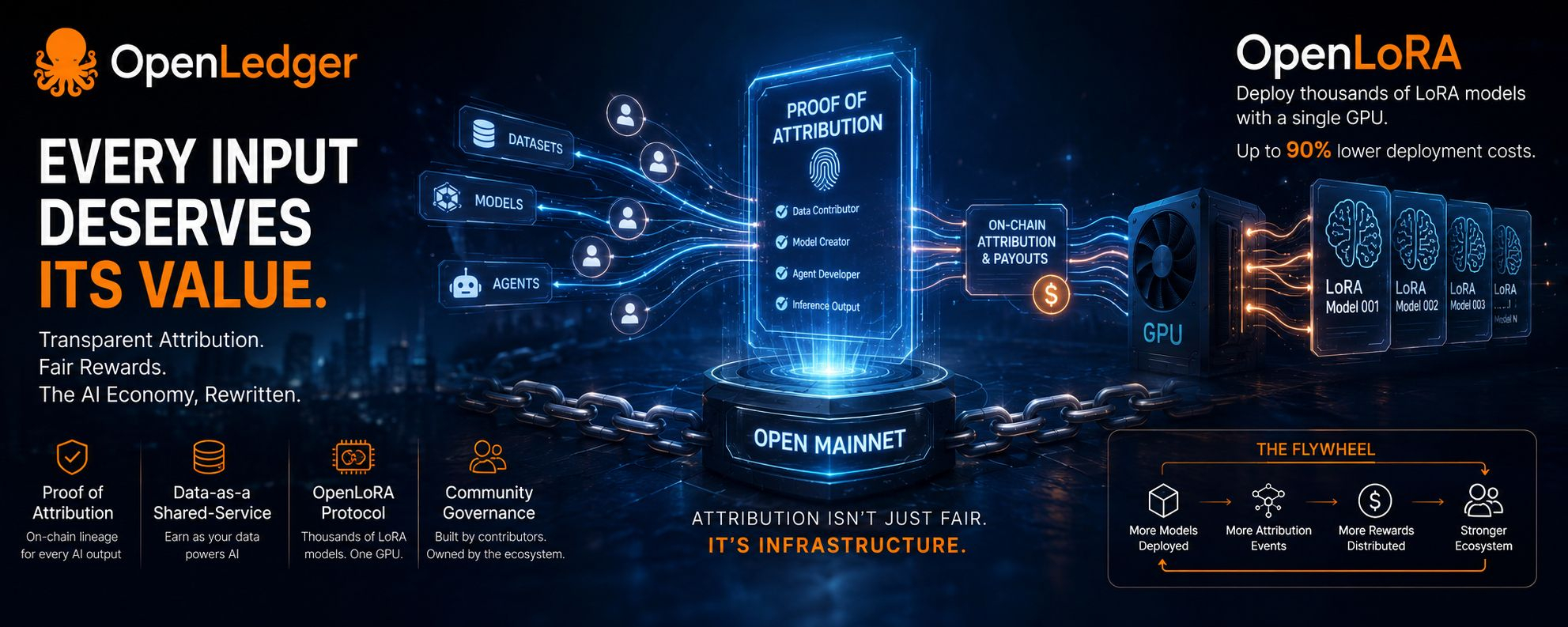
At the heart of OPEN Mainnet is the Proof of Attribution system a blockchain-based mechanism that logs the entire lineage of AI assets, datasets, models, and agents, on-chain. This creates an immutable trail for every AI output, allowing it to be traced back to its original contributors. When a model generates an output, PoA quantifies how much each piece of data influenced that output, then triggers automated payouts via smart contracts. No middleman. No discretionary distribution. Just math and on-chain records.
Sounds clean. Almost too clean.
And here's where I started getting honest with myself about the friction.
The June 2025 PoA whitepaper describes two approaches: influence-function methods and other attribution frameworks for measuring how much a dataset actually moved a model's behavior. Influence functions are a real concept in ML research. They're computationally expensive. They work well in theory and produce messy results in practice, especially at scale. So the question isn't whether attribution is a good idea. Obviously it is. The question is whether it can survive contact with real AI systems that have millions of micro-inputs from thousands of contributors.
Because the system measures the impact of your data on a model's performance. If your contribution improves the model and makes it more useful, you earn more rewards. If the data is of low quality or harmful, it can be flagged and penalized. That sounds fair until you think about edge cases. What happens to a contributor who submitted excellent data for a model that never got widely deployed? What happens when two contributors submitted nearly identical datasets from different sources? Who arbitrates materiality? These aren't rhetorical questions they're engineering and governance questions that will determine whether PoA is infrastructure or theater.
Still. The underlying impulse is right.
Each AI output can be traced back to its source contributors, enabling verifiable credits and automated payouts based on actual usage. The company describes the infrastructure as "Data-as-a-Shared-Service," giving data producers tools to plug into AI supply chains and earn passively as models consume their work. That last part earn passively as models consume their work is genuinely new framing. It's royalties logic applied to AI. Like a musician earning Spotify streams, except the "song" is a domain-specific dataset and the "stream" is an inference call.
Now let's talk about the deployment side. Because attribution without deployment is just bookkeeping.
OpenLedger launched OpenLoRA, a new open protocol that enables developers to deploy thousands of LoRA fine-tuned models using a single GPU, saving up to 90% of deployment costs. That number is the one that made me stop scrolling. Because full fine-tuning and full-parameter deployment are genuinely expensive at scale. Every specialized model needing its own GPU is the reason most AI personalization stays theoretical. OpenLoRA allows developers to serve thousands of LoRA models on one GPU without preloading them, dynamically merging and inferring on demand using quantization, flash attention, and tensor parallelism.
The technical claim here is serious. If it holds in production and that if carries weight, because these performance indicators are technically accessible, but closer to the upper limit performance. In actual production environments, performance may be limited by hardware, scheduling strategies, and scene complexity, and should be regarded as ideal upper limit rather than stable daily then you're looking at infrastructure that makes the long tail of AI models economically viable. Thousands of niche specialized models that couldn't justify their own GPU now can.
That changes the economics for contributors too.
If deploying specialized models becomes cheap, then data that trained those models becomes more in-demand. More demand means PoA attribution events happen more frequently. More attribution events means more reward distribution. The flywheel is visible from here.
The largest share of OPEN supply is reserved for the ecosystem, creating long-term incentives for data contributors, model builders, validators, and agent developers to build and operate on-chain. By rewarding contributors with tokens, ensuring transparent pay-per-use structures, and empowering users with governance rights, the platform aligns incentives toward building an AI ecosystem that is both ethical and efficient.
There's a tension here though that I keep coming back to.
OPEN reached an all-time low, dropping approximately 89% from its listing price. That's a brutal number. And it tells a story that's different from the infrastructure narrative. It says that the market has not yet found a way to price attribution correctly. Or that the market hasn't believed the PoA flywheel will actually spin. Or both.
Enterprise revenue funding a buyback program is one signal that real economic activity is starting. But one buyback doesn't make a data economy. The question is whether enough developers find OpenLoRA compelling enough to build on it, and whether enough contributors find Datanets worthwhile enough to sustain quality data input across specialized domains.
Because the whole system lives or dies on one thing whether attribution becomes something people actually trust. Not just technically. Institutionally. The main reason AI agents face distrust is that most consume large volumes of data, work on transformations and execution, and after that, data history is unclear, inputs are not cryptographically verifiable, and decisions cannot be audited end-to-end.
If @OpenLedger solves that, even partially, the market is drastically mispricing what it built.
If it doesn't if PoA collapses under governance disputes about materiality thresholds or stalls because influence-function calculations don't scale cleanly then it's a genuinely interesting experiment that stopped short of infrastructure.
I don't have a confident answer on which direction it goes. The architecture is real. The problem it addresses is real. The gap between those two facts and a functioning attribution economy is the most honest thing I can say about this right now.
Watch whether developer adoption of OpenLoRA accelerates. Watch whether Datanets grow beyond early contributor farming. Watch whether PoA disputes start generating governance pressure.
The answers will come from behavior, not whitepapers.