
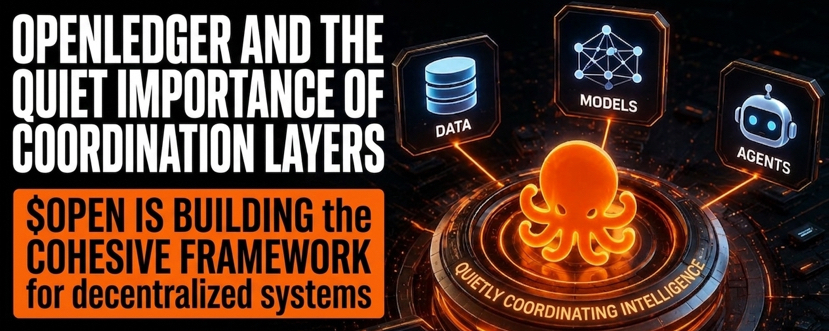
I’ll be honest, I first looked at OpenLedger the same way I look at most AI crypto projects another attempt to attach infrastructure language to a fast moving narrative.
But the more I thought about it, the more interesting the coordination angle became to me.
A lot of the conversation around AI infrastructure still focuses on isolated capability. Bigger models. Faster inference. Better agents. More efficient compute. But once you zoom out far enough, those things start looking like individual organs without a nervous system connecting them.
Intelligence alone doesn’t create coherent systems.
Coordination does.
That’s partly why I think OpenLedger may be underrated in the broader AI conversation. Not because it promises some singular breakthrough model or consumer-facing application, but because it appears to be exploring something more foundational: how different forms of intelligence, data, incentives, and execution layers interact with one another in a shared environment.
In a strange way, coordination itself may become the product.
And historically, those kinds of systems often look unimportant at first because they operate mostly in the background.
You rarely notice connective tissue until it fails.
The internet itself became valuable partly because it standardized communication between disconnected systems. Financial markets became scalable because clearing mechanisms and settlement layers emerged beneath visible activity. Even cities depend less on individual buildings than on the infrastructure coordinating movement, energy, and information between them.
AI ecosystems may be approaching a similar phase.
Right now, most activity still feels fragmented. Models operate independently. Data is siloed. Agents execute tasks without broader awareness of surrounding systems. Protocols incentivize narrow behaviors. Economic activity exists, but often without shared coordination frameworks tying it together coherently.
As a result, a lot of AI infrastructure feels productive locally but inefficient systemically.
Everyone is generating outputs, but fewer systems are reinforcing one another.
That distinction matters.
Because once AI ecosystems become sufficiently autonomous, execution stops being the primary bottleneck. The bottleneck becomes orchestration: how information flows, how incentives align, how trust is established, how value is attributed, and how independent actors coordinate without central oversight.
That’s a very different kind of infrastructure problem.
And honestly, I don’t think the market fully prices these layers yet because they aren’t visually dramatic. Coordination systems rarely look impressive on the surface. They tend to feel abstract compared to flashy applications or frontier models.
But scale changes what matters.
At small scale, fragmentation is manageable. Humans manually coordinate around inefficiencies. Teams improvise. Platforms absorb friction internally.
At large scale, invisible systems become critical.
Without coordination layers, ecosystems eventually start competing against themselves. Agents duplicate work. Data becomes underutilized. Incentives diverge. Trust deteriorates. Economic activity fragments into disconnected islands that cannot compound collectively.
You end up with activity everywhere but coherence nowhere.
That’s the scenario I increasingly think about when I look at decentralized AI infrastructure.
Because decentralized systems amplify both opportunity and coordination difficulty simultaneously. The moment participation becomes open and distributed, you gain resilience and innovation, but you also inherit complexity. Thousands of independent contributors, models, agents, and datasets cannot rely on centralized management forever.
Something else has to organize interactions between them.
And this is where OpenLedger becomes conceptually interesting to me.
Not necessarily as a destination platform where users simply “use AI,” but more as connective tissue between different layers of activity.
That distinction feels important.
Some infrastructure exists primarily to execute tasks. Other infrastructure exists to make entire ecosystems interoperable. The latter often matters more over time because coordination compounds.
If one system improves execution speed, the gains are localized.
If another system improves coordination between many independent systems, the gains become network-wide.
That creates second-order effects.
Data contributes value more effectively because it becomes easier to route, verify, and utilize across environments. Models become more useful because outputs can integrate into broader economic systems rather than existing in isolation. Agents become more capable because they can interact with interoperable infrastructure instead of operating inside closed loops.
In that environment, intelligence stops being static.
It becomes relational.
And I think that’s where a lot of AI discourse still feels incomplete. We talk about intelligence as if it exists primarily inside models themselves, when in reality large-scale intelligence may emerge from interactions between systems rather than from any single model in isolation.
Coordination layers influence those interactions profoundly.
They determine whether ecosystems behave like disconnected tools or adaptive networks.
That’s also why I find the economic dimension increasingly important. Not because speculation matters more than technology, but because incentives shape coordination behavior. Every large-scale decentralized system eventually becomes an incentive design problem as much as a technical one.
Who contributes data?
Who verifies outputs?
Who benefits from system improvement?
Who coordinates execution?
How does trust emerge between independent actors that may never directly know one another?
These are infrastructure questions, not application questions.
And they become exponentially harder once AI agents themselves begin participating economically.
An autonomous agent capable of executing financial actions, retrieving information, interacting with protocols, or coordinating with other agents introduces entirely new coordination requirements. Reliability matters differently in those environments. Attribution matters differently. Verification matters differently.
At that point, systems can no longer rely purely on intelligence quality.
They require coordination quality.
That may ultimately become the defining infrastructure race of this cycle.
Not simply who builds the smartest model, but who builds environments where models, data providers, agents, users, and protocols can coordinate productively at scale.
And historically, the most valuable infrastructure layers are often the ones that reduce systemic friction rather than maximizing visible output.
You can already see hints of this shift happening across technology more broadly. Modern systems increasingly depend on invisible orchestration layers operating beneath user-facing experiences. Cloud infrastructure abstracted server management. APIs standardized communication between services. Distributed networks coordinated resources globally.
AI may now be entering its own orchestration phase.
If that’s true, then projects focused purely on isolated intelligence may eventually feel incomplete without coordination frameworks connecting them into coherent economic systems.
That’s partly why OpenLedger feels more interesting to me as an infrastructure idea than as a conventional AI product narrative.
It seems less focused on becoming the singular intelligence layer and more focused on enabling interaction between many forms of intelligence and contribution simultaneously.
That approach may look less exciting in the short term because coordination infrastructure is inherently abstract. It doesn’t always produce dramatic demos. It operates quietly beneath visible activity.
But invisible systems are often what determine whether ecosystems scale sustainably or collapse under their own complexity.
And increasingly, I think the future AI economy may depend less on raw generation and more on organized interaction.
The systems that matter most could end up being the ones capable of aligning fragmented activity into coherent networks where data, models, agents, and protocols reinforce one another instead of competing chaotically for attention and value.
In that world, coordination stops being secondary infrastructure.
It becomes the infrastructure.
That’s why OpenLedger keeps standing out to me. Not as a loud consumer platform or isolated AI product, but as infrastructure attempting to make coordination itself functional in increasingly autonomous environments.
And if AI ecosystems continue becoming more distributed, interconnected, and agent driven, that coordination layer may end up mattering far more than most people currently realize about OpenLedger.