
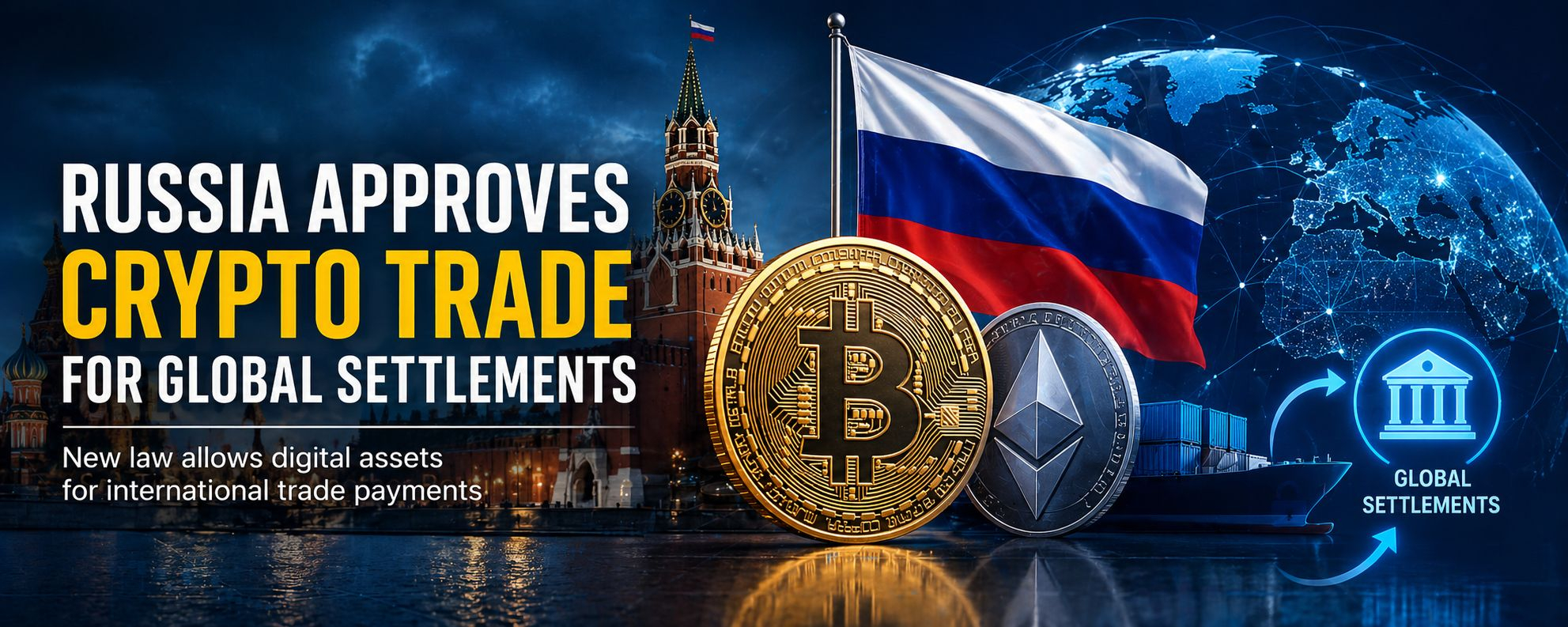

Russia has taken a significant step toward integrating digital assets into its financial system. The country’s lower house of parliament, the State Duma, has approved the first reading of a bill that would allow cryptocurrencies to be used for international trade settlements.
This development reflects a broader shift in Russia’s financial strategy, driven largely by ongoing Western sanctions that have limited access to global banking systems such as the SWIFT.
A Controlled Approach to Crypto Adoption
The proposed law is based on a framework developed by the Central Bank of Russia in late 2025. It allows Russian companies engaged in international trade to use cryptocurrencies for cross-border payments, particularly in situations where traditional banking channels face delays or restrictions.
However, the use of crypto will remain tightly controlled:
Domestic payments using cryptocurrency will still be banned.
Only approved, large-cap digital assets will be allowed.
Retail investors will face strict limits and classifications.
Transactions must go through licensed and regulated platforms.
Among the cryptocurrencies expected to qualify first are Bitcoin and Ethereum, due to their market size and long trading history.
Why Russia Is Making This Move
Since 2022, Russia has faced increasing restrictions on its access to global financial systems. These include limits on dollar-based transactions and reduced access to international banking relationships.
In response, the country has explored several alternatives, including:
Using non-dollar currencies in trade agreements
Creating bilateral payment systems with partner countries
Testing digital asset-based settlement methods
The new legislation aims to formalize these efforts by creating a legal structure for crypto-based payments rather than relying on informal or unregulated channels.
Impact on Trade and Businesses
If fully approved, the law could reshape how Russian companies handle international transactions. Businesses in sectors like energy, metals, and agriculture key drivers of Russia’s exports could benefit the most.
The framework provides:
A legal pathway for cross-border crypto settlements
Reduced reliance on traditional banking intermediaries
Faster transaction processing in restricted markets
At the same time, companies may face new compliance challenges, especially when dealing with international partners subject to sanctions regulations.
Regulatory Safeguards and Oversight
The Central Bank will maintain strict control over the system. It will be responsible for:
Approving which cryptocurrencies can be used
Licensing exchanges and platforms
Monitoring transactions and enforcing compliance
Mining operations will also be regulated, with registration requirements and regional restrictions based on energy availability.
What Happens Next
The bill is not yet law. It must still pass
Two additional readings in parliament
Approval from the Federation Council
Final signing by the president
Implementation is expected to roll out gradually between 2026 and 2027.
A Strategic Shift, Not Full Adoption
Russia’s approach shows that it is not fully embracing cryptocurrency as a domestic payment tool. Instead, it is selectively using digital assets to solve external trade challenges while keeping tight control over its internal financial system.
This model reflects a growing global trend: governments exploring crypto not as a replacement for traditional finance, but as a strategic tool within a regulated framework.
Conclusion
Russia’s move to legalize cryptocurrency for international trade marks an important policy shift. While the system will remain tightly controlled, it opens the door for digital assets to play a larger role in global commerce especially in regions facing financial restrictions.
The success of this framework will depend on how well it balances regulatory control with practical usability, and how international partners respond to crypto-based settlement channels.
#CryptoAdoption #RussiaCrypto #CryptoLegalVictory #BinanceSquareFamily