
I was sitting with a friend the other night, both of us half-listening to each other while scrolling through our phones. At some point I realized we weren’t really sharing anything anymore, just reacting—liking, tapping, sending quick signals that said “I’m here” without actually being present. It felt social on the surface, but strangely hollow underneath.
That feeling came back to me while I was inside Pixels, specifically when I opened the social panel and started interacting through the in-game chat and visiting other players’ farms. I remember clicking through the player list, jumping into someone else’s land, leaving a quick message, then moving on almost immediately. The interface made it frictionless—names, chat bubbles, quick travel—but the moment I paused, it didn’t feel like connection. It felt like motion.
What unsettled me is that I started to think the social layer wasn’t deepening engagement—it was masking how thin it actually was.
While performing the CreatorPad task, there was a moment where I used the chat window after harvesting and checked nearby players through the map overlay. That loop—harvest, glance at chat, hop to another plot—was smooth enough to feel intentional. But it was that exact smoothness that triggered something. The interactions were constant, but they didn’t accumulate into anything meaningful. I wasn’t building relationships, just touching surfaces.
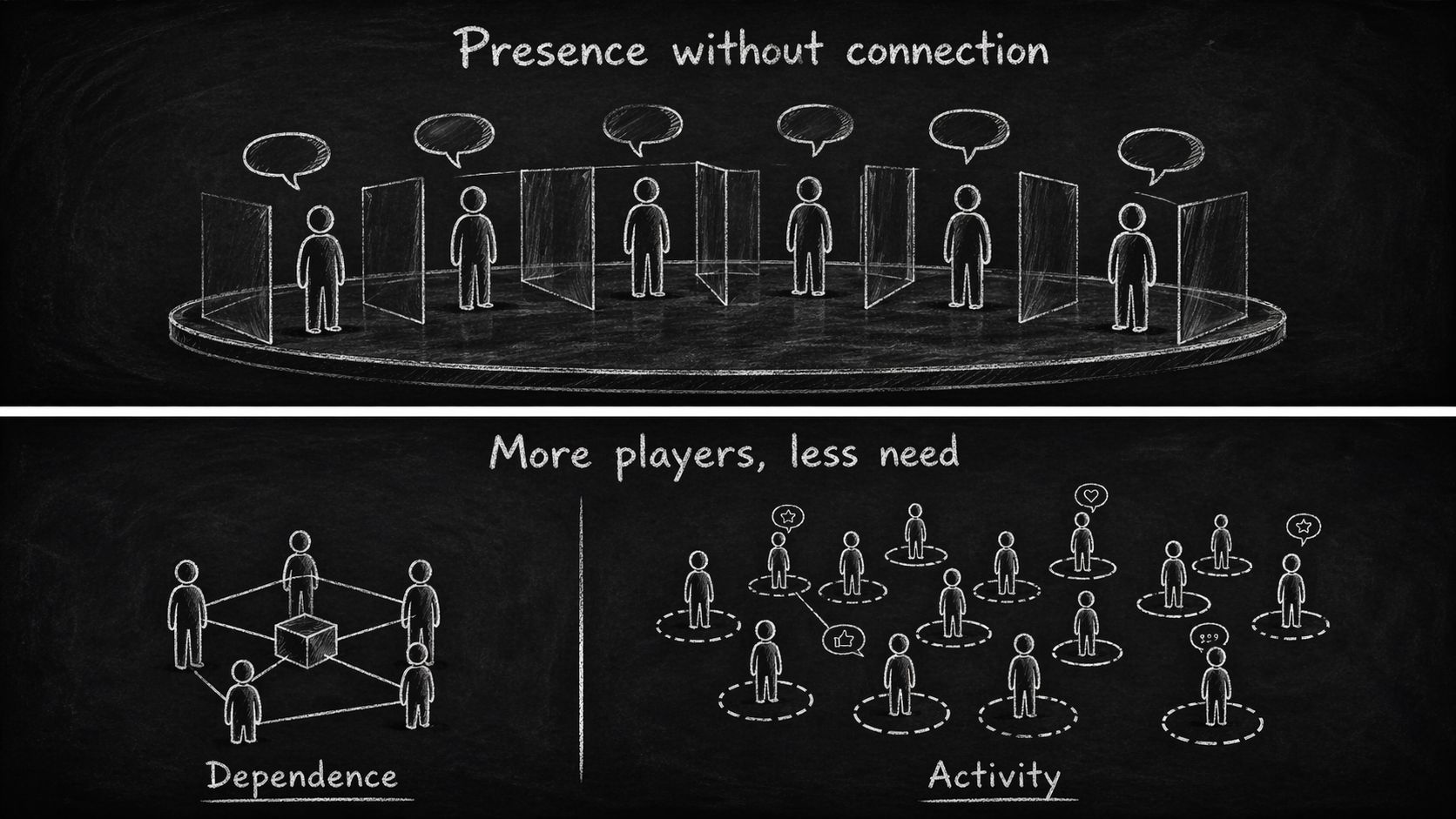
I’ve always heard the idea that adding social features strengthens Web3 games—that shared spaces, chats, and visible players naturally create stickiness. But what I experienced here suggested something else: if the underlying activity doesn’t require real dependence between players, the social layer becomes more like ambient noise than connection.
In Pixels, the world looks alive. You see other players moving, chatting, occupying land. But most of what I did didn’t actually require them. Even when I visited someone’s farm, it felt transactional—enter, interact, leave. The system encouraged presence, not reliance.
That distinction started to bother me more than I expected.
Because if engagement is being measured by how often players pass through each other rather than how much they actually matter to one another, then the social layer isn’t strengthening the game—it’s cushioning it. It gives the impression of a shared economy or community without forcing the friction that real interaction usually brings.
And that has a strange side effect. It makes everything feel active while quietly removing the need to care.
I’m not saying Pixels is doing this poorly. If anything, it does it very well. The transitions are smooth, the chat is accessible, and the visibility of other players is constant. But that’s exactly why it stood out to me. The system works so seamlessly that it hides the absence of depth.
It made me question something broader about Web3 design. We often assume that visible interaction equals meaningful interaction. That if players can see and reach each other easily, engagement will naturally follow. But what I felt instead was a kind of polite distance—everyone present, no one necessary.
Pixels becomes a useful example here not because it fails, but because it reveals something uncomfortable when it succeeds. It shows how easy it is to simulate community without actually requiring it.
And once you notice that, it’s hard to unsee.
If a game can feel socially full without players truly depending on each other, then what exactly is the social layer optimizing for?