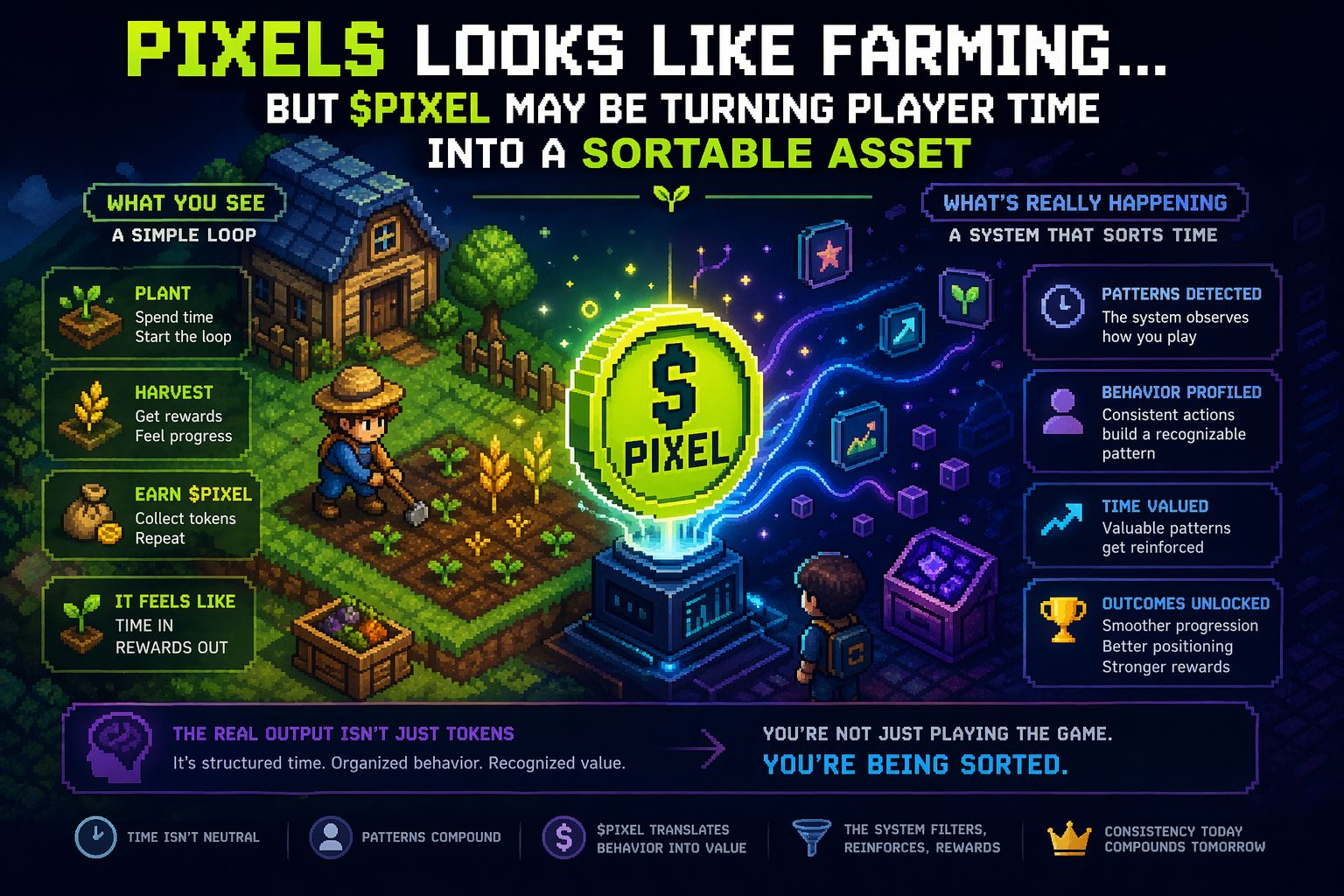
At first, it feels simple.
Log in. Plant. Harvest. Repeat.
A loop you’ve seen before. Comfortable enough that you don’t question it...
But stay a little longer, and something starts to feel off...
Two players can spend the same amount of time and walk away with completely different outcomes. Not because one is more skilled. Not because one got lucky.
Because the system reads their time differently...
We like to think time in games is neutral. An hour in should mean roughly the same progress out.
Pixels doesn’t work like that...
Some ways of playing just… land better. Not with huge spikes or obvious rewards. Things just start to smooth out. Less friction. Fewer wasted actions. Progress stops feeling forced and starts feeling automatic.
It’s subtle...
But it’s not random...
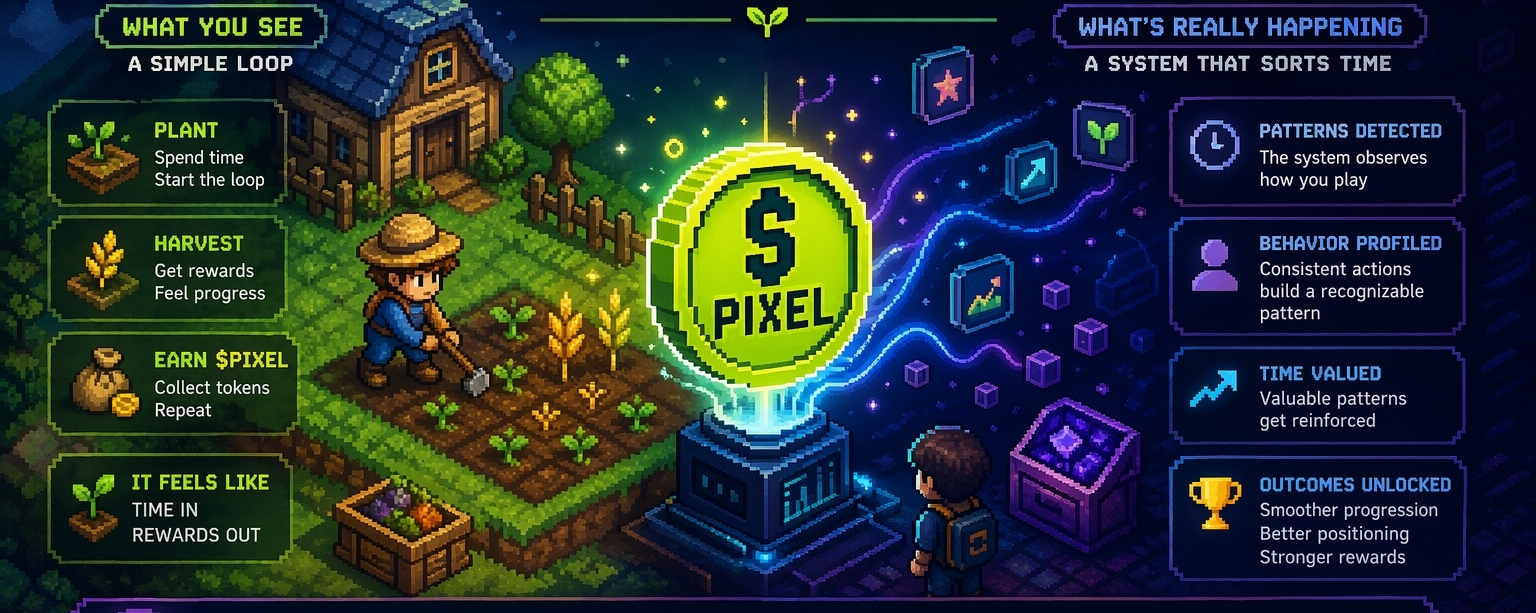
What looks like a farming loop is closer to a sorting system...
You can play freely, experiment, try everything. The game allows it...
But that kind of play doesn’t really stack...
Then you fall into a pattern. A routine that works. And suddenly, everything connects. Not faster, just cleaner.
That’s when the system starts recognizing you...
And that’s where $PIXEL changes meaning...
It’s not just a reward token...
It’s part of how the system translates behavior into outcomes.
Not all time earns equally. Structured time earns more.
Think about how platforms rank sellers...
Not just by volume, but by consistency. Predictable behavior scales because it’s easier to trust, easier to use, easier to build on.
Pixels feels like it’s doing the same thing...
Quietly favoring patterns it can rely on.
Once your behavior becomes predictable, it becomes valuable.
Not because of who you are.
Because of how you act.
And over time, that creates pressure...
You stop exploring. You start aligning. Then optimizing. Not because you have to, but because you can feel what works.
Efficiency replaces curiosity.
And the game slowly narrows.
That’s the tension...
The system gets stronger as behavior becomes more consistent.
But the experience gets thinner as behavior becomes less diverse.
And most players won’t even notice when that shift happens.
They’ll just call it progress...
From the outside, this makes $PIXEL harder to read.
It’s not just tied to player growth.
It’s tied to how well the system can recognize and reinforce useful behavior.
More players don’t automatically create more value.
More predictable players might.
That’s a different kind of scaling.
Quieter. Slower. But potentially stronger.
Because what’s being built isn’t just an economy.
It’s a filter...
Pixels doesn’t just reward your time.
It decides what kind of time counts.
And once your time starts getting recognized…
you’re not just playing anymore.
You’re being sorted... @Pixels #pixel