
Most crypto assets are valued on a simple premise: buy, hold, and wait. Demand is expected to come from speculation, and price becomes the primary signal. Pixels challenges that model at its core. PIXEL is not designed to be held. It is designed to be used—continuously.
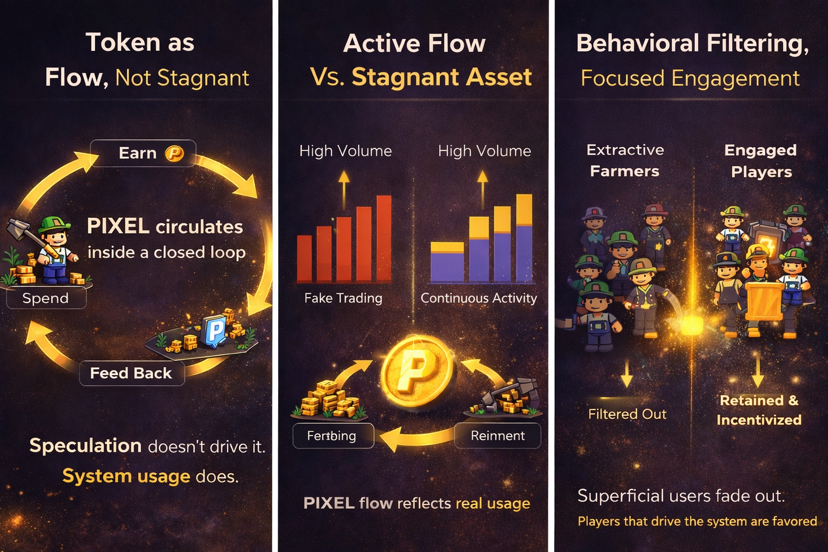
At the center of this thesis is a structural shift: PIXEL functions less like a store of value and more like a unit of flow within a closed-loop system. Players earn tokens through gameplay, but progression requires reinvestment. Crafting, upgrading, and interacting with in-game assets all route PIXEL back into circulation. This creates a self-reinforcing loop where usage, not speculation, sustains the economy.
This distinction matters. In most Web3 games, user behavior follows a predictable pattern: farm rewards, extract value, and exit. The result is constant sell pressure and a declining user base. Pixels reverses this dynamic by embedding rewards directly into gameplay loops that require ongoing participation. The system does not reward presence; it rewards continuity.
One of the most misunderstood signals in the PIXEL ecosystem is its unusually high trading volume relative to market capitalization. In a typical context, this would raise concerns about artificial activity or wash trading. However, in Pixels, high velocity is a feature, not a flaw. The token is constantly moving—used in transactions, reinvested into progression, and circulated across multiple in-game layers. Volume, in this case, reflects active usage rather than speculative churn.
A critical component reinforcing this structure is what can be described as a behavioral filtering system—referred to as “Stacked.” Unlike traditional models that treat all users equally, Pixels differentiates between types of participation. Users who engage superficially—those who farm rewards without integrating into the loop—are gradually filtered out. In contrast, users who participate deeply in the system’s cycles are retained and incentivized. This results in a higher-quality user base and reduces extractive behavior over time.
NFTs, particularly land, serve as anchors within this ecosystem. Their value is not derived from scarcity alone but from their role in stabilizing participation. Landowners are more likely to remain within the loop, engage consistently, and contribute to sustained economic activity. This reduces volatility at the behavioral level, which in turn supports the broader token economy.
Another key insight is that Pixels is not fundamentally a game-first product. While gameplay provides the interface, the true core lies in its economic design. Graphics, mechanics, and surface-level engagement are secondary. What matters is whether the system can maintain a continuous loop of actions—farming, crafting, trading, reinvesting—without interruption. The health of the economy depends on the persistence of this loop, not the intensity of individual actions.
The primary risk, therefore, is not a sudden collapse but a breakdown in synchronization. If users fall out of rhythm with the system—if friction increases or incentives weaken—the loop slows. When the loop weakens, token velocity declines, and the economic structure begins to deteriorate. Monitoring user behavior, retention within loops, and the consistency of in-game interactions becomes more important than tracking price movements alone.
In this context, PIXEL should not be evaluated as a speculative asset but as a signal of system health. Price appreciation is not the driver; it is the output. The underlying driver is whether the loop remains intact and whether users are continuously engaged within it.
The core thesis can be summarized simply:
PIXEL is not a token you hold.
It is a token the system forces you to use.
And as long as that usage remains continuous, the foundation for value persists.
