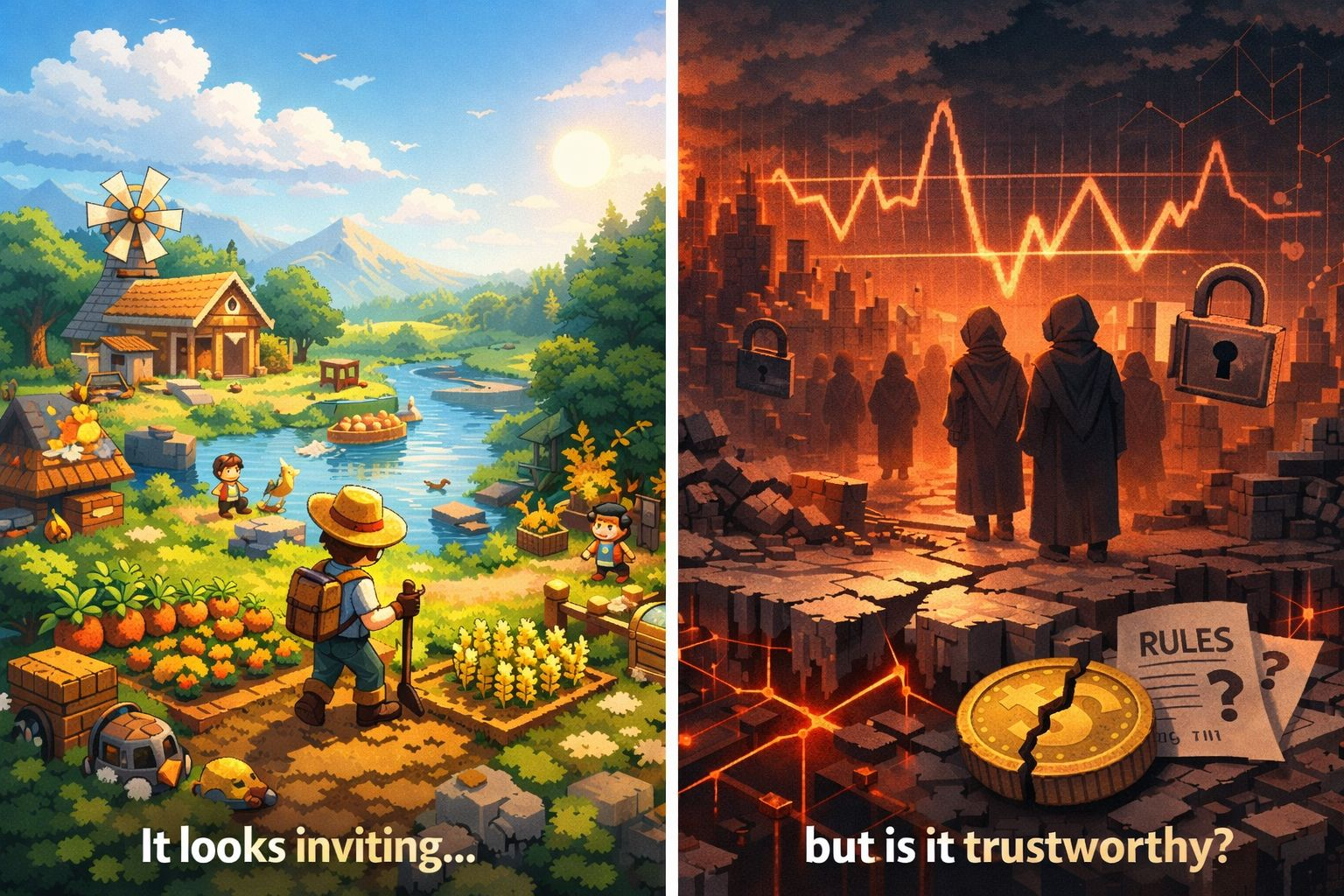
I had the same first reaction to Pixels that I have to a lot of polished Web3 products: this looks almost too clean.
Not bad. Not unserious. Just too neatly packaged.
A social casual game built around farming, exploration, and creation on Ronin should, in theory, be exactly the sort of thing Web3 people say they want. It is accessible. It is legible. It does not ask players to become crypto-native economists or memorize a white paper before planting a crop. It offers a familiar promise dressed in modern infrastructure: a game that feels light, social, and open-ended, with ownership layered underneath. That is the pitch. And to be fair, it is not a stupid one.
In fact, parts of it are genuinely smart.
There is obvious discipline in aiming for a game people can understand immediately. “Farming, exploration, creation” is not jargon. It is a language almost anyone can read. That matters. Most blockchain games do not fail because the chain is weak or the token is invisible. They fail because the product feels like homework. Pixels at least understands that entertainment has to come first, and that usability beats ideology every time.
That is the promising part.
But the real question is not whether the surface works. The real question is what is happening beneath the surface, where trust is either earned or quietly lost.
Because a game can be easy to use and still hard to trust.
That is the tension here. Usability versus assurance. Adoption versus reliability. A world can feel inviting on the outside while being structurally fragile underneath. In Web3 especially, the gap between the two is often wider than the marketing admits. The interface says “play.” The architecture says “believe.” And those are not the same thing.
What, exactly, are players being asked to trust?
That their time means something. That the economy will remain coherent. That the social layer will stay social rather than collapse into optimization. That the systems behind the scenes will not make the experience feel arbitrary, extractive, or brittle once the first wave of enthusiasm fades. These are not minor details. They are the whole game after the novelty wears off.
And novelty always wears off.
The deeper concern with a project like Pixels is not that it is trying to be pleasant. It is that pleasantness can disguise dependency. A player may think they are enjoying a casual open world, when in reality they are participating in a tightly coupled machine of incentives, retention loops, and token-adjacent expectations. That machine can work beautifully for a while. Then one small assumption breaks. A rewards curve becomes stale. A social loop thins out. A speculative crowd leaves. The economy feels “off.” And suddenly the thing that looked frictionless is revealed to be held together by invisible tension.
That is the hidden risk: the system only appears casual because the complexity is being absorbed somewhere else.
Usually that somewhere else is trust.
Who gets to set the rules? Who benefits when the rules change? What happens when the social promise of the game collides with the economic reality of the network? If the game becomes popular, does that validate the model, or merely stress-test it? If players are drawn in by the world, are they staying because they love the world, or because they are trying to extract value from it before it shifts? These are uncomfortable questions, but they are the right ones.
And they are not answered by good art direction.
This is where a lot of Web3 projects overestimate their own clarity. They mistake the clean first impression for durable confidence. They think a smooth onboarding experience is evidence that the deeper structure makes sense. It is not. It only means the first gate is well designed. The real test comes later, when the system has to remain fair, comprehensible, and resilient after the easiest users have already arrived.
That is the part no one wants to talk about.
Because once a game is social, the trust problem multiplies. A solo game can survive on taste. A social game cannot. It has to survive on shared expectations. If one group believes the world is being tuned for newcomers while another believes it is being tuned for speculators, the sense of common purpose fractures. If the game depends on an economy but is marketed like a pastime, the mismatch eventually becomes visible. If ownership matters, then every design decision carries two meanings: one for play, one for value. That duality is powerful, but it is also unstable.
And instability is often invisible at first.
That is what makes this category so hard to evaluate honestly. The promise is real. The mechanics can be good. The vibe can be excellent. None of that prevents the model from being structurally overconfident. In fact, the better the experience looks, the easier it is to ignore the fragility underneath. A polished game can become a confidence trap: because it feels coherent, people assume the incentives are coherent too. Because it is easy to enter, people assume it is easy to sustain. Because it is fun today, people assume it will still make sense tomorrow.
But what if the experience is only stable as long as everyone keeps believing the same story?
That is the deeper issue. Not whether Pixels is fun. Not whether Ronin gives it a credible home. Not whether the concept is clever enough to stand out in a crowded Web3 landscape. The issue is whether the project can preserve trust after the initial delight has faded and the real frictions start to matter: economic drift, behavioral gaming, changing user expectations, and the persistent possibility that the game’s most elegant features are also the most fragile.
Usability is easy to admire.
Trust is harder. Trust has to survive bad days. It has to survive market cycles, feature fatigue, power users, opportunists, and the slow disappearance of optimism. A game does not become durable because it looks inviting. It becomes durable because its hidden machinery does not betray the people who spend time inside it.
That is why the safest criticism of Pixels is not that it is unserious. It is that it may be too confident in how quickly a good surface can substitute for deep assurance.
And that is where the warning lives.
In a space full of products that promise ownership, community, and play, the real test is not whether the world is charming. The real test is whether the system deserves to be believed after the charm has done its work. That is the difference between a product people try and a platform they trust.
One is a launch.
The other is a promise that has to keep surviving itself.