

In most digital games, governance is invisible.
Decisions are made far away from the player experience—updates, reward structures, economic shifts, and rule changes all flow from centralized teams. Players participate, but rarely influence the architecture of the world they inhabit.
Web3 gaming breaks that assumption.
Within ecosystems like Pixels (@Pixels pixels_online), governance is no longer a background function. It becomes an active layer of participation—where players are not just users of the system, but contributors to its direction, economy, and evolution.
Th $Pixel token sits at the center of this system, acting as both an economic anchor and a coordination signal across the ecosystem
The Core Idea: Governance as Participation, Not Permission
Pixel governance is built on a simple but disruptive shift:
Value creation in the game should also translate into influence over the game.
Instead of treating governance as an external voting mechanism, it is embedded into the ecosystem itself. Players who engage, contribute, and hold ecosystem assets gain proximity to decision-making processes.
This changes the role of the player from passive participant to economic stakeholder.
The Structural Layers of Governance in Pixels
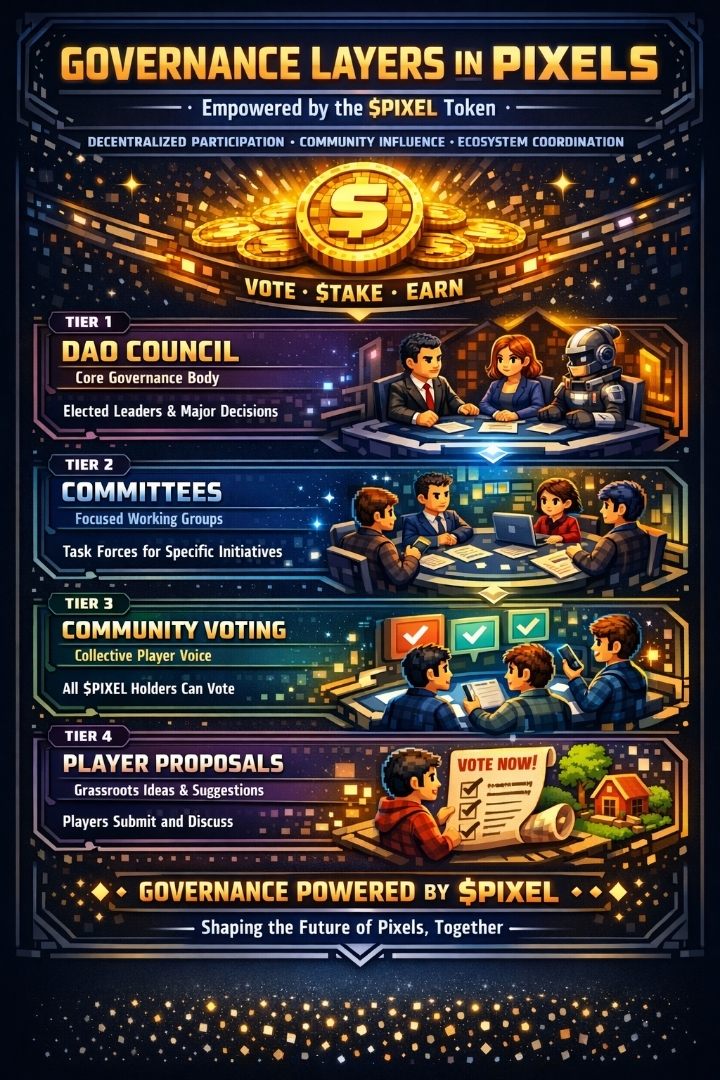
To understand how governance operates in practice, it can be broken into four functional layers:
1. Economic Alignment Layer
The in-game economy is tied directly to the $Pixel token, creating alignment between gameplay activity and economic weight. Players who contribute meaningfully to the ecosystem indirectly shape its sustainability.
2. Asset-Based Influence Layer
Ownership matters. Digital assets within Pixels function as more than collectibles—they act as participation credentials within governance structures.
3. Decision Feedback Layer
Governance proposals are shaped by ecosystem signals: player behavior, engagement trends, and economic activity. This creates a continuous feedback loop between gameplay and policy adjustment.
4. Community Coordination Layer
Guilds and player groups form decentralized coordination units. These communities amplify collective influence, allowing structured participation in governance outcomes.
Why This Matters: Governance as a Growth Engine
In traditional games, governance is a cost center.
In Web3 ecosystems like Pixels (@pixels_online), governance becomes a growth mechanism powered by $PIXEL.
Because decisions are partially influenced by players:
Retention increases through ownership psychology
Engagement deepens through participatory identity
Ecosystem resilience improves through distributed feedback
Economic design becomes more adaptive over time
This transforms governance from administration into infrastructure for sustained engagement.
The Hidden Reality Most Players Miss
Many assume governance is about voting on proposals.
In reality, most influence happens before voting ever begins.
It exists in:
Activity patterns
Asset accumulation
Community alignment
Economic behavior signals
Voting is only the visible layer. The real system is continuous, not episodic.
The Strategic Shift
Pixels demonstrates a broader evolution in Web3 gaming:
Games are no longer just worlds to play in—they are systems to participate in.
Governance is the mechanism that bridges gameplay and system design. It is how digital economies become self-adjusting rather than centrally controlled.
The long-term implication is clear:
Players are not just entering a game.
They are entering a living economy where their actions continuously reshape the rules they operate under, with $PIXEL acting as the coordination backbone.