
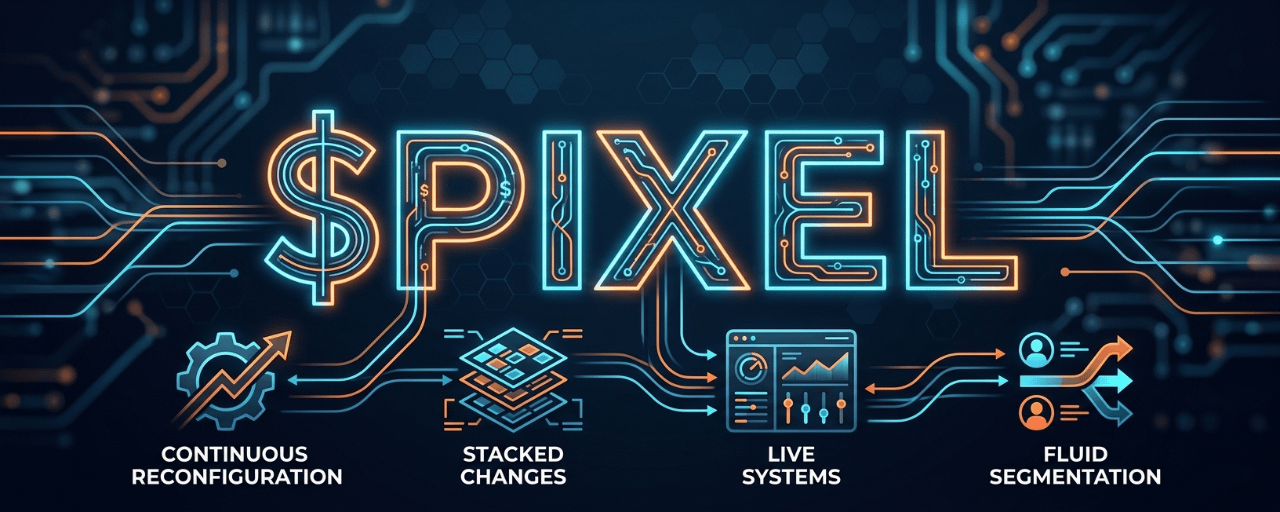
What stands out in $PIXEL is not the visible loop, but how Stacked restructures the way the system operates underneath. Instead of relying on fixed logic deployed once and updated manually, it introduces a layer where core parameters can be adjusted continuously without rewriting the base game.
From a technical perspective, this looks closer to a LiveOps control system than a traditional game backend. Game states are no longer entirely deterministic. They are partially driven by real time configuration, where variables such as progression pacing, interaction frequency, and system responses can be modified dynamically based on live data. This reduces dependence on patch cycles and shifts control toward runtime adjustment.
The AI layer is not replacing logic, it is compressing the pipeline between observation and execution. Behavioral data does not need to leave the system to be processed externally. It can be interpreted in place, then translated into immediate configuration changes. That removes latency from decision loops and allows the system to iterate at a much higher frequency than static architectures.
A detail that becomes important here is how state is managed. Instead of assigning players to fixed categories, the system likely maintains fluid segmentation where classifications evolve as new data comes in. That means system responses are not tied to who a player was, but who they are becoming based on recent behavior patterns. This type of shifting state model is significantly harder to implement than static segmentation, especially at scale.
When this extends through Stacked beyond a single environment, the challenge becomes standardization. Different games produce different interaction data, but the system needs a unified structure to interpret them. That implies an abstraction layer where diverse actions are mapped into consistent behavioral signals before being processed.
If this architecture holds, then the real shift is not at the surface level. It is in how the system is built to continuously reconfigure itself while running, rather than waiting to be updated.