
There's a decision buried inside Pixels that I keep coming back to, and I'm not sure enough people have noticed what it actually means.
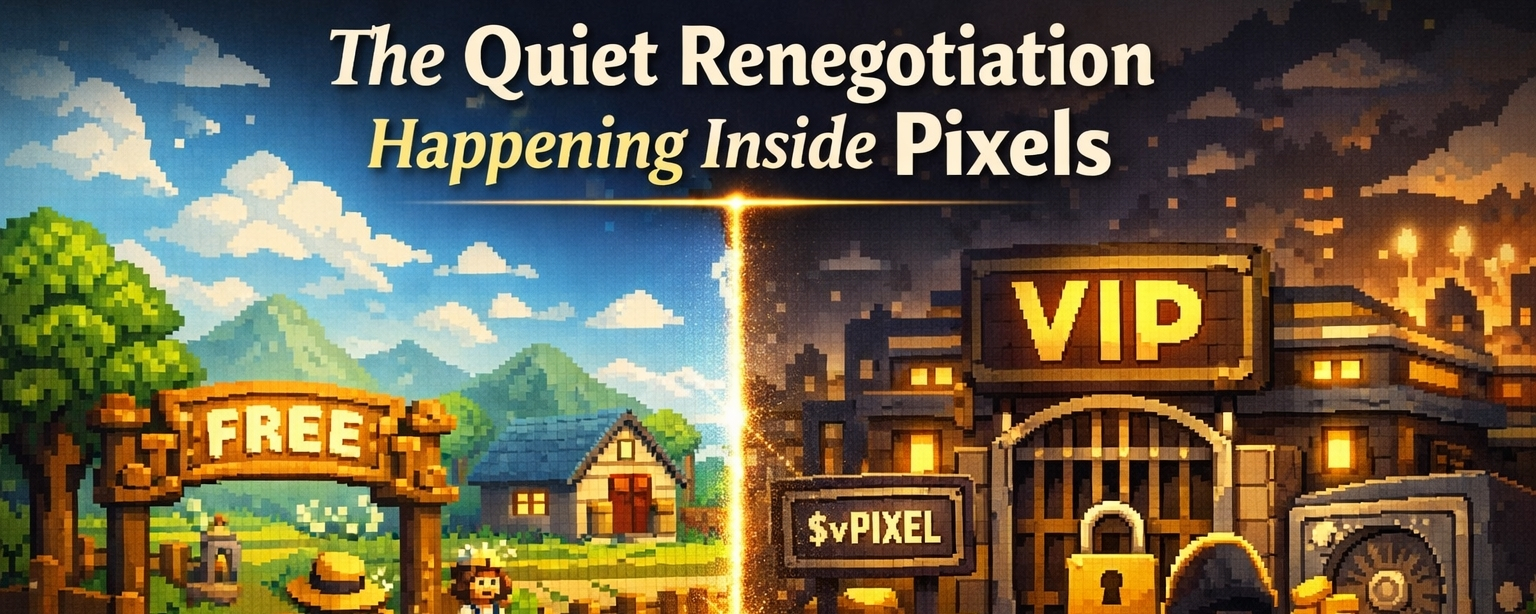
At some point in 2025, the team made a deliberate choice to stop optimizing for daily active users and start optimizing for daily active users with high lifetime value. On paper that sounds like a sensible business pivot. In practice it means the game quietly redrew the line between who it wants and who it doesn't. And if you're on the wrong side of that line, the game you log into today is meaningfully different from the one that existed a year ago.
That shift is worth sitting with for a minute before moving on to anything else.
I came into Pixels during the period when the numbers were enormous. Over a million daily active users at peak, Ronin Network briefly surpassing Solana in daily active wallets, a community that felt genuinely large in a way most Web3 games only simulate. The game had a low barrier to entry by design. You didn't need to own land. You didn't need to spend anything. You could just show up, plant crops, complete quests, and exist inside the economy. Whether that was sustainable was a different question, and one the team was clearly asking themselves even then.
The answer they arrived at was VIP gating. Core earning opportunities are now locked behind a membership that requires spending PIXEL to access. The ability to withdraw tokens to your wallet is tied to VIP status. The free-to-play entry point still exists, technically. But the ceiling above that entry point has been lowered considerably. What used to be a game you could participate in meaningfully without paying has become a game where paying determines how much of the game you're actually playing.
I want to be careful about how I frame this, because it's not obviously wrong. The old model had a real problem. A massive user base with low conversion rates and high token extraction generates inflation and sell pressure without generating the economic activity that sustains an ecosystem. The team has said explicitly that they were concentrating too much on surface-level numbers and not enough on players who contribute to the long-term health of the economy. That's a coherent critique of their own earlier choices.
But here's what I think about when I consider the VIP shift. The original accessibility of Pixels was not incidental to its identity. It was the pitch. A Web3 game you could play without significant upfront cost, in a sector where barrier-to-entry had historically excluded the people the space claimed to be serving. When the game pulled in a million daily users, a meaningful portion of those users were there because the door was open. Closing the door more carefully in the name of economic sustainability is rational. It's also a different game, aimed at a different player, with a different implied promise.
The $vPIXEL introduction runs parallel to this and is worth understanding on its own terms. The new token is backed one-to-one by PIXEL but cannot be traded, sent to other players, or sold. It can only be spent or staked within the ecosystem. Players who withdraw rewards as vPIXEL pay zero fees. Players who withdraw as actual PIXEL face a farmer fee that currently sits between 20 and 50 percent depending on their reputation, with that fee redistributed to stakers. The design intention is clear: make it economically unattractive to extract value from the ecosystem and economically comfortable to keep value inside it.
What this creates, structurally, is a two-tier reward system where the same in-game labor yields meaningfully different outcomes depending on what you choose to do with the output. If you're building inside the ecosystem, spending on upgrades and pets and VIP, staking your tokens and participating in the governance layer, the game is designed to reward you. If you're playing primarily to convert time into extractable value, the game now actively discourages that. The farmer fee is not a subtle signal. It's a fairly direct statement about which kind of player Pixels wants to optimize for.
I don't think this is predatory. I think it's a specific bet about what a sustainable Web3 game economy looks like. The bet is that an ecosystem of engaged, spending participants with genuine skin in the game is more durable than a large population of extractors with shallow commitment. That might be right. The staking mechanics being built around PIXEL — where stakers influence which partner games receive token emissions, essentially functioning as community-governed publishing decisions — suggest a longer-term vision where token holders and players are the same people making meaningful decisions about the ecosystem's direction.

What I find myself uncertain about is whether the transition was handled in a way that preserved the people who made the game what it was before the pivot. The players who showed up during the open period weren't all extractors. A lot of them were genuinely engaged with the farming loop, the community, the social architecture of guilds and shared land plots. Some of those players could afford the VIP conversion. Others couldn't, or chose not to, and found the game had moved in a direction that no longer included them.
That's not an accusation. Games change. Communities change. The economic reality of running a live Web3 game with ambitions to expand into a multi-game publishing ecosystem is different from the economic reality of running a farming sim with an open door policy. But the people who were there for the open door deserved to understand clearly that the door was closing, and why, and what the path forward looked like for them specifically.
The multi-game expansion complicates all of this further. Pixels is not just trying to be a better version of itself. It's trying to be the infrastructure layer that other Web3 games build on, with PIXEL as the shared token flowing across titles like Runiverse and whatever comes next. The staking system where token holders direct emissions toward specific partner games is genuinely novel. It turns passive token holders into something more like active curators of a gaming ecosystem. Whether that works depends heavily on whether the underlying games are worth curating.
That's the part nobody can know yet. The architecture is interesting. The intentions are coherent. The track record is mixed in ways the team would probably acknowledge themselves.
What I know is that the game I'm looking at now is structurally more sophisticated than the one that launched. It's also more demanding, more closed, and more explicitly designed around the needs of its most committed participants. That might be exactly right for what it's trying to become.
It's a quieter game than it used to be. Whether that's the sound of a more stable foundation or a smaller room is the question I can't fully answer from here.
