
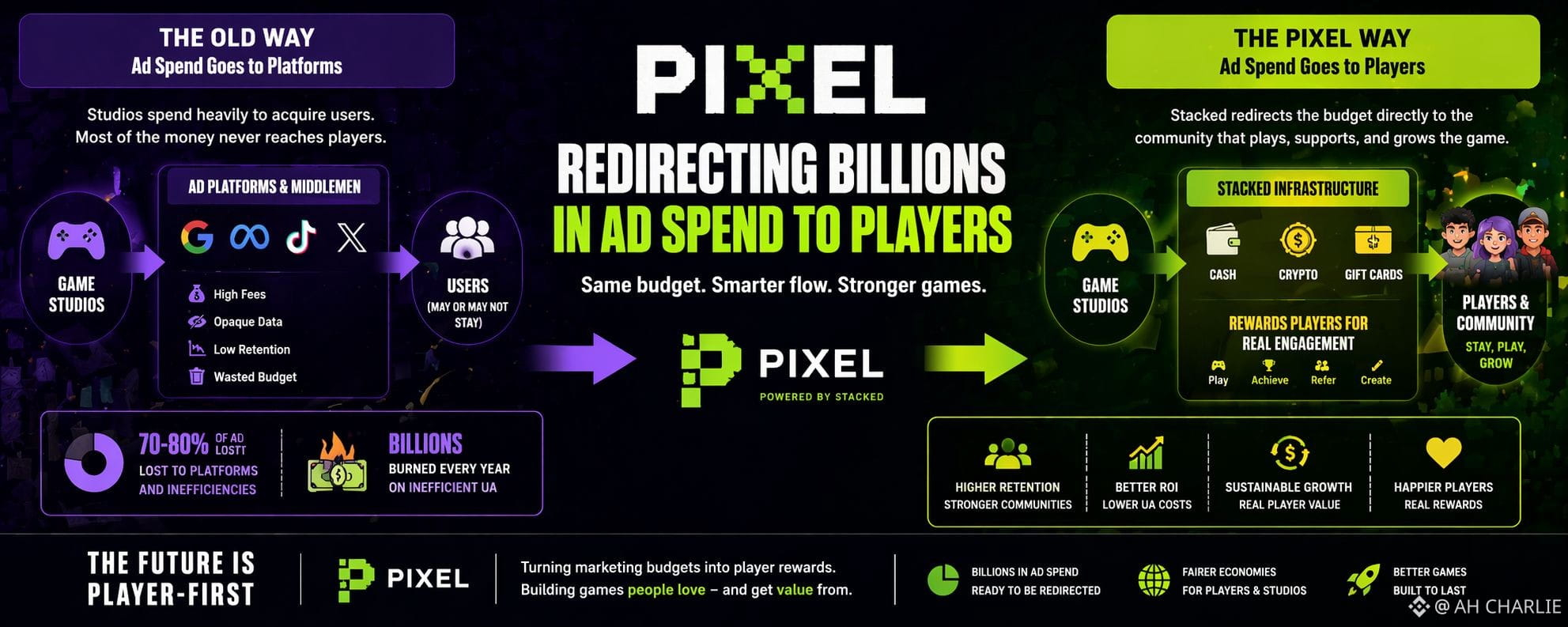
$PIXEL is trying to flip a very old scammy habit in gaming. Instead of paying ad networks to hunt for users, it wants that money to land in player pockets. That changes more than marketing. It changes what growth even means. I keep thinking about how weird the normal model really is. A game studio builds something.
Then it burns cash begging ad platforms to send people in. A click here. An install there. Maybe a cheap user for one week. Maybe a bot farm with a decent conversion sheet. Maybe a crowd that leaves the moment the reward dries up. The studio pays anyway. The middlemen eat first. Players, the people doing the actual playing, usually get nothing from that budget. That is the old machine.
PIXEL, through Stacked, is pushing a different one. The pitch is simple enough that even crypto cannot fully ruin it with fancy words. Studios already spend money to get users. So why not send that budget straight to players instead of tossing it into the ad-tech furnace?
Cash. Crypto. Gift cards. Straight to the people creating the activity the game needs. That is not a small tweak. That is moving the pipe. And once you move the pipe, the whole room starts to look different. The first thing this changes is who gets treated like the valuable part of the system.
In normal gaming, the player is often the product being sold upstream. Their attention gets packaged, tracked, priced, and fed into ad dashboards. The budget moves around them, not to them. PIXEL’s model says, hold on, the player is the one doing the work here. Showing up. Testing loops.
Building game life. Filling servers. Creating social proof. So maybe the player should get a slice of the money that used to vanish into paid user acquisition. That lands hard because it exposes how bloated the old setup is. Studios have been paying massive tolls just to rent attention. Not loyalty.
Not love for the game. Just attention. A rented crowd. It is like paying a guy outside a restaurant to drag random people through the door, then acting shocked when they leave after free water. Stacked is saying that same budget could be used to reward actual participation inside the game. Not just the install. Not just the click. The behavior. The return session. The real engagement. Now, that sounds clean on paper. Human beings adore paper. Paper forgives everything.
Real systems do not. So the second shift here is more dangerous, and more interesting. When you redirect ad spend to players, you are not just fixing waste. You are turning marketing into part of the economy itself. The growth budget is no longer outside the product. It lives inside it. That means the line between player reward and user acquisition starts to blur. Fast. And that is where PIXEL becomes worth watching. Because if this works, studios stop paying Google, Meta, and whoever else to maybe find a user.
They start paying players directly for actions that keep the game alive. That is brutally rational. Why pay a platform for traffic when you can pay your own community for momentum? Why reward a black-box ad auction when you can reward the people who actually stick around?Okay, but let’s not get drunk on the clean version of the story.
Direct rewards can build stronger communities. They can also build prettier forms of dependence. If players stay because the value loop is good, great. If they stay because the payout map is optimized just enough to keep them orbiting, that is a different beast. Same smile. Different skeleton. So the real test is not whether PIXEL can redirect budget. It is whether the game still has a pulse when the incentive volume drops.
The third shift is strategic. Studios using this kind of system are not just buying users anymore. They are buying measurable behavior in their own territory. That gives them something ad platforms never really give back: tighter control. Better feedback. Faster learning. They can see what players respond to, where money leaks, and what kind of reward actually creates useful activity.
They stop shouting into the street and start talking to people already inside the house. That is powerful. Maybe too powerful, depending on how cynical you feel that day. Still, there is a real economic logic here. Ad spend has always been a tax on growth. A giant leak. A studio pays a platform, the platform keeps its cut, and the user arrives with no real bond to the game.
PIXEL’s model tries to turn that leak into an internal loop. Keep the money closer. Let the player touch it. Let the game economy absorb it. In theory, that should make growth cheaper, stickier, and more honest. There is that phrase again. The favorite blanket of people with pitch decks.
PIXEL is not interesting because it sounds generous. It is interesting because it admits a truth most projects dodge: game growth is a market problem, not just a design problem. And if studios are already spending billions to buy attention, then redirecting part of that spend to players is not crazy. It is cleaner. Maybe colder, too. But cleaner.
I like the direction more than the usual ad-network circus. But I am not giving it a free pass. If the rewards deepen real game demand, this is smart. If they just replace ad spend with a better-looking bribe, then nothing has really changed. The middleman got cut out, sure. The dependency did not. That is the real question hanging over PIXEL. Not whether players can get paid. Whether getting paid helps build a game people would still care about when the extra push fades.
@Pixels #pixel $PIXEL #Web3Gaming
