
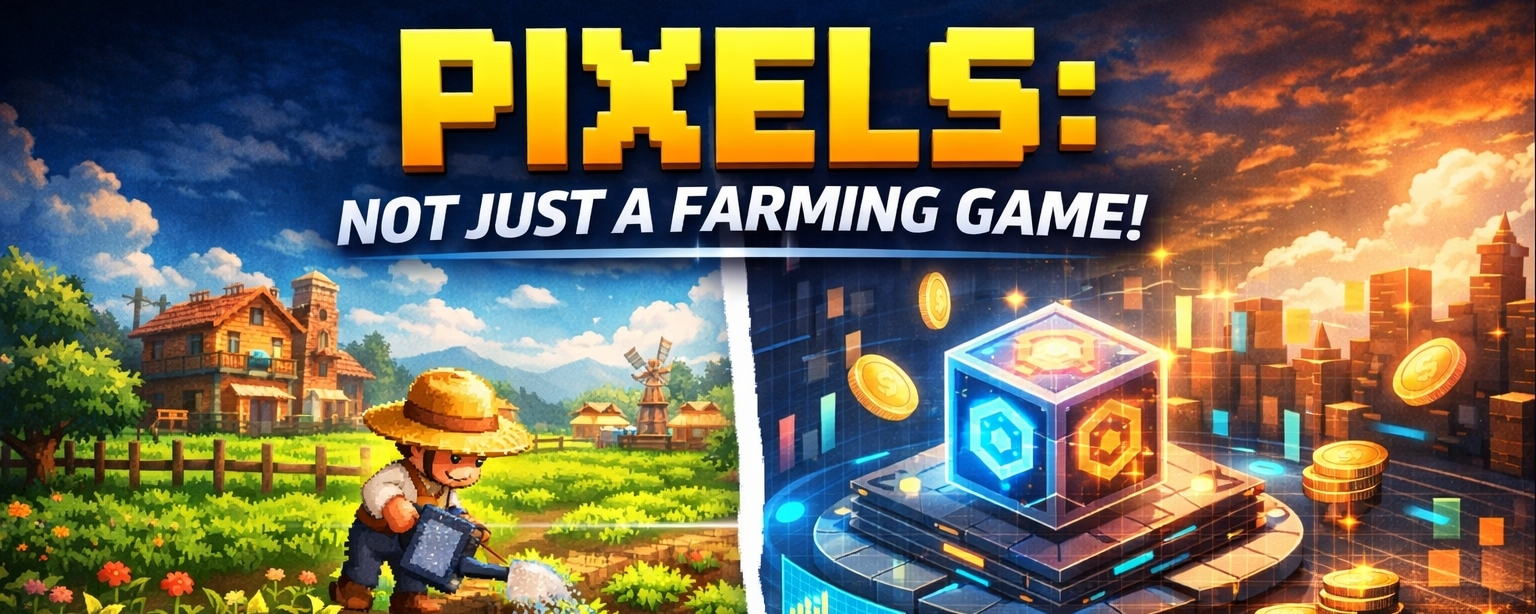
Why does a simple farming game actually need an economy?
I kept asking myself this while observing Pixels.
At first glance, it looks like a typical farming game — water crops, collect resources, decorate land. A slow, calm experience. Nothing unusual.
But if you spend time inside it, you begin to notice something deeper.
This isn’t just a game.
It’s a Web3 gaming experiment — quietly building a system around ownership, behavior, and coordination.
From Gameplay to Economic Design
Most traditional games follow a predictable loop:
Play → Earn → Spend → Repeat
Once you log out, your effort loses relevance. There’s no long-term value attached.
Pixels tries to extend that loop.
Through blockchain gaming, it introduces real ownership. Assets are not just visual — they exist within a broader tokenomics structure.
But here’s the important question:
Does ownership automatically create value?
Not really.
Ownership without economic incentives is just static possession.
Pixels seems to understand this — and instead of forcing value, it builds it through player engagement and behavior.
Behavior > Time Spent
In most play-to-earn (P2E) models, rewards are fixed.
Spend more time → Earn more rewards.
But Pixels shifts this toward incentive alignment.
Here, outcomes depend on:
Efficiency
Planning
Coordination
Decision-making
Two players can spend the same time, but their results differ.
Why?
Because Pixels rewards genuine player contributions, not just activity.
This introduces intrinsic motivation — players are not just farming tokens, they are optimizing strategies.
It starts to feel less like grinding…
and more like participating in a micro digital economy.
Guilds as Coordination Systems
The social layer is where things evolve further.
Guilds in Pixels are not just communities — they function like production units.
Shared strategies
Coordinated actions
Collective efficiency
This creates a system where player actions → long-term value.
Instead of isolated gameplay, Pixels encourages coordination-driven growth.
It’s closer to digital cooperatives than traditional multiplayer gaming.
Tokenomics & Smart Reward Targeting
The $PIXEL token isn’t just a reward tool.
It’s part of a broader token mechanics framework designed around:
Activity-based rewards
Staking participation
Controlled reward allocation
Pixels is clearly trying to solve a major problem in blockchain gaming:
👉 The “free reward → instant dump” cycle
Instead, it experiments with smart reward targeting, where distribution connects to meaningful participation.
This is where the shift becomes clear:
Play-to-Earn → Play-and-Participate
You’re not just extracting value —
you’re contributing to ecosystem growth.
Data, Systems & Continuous Tuning
One interesting pattern is frequent updates.
At first, it looks like content updates.
But in reality, it reflects data-driven infrastructure.
New items = economic inputs
New sinks = inflation control
New systems = behavioral adjustments
This is very similar to machine learning feedback loops, where systems continuously adapt based on user behavior.
Even their publishing strategy seems aligned with this — creating a kind of publishing flywheel that helps with:
User acquisition (UA)
Retention
Lowering UA costs
Over time, this could evolve into a next-generation ad network built around player activity.
The Bigger Question: Can This Sustain Itself?
Pixels is clearly aiming for:
Self-sustaining growth
Balanced reward systems
Long-term engagement
But important questions remain:
Can rewards survive if daily active users decline?
How strong is backend control vs decentralization?
Is reward distribution truly fair?
These are not small challenges.
Final Thought
Pixels doesn’t try to be the most complex game.
It keeps things simple on the surface —
but underneath, it’s experimenting with something difficult:
👉 Can a game function as a real economic system?
👉 Can incentive alignment shape player behavior?
👉 Can coordination outperform individual grinding?
It doesn’t have perfect answers yet.
But it’s asking the right questions.
And more importantly —
it’s building in a way where answers can emerge over time.