
Most Web3 game teams still run their economy like a guy tapping a broken fuel gauge and pretending that counts as live ops. That is why the idea behind @Pixels AI economist matters. Not because it sounds futuristic. A lot of things in crypto sound futuristic right before they fall apart.
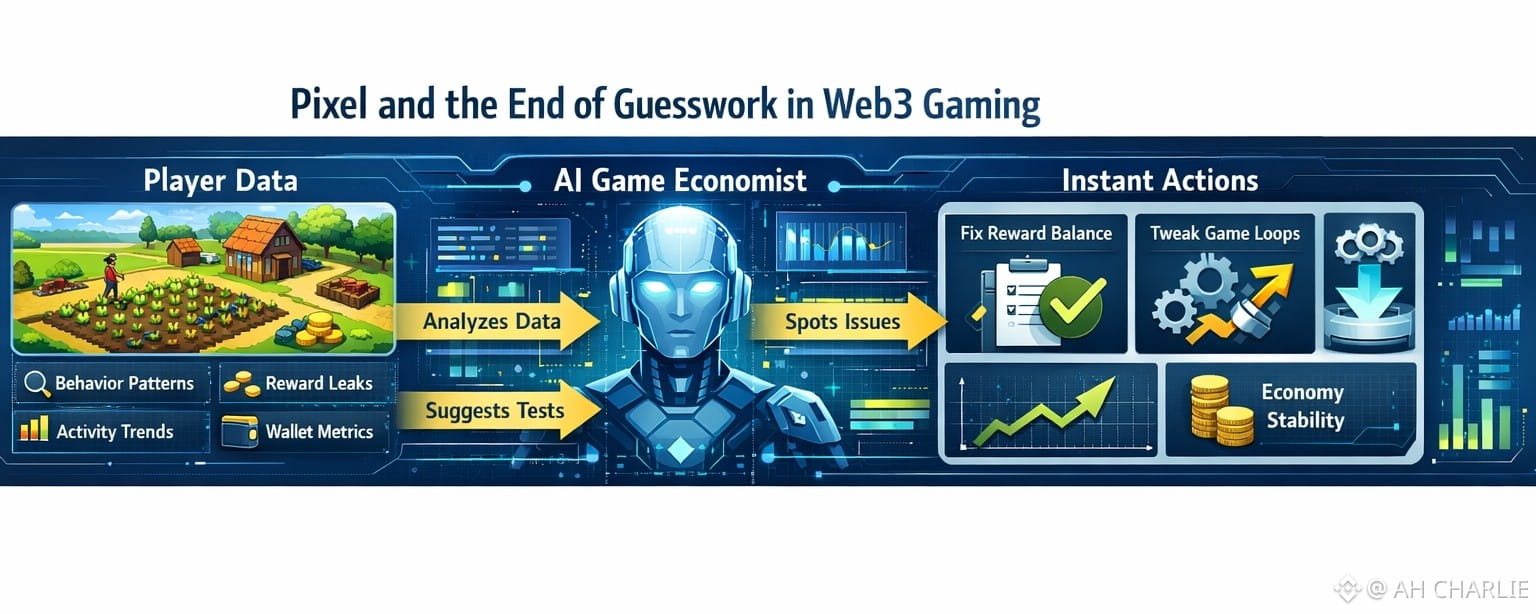
Pixel is pushing a model where game management stops being gut feel and starts acting more like a live control room. The AI game economist watches player behavior, spots where reward budgets are leaking, and suggests fast tests the team can run right away. That shifts the job from guessing what keeps players active to measuring it, then adjusting on the fly. That is a real change.
Think about how most game economies drift. A studio launches rewards, quests, token sinks, maybe some timed events. Early numbers look fine. Users show up. Wallet activity rises. Everyone claps. Then the leaks start. Players farm the wrong tasks. Rewards go to habits that do not build a healthy game loop. Some users stay only for payout. Others leave because progress feels flat. The team sees the damage late, usually after the budget is already bleeding.
Pixel’s is that AI can catch this earlier. Not in some magical sci-fi way. Just in a blunt operational way. It reads player behavior at scale, finds where rewards are being wasted, and points toward immediate experiments.
It helps the studio ask better questions. Which actions actually keep good players around? Which rewards are too rich for the value they create? Which parts of the game are pulling users forward, and which ones are just expensive noise? That matters because Web3 games have a bad habit of paying for motion and calling it traction.
There is the first big shift here. AI replaces guesswork with live feedback. That sounds obvious, but game teams rarely have clean visibility once a token economy goes live. They are not just managing fun. They are managing incentives, wallets, timing, behavior loops, and player churn all at once. One wrong reward path can turn the whole system into a farm. One weak sink can make the token feel loose. One sticky payout path can train users to repeat low-value actions forever.
So instead of staring at dashboards and making broad guesses, Pixel’s system tries to act like an in-house economy analyst that never sleeps. It watches, compares, flags weak points, then suggests what to test next. Not ideology. Not vibes. Just operational signals.
The second part is where it gets more interesting. AI in this setup is not only reading data. It is helping turn data into action while the game is still alive and moving.
That is a big deal in Web3. These economies do not wait politely for monthly review meetings. They mutate fast. Players adapt fast too. The second a reward path becomes soft, the market usually finds it before the team does. Farmers notice. Bots notice. Smart users notice. Human nature is annoyingly efficient when free value is lying around. So speed matters.
If Pixel can spot a reward leak early and suggest a quick test, like trimming one payout route, boosting another, or changing how rewards tie to useful player behavior, the studio gets a shot at fixing the loop before it turns rotten. That is the real promise here. Less blind tuning. More live response. More chance of keeping the game economy tied to actual user value instead of pure token emission.
An AI economist can tell you where the budget leaks. Fine. It can suggest experiments. Useful. But it still depends on what the studio wants to optimize. That is the knife edge. If the goal is only session time, spend depth, or short-term retention, then the AI may become a very smart machine for polishing a weak loop. It can make a bad system more efficient without making it good.
If Pixel uses this system to improve game health, better loops, smarter reward use, stronger retention without brute-force payouts, then it has real value. If it uses the same system to squeeze behavior harder and stretch incentives thinner while calling it optimization, players will feel that too. Fast.
So the question is not whether AI belongs in Web3 gaming. It already does. The real question is whether it helps studios build better games, or just better control systems.
Pixel is pointing at something real. Web3 gaming cannot keep running token economies on instinct and delayed reports. That era is too messy, too slow, too expensive. An AI economist makes sense because live economies need live management. It is basically moving from a paper map to radar.
Still, First #DYOR , because better data tools do not automatically mean better player outcomes.
I think Pixel’s direction is smart. Not flashy. Smart. It treats game management like a living system instead of a launch-day spreadsheet. And honestly, that is probably where this sector has to go. The old guess-first model was always going to crack. AI is not the cure for bad design. But it may be the tool that finally exposes it.