You might be familiar with spreadsheets or databases. A blockchain is somewhat similar because it is a database where information is entered and stored. The key difference between a traditional database or spreadsheet and a blockchain is how the data is structured and accessed.
A blockchain consists of programs called scripts that conduct the tasks you usually would in a database: entering and accessing information, and saving and storing it somewhere. A blockchain is distributed, meaning multiple copies are saved on many machines and must match for it to be valid.
The Bitcoin blockchain collects transaction information and enters it into a 4MB file called a block (different blockchains have different-sized blocks). Once the block is full, the block data is run through a cryptographic hash function, which creates a hexadecimal number called the block header hash.
The hash is then entered into the following block header and encrypted with the other information in that block's header, creating a chain of blocks, hence the name “blockchain.”
✅ Example:
🟢 TransactionProcess
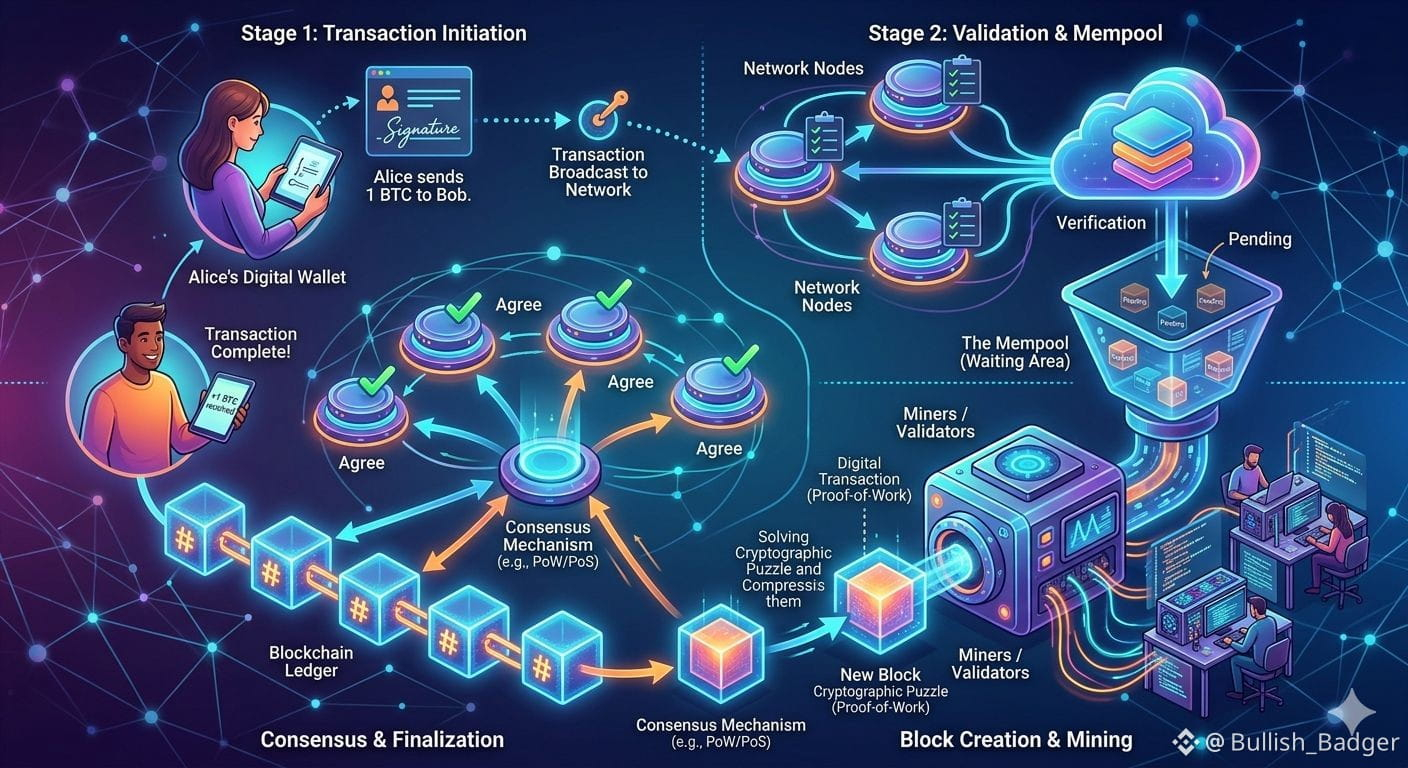
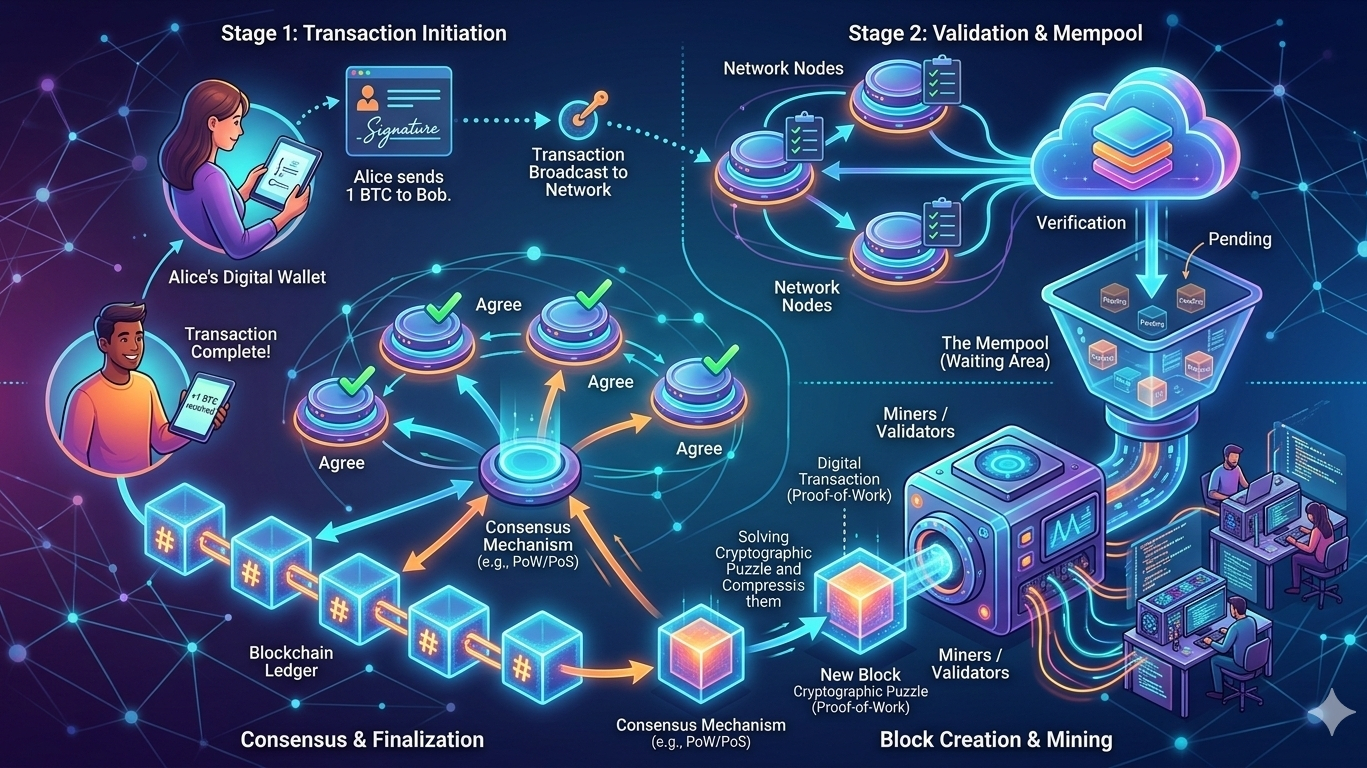
When a transaction occurs (e.g., Alice sends 1 Bitcoin to Bob), it typically follows these steps:
Initiation: A user starts a transaction using a digital wallet, signing it with their private key to prove ownership and prevent tampering.
Broadcasting: The transaction is sent to the peer-to-peer network, where nodes receive it and verify its validity, such as checking if the sender has enough funds.
Mempool: Validated transactions enter a temporary waiting area called a mempool (memory pool) until they are selected for processing.
Block Creation: Specialized nodes—miners (in Proof of Work) or validators (in Proof of Stake)—group verified transactions into a new "block".
Consensus: The network must agree that this new block is valid. This is achieved through a consensus mechanism (like Proof of Work or Proof of Stake), which ensures all nodes share the same version of the truth.
Finalization: Once consensus is reached, the block is added to the existing chain. Every node updates its own copy of the ledger, and the transaction becomes a permanent, irreversible record
#blockchain #BinanceSquareFamily #DriftProtocolExploited $BTC $ETH