
i’m watching SIGN the way i’d monitor a system that hasn’t broken—but keeps brushing against the conditions where it could. The dashboards don’t flash red; they hum. Quiet throughput, steady contract interactions, a cadence of credential verifications that feels procedural rather than speculative. i’ve been less interested in what the token says it will become and more focused on what the system is already forcing participants to do. behavior is the only honest metric left.
i’ve been tracing the tokenomics not as a static allocation chart, but as a timeline of pressure. supply doesn’t arrive all at once—it seeps. unlock schedules are staggered with intent, but intent doesn’t neutralize impact. every vesting tranche is a decision point: insiders convert conviction into liquidity, or extend exposure into uncertainty. i watch those moments like 2 a.m. alerts—low volume, high signal. if distribution clusters around early stakeholders without corresponding organic demand, price discovery becomes theater. not collapse—just slow erosion masked as stability.
i’ve been mapping issuance against usage. credential verification events, session creation, developer interactions with the infrastructure—these aren’t abstractions. they’re demand surfaces. if the token is to function as security fuel, then its consumption needs to correlate with real system activity, not just speculative positioning. i don’t care about nominal transaction counts; i care about meaningful interactions that require state changes, permissioning, and verification. anything else is noise dressed as growth.
i’ve been sitting in on internal risk committee simulations—hypothetical, but grounded. what happens when unlock velocity outpaces organic demand? what happens when staking participation becomes passive rather than intentional? staking here isn’t yield—it’s responsibility. if validators or participants treat it like a fixed-income product, the system’s security assumptions start to rot from the inside. incentives drift. alignment fractures quietly before it breaks loudly.
the architecture itself leans into a different philosophy. SVM-based execution isn’t just about speed—it’s about deterministic behavior under constraint. high-performance L1, yes, but with guardrails that matter more than raw throughput. i’ve stopped caring about TPS dashboards. they’re vanity metrics. real failure doesn’t come from slow blocks; it comes from permission sprawl and key exposure. the attack surface isn’t latency—it’s human behavior interacting with poorly scoped authority.
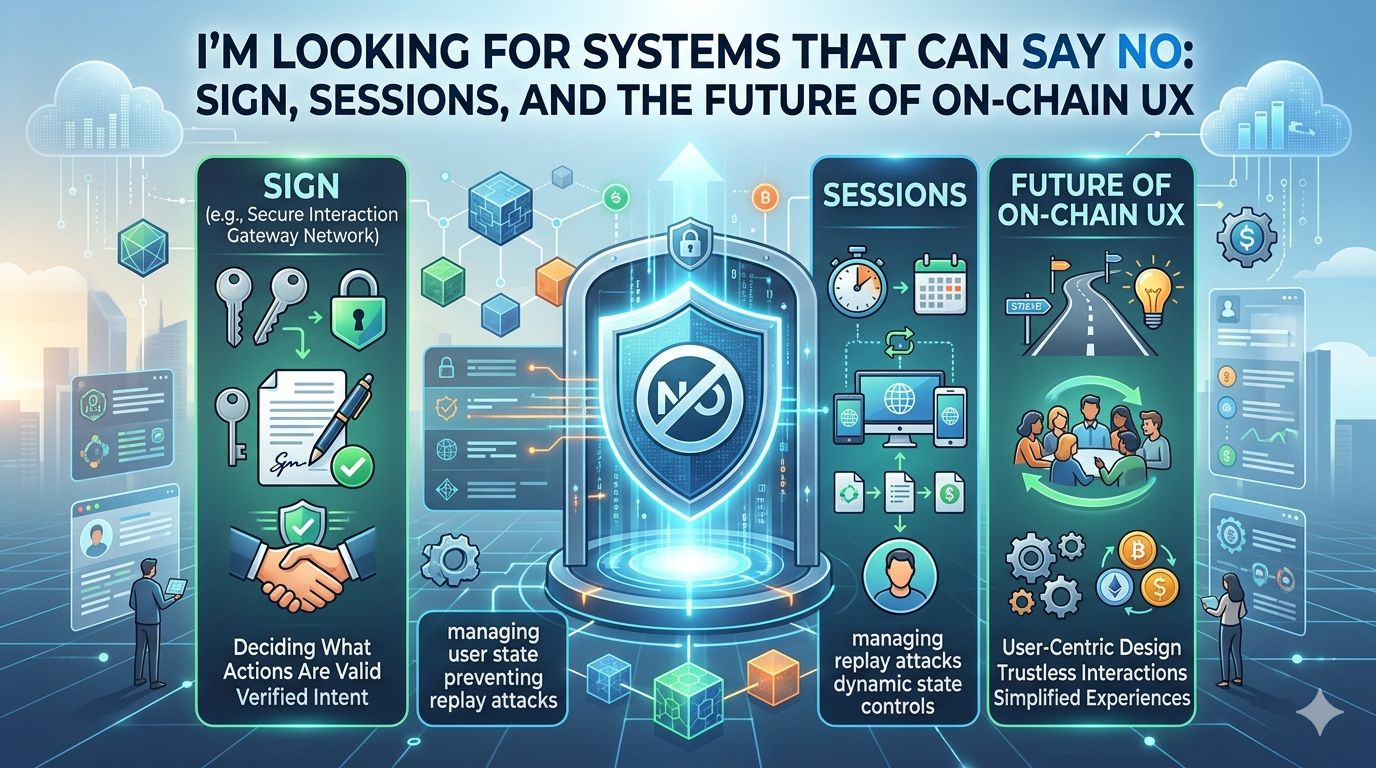
this is where Project Sessions start to matter. enforced, time-bound, scope-bound delegation isn’t just a feature—it’s a constraint system imposed on user behavior. Scoped delegation + fewer signatures is the next wave of on-chain UX. i’ve been watching how often sessions are created versus how often full wallet approvals are still used. that ratio tells me whether the system is actually changing habits or just offering alternatives that no one adopts. if users default to legacy approval flows, then the innovation is ornamental. if sessions become the norm, then we’re looking at a structural shift in how risk is distributed.
i’ve been reviewing audit trails—not just formal audits, but real transaction patterns. repeated approval scopes, contract interactions that exceed their intended boundaries, wallets acting with more authority than they should. these are the early warning signs. audits catch code vulnerabilities; they don’t catch behavioral drift. and behavioral drift is where systems fail in production.
the modular execution layer adds another dimension. execution sits above a more conservative settlement base, which is where i start to see the long-term design philosophy. don’t optimize the foundation for speed—optimize it for finality and integrity. push complexity upward, where it can be iterated without compromising the base layer. EVM compatibility here isn’t ideological; it’s practical. it reduces tooling friction, lowers the barrier for developers, and accelerates integration without forcing them to relearn everything. but compatibility also imports legacy assumptions—and not all of those assumptions are safe.
i’ve been tracking developer behavior more than announcements. which modules are actually being deployed? which contracts are seeing repeated use? where are developers spending gas consistently, not just during launch windows? adoption isn’t measured by integrations announced—it’s measured by integrations that persist when no one is watching. the quiet parts of the chain tell the truth.
revenue, if it exists meaningfully, needs to be examined without narrative padding. are fees being generated from real usage, or are they artifacts of incentive programs? if there’s any mechanism that feeds value back into the token—buybacks, burns, redistribution—it needs to be tied directly to sustained activity. otherwise, it’s just reflexive engineering. value looping without external input collapses eventually.
bridge interactions remain a point of unease. i’ve seen too many systems treat cross-chain movement as solved infrastructure. it isn’t. Trust doesn’t degrade politely—it snaps. one compromised bridge doesn’t just drain assets; it fractures confidence in the entire system. i watch bridge flows not for volume, but for concentration. where assets cluster, risk concentrates.
i’ve been thinking about asymmetry. the upside case depends on behavior changing—developers adopting sessions, users accepting constrained permissions, validators treating staking as duty rather than yield. the downside case requires none of that. it only requires inertia. if habits don’t change, the system inherits the same failure modes it claims to solve.
what would change my thesis isn’t a partnership or a headline. it’s verifiable shifts in behavior. a sustained increase in session-based interactions relative to full approvals. a visible correlation between token usage and credential verification demand. staking participation that remains stable through unlock events rather than collapsing into liquidity exits. these are the signals that matter.
i’ve stopped looking for explosive growth. i’m looking for consistency under pressure. systems don’t fail when they’re stressed—they fail when they’re predictable. a fast ledger that can say “no” doesn’t just improve UX; it prevents the kind of failures we’ve already seen too many times.
@SignOfficial #SignDigitalSovereignInfra $SIGN
