
$ETH may look fairly “normal” at first glance.
No explosive breakout, no dominant narrative, and no obvious wave of FOMO capital.
But that kind of quiet is often when the market is building something bigger beneath the surface.
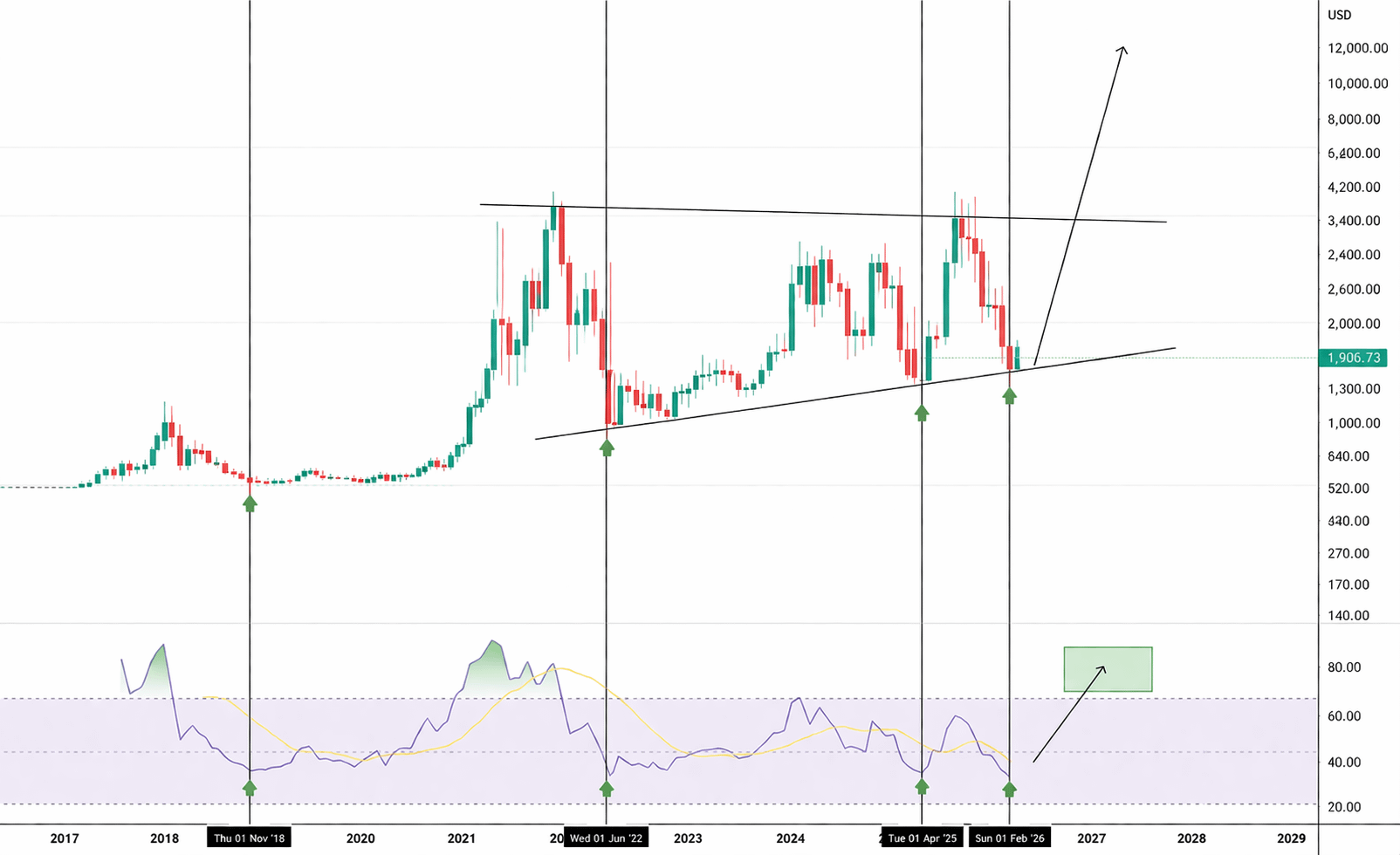
Zooming out, Ethereum has been trading within a high-timeframe range for nearly five years — a prolonged accumulation zone, repeatedly testing both the highs and lows without a decisive breakout.
The key point isn’t that it hasn’t broken out —
it’s that the structure continues to hold through multiple cycles.
Each return to the lower end of the range has been absorbed, forming higher lows instead of breaking down. This suggests underlying demand hasn’t disappeared — it simply hasn’t been strong enough (yet) to trigger a breakout.
From this perspective, ETH isn’t “sideways because it’s weak” —
it’s compressing because the timing isn’t ready.
Another important detail lies in higher-timeframe momentum.
The monthly RSI is rotating back toward lower levels — a zone that has historically aligned with major reversal points. This doesn’t guarantee an immediate bounce, but it does suggest that downside risk may be gradually diminishing over time.
When an asset sits at the bottom of a long-term range while momentum resets, what forms isn’t a clear trend —
it’s asymmetry.
Risk doesn’t disappear, but the reward profile starts to skew.
At this stage, the question isn’t whether ETH will reach extreme price targets —
it’s whether the current structure is setting up for a significant move in either direction.
Because when a range of this scale finally breaks, the market rarely offers easy re-entry opportunities.
“The bigger the base, the higher in space” may sound cliché —
but in this context, it holds weight.
ETH is building a base that few assets achieve —
not through hype, but through time.
And when a structure is built over time,
its breakout is rarely subtle.
For now, ETH hasn’t broken out yet.
But it may no longer be in a phase where it needs to prove anything.