I was going through a wallet explorer recently after a small (and slightly uncomfortable) trading slip, and it made something clear again: in crypto, very little is hidden. Balances, transactions, patterns — nearly everything is visible on-chain. That openness played a big role in building early trust, but it also introduced a new form of exposure.
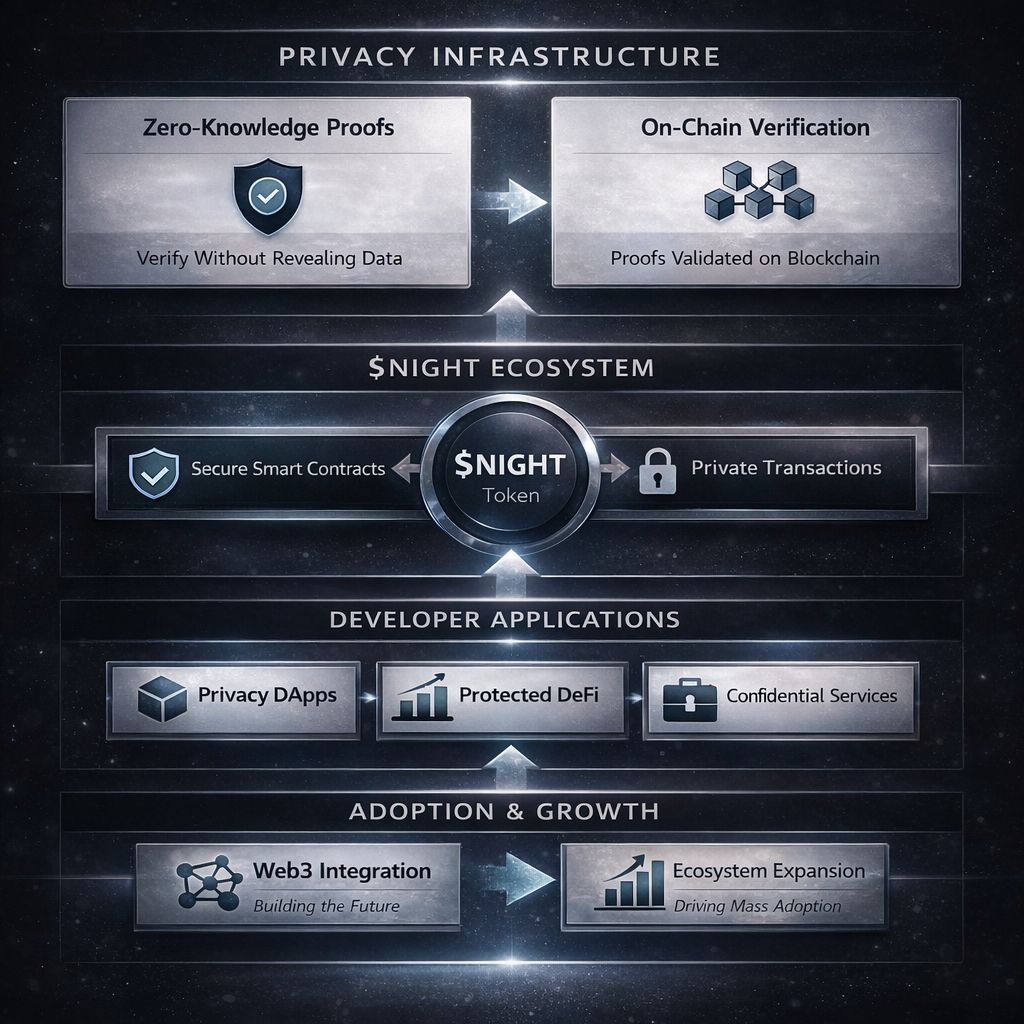
That’s one of the reasons @MidnightNetwork stood out to me. Instead of adding privacy later, it’s built around zero-knowledge proofs — a way to confirm something is valid without revealing the underlying information. Essentially, verification without disclosure.
At the center is $NIGHT , supporting an ecosystem where developers can design applications that prioritize user privacy by default while still remaining verifiable on-chain. It’s not a loud or flashy innovation, but it reflects a meaningful shift in how systems can be structured.
Of course, an idea on its own doesn’t carry much weight. What really matters is whether developers build things that people actually find useful.
If privacy becomes a foundational layer for broader adoption, networks like Midnight could help influence what comes next for Web3. The question is whether the ecosystem can develop quickly enough to turn that possibility into something real.