
When I first started learning about Fogo, what really caught my attention was not just the word high-performance, because honestly almost every blockchain says that, but the fact that they are building a Layer 1 network powered by the Solana Virtual Machine, which tells me they are serious about execution from day one. I’m someone who believes infrastructure matters more than noise, and Fogo feels like a project that is thinking about how things actually work behind the scenes instead of just focusing on short-term excitement. They are not trying to be different for the sake of being different, but instead they are trying to be efficient, scalable, and ready for real demand.
To me, a Layer 1 blockchain is like the foundation of a building, and if that foundation is weak, everything built on top of it will eventually feel unstable. Fogo is building at that base level, where transactions are processed, validated, and finalized, and they are designing it with performance in mind from the very beginning. I like that approach because I have seen how some networks grow fast in users but struggle technically when activity increases. They’re building with the assumption that growth will come, and they want the system to stay smooth even when usage becomes heavy.
What makes their structure powerful is the use of the Solana Virtual Machine, which changes how transactions are handled compared to older models that process everything one by one. I think of it like this: instead of forcing every transaction to wait in a single line, the system can process many at the same time as long as they do not interfere with each other. That parallel execution is a big deal because it allows speed without chaos, and it keeps the network responsive even when there is a lot happening at once. I’m not a developer, but even from a user perspective I understand how important it is for transactions to feel fast and reliable instead of delayed and unpredictable.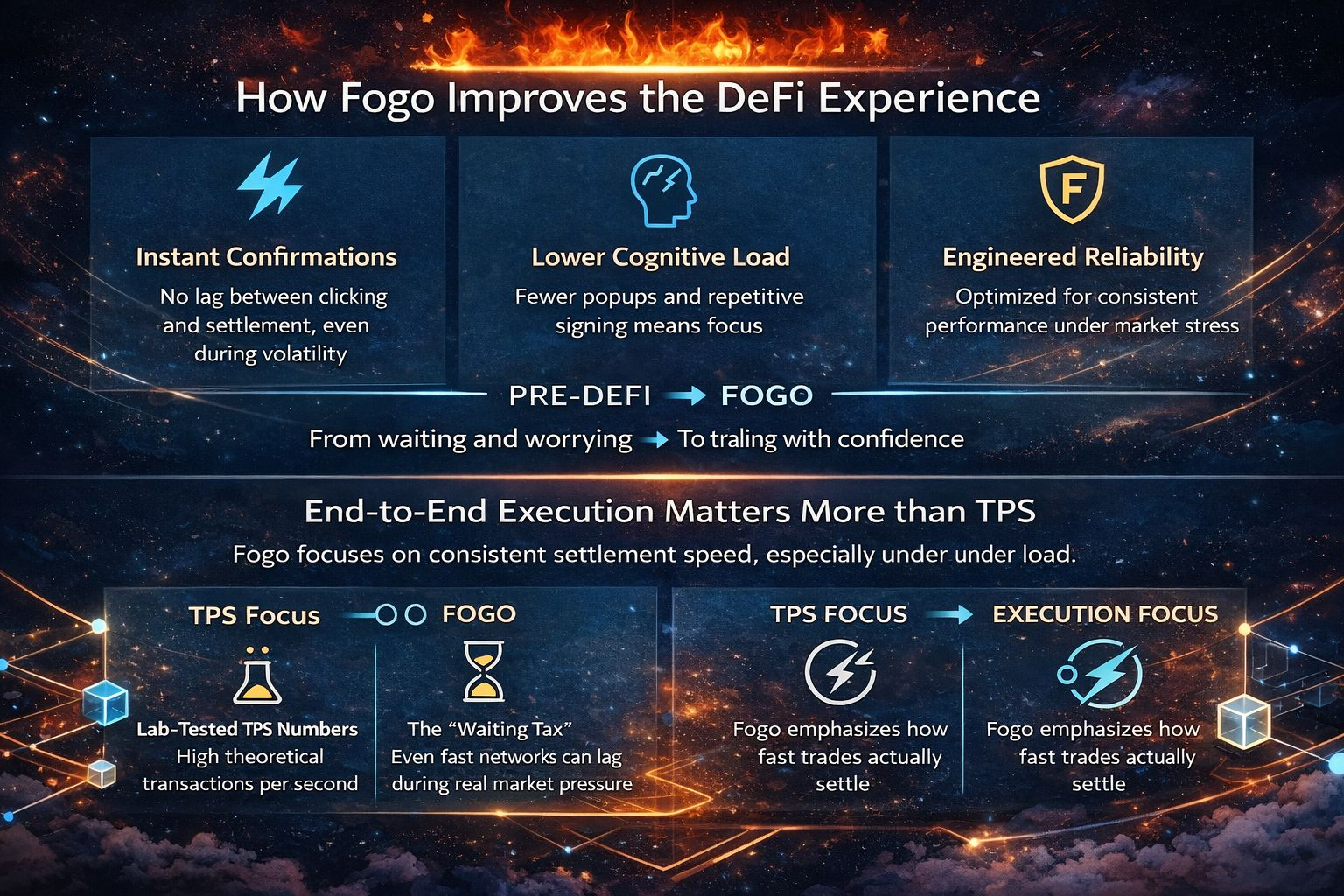
Scalability is a word people use often, but for me it simply means the network should not slow down or become expensive when more people start using it. Fogo seems to be designed around that idea, where performance is not just impressive in theory but sustainable in real conditions. I appreciate when a project thinks long term, because true adoption will only happen if the infrastructure can handle thousands or even millions of interactions without breaking under pressure. They’re building something that aims to remain stable when demand increases, and that kind of preparation shows maturity.
Another thing I find important is how developers interact with the network, because without builders there is no ecosystem. By utilizing the Solana Virtual Machine, Fogo creates an environment that feels familiar to developers who already understand that system, which lowers the barrier to entry and reduces the need for rewriting everything from scratch. I believe developers prefer continuity, and when moving or deploying applications feels smooth instead of complicated, innovation grows naturally. They’re making it easier for builders to focus on ideas and products instead of constantly adjusting to new technical rules.
Performance also affects fairness, especially in environments where timing and execution speed can influence results. If a network becomes congested or inconsistent, users start competing against technical limitations instead of just market conditions. Fogo’s focus on high-performance execution suggests they want the system to remain predictable and efficient even during busy periods. I feel that predictability creates trust, and trust is something every blockchain needs if it wants to grow beyond speculation. They’re trying to build a network where users and developers can rely on the infrastructure rather than worry about its limitations.
Of course, speed means nothing without security, and I always think about how a network balances performance with protection. Fogo’s approach of building on a proven virtual machine architecture gives a sense of stability, because they are not experimenting with completely untested execution logic. They’re combining performance optimization with structured validation, which is important if the network is going to support real financial and decentralized activity. I’m naturally cautious with new systems, but when I see a project focusing on strengthening the base layer instead of cutting corners, it builds confidence over time.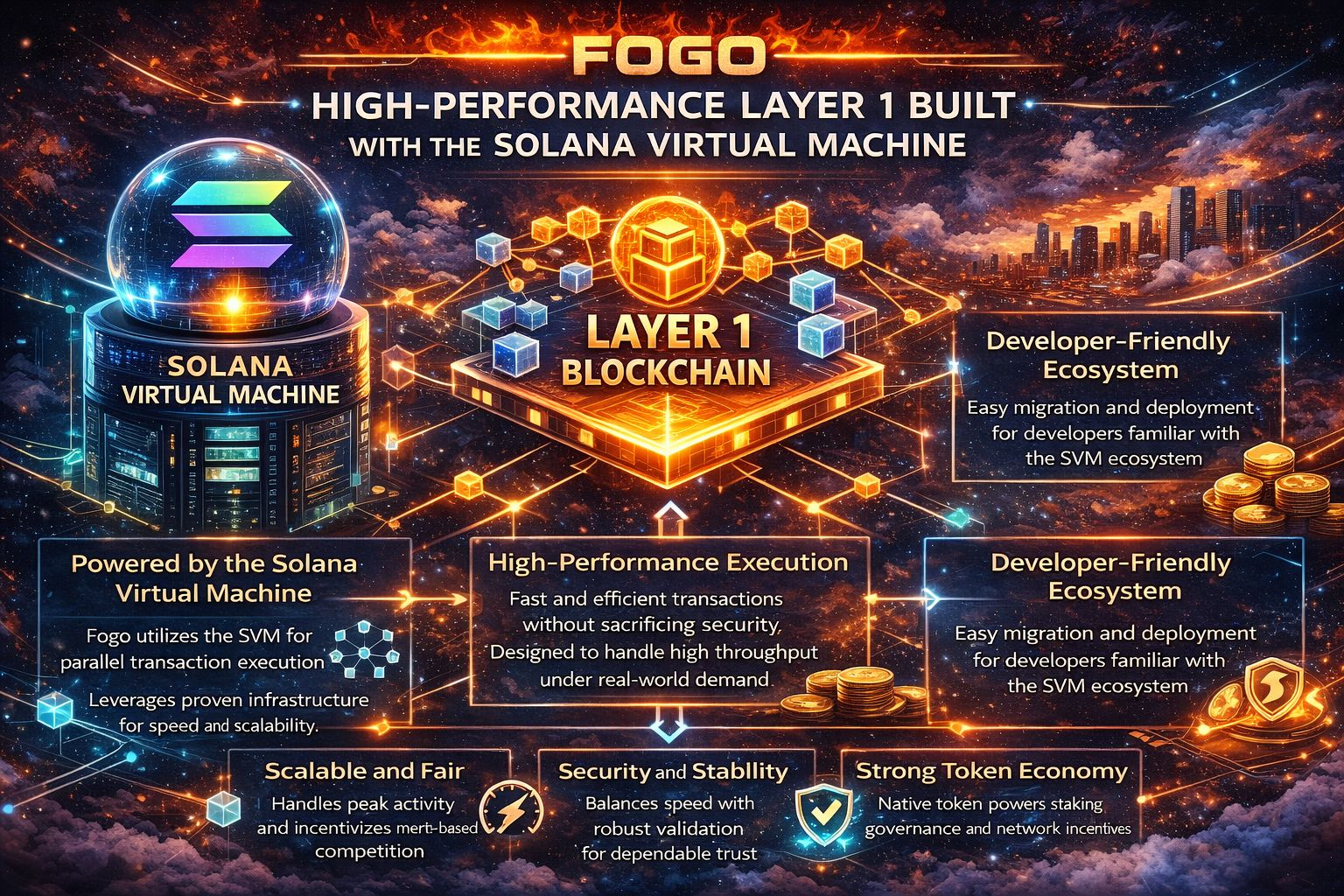
The economic layer also plays a big role, because in any Layer 1 network the native token is usually tied to fees, staking, and network participation. In a high-performance chain like Fogo, the token becomes part of the engine that keeps everything running smoothly. I see that as an alignment mechanism, where users, validators, and developers all benefit when the network performs well. They’re not just creating speed, they’re creating an environment where activity and contribution have measurable impact inside the ecosystem.
When I step back and look at everything together, Fogo feels like a project that understands modern blockchain demands. Applications today require fast execution, low latency, and reliable finality, and users expect smooth experiences rather than technical frustration. By building a Layer 1 powered by the Solana Virtual Machine, they are positioning themselves around performance, scalability, and developer accessibility all at once. I’m not saying the journey will be simple, because infrastructure takes time to mature, but I can see the intention clearly. They’re building for growth, building for real usage, and building with the belief that strong foundations create long-term value.
