
I found raw throughput impressive. The industry has spent years celebrating lower block times and higher TPS as if they were synonymous with progress. They are not. Capacity is a hardware story. Markets are a coordination story. What sophisticated capital demands is not spectacle, but execution quality under pressure. Fogo, architecturally at least, appears to recognize that distinction. It is not simply building a faster chain. It is attempting to build a chain optimized for market structure itself.
The prevailing narrative still treats performance as a race: shrink intervals, parallelize execution, scale validator counts. The assumption is linear, less latency equals better outcomes. But in adversarial trading environments, latency is not just delay; it is opportunity. What matters is inclusion variance: how tightly execution timing clusters around expectation when incentives sharpen. We are no longer constrained by bandwidth scarcity. We are constrained by predictability scarcity.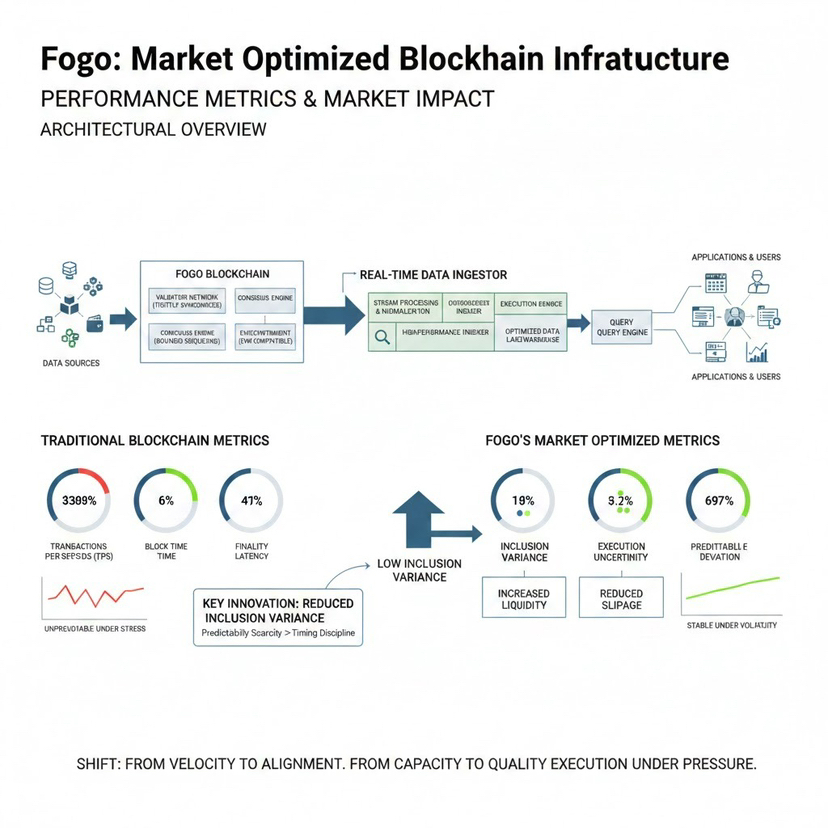
Fogo’s design addresses that constraint directly. By compressing network induced timing dispersion through tightly synchronized validator environments and bounded sequencing tolerances, it narrows the gap between broadcast and finality. That gap is where adverse selection forms. In most distributed systems, geography and jitter blur accountability. Environmental noise absorbs inefficiency. Fogo reduces that noise. Once dispersion shrinks, the dominant variable becomes implementation discipline: client efficiency, scheduling precision, consensus alignment. The bottleneck moves from cables to code.
This shift has economic consequences. Inclusion variance translates into execution uncertainty. Execution uncertainty widens spreads. Market makers do not price TPS; they price the probability of being picked off during unstable confirmation windows. When timing becomes tightly bounded, that insurance premium declines. Slippage begins to reflect genuine liquidity depth rather than structural fragility. Routing logic simplifies. Liquidity consolidates instead of fragmenting defensively. Predictability is not aesthetic, it is capital attractive.
The difference becomes most visible during volatility. Under calm conditions, almost any high speed chain appears efficient. But stress compresses time. Liquidations cascade. Order flow clusters. Automated strategies compete within millisecond windows. In that environment, a 20 millisecond inclusion drift is not theoretical, it is extractable. If sequencing discipline holds under load, spreads remain narrower and depth remains stable. If dispersion widens, liquidity retreats behind private channels regardless of headline performance metrics. Markets punish asymmetry faster than they reward speed.
There are trade offs. Tighter synchronization can introduce concentration concerns. Bounded sequencing discretion may limit flexibility at the margins. Optimizing for latency sensitive DeFi may privilege certain use cases over others. Market optimized infrastructure is not universally optimized infrastructure. The question is whether disciplined coordination outweighs distributed noise. Serious liquidity tends to prefer rails that degrade predictably over systems that fail theatrically.
Compatibility strengthens the wager. Maintaining virtual machine alignment lowers migration friction for builders and liquidity. Infrastructure evolution that forces ecosystem reinvention rarely succeeds. By preserving familiar execution environments while refining consensus timing discipline, Fogo attempts structural improvement without social disruption. That balance is pragmatic.
The deeper shift here is philosophical but measurable. We are moving from blockchains optimized for activity to blockchains optimized for markets. From maximizing transactions per second to minimizing economic asymmetry per slot. From celebrating velocity in isolation to engineering alignment under stress. Wider highways are easy to build. Traffic discipline is harder and more valuable.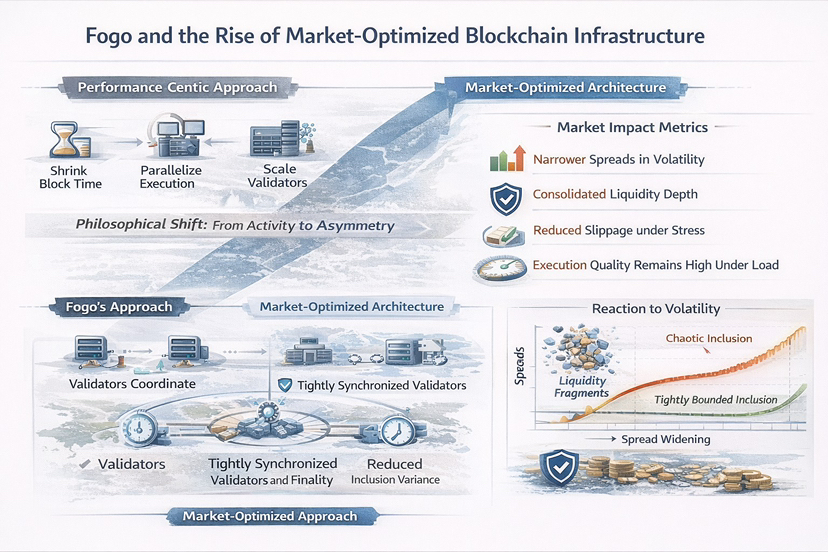
Whether Fogo succeeds will not be determined by lab benchmarks or marketing dashboards. It will be decided during volatility spikes, liquidity shocks, and sustained scale. If inclusion timing remains tightly clustered when incentives intensify, capital will consolidate. If it does not, spreads will widen and narratives will not matter.
The next generation of blockchain infrastructure will not be defined by how fast it moves in calm conditions, but by how cleanly it behaves when pressure arrives. If Fogo’s thesis holds, market optimization will replace throughput as the dominant design goal and execution quality will become the true measure of performance.
