
There is a quiet, almost unspoken frustration that lives inside the modern blockchain experience, and most people have felt it even if they cannot quite name it. You press a button to confirm a transaction, and for a brief moment your intention feels suspended in midair. It exists, but it has not yet become real. You refresh your wallet, you glance at the pending status, you calculate whether the fee you chose was generous enough. In that small gap between action and confirmation, there is a subtle tension. For years, we accepted that tension as the necessary cost of decentralization, because when Bitcoin first demonstrated that strangers could coordinate trustlessly across the globe, the miracle outweighed the inconvenience. When Ethereum expanded the idea into programmable contracts that could hold logic as well as value, the waiting felt like a small price to pay for participating in something revolutionary. Even when high-performance systems like Solana dramatically increased throughput and reduced latency, the underlying rhythm remained the same: submit, wait, confirm, repeat.
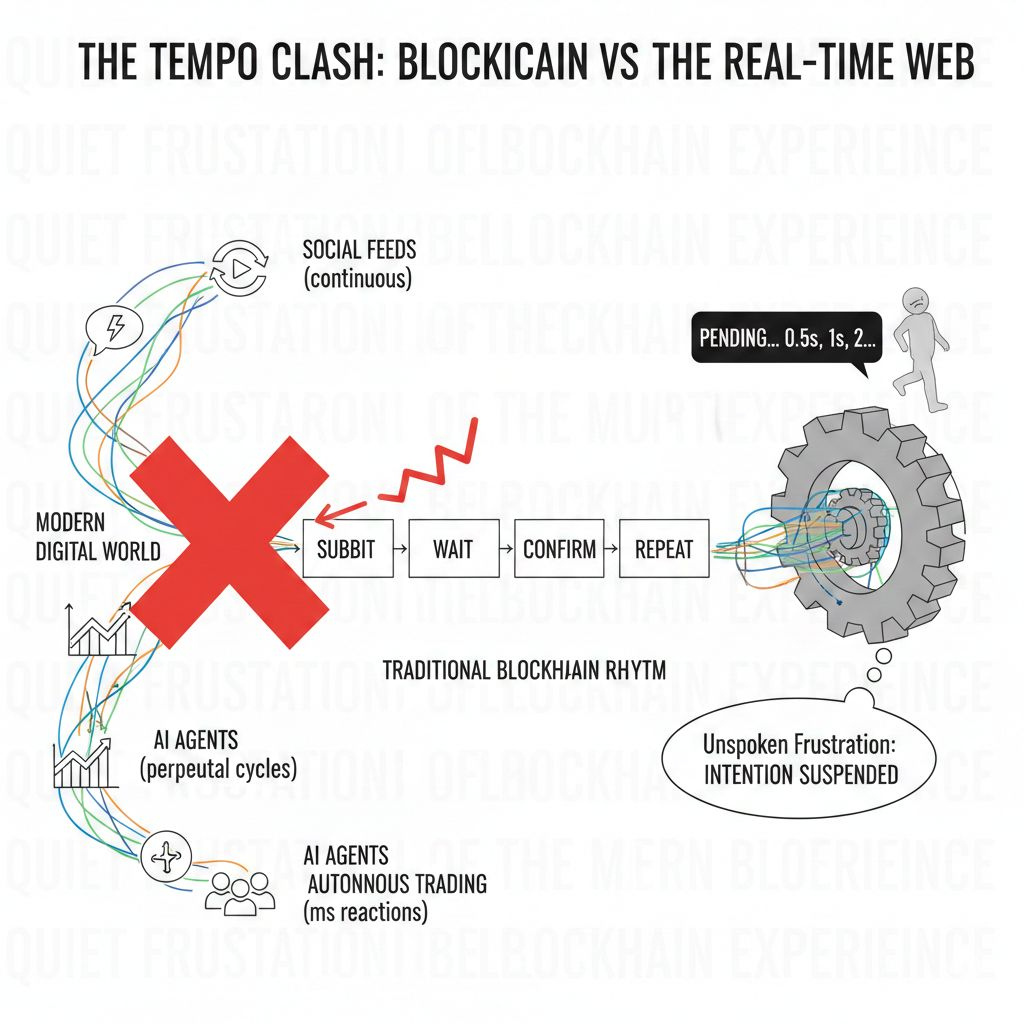
That rhythm made sense in a world where blockchains were primarily used for payments, token transfers, and occasional trades. A transaction would be created, broadcast, included in a block, and finalized, and then the system would pause until the next wave of activity arrived. However, the digital world we now inhabit no longer operates in such measured intervals. Social platforms evolve every second, with posts, reactions, and interactions unfolding continuously rather than in bursts. Autonomous trading systems react to price movements in milliseconds, recalculating positions in an endless loop of observation and response. AI agents, increasingly capable of managing wallets and executing strategies, do not think in discrete submissions; they exist in cycles of perception and adaptation that never truly stop. When these systems attempt to live on traditional blockchains, they encounter friction not because the chains are weak, but because they were architected for a different tempo.
Developers understand this friction at a deeply emotional level, because they encounter it daily. They build ambitious decentralized applications, only to find themselves engineering elaborate workarounds to mask latency and unpredictability. They create off-chain indexers to simulate real-time feeds, caching layers to smooth over delays, and retry logic to handle failed confirmations during congestion spikes. What begins as a vision of fully on-chain continuity often becomes a hybrid compromise, where essential components are quietly shifted off-chain simply to maintain usability. Over time, that pattern breeds a quiet exhaustion. It is not dramatic enough to headline conferences, but it lingers in late-night debugging sessions and careful product decisions shaped by the limitations of block timing.
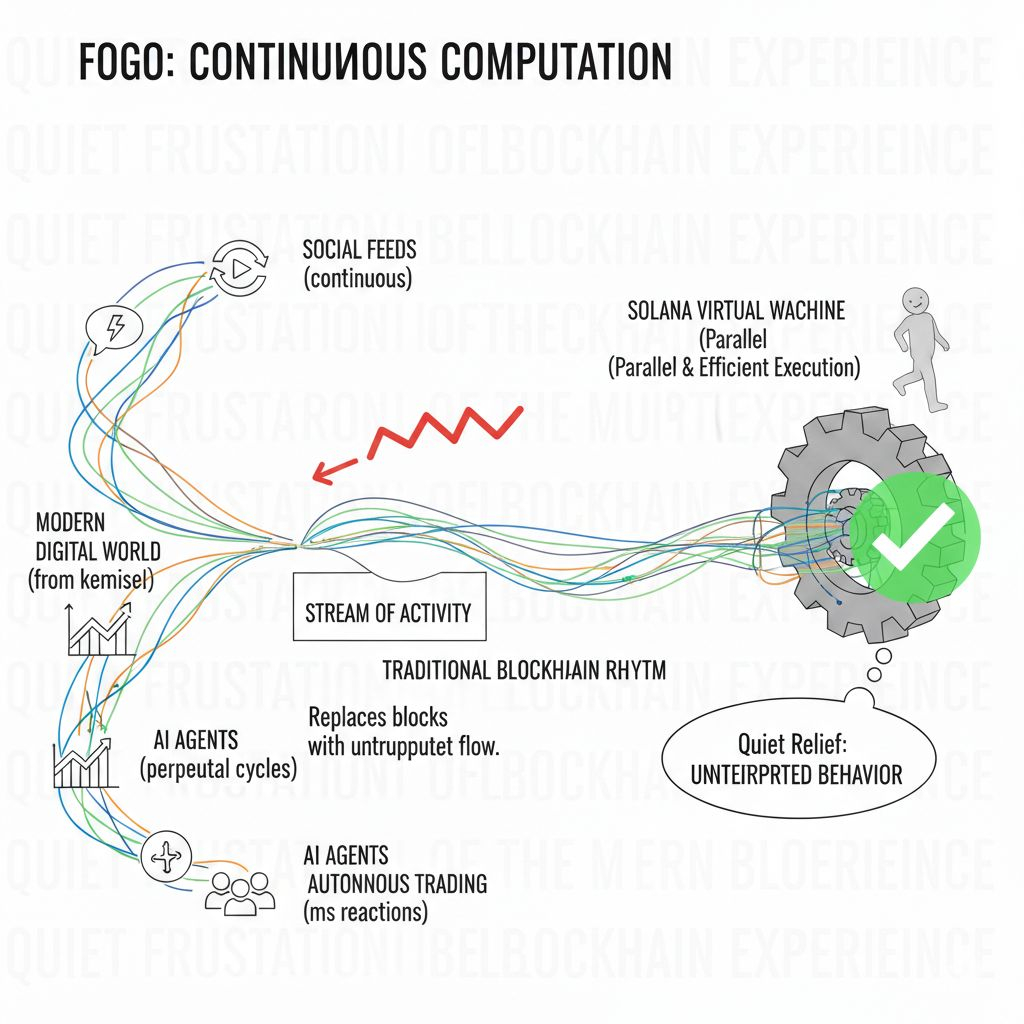
Fogo emerges from that emotional landscape with a different premise. Instead of asking how to increase the number of transactions per block, it asks whether the dominance of blocks themselves should remain unquestioned. Instead of treating activity as isolated events that compete for inclusion, it reimagines activity as a stream that flows continuously. Built upon the performance-oriented foundation of the Solana Virtual Machine, Fogo inherits an execution environment known for parallel processing and efficiency. Yet its ambition goes beyond speed within existing constraints; it seeks to soften those constraints by designing for uninterrupted behavior rather than periodic settlement.
In a stream-oriented environment, activity is not something that waits in line. It is something that moves. Traditional batch-based systems collect transactions, organize them into blocks, and release them at regular intervals, a structure that has proven powerful for consensus and verification. However, batching naturally introduces competition for limited space, which in turn creates fee volatility and unpredictable delays when demand surges. A streaming model, by contrast, focuses on sustaining ongoing workloads, smoothing demand across time, and aligning the infrastructure with continuous flows rather than episodic bursts. This shift is not merely technical; it reshapes how applications feel to build and to use.
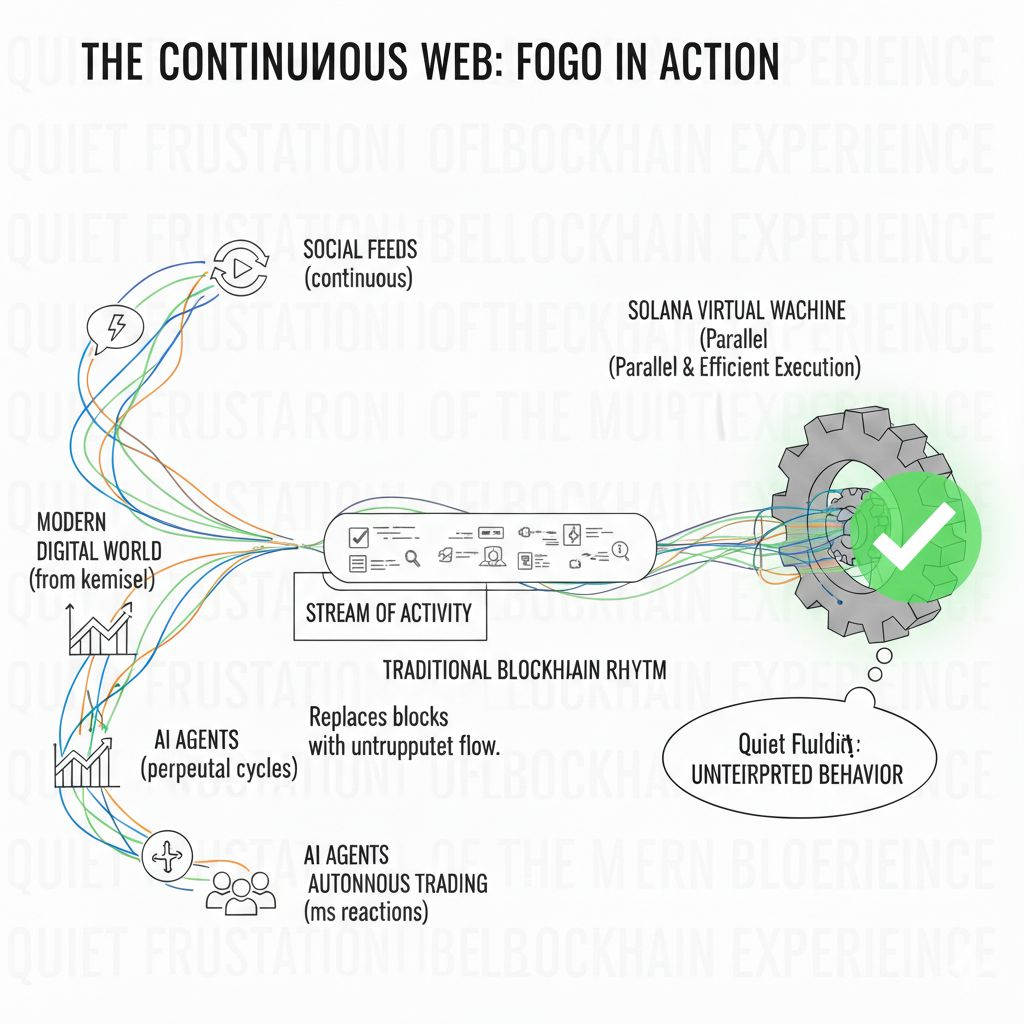
Imagine a decentralized social protocol that does not rely on hidden centralized components to feel responsive, but instead derives its immediacy from the chain itself. Envision AI agents negotiating, allocating capital, and adjusting strategies without needing to pause for discrete confirmation windows. Consider autonomous financial systems that respond fluidly to market dynamics rather than stepping forward in block-sized increments. In such a world, the anxiety that accompanies pending transactions begins to dissolve, because the network is not perceived as a gatekeeper that must periodically acknowledge your actions, but as an environment that continuously sustains them.
The emotional difference between these paradigms is profound. When infrastructure forces you to wait, even briefly, it introduces doubt. When it spikes fees unpredictably, it introduces hesitation. When it requires architectural compromises, it introduces creative restraint. Designing for continuity reduces these tensions by aligning the network’s structure with the natural flow of modern digital life. Instead of bending applications to fit block intervals, the network adapts to the rhythm of the applications themselves. That alignment creates a subtle sense of ease, a feeling that intention and execution are more closely connected.
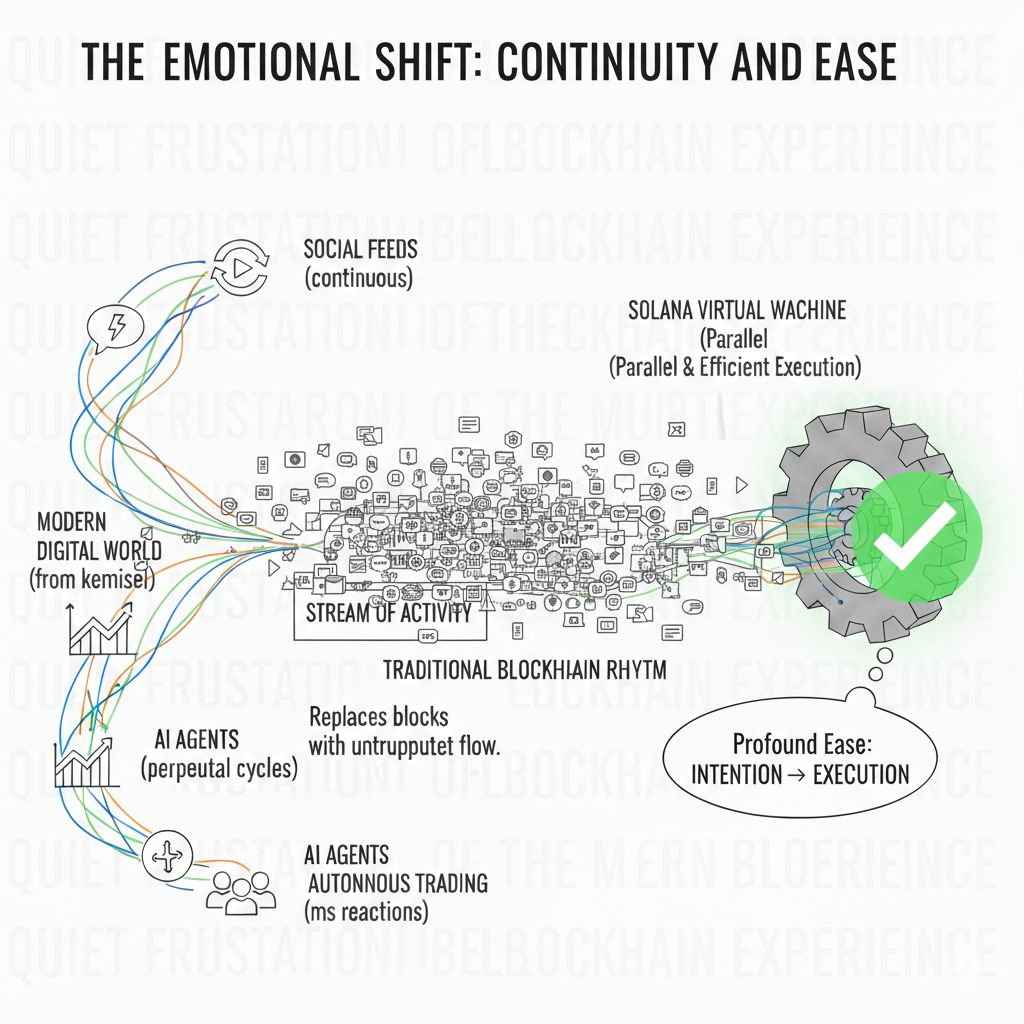
The evolution of blockchain technology has always mirrored expanding ambition. First came secure digital scarcity, then programmable logic, followed by performance scaling and modular architectures. Each stage addressed a different limitation, expanding what decentralized systems could support. The next frontier may not be defined by a single metric like transactions per second, but by the quality of continuity. As AI agents grow more autonomous, as global markets operate around the clock, and as users expect real-time responsiveness from every digital interaction, infrastructure designed around periodic pauses begins to feel increasingly out of step.
Fogo’s vision resonates because it acknowledges this shift not just intellectually, but emotionally. It recognizes that the future of decentralized systems will be shaped by entities that never sleep and processes that never truly stop. It suggests that blockchains should feel less like ledgers you submit requests to and more like environments you inhabit. When the chain no longer feels like a waiting room, when applications no longer apologize for their own latency, and when builders no longer compromise their designs to accommodate pauses, something subtle but powerful changes. The technology fades into the background, and what remains is flow — continuous, responsive, alive.
