
Where does Vanry actually fit in today’s crypto space? And more importantly, when people use products built on the network, how does that activity really flow back to the token?
These are the kinds of questions that matter if you’re thinking long term.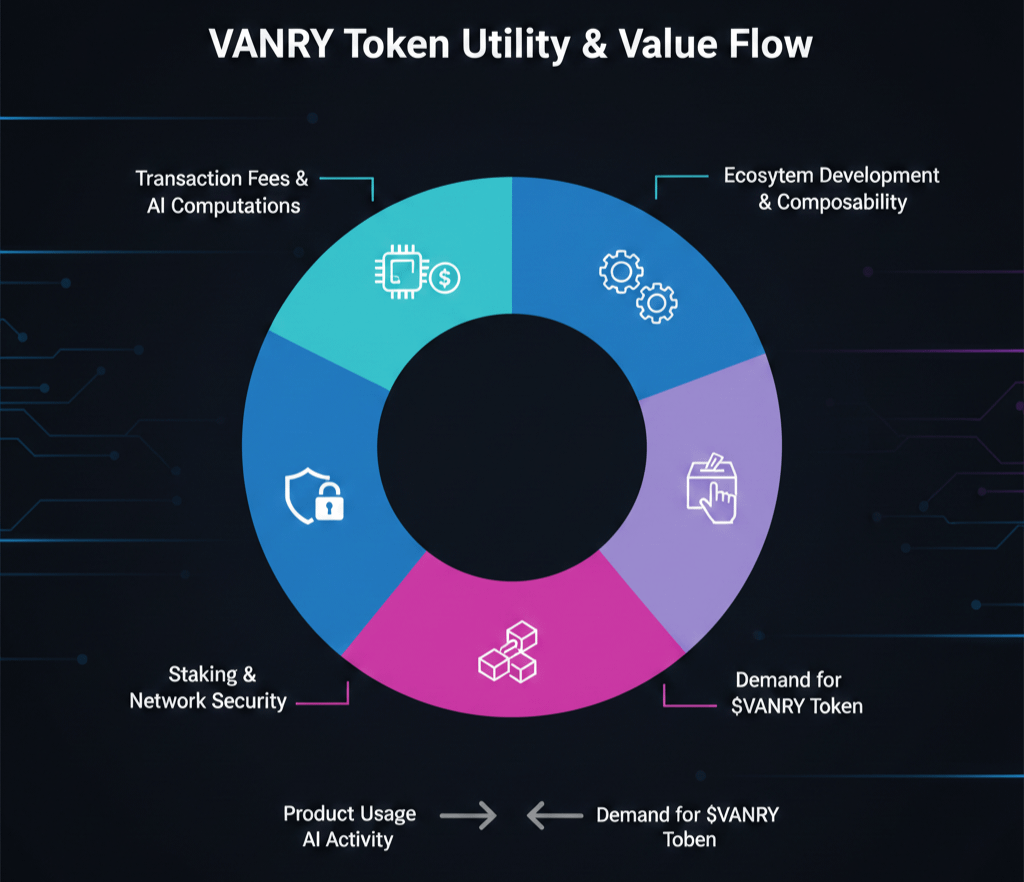
Vanry Coin isn’t trying to be just another generic Layer-1 shouting about high TPS. What makes it interesting is its focus on AI-driven infrastructure. While many chains compete for the same DeFi or NFT narratives, Vanry is positioning itself around intelligent on-chain processes systems where AI agents, automated logic and complex data interactions require scalable, secure settlement.
To me, that focus feels intentional. The next phase of blockchain adoption won’t just be about sending tokens from one wallet to another. It will be about AI agents making decisions, verifying outcomes, executing strategies and interacting autonomously on-chain. And all of that needs a base layer.
That’s where $VANRY fits.
At its core, Vanry powers the network. Every transaction, every smart contract execution and every AI-related computation that touches the chain consumes resources. Those resources are paid for in VANRY. So when developers build, when users interact, when AI systems execute, they all create demand for the token.
It’s simple but powerful: more usage means more need for the token.
But it doesn’t stop at transaction fees.
Validators stake VANRY to secure the network. That staking mechanism locks tokens and aligns incentives. As network activity grows, fee generation can increase, which potentially strengthens validator rewards. That makes staking more attractive, which improves network security, which attracts more builders. It becomes a cycle.
Personally, I think this loop is crucial. Many projects talk about “value accrual,” but the real question is: is there a clear connection between usage and token demand? In Vanry’s case, the connection feels more structural than speculative.
Now let’s talk about the AI angle.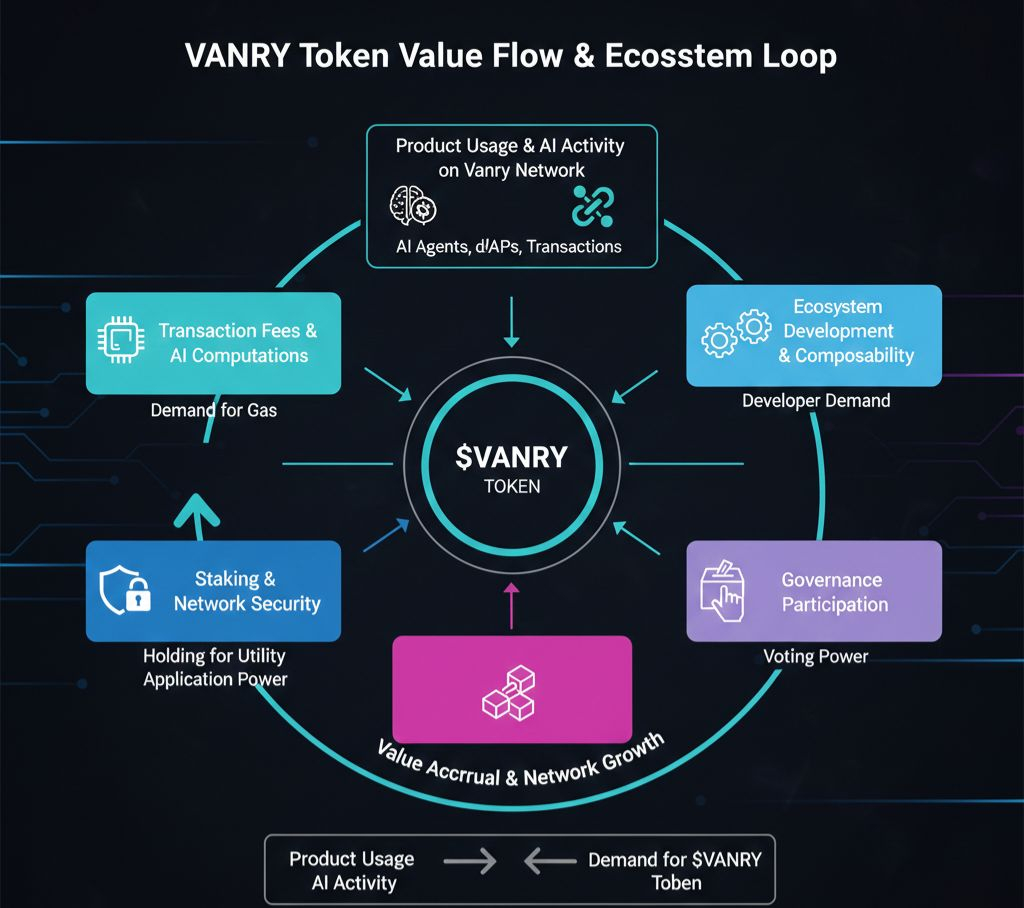
If Vanry becomes a serious hub for AI-powered applications whether that’s automated trading agents, decentralized reasoning systems or algorithmic governance tools those systems will constantly interact with the blockchain. They will submit transactions, verify outputs and settle results. Every one of those interactions flows back into VANRY usage.
That means product adoption doesn’t sit on the surface. It feeds directly into the base layer economy.
From my point of view, this is why I believe Vanry Coin has the potential to outperform many similar Layer-1 tokens. It’s not just chasing general-purpose scalability. It’s building around AI applications and I genuinely think AI will define the next major wave of blockchain utility. A network optimized for that environment could have a serious edge.
Another thing I appreciate is composability. If AI modules, contracts, and data layers can plug into each other smoothly within the ecosystem, it lowers friction for developers. When developers can build faster and reuse existing tools, experimentation increases. And every new experiment successful or not adds transaction volume and token utility.
Liquidity and holding behavior also matter. If participants are staking $VANRY, using it for governance, or holding it to power their applications, supply dynamics change. The token becomes something people need, not just something they trade. In my opinion, that shift from speculation to necessity is what separates short-lived hype from long-term ecosystems.
Governance is another subtle but important piece. If $VANRY is required to vote on upgrades, parameter changes or ecosystem direction, then token holders aren’t passive. They become part of the coordination layer. For a network centered around emerging technologies like AI, adaptability is key. Governance backed by token participation can make that adaptability possible.
Of course, no token moves in isolation. Market cycles, sentiment, and macro conditions all play their roles. But when I zoom out, I ask myself one thing: does this network solve a problem that will matter in five to ten years?
With Vanry, I think the answer could be yes.
If AI continues integrating into finance, infrastructure, and digital coordination, blockchains capable of supporting intelligent on-chain processes will be in demand. If Vanry captures even a portion of that space, VANRY won’t just be a utility token, it will be the fuel behind a growing ecosystem of autonomous systems.
So where does $VANRY fit.
It fits as the economic engine behind AI-focused blockchain activity. Usage across products flows back through gas fees, staking demand, governance participation, and overall network security. The more real activity happens, the stronger the foundation for the token becomes.
And personally, I’m watching that intersection of AI and blockchain very closely. Because if Vanry executes well, it won’t just participate in the next wave, it could help define it.
