

WuBlockchain
12.2k Publications

WuBlockchain
 Compte Square Vérifié+
Signaler
Bloquer l’utilisateur
Important Crypto News mainly Asia
Lead by Colin Wu 吴说
0 Suivis
14.0K+ Abonnés
41.2K+ J’aime
Publications
Tous
Vidéos
·
--
Bitget CEO Gracy Chen Formally Asks THORChain to Reject Transactions from Exploiter AddressesOn-chain tracking platform MistTrack, an arm of SlowMist, pointed out that following an earlier exploit of Bybit where nearly $1.2 billion in stolen funds was routed through THORChain for cross-chain transfers, proceeds from the recent Bitget security incident are once again flowing into THORChain for asset swaps and cross-chain bridging. MistTrack stated that the hacker addresses had already been publicly flagged and actively tracked across the industry. With the protocol continuing to facilitate large-scale cross-chain swaps despite knowing the assets originated from a publicly known major exploit, MistTrack argued that decentralization should not serve as an excuse for handling known stolen funds, and that the industry needs to seriously discuss what responsibility THORChain should bear in such scenarios.
In response, Bitget CEO Gracy Chen stated that the associated attacker addresses have been made public and remain under active surveillance, formally asking THORChain to reject transactions originating from these addresses. She noted that decentralization is a design principle rather than a shield for facilitating the movement of known stolen funds.
Bitget CEO Gracy Chen Formally Asks THORChain to Reject Transactions from Exploiter Addresses
On-chain tracking platform MistTrack, an arm of SlowMist, pointed out that following an earlier exploit of Bybit where nearly $1.2 billion in stolen funds was routed through THORChain for cross-chain transfers, proceeds from the recent Bitget security incident are once again flowing into THORChain for asset swaps and cross-chain bridging. MistTrack stated that the hacker addresses had already been publicly flagged and actively tracked across the industry. With the protocol continuing to facilitate large-scale cross-chain swaps despite knowing the assets originated from a publicly known major exploit, MistTrack argued that decentralization should not serve as an excuse for handling known stolen funds, and that the industry needs to seriously discuss what responsibility THORChain should bear in such scenarios.
In response, Bitget CEO Gracy Chen stated that the associated attacker addresses have been made public and remain under active surveillance, formally asking THORChain to reject transactions originating from these addresses. She noted that decentralization is a design principle rather than a shield for facilitating the movement of known stolen funds.
In response, Bitget CEO Gracy Chen stated that the associated attacker addresses have been made public and remain under active surveillance, formally asking THORChain to reject transactions originating from these addresses. She noted that decentralization is a design principle rather than a shield for facilitating the movement of known stolen funds.
131
·
--
Article
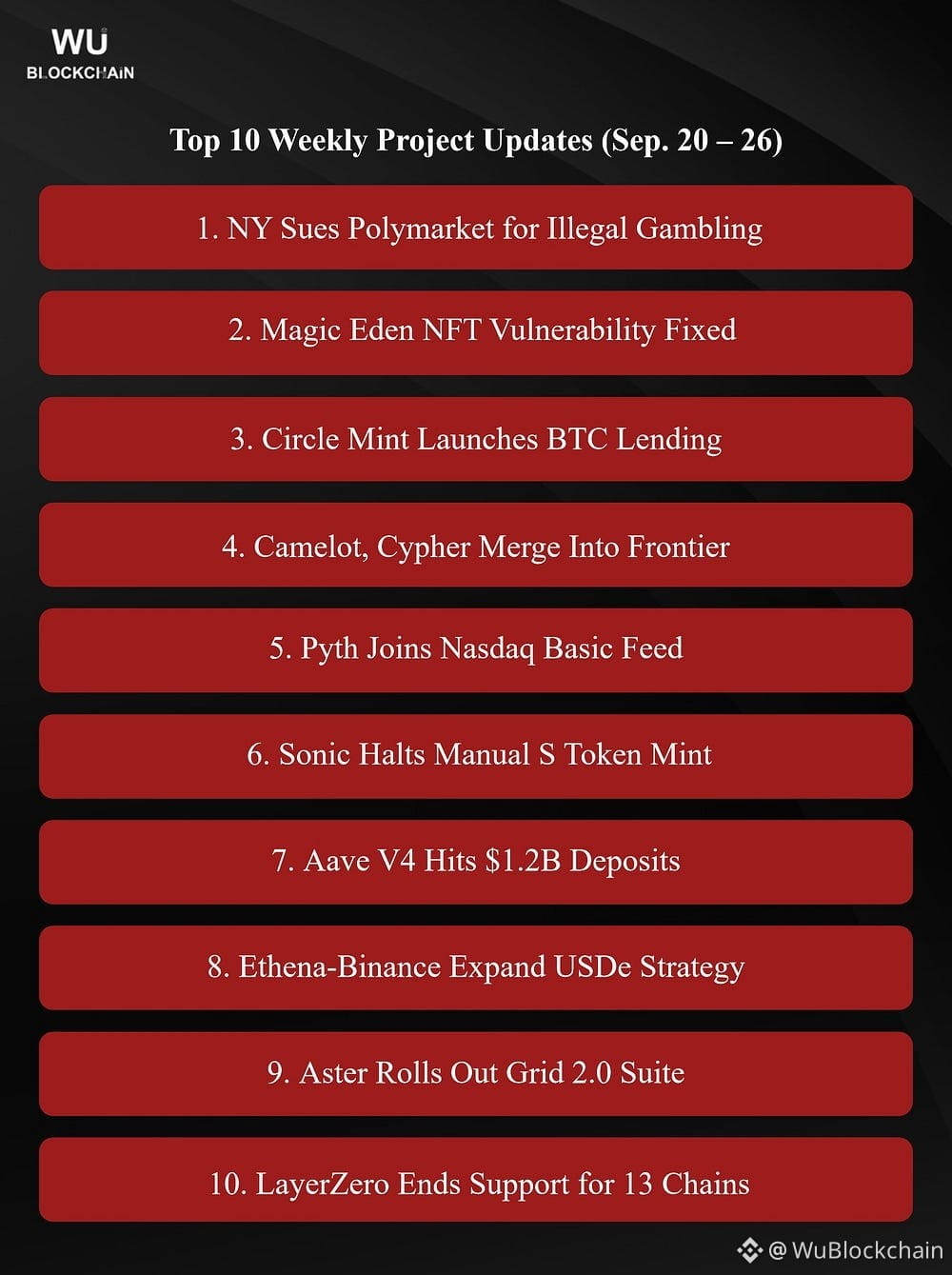
Weekly Project Updates: Magic Eden NFT Theft, Ethena Expands Basis Strategy to Stock Perpetuals, ...1. New York State Sues Polymarket Over Illegal Gambling Operations link
Authorities in New York State formally filed a lawsuit against crypto prediction market platform Polymarket on local Thursday, accusing it of operating an illegal gambling operation within New York State. Previously, New York Attorney General Letitia James and relevant agencies have taken a series of legal actions against multiple entities involved in prediction market services including Kalshi, Coinbase and Gemini. They allege these platforms offer event wagering without obtaining a license from the State Gaming Commission.
2. Magic Eden: Old EVM Orders Vulnerable to Limit Break Exploit; White Hats Secure 23,000 NFTs link
A security vulnerability has been suspected on NFT marketplace Magic Eden, and white hat actors have transferred 3,832 NFTs from hundreds of wallets. Michael Figge, CEO of Yuga Labs, stated that the vulnerability was discovered hours ago. Quit (0xQuit), Vice President of Blockchain at Yuga Labs, is currently handling affected assets within the scope of white hat rescue, and more information will be released later. Quit stated that the asset transfer is a white hat protection operation. The relevant NFTs are currently stored in a single address starting with 0x71cF and remain safe, and all will be returned to their original owners after risks are eliminated. Up to now, Magic Eden has not disclosed the root cause of the vulnerability or the exact scope of impact.
Quit (0xQuit), Vice President of Blockchain at Yuga Labs, said the suspected NFT security incident involving Magic Eden stemmed from a flaw in Limit Break Payment Processor V2. The team then launched a white hat rescue, protecting a total of 23,155 NFTs worth more than 5.7 million US dollars, and all relevant NFTs have now been safely transferred. Quit also noted that the same vulnerability could be exploited to steal WETH, and approximately 660 WETH could not be recovered in time. Payment Processor V3 on ApeChain carries similar risks. Quit has published the contract addresses of Payment Processor V2 (Ethereum) and V3 (ApeChain) whose approvals need to be revoked, and advised users to revoke relevant permissions via tools such as revoke.cash.
Magic Eden stated that it stopped using Payment Processor V2 in October 2024 and shut down its EVM Marketplace in Q1 2026, so active listings were unaffected by this incident. According to the official preliminary assessment, NFTs listed via Magic Eden’s EVM marketplace between February and October 2024 may be impacted, while listings created after October 2024 are expected to remain unaffected. Magic Eden is continuing its investigation and communicating with Limit Break on further mitigation measures.
3. Circle Mint Launches Digital Asset Lending, BTC Collateral for USDC Borrowing link
Circle announced that its institutional services platform Circle Mint has launched the Digital Asset Backed Borrowing (DABB) feature, enabling eligible institutional clients to borrow USDC by collateralizing BTC on Arc and Ethereum networks. Users may deposit BTC to mint cirBTC backed 1:1 by native BTC, and use it as collateral via third-party lending markets. Borrowed USDC will be credited directly to the Circle Mint account. The service has integrated decentralized lending protocol Morpho in the first phase, with plans to support other protocols such as Aave in the future. Lending rates, collateral requirements and liquidation thresholds are determined by third-party markets.
4. Camelot and Cypher Merge into Frontier, Uniswap v4-based Liquidity Infrastructure link
DeFi protocols Camelot and Cypher announced their merger into a new brand named Frontier. Going forward, a unified liquidity and asset issuance infrastructure will be built based on Uniswap v4, while the original protocols, brands and token ecosystems will cease operation after migration completion. Frontier will reserve 15% of the total FRONT supply for the communities of the two projects. Holders of GRAIL, xGRAIL, CYPH and xCYPH may participate in the migration within 30 days. The FRONT received will be subject to a 3-month lock-up followed by 12-month linear vesting after TGE. The project also offers a USDC redemption option calculated at the 7-day volume-weighted average price prior to the announcement. Eligible xGRAIL holders captured in the snapshot who opt for migration will receive an additional 25% FRONT allocation.
5. Pyth Network Becomes External Distributor for Nasdaq Basic Market Data link
Oracle network Pyth Network announced that it has become an external distributor for Nasdaq Basic market data feed. It will deliver real-time US equity quotes and trade data via the Pyth Data Marketplace. Nasdaq Basic covers securities listed on US exchanges, not limited to Nasdaq-listed stocks, providing best bid and ask prices, order sizes, last traded prices, trading volumes, as well as official Nasdaq opening and closing prices. Pyth stated that the service targets brokerages, banks, fintech platforms and blockchain-native applications.
6. Sonic Labs Cancels Manual S Token Minting, Retains Automatic Validator Rewards Issuance link
Matt Visser, CEO of Sonic Labs, announced in the project’s 100-day progress report that all manual issuance of S tokens will be eliminated, with only the automatic issuance mechanism for validator rewards retained to maintain network security. The team is onboarding new independent validators and researching dynamic reward mechanisms. A third party has been commissioned to audit the S token supply and related disclosures, with the report expected to be released in the coming weeks. Visser stated that buybacks, burns and fee sharing must be based on actual revenue, and such arrangements will not be pursued without revenue support. In addition, Sonic V2.2 launched on September 22, introducing transaction bundling, expanded transaction fee sponsorship and a new execution engine. The project will also carry out organizational restructuring. While sustaining the operation of the Sonic L1 network, an independent technical business unit will focus on payments and foreign exchange, AI, RWA and tokenization, and prediction markets.
7. Aave Founder: V4 Secures $1.2B Deposits and Multi-chain Deployment link
Stani Kulechov, founder of Aave, tweeted that the hub-and-spoke markets of Aave V4 are isolated by default based on risk profiles. Risk-adjusted markets can share liquidity through the hub within set caps to reduce capital fragmentation and boost utilization and capital efficiency. The V4 codebase has been significantly reduced compared with V3. It currently holds $1.2 billion in deposits and is deployed on Ethereum, Avalanche and Arc. V4 also enables third-party market administrators such as EtherFi to build and manage full market structures and participate in broader lending market yields.
Stani Kulechov, founder of Aave, announced that Coinbase tokenized stocks have gone live on Aave V4 on the Base network. Users can borrow USDC by collateralizing tokenized stocks. Aave stated that these tokenized stocks are only available to eligible users in jurisdictions outside the United States.
8. Ethena Partners with Binance to Expand USDe Basis Strategy to Stock Perpetuals link
Ethena announced a partnership with Binance to extend the USDe basis trading strategy to stock perpetual contracts for the first time. Under the cooperation arrangement, Ethena will use bStocks as tokenized spot stock collateral and hedge via USDT-denominated stock perpetual contracts on Binance, continuing its delta-neutral strategy. The annualized average basis of Binance stock perp contracts stood at approximately 11% over the past six months, and the relevant allocation kicks off today.
9. Aster Rolls out Grid 2.0 and Grid Marketplace link
Aster launches Grid 2.0 and Grid Marketplace. Grid 2.0 supports parallel operation of grid strategies and manual trading on the same perpetual contract, with independent management of grid orders and positions. Under isolated margin mode, up to 50 separate grid strategies can run simultaneously for one trading pair. Grid Marketplace allows users to browse live grid strategies on Aster and filter by market, compare PnL, ROI, runtime and trading activity. Users may copy existing parameters or reverse-copy long-short directions and adjust settings before creation. After a grid strategy is activated, the initial margin will be transferred from the perpetual account to the grid account, reducing the balance available for other perpetual positions. Remaining funds will be automatically transferred back once the strategy is fully closed.
10. LayerZero to Discontinue Off-chain Services for 13 Chains Including Taiko and Zora link
LayerZero issued a reminder that it is gradually phasing out off-chain support for certain low-activity blockchains, covering a total of 13 chains including Aurora, Taiko, Japan Open Chain, LightLink, Viction, Animechain, XPLA, Merlin, Gnosis, Zora, Otherworld Space, XAI and opBNB. These networks will no longer have access to LayerZero’s DVN and Executor services. This move will also cause Stargate Hydra to discontinue support for some of these chains. LayerZero reminds users to redeem Hydra assets such as USDC.e, wETH and Hydra USDT on the affected chains. The official announcement shall prevail for the specific affected networks and effective dates.
Follow us
Twitter: https://twitter.com/WuBlockchain
Telegram: https://t.me/wublockchainenglish
Weekly Project Updates: Magic Eden NFT Theft, Ethena Expands Basis Strategy to Stock Perpetuals, ...
1. New York State Sues Polymarket Over Illegal Gambling Operations link
Authorities in New York State formally filed a lawsuit against crypto prediction market platform Polymarket on local Thursday, accusing it of operating an illegal gambling operation within New York State. Previously, New York Attorney General Letitia James and relevant agencies have taken a series of legal actions against multiple entities involved in prediction market services including Kalshi, Coinbase and Gemini. They allege these platforms offer event wagering without obtaining a license from the State Gaming Commission.
2. Magic Eden: Old EVM Orders Vulnerable to Limit Break Exploit; White Hats Secure 23,000 NFTs link
A security vulnerability has been suspected on NFT marketplace Magic Eden, and white hat actors have transferred 3,832 NFTs from hundreds of wallets. Michael Figge, CEO of Yuga Labs, stated that the vulnerability was discovered hours ago. Quit (0xQuit), Vice President of Blockchain at Yuga Labs, is currently handling affected assets within the scope of white hat rescue, and more information will be released later. Quit stated that the asset transfer is a white hat protection operation. The relevant NFTs are currently stored in a single address starting with 0x71cF and remain safe, and all will be returned to their original owners after risks are eliminated. Up to now, Magic Eden has not disclosed the root cause of the vulnerability or the exact scope of impact.
Quit (0xQuit), Vice President of Blockchain at Yuga Labs, said the suspected NFT security incident involving Magic Eden stemmed from a flaw in Limit Break Payment Processor V2. The team then launched a white hat rescue, protecting a total of 23,155 NFTs worth more than 5.7 million US dollars, and all relevant NFTs have now been safely transferred. Quit also noted that the same vulnerability could be exploited to steal WETH, and approximately 660 WETH could not be recovered in time. Payment Processor V3 on ApeChain carries similar risks. Quit has published the contract addresses of Payment Processor V2 (Ethereum) and V3 (ApeChain) whose approvals need to be revoked, and advised users to revoke relevant permissions via tools such as revoke.cash.
Magic Eden stated that it stopped using Payment Processor V2 in October 2024 and shut down its EVM Marketplace in Q1 2026, so active listings were unaffected by this incident. According to the official preliminary assessment, NFTs listed via Magic Eden’s EVM marketplace between February and October 2024 may be impacted, while listings created after October 2024 are expected to remain unaffected. Magic Eden is continuing its investigation and communicating with Limit Break on further mitigation measures.
3. Circle Mint Launches Digital Asset Lending, BTC Collateral for USDC Borrowing link
Circle announced that its institutional services platform Circle Mint has launched the Digital Asset Backed Borrowing (DABB) feature, enabling eligible institutional clients to borrow USDC by collateralizing BTC on Arc and Ethereum networks. Users may deposit BTC to mint cirBTC backed 1:1 by native BTC, and use it as collateral via third-party lending markets. Borrowed USDC will be credited directly to the Circle Mint account. The service has integrated decentralized lending protocol Morpho in the first phase, with plans to support other protocols such as Aave in the future. Lending rates, collateral requirements and liquidation thresholds are determined by third-party markets.
4. Camelot and Cypher Merge into Frontier, Uniswap v4-based Liquidity Infrastructure link
DeFi protocols Camelot and Cypher announced their merger into a new brand named Frontier. Going forward, a unified liquidity and asset issuance infrastructure will be built based on Uniswap v4, while the original protocols, brands and token ecosystems will cease operation after migration completion. Frontier will reserve 15% of the total FRONT supply for the communities of the two projects. Holders of GRAIL, xGRAIL, CYPH and xCYPH may participate in the migration within 30 days. The FRONT received will be subject to a 3-month lock-up followed by 12-month linear vesting after TGE. The project also offers a USDC redemption option calculated at the 7-day volume-weighted average price prior to the announcement. Eligible xGRAIL holders captured in the snapshot who opt for migration will receive an additional 25% FRONT allocation.
5. Pyth Network Becomes External Distributor for Nasdaq Basic Market Data link
Oracle network Pyth Network announced that it has become an external distributor for Nasdaq Basic market data feed. It will deliver real-time US equity quotes and trade data via the Pyth Data Marketplace. Nasdaq Basic covers securities listed on US exchanges, not limited to Nasdaq-listed stocks, providing best bid and ask prices, order sizes, last traded prices, trading volumes, as well as official Nasdaq opening and closing prices. Pyth stated that the service targets brokerages, banks, fintech platforms and blockchain-native applications.
6. Sonic Labs Cancels Manual S Token Minting, Retains Automatic Validator Rewards Issuance link
Matt Visser, CEO of Sonic Labs, announced in the project’s 100-day progress report that all manual issuance of S tokens will be eliminated, with only the automatic issuance mechanism for validator rewards retained to maintain network security. The team is onboarding new independent validators and researching dynamic reward mechanisms. A third party has been commissioned to audit the S token supply and related disclosures, with the report expected to be released in the coming weeks. Visser stated that buybacks, burns and fee sharing must be based on actual revenue, and such arrangements will not be pursued without revenue support. In addition, Sonic V2.2 launched on September 22, introducing transaction bundling, expanded transaction fee sponsorship and a new execution engine. The project will also carry out organizational restructuring. While sustaining the operation of the Sonic L1 network, an independent technical business unit will focus on payments and foreign exchange, AI, RWA and tokenization, and prediction markets.
7. Aave Founder: V4 Secures $1.2B Deposits and Multi-chain Deployment link
Stani Kulechov, founder of Aave, tweeted that the hub-and-spoke markets of Aave V4 are isolated by default based on risk profiles. Risk-adjusted markets can share liquidity through the hub within set caps to reduce capital fragmentation and boost utilization and capital efficiency. The V4 codebase has been significantly reduced compared with V3. It currently holds $1.2 billion in deposits and is deployed on Ethereum, Avalanche and Arc. V4 also enables third-party market administrators such as EtherFi to build and manage full market structures and participate in broader lending market yields.
Stani Kulechov, founder of Aave, announced that Coinbase tokenized stocks have gone live on Aave V4 on the Base network. Users can borrow USDC by collateralizing tokenized stocks. Aave stated that these tokenized stocks are only available to eligible users in jurisdictions outside the United States.
8. Ethena Partners with Binance to Expand USDe Basis Strategy to Stock Perpetuals link
Ethena announced a partnership with Binance to extend the USDe basis trading strategy to stock perpetual contracts for the first time. Under the cooperation arrangement, Ethena will use bStocks as tokenized spot stock collateral and hedge via USDT-denominated stock perpetual contracts on Binance, continuing its delta-neutral strategy. The annualized average basis of Binance stock perp contracts stood at approximately 11% over the past six months, and the relevant allocation kicks off today.
9. Aster Rolls out Grid 2.0 and Grid Marketplace link
Aster launches Grid 2.0 and Grid Marketplace. Grid 2.0 supports parallel operation of grid strategies and manual trading on the same perpetual contract, with independent management of grid orders and positions. Under isolated margin mode, up to 50 separate grid strategies can run simultaneously for one trading pair. Grid Marketplace allows users to browse live grid strategies on Aster and filter by market, compare PnL, ROI, runtime and trading activity. Users may copy existing parameters or reverse-copy long-short directions and adjust settings before creation. After a grid strategy is activated, the initial margin will be transferred from the perpetual account to the grid account, reducing the balance available for other perpetual positions. Remaining funds will be automatically transferred back once the strategy is fully closed.
10. LayerZero to Discontinue Off-chain Services for 13 Chains Including Taiko and Zora link
LayerZero issued a reminder that it is gradually phasing out off-chain support for certain low-activity blockchains, covering a total of 13 chains including Aurora, Taiko, Japan Open Chain, LightLink, Viction, Animechain, XPLA, Merlin, Gnosis, Zora, Otherworld Space, XAI and opBNB. These networks will no longer have access to LayerZero’s DVN and Executor services. This move will also cause Stargate Hydra to discontinue support for some of these chains. LayerZero reminds users to redeem Hydra assets such as USDC.e, wETH and Hydra USDT on the affected chains. The official announcement shall prevail for the specific affected networks and effective dates.
Follow us
Twitter: https://twitter.com/WuBlockchain
Telegram: https://t.me/wublockchainenglish
Authorities in New York State formally filed a lawsuit against crypto prediction market platform Polymarket on local Thursday, accusing it of operating an illegal gambling operation within New York State. Previously, New York Attorney General Letitia James and relevant agencies have taken a series of legal actions against multiple entities involved in prediction market services including Kalshi, Coinbase and Gemini. They allege these platforms offer event wagering without obtaining a license from the State Gaming Commission.
2. Magic Eden: Old EVM Orders Vulnerable to Limit Break Exploit; White Hats Secure 23,000 NFTs link
A security vulnerability has been suspected on NFT marketplace Magic Eden, and white hat actors have transferred 3,832 NFTs from hundreds of wallets. Michael Figge, CEO of Yuga Labs, stated that the vulnerability was discovered hours ago. Quit (0xQuit), Vice President of Blockchain at Yuga Labs, is currently handling affected assets within the scope of white hat rescue, and more information will be released later. Quit stated that the asset transfer is a white hat protection operation. The relevant NFTs are currently stored in a single address starting with 0x71cF and remain safe, and all will be returned to their original owners after risks are eliminated. Up to now, Magic Eden has not disclosed the root cause of the vulnerability or the exact scope of impact.
Quit (0xQuit), Vice President of Blockchain at Yuga Labs, said the suspected NFT security incident involving Magic Eden stemmed from a flaw in Limit Break Payment Processor V2. The team then launched a white hat rescue, protecting a total of 23,155 NFTs worth more than 5.7 million US dollars, and all relevant NFTs have now been safely transferred. Quit also noted that the same vulnerability could be exploited to steal WETH, and approximately 660 WETH could not be recovered in time. Payment Processor V3 on ApeChain carries similar risks. Quit has published the contract addresses of Payment Processor V2 (Ethereum) and V3 (ApeChain) whose approvals need to be revoked, and advised users to revoke relevant permissions via tools such as revoke.cash.
Magic Eden stated that it stopped using Payment Processor V2 in October 2024 and shut down its EVM Marketplace in Q1 2026, so active listings were unaffected by this incident. According to the official preliminary assessment, NFTs listed via Magic Eden’s EVM marketplace between February and October 2024 may be impacted, while listings created after October 2024 are expected to remain unaffected. Magic Eden is continuing its investigation and communicating with Limit Break on further mitigation measures.
3. Circle Mint Launches Digital Asset Lending, BTC Collateral for USDC Borrowing link
Circle announced that its institutional services platform Circle Mint has launched the Digital Asset Backed Borrowing (DABB) feature, enabling eligible institutional clients to borrow USDC by collateralizing BTC on Arc and Ethereum networks. Users may deposit BTC to mint cirBTC backed 1:1 by native BTC, and use it as collateral via third-party lending markets. Borrowed USDC will be credited directly to the Circle Mint account. The service has integrated decentralized lending protocol Morpho in the first phase, with plans to support other protocols such as Aave in the future. Lending rates, collateral requirements and liquidation thresholds are determined by third-party markets.
4. Camelot and Cypher Merge into Frontier, Uniswap v4-based Liquidity Infrastructure link
DeFi protocols Camelot and Cypher announced their merger into a new brand named Frontier. Going forward, a unified liquidity and asset issuance infrastructure will be built based on Uniswap v4, while the original protocols, brands and token ecosystems will cease operation after migration completion. Frontier will reserve 15% of the total FRONT supply for the communities of the two projects. Holders of GRAIL, xGRAIL, CYPH and xCYPH may participate in the migration within 30 days. The FRONT received will be subject to a 3-month lock-up followed by 12-month linear vesting after TGE. The project also offers a USDC redemption option calculated at the 7-day volume-weighted average price prior to the announcement. Eligible xGRAIL holders captured in the snapshot who opt for migration will receive an additional 25% FRONT allocation.
5. Pyth Network Becomes External Distributor for Nasdaq Basic Market Data link
Oracle network Pyth Network announced that it has become an external distributor for Nasdaq Basic market data feed. It will deliver real-time US equity quotes and trade data via the Pyth Data Marketplace. Nasdaq Basic covers securities listed on US exchanges, not limited to Nasdaq-listed stocks, providing best bid and ask prices, order sizes, last traded prices, trading volumes, as well as official Nasdaq opening and closing prices. Pyth stated that the service targets brokerages, banks, fintech platforms and blockchain-native applications.
6. Sonic Labs Cancels Manual S Token Minting, Retains Automatic Validator Rewards Issuance link
Matt Visser, CEO of Sonic Labs, announced in the project’s 100-day progress report that all manual issuance of S tokens will be eliminated, with only the automatic issuance mechanism for validator rewards retained to maintain network security. The team is onboarding new independent validators and researching dynamic reward mechanisms. A third party has been commissioned to audit the S token supply and related disclosures, with the report expected to be released in the coming weeks. Visser stated that buybacks, burns and fee sharing must be based on actual revenue, and such arrangements will not be pursued without revenue support. In addition, Sonic V2.2 launched on September 22, introducing transaction bundling, expanded transaction fee sponsorship and a new execution engine. The project will also carry out organizational restructuring. While sustaining the operation of the Sonic L1 network, an independent technical business unit will focus on payments and foreign exchange, AI, RWA and tokenization, and prediction markets.
7. Aave Founder: V4 Secures $1.2B Deposits and Multi-chain Deployment link
Stani Kulechov, founder of Aave, tweeted that the hub-and-spoke markets of Aave V4 are isolated by default based on risk profiles. Risk-adjusted markets can share liquidity through the hub within set caps to reduce capital fragmentation and boost utilization and capital efficiency. The V4 codebase has been significantly reduced compared with V3. It currently holds $1.2 billion in deposits and is deployed on Ethereum, Avalanche and Arc. V4 also enables third-party market administrators such as EtherFi to build and manage full market structures and participate in broader lending market yields.
Stani Kulechov, founder of Aave, announced that Coinbase tokenized stocks have gone live on Aave V4 on the Base network. Users can borrow USDC by collateralizing tokenized stocks. Aave stated that these tokenized stocks are only available to eligible users in jurisdictions outside the United States.
8. Ethena Partners with Binance to Expand USDe Basis Strategy to Stock Perpetuals link
Ethena announced a partnership with Binance to extend the USDe basis trading strategy to stock perpetual contracts for the first time. Under the cooperation arrangement, Ethena will use bStocks as tokenized spot stock collateral and hedge via USDT-denominated stock perpetual contracts on Binance, continuing its delta-neutral strategy. The annualized average basis of Binance stock perp contracts stood at approximately 11% over the past six months, and the relevant allocation kicks off today.
9. Aster Rolls out Grid 2.0 and Grid Marketplace link
Aster launches Grid 2.0 and Grid Marketplace. Grid 2.0 supports parallel operation of grid strategies and manual trading on the same perpetual contract, with independent management of grid orders and positions. Under isolated margin mode, up to 50 separate grid strategies can run simultaneously for one trading pair. Grid Marketplace allows users to browse live grid strategies on Aster and filter by market, compare PnL, ROI, runtime and trading activity. Users may copy existing parameters or reverse-copy long-short directions and adjust settings before creation. After a grid strategy is activated, the initial margin will be transferred from the perpetual account to the grid account, reducing the balance available for other perpetual positions. Remaining funds will be automatically transferred back once the strategy is fully closed.
10. LayerZero to Discontinue Off-chain Services for 13 Chains Including Taiko and Zora link
LayerZero issued a reminder that it is gradually phasing out off-chain support for certain low-activity blockchains, covering a total of 13 chains including Aurora, Taiko, Japan Open Chain, LightLink, Viction, Animechain, XPLA, Merlin, Gnosis, Zora, Otherworld Space, XAI and opBNB. These networks will no longer have access to LayerZero’s DVN and Executor services. This move will also cause Stargate Hydra to discontinue support for some of these chains. LayerZero reminds users to redeem Hydra assets such as USDC.e, wETH and Hydra USDT on the affected chains. The official announcement shall prevail for the specific affected networks and effective dates.
Follow us
Twitter: https://twitter.com/WuBlockchain
Telegram: https://t.me/wublockchainenglish
103
·
--
Bitcoin ETFs See $134M in Net Inflows, Ethereum ETFs Add $86.95M on Sept. 25 (ET)According to SoSoValue, Bitcoin spot ETFs recorded $134 million in net inflows on September 25 (ET), marking seven consecutive days of inflows. BlackRock's IBIT led with $96.99 million, followed by Fidelity's FBTC with $49.32 million.
Ethereum spot ETFs saw $86.95 million in net inflows, extending their streak to six days. BlackRock's ETHA and ETHB attracted $50.37 million and $31.88 million, respectively.
Bitcoin ETFs See $134M in Net Inflows, Ethereum ETFs Add $86.95M on Sept. 25 (ET)
According to SoSoValue, Bitcoin spot ETFs recorded $134 million in net inflows on September 25 (ET), marking seven consecutive days of inflows. BlackRock's IBIT led with $96.99 million, followed by Fidelity's FBTC with $49.32 million.
Ethereum spot ETFs saw $86.95 million in net inflows, extending their streak to six days. BlackRock's ETHA and ETHB attracted $50.37 million and $31.88 million, respectively.
Ethereum spot ETFs saw $86.95 million in net inflows, extending their streak to six days. BlackRock's ETHA and ETHB attracted $50.37 million and $31.88 million, respectively.
51
·
--
Bitget: Withdrawals Set to Resume in Phases Starting September 28, Vulnerability FixedBitget said the vulnerability involved in its September 24 security incident has been identified and fixed, with withdrawals set to resume in phases after security checks are completed. The schedule is as follows, all at 08:00 UTC: BTC on September 28, ETH on September 29, USDT on September 30, and other tokens, fiat and P2P services on October 2.
Bitget said user account balances remain unaffected and its Protection Fund will cover the financial impact of the incident. Trading and deposits remain operational, while Mandiant and SlowMist continue to assist with the investigation.
Bitget: Withdrawals Set to Resume in Phases Starting September 28, Vulnerability Fixed
Bitget said the vulnerability involved in its September 24 security incident has been identified and fixed, with withdrawals set to resume in phases after security checks are completed. The schedule is as follows, all at 08:00 UTC: BTC on September 28, ETH on September 29, USDT on September 30, and other tokens, fiat and P2P services on October 2.
Bitget said user account balances remain unaffected and its Protection Fund will cover the financial impact of the incident. Trading and deposits remain operational, while Mandiant and SlowMist continue to assist with the investigation.
Bitget said user account balances remain unaffected and its Protection Fund will cover the financial impact of the incident. Trading and deposits remain operational, while Mandiant and SlowMist continue to assist with the investigation.
50
·
--
SEC's Best-Known Crypto Advocate Hester Peirce to Step DownAccording to crypto journalist Eleanor Terrett, SEC Commissioner Hester Peirce will leave the agency on October 2 after nearly nine years of service. She will join Regent University School of Law as an associate professor in November. Known as "Crypto Mom," Peirce has been a longtime advocate for the crypto industry.
SEC's Best-Known Crypto Advocate Hester Peirce to Step Down
According to crypto journalist Eleanor Terrett, SEC Commissioner Hester Peirce will leave the agency on October 2 after nearly nine years of service. She will join Regent University School of Law as an associate professor in November. Known as "Crypto Mom," Peirce has been a longtime advocate for the crypto industry.
66
·
--
Circle and Tether Freeze $318,000 Linked to Bitget HackAccording to CoinDesk, Circle and Tether blacklisted an address labeled "Bitget Exploiter 8," freezing 218,023 USDT and 99,990 USDC, worth approximately $318,000 combined. Circle took action at 05:00 UTC on September 25, and MistTrack later confirmed that Tether had also blacklisted the address. The frozen funds represent only a small fraction of the stolen assets. MistTrack data shows that other attacker-linked addresses still hold more than 63,000 ETH, which stablecoin issuers cannot freeze.
Circle and Tether Freeze $318,000 Linked to Bitget Hack
According to CoinDesk, Circle and Tether blacklisted an address labeled "Bitget Exploiter 8," freezing 218,023 USDT and 99,990 USDC, worth approximately $318,000 combined. Circle took action at 05:00 UTC on September 25, and MistTrack later confirmed that Tether had also blacklisted the address. The frozen funds represent only a small fraction of the stolen assets. MistTrack data shows that other attacker-linked addresses still hold more than 63,000 ETH, which stablecoin issuers cannot freeze.
398
·
--
SEC Staff: Token Buybacks and Continued Development of Functional Crypto Networks May Not Trigger...The SEC’s Division of Corporation Finance issued new FAQs clarifying its March 17 crypto guidance. Staff said Staking Receipt Tokens may qualify as “digital tools” or “digital commodities,” depending on their structure.
For already functional crypto systems, continued maintenance, improvements, network development and non-security token buybacks generally do not constitute “essential managerial efforts” under the Howey test. However, buybacks promoted as generating returns before a system becomes functional may constitute such efforts. The FAQs represent staff views and have no legal force or effect.
SEC Staff: Token Buybacks and Continued Development of Functional Crypto Networks May Not Trigger...
The SEC’s Division of Corporation Finance issued new FAQs clarifying its March 17 crypto guidance. Staff said Staking Receipt Tokens may qualify as “digital tools” or “digital commodities,” depending on their structure.
For already functional crypto systems, continued maintenance, improvements, network development and non-security token buybacks generally do not constitute “essential managerial efforts” under the Howey test. However, buybacks promoted as generating returns before a system becomes functional may constitute such efforts. The FAQs represent staff views and have no legal force or effect.
For already functional crypto systems, continued maintenance, improvements, network development and non-security token buybacks generally do not constitute “essential managerial efforts” under the Howey test. However, buybacks promoted as generating returns before a system becomes functional may constitute such efforts. The FAQs represent staff views and have no legal force or effect.
118
·
--
Highlight Clip: Bitget CEO: A Fake Interview Cost Me $80,000Bitget CEO: A Fake Interview Cost Me $80,000
On September 24, Bitget CEO Gracy Chen shared her experience of being targeted by the Lazarus Group. The attackers first compromised the official Twitter account of a major crypto media outlet, then impersonated a journalist to contact her and communicated with her assistant and PR team via Telegram, gradually building credibility. She said the attackers ultimately carried out the attack through a Zoom “interview,” highlighting how social engineering and identity impersonation continue to pose threats to the crypto industry.
Highlight Clip: Bitget CEO: A Fake Interview Cost Me $80,000
Bitget CEO: A Fake Interview Cost Me $80,000
On September 24, Bitget CEO Gracy Chen shared her experience of being targeted by the Lazarus Group. The attackers first compromised the official Twitter account of a major crypto media outlet, then impersonated a journalist to contact her and communicated with her assistant and PR team via Telegram, gradually building credibility. She said the attackers ultimately carried out the attack through a Zoom “interview,” highlighting how social engineering and identity impersonation continue to pose threats to the crypto industry.
On September 24, Bitget CEO Gracy Chen shared her experience of being targeted by the Lazarus Group. The attackers first compromised the official Twitter account of a major crypto media outlet, then impersonated a journalist to contact her and communicated with her assistant and PR team via Telegram, gradually building credibility. She said the attackers ultimately carried out the attack through a Zoom “interview,” highlighting how social engineering and identity impersonation continue to pose threats to the crypto industry.
103
·
--
Bybit Publishes Restricted Counterparty List Covering Multiple Crypto Platforms and Entities Incl...Bybit has published a Restricted Counterparty List that includes Garantex, Bitzlato, EXMO, Payeer, Nobitex, Bitpapa, Chatex, Cryptex, Grinex, Rapira, WhiteBird, OMPFinex, Ramzinex, HTX, Wallex, Tetherland, Bit24, QvaPay, Huione Guarantee, Xinbi Guarantee, Samourai Wallet, Bitcoin Fog, ChipMixer, Sinbad and Hydra Market, covering crypto trading platforms, payment and wallet services, guarantee marketplaces, mixers and darknet markets. The list also includes entities and organizations such as Lazarus Group, Hamas, Ansarallah (Houthis) and ISIS-K. Where a connection to a prohibited entity is identified, Bybit reserves the right to take appropriate action to comply with the restriction or the laws of the relevant jurisdiction, including suspending or terminating accounts, blocking related transactions or funds, filing relevant regulatory reports, and liquidating open positions.
Bybit Publishes Restricted Counterparty List Covering Multiple Crypto Platforms and Entities Incl...
Bybit has published a Restricted Counterparty List that includes Garantex, Bitzlato, EXMO, Payeer, Nobitex, Bitpapa, Chatex, Cryptex, Grinex, Rapira, WhiteBird, OMPFinex, Ramzinex, HTX, Wallex, Tetherland, Bit24, QvaPay, Huione Guarantee, Xinbi Guarantee, Samourai Wallet, Bitcoin Fog, ChipMixer, Sinbad and Hydra Market, covering crypto trading platforms, payment and wallet services, guarantee marketplaces, mixers and darknet markets. The list also includes entities and organizations such as Lazarus Group, Hamas, Ansarallah (Houthis) and ISIS-K. Where a connection to a prohibited entity is identified, Bybit reserves the right to take appropriate action to comply with the restriction or the laws of the relevant jurisdiction, including suspending or terminating accounts, blocking related transactions or funds, filing relevant regulatory reports, and liquidating open positions.
32
·
--
CZ: Binance, BNB Chain Ecosystem and Community Will Do Everything Possible to Help BitgetCZ said it was a “tough day for Bitget” and that he expects and knows Binance, the BNB Chain ecosystem, and the community will do everything possible to help, adding, “Stay SAFU!” On the same day, Bybit CEO Ben Zhou, Binance co-CEO Richard Teng, MEXC CEO Vugar Usi, and CoinDCX co-founder Sumit Gupta also publicly offered assistance.
CZ: Binance, BNB Chain Ecosystem and Community Will Do Everything Possible to Help Bitget
CZ said it was a “tough day for Bitget” and that he expects and knows Binance, the BNB Chain ecosystem, and the community will do everything possible to help, adding, “Stay SAFU!” On the same day, Bybit CEO Ben Zhou, Binance co-CEO Richard Teng, MEXC CEO Vugar Usi, and CoinDCX co-founder Sumit Gupta also publicly offered assistance.
35
·
--
Bitget Raises Confirmed Incident Amount to $387.5M, Withdrawal Resumption Plan Due by Sept. 26Bitget CEO Gracy Chen said in a post that the security incident has been contained and that no further unauthorized asset transfers are possible. Bitget will announce its withdrawal resumption plan by 4:00 AM UTC on September 26. Chen said Bitget has confirmed that approximately $387.5 million in assets were transferred to attacker-controlled addresses, up from the initial estimate of $351.6 million. The higher figure reflects additional Zcash and TRON assets identified during tracing and does not represent new theft. Bitget has also launched a recovery bounty program offering 5% of successfully frozen or recovered funds to eligible participants who directly contribute to those efforts.
Bitget Raises Confirmed Incident Amount to $387.5M, Withdrawal Resumption Plan Due by Sept. 26
Bitget CEO Gracy Chen said in a post that the security incident has been contained and that no further unauthorized asset transfers are possible. Bitget will announce its withdrawal resumption plan by 4:00 AM UTC on September 26. Chen said Bitget has confirmed that approximately $387.5 million in assets were transferred to attacker-controlled addresses, up from the initial estimate of $351.6 million. The higher figure reflects additional Zcash and TRON assets identified during tracing and does not represent new theft. Bitget has also launched a recovery bounty program offering 5% of successfully frozen or recovered funds to eligible participants who directly contribute to those efforts.
1
40
·
--
Binance-Owned CoinMarketCap Acquires Crypto Derivatives Data Platform CoinGlassCoinMarketCap has completed its acquisition of crypto derivatives data platform CoinGlass for an undisclosed amount. CoinMarketCap said it will integrate CoinGlass data including open interest, funding rates, liquidations and options into its broader market-data offering. CoinGlass covers 28 exchanges and more than 2,500 instruments, has over 5 million monthly users and more than 10,000 API clients, while CoinMarketCap says it serves about 115 million monthly users. CoinGlass will continue operating independently under its existing brand, with its website, app, free tools, APIs and pricing unchanged for now.
CoinMarketCap itself was acquired by Binance in 2020. The purchase price was not officially disclosed, though The Block reported at the time that the deal could be worth as much as $400 million. Subsequent reporting said the transaction was structured primarily in equity and BNB.
Binance-Owned CoinMarketCap Acquires Crypto Derivatives Data Platform CoinGlass
CoinMarketCap has completed its acquisition of crypto derivatives data platform CoinGlass for an undisclosed amount. CoinMarketCap said it will integrate CoinGlass data including open interest, funding rates, liquidations and options into its broader market-data offering. CoinGlass covers 28 exchanges and more than 2,500 instruments, has over 5 million monthly users and more than 10,000 API clients, while CoinMarketCap says it serves about 115 million monthly users. CoinGlass will continue operating independently under its existing brand, with its website, app, free tools, APIs and pricing unchanged for now.
CoinMarketCap itself was acquired by Binance in 2020. The purchase price was not officially disclosed, though The Block reported at the time that the deal could be worth as much as $400 million. Subsequent reporting said the transaction was structured primarily in equity and BNB.
CoinMarketCap itself was acquired by Binance in 2020. The purchase price was not officially disclosed, though The Block reported at the time that the deal could be worth as much as $400 million. Subsequent reporting said the transaction was structured primarily in equity and BNB.
27
·
--
Wallets Linked to Bitkub Co-Founder Sold 139.6K ZEC, Missing Over $110M in Potential GainsAccording to MLM onchain, a cluster of wallets suspected to be linked to Bitkub co-founder and former chairman Sakolkorn Sakavee has been unshielding and selling ZEC over the past four weeks. MLM said the wallets sold around 139,600 ZEC for roughly $111 million; at current prices, the same amount would be worth about $223 million, implying more than $110 million in unrealized upside was missed. On Aug. 27, MLM had reported that the wallets had unshielded 65,820 ZEC, sold 53,900 ZEC, and bought 536.7 BTC.
Wallets Linked to Bitkub Co-Founder Sold 139.6K ZEC, Missing Over $110M in Potential Gains
According to MLM onchain, a cluster of wallets suspected to be linked to Bitkub co-founder and former chairman Sakolkorn Sakavee has been unshielding and selling ZEC over the past four weeks. MLM said the wallets sold around 139,600 ZEC for roughly $111 million; at current prices, the same amount would be worth about $223 million, implying more than $110 million in unrealized upside was missed. On Aug. 27, MLM had reported that the wallets had unshielded 65,820 ZEC, sold 53,900 ZEC, and bought 536.7 BTC.
387
·
--
WuBlockchain WeeklyBitget suffers a $351.6 million security breach, the ECB launches blockchain-based settlement in central bank money, Binance expands into stock trading and deepens its USDC partnership with Circle, while Coinbase opens IPO access to U.S. retail users. This week also saw further momentum in tokenized assets, tokenized deposits, stablecoin infrastructure, and regulated onchain capital markets. For the complete weekly curated reports, subscribe to our Substack:
WuBlockchain Weekly
Bitget suffers a $351.6 million security breach, the ECB launches blockchain-based settlement in central bank money, Binance expands into stock trading and deepens its USDC partnership with Circle, while Coinbase opens IPO access to U.S. retail users. This week also saw further momentum in tokenized assets, tokenized deposits, stablecoin infrastructure, and regulated onchain capital markets. For the complete weekly curated reports, subscribe to our Substack:
146
·
--
WuBlockchain Weekly: Suspected North Korean Hackers Steal $350M from Bitget, ECB Launches Blockch...1. Bitget Confirms $351.6M Security Breach; Loss Contained, Withdrawals Suspended link
Bitget CEO Gracy Chen stated that at 02:31 (UTC+8) on September 25, Bitget’s security system detected unauthorized transfers from some hot wallets, with an estimated affected fund amount of $351.6 million. Bitget said cold wallets remain secure, the incident only involves part of the hot and warm wallet layers, and user funds are covered by the user protection fund which currently exceeds $464 million. The platform has identified and flagged abnormal transfer addresses, notified law enforcement and on-chain security agencies, and temporarily suspended withdrawals; deposits and trading remain operational.
Bitget CEO Gracy Chen said the security team has preliminarily confirmed that hackers breached key backend systems of the wallet service, forged transfer information and invoked authorized signature workflows to transfer out funds, ruling out private key leaks. Multiple technical teams are simultaneously advancing system repair, security hardening and preparations for withdrawal resumption, with the recovery timeline yet to be determined.
According to Specter monitoring, the stolen XRP from Bitget, after cross-chain bridging, can be directly linked to the $24 million stolen in the AFX hack in July this year. The AFX attack was previously attributed to TraderTraitor, leading Specter to believe Lazarus Group is behind this attack.
In a live stream, Bitget CEO said the attacker identity cannot be fully confirmed at present, but some IPs closely match VPN characteristics used by a North Korea-linked group. The attackers are highly professional and may have monitored Bitget for a long time. The compromised assets mainly came from hot wallets; one wallet that appeared to be a cold wallet was actually a warm wallet, and cold wallets were unaffected. She noted Bitget’s protection fund of over $465 million can cover the losses, and the platform holds more than $1 billion in its own capital. The withdrawal suspension may last from several hours to one or two days. She stated Bitget is “absolutely not another FTX” and can handle mass withdrawals after withdrawals resume. Bitget’s retail business scale is close to Bybit’s; if Bybit could withstand a $1.5 billion loss, Bitget can absorb losses exceeding $300 million.
Bitget is cooperating with independent third-party specialists Mandiant and SlowMist to conduct a full investigation into the incident. Chen reaffirmed that Bitget’s top priority is protecting users, user balances remain intact, and the Bitget User Protection Fund will cover impacts caused by this platform-level incident. Bitget Wallet uses self-custody infrastructure independent of Bitget Exchange and is unaffected. Deposit, trading, reward and other functions on Bitget Exchange are operating normally; withdrawals are temporarily suspended pending additional security reviews and will resume as soon as safety is confirmed.
Binance Co-CEO Richard Teng posted that following Bitget’s recent security incident, Binance’s security team has been working closely with the Bitget team since the incident was discovered, including sharing intelligence, tracking stolen funds and supporting asset recovery. Teng said the crypto industry unites to fight attackers in such incidents, and relevant work is ongoing.
2. Trump Discloses Coinbase & Strategy Buys, Sells CleanSpark and MARA link
Periodic transaction reports disclosed by the U.S. Office of Government Ethics (OGE) show that Trump reported purchasing Class A shares of Coinbase valued between $1,001 and $15,000 on July 24. He also bought Class A shares of Strategy valued between $1,001 and $15,000 on July 24 and between $50,000 and $100,000 on July 27. Previously, he sold Class A shares of Strategy worth $1,001 to $15,000 on July 8. In addition, the report indicates that on July 29, he sold stocks of Bitcoin mining firms CleanSpark and MARA, each valued at $15,000 to $50,000. The White House has repeatedly responded that Trump’s stock and bond portfolio is independently managed by a third-party financial institution, and neither Trump nor his family can direct, influence, or provide input on specific investments or transaction timing.
3. SEC Commissioner Hester Peirce Criticizes KYC/AML, Advocates Zero-Knowledge Proofs link
SEC Commissioner Hester Peirce stated in a recent speech regarding the “Innovation Exemption” rolled out by the SEC last week. She believes the exemption offers an interim pathway for trading tokenized securities via AMMs, designed to prevent overseas markets from monopolizing tokenized exposure to US stocks and serve as a bridge toward permanent long-term rules. Furthermore, she sharply criticized the existing KYC/AML anti-money laundering regulatory model. She pointed out that the costly approach of expanding the “data haystack” to find the criminal “needle” yields little effect, and instead turns the financial system into a privacy-invasive “panopticon”. She called on regulators to embrace cryptographic tools such as zero-knowledge proofs (ZKPs) and attribute credentials to verify compliance attributes without collecting or repeatedly storing users’ sensitive raw data, while maximizing the protection of citizens’ personal privacy.
4. ECB Launches Pontes for Tokenized Asset Settlement in Central Bank Money link
The European Central Bank (ECB) launched its blockchain settlement service Pontes on September 21, connecting existing payment systems with blockchain financial markets. It enables banks and investors to settle blockchain transactions in euro central bank money instead of relying on private instruments such as stablecoins. First participants including Deutsche Bank, Santander and securities settlement provider Clearstream have completed onboarding. The service will initially run from 08:00 to 16:00 Central European Time on business days. In addition, the ECB plans to allocate a small portion of its own funds to invest in high-rated, euro-denominated tokenised debt securities issued by public institutions.
5. ESMA Prioritizes AI and Tokenization for EU Regulation Starting 2027 link
The European Securities and Markets Authority (ESMA) released a report announcing that artificial intelligence (AI), tokenization and other emerging financial technologies will be designated core regulatory priorities across the EU starting from 2027. Under the regulatory programme titled “Innovation with investor safeguards”, ESMA will collaborate with national regulators of EU member states to focus on examining how licensed financial institutions deploy AI and tokenised financial products in customer-facing core business processes rather than only back-office and middle-office operations, and assess their data governance compliance and framework risks. In addition, EU regulators will conduct a comprehensive mapping next year of relevant applications by financial institutions in customer-facing products and launch the first round of targeted inspections for the most affected business entities.
6. Major UK Banks Complete World’s First Cross-Bank Tokenized Deposit Transfers link
Major UK banks including Lloyds, NatWest, Barclays and HSBC have completed the world’s first cross-border fund transfers using tokenised deposits. The test scenarios covered two mortgage transactions and one P2P payment simulating online shopping. Programmable deposits can automatically release funds once conditions such as goods delivery or property transaction completion are met. The Bank of England has previously stated that it prefers banks to develop tokenised deposits carrying the same legal status as traditional bank deposits over privately issued stablecoins.
7. Binance Renames Funding Account; Crypto Assets Migrated to Spot Wallet link
Binance will gradually migrate crypto assets held in users’ Funding Accounts to Spot Accounts starting September 29, and the migration is expected to last until January 2027. Upon completion of the migration period, the Funding Account will be officially renamed the Stocks Account, which will be dedicated solely to trade settlement for stocks and stock options. Under the arrangement, Funding Accounts will no longer support on-chain deposits starting September 29. Going forward, six settlement assets (USD, USDC, USDT, USD1, U, BNB) will be available for stock trading, while deposits and withdrawals of other crypto assets will be consolidated and processed via Spot Accounts. The platform will provide a “One-Click Migration” function for users to manually migrate assets in advance. Assets left unmigrated will be automatically transferred to Spot Accounts in batches by the system starting January 2027, with total asset value and security unaffected.
8. Binance Invests $100M in Circle, Signs 5-Year USDC Partnership link
Circle (CRCL) disclosed in its 8-K filing submitted on September 22 that its subsidiary entered into a new five-year cooperation agreement with Binance on September 17 to expand USDC promotion, replacing the prior agreements signed between the two parties in November 2024 and August 2025. Circle will pay Binance monthly incentive fees proportionally based on the volume of USDC held via its modular smart contract wallet infrastructure service. On the same day, Binance subscribed to 1,237,011 shares of Circle’s Class A common stock at a discounted price of $80.84 per share, for a total amount of $100 million, and the transaction has been completed. The shares are subject to a two-year transfer restriction in principle, subject to early termination and other exceptions.
9. Coinbase Opens IPO Share Access to US Retail Users, Starting with Oura IPO link
Coinbase announced the launch of IPO share subscription for US retail investors, with the Oura IPO scheduled for this week as the first supported offering. Eligible users may apply to obtain shares at the offering price via the Coinbase App prior to public trading, and final allocations may be fulfilled in full, partially or not at all. Coinbase stated that users who sell IPO shares within 30 days after listing may face a 60-day suspension from participating in future IPO subscriptions. The service is provided by Coinbase Capital Markets, a FINRA-registered broker-dealer, with clearing and custody handled by Apex Clearing.
10. First SEC Innovation Exemption Tokenized Stock Platform Due Next Quarter link
Taylor Lindman, Chief Counsel of the SEC Crypto Task Force, stated that under the newly launched Innovation Exemption, the first batch of tokenized stock trading platforms may release operational plans as early as next quarter, and the SEC has received expressions of interest from multiple companies. Valid for five years, the exemption permits qualified platforms to trade tokenized US-listed stocks via permissioned AMMs and liquidity pools on public, permissionless blockchains; such tokens must preserve traditional shareholder rights including dividends and voting. SEC Commissioner Hester Peirce remarked that the existing trading volume cap is sufficient to support commercial operations rather than merely small-scale trials, and regards the exemption as a transitional arrangement prior to establishing long-term rules.
Fundraising
HIFI has closed a $37 million Series A round led by Left Lane Capital. link
DeFi project infiniFi has secured over $3 million in seed funding and plans to conduct its TGE in Q4. link
Stablecoin payment network Atum has completed a $13.5 million financing round led by Variant. link
Stablecoin payment platform Infini has raised $6 million in seed funding. link
XStable has closed a new financing round with participation from YZi Labs, Sui Foundation and other investors. link
Learn more, check out crypto-fundraising.info.
Follow us
Twitter: https://twitter.com/WuBlockchain
Telegram: https://t.me/wublockchainenglish
WuBlockchain Weekly: Suspected North Korean Hackers Steal $350M from Bitget, ECB Launches Blockch...
1. Bitget Confirms $351.6M Security Breach; Loss Contained, Withdrawals Suspended link
Bitget CEO Gracy Chen stated that at 02:31 (UTC+8) on September 25, Bitget’s security system detected unauthorized transfers from some hot wallets, with an estimated affected fund amount of $351.6 million. Bitget said cold wallets remain secure, the incident only involves part of the hot and warm wallet layers, and user funds are covered by the user protection fund which currently exceeds $464 million. The platform has identified and flagged abnormal transfer addresses, notified law enforcement and on-chain security agencies, and temporarily suspended withdrawals; deposits and trading remain operational.
Bitget CEO Gracy Chen said the security team has preliminarily confirmed that hackers breached key backend systems of the wallet service, forged transfer information and invoked authorized signature workflows to transfer out funds, ruling out private key leaks. Multiple technical teams are simultaneously advancing system repair, security hardening and preparations for withdrawal resumption, with the recovery timeline yet to be determined.
According to Specter monitoring, the stolen XRP from Bitget, after cross-chain bridging, can be directly linked to the $24 million stolen in the AFX hack in July this year. The AFX attack was previously attributed to TraderTraitor, leading Specter to believe Lazarus Group is behind this attack.
In a live stream, Bitget CEO said the attacker identity cannot be fully confirmed at present, but some IPs closely match VPN characteristics used by a North Korea-linked group. The attackers are highly professional and may have monitored Bitget for a long time. The compromised assets mainly came from hot wallets; one wallet that appeared to be a cold wallet was actually a warm wallet, and cold wallets were unaffected. She noted Bitget’s protection fund of over $465 million can cover the losses, and the platform holds more than $1 billion in its own capital. The withdrawal suspension may last from several hours to one or two days. She stated Bitget is “absolutely not another FTX” and can handle mass withdrawals after withdrawals resume. Bitget’s retail business scale is close to Bybit’s; if Bybit could withstand a $1.5 billion loss, Bitget can absorb losses exceeding $300 million.
Bitget is cooperating with independent third-party specialists Mandiant and SlowMist to conduct a full investigation into the incident. Chen reaffirmed that Bitget’s top priority is protecting users, user balances remain intact, and the Bitget User Protection Fund will cover impacts caused by this platform-level incident. Bitget Wallet uses self-custody infrastructure independent of Bitget Exchange and is unaffected. Deposit, trading, reward and other functions on Bitget Exchange are operating normally; withdrawals are temporarily suspended pending additional security reviews and will resume as soon as safety is confirmed.
Binance Co-CEO Richard Teng posted that following Bitget’s recent security incident, Binance’s security team has been working closely with the Bitget team since the incident was discovered, including sharing intelligence, tracking stolen funds and supporting asset recovery. Teng said the crypto industry unites to fight attackers in such incidents, and relevant work is ongoing.
2. Trump Discloses Coinbase & Strategy Buys, Sells CleanSpark and MARA link
Periodic transaction reports disclosed by the U.S. Office of Government Ethics (OGE) show that Trump reported purchasing Class A shares of Coinbase valued between $1,001 and $15,000 on July 24. He also bought Class A shares of Strategy valued between $1,001 and $15,000 on July 24 and between $50,000 and $100,000 on July 27. Previously, he sold Class A shares of Strategy worth $1,001 to $15,000 on July 8. In addition, the report indicates that on July 29, he sold stocks of Bitcoin mining firms CleanSpark and MARA, each valued at $15,000 to $50,000. The White House has repeatedly responded that Trump’s stock and bond portfolio is independently managed by a third-party financial institution, and neither Trump nor his family can direct, influence, or provide input on specific investments or transaction timing.
3. SEC Commissioner Hester Peirce Criticizes KYC/AML, Advocates Zero-Knowledge Proofs link
SEC Commissioner Hester Peirce stated in a recent speech regarding the “Innovation Exemption” rolled out by the SEC last week. She believes the exemption offers an interim pathway for trading tokenized securities via AMMs, designed to prevent overseas markets from monopolizing tokenized exposure to US stocks and serve as a bridge toward permanent long-term rules. Furthermore, she sharply criticized the existing KYC/AML anti-money laundering regulatory model. She pointed out that the costly approach of expanding the “data haystack” to find the criminal “needle” yields little effect, and instead turns the financial system into a privacy-invasive “panopticon”. She called on regulators to embrace cryptographic tools such as zero-knowledge proofs (ZKPs) and attribute credentials to verify compliance attributes without collecting or repeatedly storing users’ sensitive raw data, while maximizing the protection of citizens’ personal privacy.
4. ECB Launches Pontes for Tokenized Asset Settlement in Central Bank Money link
The European Central Bank (ECB) launched its blockchain settlement service Pontes on September 21, connecting existing payment systems with blockchain financial markets. It enables banks and investors to settle blockchain transactions in euro central bank money instead of relying on private instruments such as stablecoins. First participants including Deutsche Bank, Santander and securities settlement provider Clearstream have completed onboarding. The service will initially run from 08:00 to 16:00 Central European Time on business days. In addition, the ECB plans to allocate a small portion of its own funds to invest in high-rated, euro-denominated tokenised debt securities issued by public institutions.
5. ESMA Prioritizes AI and Tokenization for EU Regulation Starting 2027 link
The European Securities and Markets Authority (ESMA) released a report announcing that artificial intelligence (AI), tokenization and other emerging financial technologies will be designated core regulatory priorities across the EU starting from 2027. Under the regulatory programme titled “Innovation with investor safeguards”, ESMA will collaborate with national regulators of EU member states to focus on examining how licensed financial institutions deploy AI and tokenised financial products in customer-facing core business processes rather than only back-office and middle-office operations, and assess their data governance compliance and framework risks. In addition, EU regulators will conduct a comprehensive mapping next year of relevant applications by financial institutions in customer-facing products and launch the first round of targeted inspections for the most affected business entities.
6. Major UK Banks Complete World’s First Cross-Bank Tokenized Deposit Transfers link
Major UK banks including Lloyds, NatWest, Barclays and HSBC have completed the world’s first cross-border fund transfers using tokenised deposits. The test scenarios covered two mortgage transactions and one P2P payment simulating online shopping. Programmable deposits can automatically release funds once conditions such as goods delivery or property transaction completion are met. The Bank of England has previously stated that it prefers banks to develop tokenised deposits carrying the same legal status as traditional bank deposits over privately issued stablecoins.
7. Binance Renames Funding Account; Crypto Assets Migrated to Spot Wallet link
Binance will gradually migrate crypto assets held in users’ Funding Accounts to Spot Accounts starting September 29, and the migration is expected to last until January 2027. Upon completion of the migration period, the Funding Account will be officially renamed the Stocks Account, which will be dedicated solely to trade settlement for stocks and stock options. Under the arrangement, Funding Accounts will no longer support on-chain deposits starting September 29. Going forward, six settlement assets (USD, USDC, USDT, USD1, U, BNB) will be available for stock trading, while deposits and withdrawals of other crypto assets will be consolidated and processed via Spot Accounts. The platform will provide a “One-Click Migration” function for users to manually migrate assets in advance. Assets left unmigrated will be automatically transferred to Spot Accounts in batches by the system starting January 2027, with total asset value and security unaffected.
8. Binance Invests $100M in Circle, Signs 5-Year USDC Partnership link
Circle (CRCL) disclosed in its 8-K filing submitted on September 22 that its subsidiary entered into a new five-year cooperation agreement with Binance on September 17 to expand USDC promotion, replacing the prior agreements signed between the two parties in November 2024 and August 2025. Circle will pay Binance monthly incentive fees proportionally based on the volume of USDC held via its modular smart contract wallet infrastructure service. On the same day, Binance subscribed to 1,237,011 shares of Circle’s Class A common stock at a discounted price of $80.84 per share, for a total amount of $100 million, and the transaction has been completed. The shares are subject to a two-year transfer restriction in principle, subject to early termination and other exceptions.
9. Coinbase Opens IPO Share Access to US Retail Users, Starting with Oura IPO link
Coinbase announced the launch of IPO share subscription for US retail investors, with the Oura IPO scheduled for this week as the first supported offering. Eligible users may apply to obtain shares at the offering price via the Coinbase App prior to public trading, and final allocations may be fulfilled in full, partially or not at all. Coinbase stated that users who sell IPO shares within 30 days after listing may face a 60-day suspension from participating in future IPO subscriptions. The service is provided by Coinbase Capital Markets, a FINRA-registered broker-dealer, with clearing and custody handled by Apex Clearing.
10. First SEC Innovation Exemption Tokenized Stock Platform Due Next Quarter link
Taylor Lindman, Chief Counsel of the SEC Crypto Task Force, stated that under the newly launched Innovation Exemption, the first batch of tokenized stock trading platforms may release operational plans as early as next quarter, and the SEC has received expressions of interest from multiple companies. Valid for five years, the exemption permits qualified platforms to trade tokenized US-listed stocks via permissioned AMMs and liquidity pools on public, permissionless blockchains; such tokens must preserve traditional shareholder rights including dividends and voting. SEC Commissioner Hester Peirce remarked that the existing trading volume cap is sufficient to support commercial operations rather than merely small-scale trials, and regards the exemption as a transitional arrangement prior to establishing long-term rules.
Fundraising
HIFI has closed a $37 million Series A round led by Left Lane Capital. link
DeFi project infiniFi has secured over $3 million in seed funding and plans to conduct its TGE in Q4. link
Stablecoin payment network Atum has completed a $13.5 million financing round led by Variant. link
Stablecoin payment platform Infini has raised $6 million in seed funding. link
XStable has closed a new financing round with participation from YZi Labs, Sui Foundation and other investors. link
Learn more, check out crypto-fundraising.info.
Follow us
Twitter: https://twitter.com/WuBlockchain
Telegram: https://t.me/wublockchainenglish
Bitget CEO Gracy Chen stated that at 02:31 (UTC+8) on September 25, Bitget’s security system detected unauthorized transfers from some hot wallets, with an estimated affected fund amount of $351.6 million. Bitget said cold wallets remain secure, the incident only involves part of the hot and warm wallet layers, and user funds are covered by the user protection fund which currently exceeds $464 million. The platform has identified and flagged abnormal transfer addresses, notified law enforcement and on-chain security agencies, and temporarily suspended withdrawals; deposits and trading remain operational.
Bitget CEO Gracy Chen said the security team has preliminarily confirmed that hackers breached key backend systems of the wallet service, forged transfer information and invoked authorized signature workflows to transfer out funds, ruling out private key leaks. Multiple technical teams are simultaneously advancing system repair, security hardening and preparations for withdrawal resumption, with the recovery timeline yet to be determined.
According to Specter monitoring, the stolen XRP from Bitget, after cross-chain bridging, can be directly linked to the $24 million stolen in the AFX hack in July this year. The AFX attack was previously attributed to TraderTraitor, leading Specter to believe Lazarus Group is behind this attack.
In a live stream, Bitget CEO said the attacker identity cannot be fully confirmed at present, but some IPs closely match VPN characteristics used by a North Korea-linked group. The attackers are highly professional and may have monitored Bitget for a long time. The compromised assets mainly came from hot wallets; one wallet that appeared to be a cold wallet was actually a warm wallet, and cold wallets were unaffected. She noted Bitget’s protection fund of over $465 million can cover the losses, and the platform holds more than $1 billion in its own capital. The withdrawal suspension may last from several hours to one or two days. She stated Bitget is “absolutely not another FTX” and can handle mass withdrawals after withdrawals resume. Bitget’s retail business scale is close to Bybit’s; if Bybit could withstand a $1.5 billion loss, Bitget can absorb losses exceeding $300 million.
Bitget is cooperating with independent third-party specialists Mandiant and SlowMist to conduct a full investigation into the incident. Chen reaffirmed that Bitget’s top priority is protecting users, user balances remain intact, and the Bitget User Protection Fund will cover impacts caused by this platform-level incident. Bitget Wallet uses self-custody infrastructure independent of Bitget Exchange and is unaffected. Deposit, trading, reward and other functions on Bitget Exchange are operating normally; withdrawals are temporarily suspended pending additional security reviews and will resume as soon as safety is confirmed.
Binance Co-CEO Richard Teng posted that following Bitget’s recent security incident, Binance’s security team has been working closely with the Bitget team since the incident was discovered, including sharing intelligence, tracking stolen funds and supporting asset recovery. Teng said the crypto industry unites to fight attackers in such incidents, and relevant work is ongoing.
2. Trump Discloses Coinbase & Strategy Buys, Sells CleanSpark and MARA link
Periodic transaction reports disclosed by the U.S. Office of Government Ethics (OGE) show that Trump reported purchasing Class A shares of Coinbase valued between $1,001 and $15,000 on July 24. He also bought Class A shares of Strategy valued between $1,001 and $15,000 on July 24 and between $50,000 and $100,000 on July 27. Previously, he sold Class A shares of Strategy worth $1,001 to $15,000 on July 8. In addition, the report indicates that on July 29, he sold stocks of Bitcoin mining firms CleanSpark and MARA, each valued at $15,000 to $50,000. The White House has repeatedly responded that Trump’s stock and bond portfolio is independently managed by a third-party financial institution, and neither Trump nor his family can direct, influence, or provide input on specific investments or transaction timing.
3. SEC Commissioner Hester Peirce Criticizes KYC/AML, Advocates Zero-Knowledge Proofs link
SEC Commissioner Hester Peirce stated in a recent speech regarding the “Innovation Exemption” rolled out by the SEC last week. She believes the exemption offers an interim pathway for trading tokenized securities via AMMs, designed to prevent overseas markets from monopolizing tokenized exposure to US stocks and serve as a bridge toward permanent long-term rules. Furthermore, she sharply criticized the existing KYC/AML anti-money laundering regulatory model. She pointed out that the costly approach of expanding the “data haystack” to find the criminal “needle” yields little effect, and instead turns the financial system into a privacy-invasive “panopticon”. She called on regulators to embrace cryptographic tools such as zero-knowledge proofs (ZKPs) and attribute credentials to verify compliance attributes without collecting or repeatedly storing users’ sensitive raw data, while maximizing the protection of citizens’ personal privacy.
4. ECB Launches Pontes for Tokenized Asset Settlement in Central Bank Money link
The European Central Bank (ECB) launched its blockchain settlement service Pontes on September 21, connecting existing payment systems with blockchain financial markets. It enables banks and investors to settle blockchain transactions in euro central bank money instead of relying on private instruments such as stablecoins. First participants including Deutsche Bank, Santander and securities settlement provider Clearstream have completed onboarding. The service will initially run from 08:00 to 16:00 Central European Time on business days. In addition, the ECB plans to allocate a small portion of its own funds to invest in high-rated, euro-denominated tokenised debt securities issued by public institutions.
5. ESMA Prioritizes AI and Tokenization for EU Regulation Starting 2027 link
The European Securities and Markets Authority (ESMA) released a report announcing that artificial intelligence (AI), tokenization and other emerging financial technologies will be designated core regulatory priorities across the EU starting from 2027. Under the regulatory programme titled “Innovation with investor safeguards”, ESMA will collaborate with national regulators of EU member states to focus on examining how licensed financial institutions deploy AI and tokenised financial products in customer-facing core business processes rather than only back-office and middle-office operations, and assess their data governance compliance and framework risks. In addition, EU regulators will conduct a comprehensive mapping next year of relevant applications by financial institutions in customer-facing products and launch the first round of targeted inspections for the most affected business entities.
6. Major UK Banks Complete World’s First Cross-Bank Tokenized Deposit Transfers link
Major UK banks including Lloyds, NatWest, Barclays and HSBC have completed the world’s first cross-border fund transfers using tokenised deposits. The test scenarios covered two mortgage transactions and one P2P payment simulating online shopping. Programmable deposits can automatically release funds once conditions such as goods delivery or property transaction completion are met. The Bank of England has previously stated that it prefers banks to develop tokenised deposits carrying the same legal status as traditional bank deposits over privately issued stablecoins.
7. Binance Renames Funding Account; Crypto Assets Migrated to Spot Wallet link
Binance will gradually migrate crypto assets held in users’ Funding Accounts to Spot Accounts starting September 29, and the migration is expected to last until January 2027. Upon completion of the migration period, the Funding Account will be officially renamed the Stocks Account, which will be dedicated solely to trade settlement for stocks and stock options. Under the arrangement, Funding Accounts will no longer support on-chain deposits starting September 29. Going forward, six settlement assets (USD, USDC, USDT, USD1, U, BNB) will be available for stock trading, while deposits and withdrawals of other crypto assets will be consolidated and processed via Spot Accounts. The platform will provide a “One-Click Migration” function for users to manually migrate assets in advance. Assets left unmigrated will be automatically transferred to Spot Accounts in batches by the system starting January 2027, with total asset value and security unaffected.
8. Binance Invests $100M in Circle, Signs 5-Year USDC Partnership link
Circle (CRCL) disclosed in its 8-K filing submitted on September 22 that its subsidiary entered into a new five-year cooperation agreement with Binance on September 17 to expand USDC promotion, replacing the prior agreements signed between the two parties in November 2024 and August 2025. Circle will pay Binance monthly incentive fees proportionally based on the volume of USDC held via its modular smart contract wallet infrastructure service. On the same day, Binance subscribed to 1,237,011 shares of Circle’s Class A common stock at a discounted price of $80.84 per share, for a total amount of $100 million, and the transaction has been completed. The shares are subject to a two-year transfer restriction in principle, subject to early termination and other exceptions.
9. Coinbase Opens IPO Share Access to US Retail Users, Starting with Oura IPO link
Coinbase announced the launch of IPO share subscription for US retail investors, with the Oura IPO scheduled for this week as the first supported offering. Eligible users may apply to obtain shares at the offering price via the Coinbase App prior to public trading, and final allocations may be fulfilled in full, partially or not at all. Coinbase stated that users who sell IPO shares within 30 days after listing may face a 60-day suspension from participating in future IPO subscriptions. The service is provided by Coinbase Capital Markets, a FINRA-registered broker-dealer, with clearing and custody handled by Apex Clearing.
10. First SEC Innovation Exemption Tokenized Stock Platform Due Next Quarter link
Taylor Lindman, Chief Counsel of the SEC Crypto Task Force, stated that under the newly launched Innovation Exemption, the first batch of tokenized stock trading platforms may release operational plans as early as next quarter, and the SEC has received expressions of interest from multiple companies. Valid for five years, the exemption permits qualified platforms to trade tokenized US-listed stocks via permissioned AMMs and liquidity pools on public, permissionless blockchains; such tokens must preserve traditional shareholder rights including dividends and voting. SEC Commissioner Hester Peirce remarked that the existing trading volume cap is sufficient to support commercial operations rather than merely small-scale trials, and regards the exemption as a transitional arrangement prior to establishing long-term rules.
Fundraising
HIFI has closed a $37 million Series A round led by Left Lane Capital. link
DeFi project infiniFi has secured over $3 million in seed funding and plans to conduct its TGE in Q4. link
Stablecoin payment network Atum has completed a $13.5 million financing round led by Variant. link
Stablecoin payment platform Infini has raised $6 million in seed funding. link
XStable has closed a new financing round with participation from YZi Labs, Sui Foundation and other investors. link
Learn more, check out crypto-fundraising.info.
Follow us
Twitter: https://twitter.com/WuBlockchain
Telegram: https://t.me/wublockchainenglish
181
·
--
Highlight Clip: Bitget CEO: If Bybit Can Withstand a $1.5B Loss, We Can Withstand a $300M+ LossBitget CEO: If Bybit Can Withstand a $1.5B Loss, We Can Withstand a $300M+ Loss
On September 24, roughly $350 million was stolen from Bitget. CEO Gracy Chen said the exchange could absorb the loss and handle a potential bank run when withdrawals resume. She said Bitget's retail trading volume is comparable to Bybit's, arguing that if Bybit could absorb a $1.5 billion loss, Bitget could absorb a $300 million-plus loss. Some public chains have frozen stolen funds, and recovery efforts are underway, though Chen does not expect a full recovery.
Highlight Clip: Bitget CEO: If Bybit Can Withstand a $1.5B Loss, We Can Withstand a $300M+ Loss
Bitget CEO: If Bybit Can Withstand a $1.5B Loss, We Can Withstand a $300M+ Loss
On September 24, roughly $350 million was stolen from Bitget. CEO Gracy Chen said the exchange could absorb the loss and handle a potential bank run when withdrawals resume. She said Bitget's retail trading volume is comparable to Bybit's, arguing that if Bybit could absorb a $1.5 billion loss, Bitget could absorb a $300 million-plus loss. Some public chains have frozen stolen funds, and recovery efforts are underway, though Chen does not expect a full recovery.
On September 24, roughly $350 million was stolen from Bitget. CEO Gracy Chen said the exchange could absorb the loss and handle a potential bank run when withdrawals resume. She said Bitget's retail trading volume is comparable to Bybit's, arguing that if Bybit could absorb a $1.5 billion loss, Bitget could absorb a $300 million-plus loss. Some public chains have frozen stolen funds, and recovery efforts are underway, though Chen does not expect a full recovery.
71
·
--
$14.04B in BTC Options and $2.1B in ETH Options Expire on Sept. 25According to Greeks live, around 167,000 BTC options expire on Sept. 25, with a Put/Call Ratio of 0.87, a max pain level of $79,000, and a notional value of about $14.04 billion. Around 789,000 ETH options also expire, with a Put/Call Ratio of 0.67, a max pain level of $2,380, and a notional value of about $2.1 billion. Today marks the quarterly expiry, with roughly 32% of BTC options open interest and 40% of ETH options open interest expiring. Greeks live said market sentiment has recently improved, though short-term volatility around the expiry remains worth watching.
$14.04B in BTC Options and $2.1B in ETH Options Expire on Sept. 25
According to Greeks live, around 167,000 BTC options expire on Sept. 25, with a Put/Call Ratio of 0.87, a max pain level of $79,000, and a notional value of about $14.04 billion. Around 789,000 ETH options also expire, with a Put/Call Ratio of 0.67, a max pain level of $2,380, and a notional value of about $2.1 billion. Today marks the quarterly expiry, with roughly 32% of BTC options open interest and 40% of ETH options open interest expiring. Greeks live said market sentiment has recently improved, though short-term volatility around the expiry remains worth watching.
175
·
--
Magic Eden Suspected of NFT Security Vulnerability as White Hat Moves 3,832 NFTsMagic Eden Suspected of NFT Security Vulnerability as White Hat Moves 3,832 NFTs
NFT marketplace Magic Eden is suspected of having a security vulnerability after a white hat moved 3,832 NFTs from hundreds of wallets. Yuga Labs CEO Michael Figge said the issue was discovered hours earlier and that Yuga Labs VP of Blockchain Quit (0xQuit) is handling affected assets within the scope of the white-hat rescue. Quit said the NFTs are currently secured at an address beginning with 0x71cF and will be returned to their original owners once the risk is resolved. Magic Eden has not yet disclosed the cause or full scope of the issue.
Magic Eden Suspected of NFT Security Vulnerability as White Hat Moves 3,832 NFTs
Magic Eden Suspected of NFT Security Vulnerability as White Hat Moves 3,832 NFTs
NFT marketplace Magic Eden is suspected of having a security vulnerability after a white hat moved 3,832 NFTs from hundreds of wallets. Yuga Labs CEO Michael Figge said the issue was discovered hours earlier and that Yuga Labs VP of Blockchain Quit (0xQuit) is handling affected assets within the scope of the white-hat rescue. Quit said the NFTs are currently secured at an address beginning with 0x71cF and will be returned to their original owners once the risk is resolved. Magic Eden has not yet disclosed the cause or full scope of the issue.
NFT marketplace Magic Eden is suspected of having a security vulnerability after a white hat moved 3,832 NFTs from hundreds of wallets. Yuga Labs CEO Michael Figge said the issue was discovered hours earlier and that Yuga Labs VP of Blockchain Quit (0xQuit) is handling affected assets within the scope of the white-hat rescue. Quit said the NFTs are currently secured at an address beginning with 0x71cF and will be returned to their original owners once the risk is resolved. Magic Eden has not yet disclosed the cause or full scope of the issue.
159
·
--
Highlight Clip: Qiao Wang: Zcash Is Bitcoin That Is Capable of ChangesQiao Wang: Zcash Is Bitcoin That Is Capable of Changes
On September 15, 2026, Qiao Wang, co-founder of Alliance, said on the Good Game Podcast that Zcash is like "Bitcoin that can change," with its key advantage being its ability to adapt to emerging threats such as quantum computing and users' privacy needs. He argued that Bitcoin's protocol ossification provides stronger guarantees of fixed supply and immutability, but comes with a trade-off in adaptability. He said that Zcash is a "different Bitcoin," not necessarily a "better Bitcoin," and that his Bitcoin holdings remain far larger than his Zcash holdings, which he primarily views as a hedge against risks facing Bitcoin.
Zcash launched in 2016 and uses zero-knowledge proofs to protect transaction privacy, supporting both transparent and shielded transactions. However, its development has also been accompanied by controversy. F2Pool co-founder Chun Wang has criticized Zcash's rally as primarily narrative-driven, arguing that its market capitalization ranking cannot substitute for actual usage. He has also questioned its early reward allocation, development funding model, governance and security history.
Highlight Clip: Qiao Wang: Zcash Is Bitcoin That Is Capable of Changes
Qiao Wang: Zcash Is Bitcoin That Is Capable of Changes
On September 15, 2026, Qiao Wang, co-founder of Alliance, said on the Good Game Podcast that Zcash is like "Bitcoin that can change," with its key advantage being its ability to adapt to emerging threats such as quantum computing and users' privacy needs. He argued that Bitcoin's protocol ossification provides stronger guarantees of fixed supply and immutability, but comes with a trade-off in adaptability. He said that Zcash is a "different Bitcoin," not necessarily a "better Bitcoin," and that his Bitcoin holdings remain far larger than his Zcash holdings, which he primarily views as a hedge against risks facing Bitcoin.
Zcash launched in 2016 and uses zero-knowledge proofs to protect transaction privacy, supporting both transparent and shielded transactions. However, its development has also been accompanied by controversy. F2Pool co-founder Chun Wang has criticized Zcash's rally as primarily narrative-driven, arguing that its market capitalization ranking cannot substitute for actual usage. He has also questioned its early reward allocation, development funding model, governance and security history.
On September 15, 2026, Qiao Wang, co-founder of Alliance, said on the Good Game Podcast that Zcash is like "Bitcoin that can change," with its key advantage being its ability to adapt to emerging threats such as quantum computing and users' privacy needs. He argued that Bitcoin's protocol ossification provides stronger guarantees of fixed supply and immutability, but comes with a trade-off in adaptability. He said that Zcash is a "different Bitcoin," not necessarily a "better Bitcoin," and that his Bitcoin holdings remain far larger than his Zcash holdings, which he primarily views as a hedge against risks facing Bitcoin.
Zcash launched in 2016 and uses zero-knowledge proofs to protect transaction privacy, supporting both transparent and shielded transactions. However, its development has also been accompanied by controversy. F2Pool co-founder Chun Wang has criticized Zcash's rally as primarily narrative-driven, arguing that its market capitalization ranking cannot substitute for actual usage. He has also questioned its early reward allocation, development funding model, governance and security history.
283
·
--
Highlight Clip: Bitget CEO: After FTX, I Don’t Think Major Exchanges Would Comingle User FundsBitget CEO: After FTX, I Don’t Think Major Exchanges Would Comingle User Funds
On September 24, Bitget CEO Gracy Chen said the collapse of FTX was a hard lesson for the entire industry, and that she does not believe major exchanges today would intentionally comingle customer funds. The exchange has a publicly verifiable protection fund of about $460 million, as well as more than $1 billion in Bitget-owned assets, separate from customer funds. She said user assets are backed 1:1 and can be checked through proof-of-reserves and Merkle Tree data.
Highlight Clip: Bitget CEO: After FTX, I Don’t Think Major Exchanges Would Comingle User Funds
Bitget CEO: After FTX, I Don’t Think Major Exchanges Would Comingle User Funds
On September 24, Bitget CEO Gracy Chen said the collapse of FTX was a hard lesson for the entire industry, and that she does not believe major exchanges today would intentionally comingle customer funds. The exchange has a publicly verifiable protection fund of about $460 million, as well as more than $1 billion in Bitget-owned assets, separate from customer funds. She said user assets are backed 1:1 and can be checked through proof-of-reserves and Merkle Tree data.
On September 24, Bitget CEO Gracy Chen said the collapse of FTX was a hard lesson for the entire industry, and that she does not believe major exchanges today would intentionally comingle customer funds. The exchange has a publicly verifiable protection fund of about $460 million, as well as more than $1 billion in Bitget-owned assets, separate from customer funds. She said user assets are backed 1:1 and can be checked through proof-of-reserves and Merkle Tree data.
35
Connectez-vous pour découvrir plus de contenu
Rejoignez la communauté mondiale des adeptes de cryptomonnaies sur Binance Square
⚡️ Suviez les dernières informations importantes sur les cryptomonnaies.
💬 Jugé digne de confiance par la plus grande plateforme d’échange de cryptomonnaies au monde.
👍 Découvrez les connaissances que partagent les créateurs vérifiés.
Adresse e-mail/Nº de téléphone
Sujets d’actualité
CircleMints500MUSDCOnSolana
52,865 vues
1,318 mentions
💵 Solana just received another $500M of USDC. But don't make the mistake everyone else is making...
#circlemints500musdconsolana
Circle's USDC Treasury recorded two 250M USDC mints on Solana, creating $500M of fresh supply through its authorized infrastructure.
Circle now reports $75.2B USDC in circulation globally.
But:
A mint is not the same as $500M of fresh market demand.
It tells us Circle created the inventory.
It does not tell us that $500M has already entered Solana DeFi, exchanges, payments or trading.
That's where the interesting signal begins.
Solana's stablecoin economy is already operating at enormous scale, with recent reporting putting network stablecoin volume above $5T in 2026.
So this isn't really a “USDC mint = SOL bullish” story.
It's an inventory → deployment story.
Watch the wallets.
Where does that $500M move next?
If it gets deployed into exchanges, lending, payments or liquidity pools, the market has something much more meaningful than a treasury print.
The mint confirms creation of USDC, not the eventual destination or economic use of the funds.
$SOL $RARE $USDC
#CircleMints500MUSDCOnSolana #solana #BlackRockBuildsTokenizedPortfoliosForOndo #defi
Stink meaner
·8 mentions J’aime
·5.1k vues
PolymarketBankFailureBetsDrawFDICConcern
66,402 vues
1,365 mentions
BlackRockBuildsTokenizedPortfoliosForOndo
52,623 vues
952 mentions