

CryptonewsCom
11.8k Publications

CryptonewsCom
 Compte Square Vérifié+
Signaler
Bloquer l’utilisateur
Latest cryptocurrency news from cryptonews.com
0 Suivis
3.8K+ Abonnés
7.5K+ J’aime
Publications
Article
Bitcoin Price Prediction: ETF Flows Turned Green After $5.8 Billion OutflowBitcoin price is hovering around $86,500 with a sharp 13.90% run over the past week, which keeps its bullish prediction intact. The rebound is tied directly to a reversal in institutional demand that few saw coming just two months ago. There’s a second data point buried in the flow numbers, though, that changes how traders should read this rally.
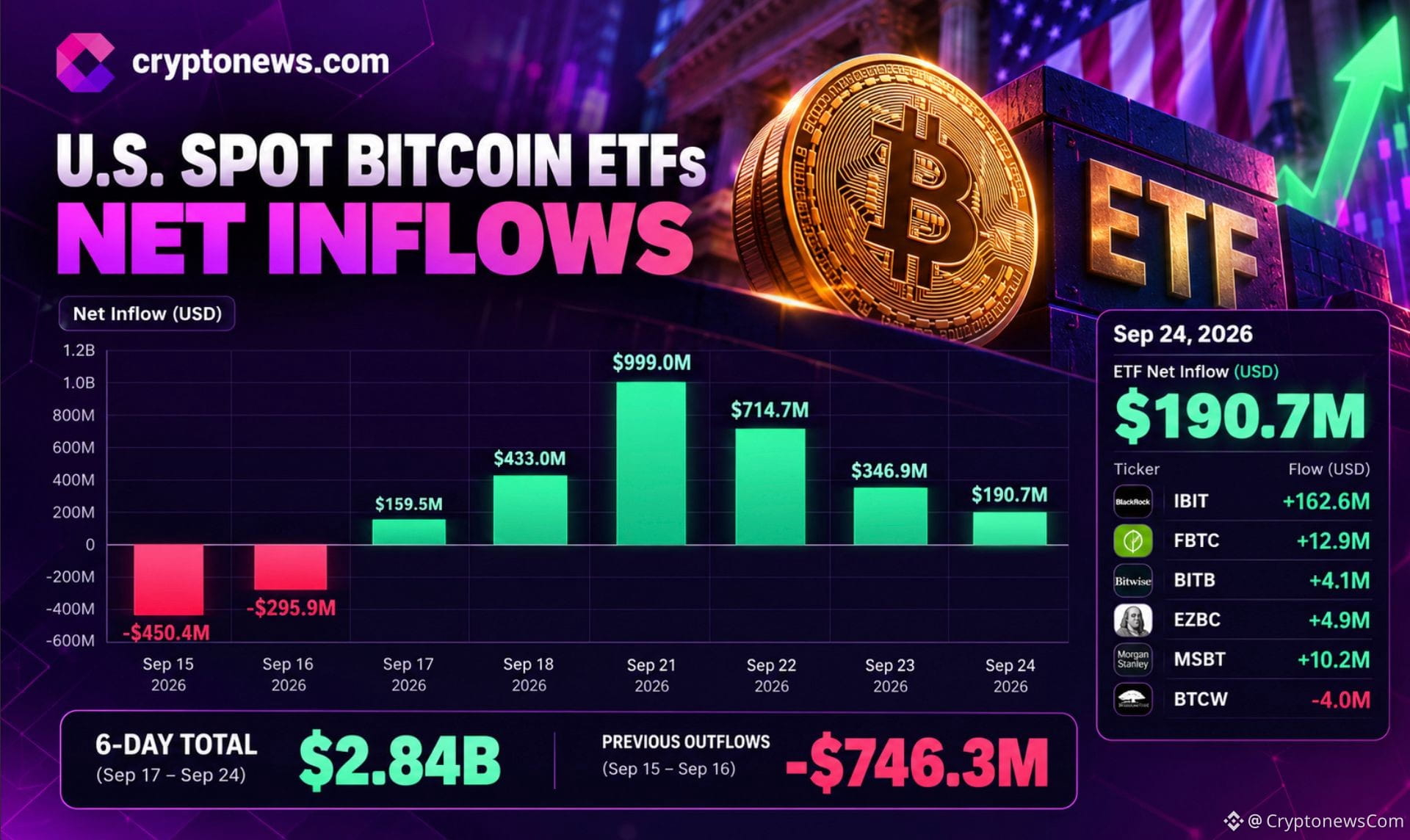
U.S. spot Bitcoin ETFs recorded $190.7 million in net inflows on September 24, extending their winning streak to six consecutive trading sessions. BlackRock’s IBIT led with $162.6 million, while Fidelity’s FBTC added $12.9 million and Morgan Stanley’s MSBT brought in $10.2 million. Bitwise’s BITB added $4.1 million, and Franklin Templeton’s EZBC gained $4.9 million, partly offset by a $4 million outflow from WisdomTree’s BTCW.
The latest inflow brought the six-session total to roughly $2.84 billion, following $159.5 million on September 17, $433 million on September 18, $999 million on September 21, $714.7 million on September 22, and $346.9 million on September 23. That marks a sharp reversal from the $450.4 million and $295.9 million outflows recorded on September 15 and 16.
Cumulative flows for the year have swung from a $5.8 billion deficit in mid-July to $800 million net positive today. This is a $6.6 billion turnaround in just over two months. The shift forces short-term traders to rethink positioning, and it sets up the technical picture worth breaking down.
Discover: The Best Token Presales
Bitcoin Price Prediction: Can BTC Hit $90,000 This Week?
Bitcoin is consolidating in the mid-$80,000s after last week’s sharp move, with price action bouncing between $84,000 and $86,500 depending on the session. Volume has stayed elevated, with the $3.74 billion ETF turnover on September 23 alone signaling this isn’t a low-liquidity drift.
Bitcoin is also trading above both its 20-day and 50-day moving averages, and the MACD remains bullish, which on-chain accumulation data suggests is being reinforced by whale buying rather than pure ETF flow.
Bitcoin (BTC)
24h7d30d1yAll time
For now, the immediate battle is at the $85,000–$86,000 resistance. Clear that, and $87,300–$88,000 opens up, with $90,000 the next magnet if momentum holds. Some technicians point to an inverse head-and-shoulders pattern with a neckline near $84,045, projecting as high as $117,247 if Bitcoin sustains above $86,93.
However, failing to hold $83,500–$84,000, though, the setup weakens fast, with $82,000 and eventually $77,000 back in play. Worth tracking against the Bitcoin price prediction covering these same levels in more depth.
Earn $50 and Enter $300K Prize Draw on EdgeXBitcoin Hyper Targets Early Mover Upside as Bitcoin Tests Key Levels
A 13.9% weekly gain feels good if already positioned. For anyone buying Bitcoin fresh at $86,000, the math is less exciting. A move to $100,000 from here is just around 16% upside, not the kind of asymmetric return that built early crypto fortunes.
Now, the same reasoning pushed capital toward earlier-stage infrastructure plays, and Bitcoin’s own scaling limitations (still slow, still expensive for anything beyond simple transfers) are exactly the gap projects like Bitcoin Hyper are built to fill.
The city sleeps. $HYPER stays charged. pic.twitter.com/LKBUzZLH39
— Bitcoin Hyper (@BTC_Hyper2) September 22, 2026
Bitcoin Hyper ($HYPER) is positioning as the first Bitcoin Layer 2 with native SVM integration, aiming for execution speeds faster than Solana while settling back to Bitcoin’s base layer. The presale has raised $33.1 million at a current token price of $0.0136867, with staking APY available for early participants.
Its decentralized canonical bridge handles BTC transfers without relying on custodial intermediaries, and traders can research Bitcoin Hyper directly through the presale page.
Trade Bitcoin on Bybit and Get a Chance to Win Our $1,000 USDT Airdrop
The post Bitcoin Price Prediction: ETF Flows Turned Green After $5.8 Billion Outflow appeared first on Cryptonews.
Bitcoin Price Prediction: ETF Flows Turned Green After $5.8 Billion Outflow
Bitcoin price is hovering around $86,500 with a sharp 13.90% run over the past week, which keeps its bullish prediction intact. The rebound is tied directly to a reversal in institutional demand that few saw coming just two months ago. There’s a second data point buried in the flow numbers, though, that changes how traders should read this rally.
U.S. spot Bitcoin ETFs recorded $190.7 million in net inflows on September 24, extending their winning streak to six consecutive trading sessions. BlackRock’s IBIT led with $162.6 million, while Fidelity’s FBTC added $12.9 million and Morgan Stanley’s MSBT brought in $10.2 million. Bitwise’s BITB added $4.1 million, and Franklin Templeton’s EZBC gained $4.9 million, partly offset by a $4 million outflow from WisdomTree’s BTCW.
The latest inflow brought the six-session total to roughly $2.84 billion, following $159.5 million on September 17, $433 million on September 18, $999 million on September 21, $714.7 million on September 22, and $346.9 million on September 23. That marks a sharp reversal from the $450.4 million and $295.9 million outflows recorded on September 15 and 16.
Cumulative flows for the year have swung from a $5.8 billion deficit in mid-July to $800 million net positive today. This is a $6.6 billion turnaround in just over two months. The shift forces short-term traders to rethink positioning, and it sets up the technical picture worth breaking down.
Discover: The Best Token Presales
Bitcoin Price Prediction: Can BTC Hit $90,000 This Week?
Bitcoin is consolidating in the mid-$80,000s after last week’s sharp move, with price action bouncing between $84,000 and $86,500 depending on the session. Volume has stayed elevated, with the $3.74 billion ETF turnover on September 23 alone signaling this isn’t a low-liquidity drift.
Bitcoin is also trading above both its 20-day and 50-day moving averages, and the MACD remains bullish, which on-chain accumulation data suggests is being reinforced by whale buying rather than pure ETF flow.
Bitcoin (BTC)
24h7d30d1yAll time
For now, the immediate battle is at the $85,000–$86,000 resistance. Clear that, and $87,300–$88,000 opens up, with $90,000 the next magnet if momentum holds. Some technicians point to an inverse head-and-shoulders pattern with a neckline near $84,045, projecting as high as $117,247 if Bitcoin sustains above $86,93.
However, failing to hold $83,500–$84,000, though, the setup weakens fast, with $82,000 and eventually $77,000 back in play. Worth tracking against the Bitcoin price prediction covering these same levels in more depth.
Earn $50 and Enter $300K Prize Draw on EdgeXBitcoin Hyper Targets Early Mover Upside as Bitcoin Tests Key Levels
A 13.9% weekly gain feels good if already positioned. For anyone buying Bitcoin fresh at $86,000, the math is less exciting. A move to $100,000 from here is just around 16% upside, not the kind of asymmetric return that built early crypto fortunes.
Now, the same reasoning pushed capital toward earlier-stage infrastructure plays, and Bitcoin’s own scaling limitations (still slow, still expensive for anything beyond simple transfers) are exactly the gap projects like Bitcoin Hyper are built to fill.
The city sleeps. $HYPER stays charged. pic.twitter.com/LKBUzZLH39
— Bitcoin Hyper (@BTC_Hyper2) September 22, 2026
Bitcoin Hyper ($HYPER) is positioning as the first Bitcoin Layer 2 with native SVM integration, aiming for execution speeds faster than Solana while settling back to Bitcoin’s base layer. The presale has raised $33.1 million at a current token price of $0.0136867, with staking APY available for early participants.
Its decentralized canonical bridge handles BTC transfers without relying on custodial intermediaries, and traders can research Bitcoin Hyper directly through the presale page.
Trade Bitcoin on Bybit and Get a Chance to Win Our $1,000 USDT Airdrop
The post Bitcoin Price Prediction: ETF Flows Turned Green After $5.8 Billion Outflow appeared first on Cryptonews.
U.S. spot Bitcoin ETFs recorded $190.7 million in net inflows on September 24, extending their winning streak to six consecutive trading sessions. BlackRock’s IBIT led with $162.6 million, while Fidelity’s FBTC added $12.9 million and Morgan Stanley’s MSBT brought in $10.2 million. Bitwise’s BITB added $4.1 million, and Franklin Templeton’s EZBC gained $4.9 million, partly offset by a $4 million outflow from WisdomTree’s BTCW.
The latest inflow brought the six-session total to roughly $2.84 billion, following $159.5 million on September 17, $433 million on September 18, $999 million on September 21, $714.7 million on September 22, and $346.9 million on September 23. That marks a sharp reversal from the $450.4 million and $295.9 million outflows recorded on September 15 and 16.
Cumulative flows for the year have swung from a $5.8 billion deficit in mid-July to $800 million net positive today. This is a $6.6 billion turnaround in just over two months. The shift forces short-term traders to rethink positioning, and it sets up the technical picture worth breaking down.
Discover: The Best Token Presales
Bitcoin Price Prediction: Can BTC Hit $90,000 This Week?
Bitcoin is consolidating in the mid-$80,000s after last week’s sharp move, with price action bouncing between $84,000 and $86,500 depending on the session. Volume has stayed elevated, with the $3.74 billion ETF turnover on September 23 alone signaling this isn’t a low-liquidity drift.
Bitcoin is also trading above both its 20-day and 50-day moving averages, and the MACD remains bullish, which on-chain accumulation data suggests is being reinforced by whale buying rather than pure ETF flow.
Bitcoin (BTC)
24h7d30d1yAll time
For now, the immediate battle is at the $85,000–$86,000 resistance. Clear that, and $87,300–$88,000 opens up, with $90,000 the next magnet if momentum holds. Some technicians point to an inverse head-and-shoulders pattern with a neckline near $84,045, projecting as high as $117,247 if Bitcoin sustains above $86,93.
However, failing to hold $83,500–$84,000, though, the setup weakens fast, with $82,000 and eventually $77,000 back in play. Worth tracking against the Bitcoin price prediction covering these same levels in more depth.
Earn $50 and Enter $300K Prize Draw on EdgeXBitcoin Hyper Targets Early Mover Upside as Bitcoin Tests Key Levels
A 13.9% weekly gain feels good if already positioned. For anyone buying Bitcoin fresh at $86,000, the math is less exciting. A move to $100,000 from here is just around 16% upside, not the kind of asymmetric return that built early crypto fortunes.
Now, the same reasoning pushed capital toward earlier-stage infrastructure plays, and Bitcoin’s own scaling limitations (still slow, still expensive for anything beyond simple transfers) are exactly the gap projects like Bitcoin Hyper are built to fill.
The city sleeps. $HYPER stays charged. pic.twitter.com/LKBUzZLH39
— Bitcoin Hyper (@BTC_Hyper2) September 22, 2026
Bitcoin Hyper ($HYPER) is positioning as the first Bitcoin Layer 2 with native SVM integration, aiming for execution speeds faster than Solana while settling back to Bitcoin’s base layer. The presale has raised $33.1 million at a current token price of $0.0136867, with staking APY available for early participants.
Its decentralized canonical bridge handles BTC transfers without relying on custodial intermediaries, and traders can research Bitcoin Hyper directly through the presale page.
Trade Bitcoin on Bybit and Get a Chance to Win Our $1,000 USDT Airdrop
The post Bitcoin Price Prediction: ETF Flows Turned Green After $5.8 Billion Outflow appeared first on Cryptonews.
23
Article
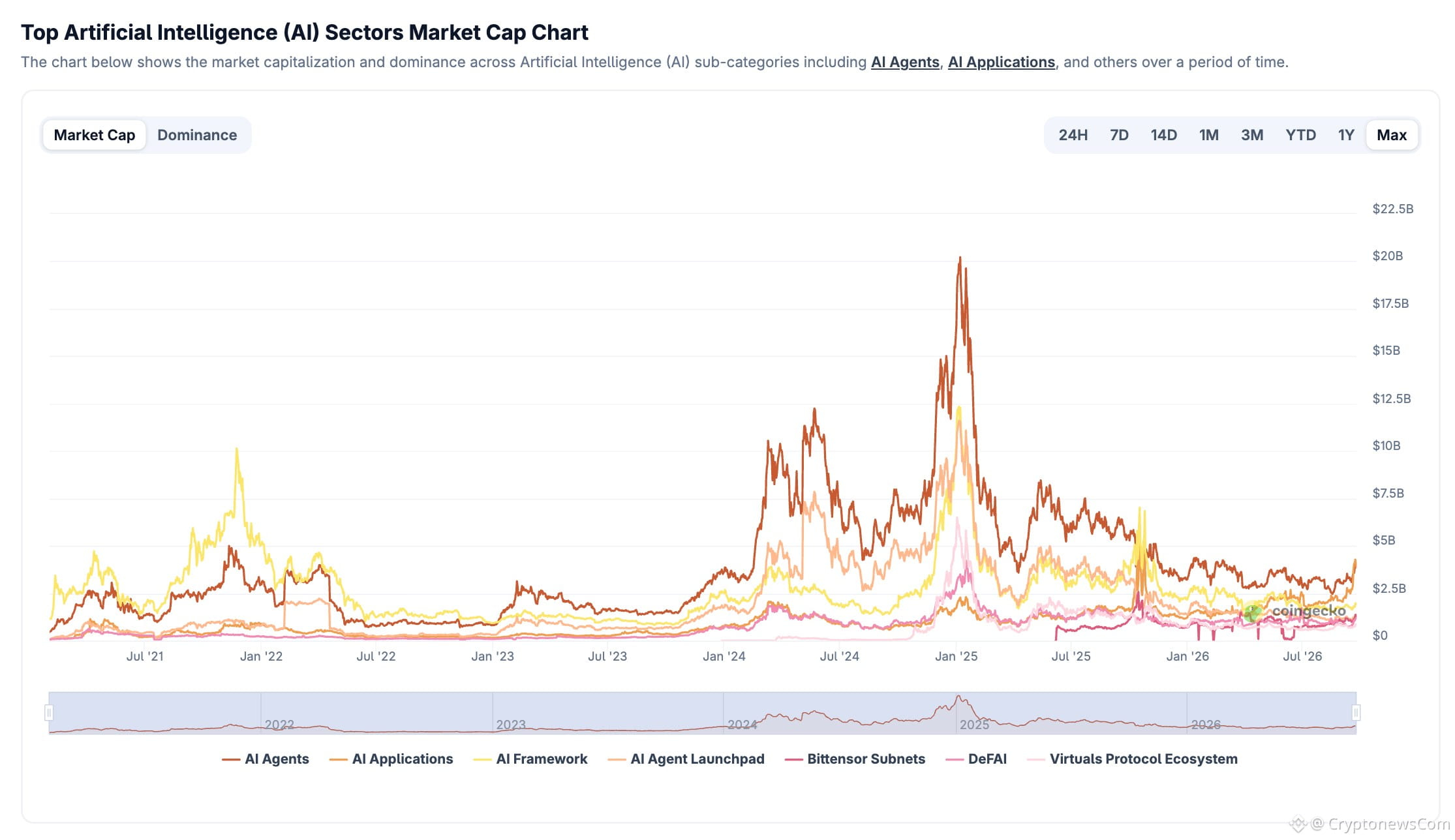
AI Crypto Coins Revenue Gap Puts Token Value to the TestThe AI coin crypto sector sits at $24-25 billion, with a total crypto market of approximately $2.86 trillion. Anthropic reportedly raised $65 billion at a $965 billion valuation in May, and Nvidia posted $96.2 billion in quarterly revenue in July, up 106% year over year, yet most major AI-related tokens remain 70%-90% below their 2024-2025 highs.
AI Crypto Category, Coingecko
Does AI growth create direct demand for tokens, or does it primarily enrich the companies building chips, cloud infrastructure, models, and enterprise software?
The pattern already showing up in stablecoin rails is instructive. Large AI-agent payment volumes have not yet clearly translated into demand for Solana or other underlying tokens, which is exactly the disconnect now visible across the AI-coin basket.
A recent BlackRock research paper frames AI and digital assets as the two technologies defining the current era, stating that AI represents machine-native intelligence, while digital assets represent machine-native money.
“this alignment becomes particularly important with the rise of agentic AI…with blockchains providing the programmable infrastructure that connects intelligence with economic activity.”
That framing matters because it separates two distinct exposures that traders often conflate. AI companies monetize through cloud contracts, hardware sales, and enterprise licensing; token value depends entirely on protocol usage, fee capture, and emissions. This is a sharp gap that shows up in the contrasting case where AI-driven stablecoin payments could generate direct demand for a major asset like Ethereum, rather than for a narrower AI-labeled coin.
Discover: The Best Token Presales
Attention Is High, but Capital Favors Revenue and Infrastructure
AI coins captured 35.7% of crypto-market narrative attention in Q1 2026, ahead of meme coins at 27.1%, according to CoinGecko’s quarterly narrative report. Combined, those two categories commanded 62.8% of reported mindshare, yet that attention has not translated into proportional capital retention across the sector’s roughly $24-25 billion market cap.
Venture capital tells a sharper story about where the money is actually going. AI captured approximately $240 billion, or 80% of global VC funding, in Q1 2026, and AI-blockchain companies specifically received 40% of crypto-related VC funding, more than double the 18% share a year earlier.
Gartner projects global AI spending is climbing from $1.76 trillion in 2025 to $2.52 trillion in 2026 and $3.34 trillion by 2027, with AI infrastructure taking the largest share.
CoinGecko lists 1,473 projects at the intersection of AI and blockchain, but investors are objectively prioritizing compute, agents, and measurable workloads over tokens that merely carry the AI label.
Earn $50 and Enter $300K Prize Draw on EdgeXWhy AI and Crypto Need Activity, Not Just a Label?
Crypto’s structural pitch to AI is straightforward: smart contracts and stablecoins provide the execution layer autonomous agents need to transact cheaply and continuously. BlackRock’s paper notes that stablecoins, native cryptoassets, and other on-chain instruments can serve as machine-native tools for payment and settlement, with compute spending forecast to reach $1 trillion by 2030.
BLACKROCK SAYS AI WILL USE CRYPTO!@cryptomanran on the BlackRock report:
It’s the same thesis crypto’s been running. AI agents have to pay other machines and banks weren’t built for that.
BlackRock says that demand hits blockchains, stablecoins, and on-chain assets.
Watch… pic.twitter.com/VnCIzS5DTu
— Crypto Banter (@crypto_banter) September 24, 2026
None of that guarantees uniform gains across AI coins. The sector’s next moves should be judged on transaction volume, fee generation, and partnership activity rather than category labels. Continued agent usage and revenue capture would strengthen the case for token value, while attention without those metrics would leave the $24-25 billion basket exactly where it is now.
Trade AI Coins on Bybit and Get a Chance to Win Our $1,000 USDT Airdrop
The post AI Crypto Coins Revenue Gap Puts Token Value to the Test appeared first on Cryptonews.
AI Crypto Coins Revenue Gap Puts Token Value to the Test
The AI coin crypto sector sits at $24-25 billion, with a total crypto market of approximately $2.86 trillion. Anthropic reportedly raised $65 billion at a $965 billion valuation in May, and Nvidia posted $96.2 billion in quarterly revenue in July, up 106% year over year, yet most major AI-related tokens remain 70%-90% below their 2024-2025 highs.
AI Crypto Category, Coingecko
Does AI growth create direct demand for tokens, or does it primarily enrich the companies building chips, cloud infrastructure, models, and enterprise software?
The pattern already showing up in stablecoin rails is instructive. Large AI-agent payment volumes have not yet clearly translated into demand for Solana or other underlying tokens, which is exactly the disconnect now visible across the AI-coin basket.
A recent BlackRock research paper frames AI and digital assets as the two technologies defining the current era, stating that AI represents machine-native intelligence, while digital assets represent machine-native money.
“this alignment becomes particularly important with the rise of agentic AI…with blockchains providing the programmable infrastructure that connects intelligence with economic activity.”
That framing matters because it separates two distinct exposures that traders often conflate. AI companies monetize through cloud contracts, hardware sales, and enterprise licensing; token value depends entirely on protocol usage, fee capture, and emissions. This is a sharp gap that shows up in the contrasting case where AI-driven stablecoin payments could generate direct demand for a major asset like Ethereum, rather than for a narrower AI-labeled coin.
Discover: The Best Token Presales
Attention Is High, but Capital Favors Revenue and Infrastructure
AI coins captured 35.7% of crypto-market narrative attention in Q1 2026, ahead of meme coins at 27.1%, according to CoinGecko’s quarterly narrative report. Combined, those two categories commanded 62.8% of reported mindshare, yet that attention has not translated into proportional capital retention across the sector’s roughly $24-25 billion market cap.
Venture capital tells a sharper story about where the money is actually going. AI captured approximately $240 billion, or 80% of global VC funding, in Q1 2026, and AI-blockchain companies specifically received 40% of crypto-related VC funding, more than double the 18% share a year earlier.
Gartner projects global AI spending is climbing from $1.76 trillion in 2025 to $2.52 trillion in 2026 and $3.34 trillion by 2027, with AI infrastructure taking the largest share.
CoinGecko lists 1,473 projects at the intersection of AI and blockchain, but investors are objectively prioritizing compute, agents, and measurable workloads over tokens that merely carry the AI label.
Earn $50 and Enter $300K Prize Draw on EdgeXWhy AI and Crypto Need Activity, Not Just a Label?
Crypto’s structural pitch to AI is straightforward: smart contracts and stablecoins provide the execution layer autonomous agents need to transact cheaply and continuously. BlackRock’s paper notes that stablecoins, native cryptoassets, and other on-chain instruments can serve as machine-native tools for payment and settlement, with compute spending forecast to reach $1 trillion by 2030.
BLACKROCK SAYS AI WILL USE CRYPTO!@cryptomanran on the BlackRock report:
It’s the same thesis crypto’s been running. AI agents have to pay other machines and banks weren’t built for that.
BlackRock says that demand hits blockchains, stablecoins, and on-chain assets.
Watch… pic.twitter.com/VnCIzS5DTu
— Crypto Banter (@crypto_banter) September 24, 2026
None of that guarantees uniform gains across AI coins. The sector’s next moves should be judged on transaction volume, fee generation, and partnership activity rather than category labels. Continued agent usage and revenue capture would strengthen the case for token value, while attention without those metrics would leave the $24-25 billion basket exactly where it is now.
Trade AI Coins on Bybit and Get a Chance to Win Our $1,000 USDT Airdrop
The post AI Crypto Coins Revenue Gap Puts Token Value to the Test appeared first on Cryptonews.
AI Crypto Category, Coingecko
Does AI growth create direct demand for tokens, or does it primarily enrich the companies building chips, cloud infrastructure, models, and enterprise software?
The pattern already showing up in stablecoin rails is instructive. Large AI-agent payment volumes have not yet clearly translated into demand for Solana or other underlying tokens, which is exactly the disconnect now visible across the AI-coin basket.
A recent BlackRock research paper frames AI and digital assets as the two technologies defining the current era, stating that AI represents machine-native intelligence, while digital assets represent machine-native money.
“this alignment becomes particularly important with the rise of agentic AI…with blockchains providing the programmable infrastructure that connects intelligence with economic activity.”
That framing matters because it separates two distinct exposures that traders often conflate. AI companies monetize through cloud contracts, hardware sales, and enterprise licensing; token value depends entirely on protocol usage, fee capture, and emissions. This is a sharp gap that shows up in the contrasting case where AI-driven stablecoin payments could generate direct demand for a major asset like Ethereum, rather than for a narrower AI-labeled coin.
Discover: The Best Token Presales
Attention Is High, but Capital Favors Revenue and Infrastructure
AI coins captured 35.7% of crypto-market narrative attention in Q1 2026, ahead of meme coins at 27.1%, according to CoinGecko’s quarterly narrative report. Combined, those two categories commanded 62.8% of reported mindshare, yet that attention has not translated into proportional capital retention across the sector’s roughly $24-25 billion market cap.
Venture capital tells a sharper story about where the money is actually going. AI captured approximately $240 billion, or 80% of global VC funding, in Q1 2026, and AI-blockchain companies specifically received 40% of crypto-related VC funding, more than double the 18% share a year earlier.
Gartner projects global AI spending is climbing from $1.76 trillion in 2025 to $2.52 trillion in 2026 and $3.34 trillion by 2027, with AI infrastructure taking the largest share.
CoinGecko lists 1,473 projects at the intersection of AI and blockchain, but investors are objectively prioritizing compute, agents, and measurable workloads over tokens that merely carry the AI label.
Earn $50 and Enter $300K Prize Draw on EdgeXWhy AI and Crypto Need Activity, Not Just a Label?
Crypto’s structural pitch to AI is straightforward: smart contracts and stablecoins provide the execution layer autonomous agents need to transact cheaply and continuously. BlackRock’s paper notes that stablecoins, native cryptoassets, and other on-chain instruments can serve as machine-native tools for payment and settlement, with compute spending forecast to reach $1 trillion by 2030.
BLACKROCK SAYS AI WILL USE CRYPTO!@cryptomanran on the BlackRock report:
It’s the same thesis crypto’s been running. AI agents have to pay other machines and banks weren’t built for that.
BlackRock says that demand hits blockchains, stablecoins, and on-chain assets.
Watch… pic.twitter.com/VnCIzS5DTu
— Crypto Banter (@crypto_banter) September 24, 2026
None of that guarantees uniform gains across AI coins. The sector’s next moves should be judged on transaction volume, fee generation, and partnership activity rather than category labels. Continued agent usage and revenue capture would strengthen the case for token value, while attention without those metrics would leave the $24-25 billion basket exactly where it is now.
Trade AI Coins on Bybit and Get a Chance to Win Our $1,000 USDT Airdrop
The post AI Crypto Coins Revenue Gap Puts Token Value to the Test appeared first on Cryptonews.
7

Article
Ethereum Price Prediction: ETH Finally Breaks the Bear PatternEthereum price trades at $2,675 after clearing a bull-flag structure that had capped its bullish prediction for weeks. The breakout is real. But whether it holds is the question we are now asking.
ETH broke out of its bull-flag formation at $2,660, shifting the market’s focus from downside continuation to upside targets near $3,050. The move came alongside a broader risk-off tone across equities, where rising Treasury yields and a stronger dollar pressured both stocks and crypto simultaneously.
HOLY MOLY ETHEREUM BULL FLAG IS PLAYING OUT
What happens to bears when $ETH goes to $10,000? https://t.co/3w4kWvLjj0 pic.twitter.com/thkaZlyfKa
— Stealthct (@Stealthct_Storm) September 18, 2026
ETH isn’t trading in a vacuum, and macro headwinds have already knocked the price back below $2,700 once this week after leveraged longs got flushed out. Bond market volatility isn’t going away soon, and that keeps ETH’s breakout on probation.
The next section breaks down what needs to happen for the rally to extend, and what would kill it.
Discover: Best Crypto IPO this September
Ethereum Price Prediction: Can ETH Hit $3,000 Next Week?
ETH is consolidating in the $2,626–$2,700 range after the bull-flag breakout, with immediate resistance clustered near $2,800. Our analyst describes the structure as “rally-base-rally,” with a base forming between roughly $2,385 and $2,600. This is a pattern that, if it holds, typically resolves higher. Our analyst also points to $2,550 as the level that matters most: a weekly close above it opens the door toward $3,000.
Earn $50 and Enter $300K Prize Draw on EdgeX
Bull case happens if a sustained close above $2,800 confirms the breakout, targeting the $3,050–$3,445 zone outlined by Reuters. The likely scenario is ETH chops between $2,560 and $2,800 while the market digests bond-yield volatility.
However, a break below $2,560–$2,565 weakens the setup, and a fall under $2,350–$2,360 would invalidate the rally structure entirely. More context on ETF flows and whale accumulation is available in this Ethereum price prediction covering key levels.
Trade Ethereum on Bybit and Get a Chance to Win Our $1,000 USDT AirdropLiquidChain Targets Early Mover Upside as Ethereum Tests Key Levels
ETH holders who bought the breakout are sitting on gains, but let’s be honest about the math: a move from $2,671 to $3,050 is just 14%. Solid, not life-changing.
At Ethereum’s market cap, outsized returns increasingly come from elsewhere, which is why traders scanning for asymmetric upside keep rotating capital into early-stage infrastructure plays while the majors consolidate.
The King. ⟁https://t.co/vqvBcdSQYC pic.twitter.com/TDTxXzjhRu
— LiquidChain (@getliquidchain) September 19, 2026
LiquidChain ($LIQUID), a Layer 3 infrastructure project, is positioning itself as the connective tissue between Bitcoin, Ethereum, and Solana liquidity, fusing all three into a single execution environment rather than forcing developers to build separate integrations.
The presale is priced at $0.014959, with $970K raised so far. Its Unified Liquidity Layer and Deploy-Once Architecture let builders ship once and reach all three ecosystems, a genuinely useful pitch if adoption follows.
Research LiquidChain directly before the IPO window closes.
Earn $50 and Enter $300K Prize Draw on EdgeX
The post Ethereum Price Prediction: ETH Finally Breaks the Bear Pattern appeared first on Cryptonews.
Ethereum Price Prediction: ETH Finally Breaks the Bear Pattern
Ethereum price trades at $2,675 after clearing a bull-flag structure that had capped its bullish prediction for weeks. The breakout is real. But whether it holds is the question we are now asking.
ETH broke out of its bull-flag formation at $2,660, shifting the market’s focus from downside continuation to upside targets near $3,050. The move came alongside a broader risk-off tone across equities, where rising Treasury yields and a stronger dollar pressured both stocks and crypto simultaneously.
HOLY MOLY ETHEREUM BULL FLAG IS PLAYING OUT
What happens to bears when $ETH goes to $10,000? https://t.co/3w4kWvLjj0 pic.twitter.com/thkaZlyfKa
— Stealthct (@Stealthct_Storm) September 18, 2026
ETH isn’t trading in a vacuum, and macro headwinds have already knocked the price back below $2,700 once this week after leveraged longs got flushed out. Bond market volatility isn’t going away soon, and that keeps ETH’s breakout on probation.
The next section breaks down what needs to happen for the rally to extend, and what would kill it.
Discover: Best Crypto IPO this September
Ethereum Price Prediction: Can ETH Hit $3,000 Next Week?
ETH is consolidating in the $2,626–$2,700 range after the bull-flag breakout, with immediate resistance clustered near $2,800. Our analyst describes the structure as “rally-base-rally,” with a base forming between roughly $2,385 and $2,600. This is a pattern that, if it holds, typically resolves higher. Our analyst also points to $2,550 as the level that matters most: a weekly close above it opens the door toward $3,000.
Earn $50 and Enter $300K Prize Draw on EdgeX
Bull case happens if a sustained close above $2,800 confirms the breakout, targeting the $3,050–$3,445 zone outlined by Reuters. The likely scenario is ETH chops between $2,560 and $2,800 while the market digests bond-yield volatility.
However, a break below $2,560–$2,565 weakens the setup, and a fall under $2,350–$2,360 would invalidate the rally structure entirely. More context on ETF flows and whale accumulation is available in this Ethereum price prediction covering key levels.
Trade Ethereum on Bybit and Get a Chance to Win Our $1,000 USDT AirdropLiquidChain Targets Early Mover Upside as Ethereum Tests Key Levels
ETH holders who bought the breakout are sitting on gains, but let’s be honest about the math: a move from $2,671 to $3,050 is just 14%. Solid, not life-changing.
At Ethereum’s market cap, outsized returns increasingly come from elsewhere, which is why traders scanning for asymmetric upside keep rotating capital into early-stage infrastructure plays while the majors consolidate.
The King. ⟁https://t.co/vqvBcdSQYC pic.twitter.com/TDTxXzjhRu
— LiquidChain (@getliquidchain) September 19, 2026
LiquidChain ($LIQUID), a Layer 3 infrastructure project, is positioning itself as the connective tissue between Bitcoin, Ethereum, and Solana liquidity, fusing all three into a single execution environment rather than forcing developers to build separate integrations.
The presale is priced at $0.014959, with $970K raised so far. Its Unified Liquidity Layer and Deploy-Once Architecture let builders ship once and reach all three ecosystems, a genuinely useful pitch if adoption follows.
Research LiquidChain directly before the IPO window closes.
Earn $50 and Enter $300K Prize Draw on EdgeX
The post Ethereum Price Prediction: ETH Finally Breaks the Bear Pattern appeared first on Cryptonews.
ETH broke out of its bull-flag formation at $2,660, shifting the market’s focus from downside continuation to upside targets near $3,050. The move came alongside a broader risk-off tone across equities, where rising Treasury yields and a stronger dollar pressured both stocks and crypto simultaneously.
HOLY MOLY ETHEREUM BULL FLAG IS PLAYING OUT
What happens to bears when $ETH goes to $10,000? https://t.co/3w4kWvLjj0 pic.twitter.com/thkaZlyfKa
— Stealthct (@Stealthct_Storm) September 18, 2026
ETH isn’t trading in a vacuum, and macro headwinds have already knocked the price back below $2,700 once this week after leveraged longs got flushed out. Bond market volatility isn’t going away soon, and that keeps ETH’s breakout on probation.
The next section breaks down what needs to happen for the rally to extend, and what would kill it.
Discover: Best Crypto IPO this September
Ethereum Price Prediction: Can ETH Hit $3,000 Next Week?
ETH is consolidating in the $2,626–$2,700 range after the bull-flag breakout, with immediate resistance clustered near $2,800. Our analyst describes the structure as “rally-base-rally,” with a base forming between roughly $2,385 and $2,600. This is a pattern that, if it holds, typically resolves higher. Our analyst also points to $2,550 as the level that matters most: a weekly close above it opens the door toward $3,000.
Earn $50 and Enter $300K Prize Draw on EdgeX
Bull case happens if a sustained close above $2,800 confirms the breakout, targeting the $3,050–$3,445 zone outlined by Reuters. The likely scenario is ETH chops between $2,560 and $2,800 while the market digests bond-yield volatility.
However, a break below $2,560–$2,565 weakens the setup, and a fall under $2,350–$2,360 would invalidate the rally structure entirely. More context on ETF flows and whale accumulation is available in this Ethereum price prediction covering key levels.
Trade Ethereum on Bybit and Get a Chance to Win Our $1,000 USDT AirdropLiquidChain Targets Early Mover Upside as Ethereum Tests Key Levels
ETH holders who bought the breakout are sitting on gains, but let’s be honest about the math: a move from $2,671 to $3,050 is just 14%. Solid, not life-changing.
At Ethereum’s market cap, outsized returns increasingly come from elsewhere, which is why traders scanning for asymmetric upside keep rotating capital into early-stage infrastructure plays while the majors consolidate.
The King. ⟁https://t.co/vqvBcdSQYC pic.twitter.com/TDTxXzjhRu
— LiquidChain (@getliquidchain) September 19, 2026
LiquidChain ($LIQUID), a Layer 3 infrastructure project, is positioning itself as the connective tissue between Bitcoin, Ethereum, and Solana liquidity, fusing all three into a single execution environment rather than forcing developers to build separate integrations.
The presale is priced at $0.014959, with $970K raised so far. Its Unified Liquidity Layer and Deploy-Once Architecture let builders ship once and reach all three ecosystems, a genuinely useful pitch if adoption follows.
Research LiquidChain directly before the IPO window closes.
Earn $50 and Enter $300K Prize Draw on EdgeX
The post Ethereum Price Prediction: ETH Finally Breaks the Bear Pattern appeared first on Cryptonews.
15

Article
Solana ETF News: Cumulative Inflows Surge to $1.52B as LiquidChain Presale Nears $1MInstitutional interest in the Solana ecosystem is accelerating at a rapid pace, establishing a strong foundation for the network’s next growth phase. Even with the native SOL token trading at $116—down from its January 2025 high of $294—large-scale capital continues to pour into the market. This institutional momentum is most clearly reflected in the latest Solana ETF news, with US spot Solana ETFs securing an impressive $101.55 million in net inflows this week alone. This push has elevated cumulative net inflows to $1.52 billion, boosting combined net assets to $1.81 billion. Currently, SOL boasts a market capitalization of $68.85 billion, backed by a strong 24-hour trading volume of $4.1 billion.
This wave of institutional validation is also drawing significant attention to early-stage infrastructure projects focused on cross-chain interoperability. Leading this trend is the LiquidChain LIQUID token presale, which has quickly raised over $970,000 and is on the verge of crossing the key $1 million mark. Designed as a high-performance Layer 3 network, LiquidChain is built to unify the liquidity of Bitcoin, the decentralized finance (DeFi) depth of Ethereum, and the ultra-fast execution of Solana into a single ecosystem.
As it approaches the seven-figure milestone, the rapid pace of the LiquidChain presale highlights it as one of the most closely watched infrastructure launches of the current market cycle.
Solana ETF News: Institutional Demand Drives $101.55M Weekly Haul
The upward trajectory of Solana’s institutional investment vehicles shows no signs of slowing down. Yesterday saw $32.81 million rush into spot SOL ETFs, driven largely by Bitwise’s BSOL product, which brought in $27.97 million in daily inflows. This brings BSOL’s lifetime inflows to an impressive $1.16 billion. Fidelity’s FSOL fund also contributed $4.84 million to yesterday’s total, with zero outflows recorded across the entire category. Today, combined assets in US Solana ETFs account for 2.63% of SOL’s total market cap, marking 12 consecutive weeks of positive net inflows for the product class.
Alongside this institutional inflows, Solana’s underlying network architecture is undergoing major technical upgrades. Public testnet testing has commenced for Alpenglow, a consensus mechanism update designed to slash transaction finality from 12.8 seconds down to just 150 milliseconds. By allowing validators to finalize blocks in one or two direct voting rounds, alongside a live slot-time reduction to 250 milliseconds, the network is delivering near-instant execution for wallets and exchanges. This technical evolution coincides with growing real-world adoption, as tokenized stocks on Solana have officially surpassed 1.03 million cumulative holders.
Analyzing the technical setup, prominent trader TraderSZ highlighted key levels to his 696,000 X followers, noting that reclaiming the $117 to $125 range will be crucial for bulls to spark the next major leg up.
a little caution with this
if it does reclaim then we should blast off…will find out soon if this acts as resistance and ranges/pullsback
i'll personally be compounding if it does get above it$sol https://t.co/1vjVqp62j3 pic.twitter.com/Ljax001o29
— TraderSZ (@trader1sz) September 25, 2026
While traders debate short-term resistance levels, institutional investors are looking at the bigger picture. The ongoing success of Solana ETFs demonstrates a growing demand for high-speed, scalable blockspace—a trend that is directly fueling interest in advanced multi-chain protocols like LiquidChain.
How the Solana ETF Boom is Fueling LiquidChain’s Cross-Chain Layer 3
As institutional capital highlights the value of high-throughput networks, LiquidChain (LIQUID) is building the ultimate bridge between the industry’s three largest ecosystems. Rather than relying on risky wrapped tokens or synthetic assets, LiquidChain’s Layer 3 network establishes unified liquidity pools that represent native Bitcoin, Ethereum, and Solana assets directly. Powered by a Solana-class execution virtual machine, the network utilizes trust-minimized proofs to verify states across all three chains, enabling secure, atomic cross-chain settlements.
The King. ⟁https://t.co/vqvBcdSQYC pic.twitter.com/TDTxXzjhRu
— LiquidChain (@getliquidchain) September 19, 2026
The native LIQUID token serves as the economic engine of this Layer 3, powering transaction fees, network staking, and governance. The total token supply is strictly capped at 11,800,000,100, with a structured allocation plan: 35% dedicated to core development, 32.5% to LiquidLabs, 15% to AquaVault for business development and community incentives, 10% for staking rewards, and 7.5% allocated to marketing and exchange listings. To ensure institutional-grade security, the token contract has been fully audited by CertiK and SpyWolf, with major exchange listings scheduled immediately following the presale’s conclusion later this year.
Currently, the LIQUID presale has raised over $970,000 and is fast approaching its next stage target of $1.08 million. During the current phase, tokens are priced at $0.014959, with a scheduled price increase set to take place over the coming weekend. Early participants can also take advantage of immediate staking, which currently offers an attractive 1,176% APY that will dynamically adjust as the staking pool expands.
How to Secure LIQUID Tokens Before the Next Price Increase
With the presale moving rapidly toward its hard cap and exchange listings on the horizon, the current price of $0.014959 presents a limited-time entry point. To participate, investors can visit the official LiquidChain site, connect a compatible Web3 wallet, select their preferred purchase amount, and confirm the transaction.
By staking their tokens immediately upon purchase, buyers can begin earning the 1,176% APY starting from the very next block.
For added convenience, the presale is also integrated with the Best Wallet application, available for download on both the Apple App Store and Google Play. Supported payment methods across both platforms include BTC, ETH, SOL, BNB, USDT, and USDC, alongside traditional bank card options for those looking to purchase with fiat currency.
To stay updated on development milestones, mainnet updates, and presale announcements, you can follow LiquidChain on X and join its Telegram channel.
Gain Special Access to Layer 3 Trading Here
The post Solana ETF News: Cumulative Inflows Surge to $1.52B as LiquidChain Presale Nears $1M appeared first on Cryptonews.
Solana ETF News: Cumulative Inflows Surge to $1.52B as LiquidChain Presale Nears $1M
Institutional interest in the Solana ecosystem is accelerating at a rapid pace, establishing a strong foundation for the network’s next growth phase. Even with the native SOL token trading at $116—down from its January 2025 high of $294—large-scale capital continues to pour into the market. This institutional momentum is most clearly reflected in the latest Solana ETF news, with US spot Solana ETFs securing an impressive $101.55 million in net inflows this week alone. This push has elevated cumulative net inflows to $1.52 billion, boosting combined net assets to $1.81 billion. Currently, SOL boasts a market capitalization of $68.85 billion, backed by a strong 24-hour trading volume of $4.1 billion.
This wave of institutional validation is also drawing significant attention to early-stage infrastructure projects focused on cross-chain interoperability. Leading this trend is the LiquidChain LIQUID token presale, which has quickly raised over $970,000 and is on the verge of crossing the key $1 million mark. Designed as a high-performance Layer 3 network, LiquidChain is built to unify the liquidity of Bitcoin, the decentralized finance (DeFi) depth of Ethereum, and the ultra-fast execution of Solana into a single ecosystem.
As it approaches the seven-figure milestone, the rapid pace of the LiquidChain presale highlights it as one of the most closely watched infrastructure launches of the current market cycle.
Solana ETF News: Institutional Demand Drives $101.55M Weekly Haul
The upward trajectory of Solana’s institutional investment vehicles shows no signs of slowing down. Yesterday saw $32.81 million rush into spot SOL ETFs, driven largely by Bitwise’s BSOL product, which brought in $27.97 million in daily inflows. This brings BSOL’s lifetime inflows to an impressive $1.16 billion. Fidelity’s FSOL fund also contributed $4.84 million to yesterday’s total, with zero outflows recorded across the entire category. Today, combined assets in US Solana ETFs account for 2.63% of SOL’s total market cap, marking 12 consecutive weeks of positive net inflows for the product class.
Alongside this institutional inflows, Solana’s underlying network architecture is undergoing major technical upgrades. Public testnet testing has commenced for Alpenglow, a consensus mechanism update designed to slash transaction finality from 12.8 seconds down to just 150 milliseconds. By allowing validators to finalize blocks in one or two direct voting rounds, alongside a live slot-time reduction to 250 milliseconds, the network is delivering near-instant execution for wallets and exchanges. This technical evolution coincides with growing real-world adoption, as tokenized stocks on Solana have officially surpassed 1.03 million cumulative holders.
Analyzing the technical setup, prominent trader TraderSZ highlighted key levels to his 696,000 X followers, noting that reclaiming the $117 to $125 range will be crucial for bulls to spark the next major leg up.
a little caution with this
if it does reclaim then we should blast off…will find out soon if this acts as resistance and ranges/pullsback
i'll personally be compounding if it does get above it$sol https://t.co/1vjVqp62j3 pic.twitter.com/Ljax001o29
— TraderSZ (@trader1sz) September 25, 2026
While traders debate short-term resistance levels, institutional investors are looking at the bigger picture. The ongoing success of Solana ETFs demonstrates a growing demand for high-speed, scalable blockspace—a trend that is directly fueling interest in advanced multi-chain protocols like LiquidChain.
How the Solana ETF Boom is Fueling LiquidChain’s Cross-Chain Layer 3
As institutional capital highlights the value of high-throughput networks, LiquidChain (LIQUID) is building the ultimate bridge between the industry’s three largest ecosystems. Rather than relying on risky wrapped tokens or synthetic assets, LiquidChain’s Layer 3 network establishes unified liquidity pools that represent native Bitcoin, Ethereum, and Solana assets directly. Powered by a Solana-class execution virtual machine, the network utilizes trust-minimized proofs to verify states across all three chains, enabling secure, atomic cross-chain settlements.
The King. ⟁https://t.co/vqvBcdSQYC pic.twitter.com/TDTxXzjhRu
— LiquidChain (@getliquidchain) September 19, 2026
The native LIQUID token serves as the economic engine of this Layer 3, powering transaction fees, network staking, and governance. The total token supply is strictly capped at 11,800,000,100, with a structured allocation plan: 35% dedicated to core development, 32.5% to LiquidLabs, 15% to AquaVault for business development and community incentives, 10% for staking rewards, and 7.5% allocated to marketing and exchange listings. To ensure institutional-grade security, the token contract has been fully audited by CertiK and SpyWolf, with major exchange listings scheduled immediately following the presale’s conclusion later this year.
Currently, the LIQUID presale has raised over $970,000 and is fast approaching its next stage target of $1.08 million. During the current phase, tokens are priced at $0.014959, with a scheduled price increase set to take place over the coming weekend. Early participants can also take advantage of immediate staking, which currently offers an attractive 1,176% APY that will dynamically adjust as the staking pool expands.
How to Secure LIQUID Tokens Before the Next Price Increase
With the presale moving rapidly toward its hard cap and exchange listings on the horizon, the current price of $0.014959 presents a limited-time entry point. To participate, investors can visit the official LiquidChain site, connect a compatible Web3 wallet, select their preferred purchase amount, and confirm the transaction.
By staking their tokens immediately upon purchase, buyers can begin earning the 1,176% APY starting from the very next block.
For added convenience, the presale is also integrated with the Best Wallet application, available for download on both the Apple App Store and Google Play. Supported payment methods across both platforms include BTC, ETH, SOL, BNB, USDT, and USDC, alongside traditional bank card options for those looking to purchase with fiat currency.
To stay updated on development milestones, mainnet updates, and presale announcements, you can follow LiquidChain on X and join its Telegram channel.
Gain Special Access to Layer 3 Trading Here
The post Solana ETF News: Cumulative Inflows Surge to $1.52B as LiquidChain Presale Nears $1M appeared first on Cryptonews.
This wave of institutional validation is also drawing significant attention to early-stage infrastructure projects focused on cross-chain interoperability. Leading this trend is the LiquidChain LIQUID token presale, which has quickly raised over $970,000 and is on the verge of crossing the key $1 million mark. Designed as a high-performance Layer 3 network, LiquidChain is built to unify the liquidity of Bitcoin, the decentralized finance (DeFi) depth of Ethereum, and the ultra-fast execution of Solana into a single ecosystem.
As it approaches the seven-figure milestone, the rapid pace of the LiquidChain presale highlights it as one of the most closely watched infrastructure launches of the current market cycle.
Solana ETF News: Institutional Demand Drives $101.55M Weekly Haul
The upward trajectory of Solana’s institutional investment vehicles shows no signs of slowing down. Yesterday saw $32.81 million rush into spot SOL ETFs, driven largely by Bitwise’s BSOL product, which brought in $27.97 million in daily inflows. This brings BSOL’s lifetime inflows to an impressive $1.16 billion. Fidelity’s FSOL fund also contributed $4.84 million to yesterday’s total, with zero outflows recorded across the entire category. Today, combined assets in US Solana ETFs account for 2.63% of SOL’s total market cap, marking 12 consecutive weeks of positive net inflows for the product class.
Alongside this institutional inflows, Solana’s underlying network architecture is undergoing major technical upgrades. Public testnet testing has commenced for Alpenglow, a consensus mechanism update designed to slash transaction finality from 12.8 seconds down to just 150 milliseconds. By allowing validators to finalize blocks in one or two direct voting rounds, alongside a live slot-time reduction to 250 milliseconds, the network is delivering near-instant execution for wallets and exchanges. This technical evolution coincides with growing real-world adoption, as tokenized stocks on Solana have officially surpassed 1.03 million cumulative holders.
Analyzing the technical setup, prominent trader TraderSZ highlighted key levels to his 696,000 X followers, noting that reclaiming the $117 to $125 range will be crucial for bulls to spark the next major leg up.
a little caution with this
if it does reclaim then we should blast off…will find out soon if this acts as resistance and ranges/pullsback
i'll personally be compounding if it does get above it$sol https://t.co/1vjVqp62j3 pic.twitter.com/Ljax001o29
— TraderSZ (@trader1sz) September 25, 2026
While traders debate short-term resistance levels, institutional investors are looking at the bigger picture. The ongoing success of Solana ETFs demonstrates a growing demand for high-speed, scalable blockspace—a trend that is directly fueling interest in advanced multi-chain protocols like LiquidChain.
How the Solana ETF Boom is Fueling LiquidChain’s Cross-Chain Layer 3
As institutional capital highlights the value of high-throughput networks, LiquidChain (LIQUID) is building the ultimate bridge between the industry’s three largest ecosystems. Rather than relying on risky wrapped tokens or synthetic assets, LiquidChain’s Layer 3 network establishes unified liquidity pools that represent native Bitcoin, Ethereum, and Solana assets directly. Powered by a Solana-class execution virtual machine, the network utilizes trust-minimized proofs to verify states across all three chains, enabling secure, atomic cross-chain settlements.
The King. ⟁https://t.co/vqvBcdSQYC pic.twitter.com/TDTxXzjhRu
— LiquidChain (@getliquidchain) September 19, 2026
The native LIQUID token serves as the economic engine of this Layer 3, powering transaction fees, network staking, and governance. The total token supply is strictly capped at 11,800,000,100, with a structured allocation plan: 35% dedicated to core development, 32.5% to LiquidLabs, 15% to AquaVault for business development and community incentives, 10% for staking rewards, and 7.5% allocated to marketing and exchange listings. To ensure institutional-grade security, the token contract has been fully audited by CertiK and SpyWolf, with major exchange listings scheduled immediately following the presale’s conclusion later this year.
Currently, the LIQUID presale has raised over $970,000 and is fast approaching its next stage target of $1.08 million. During the current phase, tokens are priced at $0.014959, with a scheduled price increase set to take place over the coming weekend. Early participants can also take advantage of immediate staking, which currently offers an attractive 1,176% APY that will dynamically adjust as the staking pool expands.
How to Secure LIQUID Tokens Before the Next Price Increase
With the presale moving rapidly toward its hard cap and exchange listings on the horizon, the current price of $0.014959 presents a limited-time entry point. To participate, investors can visit the official LiquidChain site, connect a compatible Web3 wallet, select their preferred purchase amount, and confirm the transaction.
By staking their tokens immediately upon purchase, buyers can begin earning the 1,176% APY starting from the very next block.
For added convenience, the presale is also integrated with the Best Wallet application, available for download on both the Apple App Store and Google Play. Supported payment methods across both platforms include BTC, ETH, SOL, BNB, USDT, and USDC, alongside traditional bank card options for those looking to purchase with fiat currency.
To stay updated on development milestones, mainnet updates, and presale announcements, you can follow LiquidChain on X and join its Telegram channel.
Gain Special Access to Layer 3 Trading Here
The post Solana ETF News: Cumulative Inflows Surge to $1.52B as LiquidChain Presale Nears $1M appeared first on Cryptonews.
4

Article
Whisper, a Secure Messaging and Web3 Wallet Super App, to Unveil New Ecosystem at Korea Blockchai...Whisper, the Web3 super app developed by EQBR Holdings Co., Ltd., has announced it will unveil a new ecosystem built around the app at Korea Blockchain Week (KBW) in Seoul.
Paulus J. Lee, Founder of Whisper and Chairman of EQBR Holdings, will present the keynote on 4:40pm on September 30th at Grand WalkerHill in Seoul, where the team will show what it has been building beyond the app itself.
Whisper brings everyday digital activity into one place. Its features include:
Secure messaging: end-to-end encrypted, with private-key-based messages.
Digital wallet: support for more than 10 blockchains and more than 100 assets.
Swap exchange: instant token swaps, compatible with the Ethereum Virtual Machine (EVM).
dApp Store: a curated way to browse DeFi, NFT, GameFi and SocialFi applications.
Feed: curated Web3 news and project alerts.
The app has recorded 1.38 million cumulative downloads. The team has also tested the technology in real-world use, providing real-time, fully on-chain peer-to-peer payments at the Jeju Food & Wine Festival in 2023, 2024, and 2025, in partnership with Jeju Bank, a local commercial bank. In 2023-2025, the payment system operated across more than 200 restaurants at the festival, alongside the purchase and redemption of digital gift vouchers. A separate demonstration showed the underlying technology running on a Raspberry Pi, illustrating its ability to run on low-power devices.
Whisper is built on blockchain technology protected by U.S. Patent No. 12,586,064 B2, granted in March 2026. The patented system uses a non-competitive consensus method and a micro-chain architecture that lets different services run independently, so that heavy activity in one application does not slow the others. In testing, the approach achieved confirmation times of three seconds and throughput of up to about 4,500 transactions per second on a single micro-chain.
“Most people don’t want to learn about blockchain. They want to message a friend, pay a merchant, and swap a token in one place, quickly and securely,” said Lee. “We built Whisper so those everyday actions work smoothly on-chain, without the user having to think about the chain.”
“At Korea Blockchain Week, we’ll show the next step for Whisper: a new ecosystem built around the app,” Lee added. “We look forward to sharing it with the community in Seoul.”
Lee has more than three decades of experience as a founding father of games and digital content in Korea, including producing Electronic Arts’ Tiger Woods Golf 2000, and holds a master’s degree in materials science from KAIST (Korea Advanced Institute of Science and Technology).
Availability
Whisper is available on Apple App Store/Google Play as named “Whisper MSG”
About Whisper
Whisper is a Web3 super app that combines encrypted messaging, a multi-chain digital wallet, token swaps, a dApp store and a curated news feed. It is developed by EQBR Holdings Co., Ltd., based in Seoul, South Korea.
The post Whisper, a Secure Messaging and Web3 Wallet Super App, to Unveil New Ecosystem at Korea Blockchain Week appeared first on Cryptonews.
Whisper, a Secure Messaging and Web3 Wallet Super App, to Unveil New Ecosystem at Korea Blockchai...
Whisper, the Web3 super app developed by EQBR Holdings Co., Ltd., has announced it will unveil a new ecosystem built around the app at Korea Blockchain Week (KBW) in Seoul.
Paulus J. Lee, Founder of Whisper and Chairman of EQBR Holdings, will present the keynote on 4:40pm on September 30th at Grand WalkerHill in Seoul, where the team will show what it has been building beyond the app itself.
Whisper brings everyday digital activity into one place. Its features include:
Secure messaging: end-to-end encrypted, with private-key-based messages.
Digital wallet: support for more than 10 blockchains and more than 100 assets.
Swap exchange: instant token swaps, compatible with the Ethereum Virtual Machine (EVM).
dApp Store: a curated way to browse DeFi, NFT, GameFi and SocialFi applications.
Feed: curated Web3 news and project alerts.
The app has recorded 1.38 million cumulative downloads. The team has also tested the technology in real-world use, providing real-time, fully on-chain peer-to-peer payments at the Jeju Food & Wine Festival in 2023, 2024, and 2025, in partnership with Jeju Bank, a local commercial bank. In 2023-2025, the payment system operated across more than 200 restaurants at the festival, alongside the purchase and redemption of digital gift vouchers. A separate demonstration showed the underlying technology running on a Raspberry Pi, illustrating its ability to run on low-power devices.
Whisper is built on blockchain technology protected by U.S. Patent No. 12,586,064 B2, granted in March 2026. The patented system uses a non-competitive consensus method and a micro-chain architecture that lets different services run independently, so that heavy activity in one application does not slow the others. In testing, the approach achieved confirmation times of three seconds and throughput of up to about 4,500 transactions per second on a single micro-chain.
“Most people don’t want to learn about blockchain. They want to message a friend, pay a merchant, and swap a token in one place, quickly and securely,” said Lee. “We built Whisper so those everyday actions work smoothly on-chain, without the user having to think about the chain.”
“At Korea Blockchain Week, we’ll show the next step for Whisper: a new ecosystem built around the app,” Lee added. “We look forward to sharing it with the community in Seoul.”
Lee has more than three decades of experience as a founding father of games and digital content in Korea, including producing Electronic Arts’ Tiger Woods Golf 2000, and holds a master’s degree in materials science from KAIST (Korea Advanced Institute of Science and Technology).
Availability
Whisper is available on Apple App Store/Google Play as named “Whisper MSG”
About Whisper
Whisper is a Web3 super app that combines encrypted messaging, a multi-chain digital wallet, token swaps, a dApp store and a curated news feed. It is developed by EQBR Holdings Co., Ltd., based in Seoul, South Korea.
The post Whisper, a Secure Messaging and Web3 Wallet Super App, to Unveil New Ecosystem at Korea Blockchain Week appeared first on Cryptonews.
Paulus J. Lee, Founder of Whisper and Chairman of EQBR Holdings, will present the keynote on 4:40pm on September 30th at Grand WalkerHill in Seoul, where the team will show what it has been building beyond the app itself.
Whisper brings everyday digital activity into one place. Its features include:
Secure messaging: end-to-end encrypted, with private-key-based messages.
Digital wallet: support for more than 10 blockchains and more than 100 assets.
Swap exchange: instant token swaps, compatible with the Ethereum Virtual Machine (EVM).
dApp Store: a curated way to browse DeFi, NFT, GameFi and SocialFi applications.
Feed: curated Web3 news and project alerts.
The app has recorded 1.38 million cumulative downloads. The team has also tested the technology in real-world use, providing real-time, fully on-chain peer-to-peer payments at the Jeju Food & Wine Festival in 2023, 2024, and 2025, in partnership with Jeju Bank, a local commercial bank. In 2023-2025, the payment system operated across more than 200 restaurants at the festival, alongside the purchase and redemption of digital gift vouchers. A separate demonstration showed the underlying technology running on a Raspberry Pi, illustrating its ability to run on low-power devices.
Whisper is built on blockchain technology protected by U.S. Patent No. 12,586,064 B2, granted in March 2026. The patented system uses a non-competitive consensus method and a micro-chain architecture that lets different services run independently, so that heavy activity in one application does not slow the others. In testing, the approach achieved confirmation times of three seconds and throughput of up to about 4,500 transactions per second on a single micro-chain.
“Most people don’t want to learn about blockchain. They want to message a friend, pay a merchant, and swap a token in one place, quickly and securely,” said Lee. “We built Whisper so those everyday actions work smoothly on-chain, without the user having to think about the chain.”
“At Korea Blockchain Week, we’ll show the next step for Whisper: a new ecosystem built around the app,” Lee added. “We look forward to sharing it with the community in Seoul.”
Lee has more than three decades of experience as a founding father of games and digital content in Korea, including producing Electronic Arts’ Tiger Woods Golf 2000, and holds a master’s degree in materials science from KAIST (Korea Advanced Institute of Science and Technology).
Availability
Whisper is available on Apple App Store/Google Play as named “Whisper MSG”
About Whisper
Whisper is a Web3 super app that combines encrypted messaging, a multi-chain digital wallet, token swaps, a dApp store and a curated news feed. It is developed by EQBR Holdings Co., Ltd., based in Seoul, South Korea.
The post Whisper, a Secure Messaging and Web3 Wallet Super App, to Unveil New Ecosystem at Korea Blockchain Week appeared first on Cryptonews.
63
Article
XRP Price Prediction: Weekly Gains Lead Crypto Market, But Can XRP Clear $1.63?XRP price trades at $1.53, up by a marginal 1.5% on the day, and is still sitting on one of the strongest weekly charts among large-cap tokens, shrugging off bearish prediction. Zoom out to seven days, and the picture changes dramatically. Gains in the 17-18% range put XRP ahead of most of the top-10 field.
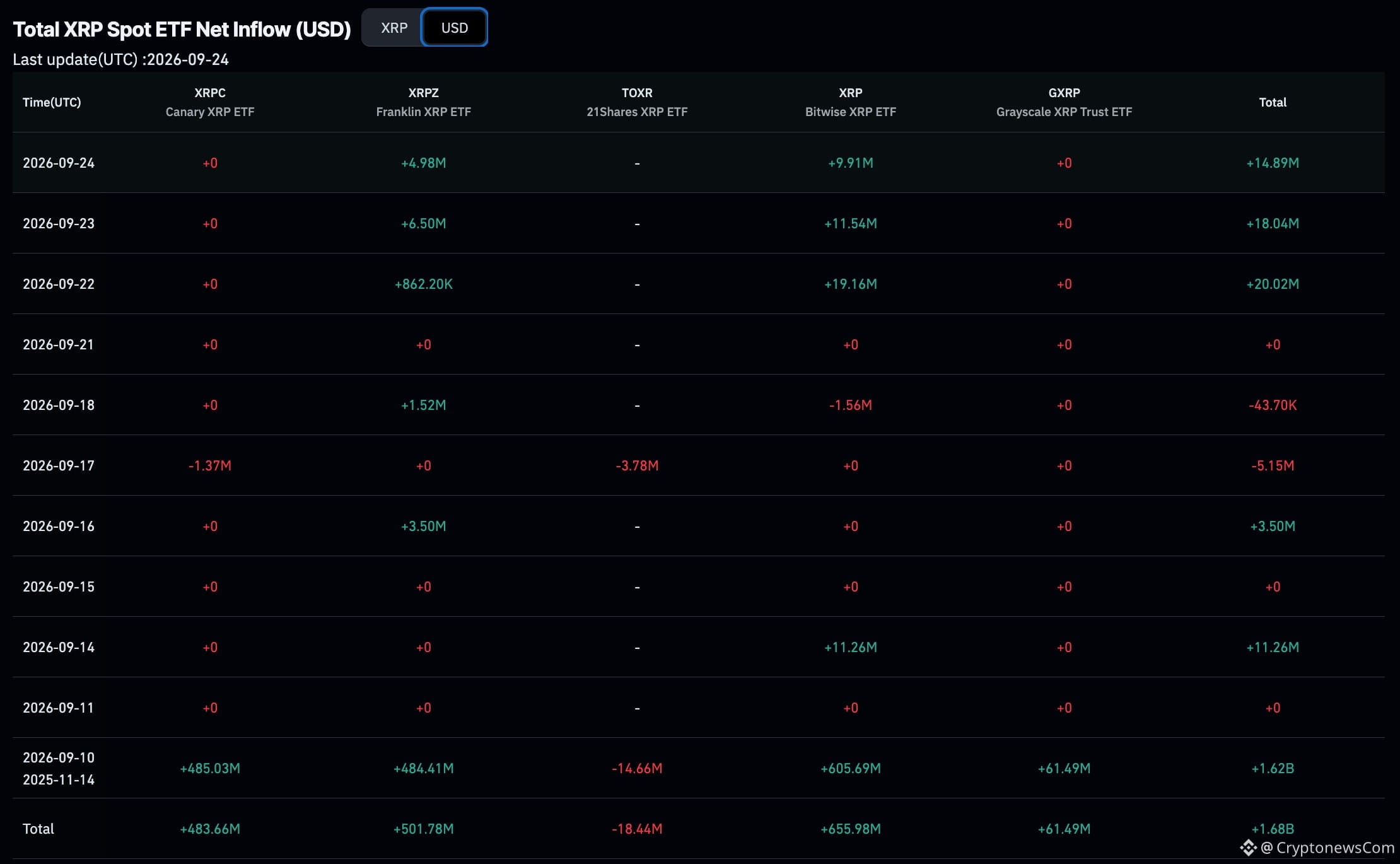
The move has been driven by real inflows. Spot ETF products tied to XRP pulled in $1.73 billion, and total ETF assets under management now sit near $1.7 billion. Absa’s launch of institutional digital asset custody with Ripple expanded regulated access across Africa.
XRP ETFs Flow, Coinglass
Meanwhile, the CFTC’s ongoing work on new crypto asset rules keeps compliance-driven capital watching the token closely. Community chatter has flagged a double-top forming near $1.55-$1.60, a pattern that makes technical traders nervous even when the fundamental backdrop looks constructive.
Broader crypto markets remain risk-on this week, but XRP’s own volatility tells a cautionary tale: a reported 15.8% surge on September 23 was followed almost immediately by a 6.9% pullback the next day. That whipsaw sets the stage for the technical breakdown below.
Earn $50 and Enter $300K Prize Draw on EdgeXXRP Price Prediction: Can Ripple Hit $1.63 This Week?
XRP is changing hands at $1.53, almost flat on the session after a volatile week that saw the price swing between $1.45 and $1.55. Daily volume has run near $4.5 billion, evidence that liquidity hasn’t dried up despite the choppiness.
The token holds above its MA-20, MA-50, and long-term MA-200, a generally constructive technical posture, with the Ichimoku Kijun line at $1.50 acting as immediate support. Momentum readings are mixed but lean positive: MACD signals buy, RSI sits in buy territory, yet ADX and CCI register neutral, and Stochastic RSI flags an oversold condition.
Xrp (XRP)
24h7d30d1yAll time
Bull case: a clean break above $1.60-$1.63 opens a path toward $1.66 and eventually $1.83.
Base case: consolidation inside the $1.4642-$1.6359 corridor, which carries a modeled 78% probability of resolving upward.
Bear case: a decisive loss of the $1.4642-$1.4800 support zone exposes $1.40-$1.41.
For a deeper breakdown of the resistance structure and Binance reserve trends shaping this setup, see this XRP price prediction analysis of the $1.63 test. Traders should treat $1.63 as the line that separates continuation from another round of chop.
Trade XRP on Bybit and Get a Chance to Win Our $1,000 USDT AirdropMaxi Doge Targets Early Mover Upside as XRP Tests Key Levels
XRP holders riding this week’s rally already have their answer on the upside. A breakout above $1.63 likely means single-digit percentage gains from here, not a multiple. That’s the reality of trading a token with XRP’s market cap.
Whale flows and futures positioning covered in this bullish October outlook for XRP support the near-term case, but anyone chasing outsized returns is looking in the wrong place. Early-stage presales are where that asymmetry still exists.
pic.twitter.com/Vg6OpDX6Bq
— MaxiDoge (@MaxiDoge_) August 13, 2026
Maxi Doge ($MAXI) is building exactly that kind of setup on Ethereum. The project has raised $4.8 million at a current presale price of $0.000284, with dynamic APY staking live for early participants. Its identity leans hard into gym-bro meme culture, a 240-lb canine mascot channeling 1000x leverage energy.
Holder-only trading competitions with leaderboard rewards, and a Maxi Fund treasury earmarked for liquidity and partnerships. The tagline says it plainly: never skip leg-day, never skip a pump.
Research Maxi Doge’s presale now before the funding window closes.
Discover: Best Crypto IPO this September
The post XRP Price Prediction: Weekly Gains Lead Crypto Market, But Can XRP Clear $1.63? appeared first on Cryptonews.
XRP Price Prediction: Weekly Gains Lead Crypto Market, But Can XRP Clear $1.63?
XRP price trades at $1.53, up by a marginal 1.5% on the day, and is still sitting on one of the strongest weekly charts among large-cap tokens, shrugging off bearish prediction. Zoom out to seven days, and the picture changes dramatically. Gains in the 17-18% range put XRP ahead of most of the top-10 field.
The move has been driven by real inflows. Spot ETF products tied to XRP pulled in $1.73 billion, and total ETF assets under management now sit near $1.7 billion. Absa’s launch of institutional digital asset custody with Ripple expanded regulated access across Africa.
XRP ETFs Flow, Coinglass
Meanwhile, the CFTC’s ongoing work on new crypto asset rules keeps compliance-driven capital watching the token closely. Community chatter has flagged a double-top forming near $1.55-$1.60, a pattern that makes technical traders nervous even when the fundamental backdrop looks constructive.
Broader crypto markets remain risk-on this week, but XRP’s own volatility tells a cautionary tale: a reported 15.8% surge on September 23 was followed almost immediately by a 6.9% pullback the next day. That whipsaw sets the stage for the technical breakdown below.
Earn $50 and Enter $300K Prize Draw on EdgeXXRP Price Prediction: Can Ripple Hit $1.63 This Week?
XRP is changing hands at $1.53, almost flat on the session after a volatile week that saw the price swing between $1.45 and $1.55. Daily volume has run near $4.5 billion, evidence that liquidity hasn’t dried up despite the choppiness.
The token holds above its MA-20, MA-50, and long-term MA-200, a generally constructive technical posture, with the Ichimoku Kijun line at $1.50 acting as immediate support. Momentum readings are mixed but lean positive: MACD signals buy, RSI sits in buy territory, yet ADX and CCI register neutral, and Stochastic RSI flags an oversold condition.
Xrp (XRP)
24h7d30d1yAll time
Bull case: a clean break above $1.60-$1.63 opens a path toward $1.66 and eventually $1.83.
Base case: consolidation inside the $1.4642-$1.6359 corridor, which carries a modeled 78% probability of resolving upward.
Bear case: a decisive loss of the $1.4642-$1.4800 support zone exposes $1.40-$1.41.
For a deeper breakdown of the resistance structure and Binance reserve trends shaping this setup, see this XRP price prediction analysis of the $1.63 test. Traders should treat $1.63 as the line that separates continuation from another round of chop.
Trade XRP on Bybit and Get a Chance to Win Our $1,000 USDT AirdropMaxi Doge Targets Early Mover Upside as XRP Tests Key Levels
XRP holders riding this week’s rally already have their answer on the upside. A breakout above $1.63 likely means single-digit percentage gains from here, not a multiple. That’s the reality of trading a token with XRP’s market cap.
Whale flows and futures positioning covered in this bullish October outlook for XRP support the near-term case, but anyone chasing outsized returns is looking in the wrong place. Early-stage presales are where that asymmetry still exists.
pic.twitter.com/Vg6OpDX6Bq
— MaxiDoge (@MaxiDoge_) August 13, 2026
Maxi Doge ($MAXI) is building exactly that kind of setup on Ethereum. The project has raised $4.8 million at a current presale price of $0.000284, with dynamic APY staking live for early participants. Its identity leans hard into gym-bro meme culture, a 240-lb canine mascot channeling 1000x leverage energy.
Holder-only trading competitions with leaderboard rewards, and a Maxi Fund treasury earmarked for liquidity and partnerships. The tagline says it plainly: never skip leg-day, never skip a pump.
Research Maxi Doge’s presale now before the funding window closes.
Discover: Best Crypto IPO this September
The post XRP Price Prediction: Weekly Gains Lead Crypto Market, But Can XRP Clear $1.63? appeared first on Cryptonews.
The move has been driven by real inflows. Spot ETF products tied to XRP pulled in $1.73 billion, and total ETF assets under management now sit near $1.7 billion. Absa’s launch of institutional digital asset custody with Ripple expanded regulated access across Africa.
XRP ETFs Flow, Coinglass
Meanwhile, the CFTC’s ongoing work on new crypto asset rules keeps compliance-driven capital watching the token closely. Community chatter has flagged a double-top forming near $1.55-$1.60, a pattern that makes technical traders nervous even when the fundamental backdrop looks constructive.
Broader crypto markets remain risk-on this week, but XRP’s own volatility tells a cautionary tale: a reported 15.8% surge on September 23 was followed almost immediately by a 6.9% pullback the next day. That whipsaw sets the stage for the technical breakdown below.
Earn $50 and Enter $300K Prize Draw on EdgeXXRP Price Prediction: Can Ripple Hit $1.63 This Week?
XRP is changing hands at $1.53, almost flat on the session after a volatile week that saw the price swing between $1.45 and $1.55. Daily volume has run near $4.5 billion, evidence that liquidity hasn’t dried up despite the choppiness.
The token holds above its MA-20, MA-50, and long-term MA-200, a generally constructive technical posture, with the Ichimoku Kijun line at $1.50 acting as immediate support. Momentum readings are mixed but lean positive: MACD signals buy, RSI sits in buy territory, yet ADX and CCI register neutral, and Stochastic RSI flags an oversold condition.
Xrp (XRP)
24h7d30d1yAll time
Bull case: a clean break above $1.60-$1.63 opens a path toward $1.66 and eventually $1.83.
Base case: consolidation inside the $1.4642-$1.6359 corridor, which carries a modeled 78% probability of resolving upward.
Bear case: a decisive loss of the $1.4642-$1.4800 support zone exposes $1.40-$1.41.
For a deeper breakdown of the resistance structure and Binance reserve trends shaping this setup, see this XRP price prediction analysis of the $1.63 test. Traders should treat $1.63 as the line that separates continuation from another round of chop.
Trade XRP on Bybit and Get a Chance to Win Our $1,000 USDT AirdropMaxi Doge Targets Early Mover Upside as XRP Tests Key Levels
XRP holders riding this week’s rally already have their answer on the upside. A breakout above $1.63 likely means single-digit percentage gains from here, not a multiple. That’s the reality of trading a token with XRP’s market cap.
Whale flows and futures positioning covered in this bullish October outlook for XRP support the near-term case, but anyone chasing outsized returns is looking in the wrong place. Early-stage presales are where that asymmetry still exists.
pic.twitter.com/Vg6OpDX6Bq
— MaxiDoge (@MaxiDoge_) August 13, 2026
Maxi Doge ($MAXI) is building exactly that kind of setup on Ethereum. The project has raised $4.8 million at a current presale price of $0.000284, with dynamic APY staking live for early participants. Its identity leans hard into gym-bro meme culture, a 240-lb canine mascot channeling 1000x leverage energy.
Holder-only trading competitions with leaderboard rewards, and a Maxi Fund treasury earmarked for liquidity and partnerships. The tagline says it plainly: never skip leg-day, never skip a pump.
Research Maxi Doge’s presale now before the funding window closes.
Discover: Best Crypto IPO this September
The post XRP Price Prediction: Weekly Gains Lead Crypto Market, But Can XRP Clear $1.63? appeared first on Cryptonews.
1
251

Article
Bitget Wallet Hack Steals $351.6M: Gracy Chen Points Finger at North KoreaBitget detected a hack involving $351.6 million in unauthorized transfers from parts of its wallet infrastructure and says its User Protection Fund, which it claims holds more than $464 million, covers the entire loss. Withdrawals remain suspended pending a security review, though deposits and trading continue uninterrupted.
Bitget’s security systems flagged the unauthorized activity within minutes of it starting, and emergency response protocols were activated immediately, according to the exchange’s own incident notice. The exchange has said it will not speculate on the attack vector until its internal investigation is complete.
BREAKING: Crypto exchange Bitget confirms a $351.6 million wallet hack, saying its $464 million User Protection Fund fully covers the affected amount.
— Polymarket (@Polymarket) September 24, 2026
The episode lands in a market that has already had to price in exchange-linked losses this year, from wallet exploits to platform-side fraud cases tied to major exchange customer losses elsewhere in the industry. Centralized custody risk hasn’t gone away just because reserves look large on a dashboard.
Trade Crypto Safely on Bybit and Get a Chance to Win Our $1,000 USDT AirdropNorth Korean Hacker Behind The Bitget Wallet Hack?
Bitget CEO Gracy Chen moved quickly to address the $351.6 million hack on X, confirming the wallet hack. Chen said the incident was detected at 18:31 UTC on September 24, with emergency response procedures activated within minutes. She also said Bitget’s cold wallets remained secure and that the exchange’s User Protection Fund held more than $464 million.
Chen later provided more detail during a livestream on X, saying attackers had compromised a backend system connected to Bitget’s wallet infrastructure. Rather than stealing private keys, the hackers allegedly manipulated transaction data and triggered the exchange’s own authorization process to move the funds.
Live about Bitget Hot Wallet Incident on September 24, 2026 https://t.co/limZaY2pRf
— Bitget (@bitget) September 24, 2026
The most explosive part of Chen’s comments was her suggestion that North Korean hackers may be behind the attack. She said Bitget’s preliminary investigation found IP addresses that matched VPN services associated with a North Korean hacking group. Chen also pointed to similarities with previous attacks attributed to North Korean operators, making the connection a key line of investigation.
Chen has stopped short of calling the attribution confirmed, however, describing North Korean involvement as “very likely” while investigators continue examining the evidence. Chen said Bitget does not currently believe the incident was an inside job, although the investigation remains ongoing.
Earn $50 and Enter $300K Prize Draw on EdgeXWhat About Bitget Users?
Withdrawals stay frozen until Bitget’s security review concludes, and the exchange has not committed to a specific reopening window in its official notice. Reporting from Bloomberg indicates Chen said a full incident report with root-cause analysis and corrective actions would follow within 24 hours of the disclosure.
Now, will withdrawals actually resume on the timeline Bitget signals? Will the promised incident report name a concrete root cause?
Trading and deposits continue, and Bitget says customer balances remain accurate and protected. Its $464 million User Protection Fund is also claimed to cover the reported $351.6 million loss.
What happens next depends on the security review. Bitget has not given a withdrawal reopening date, saying services will resume once the investigation is complete. Until then, users should follow official updates rather than assume the incident is fully resolved.
Discover: The Best Token Presales
The post Bitget Wallet Hack Steals $351.6M: Gracy Chen Points Finger at North Korea appeared first on Cryptonews.
Bitget Wallet Hack Steals $351.6M: Gracy Chen Points Finger at North Korea
Bitget detected a hack involving $351.6 million in unauthorized transfers from parts of its wallet infrastructure and says its User Protection Fund, which it claims holds more than $464 million, covers the entire loss. Withdrawals remain suspended pending a security review, though deposits and trading continue uninterrupted.
Bitget’s security systems flagged the unauthorized activity within minutes of it starting, and emergency response protocols were activated immediately, according to the exchange’s own incident notice. The exchange has said it will not speculate on the attack vector until its internal investigation is complete.
BREAKING: Crypto exchange Bitget confirms a $351.6 million wallet hack, saying its $464 million User Protection Fund fully covers the affected amount.
— Polymarket (@Polymarket) September 24, 2026
The episode lands in a market that has already had to price in exchange-linked losses this year, from wallet exploits to platform-side fraud cases tied to major exchange customer losses elsewhere in the industry. Centralized custody risk hasn’t gone away just because reserves look large on a dashboard.
Trade Crypto Safely on Bybit and Get a Chance to Win Our $1,000 USDT AirdropNorth Korean Hacker Behind The Bitget Wallet Hack?
Bitget CEO Gracy Chen moved quickly to address the $351.6 million hack on X, confirming the wallet hack. Chen said the incident was detected at 18:31 UTC on September 24, with emergency response procedures activated within minutes. She also said Bitget’s cold wallets remained secure and that the exchange’s User Protection Fund held more than $464 million.
Chen later provided more detail during a livestream on X, saying attackers had compromised a backend system connected to Bitget’s wallet infrastructure. Rather than stealing private keys, the hackers allegedly manipulated transaction data and triggered the exchange’s own authorization process to move the funds.
Live about Bitget Hot Wallet Incident on September 24, 2026 https://t.co/limZaY2pRf
— Bitget (@bitget) September 24, 2026
The most explosive part of Chen’s comments was her suggestion that North Korean hackers may be behind the attack. She said Bitget’s preliminary investigation found IP addresses that matched VPN services associated with a North Korean hacking group. Chen also pointed to similarities with previous attacks attributed to North Korean operators, making the connection a key line of investigation.
Chen has stopped short of calling the attribution confirmed, however, describing North Korean involvement as “very likely” while investigators continue examining the evidence. Chen said Bitget does not currently believe the incident was an inside job, although the investigation remains ongoing.
Earn $50 and Enter $300K Prize Draw on EdgeXWhat About Bitget Users?
Withdrawals stay frozen until Bitget’s security review concludes, and the exchange has not committed to a specific reopening window in its official notice. Reporting from Bloomberg indicates Chen said a full incident report with root-cause analysis and corrective actions would follow within 24 hours of the disclosure.
Now, will withdrawals actually resume on the timeline Bitget signals? Will the promised incident report name a concrete root cause?
Trading and deposits continue, and Bitget says customer balances remain accurate and protected. Its $464 million User Protection Fund is also claimed to cover the reported $351.6 million loss.
What happens next depends on the security review. Bitget has not given a withdrawal reopening date, saying services will resume once the investigation is complete. Until then, users should follow official updates rather than assume the incident is fully resolved.
Discover: The Best Token Presales
The post Bitget Wallet Hack Steals $351.6M: Gracy Chen Points Finger at North Korea appeared first on Cryptonews.
Bitget’s security systems flagged the unauthorized activity within minutes of it starting, and emergency response protocols were activated immediately, according to the exchange’s own incident notice. The exchange has said it will not speculate on the attack vector until its internal investigation is complete.
BREAKING: Crypto exchange Bitget confirms a $351.6 million wallet hack, saying its $464 million User Protection Fund fully covers the affected amount.
— Polymarket (@Polymarket) September 24, 2026
The episode lands in a market that has already had to price in exchange-linked losses this year, from wallet exploits to platform-side fraud cases tied to major exchange customer losses elsewhere in the industry. Centralized custody risk hasn’t gone away just because reserves look large on a dashboard.
Trade Crypto Safely on Bybit and Get a Chance to Win Our $1,000 USDT AirdropNorth Korean Hacker Behind The Bitget Wallet Hack?
Bitget CEO Gracy Chen moved quickly to address the $351.6 million hack on X, confirming the wallet hack. Chen said the incident was detected at 18:31 UTC on September 24, with emergency response procedures activated within minutes. She also said Bitget’s cold wallets remained secure and that the exchange’s User Protection Fund held more than $464 million.
Chen later provided more detail during a livestream on X, saying attackers had compromised a backend system connected to Bitget’s wallet infrastructure. Rather than stealing private keys, the hackers allegedly manipulated transaction data and triggered the exchange’s own authorization process to move the funds.
Live about Bitget Hot Wallet Incident on September 24, 2026 https://t.co/limZaY2pRf
— Bitget (@bitget) September 24, 2026
The most explosive part of Chen’s comments was her suggestion that North Korean hackers may be behind the attack. She said Bitget’s preliminary investigation found IP addresses that matched VPN services associated with a North Korean hacking group. Chen also pointed to similarities with previous attacks attributed to North Korean operators, making the connection a key line of investigation.
Chen has stopped short of calling the attribution confirmed, however, describing North Korean involvement as “very likely” while investigators continue examining the evidence. Chen said Bitget does not currently believe the incident was an inside job, although the investigation remains ongoing.
Earn $50 and Enter $300K Prize Draw on EdgeXWhat About Bitget Users?
Withdrawals stay frozen until Bitget’s security review concludes, and the exchange has not committed to a specific reopening window in its official notice. Reporting from Bloomberg indicates Chen said a full incident report with root-cause analysis and corrective actions would follow within 24 hours of the disclosure.
Now, will withdrawals actually resume on the timeline Bitget signals? Will the promised incident report name a concrete root cause?
Trading and deposits continue, and Bitget says customer balances remain accurate and protected. Its $464 million User Protection Fund is also claimed to cover the reported $351.6 million loss.
What happens next depends on the security review. Bitget has not given a withdrawal reopening date, saying services will resume once the investigation is complete. Until then, users should follow official updates rather than assume the incident is fully resolved.
Discover: The Best Token Presales
The post Bitget Wallet Hack Steals $351.6M: Gracy Chen Points Finger at North Korea appeared first on Cryptonews.
227

Article
Microsoft Copilot AI Predicts Bitcoin Will Do Something Incredible in Q4 2026Microsoft Copilot AI predicts a wild move for BTC in Q4 2026, calling it one of the strongest asymmetric risk-reward positions available. The base case sits at $140,000 to $180,000. A credible bull case reaches $200,000 to $250,000 if institutional demand actually accelerates from here.
The catalyst list is long, but the underlying logic is simple. Continued spot ETF inflows, expanding wealth management distribution, and growing corporate treasury adoption all pull the same lever: more structural buyers competing for a shrinking pool of coins.
After the 2024 halving, supply constraints are already in effect. Layer declining exchange balances and long-term holder accumulation on top, and Microsoft Copilot AI sees a market where sellers are becoming scarce at the exact moment demand keeps widening.
Source: Microsoft Copilot AI Bitcoin Price Prediction
Macro matters here, too. Improving global liquidity if the Fed eases, broader regulatory clarity, and early participation by sovereign or pension funds would all push in the same direction.
Microsoft Copilot AI frames Bitcoin’s evolving role as a strategic reserve asset and digital gold as the connective thread running through it all. The argument is that even modest institutional allocations could absorb a meaningful share of new issuance, given how constrained supply already is.
The bear case is not soft. Persistent high rates, weaker liquidity, ETF outflows, a recession-driven flight from risk, geopolitical shocks, or adverse regulation could all delay institutional adoption.
In that bearish scenario, Microsoft Copilot sees Bitcoin stuck in a $60,000 to $80,000 range before any longer-term uptrend resumes. Notably, the model draws a hard line at $60,000, arguing that sustained trading below it would require actual macro tightening and real institutional outflows, not just a normal pullback.
Bitcoin (BTC)
24h7d30d1yAll time
Bitcoin Price Prediction: Five Years On A Weekly Chart Says This Is Still The Same Cycle
Zoom out to the weekly, and the story changes shape entirely. Bitcoin closed yesterday above $84,000, essentially flat, with a range between $83,600 and $86,600.
From the 2022 bear market low, the climb into 2025 was one of the cleanest uptrends this asset has ever produced, breaking cleanly above the old 2021 highs and pushing toward $128,000 by late 2025.
What followed was a sharp, multi-month correction that brought the price back to a level it last visited over a year ago. It has since pushed back above $80,000 following a two-week period of bullish price action across the market.
$BTC is above all its key levels, which confirms a cycle bottom.
But that doesn't mean up-only.
IMO, Bitcoin will have an 8%-10% correction from here to flush out late longs. pic.twitter.com/6hcvO5ziQ0
— Ted (@TedPillows) September 23, 2026
Support on this weekly view sits at $80,000, a level defended multiple times across March and April 2025 before the breakout. Below that, $73,000 marks the last major consolidation floor from earlier in the cycle.
Resistance is layered higher up, first at $84,000, then a heavier ceiling near $92,000 to $120,000, where the 2025 top formed. Reclaiming that zone would be the first real signal that the uptrend has resumed rather than just paused.
Momentum on the weekly is neutral, neither compressed nor extended, which fits a market that has spent months digesting a major move rather than trending in either direction.
For the ‘Microsoft Copilot AI predicts’ 2027 targets to play out, this current range needs to resolve as a pause within a longer uptrend, not the top of one. The chart itself hasn’t answered that question yet.
Here is What Microsoft Copilot AI Predicts About LiquidChain
Most people will only recognize this shift in hindsight. Smart investors have already made their moves. Large-cap tokens are still finding their feet in this growing bull market structure, but they aren’t going parabolic just yet.
Bitcoin, Ethereum, and XRP are all testing key resistance levels right now. Each favorable macro trend has a new expected timeline, and the true institutional investment wave is expected to arrive next quarter.
Investing in assets where growth depends solely on someone else’s decision isn’t a solid strategy; it’s just waiting in a waiting room. Capital that has weathered numerous market cycles understands one key point: it moves before the destination becomes clear.
Early-stage infrastructure plays by completely different rules. A small market cap means that a modest rotation can produce dramatic price movement.
The returns live in the gap between what something is genuinely worth and what the market has assigned it so far. That gap exists only while the project remains undiscovered. Once found, it closes permanently.
Multi-chain fragmentation bleeds DeFi every day. Bitcoin, Ethereum, and Solana exist as completely isolated systems. No native bridge between them. Every user crossing those boundaries absorbs the cost directly in fees, slippage, and failed transactions. Every single crossing. Every single time.
Microsoft Copilot AI predicts LiquidChain fixes this entirely. All 3 networks within a single execution layer. One deployment reaches everything. Zero cross-chain tax on any interaction.
The presale is at $0.014958 with just over $972,000 raised. The market has not fully discovered this yet, and that is exactly the point.
Gain Special Access to Layer 3 Trading Here
Don’t Miss: The Hottest Meme Coin Opportunities Silently Climbing the Crypto Ranks in September
The post Microsoft Copilot AI Predicts Bitcoin Will Do Something Incredible in Q4 2026 appeared first on Cryptonews.
Microsoft Copilot AI Predicts Bitcoin Will Do Something Incredible in Q4 2026
Microsoft Copilot AI predicts a wild move for BTC in Q4 2026, calling it one of the strongest asymmetric risk-reward positions available. The base case sits at $140,000 to $180,000. A credible bull case reaches $200,000 to $250,000 if institutional demand actually accelerates from here.
The catalyst list is long, but the underlying logic is simple. Continued spot ETF inflows, expanding wealth management distribution, and growing corporate treasury adoption all pull the same lever: more structural buyers competing for a shrinking pool of coins.
After the 2024 halving, supply constraints are already in effect. Layer declining exchange balances and long-term holder accumulation on top, and Microsoft Copilot AI sees a market where sellers are becoming scarce at the exact moment demand keeps widening.
Source: Microsoft Copilot AI Bitcoin Price Prediction
Macro matters here, too. Improving global liquidity if the Fed eases, broader regulatory clarity, and early participation by sovereign or pension funds would all push in the same direction.
Microsoft Copilot AI frames Bitcoin’s evolving role as a strategic reserve asset and digital gold as the connective thread running through it all. The argument is that even modest institutional allocations could absorb a meaningful share of new issuance, given how constrained supply already is.
The bear case is not soft. Persistent high rates, weaker liquidity, ETF outflows, a recession-driven flight from risk, geopolitical shocks, or adverse regulation could all delay institutional adoption.
In that bearish scenario, Microsoft Copilot sees Bitcoin stuck in a $60,000 to $80,000 range before any longer-term uptrend resumes. Notably, the model draws a hard line at $60,000, arguing that sustained trading below it would require actual macro tightening and real institutional outflows, not just a normal pullback.
Bitcoin (BTC)
24h7d30d1yAll time
Bitcoin Price Prediction: Five Years On A Weekly Chart Says This Is Still The Same Cycle
Zoom out to the weekly, and the story changes shape entirely. Bitcoin closed yesterday above $84,000, essentially flat, with a range between $83,600 and $86,600.
From the 2022 bear market low, the climb into 2025 was one of the cleanest uptrends this asset has ever produced, breaking cleanly above the old 2021 highs and pushing toward $128,000 by late 2025.
What followed was a sharp, multi-month correction that brought the price back to a level it last visited over a year ago. It has since pushed back above $80,000 following a two-week period of bullish price action across the market.
$BTC is above all its key levels, which confirms a cycle bottom.
But that doesn't mean up-only.
IMO, Bitcoin will have an 8%-10% correction from here to flush out late longs. pic.twitter.com/6hcvO5ziQ0
— Ted (@TedPillows) September 23, 2026
Support on this weekly view sits at $80,000, a level defended multiple times across March and April 2025 before the breakout. Below that, $73,000 marks the last major consolidation floor from earlier in the cycle.
Resistance is layered higher up, first at $84,000, then a heavier ceiling near $92,000 to $120,000, where the 2025 top formed. Reclaiming that zone would be the first real signal that the uptrend has resumed rather than just paused.
Momentum on the weekly is neutral, neither compressed nor extended, which fits a market that has spent months digesting a major move rather than trending in either direction.
For the ‘Microsoft Copilot AI predicts’ 2027 targets to play out, this current range needs to resolve as a pause within a longer uptrend, not the top of one. The chart itself hasn’t answered that question yet.
Here is What Microsoft Copilot AI Predicts About LiquidChain
Most people will only recognize this shift in hindsight. Smart investors have already made their moves. Large-cap tokens are still finding their feet in this growing bull market structure, but they aren’t going parabolic just yet.
Bitcoin, Ethereum, and XRP are all testing key resistance levels right now. Each favorable macro trend has a new expected timeline, and the true institutional investment wave is expected to arrive next quarter.
Investing in assets where growth depends solely on someone else’s decision isn’t a solid strategy; it’s just waiting in a waiting room. Capital that has weathered numerous market cycles understands one key point: it moves before the destination becomes clear.
Early-stage infrastructure plays by completely different rules. A small market cap means that a modest rotation can produce dramatic price movement.
The returns live in the gap between what something is genuinely worth and what the market has assigned it so far. That gap exists only while the project remains undiscovered. Once found, it closes permanently.
Multi-chain fragmentation bleeds DeFi every day. Bitcoin, Ethereum, and Solana exist as completely isolated systems. No native bridge between them. Every user crossing those boundaries absorbs the cost directly in fees, slippage, and failed transactions. Every single crossing. Every single time.
Microsoft Copilot AI predicts LiquidChain fixes this entirely. All 3 networks within a single execution layer. One deployment reaches everything. Zero cross-chain tax on any interaction.
The presale is at $0.014958 with just over $972,000 raised. The market has not fully discovered this yet, and that is exactly the point.
Gain Special Access to Layer 3 Trading Here
Don’t Miss: The Hottest Meme Coin Opportunities Silently Climbing the Crypto Ranks in September
The post Microsoft Copilot AI Predicts Bitcoin Will Do Something Incredible in Q4 2026 appeared first on Cryptonews.
The catalyst list is long, but the underlying logic is simple. Continued spot ETF inflows, expanding wealth management distribution, and growing corporate treasury adoption all pull the same lever: more structural buyers competing for a shrinking pool of coins.
After the 2024 halving, supply constraints are already in effect. Layer declining exchange balances and long-term holder accumulation on top, and Microsoft Copilot AI sees a market where sellers are becoming scarce at the exact moment demand keeps widening.
Source: Microsoft Copilot AI Bitcoin Price Prediction
Macro matters here, too. Improving global liquidity if the Fed eases, broader regulatory clarity, and early participation by sovereign or pension funds would all push in the same direction.
Microsoft Copilot AI frames Bitcoin’s evolving role as a strategic reserve asset and digital gold as the connective thread running through it all. The argument is that even modest institutional allocations could absorb a meaningful share of new issuance, given how constrained supply already is.
The bear case is not soft. Persistent high rates, weaker liquidity, ETF outflows, a recession-driven flight from risk, geopolitical shocks, or adverse regulation could all delay institutional adoption.
In that bearish scenario, Microsoft Copilot sees Bitcoin stuck in a $60,000 to $80,000 range before any longer-term uptrend resumes. Notably, the model draws a hard line at $60,000, arguing that sustained trading below it would require actual macro tightening and real institutional outflows, not just a normal pullback.
Bitcoin (BTC)
24h7d30d1yAll time
Bitcoin Price Prediction: Five Years On A Weekly Chart Says This Is Still The Same Cycle
Zoom out to the weekly, and the story changes shape entirely. Bitcoin closed yesterday above $84,000, essentially flat, with a range between $83,600 and $86,600.
From the 2022 bear market low, the climb into 2025 was one of the cleanest uptrends this asset has ever produced, breaking cleanly above the old 2021 highs and pushing toward $128,000 by late 2025.
What followed was a sharp, multi-month correction that brought the price back to a level it last visited over a year ago. It has since pushed back above $80,000 following a two-week period of bullish price action across the market.
$BTC is above all its key levels, which confirms a cycle bottom.
But that doesn't mean up-only.
IMO, Bitcoin will have an 8%-10% correction from here to flush out late longs. pic.twitter.com/6hcvO5ziQ0
— Ted (@TedPillows) September 23, 2026
Support on this weekly view sits at $80,000, a level defended multiple times across March and April 2025 before the breakout. Below that, $73,000 marks the last major consolidation floor from earlier in the cycle.
Resistance is layered higher up, first at $84,000, then a heavier ceiling near $92,000 to $120,000, where the 2025 top formed. Reclaiming that zone would be the first real signal that the uptrend has resumed rather than just paused.
Momentum on the weekly is neutral, neither compressed nor extended, which fits a market that has spent months digesting a major move rather than trending in either direction.
For the ‘Microsoft Copilot AI predicts’ 2027 targets to play out, this current range needs to resolve as a pause within a longer uptrend, not the top of one. The chart itself hasn’t answered that question yet.
Here is What Microsoft Copilot AI Predicts About LiquidChain
Most people will only recognize this shift in hindsight. Smart investors have already made their moves. Large-cap tokens are still finding their feet in this growing bull market structure, but they aren’t going parabolic just yet.
Bitcoin, Ethereum, and XRP are all testing key resistance levels right now. Each favorable macro trend has a new expected timeline, and the true institutional investment wave is expected to arrive next quarter.
Investing in assets where growth depends solely on someone else’s decision isn’t a solid strategy; it’s just waiting in a waiting room. Capital that has weathered numerous market cycles understands one key point: it moves before the destination becomes clear.
Early-stage infrastructure plays by completely different rules. A small market cap means that a modest rotation can produce dramatic price movement.
The returns live in the gap between what something is genuinely worth and what the market has assigned it so far. That gap exists only while the project remains undiscovered. Once found, it closes permanently.
Multi-chain fragmentation bleeds DeFi every day. Bitcoin, Ethereum, and Solana exist as completely isolated systems. No native bridge between them. Every user crossing those boundaries absorbs the cost directly in fees, slippage, and failed transactions. Every single crossing. Every single time.
Microsoft Copilot AI predicts LiquidChain fixes this entirely. All 3 networks within a single execution layer. One deployment reaches everything. Zero cross-chain tax on any interaction.
The presale is at $0.014958 with just over $972,000 raised. The market has not fully discovered this yet, and that is exactly the point.
Gain Special Access to Layer 3 Trading Here
Don’t Miss: The Hottest Meme Coin Opportunities Silently Climbing the Crypto Ranks in September
The post Microsoft Copilot AI Predicts Bitcoin Will Do Something Incredible in Q4 2026 appeared first on Cryptonews.
110
XRP Price Under Pressure: Spot Selling Overwhelms ETF DemandXRP price is hovering at the $1.50 level, down 8% over the prior 24 hours after failing to hold the $1.60 level. The drop happens even as U.S. spot XRP ETFs pulled in $18.04 million in net inflows during the previous session. The gap forces a blunt question onto the desk: if demand for regulated funds keeps showing up and the token still can’t hold its highs, how much weight does that demand actually carry against spot-market selling?
Xrp (XRP)
24h7d30d1yAll time
XRP’s 24-hour range ran from $1.60 down to $1.46, meaning the token was sitting at the bottom of its own daily band. Market capitalization fell to $92 billion, keeping XRP fifth by market cap. Against Bitcoin, XRP slipped 5.6% to 0.00001755 BTC, confirming the move wasn’t purely a dollar-denominated dip.
Discover: Best Crypto IPO this September
Why ETF Inflows Did Not Stop XRP Price Drop?
The Bitwise XRP ETF led Tuesday’s inflows with $11.54 million, lifting its cumulative total to $646.08 million, while Franklin Templeton’s XRPZ added $6.50 million to reach $496.80 million cumulatively. Across all XRP ETFs, net inflows reached $18.04 million, taking cumulative inflows since launch to roughly $1.67 billion.
Total net assets actually fell from $1.731 billion in the prior session despite the fresh inflows. That decline can be explained by XRP’s lower price, which reduced the market value of the tokens already held by the funds.
The scale of the new money also remains relatively small compared with XRP’s spot market. The $18.04 million ETF inflow represented roughly 0.44% of the $4.1 billion in XRP spot volume over 24 hours. The two measurements use different time windows, with ETF flows covering a U.S. trading session and spot volume covering a rolling 24-hour period, but the comparison still shows the ETF inflow was modest relative to overall trading activity.
XRP ETF, Coinglass
CoinGecko’s own market note points to profit-taking as the session’s primary driver. XRP price ran from about $1.29 to $1.38 on September 18, then pushed toward $1.60 over the following days. It was a move that left recent buyers sitting on gains once the price stalled below resistance.
Elevated Binance deposits add a possible distribution signal to that story, but a deposit isn’t a sale. Tokens moving onto an exchange can reflect trading, market-making, custody shifts, or collateral posting just as easily as outright liquidation.
On-chain data adds a second layer. Santiment put XRP’s 365-day MVRV ratio at -11.75% on September 23, meaning the average holder active over the past year is sitting on an unrealized loss. That’s consistent with rallies drawing sell orders from traders trying to reduce exposure.
Earn $50 and Enter $300K Prize Draw on EdgeXTechnical Levels: $1.60 Rejection and $1.45 Support
The sell-off unfolded in three distinct legs. XRP traded near $1.60 late on September 23 before the first sharp break, which took it from $1.58 to about $1.52. It then chopped sideways between $1.49 and $1.52 overnight, with a failed recovery attempt lifting the price back toward $1.52 near 11:00 IST on September 24 before buyers gave up.
The final leg started after 13:45 IST, when XRP broke below $1.48 and reached $1.46 by roughly 15:00 IST. That marks a second failed attempt this week to establish price above the $1.60 zone, following a similar test on September 22.
These are reference points drawn from recent trading, not forecasts. XRP’s futures positioning around the move matters for how sharp the next leg gets, since a crowded book on either side tends to accelerate whichever direction price breaks.
Trade XRP on Bybit and Get a Chance to Win Our $1,000 USDT Airdrop
The post XRP Price Under Pressure: Spot Selling Overwhelms ETF Demand appeared first on Cryptonews.
XRP Price Under Pressure: Spot Selling Overwhelms ETF Demand
XRP price is hovering at the $1.50 level, down 8% over the prior 24 hours after failing to hold the $1.60 level. The drop happens even as U.S. spot XRP ETFs pulled in $18.04 million in net inflows during the previous session. The gap forces a blunt question onto the desk: if demand for regulated funds keeps showing up and the token still can’t hold its highs, how much weight does that demand actually carry against spot-market selling?
Xrp (XRP)
24h7d30d1yAll time
XRP’s 24-hour range ran from $1.60 down to $1.46, meaning the token was sitting at the bottom of its own daily band. Market capitalization fell to $92 billion, keeping XRP fifth by market cap. Against Bitcoin, XRP slipped 5.6% to 0.00001755 BTC, confirming the move wasn’t purely a dollar-denominated dip.
Discover: Best Crypto IPO this September
Why ETF Inflows Did Not Stop XRP Price Drop?
The Bitwise XRP ETF led Tuesday’s inflows with $11.54 million, lifting its cumulative total to $646.08 million, while Franklin Templeton’s XRPZ added $6.50 million to reach $496.80 million cumulatively. Across all XRP ETFs, net inflows reached $18.04 million, taking cumulative inflows since launch to roughly $1.67 billion.
Total net assets actually fell from $1.731 billion in the prior session despite the fresh inflows. That decline can be explained by XRP’s lower price, which reduced the market value of the tokens already held by the funds.
The scale of the new money also remains relatively small compared with XRP’s spot market. The $18.04 million ETF inflow represented roughly 0.44% of the $4.1 billion in XRP spot volume over 24 hours. The two measurements use different time windows, with ETF flows covering a U.S. trading session and spot volume covering a rolling 24-hour period, but the comparison still shows the ETF inflow was modest relative to overall trading activity.
XRP ETF, Coinglass
CoinGecko’s own market note points to profit-taking as the session’s primary driver. XRP price ran from about $1.29 to $1.38 on September 18, then pushed toward $1.60 over the following days. It was a move that left recent buyers sitting on gains once the price stalled below resistance.
Elevated Binance deposits add a possible distribution signal to that story, but a deposit isn’t a sale. Tokens moving onto an exchange can reflect trading, market-making, custody shifts, or collateral posting just as easily as outright liquidation.
On-chain data adds a second layer. Santiment put XRP’s 365-day MVRV ratio at -11.75% on September 23, meaning the average holder active over the past year is sitting on an unrealized loss. That’s consistent with rallies drawing sell orders from traders trying to reduce exposure.
Earn $50 and Enter $300K Prize Draw on EdgeXTechnical Levels: $1.60 Rejection and $1.45 Support
The sell-off unfolded in three distinct legs. XRP traded near $1.60 late on September 23 before the first sharp break, which took it from $1.58 to about $1.52. It then chopped sideways between $1.49 and $1.52 overnight, with a failed recovery attempt lifting the price back toward $1.52 near 11:00 IST on September 24 before buyers gave up.
The final leg started after 13:45 IST, when XRP broke below $1.48 and reached $1.46 by roughly 15:00 IST. That marks a second failed attempt this week to establish price above the $1.60 zone, following a similar test on September 22.
These are reference points drawn from recent trading, not forecasts. XRP’s futures positioning around the move matters for how sharp the next leg gets, since a crowded book on either side tends to accelerate whichever direction price breaks.
Trade XRP on Bybit and Get a Chance to Win Our $1,000 USDT Airdrop
The post XRP Price Under Pressure: Spot Selling Overwhelms ETF Demand appeared first on Cryptonews.
Xrp (XRP)
24h7d30d1yAll time
XRP’s 24-hour range ran from $1.60 down to $1.46, meaning the token was sitting at the bottom of its own daily band. Market capitalization fell to $92 billion, keeping XRP fifth by market cap. Against Bitcoin, XRP slipped 5.6% to 0.00001755 BTC, confirming the move wasn’t purely a dollar-denominated dip.
Discover: Best Crypto IPO this September
Why ETF Inflows Did Not Stop XRP Price Drop?
The Bitwise XRP ETF led Tuesday’s inflows with $11.54 million, lifting its cumulative total to $646.08 million, while Franklin Templeton’s XRPZ added $6.50 million to reach $496.80 million cumulatively. Across all XRP ETFs, net inflows reached $18.04 million, taking cumulative inflows since launch to roughly $1.67 billion.
Total net assets actually fell from $1.731 billion in the prior session despite the fresh inflows. That decline can be explained by XRP’s lower price, which reduced the market value of the tokens already held by the funds.
The scale of the new money also remains relatively small compared with XRP’s spot market. The $18.04 million ETF inflow represented roughly 0.44% of the $4.1 billion in XRP spot volume over 24 hours. The two measurements use different time windows, with ETF flows covering a U.S. trading session and spot volume covering a rolling 24-hour period, but the comparison still shows the ETF inflow was modest relative to overall trading activity.
XRP ETF, Coinglass
CoinGecko’s own market note points to profit-taking as the session’s primary driver. XRP price ran from about $1.29 to $1.38 on September 18, then pushed toward $1.60 over the following days. It was a move that left recent buyers sitting on gains once the price stalled below resistance.
Elevated Binance deposits add a possible distribution signal to that story, but a deposit isn’t a sale. Tokens moving onto an exchange can reflect trading, market-making, custody shifts, or collateral posting just as easily as outright liquidation.
On-chain data adds a second layer. Santiment put XRP’s 365-day MVRV ratio at -11.75% on September 23, meaning the average holder active over the past year is sitting on an unrealized loss. That’s consistent with rallies drawing sell orders from traders trying to reduce exposure.
Earn $50 and Enter $300K Prize Draw on EdgeXTechnical Levels: $1.60 Rejection and $1.45 Support
The sell-off unfolded in three distinct legs. XRP traded near $1.60 late on September 23 before the first sharp break, which took it from $1.58 to about $1.52. It then chopped sideways between $1.49 and $1.52 overnight, with a failed recovery attempt lifting the price back toward $1.52 near 11:00 IST on September 24 before buyers gave up.
The final leg started after 13:45 IST, when XRP broke below $1.48 and reached $1.46 by roughly 15:00 IST. That marks a second failed attempt this week to establish price above the $1.60 zone, following a similar test on September 22.
These are reference points drawn from recent trading, not forecasts. XRP’s futures positioning around the move matters for how sharp the next leg gets, since a crowded book on either side tends to accelerate whichever direction price breaks.
Trade XRP on Bybit and Get a Chance to Win Our $1,000 USDT Airdrop
The post XRP Price Under Pressure: Spot Selling Overwhelms ETF Demand appeared first on Cryptonews.
109

Article
Bab Al-Mandeb Strait Betting Odds Hit 18% as Price Hinges on a Data TriggerPolymarket traders are pricing an 18% implied probability that the Bab Al-Mandeb Strait betting odds meet the platform’s definition of “effectively closed” before December 31, 2026, based on the market’s live pricing as of its September 24 update.
The contract does not require any government or naval authority to declare the waterway shut; it resolves Yes only if IMF PortWatch records a seven-day moving average of 10 or fewer ship arrivals on any date before the deadline.
SOURCE: Polymarket Bab Al Mandeb Strait Betting Odds
That distinction matters more than the headline number. Shipping through the strait has collapsed by most measures on record, but collapse and the contract’s specific data trigger are not the same thing.
Also, nothing in the available reporting confirms that the seven-day threshold has actually been crossed. Polymarket has run into this same verification gap before on Houthi-linked contracts, where ground-truth confirmation lags the market’s appetite for a clean binary answer.
Bitcoin (BTC)
24h7d30d1yAll time
Bab Al Mandeb Strait Betting Odds: What Does the Shipping Data Actually Show?
Houthi forces seized Yemen’s Red Sea coastline, the port of Mokha, Perim (Mayun) Island, and the Hanish Islands in mid-September, putting the group in control of both shores flanking the strait. No government or maritime authority has declared Bab el-Mandeb closed, but the traffic figures reported since then are stark and inconsistent across time windows.
Anadolu Agency reported on September 17 that only four vessels transited the strait in the preceding 24 hours, against a roughly 33-vessel daily norm, an 88% decline, with oil and chemical tanker traffic down 91% and container ship traffic down 86%.
Six days earlier, the same outlet cited Kpler data putting daily transits at around 26 to 27 vessels, a steep drop from the roughly 70-vessel pre-crisis baseline but nowhere near the four-vessel reading that followed.
Those two figures are not contradictory. They’re different windows capturing different moments in a fast-moving blockade. A single 24-hour count of four vessels is not a seven-day moving average, and a seven-day average sitting anywhere from 15 to 27 vessels a day.
JUST IN: Iran threatens to shut down the Bab el-Mandeb Strait.
"Linking the Strait of Hormuz and the Bab el-Mandeb will change the battlefield."
— BRICS News (@BRICSinfo) September 24, 2026
Have Your Say on the Al Mandeb Strait Closure on PolymarketThe Houthi Claim and the Contract’s Blind Spot
The Houthis maintain they are enforcing a targeted embargo on Saudi-linked shipping while asserting safe passage for other vessels, a claim attributed to the group and not independently verified in the available reporting.
International statements have emphasized freedom of navigation under UNCLOS, but assurances of safe passage from a party controlling both shores of the strait carry obvious credibility limits that the PortWatch data trigger sidesteps entirely.
That’s the core tension embedded in this market. Geopolitical risk around Bab el-Mandeb is plainly elevated, with rerouting around the Cape of Good Hope, rising insurance premiums, and the broader Iran-linked regional conflict all pressuring the corridor.
But the Polymarket contract pays out only on a narrow statistical condition, not on the broader sense that the route has become commercially unusable. Polymarket has drawn this same line before on other geopolitical contracts, where the news cycle outran the specific resolution language written into the market.
Yemen's Houthis show off seized Saudi military gear
Yemen's Iran-backed Houthis release drone footage of the Bab al-Mandeb Strait, as well as images of Saudi military equipment and bases they claim to have seized in and around Mocha and Dhubab. pic.twitter.com/SpYjHZ9yte
— AFP News Agency (@AFP) September 24, 2026
Bab Al Mandeb Strait Scenarios Into Year-End
If the IMF PortWatch seven-day average shows 10 or fewer arrivals on a qualifying date before December 31, the Yes side resolves immediately, meaning one bad week could settle the contract.
If arrivals stay in the mid-teens to mid-20s, uncertainty remains without triggering resolution, despite the high war-risk premiums shippers face. Restoring daily counts above 10 would likely reduce the 18% price, though historical reactions to data prints aren’t specified.
The key takeaway for traders is to understand resolution criteria before interpreting headline probabilities, since the 18% price reflects contract specifics rather than the broader situation at Bab el-Mandeb.
Never Miss a Swing Again: Use AI Copy Trading Bots From CryptoHopper
The post Bab Al-Mandeb Strait Betting Odds Hit 18% as Price Hinges on a Data Trigger appeared first on Cryptonews.
Bab Al-Mandeb Strait Betting Odds Hit 18% as Price Hinges on a Data Trigger
Polymarket traders are pricing an 18% implied probability that the Bab Al-Mandeb Strait betting odds meet the platform’s definition of “effectively closed” before December 31, 2026, based on the market’s live pricing as of its September 24 update.
The contract does not require any government or naval authority to declare the waterway shut; it resolves Yes only if IMF PortWatch records a seven-day moving average of 10 or fewer ship arrivals on any date before the deadline.
SOURCE: Polymarket Bab Al Mandeb Strait Betting Odds
That distinction matters more than the headline number. Shipping through the strait has collapsed by most measures on record, but collapse and the contract’s specific data trigger are not the same thing.
Also, nothing in the available reporting confirms that the seven-day threshold has actually been crossed. Polymarket has run into this same verification gap before on Houthi-linked contracts, where ground-truth confirmation lags the market’s appetite for a clean binary answer.
Bitcoin (BTC)
24h7d30d1yAll time
Bab Al Mandeb Strait Betting Odds: What Does the Shipping Data Actually Show?
Houthi forces seized Yemen’s Red Sea coastline, the port of Mokha, Perim (Mayun) Island, and the Hanish Islands in mid-September, putting the group in control of both shores flanking the strait. No government or maritime authority has declared Bab el-Mandeb closed, but the traffic figures reported since then are stark and inconsistent across time windows.
Anadolu Agency reported on September 17 that only four vessels transited the strait in the preceding 24 hours, against a roughly 33-vessel daily norm, an 88% decline, with oil and chemical tanker traffic down 91% and container ship traffic down 86%.
Six days earlier, the same outlet cited Kpler data putting daily transits at around 26 to 27 vessels, a steep drop from the roughly 70-vessel pre-crisis baseline but nowhere near the four-vessel reading that followed.
Those two figures are not contradictory. They’re different windows capturing different moments in a fast-moving blockade. A single 24-hour count of four vessels is not a seven-day moving average, and a seven-day average sitting anywhere from 15 to 27 vessels a day.
JUST IN: Iran threatens to shut down the Bab el-Mandeb Strait.
"Linking the Strait of Hormuz and the Bab el-Mandeb will change the battlefield."
— BRICS News (@BRICSinfo) September 24, 2026
Have Your Say on the Al Mandeb Strait Closure on PolymarketThe Houthi Claim and the Contract’s Blind Spot
The Houthis maintain they are enforcing a targeted embargo on Saudi-linked shipping while asserting safe passage for other vessels, a claim attributed to the group and not independently verified in the available reporting.
International statements have emphasized freedom of navigation under UNCLOS, but assurances of safe passage from a party controlling both shores of the strait carry obvious credibility limits that the PortWatch data trigger sidesteps entirely.
That’s the core tension embedded in this market. Geopolitical risk around Bab el-Mandeb is plainly elevated, with rerouting around the Cape of Good Hope, rising insurance premiums, and the broader Iran-linked regional conflict all pressuring the corridor.
But the Polymarket contract pays out only on a narrow statistical condition, not on the broader sense that the route has become commercially unusable. Polymarket has drawn this same line before on other geopolitical contracts, where the news cycle outran the specific resolution language written into the market.
Yemen's Houthis show off seized Saudi military gear
Yemen's Iran-backed Houthis release drone footage of the Bab al-Mandeb Strait, as well as images of Saudi military equipment and bases they claim to have seized in and around Mocha and Dhubab. pic.twitter.com/SpYjHZ9yte
— AFP News Agency (@AFP) September 24, 2026
Bab Al Mandeb Strait Scenarios Into Year-End
If the IMF PortWatch seven-day average shows 10 or fewer arrivals on a qualifying date before December 31, the Yes side resolves immediately, meaning one bad week could settle the contract.
If arrivals stay in the mid-teens to mid-20s, uncertainty remains without triggering resolution, despite the high war-risk premiums shippers face. Restoring daily counts above 10 would likely reduce the 18% price, though historical reactions to data prints aren’t specified.
The key takeaway for traders is to understand resolution criteria before interpreting headline probabilities, since the 18% price reflects contract specifics rather than the broader situation at Bab el-Mandeb.
Never Miss a Swing Again: Use AI Copy Trading Bots From CryptoHopper
The post Bab Al-Mandeb Strait Betting Odds Hit 18% as Price Hinges on a Data Trigger appeared first on Cryptonews.
The contract does not require any government or naval authority to declare the waterway shut; it resolves Yes only if IMF PortWatch records a seven-day moving average of 10 or fewer ship arrivals on any date before the deadline.
SOURCE: Polymarket Bab Al Mandeb Strait Betting Odds
That distinction matters more than the headline number. Shipping through the strait has collapsed by most measures on record, but collapse and the contract’s specific data trigger are not the same thing.
Also, nothing in the available reporting confirms that the seven-day threshold has actually been crossed. Polymarket has run into this same verification gap before on Houthi-linked contracts, where ground-truth confirmation lags the market’s appetite for a clean binary answer.
Bitcoin (BTC)
24h7d30d1yAll time
Bab Al Mandeb Strait Betting Odds: What Does the Shipping Data Actually Show?
Houthi forces seized Yemen’s Red Sea coastline, the port of Mokha, Perim (Mayun) Island, and the Hanish Islands in mid-September, putting the group in control of both shores flanking the strait. No government or maritime authority has declared Bab el-Mandeb closed, but the traffic figures reported since then are stark and inconsistent across time windows.
Anadolu Agency reported on September 17 that only four vessels transited the strait in the preceding 24 hours, against a roughly 33-vessel daily norm, an 88% decline, with oil and chemical tanker traffic down 91% and container ship traffic down 86%.
Six days earlier, the same outlet cited Kpler data putting daily transits at around 26 to 27 vessels, a steep drop from the roughly 70-vessel pre-crisis baseline but nowhere near the four-vessel reading that followed.
Those two figures are not contradictory. They’re different windows capturing different moments in a fast-moving blockade. A single 24-hour count of four vessels is not a seven-day moving average, and a seven-day average sitting anywhere from 15 to 27 vessels a day.
JUST IN: Iran threatens to shut down the Bab el-Mandeb Strait.
"Linking the Strait of Hormuz and the Bab el-Mandeb will change the battlefield."
— BRICS News (@BRICSinfo) September 24, 2026
Have Your Say on the Al Mandeb Strait Closure on PolymarketThe Houthi Claim and the Contract’s Blind Spot
The Houthis maintain they are enforcing a targeted embargo on Saudi-linked shipping while asserting safe passage for other vessels, a claim attributed to the group and not independently verified in the available reporting.
International statements have emphasized freedom of navigation under UNCLOS, but assurances of safe passage from a party controlling both shores of the strait carry obvious credibility limits that the PortWatch data trigger sidesteps entirely.
That’s the core tension embedded in this market. Geopolitical risk around Bab el-Mandeb is plainly elevated, with rerouting around the Cape of Good Hope, rising insurance premiums, and the broader Iran-linked regional conflict all pressuring the corridor.
But the Polymarket contract pays out only on a narrow statistical condition, not on the broader sense that the route has become commercially unusable. Polymarket has drawn this same line before on other geopolitical contracts, where the news cycle outran the specific resolution language written into the market.
Yemen's Houthis show off seized Saudi military gear
Yemen's Iran-backed Houthis release drone footage of the Bab al-Mandeb Strait, as well as images of Saudi military equipment and bases they claim to have seized in and around Mocha and Dhubab. pic.twitter.com/SpYjHZ9yte
— AFP News Agency (@AFP) September 24, 2026
Bab Al Mandeb Strait Scenarios Into Year-End
If the IMF PortWatch seven-day average shows 10 or fewer arrivals on a qualifying date before December 31, the Yes side resolves immediately, meaning one bad week could settle the contract.
If arrivals stay in the mid-teens to mid-20s, uncertainty remains without triggering resolution, despite the high war-risk premiums shippers face. Restoring daily counts above 10 would likely reduce the 18% price, though historical reactions to data prints aren’t specified.
The key takeaway for traders is to understand resolution criteria before interpreting headline probabilities, since the 18% price reflects contract specifics rather than the broader situation at Bab el-Mandeb.
Never Miss a Swing Again: Use AI Copy Trading Bots From CryptoHopper
The post Bab Al-Mandeb Strait Betting Odds Hit 18% as Price Hinges on a Data Trigger appeared first on Cryptonews.
151

Article
Bitcoin Consolidates at $84.5K Under Yield Pressure Ahead of Massive $16B Options ExpiryOn Thursday, September 24, 2026, Bitcoin (BTC) consolidated around the $84,500 level, slipping 1.94% over 24 hours as macroeconomic pressures and rising bond yields cooled risk-on momentum. Despite the short-term pullback from Monday’s peak of $87,300, BTC retains a solid 10% gain on the weekly chart, demonstrating resilience ahead of a major options expiry.
Macro Pressures and the Impending $16B Options Settlement
The immediate catalyst behind the broader market’s 2% contraction—bringing total crypto capitalization to $2.88 trillion—is a sharp ascent in traditional yields. The 10-year US Treasury yield closed at 5.11%, while a $70 billion auction of five-year notes cleared at 5.033%, marking its highest level since 2006. These elevated yields raise the opportunity cost for holding non-yielding assets, prompting brief capital reallocation.
Further volatility is anticipated with Friday’s quarterly options settlement. The market is facing a massive $16 billion open interest block in Bitcoin contracts, heavily weighted toward call options clustered near the $85,000 strike price.
From a technical perspective, analyst Daan Crypto (who has 414,900 followers on X) highlighted that $83,000 remains the key level to watch on the weekly timeframe, noting that a weekly close above this boundary would validate a macro bullish breakout.
$BTC How quick things can change. Just over a month ago BTC was struggling in the low $60Ks as it was sitting at high timeframe support.
Now it has flipped all its weekly levels and any buys done last month are sitting very pretty.
That is why I always preach to stay level… https://t.co/LxN6QyXpkw pic.twitter.com/g90cqwtjPt
— Daan Crypto Trades (@DaanCrypto) September 23, 2026
ETF Inflows and Institutional Demand Limit Downside
Despite these macroeconomic headwinds, underlying demand remains robust. The Crypto Fear and Greed Index sits at 74 (“Greed”), supported by substantial institutional activity. Spot Bitcoin ETFs recorded $346.98 million in net inflows yesterday, bringing weekly inflows to $2.06 billion and total September inflows to $2.37 billion. These sustained spot purchases by institutional buyers are focusing on spot ETFs to absorb a large portion of the yield-driven selling pressure.
This institutional appetite extends beyond the base layer. As developers and yield-seeking investors look for scaling solutions to bring smart contract capabilities to the network, early-stage infrastructure plays are securing significant funding. Most notably, Bitcoin Hyper (HYPER), an upcoming Layer 2 network, has raised over $33.15 million in its ongoing presale.
Bitcoin Hyper: Leveraging the Solana Virtual Machine for L2 Scaling
While Bitcoin remains a premier store of value, its base layer is not optimized for high-throughput decentralized applications. Bitcoin Hyper (HYPER) addresses this by deploying an execution stack based on the Solana Virtual Machine (SVM) that settles directly to the Bitcoin mainnet.
Through a non-custodial canonical bridge, users lock native BTC to mint wrapped Bitcoin on the L2, gaining access to DeFi, NFTs, and launchpads with near-instant transaction finality. Security is maintained by periodically anchoring transaction batches executed on the SVM layer back to the Bitcoin blockchain.
Strong chart. Stronger Hyper. https://t.co/VNG0P4GuDo pic.twitter.com/qAXJFTVW2X
— Bitcoin Hyper (@BTC_Hyper2) September 21, 2026
The native HYPER token features a mathematically capped supply of 21 billion tokens. The allocation is structured as: 30% for core development, 25% for the Layer 2 treasury, 20% for marketing, 15% for staking rewards, and 10% for exchange liquidity. These tokens serve to pay for network gas, secure the network through staking, participate in governance, and access premium features.
Roadmap and Presale Access
The project is targeting a Q4 2026 mainnet launch, which will introduce the canonical bridge, initial ecosystem dApps, and exchange listings. Subsequent phases will deliver developer SDKs and APIs, additional exchange integrations, and a transition to a decentralized autonomous organization (DAO) model.
The public presale has raised over $33.15 million, quickly approaching its stage target of $33.58 million. Early participants can acquire HYPER at the current stage price of $0.0136867 and immediately stake their tokens to earn an estimated 35% APY ahead of the token generation event (TGE).
To participate, investors can visit the official Bitcoin Hyper website and connect a Web3 wallet to exchange SOL, ETH, BNB, USDC, or USDT for HYPER, or use a traditional credit card.
The presale is also accessible via the Best Wallet mobile application under the “Upcoming Tokens” tab, available on the Apple App Store and Google Play.
For official updates on milestones and launch announcements, users can follow Bitcoin Hyper on X and join their Telegram channel.
Gain Access to New Bitcoin Layer 2 Early Here
The post Bitcoin Consolidates at $84.5K Under Yield Pressure Ahead of Massive $16B Options Expiry appeared first on Cryptonews.
Bitcoin Consolidates at $84.5K Under Yield Pressure Ahead of Massive $16B Options Expiry
On Thursday, September 24, 2026, Bitcoin (BTC) consolidated around the $84,500 level, slipping 1.94% over 24 hours as macroeconomic pressures and rising bond yields cooled risk-on momentum. Despite the short-term pullback from Monday’s peak of $87,300, BTC retains a solid 10% gain on the weekly chart, demonstrating resilience ahead of a major options expiry.
Macro Pressures and the Impending $16B Options Settlement
The immediate catalyst behind the broader market’s 2% contraction—bringing total crypto capitalization to $2.88 trillion—is a sharp ascent in traditional yields. The 10-year US Treasury yield closed at 5.11%, while a $70 billion auction of five-year notes cleared at 5.033%, marking its highest level since 2006. These elevated yields raise the opportunity cost for holding non-yielding assets, prompting brief capital reallocation.
Further volatility is anticipated with Friday’s quarterly options settlement. The market is facing a massive $16 billion open interest block in Bitcoin contracts, heavily weighted toward call options clustered near the $85,000 strike price.
From a technical perspective, analyst Daan Crypto (who has 414,900 followers on X) highlighted that $83,000 remains the key level to watch on the weekly timeframe, noting that a weekly close above this boundary would validate a macro bullish breakout.
$BTC How quick things can change. Just over a month ago BTC was struggling in the low $60Ks as it was sitting at high timeframe support.
Now it has flipped all its weekly levels and any buys done last month are sitting very pretty.
That is why I always preach to stay level… https://t.co/LxN6QyXpkw pic.twitter.com/g90cqwtjPt
— Daan Crypto Trades (@DaanCrypto) September 23, 2026
ETF Inflows and Institutional Demand Limit Downside
Despite these macroeconomic headwinds, underlying demand remains robust. The Crypto Fear and Greed Index sits at 74 (“Greed”), supported by substantial institutional activity. Spot Bitcoin ETFs recorded $346.98 million in net inflows yesterday, bringing weekly inflows to $2.06 billion and total September inflows to $2.37 billion. These sustained spot purchases by institutional buyers are focusing on spot ETFs to absorb a large portion of the yield-driven selling pressure.
This institutional appetite extends beyond the base layer. As developers and yield-seeking investors look for scaling solutions to bring smart contract capabilities to the network, early-stage infrastructure plays are securing significant funding. Most notably, Bitcoin Hyper (HYPER), an upcoming Layer 2 network, has raised over $33.15 million in its ongoing presale.
Bitcoin Hyper: Leveraging the Solana Virtual Machine for L2 Scaling
While Bitcoin remains a premier store of value, its base layer is not optimized for high-throughput decentralized applications. Bitcoin Hyper (HYPER) addresses this by deploying an execution stack based on the Solana Virtual Machine (SVM) that settles directly to the Bitcoin mainnet.
Through a non-custodial canonical bridge, users lock native BTC to mint wrapped Bitcoin on the L2, gaining access to DeFi, NFTs, and launchpads with near-instant transaction finality. Security is maintained by periodically anchoring transaction batches executed on the SVM layer back to the Bitcoin blockchain.
Strong chart. Stronger Hyper. https://t.co/VNG0P4GuDo pic.twitter.com/qAXJFTVW2X
— Bitcoin Hyper (@BTC_Hyper2) September 21, 2026
The native HYPER token features a mathematically capped supply of 21 billion tokens. The allocation is structured as: 30% for core development, 25% for the Layer 2 treasury, 20% for marketing, 15% for staking rewards, and 10% for exchange liquidity. These tokens serve to pay for network gas, secure the network through staking, participate in governance, and access premium features.
Roadmap and Presale Access
The project is targeting a Q4 2026 mainnet launch, which will introduce the canonical bridge, initial ecosystem dApps, and exchange listings. Subsequent phases will deliver developer SDKs and APIs, additional exchange integrations, and a transition to a decentralized autonomous organization (DAO) model.
The public presale has raised over $33.15 million, quickly approaching its stage target of $33.58 million. Early participants can acquire HYPER at the current stage price of $0.0136867 and immediately stake their tokens to earn an estimated 35% APY ahead of the token generation event (TGE).
To participate, investors can visit the official Bitcoin Hyper website and connect a Web3 wallet to exchange SOL, ETH, BNB, USDC, or USDT for HYPER, or use a traditional credit card.
The presale is also accessible via the Best Wallet mobile application under the “Upcoming Tokens” tab, available on the Apple App Store and Google Play.
For official updates on milestones and launch announcements, users can follow Bitcoin Hyper on X and join their Telegram channel.
Gain Access to New Bitcoin Layer 2 Early Here
The post Bitcoin Consolidates at $84.5K Under Yield Pressure Ahead of Massive $16B Options Expiry appeared first on Cryptonews.
Macro Pressures and the Impending $16B Options Settlement
The immediate catalyst behind the broader market’s 2% contraction—bringing total crypto capitalization to $2.88 trillion—is a sharp ascent in traditional yields. The 10-year US Treasury yield closed at 5.11%, while a $70 billion auction of five-year notes cleared at 5.033%, marking its highest level since 2006. These elevated yields raise the opportunity cost for holding non-yielding assets, prompting brief capital reallocation.
Further volatility is anticipated with Friday’s quarterly options settlement. The market is facing a massive $16 billion open interest block in Bitcoin contracts, heavily weighted toward call options clustered near the $85,000 strike price.
From a technical perspective, analyst Daan Crypto (who has 414,900 followers on X) highlighted that $83,000 remains the key level to watch on the weekly timeframe, noting that a weekly close above this boundary would validate a macro bullish breakout.
$BTC How quick things can change. Just over a month ago BTC was struggling in the low $60Ks as it was sitting at high timeframe support.
Now it has flipped all its weekly levels and any buys done last month are sitting very pretty.
That is why I always preach to stay level… https://t.co/LxN6QyXpkw pic.twitter.com/g90cqwtjPt
— Daan Crypto Trades (@DaanCrypto) September 23, 2026
ETF Inflows and Institutional Demand Limit Downside
Despite these macroeconomic headwinds, underlying demand remains robust. The Crypto Fear and Greed Index sits at 74 (“Greed”), supported by substantial institutional activity. Spot Bitcoin ETFs recorded $346.98 million in net inflows yesterday, bringing weekly inflows to $2.06 billion and total September inflows to $2.37 billion. These sustained spot purchases by institutional buyers are focusing on spot ETFs to absorb a large portion of the yield-driven selling pressure.
This institutional appetite extends beyond the base layer. As developers and yield-seeking investors look for scaling solutions to bring smart contract capabilities to the network, early-stage infrastructure plays are securing significant funding. Most notably, Bitcoin Hyper (HYPER), an upcoming Layer 2 network, has raised over $33.15 million in its ongoing presale.
Bitcoin Hyper: Leveraging the Solana Virtual Machine for L2 Scaling
While Bitcoin remains a premier store of value, its base layer is not optimized for high-throughput decentralized applications. Bitcoin Hyper (HYPER) addresses this by deploying an execution stack based on the Solana Virtual Machine (SVM) that settles directly to the Bitcoin mainnet.
Through a non-custodial canonical bridge, users lock native BTC to mint wrapped Bitcoin on the L2, gaining access to DeFi, NFTs, and launchpads with near-instant transaction finality. Security is maintained by periodically anchoring transaction batches executed on the SVM layer back to the Bitcoin blockchain.
Strong chart. Stronger Hyper. https://t.co/VNG0P4GuDo pic.twitter.com/qAXJFTVW2X
— Bitcoin Hyper (@BTC_Hyper2) September 21, 2026
The native HYPER token features a mathematically capped supply of 21 billion tokens. The allocation is structured as: 30% for core development, 25% for the Layer 2 treasury, 20% for marketing, 15% for staking rewards, and 10% for exchange liquidity. These tokens serve to pay for network gas, secure the network through staking, participate in governance, and access premium features.
Roadmap and Presale Access
The project is targeting a Q4 2026 mainnet launch, which will introduce the canonical bridge, initial ecosystem dApps, and exchange listings. Subsequent phases will deliver developer SDKs and APIs, additional exchange integrations, and a transition to a decentralized autonomous organization (DAO) model.
The public presale has raised over $33.15 million, quickly approaching its stage target of $33.58 million. Early participants can acquire HYPER at the current stage price of $0.0136867 and immediately stake their tokens to earn an estimated 35% APY ahead of the token generation event (TGE).
To participate, investors can visit the official Bitcoin Hyper website and connect a Web3 wallet to exchange SOL, ETH, BNB, USDC, or USDT for HYPER, or use a traditional credit card.
The presale is also accessible via the Best Wallet mobile application under the “Upcoming Tokens” tab, available on the Apple App Store and Google Play.
For official updates on milestones and launch announcements, users can follow Bitcoin Hyper on X and join their Telegram channel.
Gain Access to New Bitcoin Layer 2 Early Here
The post Bitcoin Consolidates at $84.5K Under Yield Pressure Ahead of Massive $16B Options Expiry appeared first on Cryptonews.
237
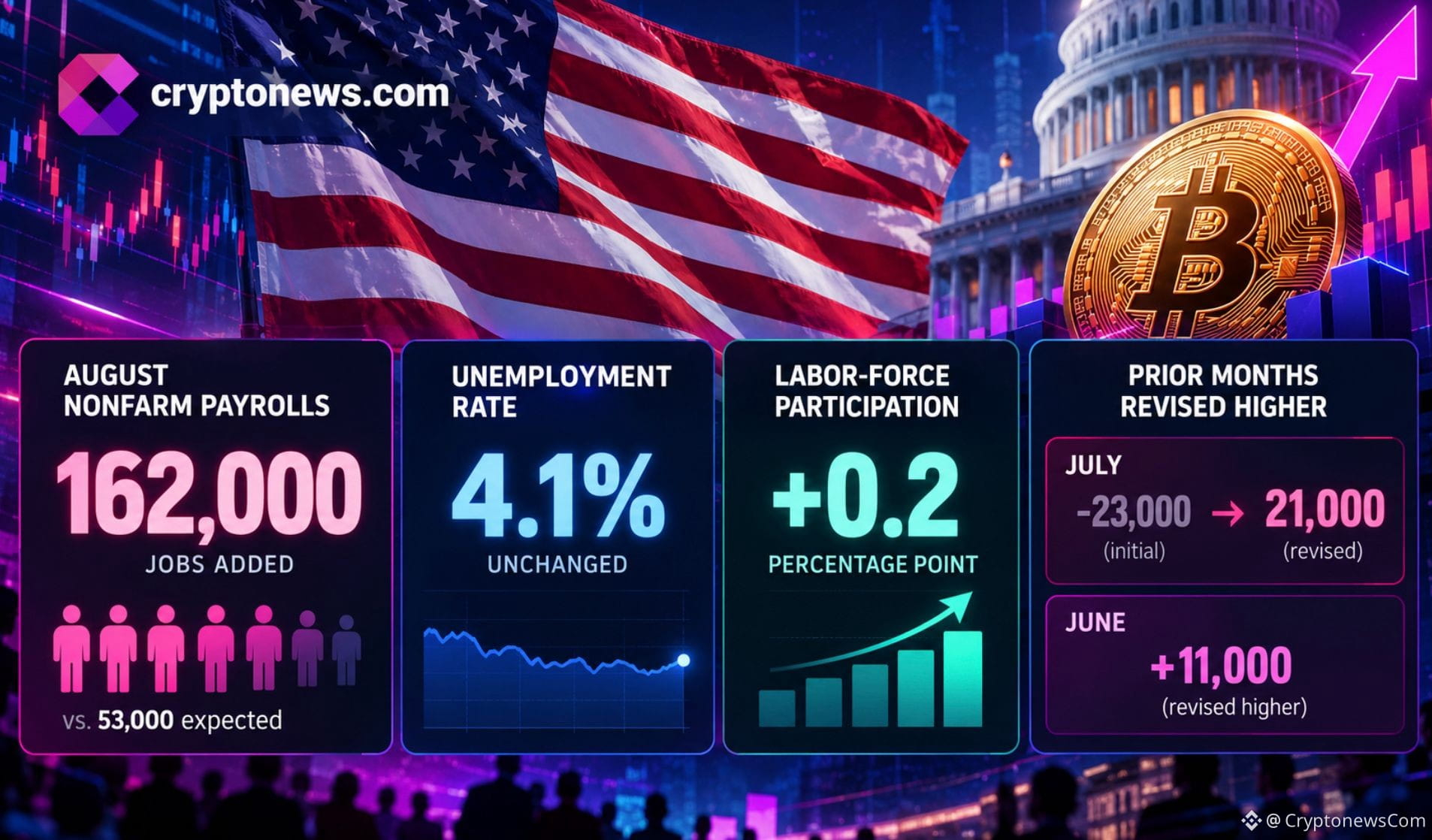
Article
Fed Rate Cut Delayed as Strong Jobs Data Tests BitcoinCitigroup pushed its forecast for the Fed first interest rate cut to June 2027 after US employers added 162,000 jobs in August, more than triple the 53,000 economists had penciled in. The revision extends the timeline for lower borrowing costs by nine months.
Now, it opens a question Bitcoin traders have been circling all year: how much longer can a resilient labor market keep real yields, the dollar, and interest rates elevated before it actually breaks risk-asset demand?
The August payrolls report did more than beat expectations on the headline number. The unemployment rate held at 4.1%, labor-force participation rose 0.2 percentage point, and prior months were revised sharply higher: July payrolls flipped from a reported loss of 23,000 to a gain of 21,000, while June was revised up by 11,000.
Citi economists Andrew Hollenhorst and Veronica Clark concluded that employment conditions looked stable enough for the Federal Reserve to shift its attention squarely to inflation.
Citi had previously been one of the more dovish desks on Wall Street, calling for cuts in October and December 2026 and January 2027. That call is gone. The bank now projects reductions in June, September, and December 2027, and the market reaction was immediate: rate futures pushed the probability of a September Fed hike from 52% to 61% the day the jobs data landed, a repricing that rattled Bitcoin within hours.
Discover: The Best Token Presales
What Does the Higher-for-Longer Policy Mean for Bitcoin?
The Fed followed through. On September 16, the Fed raised the benchmark rate by 25 basis points to a 3.75%-4% target range, the first hike since July 2023, despite traders wanting a cut. Sixteen of 18 officials projected at least one more increase before year-end, and inflation has now sat above the Fed’s 2% target for more than five years, according to the Fed’s own framing of the data.
The Federal Reserve hiked interest rates today for the first time since 2023
A 25-basis-point hike came as a result of the FOMC meeting as the Fed battles persistent inflation and higher energy prices pic.twitter.com/yBpRRjVgoV
— That Martini Guy ₿ (@MartiniGuyYT) September 16, 2026
The mechanical case against Bitcoin here is straightforward: Treasury yields and a stronger dollar compete with risk assets for capital, and Bitcoin generates no yield simply by being held, so every basis point of delay in cuts raises the opportunity cost of parking capital in it instead of government debt.
This is the textbook crypto liquidity headwind, and it showed up in price. But the textbook case stopped predicting price action the moment the hike actually landed.
Bitcoin (BTC)
24h7d30d1yAll time
Bitcoin briefly dropped toward $75,000 immediately after the September 16 decision, then reversed and climbed past $86,000 as ETF demand returned, yields eased and short sellers were squeezed out of bearish positions, a pattern consistent with BTC’s prior recoveries when yields soften. That rebound can’t be pinned on a single cause, and it doesn’t prove Bitcoin has decoupled from monetary policy. It does prove that a rate hike alone isn’t a mechanical sell signal once other flows are running in the opposite direction.
Earn $50 and Enter $300K Prize Draw on EdgeXBitcoin Levels, Flows, and Citi Fed Rate Cut Expectation
The price path around these events is the clearest evidence of how sensitive BTC remains to macro surprises. Bitcoin fell below $80,000 right after the August jobs release, reversing from an intraday high near $81,370, and was later quoted near $79,600, down about 1.5% on the day.
Ahead of the September Fed meeting, as hike odds moved above 92%, BTC fell below $76,000 before the post-decision dip toward $75,000 and the subsequent climb to a brief touch of $87,000, per the latest price action review.
Flow data backs up the recovery narrative. US spot Bitcoin ETFs logged $433 million in net inflows on September 18 after a stretch of heavy withdrawals earlier that week, suggesting institutional demand re-engaged once the hike was priced in rather than feared.
For us, the actionable variables are the same ones that moved Bitcoin twice in the past month: real yields, Treasury yields, dollar strength, spot ETF flows, and the next round of inflation and payroll prints.
If labor data stays firm and inflation proves sticky, a higher-for-longer stance keeps yields elevated and tightens the liquidity backdrop for crypto. If yields ease and ETF demand persists, Bitcoin can keep absorbing hawkish surprises well before Citi’s June 2027 cut ever arrives.
Trade Crypto on Bybit and Get a Chance to Win Our $1,000 USDT Airdrop
The post Fed Rate Cut Delayed as Strong Jobs Data Tests Bitcoin appeared first on Cryptonews.
Fed Rate Cut Delayed as Strong Jobs Data Tests Bitcoin
Citigroup pushed its forecast for the Fed first interest rate cut to June 2027 after US employers added 162,000 jobs in August, more than triple the 53,000 economists had penciled in. The revision extends the timeline for lower borrowing costs by nine months.
Now, it opens a question Bitcoin traders have been circling all year: how much longer can a resilient labor market keep real yields, the dollar, and interest rates elevated before it actually breaks risk-asset demand?
The August payrolls report did more than beat expectations on the headline number. The unemployment rate held at 4.1%, labor-force participation rose 0.2 percentage point, and prior months were revised sharply higher: July payrolls flipped from a reported loss of 23,000 to a gain of 21,000, while June was revised up by 11,000.
Citi economists Andrew Hollenhorst and Veronica Clark concluded that employment conditions looked stable enough for the Federal Reserve to shift its attention squarely to inflation.
Citi had previously been one of the more dovish desks on Wall Street, calling for cuts in October and December 2026 and January 2027. That call is gone. The bank now projects reductions in June, September, and December 2027, and the market reaction was immediate: rate futures pushed the probability of a September Fed hike from 52% to 61% the day the jobs data landed, a repricing that rattled Bitcoin within hours.
Discover: The Best Token Presales
What Does the Higher-for-Longer Policy Mean for Bitcoin?
The Fed followed through. On September 16, the Fed raised the benchmark rate by 25 basis points to a 3.75%-4% target range, the first hike since July 2023, despite traders wanting a cut. Sixteen of 18 officials projected at least one more increase before year-end, and inflation has now sat above the Fed’s 2% target for more than five years, according to the Fed’s own framing of the data.
The Federal Reserve hiked interest rates today for the first time since 2023
A 25-basis-point hike came as a result of the FOMC meeting as the Fed battles persistent inflation and higher energy prices pic.twitter.com/yBpRRjVgoV
— That Martini Guy ₿ (@MartiniGuyYT) September 16, 2026
The mechanical case against Bitcoin here is straightforward: Treasury yields and a stronger dollar compete with risk assets for capital, and Bitcoin generates no yield simply by being held, so every basis point of delay in cuts raises the opportunity cost of parking capital in it instead of government debt.
This is the textbook crypto liquidity headwind, and it showed up in price. But the textbook case stopped predicting price action the moment the hike actually landed.
Bitcoin (BTC)
24h7d30d1yAll time
Bitcoin briefly dropped toward $75,000 immediately after the September 16 decision, then reversed and climbed past $86,000 as ETF demand returned, yields eased and short sellers were squeezed out of bearish positions, a pattern consistent with BTC’s prior recoveries when yields soften. That rebound can’t be pinned on a single cause, and it doesn’t prove Bitcoin has decoupled from monetary policy. It does prove that a rate hike alone isn’t a mechanical sell signal once other flows are running in the opposite direction.
Earn $50 and Enter $300K Prize Draw on EdgeXBitcoin Levels, Flows, and Citi Fed Rate Cut Expectation
The price path around these events is the clearest evidence of how sensitive BTC remains to macro surprises. Bitcoin fell below $80,000 right after the August jobs release, reversing from an intraday high near $81,370, and was later quoted near $79,600, down about 1.5% on the day.
Ahead of the September Fed meeting, as hike odds moved above 92%, BTC fell below $76,000 before the post-decision dip toward $75,000 and the subsequent climb to a brief touch of $87,000, per the latest price action review.
Flow data backs up the recovery narrative. US spot Bitcoin ETFs logged $433 million in net inflows on September 18 after a stretch of heavy withdrawals earlier that week, suggesting institutional demand re-engaged once the hike was priced in rather than feared.
For us, the actionable variables are the same ones that moved Bitcoin twice in the past month: real yields, Treasury yields, dollar strength, spot ETF flows, and the next round of inflation and payroll prints.
If labor data stays firm and inflation proves sticky, a higher-for-longer stance keeps yields elevated and tightens the liquidity backdrop for crypto. If yields ease and ETF demand persists, Bitcoin can keep absorbing hawkish surprises well before Citi’s June 2027 cut ever arrives.
Trade Crypto on Bybit and Get a Chance to Win Our $1,000 USDT Airdrop
The post Fed Rate Cut Delayed as Strong Jobs Data Tests Bitcoin appeared first on Cryptonews.
Now, it opens a question Bitcoin traders have been circling all year: how much longer can a resilient labor market keep real yields, the dollar, and interest rates elevated before it actually breaks risk-asset demand?
The August payrolls report did more than beat expectations on the headline number. The unemployment rate held at 4.1%, labor-force participation rose 0.2 percentage point, and prior months were revised sharply higher: July payrolls flipped from a reported loss of 23,000 to a gain of 21,000, while June was revised up by 11,000.
Citi economists Andrew Hollenhorst and Veronica Clark concluded that employment conditions looked stable enough for the Federal Reserve to shift its attention squarely to inflation.
Citi had previously been one of the more dovish desks on Wall Street, calling for cuts in October and December 2026 and January 2027. That call is gone. The bank now projects reductions in June, September, and December 2027, and the market reaction was immediate: rate futures pushed the probability of a September Fed hike from 52% to 61% the day the jobs data landed, a repricing that rattled Bitcoin within hours.
Discover: The Best Token Presales
What Does the Higher-for-Longer Policy Mean for Bitcoin?
The Fed followed through. On September 16, the Fed raised the benchmark rate by 25 basis points to a 3.75%-4% target range, the first hike since July 2023, despite traders wanting a cut. Sixteen of 18 officials projected at least one more increase before year-end, and inflation has now sat above the Fed’s 2% target for more than five years, according to the Fed’s own framing of the data.
The Federal Reserve hiked interest rates today for the first time since 2023
A 25-basis-point hike came as a result of the FOMC meeting as the Fed battles persistent inflation and higher energy prices pic.twitter.com/yBpRRjVgoV
— That Martini Guy ₿ (@MartiniGuyYT) September 16, 2026
The mechanical case against Bitcoin here is straightforward: Treasury yields and a stronger dollar compete with risk assets for capital, and Bitcoin generates no yield simply by being held, so every basis point of delay in cuts raises the opportunity cost of parking capital in it instead of government debt.
This is the textbook crypto liquidity headwind, and it showed up in price. But the textbook case stopped predicting price action the moment the hike actually landed.
Bitcoin (BTC)
24h7d30d1yAll time
Bitcoin briefly dropped toward $75,000 immediately after the September 16 decision, then reversed and climbed past $86,000 as ETF demand returned, yields eased and short sellers were squeezed out of bearish positions, a pattern consistent with BTC’s prior recoveries when yields soften. That rebound can’t be pinned on a single cause, and it doesn’t prove Bitcoin has decoupled from monetary policy. It does prove that a rate hike alone isn’t a mechanical sell signal once other flows are running in the opposite direction.
Earn $50 and Enter $300K Prize Draw on EdgeXBitcoin Levels, Flows, and Citi Fed Rate Cut Expectation
The price path around these events is the clearest evidence of how sensitive BTC remains to macro surprises. Bitcoin fell below $80,000 right after the August jobs release, reversing from an intraday high near $81,370, and was later quoted near $79,600, down about 1.5% on the day.
Ahead of the September Fed meeting, as hike odds moved above 92%, BTC fell below $76,000 before the post-decision dip toward $75,000 and the subsequent climb to a brief touch of $87,000, per the latest price action review.
Flow data backs up the recovery narrative. US spot Bitcoin ETFs logged $433 million in net inflows on September 18 after a stretch of heavy withdrawals earlier that week, suggesting institutional demand re-engaged once the hike was priced in rather than feared.
For us, the actionable variables are the same ones that moved Bitcoin twice in the past month: real yields, Treasury yields, dollar strength, spot ETF flows, and the next round of inflation and payroll prints.
If labor data stays firm and inflation proves sticky, a higher-for-longer stance keeps yields elevated and tightens the liquidity backdrop for crypto. If yields ease and ETF demand persists, Bitcoin can keep absorbing hawkish surprises well before Citi’s June 2027 cut ever arrives.
Trade Crypto on Bybit and Get a Chance to Win Our $1,000 USDT Airdrop
The post Fed Rate Cut Delayed as Strong Jobs Data Tests Bitcoin appeared first on Cryptonews.
280
Vérifié

Article
NEAR Crypto Tokenized Stock Launch Puts Distribution Ahead of ScaleNEAR crypto and Ondo Finance have launched access to tokenized U.S. stocks and ETFs on near.com, opening with 20 assets including Nvidia, Tesla, Apple, Microsoft, Amazon, SPY and QQQ.
Eligible users fund their accounts with stablecoins or other supported crypto from more than 30 networks, with NEAR Intents acting as the cross-chain distribution layer that can eventually route these tokenized securities to connected wallets, applications, and DeFi protocols.
The launch is a distribution story before it is an asset-count story. Ondo’s broader tokenized stocks platform already lists more than 100 stocks and ETFs, according to Ondo’s own documentation, but NEAR’s initial rollout exposes only a fifth of that catalog through Near.com.
Ondo's Tokenized Stocks now live on NEAR Intents@NEARProtocol officially announced that @Ondo Finance tokenized stocks, such as $NVDAON, $TSLAON, and $SPYON, are now available through NEAR Intents.
The "1Click API" lets developers add these RWA-backed assets to third-party… pic.twitter.com/awthz3d8kv
— BSCN (@BSCNews) September 23, 2026
NEAR Crypto and the Multichain Route to Ondo Stocks
Near.com functions as the initial user-facing surface for this integration, while NEAR Intents is positioned separately as the cross-chain routing layer, according to the launch material from Ondo Finance.
That distinction matters: near.com is where users open accounts and trade, while NEAR Intents is the plumbing intended to eventually let other wallets and DeFi protocols surface the same real-world assets to their own users.
Ondo’s own documentation describes the broader Ondo Stocks platform as offering more than 100 tokenized stocks and ETFs, spanning individual equities, indexes such as QQQ and SPY, and fixed-income ETFs like TLT, TIP and AGG.
The 20-asset NEAR selection is a subset of that catalog, not a replacement, and Ondo has said the full app at app.ondo.finance remains the reference point for the complete list.
Purchases run through USDon, a stablecoin Ondo says is backed 1:1 by a U.S. dollar held in an Ondo Stocks brokerage account. When a user buys with a different stablecoin, the platform atomically swaps it into USDon before executing the tokenized stock purchase.
It then reverses the process on redemption, a mechanic Ondo’s documentation frames as designed to keep the buy-and-sell flow instant rather than dependent on settlement windows.
How Users Access the Initial Offering
The reported flow is straightforward: an eligible near.com user deposits stablecoins or other supported crypto from any of the more than 30 connected networks, then swaps directly into an available tokenized stock or ETF in a single transaction.
That collapses what would normally be a multi-step bridging-and-onboarding process into one action inside the near.com interface. The current selection is capped at 20 assets, not the full Ondo catalog, and the source material doesn’t publish a complete list beyond the named examples.
Traders looking for a specific ticker outside that initial set should check current availability directly rather than assume parity with Ondo’s broader 100-plus offering.
Earn $50 and Enter $300K Prize Draw on EdgeXWhy Distribution, Not Asset Count, Is the Main ChangeSOURCE: TradingView
The more consequential piece of this launch is the routing layer, not the ticker list. NEAR Intents is a cross-chain distribution mechanism that can push Ondo’s tokenized equities to wallets, applications, and DeFi protocols beyond near.com itself, meaning the 20-asset figure is a starting point for a pipe built to widen, not a ceiling.
Ondo currently restricts its tokenized securities to names trading on the NYSE and NASDAQ, though its documentation leaves room to expand to other countries’ exchanges over time.
Other issuers are pursuing distribution through different rails; Robinhood’s tokenized-stock push on its own chain is a useful comparison point for how competing platforms are structuring access, though the mechanics differ enough that a direct read-across isn’t warranted here.
What are the Eligibility and Jurisdiction Limits for the Near Crypto Ondo Stocks?
None of this is available to US persons. Ondo’s documentation states plainly that Ondo Stocks products are offered only to organizations and individuals outside the United States and other prohibited jurisdictions, subject to its own eligibility criteria, and that the products are not accessible in certain regions at all.
These are tokenized exposures to NYSE and NASDAQ-listed securities, not shares held in a conventional brokerage account, and regulators are still working out how to treat that distinction across jurisdictions.
The broader US regulatory posture toward tokenized equities remains unsettled, and nothing in this launch changes that for US-based traders.
Discover: The Best Token Presales This Bullrun
The post NEAR Crypto Tokenized Stock Launch Puts Distribution Ahead of Scale appeared first on Cryptonews.
NEAR Crypto Tokenized Stock Launch Puts Distribution Ahead of Scale
NEAR crypto and Ondo Finance have launched access to tokenized U.S. stocks and ETFs on near.com, opening with 20 assets including Nvidia, Tesla, Apple, Microsoft, Amazon, SPY and QQQ.
Eligible users fund their accounts with stablecoins or other supported crypto from more than 30 networks, with NEAR Intents acting as the cross-chain distribution layer that can eventually route these tokenized securities to connected wallets, applications, and DeFi protocols.
The launch is a distribution story before it is an asset-count story. Ondo’s broader tokenized stocks platform already lists more than 100 stocks and ETFs, according to Ondo’s own documentation, but NEAR’s initial rollout exposes only a fifth of that catalog through Near.com.
Ondo's Tokenized Stocks now live on NEAR Intents@NEARProtocol officially announced that @Ondo Finance tokenized stocks, such as $NVDAON, $TSLAON, and $SPYON, are now available through NEAR Intents.
The "1Click API" lets developers add these RWA-backed assets to third-party… pic.twitter.com/awthz3d8kv
— BSCN (@BSCNews) September 23, 2026
NEAR Crypto and the Multichain Route to Ondo Stocks
Near.com functions as the initial user-facing surface for this integration, while NEAR Intents is positioned separately as the cross-chain routing layer, according to the launch material from Ondo Finance.
That distinction matters: near.com is where users open accounts and trade, while NEAR Intents is the plumbing intended to eventually let other wallets and DeFi protocols surface the same real-world assets to their own users.
Ondo’s own documentation describes the broader Ondo Stocks platform as offering more than 100 tokenized stocks and ETFs, spanning individual equities, indexes such as QQQ and SPY, and fixed-income ETFs like TLT, TIP and AGG.
The 20-asset NEAR selection is a subset of that catalog, not a replacement, and Ondo has said the full app at app.ondo.finance remains the reference point for the complete list.
Purchases run through USDon, a stablecoin Ondo says is backed 1:1 by a U.S. dollar held in an Ondo Stocks brokerage account. When a user buys with a different stablecoin, the platform atomically swaps it into USDon before executing the tokenized stock purchase.
It then reverses the process on redemption, a mechanic Ondo’s documentation frames as designed to keep the buy-and-sell flow instant rather than dependent on settlement windows.
How Users Access the Initial Offering
The reported flow is straightforward: an eligible near.com user deposits stablecoins or other supported crypto from any of the more than 30 connected networks, then swaps directly into an available tokenized stock or ETF in a single transaction.
That collapses what would normally be a multi-step bridging-and-onboarding process into one action inside the near.com interface. The current selection is capped at 20 assets, not the full Ondo catalog, and the source material doesn’t publish a complete list beyond the named examples.
Traders looking for a specific ticker outside that initial set should check current availability directly rather than assume parity with Ondo’s broader 100-plus offering.
Earn $50 and Enter $300K Prize Draw on EdgeXWhy Distribution, Not Asset Count, Is the Main ChangeSOURCE: TradingView
The more consequential piece of this launch is the routing layer, not the ticker list. NEAR Intents is a cross-chain distribution mechanism that can push Ondo’s tokenized equities to wallets, applications, and DeFi protocols beyond near.com itself, meaning the 20-asset figure is a starting point for a pipe built to widen, not a ceiling.
Ondo currently restricts its tokenized securities to names trading on the NYSE and NASDAQ, though its documentation leaves room to expand to other countries’ exchanges over time.
Other issuers are pursuing distribution through different rails; Robinhood’s tokenized-stock push on its own chain is a useful comparison point for how competing platforms are structuring access, though the mechanics differ enough that a direct read-across isn’t warranted here.
What are the Eligibility and Jurisdiction Limits for the Near Crypto Ondo Stocks?
None of this is available to US persons. Ondo’s documentation states plainly that Ondo Stocks products are offered only to organizations and individuals outside the United States and other prohibited jurisdictions, subject to its own eligibility criteria, and that the products are not accessible in certain regions at all.
These are tokenized exposures to NYSE and NASDAQ-listed securities, not shares held in a conventional brokerage account, and regulators are still working out how to treat that distinction across jurisdictions.
The broader US regulatory posture toward tokenized equities remains unsettled, and nothing in this launch changes that for US-based traders.
Discover: The Best Token Presales This Bullrun
The post NEAR Crypto Tokenized Stock Launch Puts Distribution Ahead of Scale appeared first on Cryptonews.
Eligible users fund their accounts with stablecoins or other supported crypto from more than 30 networks, with NEAR Intents acting as the cross-chain distribution layer that can eventually route these tokenized securities to connected wallets, applications, and DeFi protocols.
The launch is a distribution story before it is an asset-count story. Ondo’s broader tokenized stocks platform already lists more than 100 stocks and ETFs, according to Ondo’s own documentation, but NEAR’s initial rollout exposes only a fifth of that catalog through Near.com.
Ondo's Tokenized Stocks now live on NEAR Intents@NEARProtocol officially announced that @Ondo Finance tokenized stocks, such as $NVDAON, $TSLAON, and $SPYON, are now available through NEAR Intents.
The "1Click API" lets developers add these RWA-backed assets to third-party… pic.twitter.com/awthz3d8kv
— BSCN (@BSCNews) September 23, 2026
NEAR Crypto and the Multichain Route to Ondo Stocks
Near.com functions as the initial user-facing surface for this integration, while NEAR Intents is positioned separately as the cross-chain routing layer, according to the launch material from Ondo Finance.
That distinction matters: near.com is where users open accounts and trade, while NEAR Intents is the plumbing intended to eventually let other wallets and DeFi protocols surface the same real-world assets to their own users.
Ondo’s own documentation describes the broader Ondo Stocks platform as offering more than 100 tokenized stocks and ETFs, spanning individual equities, indexes such as QQQ and SPY, and fixed-income ETFs like TLT, TIP and AGG.
The 20-asset NEAR selection is a subset of that catalog, not a replacement, and Ondo has said the full app at app.ondo.finance remains the reference point for the complete list.
Purchases run through USDon, a stablecoin Ondo says is backed 1:1 by a U.S. dollar held in an Ondo Stocks brokerage account. When a user buys with a different stablecoin, the platform atomically swaps it into USDon before executing the tokenized stock purchase.
It then reverses the process on redemption, a mechanic Ondo’s documentation frames as designed to keep the buy-and-sell flow instant rather than dependent on settlement windows.
How Users Access the Initial Offering
The reported flow is straightforward: an eligible near.com user deposits stablecoins or other supported crypto from any of the more than 30 connected networks, then swaps directly into an available tokenized stock or ETF in a single transaction.
That collapses what would normally be a multi-step bridging-and-onboarding process into one action inside the near.com interface. The current selection is capped at 20 assets, not the full Ondo catalog, and the source material doesn’t publish a complete list beyond the named examples.
Traders looking for a specific ticker outside that initial set should check current availability directly rather than assume parity with Ondo’s broader 100-plus offering.
Earn $50 and Enter $300K Prize Draw on EdgeXWhy Distribution, Not Asset Count, Is the Main ChangeSOURCE: TradingView
The more consequential piece of this launch is the routing layer, not the ticker list. NEAR Intents is a cross-chain distribution mechanism that can push Ondo’s tokenized equities to wallets, applications, and DeFi protocols beyond near.com itself, meaning the 20-asset figure is a starting point for a pipe built to widen, not a ceiling.
Ondo currently restricts its tokenized securities to names trading on the NYSE and NASDAQ, though its documentation leaves room to expand to other countries’ exchanges over time.
Other issuers are pursuing distribution through different rails; Robinhood’s tokenized-stock push on its own chain is a useful comparison point for how competing platforms are structuring access, though the mechanics differ enough that a direct read-across isn’t warranted here.
What are the Eligibility and Jurisdiction Limits for the Near Crypto Ondo Stocks?
None of this is available to US persons. Ondo’s documentation states plainly that Ondo Stocks products are offered only to organizations and individuals outside the United States and other prohibited jurisdictions, subject to its own eligibility criteria, and that the products are not accessible in certain regions at all.
These are tokenized exposures to NYSE and NASDAQ-listed securities, not shares held in a conventional brokerage account, and regulators are still working out how to treat that distinction across jurisdictions.
The broader US regulatory posture toward tokenized equities remains unsettled, and nothing in this launch changes that for US-based traders.
Discover: The Best Token Presales This Bullrun
The post NEAR Crypto Tokenized Stock Launch Puts Distribution Ahead of Scale appeared first on Cryptonews.
532
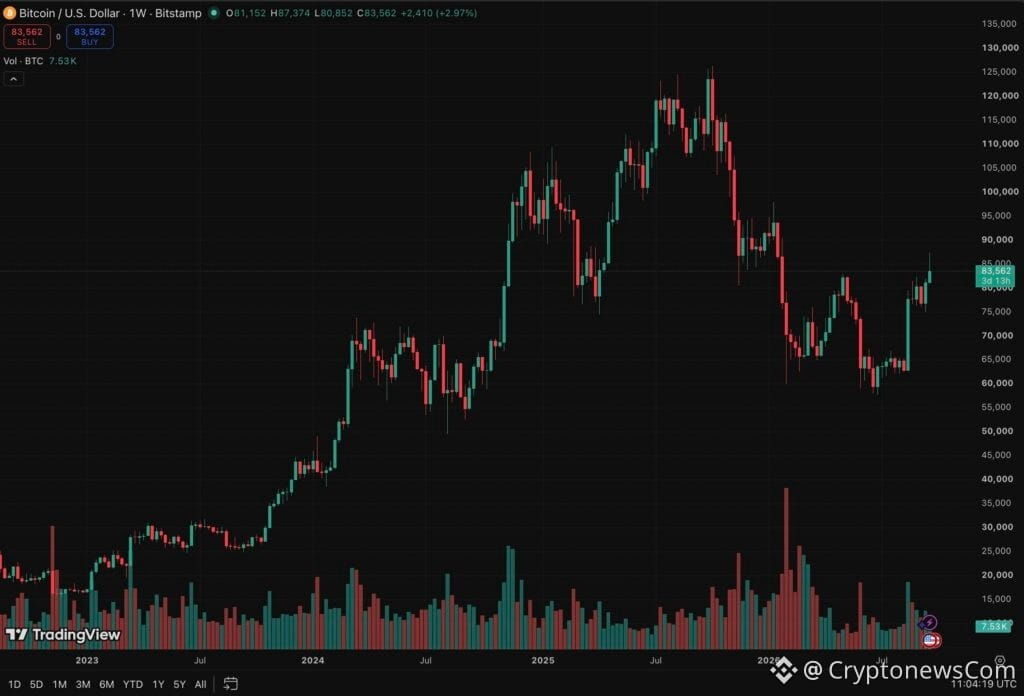
Article
Who is Ronald Spektor? New York Coinbase Scam Mastermind That Stole $15.9MEveryone is asking the same question today. ‘Who is Ronald Spektor?’ Spektor, 23, of Sheepshead Bay, Brooklyn, was sentenced on September 23, 2026, by Brooklyn Supreme Court Justice Danny Chun to four to 12 years in prison for orchestrating a Coinbase phishing and social engineering scheme that prosecutors said stole roughly $15.944M from about 100 users.
Spektor pleaded guilty on September 2, 2026, to the entire 31-count indictment, closing out a case the Brooklyn District Attorney’s Office had spent about a year building around one of the more elaborate cryptocurrency theft operations to hit Coinbase’s retail customer base.
COINBASE SCAMMER STEALS $16M, LOSES $6M GAMBLING
Ronald Spektor, 23, has been sentenced to 4–12 years in prison after stealing nearly $16 million from around 100 Coinbase users through social engineering scams.
Prosecutors say he bragged about the thefts on Telegram as… pic.twitter.com/BKaGj6nBHA
— Defraud (@DefraudTG) September 24, 2026
The plea covered first-degree grand larceny, first-degree money laundering, first-degree criminal possession of stolen property and related counts. Prosecutors had pushed for seven to 21 years and objected to the shorter negotiated term, according to the Brooklyn District Attorney’s Office.
The gap between the sought sentence for Ronald Spektor, and the one handed down underscores how plea negotiations can blunt defendants’ theoretical exposure, even in large-scale cryptocurrency theft cases.
Who is Ronald Spektor, and How Did He Pull Off the $16M Coinbase Scam?
According to the Brooklyn District Attorney’s Office, someone claiming to be a Coinbase representative contacted victims and warned that a hacker had compromised their accounts.
Believing they were securing their holdings, users moved cryptocurrency into wallets they thought remained under their sole control but that were allegedly accessible to Spektor, the core mechanic of crypto phishing built on urgency rather than any technical exploit of Coinbase’s systems.
More than 70 of the roughly 100 identified victims were interviewed during the investigation. Reported losses varied widely: a California resident lost more than $1M, a Virginia resident lost more than $900,000, a Pennsylvania victim lost about $53,150, and a Maryland victim lost about $38,750.
Investigators said the stolen assets were subsequently run through swapping and mixing services, gambling platforms and online storefronts before conversion – a laundering pattern similar to what investigators have traced in other high-profile crypto-linked money laundering cases.
Prosecutors tied Spektor to the scheme through transaction records, blockchain analysis, digital forensics and search-warrant evidence, including an alleged link between his home IP address and wallets from which cryptocurrency was stolen.
Investigators seized approximately $105,000 in cash and $400,000 in cryptocurrency from Spektor during the probe, though that figure reflects assets recovered at the time rather than a confirmed final forfeiture order.
Got a Gut Feeling? It Could Pay Out Big on PolymarketDistrict Attorney Speaks, and Coinbase’s Chief Legal Officer Details the Exchange’s Role in Catching SpektorSOURCE: TradingView
Brooklyn District Attorney Eric Gonzalez framed the sentencing as vindication for the office’s Virtual Currency Unit. “Today’s sentencing holds the defendant accountable for a brazen, long-running social engineering scam that amounted to a digital robbery of nearly 100 victims,” Gonzalez said.
“Our Virtual Currency Unit painstakingly pieced together the digital proof that identified the defendant behind this sophisticated scheme, followed the money that he stole, and compiled iron-clad evidence against him. This case should put crypto scammers on notice: we will follow the digital trail wherever it leads and aggressively pursue those responsible.”
Coinbase Chief Legal Officer Paul Grewal said the company helped identify Spektor and the customers he defrauded, provided evidence to support the charges, and assisted law enforcement in tracing and recovering stolen funds, cooperation that speaks to how exchange customer-facing security tooling increasingly factors into prosecutions like this one.
The Brooklyn District Attorney’s Office reiterated the same warning it issued at the time of the original indictment: Coinbase and most legitimate companies will never call customers or ask them to move crypto to a “safe wallet.”
Caller ID, sender names, and lookalike domains can be spoofed, so verify requests only through official in-app support channels, and treat any request pressuring an immediate transfer with extra scrutiny rather than speed.
Earn $50 and Enter $300K Prize Draw on EdgeX
The post Who is Ronald Spektor? New York Coinbase Scam Mastermind That Stole $15.9M appeared first on Cryptonews.
Who is Ronald Spektor? New York Coinbase Scam Mastermind That Stole $15.9M
Everyone is asking the same question today. ‘Who is Ronald Spektor?’ Spektor, 23, of Sheepshead Bay, Brooklyn, was sentenced on September 23, 2026, by Brooklyn Supreme Court Justice Danny Chun to four to 12 years in prison for orchestrating a Coinbase phishing and social engineering scheme that prosecutors said stole roughly $15.944M from about 100 users.
Spektor pleaded guilty on September 2, 2026, to the entire 31-count indictment, closing out a case the Brooklyn District Attorney’s Office had spent about a year building around one of the more elaborate cryptocurrency theft operations to hit Coinbase’s retail customer base.
COINBASE SCAMMER STEALS $16M, LOSES $6M GAMBLING
Ronald Spektor, 23, has been sentenced to 4–12 years in prison after stealing nearly $16 million from around 100 Coinbase users through social engineering scams.
Prosecutors say he bragged about the thefts on Telegram as… pic.twitter.com/BKaGj6nBHA
— Defraud (@DefraudTG) September 24, 2026
The plea covered first-degree grand larceny, first-degree money laundering, first-degree criminal possession of stolen property and related counts. Prosecutors had pushed for seven to 21 years and objected to the shorter negotiated term, according to the Brooklyn District Attorney’s Office.
The gap between the sought sentence for Ronald Spektor, and the one handed down underscores how plea negotiations can blunt defendants’ theoretical exposure, even in large-scale cryptocurrency theft cases.
Who is Ronald Spektor, and How Did He Pull Off the $16M Coinbase Scam?
According to the Brooklyn District Attorney’s Office, someone claiming to be a Coinbase representative contacted victims and warned that a hacker had compromised their accounts.
Believing they were securing their holdings, users moved cryptocurrency into wallets they thought remained under their sole control but that were allegedly accessible to Spektor, the core mechanic of crypto phishing built on urgency rather than any technical exploit of Coinbase’s systems.
More than 70 of the roughly 100 identified victims were interviewed during the investigation. Reported losses varied widely: a California resident lost more than $1M, a Virginia resident lost more than $900,000, a Pennsylvania victim lost about $53,150, and a Maryland victim lost about $38,750.
Investigators said the stolen assets were subsequently run through swapping and mixing services, gambling platforms and online storefronts before conversion – a laundering pattern similar to what investigators have traced in other high-profile crypto-linked money laundering cases.
Prosecutors tied Spektor to the scheme through transaction records, blockchain analysis, digital forensics and search-warrant evidence, including an alleged link between his home IP address and wallets from which cryptocurrency was stolen.
Investigators seized approximately $105,000 in cash and $400,000 in cryptocurrency from Spektor during the probe, though that figure reflects assets recovered at the time rather than a confirmed final forfeiture order.
Got a Gut Feeling? It Could Pay Out Big on PolymarketDistrict Attorney Speaks, and Coinbase’s Chief Legal Officer Details the Exchange’s Role in Catching SpektorSOURCE: TradingView
Brooklyn District Attorney Eric Gonzalez framed the sentencing as vindication for the office’s Virtual Currency Unit. “Today’s sentencing holds the defendant accountable for a brazen, long-running social engineering scam that amounted to a digital robbery of nearly 100 victims,” Gonzalez said.
“Our Virtual Currency Unit painstakingly pieced together the digital proof that identified the defendant behind this sophisticated scheme, followed the money that he stole, and compiled iron-clad evidence against him. This case should put crypto scammers on notice: we will follow the digital trail wherever it leads and aggressively pursue those responsible.”
Coinbase Chief Legal Officer Paul Grewal said the company helped identify Spektor and the customers he defrauded, provided evidence to support the charges, and assisted law enforcement in tracing and recovering stolen funds, cooperation that speaks to how exchange customer-facing security tooling increasingly factors into prosecutions like this one.
The Brooklyn District Attorney’s Office reiterated the same warning it issued at the time of the original indictment: Coinbase and most legitimate companies will never call customers or ask them to move crypto to a “safe wallet.”
Caller ID, sender names, and lookalike domains can be spoofed, so verify requests only through official in-app support channels, and treat any request pressuring an immediate transfer with extra scrutiny rather than speed.
Earn $50 and Enter $300K Prize Draw on EdgeX
The post Who is Ronald Spektor? New York Coinbase Scam Mastermind That Stole $15.9M appeared first on Cryptonews.
Spektor pleaded guilty on September 2, 2026, to the entire 31-count indictment, closing out a case the Brooklyn District Attorney’s Office had spent about a year building around one of the more elaborate cryptocurrency theft operations to hit Coinbase’s retail customer base.
COINBASE SCAMMER STEALS $16M, LOSES $6M GAMBLING
Ronald Spektor, 23, has been sentenced to 4–12 years in prison after stealing nearly $16 million from around 100 Coinbase users through social engineering scams.
Prosecutors say he bragged about the thefts on Telegram as… pic.twitter.com/BKaGj6nBHA
— Defraud (@DefraudTG) September 24, 2026
The plea covered first-degree grand larceny, first-degree money laundering, first-degree criminal possession of stolen property and related counts. Prosecutors had pushed for seven to 21 years and objected to the shorter negotiated term, according to the Brooklyn District Attorney’s Office.
The gap between the sought sentence for Ronald Spektor, and the one handed down underscores how plea negotiations can blunt defendants’ theoretical exposure, even in large-scale cryptocurrency theft cases.
Who is Ronald Spektor, and How Did He Pull Off the $16M Coinbase Scam?
According to the Brooklyn District Attorney’s Office, someone claiming to be a Coinbase representative contacted victims and warned that a hacker had compromised their accounts.
Believing they were securing their holdings, users moved cryptocurrency into wallets they thought remained under their sole control but that were allegedly accessible to Spektor, the core mechanic of crypto phishing built on urgency rather than any technical exploit of Coinbase’s systems.
More than 70 of the roughly 100 identified victims were interviewed during the investigation. Reported losses varied widely: a California resident lost more than $1M, a Virginia resident lost more than $900,000, a Pennsylvania victim lost about $53,150, and a Maryland victim lost about $38,750.
Investigators said the stolen assets were subsequently run through swapping and mixing services, gambling platforms and online storefronts before conversion – a laundering pattern similar to what investigators have traced in other high-profile crypto-linked money laundering cases.
Prosecutors tied Spektor to the scheme through transaction records, blockchain analysis, digital forensics and search-warrant evidence, including an alleged link between his home IP address and wallets from which cryptocurrency was stolen.
Investigators seized approximately $105,000 in cash and $400,000 in cryptocurrency from Spektor during the probe, though that figure reflects assets recovered at the time rather than a confirmed final forfeiture order.
Got a Gut Feeling? It Could Pay Out Big on PolymarketDistrict Attorney Speaks, and Coinbase’s Chief Legal Officer Details the Exchange’s Role in Catching SpektorSOURCE: TradingView
Brooklyn District Attorney Eric Gonzalez framed the sentencing as vindication for the office’s Virtual Currency Unit. “Today’s sentencing holds the defendant accountable for a brazen, long-running social engineering scam that amounted to a digital robbery of nearly 100 victims,” Gonzalez said.
“Our Virtual Currency Unit painstakingly pieced together the digital proof that identified the defendant behind this sophisticated scheme, followed the money that he stole, and compiled iron-clad evidence against him. This case should put crypto scammers on notice: we will follow the digital trail wherever it leads and aggressively pursue those responsible.”
Coinbase Chief Legal Officer Paul Grewal said the company helped identify Spektor and the customers he defrauded, provided evidence to support the charges, and assisted law enforcement in tracing and recovering stolen funds, cooperation that speaks to how exchange customer-facing security tooling increasingly factors into prosecutions like this one.
The Brooklyn District Attorney’s Office reiterated the same warning it issued at the time of the original indictment: Coinbase and most legitimate companies will never call customers or ask them to move crypto to a “safe wallet.”
Caller ID, sender names, and lookalike domains can be spoofed, so verify requests only through official in-app support channels, and treat any request pressuring an immediate transfer with extra scrutiny rather than speed.
Earn $50 and Enter $300K Prize Draw on EdgeX
The post Who is Ronald Spektor? New York Coinbase Scam Mastermind That Stole $15.9M appeared first on Cryptonews.
113

Article
Former VC Partner Hsin-Ju Chuang Dies at 37: What We Know So farHsin-Ju Chuang, a former partner at crypto venture capital firm Hack VC, was pronounced dead at age 37 after California Highway Patrol officers responded to a location on southbound Interstate 15 south of Field Road in San Bernardino County on Aug. 24. Authorities have not publicly disclosed a cause of death, and no reporting has established a connection between Chuang’s death and her prior public dispute with the firm.
Chuang was pronounced dead at the scene, per the coroner’s office. The California Highway Patrol had not received a response as of publication. No autopsy findings or manner-of-death determination have been made public yet.
According to her LinkedIn profile, Chuang founded Dystopia Labs and previously served as head of growth at both Stellar and Solana before moving into crypto venture capital. She joined Hack VC as a venture partner in 2021 and was promoted to partner and head of platform in 2025, a role that put her at the center of the firm’s founder-facing operations.
Her background across two major layer-1 ecosystems and her own community-building venture made her a recognizable operator in crypto circles well before her tenure at Hack VC. That visibility is part of why her death and the unresolved dispute preceding it have drawn attention across the industry.
Earn $50 and Enter $300K Prize Draw on EdgeXChuang Posted About Hack VC Dispute One Day Before Her Death
Just one day before her death, Hsin-Ju Chuang published a lengthy post on X discussing her dispute with her former employer, Hack VC. In the post, Chuang said she had rejected a settlement that she described as requiring her to remain silent about her experience at the firm.
Chuang also said she had parted ways with her lawyers and planned to publish what she described as evidence related to her time at Hack VC on Aug. 26. She made several allegations concerning her treatment while working at the firm, including claims involving her employment and health insurance. However, those allegations have not been independently verified.
1/ gm. gm. Name is Hsin-Ju.
I have a dark, kinda tragic personal announcement.
I've decided I'd rather take $0 than accept a settlement that requires me to stay silent about what happened to me. I have since fired my lawyers at @sanfordheisler & will be releasing all the… https://t.co/YqPuc8R3zj
— Hsin-Ju (@hsinju) August 23, 2026
The timing of the post has drawn attention because Chuang was pronounced dead in California the following day, Aug. 24. There is currently no established evidence connecting her X post, the dispute with Hack VC, and her death.
Trade Crypto on Bybit and Get a Chance to Win Our $1,000 USDT AirdropHack VC’s Response to Hsin-Ju Death Amid Unresolved Questions
Hack VC co-founder and managing partner Alexander Pack said the firm was shocked and saddened by Chuang’s death and offered condolences to her family, friends, and others close to her. Pack said the company had not spoken directly with Chuang for more than 10 months and was not aware of the circumstances surrounding her death, asking that people be respectful of those grieving, given the lack of further information.
We are shocked and saddened to learn the news of Hsin-Ju’s passing. Our thoughts are with her family, friends and all those who were close to her.
This is an unimaginable tragedy for many of us who worked alongside Hsin-Ju in this community, and we share the heartbreak and…
— Alexander Pack (@alpackaP) September 23, 2026
The episode has stirred conversation within crypto venture capital about workplace conduct and dispute handling at firms that operate with the informal structures common to early-stage investing. For now, the facts on record remain limited to the confirmed location, date, and Hack VC’s statement, with the cause of death still undisclosed by authorities.
Discover: The Best Token Presales
The post Former VC Partner Hsin-Ju Chuang Dies at 37: What We Know So far appeared first on Cryptonews.
Former VC Partner Hsin-Ju Chuang Dies at 37: What We Know So far
Hsin-Ju Chuang, a former partner at crypto venture capital firm Hack VC, was pronounced dead at age 37 after California Highway Patrol officers responded to a location on southbound Interstate 15 south of Field Road in San Bernardino County on Aug. 24. Authorities have not publicly disclosed a cause of death, and no reporting has established a connection between Chuang’s death and her prior public dispute with the firm.
Chuang was pronounced dead at the scene, per the coroner’s office. The California Highway Patrol had not received a response as of publication. No autopsy findings or manner-of-death determination have been made public yet.
According to her LinkedIn profile, Chuang founded Dystopia Labs and previously served as head of growth at both Stellar and Solana before moving into crypto venture capital. She joined Hack VC as a venture partner in 2021 and was promoted to partner and head of platform in 2025, a role that put her at the center of the firm’s founder-facing operations.
Her background across two major layer-1 ecosystems and her own community-building venture made her a recognizable operator in crypto circles well before her tenure at Hack VC. That visibility is part of why her death and the unresolved dispute preceding it have drawn attention across the industry.
Earn $50 and Enter $300K Prize Draw on EdgeXChuang Posted About Hack VC Dispute One Day Before Her Death
Just one day before her death, Hsin-Ju Chuang published a lengthy post on X discussing her dispute with her former employer, Hack VC. In the post, Chuang said she had rejected a settlement that she described as requiring her to remain silent about her experience at the firm.
Chuang also said she had parted ways with her lawyers and planned to publish what she described as evidence related to her time at Hack VC on Aug. 26. She made several allegations concerning her treatment while working at the firm, including claims involving her employment and health insurance. However, those allegations have not been independently verified.
1/ gm. gm. Name is Hsin-Ju.
I have a dark, kinda tragic personal announcement.
I've decided I'd rather take $0 than accept a settlement that requires me to stay silent about what happened to me. I have since fired my lawyers at @sanfordheisler & will be releasing all the… https://t.co/YqPuc8R3zj
— Hsin-Ju (@hsinju) August 23, 2026
The timing of the post has drawn attention because Chuang was pronounced dead in California the following day, Aug. 24. There is currently no established evidence connecting her X post, the dispute with Hack VC, and her death.
Trade Crypto on Bybit and Get a Chance to Win Our $1,000 USDT AirdropHack VC’s Response to Hsin-Ju Death Amid Unresolved Questions
Hack VC co-founder and managing partner Alexander Pack said the firm was shocked and saddened by Chuang’s death and offered condolences to her family, friends, and others close to her. Pack said the company had not spoken directly with Chuang for more than 10 months and was not aware of the circumstances surrounding her death, asking that people be respectful of those grieving, given the lack of further information.
We are shocked and saddened to learn the news of Hsin-Ju’s passing. Our thoughts are with her family, friends and all those who were close to her.
This is an unimaginable tragedy for many of us who worked alongside Hsin-Ju in this community, and we share the heartbreak and…
— Alexander Pack (@alpackaP) September 23, 2026
The episode has stirred conversation within crypto venture capital about workplace conduct and dispute handling at firms that operate with the informal structures common to early-stage investing. For now, the facts on record remain limited to the confirmed location, date, and Hack VC’s statement, with the cause of death still undisclosed by authorities.
Discover: The Best Token Presales
The post Former VC Partner Hsin-Ju Chuang Dies at 37: What We Know So far appeared first on Cryptonews.
Chuang was pronounced dead at the scene, per the coroner’s office. The California Highway Patrol had not received a response as of publication. No autopsy findings or manner-of-death determination have been made public yet.
According to her LinkedIn profile, Chuang founded Dystopia Labs and previously served as head of growth at both Stellar and Solana before moving into crypto venture capital. She joined Hack VC as a venture partner in 2021 and was promoted to partner and head of platform in 2025, a role that put her at the center of the firm’s founder-facing operations.
Her background across two major layer-1 ecosystems and her own community-building venture made her a recognizable operator in crypto circles well before her tenure at Hack VC. That visibility is part of why her death and the unresolved dispute preceding it have drawn attention across the industry.
Earn $50 and Enter $300K Prize Draw on EdgeXChuang Posted About Hack VC Dispute One Day Before Her Death
Just one day before her death, Hsin-Ju Chuang published a lengthy post on X discussing her dispute with her former employer, Hack VC. In the post, Chuang said she had rejected a settlement that she described as requiring her to remain silent about her experience at the firm.
Chuang also said she had parted ways with her lawyers and planned to publish what she described as evidence related to her time at Hack VC on Aug. 26. She made several allegations concerning her treatment while working at the firm, including claims involving her employment and health insurance. However, those allegations have not been independently verified.
1/ gm. gm. Name is Hsin-Ju.
I have a dark, kinda tragic personal announcement.
I've decided I'd rather take $0 than accept a settlement that requires me to stay silent about what happened to me. I have since fired my lawyers at @sanfordheisler & will be releasing all the… https://t.co/YqPuc8R3zj
— Hsin-Ju (@hsinju) August 23, 2026
The timing of the post has drawn attention because Chuang was pronounced dead in California the following day, Aug. 24. There is currently no established evidence connecting her X post, the dispute with Hack VC, and her death.
Trade Crypto on Bybit and Get a Chance to Win Our $1,000 USDT AirdropHack VC’s Response to Hsin-Ju Death Amid Unresolved Questions
Hack VC co-founder and managing partner Alexander Pack said the firm was shocked and saddened by Chuang’s death and offered condolences to her family, friends, and others close to her. Pack said the company had not spoken directly with Chuang for more than 10 months and was not aware of the circumstances surrounding her death, asking that people be respectful of those grieving, given the lack of further information.
We are shocked and saddened to learn the news of Hsin-Ju’s passing. Our thoughts are with her family, friends and all those who were close to her.
This is an unimaginable tragedy for many of us who worked alongside Hsin-Ju in this community, and we share the heartbreak and…
— Alexander Pack (@alpackaP) September 23, 2026
The episode has stirred conversation within crypto venture capital about workplace conduct and dispute handling at firms that operate with the informal structures common to early-stage investing. For now, the facts on record remain limited to the confirmed location, date, and Hack VC’s statement, with the cause of death still undisclosed by authorities.
Discover: The Best Token Presales
The post Former VC Partner Hsin-Ju Chuang Dies at 37: What We Know So far appeared first on Cryptonews.
20

Article
Ethereum Price Prediction: BlackRock Says AI Stablecoin Payments Could Drive ETH DemandEthereum trades at $2,695, down 2.6% over the past 24 hours, with the latest price prediction still shaped by its 10.3% seven-day gain. The move leaves ETH in a choppy short-term range after its recent rally.
There’s a bigger story now that involves machines paying each other without a human anywhere in the loop. BlackRock’s latest research frames stablecoins as the likely settlement rail for “agentic commerce,” AI systems transacting autonomously, and names Ethereum and Circle’s Arc as candidate venues.
Our latest research paper explores the growing connection between AI and digital assets and explains why broad AI adoption may drive new demand, utility and applications across the digital asset economy. https://t.co/z5T88Orble pic.twitter.com/GMxQqTVmUN
— BlackRock (@BlackRock) September 22, 2026
That’s a notable shift in tone: a firm managing trillions in assets is now treating AI-to-AI payments as an investable thesis, not a novelty. The price data shows ETH’s recent strength has not disappeared despite Thursday’s pullback, with the token still up 8.3% over 14 days and 7.1% over 30 days.
Ethereum’s market cap sits near $329 billion, while 24-hour trading volume stands at $16.71 billion. That leaves the AI-payment thesis unfolding against a market where ETH has gained momentum over recent weeks, even as short-term volatility remains elevated.
Earn $50 and Enter $300K Prize Draw on EdgeXEthereum Price Prediction: Can ETH Hold Support and Push Toward $3,000?
Ethereum’s structure currently looks more like post-rally digestion than a clear trend reversal. The $2,542–$2,550 zone, near the 50-week moving average, remains an important support area, with a hold keeping the broader setup intact.
On the upside, $2,672 is the first level to watch after ETH pushed through it during the latest move. A sustained break could shift attention toward $2,805, which recent analysis identifies as the next major breakout level.
Ethereum (ETH)
24h7d30d1yAll time
If buyers maintain control above $2,805, the next targets sit around $2,950–$3,000, followed by the $3,150–$3,250 region. That would put the focus back on whether momentum and institutional flows can support another leg higher. On the downside, losing $2,542–$2,550 would weaken the current structure and bring $2,533 into focus, followed by support around $2,450.
Trade Ethereum on Bybit and Get a Chance to Win Our $1,000 USDT AirdropLiquidChain Targets Early Mover Upside as Ethereum Tests Key Levels
ETH holders riding this bounce have reason to feel validated, but let’s be honest about the math. A move from $2,695 to $3,000 is just around 11%. Solid, not life-changing, and that’s the reality of buying an asset with a market cap already in the hundreds of billions.
Whether AI-agent payment volume actually shows up in Ethereum’s fee revenue is a separate question worth tracking via coverage of stablecoin payment infrastructure before assuming it’s priced in. That gap between narrative and near-term upside is exactly why early-stage infrastructure plays are drawing attention.
The King. ⟁https://t.co/vqvBcdSQYC pic.twitter.com/TDTxXzjhRu
— LiquidChain (@getliquidchain) September 19, 2026
LiquidChain ($LIQUID), a Layer 3 project, is building a unified execution environment that fuses Bitcoin, Ethereum, and Solana liquidity. It is letting developers deploy once and reach all three ecosystems rather than fragmenting across chains.
The presale is priced at just $0.014958 with $970K raised so far. Core features include Single-Step Execution and Verifiable Settlement, aimed at collapsing cross-chain friction into one deploy-once architecture.
Research LiquidChain directly before more capital enters and bumps its price.
Discover: The Best Token Presales
The post Ethereum Price Prediction: BlackRock Says AI Stablecoin Payments Could Drive ETH Demand appeared first on Cryptonews.
Ethereum Price Prediction: BlackRock Says AI Stablecoin Payments Could Drive ETH Demand
Ethereum trades at $2,695, down 2.6% over the past 24 hours, with the latest price prediction still shaped by its 10.3% seven-day gain. The move leaves ETH in a choppy short-term range after its recent rally.
There’s a bigger story now that involves machines paying each other without a human anywhere in the loop. BlackRock’s latest research frames stablecoins as the likely settlement rail for “agentic commerce,” AI systems transacting autonomously, and names Ethereum and Circle’s Arc as candidate venues.
Our latest research paper explores the growing connection between AI and digital assets and explains why broad AI adoption may drive new demand, utility and applications across the digital asset economy. https://t.co/z5T88Orble pic.twitter.com/GMxQqTVmUN
— BlackRock (@BlackRock) September 22, 2026
That’s a notable shift in tone: a firm managing trillions in assets is now treating AI-to-AI payments as an investable thesis, not a novelty. The price data shows ETH’s recent strength has not disappeared despite Thursday’s pullback, with the token still up 8.3% over 14 days and 7.1% over 30 days.
Ethereum’s market cap sits near $329 billion, while 24-hour trading volume stands at $16.71 billion. That leaves the AI-payment thesis unfolding against a market where ETH has gained momentum over recent weeks, even as short-term volatility remains elevated.
Earn $50 and Enter $300K Prize Draw on EdgeXEthereum Price Prediction: Can ETH Hold Support and Push Toward $3,000?
Ethereum’s structure currently looks more like post-rally digestion than a clear trend reversal. The $2,542–$2,550 zone, near the 50-week moving average, remains an important support area, with a hold keeping the broader setup intact.
On the upside, $2,672 is the first level to watch after ETH pushed through it during the latest move. A sustained break could shift attention toward $2,805, which recent analysis identifies as the next major breakout level.
Ethereum (ETH)
24h7d30d1yAll time
If buyers maintain control above $2,805, the next targets sit around $2,950–$3,000, followed by the $3,150–$3,250 region. That would put the focus back on whether momentum and institutional flows can support another leg higher. On the downside, losing $2,542–$2,550 would weaken the current structure and bring $2,533 into focus, followed by support around $2,450.
Trade Ethereum on Bybit and Get a Chance to Win Our $1,000 USDT AirdropLiquidChain Targets Early Mover Upside as Ethereum Tests Key Levels
ETH holders riding this bounce have reason to feel validated, but let’s be honest about the math. A move from $2,695 to $3,000 is just around 11%. Solid, not life-changing, and that’s the reality of buying an asset with a market cap already in the hundreds of billions.
Whether AI-agent payment volume actually shows up in Ethereum’s fee revenue is a separate question worth tracking via coverage of stablecoin payment infrastructure before assuming it’s priced in. That gap between narrative and near-term upside is exactly why early-stage infrastructure plays are drawing attention.
The King. ⟁https://t.co/vqvBcdSQYC pic.twitter.com/TDTxXzjhRu
— LiquidChain (@getliquidchain) September 19, 2026
LiquidChain ($LIQUID), a Layer 3 project, is building a unified execution environment that fuses Bitcoin, Ethereum, and Solana liquidity. It is letting developers deploy once and reach all three ecosystems rather than fragmenting across chains.
The presale is priced at just $0.014958 with $970K raised so far. Core features include Single-Step Execution and Verifiable Settlement, aimed at collapsing cross-chain friction into one deploy-once architecture.
Research LiquidChain directly before more capital enters and bumps its price.
Discover: The Best Token Presales
The post Ethereum Price Prediction: BlackRock Says AI Stablecoin Payments Could Drive ETH Demand appeared first on Cryptonews.
There’s a bigger story now that involves machines paying each other without a human anywhere in the loop. BlackRock’s latest research frames stablecoins as the likely settlement rail for “agentic commerce,” AI systems transacting autonomously, and names Ethereum and Circle’s Arc as candidate venues.
Our latest research paper explores the growing connection between AI and digital assets and explains why broad AI adoption may drive new demand, utility and applications across the digital asset economy. https://t.co/z5T88Orble pic.twitter.com/GMxQqTVmUN
— BlackRock (@BlackRock) September 22, 2026
That’s a notable shift in tone: a firm managing trillions in assets is now treating AI-to-AI payments as an investable thesis, not a novelty. The price data shows ETH’s recent strength has not disappeared despite Thursday’s pullback, with the token still up 8.3% over 14 days and 7.1% over 30 days.
Ethereum’s market cap sits near $329 billion, while 24-hour trading volume stands at $16.71 billion. That leaves the AI-payment thesis unfolding against a market where ETH has gained momentum over recent weeks, even as short-term volatility remains elevated.
Earn $50 and Enter $300K Prize Draw on EdgeXEthereum Price Prediction: Can ETH Hold Support and Push Toward $3,000?
Ethereum’s structure currently looks more like post-rally digestion than a clear trend reversal. The $2,542–$2,550 zone, near the 50-week moving average, remains an important support area, with a hold keeping the broader setup intact.
On the upside, $2,672 is the first level to watch after ETH pushed through it during the latest move. A sustained break could shift attention toward $2,805, which recent analysis identifies as the next major breakout level.
Ethereum (ETH)
24h7d30d1yAll time
If buyers maintain control above $2,805, the next targets sit around $2,950–$3,000, followed by the $3,150–$3,250 region. That would put the focus back on whether momentum and institutional flows can support another leg higher. On the downside, losing $2,542–$2,550 would weaken the current structure and bring $2,533 into focus, followed by support around $2,450.
Trade Ethereum on Bybit and Get a Chance to Win Our $1,000 USDT AirdropLiquidChain Targets Early Mover Upside as Ethereum Tests Key Levels
ETH holders riding this bounce have reason to feel validated, but let’s be honest about the math. A move from $2,695 to $3,000 is just around 11%. Solid, not life-changing, and that’s the reality of buying an asset with a market cap already in the hundreds of billions.
Whether AI-agent payment volume actually shows up in Ethereum’s fee revenue is a separate question worth tracking via coverage of stablecoin payment infrastructure before assuming it’s priced in. That gap between narrative and near-term upside is exactly why early-stage infrastructure plays are drawing attention.
The King. ⟁https://t.co/vqvBcdSQYC pic.twitter.com/TDTxXzjhRu
— LiquidChain (@getliquidchain) September 19, 2026
LiquidChain ($LIQUID), a Layer 3 project, is building a unified execution environment that fuses Bitcoin, Ethereum, and Solana liquidity. It is letting developers deploy once and reach all three ecosystems rather than fragmenting across chains.
The presale is priced at just $0.014958 with $970K raised so far. Core features include Single-Step Execution and Verifiable Settlement, aimed at collapsing cross-chain friction into one deploy-once architecture.
Research LiquidChain directly before more capital enters and bumps its price.
Discover: The Best Token Presales
The post Ethereum Price Prediction: BlackRock Says AI Stablecoin Payments Could Drive ETH Demand appeared first on Cryptonews.
94

Article
XRP News: SEC Opens AMM Door for Tokenized Stocks as XRPL Already Has the TechThe latest XRP news is putting the XRP Ledger back in the spotlight after the SEC opened a new path for tokenized stocks to trade through automated market makers. The SEC’s September 17 decision created a temporary exemption for certain blockchain-based venues to facilitate tokenized U.S. stocks through permissioned AMM liquidity pools.
TODAY: The SEC issued an order granting temporary, conditional exemptive relief to Tokenized Securities Venues from the definition of “exchange” in the Exchange Act to trade tokenized NMS stock using innovative permissioned automated market makers and liquidity pools. pic.twitter.com/VDi7Oty2d9
— U.S. Securities and Exchange Commission (@SECGov) September 17, 2026
The decision does not specifically mention XRP, Ripple, or the XRP Ledger. Instead, it establishes a framework for Tokenized Securities Venues, allowing eligible platforms to operate AMM-based markets under certain conditions.
Why could it be bullish for XRP? XRP Ledger already has a native AMM. Its AMM amendment went live on Mainnet in March 2024, giving the network built-in liquidity pools alongside its existing decentralized exchange. That makes the latest SEC decision particularly interesting for the XRP ecosystem.
Earn $50 and Enter $300K Prize Draw on EdgeXSEC Opens AMM Door for Tokenized Stocks
The SEC’s Innovation Exemption provides temporary relief from certain securities rules for Tokenized Securities Venues. These venues can use automated market makers and liquidity pools to bring buyers and sellers of tokenized National Market System stocks together.
The exemption is conditional rather than a blanket approval for tokenized equities across crypto markets. The SEC said participating venues must operate permissioned systems and comply with specific investor protection requirements.
Among those requirements, tokenized stocks must provide holders with the same rights and privileges as the equivalent traditional shares. That includes rights such as dividends and voting.
The framework also gives the original stock issuer an opportunity to object when a third party tokenizes its shares. Trading must also stop when trading in the underlying stock is halted on its primary listing exchange.
For crypto markets, however, the most notable part may be the SEC’s explicit recognition of AMM liquidity pools as part of an onchain securities trading structure.
The SEC said its order also provides conditional relief for certain liquidity providers supplying tokenized stocks to these pools. The exemptions are scheduled to last five years, giving regulators time to observe how the market develops.
That has created a new conversation around blockchain networks that already have native AMM infrastructure.
Discover: The Best Token Presales This Bullrun
XRP News Turns to the XRP Ledger’s Existing AMM
This is where the XRP Ledger enters the discussion. XRPL’s AMM functionality was introduced through the XLS-30 amendment, which became active on Mainnet on March 22, 2024.
Unlike a separate application running above the network, the AMM is integrated into the XRP Ledger’s decentralized exchange. Users can create liquidity pools for asset pairs, provide liquidity, and receive LP tokens representing their positions.
OK.. like and share this for $XRP
Let’s put this SEC tokenised stock trading update in simple terms:
The SEC just let real stocks trade onchain through AMMs.
XRPL already has the AMM, the permissioned DEX and RLUSD sitting there as the cash.
Ripple has been building the…
— SHILL (@ShillRaids) September 17, 2026
The XRPL’s documentation says its DEX can combine order-book liquidity and AMM liquidity when executing trades, allowing transactions to use whichever route provides the better exchange rate. That native design is now more relevant as regulators begin addressing onchain securities markets.
Still, it would be premature to say the SEC has approved tokenized stocks on XRPL. The Innovation Exemption is technology-neutral and establishes requirements for eligible Tokenized Securities Venues rather than approving individual blockchains.
Xrp (XRP)
24h7d30d1yAll time
For XRP holders, the significance is therefore more about infrastructure than an immediate new use case for XRP.
If regulated tokenized equity markets eventually expand onto public blockchains, networks with existing AMM and DEX infrastructure could have an established foundation to build upon. XRPL already has that foundation, while the SEC has now provided a regulatory framework that explicitly contemplates AMM-based trading.
The next question is whether financial firms actually choose public networks such as XRPL for these markets. The SEC has opened the door, but the industry still has to walk through it.
For now, the XRP news story is less about an SEC endorsement of XRP and more about a regulatory development that could make XRPL’s existing AMM architecture increasingly relevant to tokenized assets.
Trade XRP on Bybit and Get a Chance to Win Our $1,000 USDT Airdrop
The post XRP News: SEC Opens AMM Door for Tokenized Stocks as XRPL Already Has the Tech appeared first on Cryptonews.
XRP News: SEC Opens AMM Door for Tokenized Stocks as XRPL Already Has the Tech
The latest XRP news is putting the XRP Ledger back in the spotlight after the SEC opened a new path for tokenized stocks to trade through automated market makers. The SEC’s September 17 decision created a temporary exemption for certain blockchain-based venues to facilitate tokenized U.S. stocks through permissioned AMM liquidity pools.
TODAY: The SEC issued an order granting temporary, conditional exemptive relief to Tokenized Securities Venues from the definition of “exchange” in the Exchange Act to trade tokenized NMS stock using innovative permissioned automated market makers and liquidity pools. pic.twitter.com/VDi7Oty2d9
— U.S. Securities and Exchange Commission (@SECGov) September 17, 2026
The decision does not specifically mention XRP, Ripple, or the XRP Ledger. Instead, it establishes a framework for Tokenized Securities Venues, allowing eligible platforms to operate AMM-based markets under certain conditions.
Why could it be bullish for XRP? XRP Ledger already has a native AMM. Its AMM amendment went live on Mainnet in March 2024, giving the network built-in liquidity pools alongside its existing decentralized exchange. That makes the latest SEC decision particularly interesting for the XRP ecosystem.
Earn $50 and Enter $300K Prize Draw on EdgeXSEC Opens AMM Door for Tokenized Stocks
The SEC’s Innovation Exemption provides temporary relief from certain securities rules for Tokenized Securities Venues. These venues can use automated market makers and liquidity pools to bring buyers and sellers of tokenized National Market System stocks together.
The exemption is conditional rather than a blanket approval for tokenized equities across crypto markets. The SEC said participating venues must operate permissioned systems and comply with specific investor protection requirements.
Among those requirements, tokenized stocks must provide holders with the same rights and privileges as the equivalent traditional shares. That includes rights such as dividends and voting.
The framework also gives the original stock issuer an opportunity to object when a third party tokenizes its shares. Trading must also stop when trading in the underlying stock is halted on its primary listing exchange.
For crypto markets, however, the most notable part may be the SEC’s explicit recognition of AMM liquidity pools as part of an onchain securities trading structure.
The SEC said its order also provides conditional relief for certain liquidity providers supplying tokenized stocks to these pools. The exemptions are scheduled to last five years, giving regulators time to observe how the market develops.
That has created a new conversation around blockchain networks that already have native AMM infrastructure.
Discover: The Best Token Presales This Bullrun
XRP News Turns to the XRP Ledger’s Existing AMM
This is where the XRP Ledger enters the discussion. XRPL’s AMM functionality was introduced through the XLS-30 amendment, which became active on Mainnet on March 22, 2024.
Unlike a separate application running above the network, the AMM is integrated into the XRP Ledger’s decentralized exchange. Users can create liquidity pools for asset pairs, provide liquidity, and receive LP tokens representing their positions.
OK.. like and share this for $XRP
Let’s put this SEC tokenised stock trading update in simple terms:
The SEC just let real stocks trade onchain through AMMs.
XRPL already has the AMM, the permissioned DEX and RLUSD sitting there as the cash.
Ripple has been building the…
— SHILL (@ShillRaids) September 17, 2026
The XRPL’s documentation says its DEX can combine order-book liquidity and AMM liquidity when executing trades, allowing transactions to use whichever route provides the better exchange rate. That native design is now more relevant as regulators begin addressing onchain securities markets.
Still, it would be premature to say the SEC has approved tokenized stocks on XRPL. The Innovation Exemption is technology-neutral and establishes requirements for eligible Tokenized Securities Venues rather than approving individual blockchains.
Xrp (XRP)
24h7d30d1yAll time
For XRP holders, the significance is therefore more about infrastructure than an immediate new use case for XRP.
If regulated tokenized equity markets eventually expand onto public blockchains, networks with existing AMM and DEX infrastructure could have an established foundation to build upon. XRPL already has that foundation, while the SEC has now provided a regulatory framework that explicitly contemplates AMM-based trading.
The next question is whether financial firms actually choose public networks such as XRPL for these markets. The SEC has opened the door, but the industry still has to walk through it.
For now, the XRP news story is less about an SEC endorsement of XRP and more about a regulatory development that could make XRPL’s existing AMM architecture increasingly relevant to tokenized assets.
Trade XRP on Bybit and Get a Chance to Win Our $1,000 USDT Airdrop
The post XRP News: SEC Opens AMM Door for Tokenized Stocks as XRPL Already Has the Tech appeared first on Cryptonews.
TODAY: The SEC issued an order granting temporary, conditional exemptive relief to Tokenized Securities Venues from the definition of “exchange” in the Exchange Act to trade tokenized NMS stock using innovative permissioned automated market makers and liquidity pools. pic.twitter.com/VDi7Oty2d9
— U.S. Securities and Exchange Commission (@SECGov) September 17, 2026
The decision does not specifically mention XRP, Ripple, or the XRP Ledger. Instead, it establishes a framework for Tokenized Securities Venues, allowing eligible platforms to operate AMM-based markets under certain conditions.
Why could it be bullish for XRP? XRP Ledger already has a native AMM. Its AMM amendment went live on Mainnet in March 2024, giving the network built-in liquidity pools alongside its existing decentralized exchange. That makes the latest SEC decision particularly interesting for the XRP ecosystem.
Earn $50 and Enter $300K Prize Draw on EdgeXSEC Opens AMM Door for Tokenized Stocks
The SEC’s Innovation Exemption provides temporary relief from certain securities rules for Tokenized Securities Venues. These venues can use automated market makers and liquidity pools to bring buyers and sellers of tokenized National Market System stocks together.
The exemption is conditional rather than a blanket approval for tokenized equities across crypto markets. The SEC said participating venues must operate permissioned systems and comply with specific investor protection requirements.
Among those requirements, tokenized stocks must provide holders with the same rights and privileges as the equivalent traditional shares. That includes rights such as dividends and voting.
The framework also gives the original stock issuer an opportunity to object when a third party tokenizes its shares. Trading must also stop when trading in the underlying stock is halted on its primary listing exchange.
For crypto markets, however, the most notable part may be the SEC’s explicit recognition of AMM liquidity pools as part of an onchain securities trading structure.
The SEC said its order also provides conditional relief for certain liquidity providers supplying tokenized stocks to these pools. The exemptions are scheduled to last five years, giving regulators time to observe how the market develops.
That has created a new conversation around blockchain networks that already have native AMM infrastructure.
Discover: The Best Token Presales This Bullrun
XRP News Turns to the XRP Ledger’s Existing AMM
This is where the XRP Ledger enters the discussion. XRPL’s AMM functionality was introduced through the XLS-30 amendment, which became active on Mainnet on March 22, 2024.
Unlike a separate application running above the network, the AMM is integrated into the XRP Ledger’s decentralized exchange. Users can create liquidity pools for asset pairs, provide liquidity, and receive LP tokens representing their positions.
OK.. like and share this for $XRP
Let’s put this SEC tokenised stock trading update in simple terms:
The SEC just let real stocks trade onchain through AMMs.
XRPL already has the AMM, the permissioned DEX and RLUSD sitting there as the cash.
Ripple has been building the…
— SHILL (@ShillRaids) September 17, 2026
The XRPL’s documentation says its DEX can combine order-book liquidity and AMM liquidity when executing trades, allowing transactions to use whichever route provides the better exchange rate. That native design is now more relevant as regulators begin addressing onchain securities markets.
Still, it would be premature to say the SEC has approved tokenized stocks on XRPL. The Innovation Exemption is technology-neutral and establishes requirements for eligible Tokenized Securities Venues rather than approving individual blockchains.
Xrp (XRP)
24h7d30d1yAll time
For XRP holders, the significance is therefore more about infrastructure than an immediate new use case for XRP.
If regulated tokenized equity markets eventually expand onto public blockchains, networks with existing AMM and DEX infrastructure could have an established foundation to build upon. XRPL already has that foundation, while the SEC has now provided a regulatory framework that explicitly contemplates AMM-based trading.
The next question is whether financial firms actually choose public networks such as XRPL for these markets. The SEC has opened the door, but the industry still has to walk through it.
For now, the XRP news story is less about an SEC endorsement of XRP and more about a regulatory development that could make XRPL’s existing AMM architecture increasingly relevant to tokenized assets.
Trade XRP on Bybit and Get a Chance to Win Our $1,000 USDT Airdrop
The post XRP News: SEC Opens AMM Door for Tokenized Stocks as XRPL Already Has the Tech appeared first on Cryptonews.
2
2
1.9k
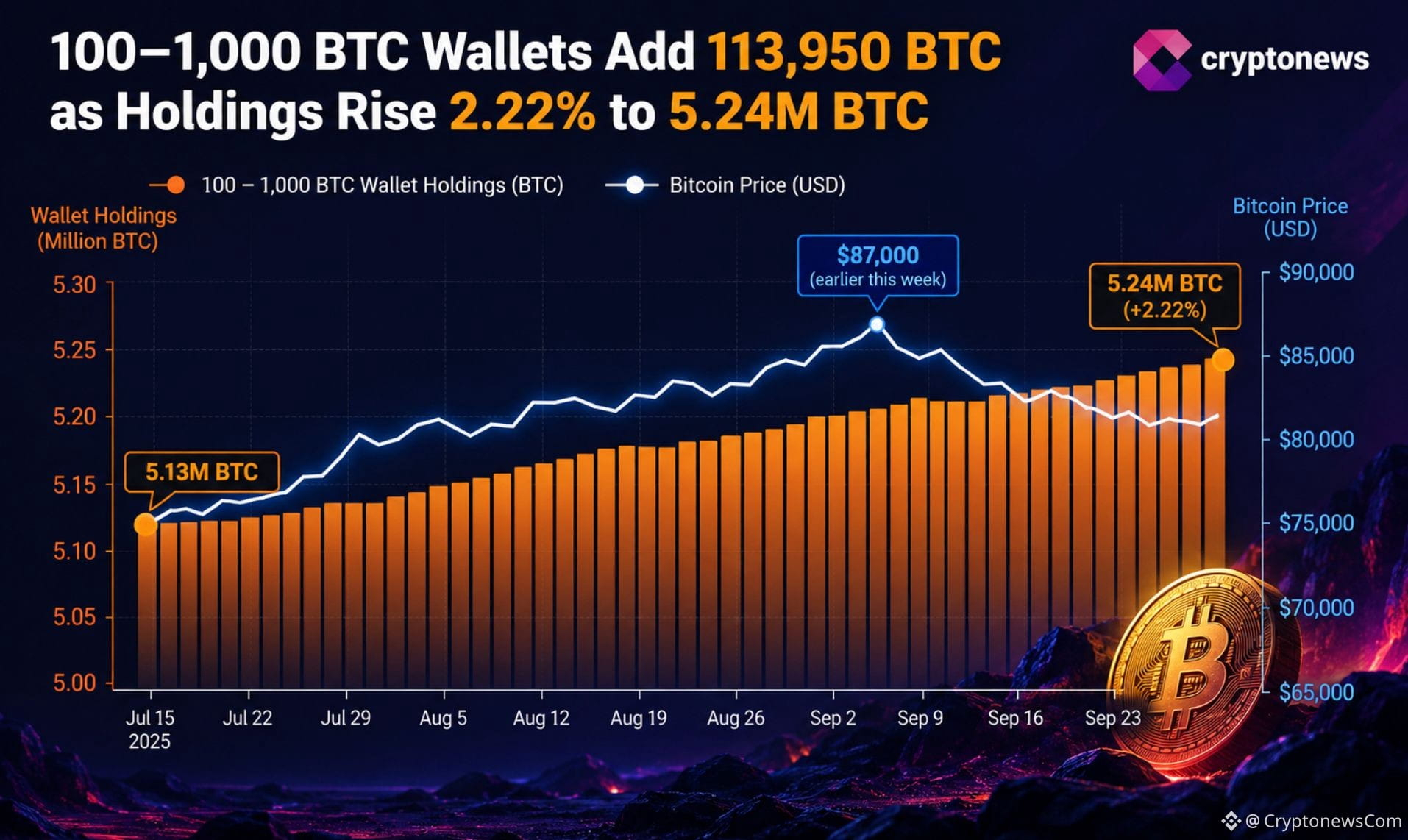
Article
Mid-Sized Bitcoin Wallets Add 113,950 Bitcoin as Price Rally Nears TestWallets holding between 100 and 1,000 BTC have added 113,950 Bitcoin since July 15, lifting their combined holdings 2.22% to 5.24 million BTC, according to Santiment. The accumulation run coincides with Bitcoin price briefly tapping $87,000 earlier this week before retracing and stabilizing near $84,000.
Is this durable demand building a base for a breakout, or is it a squeeze-driven bounce that stalls the moment leverage unwinds?
Not everyone is convinced this move reflects a genuine shift in risk appetite. Trace Finance co-founder Bernardo Brites says that the speed of the recovery was partly a function of a short squeeze, and that the bigger question is where the new money is actually coming from.
“I wouldn’t read this as a broad return of risk appetite. Bitcoin rallying through a rate hike, $100 oil, and elevated yields suggests some investors are treating it as a hedge against inflation, fiscal and geopolitical risk rather than as a bet on easy money,” Brites said.
That framing matters for anyone reading the current resistance structure as a clean technical setup rather than a macro hedge trade layered on top of one.
Santiment has tracked this 100-to-1,000-BTC wallet cohort for five years, and its activity has historically aligned closely with market direction. Periods of heavy accumulation have often preceded or coincided with stronger price moves. The current data shows the cohort continued buying through the recovery, which at minimum indicates the rally isn’t being carried by retail flow alone.
Discover: Best Crypto IPO this September
What Bitcoin Needs to Breach the $88,000-$90,000 Resistance?
The technical picture underneath the whale and ETF data is straightforward. Bitcoin reclaimed its 365-day moving average near $80,500, a level it last broke back above in March 2023 – a move that preceded a much larger rally at the time. It also cleared the $76,000-$81,000 supply band that had capped price action for weeks.
That $88,000-$90,000 Bitcoin price band matters specifically because of where the coin supply sits, not because of round-number psychology. A large concentration of Bitcoin clustered in that range means sellers are likely to show up in size the closer the price gets to it, which is exactly why the $90,000 target is treated as the next real test.
Trade Bictoin on Bybit and Get a Chance to Win Our $1,000 USDT AirdropETF Demand at the Bitcoin Price Resistance Test
The two-sided framing gives traders a concrete way to read what happens next rather than guessing. A continuation of ETF inflows alongside renewed stablecoin supply growth would, in our view, build a stronger base under the rally as it approaches resistance. A stall in either, particularly a fade in ETF demand while price sits below $88,000, leaves the move vulnerable to giving back gains as leveraged positioning unwinds.
Bitcoin (BTC)
24h7d30d1yAll time
CryptoQuant founder Ki Young Ju has separately argued this cycle is more likely to produce a 3-to-5x rally than a repeat of past 10x blow-offs, citing a maturing market and growing institutional participation as dampeners on extreme volatility.
That view doesn’t confirm where Bitcoin goes after $90,000; it simply lowers the bar for what counts as a strong outcome this cycle, a distinction worth keeping in mind while watching the longer-term structural recovery play out against this specific resistance test.
Earn $50 and Enter $300K Prize Draw on EdgeX
The post Mid-Sized Bitcoin Wallets Add 113,950 Bitcoin as Price Rally Nears Test appeared first on Cryptonews.
Mid-Sized Bitcoin Wallets Add 113,950 Bitcoin as Price Rally Nears Test
Wallets holding between 100 and 1,000 BTC have added 113,950 Bitcoin since July 15, lifting their combined holdings 2.22% to 5.24 million BTC, according to Santiment. The accumulation run coincides with Bitcoin price briefly tapping $87,000 earlier this week before retracing and stabilizing near $84,000.
Is this durable demand building a base for a breakout, or is it a squeeze-driven bounce that stalls the moment leverage unwinds?
Not everyone is convinced this move reflects a genuine shift in risk appetite. Trace Finance co-founder Bernardo Brites says that the speed of the recovery was partly a function of a short squeeze, and that the bigger question is where the new money is actually coming from.
“I wouldn’t read this as a broad return of risk appetite. Bitcoin rallying through a rate hike, $100 oil, and elevated yields suggests some investors are treating it as a hedge against inflation, fiscal and geopolitical risk rather than as a bet on easy money,” Brites said.
That framing matters for anyone reading the current resistance structure as a clean technical setup rather than a macro hedge trade layered on top of one.
Santiment has tracked this 100-to-1,000-BTC wallet cohort for five years, and its activity has historically aligned closely with market direction. Periods of heavy accumulation have often preceded or coincided with stronger price moves. The current data shows the cohort continued buying through the recovery, which at minimum indicates the rally isn’t being carried by retail flow alone.
Discover: Best Crypto IPO this September
What Bitcoin Needs to Breach the $88,000-$90,000 Resistance?
The technical picture underneath the whale and ETF data is straightforward. Bitcoin reclaimed its 365-day moving average near $80,500, a level it last broke back above in March 2023 – a move that preceded a much larger rally at the time. It also cleared the $76,000-$81,000 supply band that had capped price action for weeks.
That $88,000-$90,000 Bitcoin price band matters specifically because of where the coin supply sits, not because of round-number psychology. A large concentration of Bitcoin clustered in that range means sellers are likely to show up in size the closer the price gets to it, which is exactly why the $90,000 target is treated as the next real test.
Trade Bictoin on Bybit and Get a Chance to Win Our $1,000 USDT AirdropETF Demand at the Bitcoin Price Resistance Test
The two-sided framing gives traders a concrete way to read what happens next rather than guessing. A continuation of ETF inflows alongside renewed stablecoin supply growth would, in our view, build a stronger base under the rally as it approaches resistance. A stall in either, particularly a fade in ETF demand while price sits below $88,000, leaves the move vulnerable to giving back gains as leveraged positioning unwinds.
Bitcoin (BTC)
24h7d30d1yAll time
CryptoQuant founder Ki Young Ju has separately argued this cycle is more likely to produce a 3-to-5x rally than a repeat of past 10x blow-offs, citing a maturing market and growing institutional participation as dampeners on extreme volatility.
That view doesn’t confirm where Bitcoin goes after $90,000; it simply lowers the bar for what counts as a strong outcome this cycle, a distinction worth keeping in mind while watching the longer-term structural recovery play out against this specific resistance test.
Earn $50 and Enter $300K Prize Draw on EdgeX
The post Mid-Sized Bitcoin Wallets Add 113,950 Bitcoin as Price Rally Nears Test appeared first on Cryptonews.
Is this durable demand building a base for a breakout, or is it a squeeze-driven bounce that stalls the moment leverage unwinds?
Not everyone is convinced this move reflects a genuine shift in risk appetite. Trace Finance co-founder Bernardo Brites says that the speed of the recovery was partly a function of a short squeeze, and that the bigger question is where the new money is actually coming from.
“I wouldn’t read this as a broad return of risk appetite. Bitcoin rallying through a rate hike, $100 oil, and elevated yields suggests some investors are treating it as a hedge against inflation, fiscal and geopolitical risk rather than as a bet on easy money,” Brites said.
That framing matters for anyone reading the current resistance structure as a clean technical setup rather than a macro hedge trade layered on top of one.
Santiment has tracked this 100-to-1,000-BTC wallet cohort for five years, and its activity has historically aligned closely with market direction. Periods of heavy accumulation have often preceded or coincided with stronger price moves. The current data shows the cohort continued buying through the recovery, which at minimum indicates the rally isn’t being carried by retail flow alone.
Discover: Best Crypto IPO this September
What Bitcoin Needs to Breach the $88,000-$90,000 Resistance?
The technical picture underneath the whale and ETF data is straightforward. Bitcoin reclaimed its 365-day moving average near $80,500, a level it last broke back above in March 2023 – a move that preceded a much larger rally at the time. It also cleared the $76,000-$81,000 supply band that had capped price action for weeks.
That $88,000-$90,000 Bitcoin price band matters specifically because of where the coin supply sits, not because of round-number psychology. A large concentration of Bitcoin clustered in that range means sellers are likely to show up in size the closer the price gets to it, which is exactly why the $90,000 target is treated as the next real test.
Trade Bictoin on Bybit and Get a Chance to Win Our $1,000 USDT AirdropETF Demand at the Bitcoin Price Resistance Test
The two-sided framing gives traders a concrete way to read what happens next rather than guessing. A continuation of ETF inflows alongside renewed stablecoin supply growth would, in our view, build a stronger base under the rally as it approaches resistance. A stall in either, particularly a fade in ETF demand while price sits below $88,000, leaves the move vulnerable to giving back gains as leveraged positioning unwinds.
Bitcoin (BTC)
24h7d30d1yAll time
CryptoQuant founder Ki Young Ju has separately argued this cycle is more likely to produce a 3-to-5x rally than a repeat of past 10x blow-offs, citing a maturing market and growing institutional participation as dampeners on extreme volatility.
That view doesn’t confirm where Bitcoin goes after $90,000; it simply lowers the bar for what counts as a strong outcome this cycle, a distinction worth keeping in mind while watching the longer-term structural recovery play out against this specific resistance test.
Earn $50 and Enter $300K Prize Draw on EdgeX
The post Mid-Sized Bitcoin Wallets Add 113,950 Bitcoin as Price Rally Nears Test appeared first on Cryptonews.
255
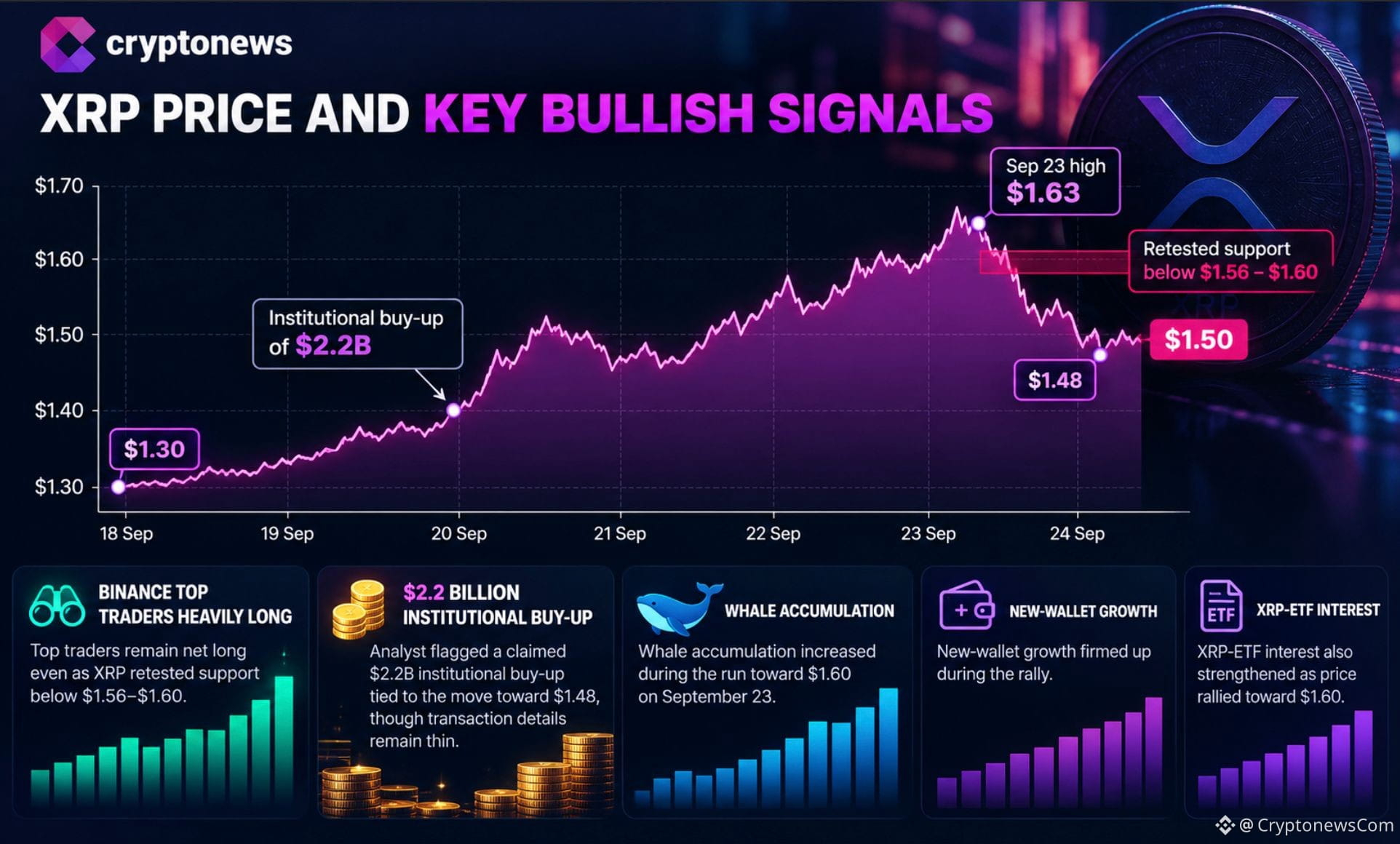
Article
XRP Price Prediction: October is a Weak Month for Ripple, But 3 Metrics Point BullishXRP is trading at $1.50, down 7.6% over the past 24 hours after reaching $1.63 during the period. Despite the pullback and a bearish price prediction, XRP remains up 15.1% over the past seven days, recovering sharply from its recent lows. XRP’s market cap currently stands at roughly $94.1 billion, below the $100 billion mark it briefly approached during the rally.
Binance’s top traders remain heavily long even as XRP retested support below the $1.56–$1.60 zone it broke through earlier in the week. Our analyst flagged a claimed $2.2 billion institutional buy-up tied to the move toward $1.48, though transaction details remain thin. Whale accumulation, new-wallet growth, and XRP-ETF interest all firmed up during the run toward $1.60 on September 23.
The broader tape isn’t helping. Treasury yields hit their highest level since 2007 this week on inflation worries, dragging the Dow, S&P 500, and Nasdaq lower, a risk-off signal that can weigh on crypto alongside token-specific factors.
Discover: Best Crypto IPO this September
XRP Price Prediction: Can Ripple Hit $1.70 This Week?
XRP’s current structure looks like a pullback after a breakout attempt, not a breakdown. Support sits at $1.50–$1.53, with deeper floors at $1.44–$1.45 and $1.35–$1.40 if selling accelerates. The 20-day EMA near $1.4171 is the level bulls need to defend to keep the broader trend intact.
Xrp (XRP)
24h7d30d1yAll time
Bull case: a reclaim and hold above $1.56–$1.60 opens a path to $1.6999 and $1.8111, especially if ETF-related demand and whale accumulation persist into Ripple’s Swell 2026 conference.
Base case: range-bound chop between $1.45 and $1.60 while the market digests macro noise.
Bear case: a close below $1.44 invalidates the near-term bullish structure and puts $1.35–$1.40 back in play.
RSI data and historical rebound patterns suggest the pullback may be shallower than October seasonality implies. See the full RSI breakdown here. Open interest, funding rates, and ETF flow data add further context on whether leverage is set up for a squeeze or a flush.
Trade XRP on Bybit and Get a Chance to Win Our $1,000 USDT AirdropMaxi Doge Targets Early Mover Upside as XRP Tests Key Levels
Holding XRP through the October chop is a defensible position; the three bullish metrics (whale flows, futures positioning, ETF interest) argue the dip gets bought. But at a $90 billion-plus market cap, XRP isn’t delivering 10x moves from here. That kind of asymmetric upside now lives further down the risk curve, in presale-stage tokens still finding their price.
pic.twitter.com/Vg6OpDX6Bq
— MaxiDoge (@MaxiDoge_) August 13, 2026
Enter Maxi Doge ($MAXI), a meme token built entirely around leverage-trading culture. Think a 240-lb canine mascot channeling “1000x leverage” energy, holder-only trading competitions with leaderboard rewards, and a Maxi Fund treasury backing liquidity and partnerships.
The presale has raised $4.8 million at a current price of just $0.000284, with dynamic APY staking live for early holders. The tagline sums up the pitch: never skip leg-day, never skip a pump.
Check the Maxi Doge presale details here.
Earn $50 and Enter $300K Prize Draw on EdgeX
The post XRP Price Prediction: October is a Weak Month for Ripple, But 3 Metrics Point Bullish appeared first on Cryptonews.
XRP Price Prediction: October is a Weak Month for Ripple, But 3 Metrics Point Bullish
XRP is trading at $1.50, down 7.6% over the past 24 hours after reaching $1.63 during the period. Despite the pullback and a bearish price prediction, XRP remains up 15.1% over the past seven days, recovering sharply from its recent lows. XRP’s market cap currently stands at roughly $94.1 billion, below the $100 billion mark it briefly approached during the rally.
Binance’s top traders remain heavily long even as XRP retested support below the $1.56–$1.60 zone it broke through earlier in the week. Our analyst flagged a claimed $2.2 billion institutional buy-up tied to the move toward $1.48, though transaction details remain thin. Whale accumulation, new-wallet growth, and XRP-ETF interest all firmed up during the run toward $1.60 on September 23.
The broader tape isn’t helping. Treasury yields hit their highest level since 2007 this week on inflation worries, dragging the Dow, S&P 500, and Nasdaq lower, a risk-off signal that can weigh on crypto alongside token-specific factors.
Discover: Best Crypto IPO this September
XRP Price Prediction: Can Ripple Hit $1.70 This Week?
XRP’s current structure looks like a pullback after a breakout attempt, not a breakdown. Support sits at $1.50–$1.53, with deeper floors at $1.44–$1.45 and $1.35–$1.40 if selling accelerates. The 20-day EMA near $1.4171 is the level bulls need to defend to keep the broader trend intact.
Xrp (XRP)
24h7d30d1yAll time
Bull case: a reclaim and hold above $1.56–$1.60 opens a path to $1.6999 and $1.8111, especially if ETF-related demand and whale accumulation persist into Ripple’s Swell 2026 conference.
Base case: range-bound chop between $1.45 and $1.60 while the market digests macro noise.
Bear case: a close below $1.44 invalidates the near-term bullish structure and puts $1.35–$1.40 back in play.
RSI data and historical rebound patterns suggest the pullback may be shallower than October seasonality implies. See the full RSI breakdown here. Open interest, funding rates, and ETF flow data add further context on whether leverage is set up for a squeeze or a flush.
Trade XRP on Bybit and Get a Chance to Win Our $1,000 USDT AirdropMaxi Doge Targets Early Mover Upside as XRP Tests Key Levels
Holding XRP through the October chop is a defensible position; the three bullish metrics (whale flows, futures positioning, ETF interest) argue the dip gets bought. But at a $90 billion-plus market cap, XRP isn’t delivering 10x moves from here. That kind of asymmetric upside now lives further down the risk curve, in presale-stage tokens still finding their price.
pic.twitter.com/Vg6OpDX6Bq
— MaxiDoge (@MaxiDoge_) August 13, 2026
Enter Maxi Doge ($MAXI), a meme token built entirely around leverage-trading culture. Think a 240-lb canine mascot channeling “1000x leverage” energy, holder-only trading competitions with leaderboard rewards, and a Maxi Fund treasury backing liquidity and partnerships.
The presale has raised $4.8 million at a current price of just $0.000284, with dynamic APY staking live for early holders. The tagline sums up the pitch: never skip leg-day, never skip a pump.
Check the Maxi Doge presale details here.
Earn $50 and Enter $300K Prize Draw on EdgeX
The post XRP Price Prediction: October is a Weak Month for Ripple, But 3 Metrics Point Bullish appeared first on Cryptonews.
Binance’s top traders remain heavily long even as XRP retested support below the $1.56–$1.60 zone it broke through earlier in the week. Our analyst flagged a claimed $2.2 billion institutional buy-up tied to the move toward $1.48, though transaction details remain thin. Whale accumulation, new-wallet growth, and XRP-ETF interest all firmed up during the run toward $1.60 on September 23.
The broader tape isn’t helping. Treasury yields hit their highest level since 2007 this week on inflation worries, dragging the Dow, S&P 500, and Nasdaq lower, a risk-off signal that can weigh on crypto alongside token-specific factors.
Discover: Best Crypto IPO this September
XRP Price Prediction: Can Ripple Hit $1.70 This Week?
XRP’s current structure looks like a pullback after a breakout attempt, not a breakdown. Support sits at $1.50–$1.53, with deeper floors at $1.44–$1.45 and $1.35–$1.40 if selling accelerates. The 20-day EMA near $1.4171 is the level bulls need to defend to keep the broader trend intact.
Xrp (XRP)
24h7d30d1yAll time
Bull case: a reclaim and hold above $1.56–$1.60 opens a path to $1.6999 and $1.8111, especially if ETF-related demand and whale accumulation persist into Ripple’s Swell 2026 conference.
Base case: range-bound chop between $1.45 and $1.60 while the market digests macro noise.
Bear case: a close below $1.44 invalidates the near-term bullish structure and puts $1.35–$1.40 back in play.
RSI data and historical rebound patterns suggest the pullback may be shallower than October seasonality implies. See the full RSI breakdown here. Open interest, funding rates, and ETF flow data add further context on whether leverage is set up for a squeeze or a flush.
Trade XRP on Bybit and Get a Chance to Win Our $1,000 USDT AirdropMaxi Doge Targets Early Mover Upside as XRP Tests Key Levels
Holding XRP through the October chop is a defensible position; the three bullish metrics (whale flows, futures positioning, ETF interest) argue the dip gets bought. But at a $90 billion-plus market cap, XRP isn’t delivering 10x moves from here. That kind of asymmetric upside now lives further down the risk curve, in presale-stage tokens still finding their price.
pic.twitter.com/Vg6OpDX6Bq
— MaxiDoge (@MaxiDoge_) August 13, 2026
Enter Maxi Doge ($MAXI), a meme token built entirely around leverage-trading culture. Think a 240-lb canine mascot channeling “1000x leverage” energy, holder-only trading competitions with leaderboard rewards, and a Maxi Fund treasury backing liquidity and partnerships.
The presale has raised $4.8 million at a current price of just $0.000284, with dynamic APY staking live for early holders. The tagline sums up the pitch: never skip leg-day, never skip a pump.
Check the Maxi Doge presale details here.
Earn $50 and Enter $300K Prize Draw on EdgeX
The post XRP Price Prediction: October is a Weak Month for Ripple, But 3 Metrics Point Bullish appeared first on Cryptonews.
1
905
Vérifié

Article
Bitcoin Price Prediction: StarkWare Discounts Quantum-Safe Solution by 79%Bitcoin price trades near $84,000, down by a huge 3.5% on the day, but the more interesting number this week has nothing to do with its prediction. It’s $67. That’s the new estimated cost to build a quantum-resistant Bitcoin transaction, down from $320 when StarkWare mined the first one on mainnet back in August, a 79% reduction achieved in a single week of open optimization work.
The move came out of the Quantum-Safe Bitcoin Optimization Challenge, a joint effort between StarkWare, Yukon Research, and Eigen Labs. According to the report, they invited developers, researchers, and even AI agents to shrink the GPU-hours needed to construct the transaction.
A post-quantum-secure Bitcoin tx now costs an estimated $67 in GPU compute.
In just ONE WEEK, devs and AI agents cut that cost by 79%, down from $320.
The challenge is still running, with $20,000 in prizes up for grabs for those who can push the cost even lower:… pic.twitter.com/4PvBLrmc4R
— StarkWare (@StarkWareLtd) September 23, 2026
StarkWare’s own dashboard now shows the figure sitting at $66, with the team noting bluntly: “A construction that costs a few hundred dollars per transaction is a demo. One that costs $67 is closer to something a holder with a large unexposed balance might reach for in an emergency.”
This is good news. Quantum risk to Bitcoin has long been theoretical enough to ignore, until the cost of defending against it starts looking like a rounding error next to a whale’s transaction fee. Against that backdrop, Bitcoin’s price action this week tells its own story of consolidation after a sharp round trip.
Discover: The Best Token Presales
Bitcoin Price Prediction: Can BTC Hold $84,000 This Week?
Bitcoin’s pullback to the $84,000–$84,500 zone followed hotter-than-expected PMI data that pushed Treasury yields higher and dented risk appetite across crypto, with total market cap falling 3% in the session. That’s a sharp reversal from the rally that took BTC to roughly $87,500 after U.S. spot ETFs pulled in an estimated $998.95 million in net inflows on September 21.
Bitcoin (BTC)
24h7d30d1yAll time
The $84,000–$84,400 band is now the line in the sand. It overlaps a key Fibonacci retracement zone and the recent breakout shelf. Lose it, and $82,193 followed by $78,571 comes into play. Hold it, and a retest of $86,381, then the $87,400 ceiling, is realistic. Recent technical work flags $90,000–$92,000 as the next real resistance if momentum returns, with $104,433 floated as a stretch target should the recovery extend.
Earn $50 and Enter $300K Prize Draw on EdgeXBitcoin Hyper Targets Early Mover Upside as Bitcoin Tests Key Levels
A rejection near $87,000 followed by a slide back under $85,000 is the kind of chop that tests conviction, not confidence. Bitcoin holding six figures away from $100,000 while yields tighten is a reminder that beta exposure at this size doesn’t move fast.
Bitcoin’s market cap is simply too large for outsized short-term returns, even on good news like a 79% cost cut to quantum defenses. That’s pushed a chunk of trader attention toward earlier-stage infrastructure plays building directly on top of Bitcoin’s base layer.
The city sleeps. $HYPER stays charged. pic.twitter.com/LKBUzZLH39
— Bitcoin Hyper (@BTC_Hyper2) September 22, 2026
Bitcoin Hyper ($HYPER) is positioning itself as the first Bitcoin Layer 2 with SVM integration, aiming to bring Solana-grade execution speed to Bitcoin’s ecosystem without touching its consensus security. The presale has raised more than $33 million to date, with tokens priced at $0.0136867 and staking rewards on offer at a high 30% APY.
Its Decentralized Canonical Bridge targets the slow-transaction, high-fee, zero-programmability problems that have kept Bitcoin’s base chain largely inert for smart contract activity.
Research Bitcoin Hyper directly before the presale window ends.
Trade Bitcoin on Bybit and Get a Chance to Win Our $1,000 USDT Airdrop
The post Bitcoin Price Prediction: StarkWare Discounts Quantum-Safe Solution by 79% appeared first on Cryptonews.
Bitcoin Price Prediction: StarkWare Discounts Quantum-Safe Solution by 79%
Bitcoin price trades near $84,000, down by a huge 3.5% on the day, but the more interesting number this week has nothing to do with its prediction. It’s $67. That’s the new estimated cost to build a quantum-resistant Bitcoin transaction, down from $320 when StarkWare mined the first one on mainnet back in August, a 79% reduction achieved in a single week of open optimization work.
The move came out of the Quantum-Safe Bitcoin Optimization Challenge, a joint effort between StarkWare, Yukon Research, and Eigen Labs. According to the report, they invited developers, researchers, and even AI agents to shrink the GPU-hours needed to construct the transaction.
A post-quantum-secure Bitcoin tx now costs an estimated $67 in GPU compute.
In just ONE WEEK, devs and AI agents cut that cost by 79%, down from $320.
The challenge is still running, with $20,000 in prizes up for grabs for those who can push the cost even lower:… pic.twitter.com/4PvBLrmc4R
— StarkWare (@StarkWareLtd) September 23, 2026
StarkWare’s own dashboard now shows the figure sitting at $66, with the team noting bluntly: “A construction that costs a few hundred dollars per transaction is a demo. One that costs $67 is closer to something a holder with a large unexposed balance might reach for in an emergency.”
This is good news. Quantum risk to Bitcoin has long been theoretical enough to ignore, until the cost of defending against it starts looking like a rounding error next to a whale’s transaction fee. Against that backdrop, Bitcoin’s price action this week tells its own story of consolidation after a sharp round trip.
Discover: The Best Token Presales
Bitcoin Price Prediction: Can BTC Hold $84,000 This Week?
Bitcoin’s pullback to the $84,000–$84,500 zone followed hotter-than-expected PMI data that pushed Treasury yields higher and dented risk appetite across crypto, with total market cap falling 3% in the session. That’s a sharp reversal from the rally that took BTC to roughly $87,500 after U.S. spot ETFs pulled in an estimated $998.95 million in net inflows on September 21.
Bitcoin (BTC)
24h7d30d1yAll time
The $84,000–$84,400 band is now the line in the sand. It overlaps a key Fibonacci retracement zone and the recent breakout shelf. Lose it, and $82,193 followed by $78,571 comes into play. Hold it, and a retest of $86,381, then the $87,400 ceiling, is realistic. Recent technical work flags $90,000–$92,000 as the next real resistance if momentum returns, with $104,433 floated as a stretch target should the recovery extend.
Earn $50 and Enter $300K Prize Draw on EdgeXBitcoin Hyper Targets Early Mover Upside as Bitcoin Tests Key Levels
A rejection near $87,000 followed by a slide back under $85,000 is the kind of chop that tests conviction, not confidence. Bitcoin holding six figures away from $100,000 while yields tighten is a reminder that beta exposure at this size doesn’t move fast.
Bitcoin’s market cap is simply too large for outsized short-term returns, even on good news like a 79% cost cut to quantum defenses. That’s pushed a chunk of trader attention toward earlier-stage infrastructure plays building directly on top of Bitcoin’s base layer.
The city sleeps. $HYPER stays charged. pic.twitter.com/LKBUzZLH39
— Bitcoin Hyper (@BTC_Hyper2) September 22, 2026
Bitcoin Hyper ($HYPER) is positioning itself as the first Bitcoin Layer 2 with SVM integration, aiming to bring Solana-grade execution speed to Bitcoin’s ecosystem without touching its consensus security. The presale has raised more than $33 million to date, with tokens priced at $0.0136867 and staking rewards on offer at a high 30% APY.
Its Decentralized Canonical Bridge targets the slow-transaction, high-fee, zero-programmability problems that have kept Bitcoin’s base chain largely inert for smart contract activity.
Research Bitcoin Hyper directly before the presale window ends.
Trade Bitcoin on Bybit and Get a Chance to Win Our $1,000 USDT Airdrop
The post Bitcoin Price Prediction: StarkWare Discounts Quantum-Safe Solution by 79% appeared first on Cryptonews.
The move came out of the Quantum-Safe Bitcoin Optimization Challenge, a joint effort between StarkWare, Yukon Research, and Eigen Labs. According to the report, they invited developers, researchers, and even AI agents to shrink the GPU-hours needed to construct the transaction.
A post-quantum-secure Bitcoin tx now costs an estimated $67 in GPU compute.
In just ONE WEEK, devs and AI agents cut that cost by 79%, down from $320.
The challenge is still running, with $20,000 in prizes up for grabs for those who can push the cost even lower:… pic.twitter.com/4PvBLrmc4R
— StarkWare (@StarkWareLtd) September 23, 2026
StarkWare’s own dashboard now shows the figure sitting at $66, with the team noting bluntly: “A construction that costs a few hundred dollars per transaction is a demo. One that costs $67 is closer to something a holder with a large unexposed balance might reach for in an emergency.”
This is good news. Quantum risk to Bitcoin has long been theoretical enough to ignore, until the cost of defending against it starts looking like a rounding error next to a whale’s transaction fee. Against that backdrop, Bitcoin’s price action this week tells its own story of consolidation after a sharp round trip.
Discover: The Best Token Presales
Bitcoin Price Prediction: Can BTC Hold $84,000 This Week?
Bitcoin’s pullback to the $84,000–$84,500 zone followed hotter-than-expected PMI data that pushed Treasury yields higher and dented risk appetite across crypto, with total market cap falling 3% in the session. That’s a sharp reversal from the rally that took BTC to roughly $87,500 after U.S. spot ETFs pulled in an estimated $998.95 million in net inflows on September 21.
Bitcoin (BTC)
24h7d30d1yAll time
The $84,000–$84,400 band is now the line in the sand. It overlaps a key Fibonacci retracement zone and the recent breakout shelf. Lose it, and $82,193 followed by $78,571 comes into play. Hold it, and a retest of $86,381, then the $87,400 ceiling, is realistic. Recent technical work flags $90,000–$92,000 as the next real resistance if momentum returns, with $104,433 floated as a stretch target should the recovery extend.
Earn $50 and Enter $300K Prize Draw on EdgeXBitcoin Hyper Targets Early Mover Upside as Bitcoin Tests Key Levels
A rejection near $87,000 followed by a slide back under $85,000 is the kind of chop that tests conviction, not confidence. Bitcoin holding six figures away from $100,000 while yields tighten is a reminder that beta exposure at this size doesn’t move fast.
Bitcoin’s market cap is simply too large for outsized short-term returns, even on good news like a 79% cost cut to quantum defenses. That’s pushed a chunk of trader attention toward earlier-stage infrastructure plays building directly on top of Bitcoin’s base layer.
The city sleeps. $HYPER stays charged. pic.twitter.com/LKBUzZLH39
— Bitcoin Hyper (@BTC_Hyper2) September 22, 2026
Bitcoin Hyper ($HYPER) is positioning itself as the first Bitcoin Layer 2 with SVM integration, aiming to bring Solana-grade execution speed to Bitcoin’s ecosystem without touching its consensus security. The presale has raised more than $33 million to date, with tokens priced at $0.0136867 and staking rewards on offer at a high 30% APY.
Its Decentralized Canonical Bridge targets the slow-transaction, high-fee, zero-programmability problems that have kept Bitcoin’s base chain largely inert for smart contract activity.
Research Bitcoin Hyper directly before the presale window ends.
Trade Bitcoin on Bybit and Get a Chance to Win Our $1,000 USDT Airdrop
The post Bitcoin Price Prediction: StarkWare Discounts Quantum-Safe Solution by 79% appeared first on Cryptonews.
1.3k
Connectez-vous pour découvrir plus de contenu
Rejoignez la communauté mondiale des adeptes de cryptomonnaies sur Binance Square
⚡️ Suviez les dernières informations importantes sur les cryptomonnaies.
💬 Jugé digne de confiance par la plus grande plateforme d’échange de cryptomonnaies au monde.
👍 Découvrez les connaissances que partagent les créateurs vérifiés.
Adresse e-mail/Nº de téléphone
Sujets d’actualité
PolymarketBankFailureBetsDrawFDICConcern
3,685 vues
178 mentions
#polymarketbankfailurebetsdrawfdicconcern
🚨 Market Alert: Bank Failure Bets on Polymarket Draw FDIC Concern
The Situation: The financial world is buzzing as a high-stakes prediction market on Polymarket—specifically betting on the probability of major bank failures—has drawn serious attention and concern from regulators, including the FDIC. This has created a volatile feedback loop where market sentiment directly influences regulatory scrutiny, driving massive volume and volatility across the sector.
What This Means for Traders: When prediction markets for financial distress gain this much traction, it signals extreme market stress and elevated systemic risk. Traders are closely monitoring contagion risk across the banking sector, making it a critical moment for risk management and sector rotation.
Highlighted Tradeable Coins to Watch:
$BTC (Bitcoin): The ultimate macro hedge. As concerns over fiat banking stability rise, traders frequently rotate capital into Bitcoin as a decentralized, non-sovereign store of value.
$ETH (Ethereum): Leading the decentralized finance (DeFi) ecosystem. If the traditional banking sector faces pressure, increased attention often turns to on-chain finance and lending protocols built on Ethereum.
$BNB (Binance Coin): As a proxy for exchange health and broader market sentiment, tracking how major exchange tokens react to sudden financial news provides insights into overall market liquidity and trader confidence.
Are you hedging against systemic risk or watching from the sidelines? Let's discuss your strategy in the comments below! 👇
#Polymarket #FDIC #BankingSector #PredictionMarkets
Axiom AlphA
·0 mentions J’aime
·2.5k vues
BlackRockBuildsTokenizedPortfoliosForOndo
2,322 vues
115 mentions
BitwiseFilesToListNEARETFOnNYSEArca
3,802 vues
149 mentions