

#stablecoin
stablecoin
3.9M vues
17,879 mentions
Populaire
Récents

·
--
Vérifié
📰 Bloomberg Launches Stablecoin Dashboard on the Terminal
Source : Blockchainreporter
description: Bloomberg's new Terminal dashboard delivers hourly stablecoin supply, mint, burn, transfer and velocity data from Allium, covering more than 98% of the market.
Time : 2026-10-01 02:00:00
Credit : jide idowu
Link : https://blockchainreporter.net/bloomberg-launches-stablecoin-dashboard-on-terminal/
#usdc #crypto_adoption #usdt #stablecoin
$CORE $BTC
📰 Bloomberg Launches Stablecoin Dashboard on the Terminal
Source : Blockchainreporter
description: Bloomberg's new Terminal dashboard delivers hourly stablecoin supply, mint, burn, transfer and velocity data from Allium, covering more than 98% of the market.
Time : 2026-10-01 02:00:00
Credit : jide idowu
Link : https://blockchainreporter.net/bloomberg-launches-stablecoin-dashboard-on-terminal/
#usdc #crypto_adoption #usdt #stablecoin
$CORE $BTC
Source : Blockchainreporter
description: Bloomberg's new Terminal dashboard delivers hourly stablecoin supply, mint, burn, transfer and velocity data from Allium, covering more than 98% of the market.
Time : 2026-10-01 02:00:00
Credit : jide idowu
Link : https://blockchainreporter.net/bloomberg-launches-stablecoin-dashboard-on-terminal/
#usdc #crypto_adoption #usdt #stablecoin
$CORE $BTC
15

·
--
Haussier
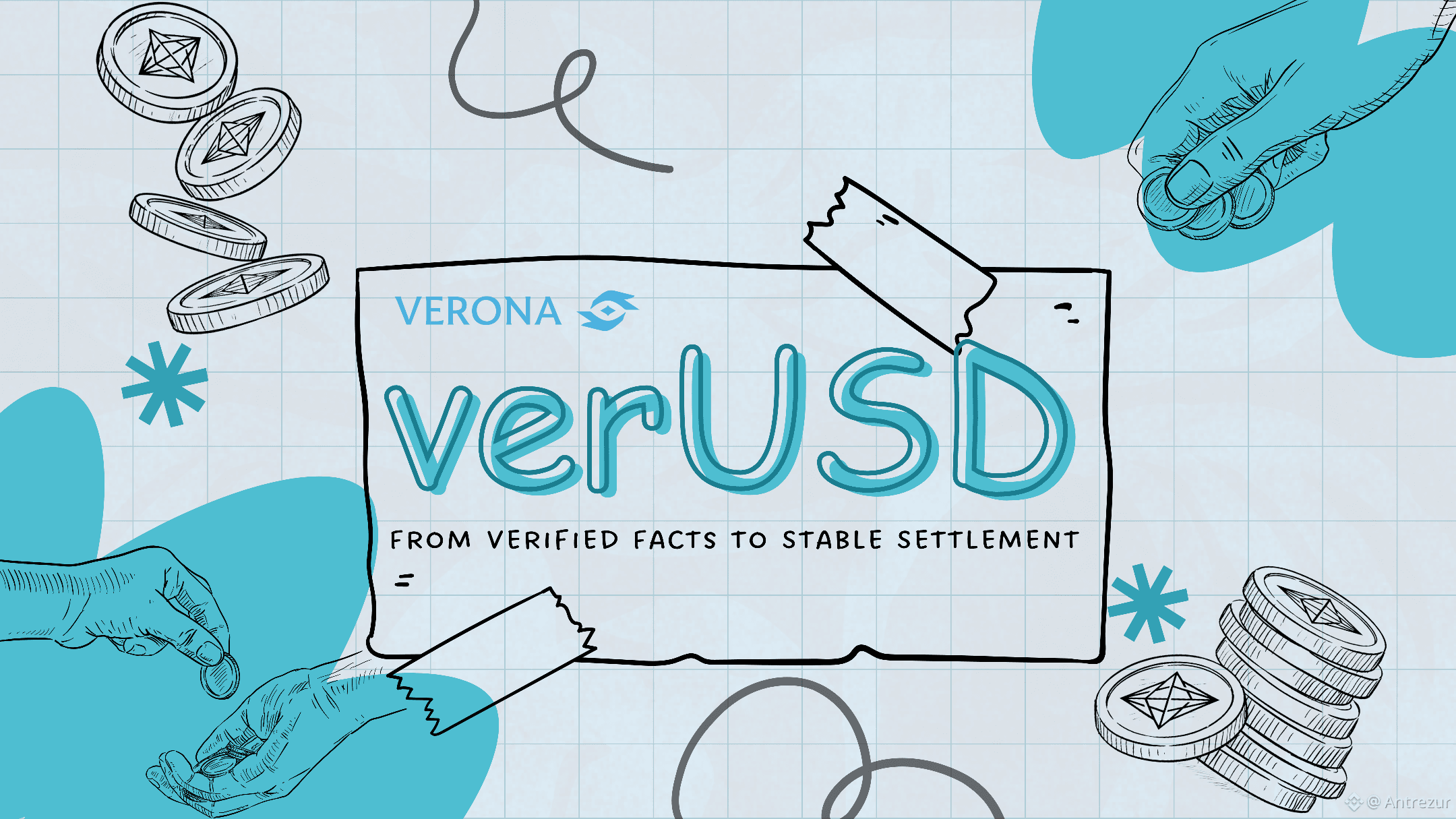
From Verified Facts to Stable Settlement
verUSD makes more sense when viewed as part of @verona_dev , not as a standalone stablecoin.
Verona has spent the last few months building around one core idea, AI agents need more than access to information. They need verified facts they can actually rely on before making decisions. Through Verona’s verification infrastructure, internet data can be turned into something provable, reusable, and usable by agents without exposing the underlying raw data.
But knowing what is true is only half of the problem.
Once an agent has enough verified context to act, it still needs a way to pay for data, services, APIs, or other transactions. Traditional payment systems were built around humans opening bank accounts, using cards, and moving through checkout flows. Software operating autonomously, potentially making thousands of small payments, needs something different.
$verUSD Launched
verUSD is Verona $USD, the dollar of the Verona network. It gives agents a stable settlement unit that can sit directly behind the actions they take. Verona verifies the information, verUSD gives the agent a way to pay once that information leads to a decision.
The launch already comes with $100M+ in institutional commitments, including more than $60M in signed, contracted revenue expected to move through verUSD as payments. That matters because verUSD is not starting from zero and then searching for a use case. Payment activity already exists around Verona, and now that activity has a settlement asset designed specifically for it.
The relationship becomes much easier to see when the pieces are placed together
Verified facts ~~> agent decision ~~> verifiable action ~~> stable settlement.
Truth Engine handles the truth layer. Verona’s infrastructure supports the action that follows. And verUSD adds money to the same flow.
So the bigger story here is not simply that Verona launched another stablecoin.
It is that truth, action, and money are beginning to live inside the same agent-native system.
#stablecoin
From Verified Facts to Stable Settlement
verUSD makes more sense when viewed as part of @verona_dev , not as a standalone stablecoin.
Verona has spent the last few months building around one core idea, AI agents need more than access to information. They need verified facts they can actually rely on before making decisions. Through Verona’s verification infrastructure, internet data can be turned into something provable, reusable, and usable by agents without exposing the underlying raw data.
But knowing what is true is only half of the problem.
Once an agent has enough verified context to act, it still needs a way to pay for data, services, APIs, or other transactions. Traditional payment systems were built around humans opening bank accounts, using cards, and moving through checkout flows. Software operating autonomously, potentially making thousands of small payments, needs something different.
$verUSD Launched
verUSD is Verona $USD, the dollar of the Verona network. It gives agents a stable settlement unit that can sit directly behind the actions they take. Verona verifies the information, verUSD gives the agent a way to pay once that information leads to a decision.
The launch already comes with $100M+ in institutional commitments, including more than $60M in signed, contracted revenue expected to move through verUSD as payments. That matters because verUSD is not starting from zero and then searching for a use case. Payment activity already exists around Verona, and now that activity has a settlement asset designed specifically for it.
The relationship becomes much easier to see when the pieces are placed together
Verified facts ~~> agent decision ~~> verifiable action ~~> stable settlement.
Truth Engine handles the truth layer. Verona’s infrastructure supports the action that follows. And verUSD adds money to the same flow.
So the bigger story here is not simply that Verona launched another stablecoin.
It is that truth, action, and money are beginning to live inside the same agent-native system.
#stablecoin
verUSD makes more sense when viewed as part of @verona_dev , not as a standalone stablecoin.
Verona has spent the last few months building around one core idea, AI agents need more than access to information. They need verified facts they can actually rely on before making decisions. Through Verona’s verification infrastructure, internet data can be turned into something provable, reusable, and usable by agents without exposing the underlying raw data.
But knowing what is true is only half of the problem.
Once an agent has enough verified context to act, it still needs a way to pay for data, services, APIs, or other transactions. Traditional payment systems were built around humans opening bank accounts, using cards, and moving through checkout flows. Software operating autonomously, potentially making thousands of small payments, needs something different.
$verUSD Launched
verUSD is Verona $USD, the dollar of the Verona network. It gives agents a stable settlement unit that can sit directly behind the actions they take. Verona verifies the information, verUSD gives the agent a way to pay once that information leads to a decision.
The launch already comes with $100M+ in institutional commitments, including more than $60M in signed, contracted revenue expected to move through verUSD as payments. That matters because verUSD is not starting from zero and then searching for a use case. Payment activity already exists around Verona, and now that activity has a settlement asset designed specifically for it.
The relationship becomes much easier to see when the pieces are placed together
Verified facts ~~> agent decision ~~> verifiable action ~~> stable settlement.
Truth Engine handles the truth layer. Verona’s infrastructure supports the action that follows. And verUSD adds money to the same flow.
So the bigger story here is not simply that Verona launched another stablecoin.
It is that truth, action, and money are beginning to live inside the same agent-native system.
#stablecoin
82

·
--
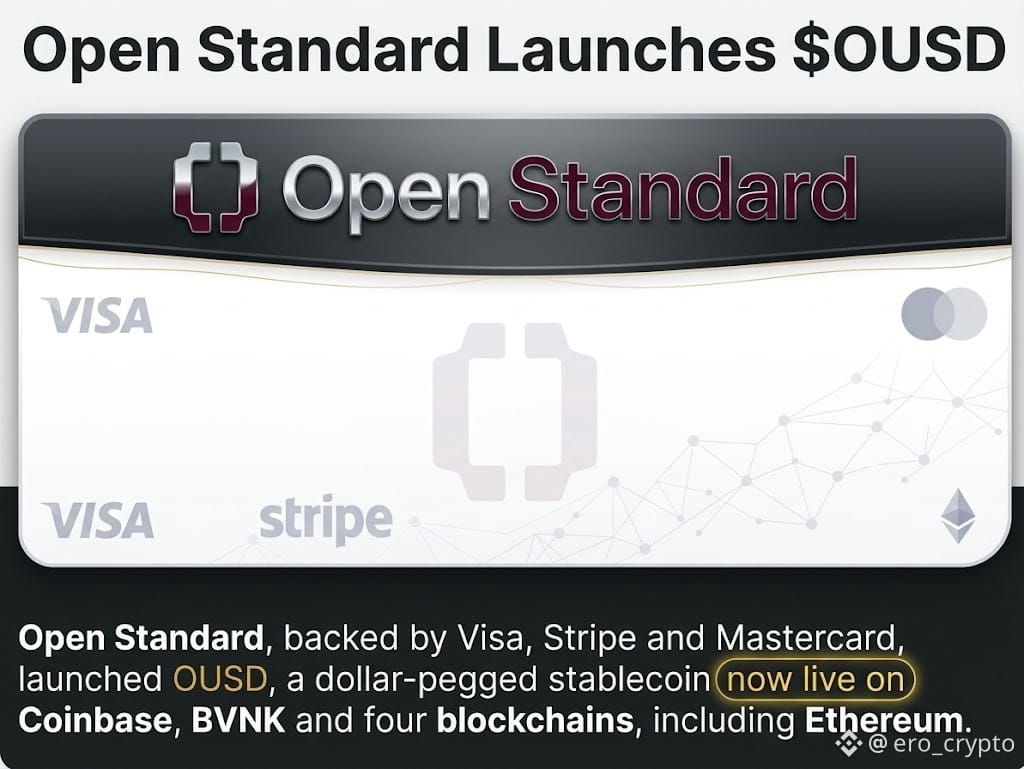
🚨 Open Standard Launches $OUSD #Stablecoin
Open Standard has launched OUSD, a dollar-pegged stablecoin backed by major players including #VİSA , #stripe , and #Mastercard .
OUSD is already live on #Coinbase , BVNK, and four blockchains, including $ETH and $SOL .
Open Standard, Visa, Stripe, Mastercard, and Shopify have committed to minting approximately $1 billion worth of OUSD to bootstrap liquidity.
Stablecoin adoption continues to expand deeper into traditional payments and financial infrastructure
🚨 Open Standard Launches $OUSD #Stablecoin
Open Standard has launched OUSD, a dollar-pegged stablecoin backed by major players including #VİSA , #stripe , and #Mastercard .
OUSD is already live on #Coinbase , BVNK, and four blockchains, including $ETH and $SOL .
Open Standard, Visa, Stripe, Mastercard, and Shopify have committed to minting approximately $1 billion worth of OUSD to bootstrap liquidity.
Stablecoin adoption continues to expand deeper into traditional payments and financial infrastructure
Open Standard has launched OUSD, a dollar-pegged stablecoin backed by major players including #VİSA , #stripe , and #Mastercard .
OUSD is already live on #Coinbase , BVNK, and four blockchains, including $ETH and $SOL .
Open Standard, Visa, Stripe, Mastercard, and Shopify have committed to minting approximately $1 billion worth of OUSD to bootstrap liquidity.
Stablecoin adoption continues to expand deeper into traditional payments and financial infrastructure
339

🚨 HSBC UNVEILS REDCOIN STABLECOIN IN HONG KONG TRIGGERING INSTITUTIONAL LIQUIDITY SHIFT FOR $USDT 🏦
Institutional adoption takes another structural leap as banking titan HSBC officially names its upcoming Hong Kong stablecoin HSBC RedCoin. Designed for peer-to-peer and merchant settlement, this initiative creates an institutional bridge between legacy clearing systems and digital currency rails. 🏦
From a market structure perspective, major financial institutions building proprietary settlement tokens validates the massive demand for friction-free digital fiat. 📊 As on-chain settlement infrastructure matures, bank-backed stablecoins are poised to reshape velocity across primary Asian capital hubs. 🔍
💬 Will commercial bank stablecoins drive broader institutional adoption, or will public chain assets maintain their structural edge? 👇
⚠️ Not financial advice. Always manage your risk. 🛡️
🏷️ #USDT #Stablecoin #Crypto #Liquidity #HongKong
🏦 🎯
🚨 HSBC UNVEILS REDCOIN STABLECOIN IN HONG KONG TRIGGERING INSTITUTIONAL LIQUIDITY SHIFT FOR $USDT 🏦
Institutional adoption takes another structural leap as banking titan HSBC officially names its upcoming Hong Kong stablecoin HSBC RedCoin. Designed for peer-to-peer and merchant settlement, this initiative creates an institutional bridge between legacy clearing systems and digital currency rails. 🏦
From a market structure perspective, major financial institutions building proprietary settlement tokens validates the massive demand for friction-free digital fiat. 📊 As on-chain settlement infrastructure matures, bank-backed stablecoins are poised to reshape velocity across primary Asian capital hubs. 🔍
💬 Will commercial bank stablecoins drive broader institutional adoption, or will public chain assets maintain their structural edge? 👇
⚠️ Not financial advice. Always manage your risk. 🛡️
🏷️ #USDT #Stablecoin #Crypto #Liquidity #HongKong
🏦 🎯
Institutional adoption takes another structural leap as banking titan HSBC officially names its upcoming Hong Kong stablecoin HSBC RedCoin. Designed for peer-to-peer and merchant settlement, this initiative creates an institutional bridge between legacy clearing systems and digital currency rails. 🏦
From a market structure perspective, major financial institutions building proprietary settlement tokens validates the massive demand for friction-free digital fiat. 📊 As on-chain settlement infrastructure matures, bank-backed stablecoins are poised to reshape velocity across primary Asian capital hubs. 🔍
💬 Will commercial bank stablecoins drive broader institutional adoption, or will public chain assets maintain their structural edge? 👇
⚠️ Not financial advice. Always manage your risk. 🛡️
🏷️ #USDT #Stablecoin #Crypto #Liquidity #HongKong
🏦 🎯

4

·
--
🚨 HSBC ENTERS STABLECOIN ARENA AS INSTITUTIONAL LIQUIDITY EXPANDS ACROSS $ZRO AND $MOVR 🦈
Institutional banking capital is formally laying down infrastructure to bridge legacy settlement rails into decentralized order books. HSBC introducing a regulated peer-to-peer payment stablecoin marks a structural pivot from pure speculation toward institutional liquidity integration. 🔍
While market participants debate short-term sentiment, smart money recognizes that enterprise payment rails provide the friction-free settlement layer necessary to sustain high-volume protocol expansion. 💡 Interoperability architectures like $ZRO stand to absorb significant institutional flow as compliance framework uncertainties clear. 📊
💬 Will this banking-grade liquidity deployment catalyze the next macro expansion phase or trigger tighter regulatory boundaries? 👇
⚠️ Not financial advice. Always manage your risk. 🛡️
🏷️ #ZRO #MOVR #Stablecoin #Crypto #Liquidity
🎯 🦈
🚨 HSBC ENTERS STABLECOIN ARENA AS INSTITUTIONAL LIQUIDITY EXPANDS ACROSS $ZRO AND $MOVR 🦈
Institutional banking capital is formally laying down infrastructure to bridge legacy settlement rails into decentralized order books. HSBC introducing a regulated peer-to-peer payment stablecoin marks a structural pivot from pure speculation toward institutional liquidity integration. 🔍
While market participants debate short-term sentiment, smart money recognizes that enterprise payment rails provide the friction-free settlement layer necessary to sustain high-volume protocol expansion. 💡 Interoperability architectures like $ZRO stand to absorb significant institutional flow as compliance framework uncertainties clear. 📊
💬 Will this banking-grade liquidity deployment catalyze the next macro expansion phase or trigger tighter regulatory boundaries? 👇
⚠️ Not financial advice. Always manage your risk. 🛡️
🏷️ #ZRO #MOVR #Stablecoin #Crypto #Liquidity
🎯 🦈
Institutional banking capital is formally laying down infrastructure to bridge legacy settlement rails into decentralized order books. HSBC introducing a regulated peer-to-peer payment stablecoin marks a structural pivot from pure speculation toward institutional liquidity integration. 🔍
While market participants debate short-term sentiment, smart money recognizes that enterprise payment rails provide the friction-free settlement layer necessary to sustain high-volume protocol expansion. 💡 Interoperability architectures like $ZRO stand to absorb significant institutional flow as compliance framework uncertainties clear. 📊
💬 Will this banking-grade liquidity deployment catalyze the next macro expansion phase or trigger tighter regulatory boundaries? 👇
⚠️ Not financial advice. Always manage your risk. 🛡️
🏷️ #ZRO #MOVR #Stablecoin #Crypto #Liquidity
🎯 🦈

90

·
--
🚀 Quick Stablecoin Move | USDT ➝ USDC
Just completed a smooth conversion from $USDT to $USDC .Both are among the most widely used dollar-pegged stablecoins in crypto, often used for liquidity management and portfolio flexibility. �
The Block +1
💹 Every trade is a step toward smarter portfolio management.
📊 Small moves today can create bigger opportunities tomorrow.
🔥 Are you holding USDT or USDC right now?
👇 Share your thoughts in the comments and repost if you're following the crypto market daily.
#Crypto #USDT #USDC #Binance #CryptoTrading #Stablecoin #DigitalAssets #CryptoCommunity #TradingJourney #Blockchain
Shorter version:
🚀 Trade Update
Successfully converted USDT → USDC ✅
Smart traders know that every move matters. Staying flexible and managing liquidity is part of the game. 📈
💬 Would you choose USDT or USDC today?
#USDT #USDC #Crypto #Binance
🚀 Quick Stablecoin Move | USDT ➝ USDC
Just completed a smooth conversion from $USDT to $USDC .Both are among the most widely used dollar-pegged stablecoins in crypto, often used for liquidity management and portfolio flexibility. �
The Block +1
💹 Every trade is a step toward smarter portfolio management.
📊 Small moves today can create bigger opportunities tomorrow.
🔥 Are you holding USDT or USDC right now?
👇 Share your thoughts in the comments and repost if you're following the crypto market daily.
#Crypto #USDT #USDC #Binance #CryptoTrading #Stablecoin #DigitalAssets #CryptoCommunity #TradingJourney #Blockchain
Shorter version:
🚀 Trade Update
Successfully converted USDT → USDC ✅
Smart traders know that every move matters. Staying flexible and managing liquidity is part of the game. 📈
💬 Would you choose USDT or USDC today?
#USDT #USDC #Crypto #Binance
Just completed a smooth conversion from $USDT to $USDC .Both are among the most widely used dollar-pegged stablecoins in crypto, often used for liquidity management and portfolio flexibility. �
The Block +1
💹 Every trade is a step toward smarter portfolio management.
📊 Small moves today can create bigger opportunities tomorrow.
🔥 Are you holding USDT or USDC right now?
👇 Share your thoughts in the comments and repost if you're following the crypto market daily.
#Crypto #USDT #USDC #Binance #CryptoTrading #Stablecoin #DigitalAssets #CryptoCommunity #TradingJourney #Blockchain
Shorter version:
🚀 Trade Update
Successfully converted USDT → USDC ✅
Smart traders know that every move matters. Staying flexible and managing liquidity is part of the game. 📈
💬 Would you choose USDT or USDC today?
#USDT #USDC #Crypto #Binance
1
87

·
--
Haussier
USDT moves into focus in report on Iran-linked financial networks
🧭 A report by Democratic minority staff on the U.S. Senate PSI found that 84% of a sample of 846 wallets sanctioned or targeted by U.S. or Israeli authorities for links to Iran and related groups used USDT exclusively or almost exclusively.
💵 The report argues that high liquidity, low transaction costs and 24/7 transfers outside the SWIFT system have made USDT an important dollar rail for these networks.
🛡️ Tether responded that it has supported freezes of roughly $550 million in Iran-linked USDT during 2026, while stressing that public blockchains allow authorities to trace fund flows more effectively.
📌 The two sides are measuring different things. The report focuses on USDT usage among designated wallets, while Tether highlights assets already frozen. The main implication is increased AML and stablecoin oversight pressure, rather than a direct signal of USDT depeg risk.
#Stablecoin $USDC
USDT moves into focus in report on Iran-linked financial networks
🧭 A report by Democratic minority staff on the U.S. Senate PSI found that 84% of a sample of 846 wallets sanctioned or targeted by U.S. or Israeli authorities for links to Iran and related groups used USDT exclusively or almost exclusively.
💵 The report argues that high liquidity, low transaction costs and 24/7 transfers outside the SWIFT system have made USDT an important dollar rail for these networks.
🛡️ Tether responded that it has supported freezes of roughly $550 million in Iran-linked USDT during 2026, while stressing that public blockchains allow authorities to trace fund flows more effectively.
📌 The two sides are measuring different things. The report focuses on USDT usage among designated wallets, while Tether highlights assets already frozen. The main implication is increased AML and stablecoin oversight pressure, rather than a direct signal of USDT depeg risk.
#Stablecoin $USDC
🧭 A report by Democratic minority staff on the U.S. Senate PSI found that 84% of a sample of 846 wallets sanctioned or targeted by U.S. or Israeli authorities for links to Iran and related groups used USDT exclusively or almost exclusively.
💵 The report argues that high liquidity, low transaction costs and 24/7 transfers outside the SWIFT system have made USDT an important dollar rail for these networks.
🛡️ Tether responded that it has supported freezes of roughly $550 million in Iran-linked USDT during 2026, while stressing that public blockchains allow authorities to trace fund flows more effectively.
📌 The two sides are measuring different things. The report focuses on USDT usage among designated wallets, while Tether highlights assets already frozen. The main implication is increased AML and stablecoin oversight pressure, rather than a direct signal of USDT depeg risk.
#Stablecoin $USDC
88

·
--
Haussier
#japanfsabacksfourthstablecointradesettlementpilot
🇯🇵🚨 JAPAN IS PUSHING DEEPER INTO STABLECOINS!
Japan’s Financial Services Agency (FSA) is backing a fourth stablecoin trade-settlement pilot, signaling continued experimentation with blockchain-based settlement infrastructure. 💴🔗
🏦 Financial institutions are testing stablecoin settlement
⚡ Faster on-chain transactions
🌏 Another major step toward tokenized finance
💰 Stablecoins moving beyond payments into trade settlement
Japan isn’t just watching the stablecoin revolution…
It’s testing how the financial system could run on it. 👀
And if these pilots scale?
The RWA + stablecoin narrative could get MUCH bigger. 🚀
#stablecoin #RWA #crypto
#japanfsabacksfourthstablecointradesettlementpilot
🇯🇵🚨 JAPAN IS PUSHING DEEPER INTO STABLECOINS!
Japan’s Financial Services Agency (FSA) is backing a fourth stablecoin trade-settlement pilot, signaling continued experimentation with blockchain-based settlement infrastructure. 💴🔗
🏦 Financial institutions are testing stablecoin settlement
⚡ Faster on-chain transactions
🌏 Another major step toward tokenized finance
💰 Stablecoins moving beyond payments into trade settlement
Japan isn’t just watching the stablecoin revolution…
It’s testing how the financial system could run on it. 👀
And if these pilots scale?
The RWA + stablecoin narrative could get MUCH bigger. 🚀
#stablecoin #RWA #crypto
🇯🇵🚨 JAPAN IS PUSHING DEEPER INTO STABLECOINS!
Japan’s Financial Services Agency (FSA) is backing a fourth stablecoin trade-settlement pilot, signaling continued experimentation with blockchain-based settlement infrastructure. 💴🔗
🏦 Financial institutions are testing stablecoin settlement
⚡ Faster on-chain transactions
🌏 Another major step toward tokenized finance
💰 Stablecoins moving beyond payments into trade settlement
Japan isn’t just watching the stablecoin revolution…
It’s testing how the financial system could run on it. 👀
And if these pilots scale?
The RWA + stablecoin narrative could get MUCH bigger. 🚀
#stablecoin #RWA #crypto
231

·
--
Haussier
Détention de 2.1 USDT en $USDC
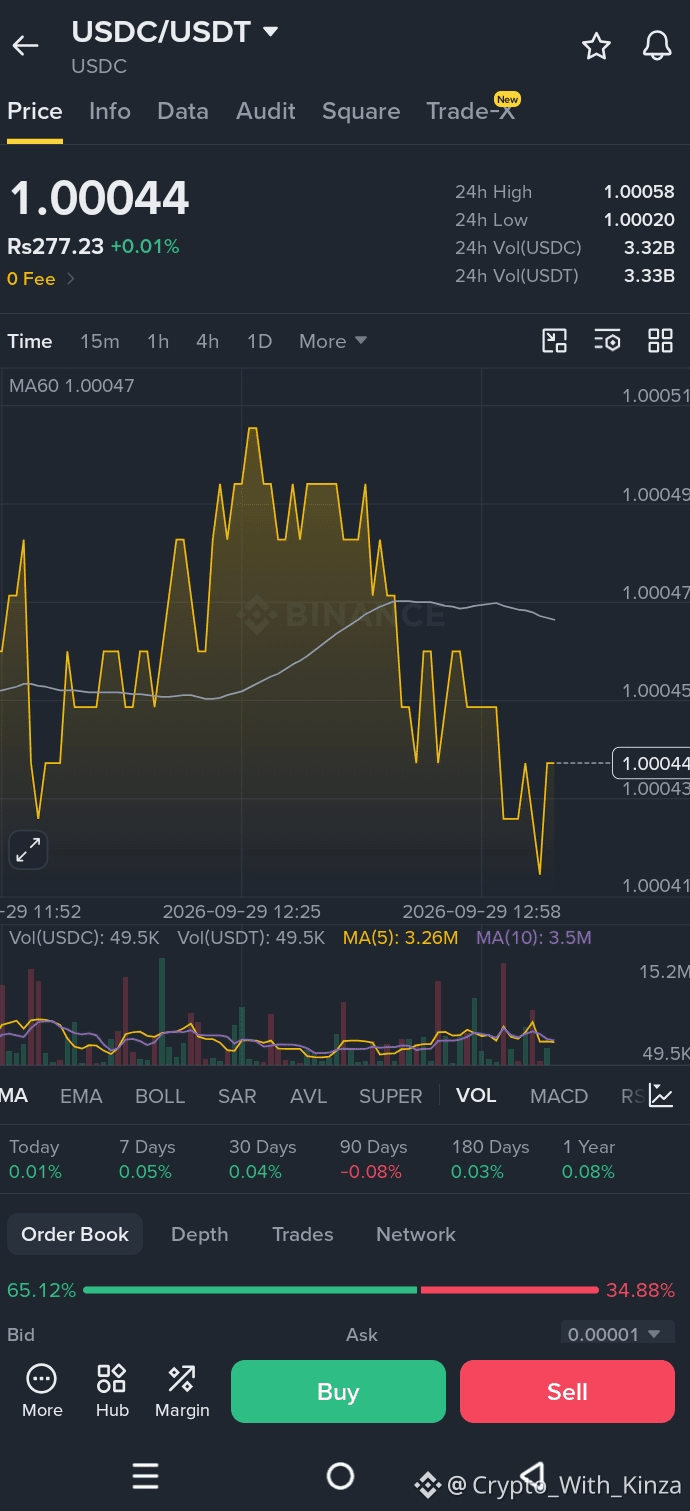
🔥 $USDC MARKET UPDATE
$USDC is holding close to the $1 peg at 1.00044, showing very little volatility. 📊
24H High: 1.00058
24H Low: 1.00020
24H Volume: $3.32B+
Order book snapshot also shows stronger bid-side activity. 👀
Stablecoin, but the market never sleeps. 💪🚀
#USDC #Crypto #BinanceSquare #Stablecoin $USDC
🔥 $USDC MARKET UPDATE
$USDC is holding close to the $1 peg at 1.00044, showing very little volatility. 📊
24H High: 1.00058
24H Low: 1.00020
24H Volume: $3.32B+
Order book snapshot also shows stronger bid-side activity. 👀
Stablecoin, but the market never sleeps. 💪🚀
#USDC #Crypto #BinanceSquare #Stablecoin $USDC
$USDC is holding close to the $1 peg at 1.00044, showing very little volatility. 📊
24H High: 1.00058
24H Low: 1.00020
24H Volume: $3.32B+
Order book snapshot also shows stronger bid-side activity. 👀
Stablecoin, but the market never sleeps. 💪🚀
#USDC #Crypto #BinanceSquare #Stablecoin $USDC
1
26

$USDT 💵 USDT – Market Update
USDT is designed to maintain a value close to $1, making it different from highly volatile cryptocurrencies such as BTC and ETH. Traders often use USDT as a stable asset for entering and exiting crypto positions.
For the coming days, keep an eye on the USDT/fiat exchange rate, market liquidity, and overall crypto-market conditions. Small deviations from $1 can happen due to supply, demand, and market conditions.
#USDT #Tether #Crypto #BinanceSquare #stablecoin
$USDT 💵 USDT – Market Update
USDT is designed to maintain a value close to $1, making it different from highly volatile cryptocurrencies such as BTC and ETH. Traders often use USDT as a stable asset for entering and exiting crypto positions.
For the coming days, keep an eye on the USDT/fiat exchange rate, market liquidity, and overall crypto-market conditions. Small deviations from $1 can happen due to supply, demand, and market conditions.
#USDT #Tether #Crypto #BinanceSquare #stablecoin
USDT is designed to maintain a value close to $1, making it different from highly volatile cryptocurrencies such as BTC and ETH. Traders often use USDT as a stable asset for entering and exiting crypto positions.
For the coming days, keep an eye on the USDT/fiat exchange rate, market liquidity, and overall crypto-market conditions. Small deviations from $1 can happen due to supply, demand, and market conditions.
#USDT #Tether #Crypto #BinanceSquare #stablecoin
54

·
--
Haussier
🚨 CITIBANK + COINBASE: STABLECOIN PAYMENTS
Citigroup and Coinbase are partnering to help institutional clients accept stablecoin payments from customers. Coinbase will provide the blockchain payment infrastructure, while Citi will handle the banking side of settlement.
The Wall Street Journal
🔹 Stablecoins meet traditional banking
🔹 Coinbase provides the blockchain payment rails
🔹 Citi handles the settlement as the bank of record
🔹 The partnership focuses on institutional payments
📌 Why is this interesting?
It shows another example of traditional financial institutions exploring blockchain-based payment infrastructure.
Could stablecoins become a bigger part of global payments? 👀
#Stablecoin #CryptoNews #DigitalAssets #BinanceSquare $NVDAB
🚨 CITIBANK + COINBASE: STABLECOIN PAYMENTS
Citigroup and Coinbase are partnering to help institutional clients accept stablecoin payments from customers. Coinbase will provide the blockchain payment infrastructure, while Citi will handle the banking side of settlement.
The Wall Street Journal
🔹 Stablecoins meet traditional banking
🔹 Coinbase provides the blockchain payment rails
🔹 Citi handles the settlement as the bank of record
🔹 The partnership focuses on institutional payments
📌 Why is this interesting?
It shows another example of traditional financial institutions exploring blockchain-based payment infrastructure.
Could stablecoins become a bigger part of global payments? 👀
#Stablecoin #CryptoNews #DigitalAssets #BinanceSquare $NVDAB
Citigroup and Coinbase are partnering to help institutional clients accept stablecoin payments from customers. Coinbase will provide the blockchain payment infrastructure, while Citi will handle the banking side of settlement.
The Wall Street Journal
🔹 Stablecoins meet traditional banking
🔹 Coinbase provides the blockchain payment rails
🔹 Citi handles the settlement as the bank of record
🔹 The partnership focuses on institutional payments
📌 Why is this interesting?
It shows another example of traditional financial institutions exploring blockchain-based payment infrastructure.
Could stablecoins become a bigger part of global payments? 👀
#Stablecoin #CryptoNews #DigitalAssets #BinanceSquare $NVDAB
74
INSTITUTIONAL INFRASTRUCTURE SHIFTS AS $9.3 TRILLION GIANT PREPARES STABLECOIN RAILS FOR $BTC 🏦 ⚡
Institutional giants are moving beyond simple passive allocation and stepping directly into on-chain liquidity infrastructure. JP Morgan evaluating an in-house stablecoin represents a structural pivot, creating high-efficiency settlement rails that seamlessly bridge traditional capital reserves with crypto liquidity pools. 📊
This validation of on-chain architecture reinforces long-term market structure across foundational assets like $BTC and high-throughput networks like $SOL . 🔍 As traditional financial mega-cap balance sheets build native rails, expect institutional order flow and systemic liquidity depth to accelerate significantly. 🏦
💬 Will private banking stablecoins deepen market efficiency, or will capital cluster around decentralized settlement layers? 👇
⚠️ Not financial advice. Always manage your risk. 🛡️
🏷️ #BTC #Stablecoin #Institutional #Crypto #MarketStructure
🦈 💎
INSTITUTIONAL INFRASTRUCTURE SHIFTS AS $9.3 TRILLION GIANT PREPARES STABLECOIN RAILS FOR $BTC 🏦 ⚡
Institutional giants are moving beyond simple passive allocation and stepping directly into on-chain liquidity infrastructure. JP Morgan evaluating an in-house stablecoin represents a structural pivot, creating high-efficiency settlement rails that seamlessly bridge traditional capital reserves with crypto liquidity pools. 📊
This validation of on-chain architecture reinforces long-term market structure across foundational assets like $BTC and high-throughput networks like $SOL . 🔍 As traditional financial mega-cap balance sheets build native rails, expect institutional order flow and systemic liquidity depth to accelerate significantly. 🏦
💬 Will private banking stablecoins deepen market efficiency, or will capital cluster around decentralized settlement layers? 👇
⚠️ Not financial advice. Always manage your risk. 🛡️
🏷️ #BTC #Stablecoin #Institutional #Crypto #MarketStructure
🦈 💎
Institutional giants are moving beyond simple passive allocation and stepping directly into on-chain liquidity infrastructure. JP Morgan evaluating an in-house stablecoin represents a structural pivot, creating high-efficiency settlement rails that seamlessly bridge traditional capital reserves with crypto liquidity pools. 📊
This validation of on-chain architecture reinforces long-term market structure across foundational assets like $BTC and high-throughput networks like $SOL . 🔍 As traditional financial mega-cap balance sheets build native rails, expect institutional order flow and systemic liquidity depth to accelerate significantly. 🏦
💬 Will private banking stablecoins deepen market efficiency, or will capital cluster around decentralized settlement layers? 👇
⚠️ Not financial advice. Always manage your risk. 🛡️
🏷️ #BTC #Stablecoin #Institutional #Crypto #MarketStructure
🦈 💎


45

🚨 EVERYONE IS WATCHING THE PRICE… BUT THIS DATA CAUGHT MY ATTENTION 👀
$USDT added 845,900 holders in just 7 days.
And it wasn’t only USDT:
🔹 $USDC: +390,800
🔹 $EURC: +69,800
🔹 $USDG: +23,300
🔹 $CASH: +18,600
That’s a lot of new stablecoin holders in just one week. 👀
Are people simply moving into stablecoin while waiting for better entries?
Or is something bigger happening beneath the surface?
$USDT
$USDC
#USDT #Crypto #Stablecoin #Write2Earn #BinanceSquare
🚨 EVERYONE IS WATCHING THE PRICE… BUT THIS DATA CAUGHT MY ATTENTION 👀
$USDT added 845,900 holders in just 7 days.
And it wasn’t only USDT:
🔹 $USDC : +390,800
🔹 $EURC: +69,800
🔹 $USDG: +23,300
🔹 $CASH: +18,600
That’s a lot of new stablecoin holders in just one week. 👀
Are people simply moving into stablecoin while waiting for better entries?
Or is something bigger happening beneath the surface?
$USDT
$USDC
#USDT #Crypto #Stablecoin #Write2Earn #BinanceSquare
$USDT added 845,900 holders in just 7 days.
And it wasn’t only USDT:
🔹 $USDC : +390,800
🔹 $EURC: +69,800
🔹 $USDG: +23,300
🔹 $CASH: +18,600
That’s a lot of new stablecoin holders in just one week. 👀
Are people simply moving into stablecoin while waiting for better entries?
Or is something bigger happening beneath the surface?
$USDT
$USDC
#USDT #Crypto #Stablecoin #Write2Earn #BinanceSquare

2
54

·
--
Haussier
CRYPTO'S BANK!
Banks are starting to use crypto tools. Column, a US bank insured by the FDIC, now has stablecoins built into its core banking system. It uses Solana as the default network for these transactions. This is a real example of crypto moving into everyday finance. When banks use blockchain, payments can become faster and cheaper. It is early, and rules can change. But it shows the technology has real uses beyond trading. Follow real adoption, not only price. Not financial advice. #Stablecoin
{spot}(BTCUSDT)
CRYPTO'S BANK!
Banks are starting to use crypto tools. Column, a US bank insured by the FDIC, now has stablecoins built into its core banking system. It uses Solana as the default network for these transactions. This is a real example of crypto moving into everyday finance. When banks use blockchain, payments can become faster and cheaper. It is early, and rules can change. But it shows the technology has real uses beyond trading. Follow real adoption, not only price. Not financial advice. #Stablecoin
Banks are starting to use crypto tools. Column, a US bank insured by the FDIC, now has stablecoins built into its core banking system. It uses Solana as the default network for these transactions. This is a real example of crypto moving into everyday finance. When banks use blockchain, payments can become faster and cheaper. It is early, and rules can change. But it shows the technology has real uses beyond trading. Follow real adoption, not only price. Not financial advice. #Stablecoin
2

🔥 What is $USDT and Why is it the Backbone of Crypto? 🔥
If you are stepping into the crypto world, $USDT (Tether) is a name you will see every single day. But what makes this token so special and absolutely essential for traders? Let’s break it down!
💡 What is $USDT?
$USDT is a stablecoin, meaning its value is pegged 1:1 to the US Dollar. Unlike highly volatile cryptocurrencies like Bitcoin or Ethereum, 1 $USDT is designed to always be worth 1 USD.
🛡️ Why Traders Love $USDT:
Safe Haven: When the market gets volatile, traders quickly convert their crypto into $USDT to protect their profits and lock in their gains.
Massive Liquidity: It is supported by almost every crypto exchange, making it incredibly easy to buy, sell, and trade any pair.
Fast & Cheap Transactions: Moving fiat money across borders can take days and cost high fees. Sending $USDT takes just minutes with very low network fees.
Passive Income: On platforms like Binance, you can place your $USDT into "Earn" products to generate steady passive income through flexible or locked savings.
🚀 Pro Tip for Beginners:
Always keep a portion of your portfolio in $USDT. This ensures you have ready funds (dry powder) to "buy the dip" whenever the market drops!
What is your favorite stablecoin to use? Let me know in the comments below! 👇
#Crypto #Stablecoin #Trading #Binance #Crypto101
🔥 What is $USDT and Why is it the Backbone of Crypto? 🔥
If you are stepping into the crypto world, $USDT (Tether) is a name you will see every single day. But what makes this token so special and absolutely essential for traders? Let’s break it down!
💡 What is $USDT?
$USDT is a stablecoin, meaning its value is pegged 1:1 to the US Dollar. Unlike highly volatile cryptocurrencies like Bitcoin or Ethereum, 1 $USDT is designed to always be worth 1 USD.
🛡️ Why Traders Love $USDT:
Safe Haven: When the market gets volatile, traders quickly convert their crypto into $USDT to protect their profits and lock in their gains.
Massive Liquidity: It is supported by almost every crypto exchange, making it incredibly easy to buy, sell, and trade any pair.
Fast & Cheap Transactions: Moving fiat money across borders can take days and cost high fees. Sending $USDT takes just minutes with very low network fees.
Passive Income: On platforms like Binance, you can place your $USDT into "Earn" products to generate steady passive income through flexible or locked savings.
🚀 Pro Tip for Beginners:
Always keep a portion of your portfolio in $USDT. This ensures you have ready funds (dry powder) to "buy the dip" whenever the market drops!
What is your favorite stablecoin to use? Let me know in the comments below! 👇
#Crypto #Stablecoin #Trading #Binance #Crypto101
If you are stepping into the crypto world, $USDT (Tether) is a name you will see every single day. But what makes this token so special and absolutely essential for traders? Let’s break it down!
💡 What is $USDT?
$USDT is a stablecoin, meaning its value is pegged 1:1 to the US Dollar. Unlike highly volatile cryptocurrencies like Bitcoin or Ethereum, 1 $USDT is designed to always be worth 1 USD.
🛡️ Why Traders Love $USDT:
Safe Haven: When the market gets volatile, traders quickly convert their crypto into $USDT to protect their profits and lock in their gains.
Massive Liquidity: It is supported by almost every crypto exchange, making it incredibly easy to buy, sell, and trade any pair.
Fast & Cheap Transactions: Moving fiat money across borders can take days and cost high fees. Sending $USDT takes just minutes with very low network fees.
Passive Income: On platforms like Binance, you can place your $USDT into "Earn" products to generate steady passive income through flexible or locked savings.
🚀 Pro Tip for Beginners:
Always keep a portion of your portfolio in $USDT. This ensures you have ready funds (dry powder) to "buy the dip" whenever the market drops!
What is your favorite stablecoin to use? Let me know in the comments below! 👇
#Crypto #Stablecoin #Trading #Binance #Crypto101
1
1
1
62

Bloomberg tích hợp dữ liệu stablecoin trên chuỗi vào Terminal
- Bảng điều khiển Allium-powered của Bloomberg cung cấp cho người dùng Terminal dữ liệu hàng giờ về nguồn cung stablecoin, phát hành, chuyển khoản và hoạt động trên các mạng blockchain.
#BinanceSquare #CryptoNews #Stablecoin
$btc $eth
#vlikevn #Titanbot
Nguồn: CoinTelegraph
Bloomberg tích hợp dữ liệu stablecoin trên chuỗi vào Terminal
- Bảng điều khiển Allium-powered của Bloomberg cung cấp cho người dùng Terminal dữ liệu hàng giờ về nguồn cung stablecoin, phát hành, chuyển khoản và hoạt động trên các mạng blockchain.
#BinanceSquare #CryptoNews #Stablecoin
$btc $eth
#vlikevn #Titanbot
Nguồn: CoinTelegraph
- Bảng điều khiển Allium-powered của Bloomberg cung cấp cho người dùng Terminal dữ liệu hàng giờ về nguồn cung stablecoin, phát hành, chuyển khoản và hoạt động trên các mạng blockchain.
#BinanceSquare #CryptoNews #Stablecoin
$btc $eth
#vlikevn #Titanbot
Nguồn: CoinTelegraph
134

·
--
Haussier
⚡️ الدولار الرقمي يدخل مرحلة جديدة.
أصبح Open USD (OUSD) متاحًا الآن على 4 شبكات:
🔹 Ethereum
🔹 Solana
🔹 Base
🔹 Tempo
واللافت أن المشروع يحظى بدعم أسماء بارزة في المدفوعات والتقنية، من بينها Coinbase، Mastercard، Stripe، Visa وShopify.
الهدف؟ بناء بنية تحتية للدولار الرقمي يمكن استخدامها في المدفوعات والتسويات والتجارة العالمية.
ومع توسع العملات المستقرة، السؤال الأهم:
هل نشهد بداية منافس جديد لـ USDT وUSDC؟
#OUSD #Stablecoin #crypto
⚡️ الدولار الرقمي يدخل مرحلة جديدة.
أصبح Open USD (OUSD) متاحًا الآن على 4 شبكات:
🔹 Ethereum
🔹 Solana
🔹 Base
🔹 Tempo
واللافت أن المشروع يحظى بدعم أسماء بارزة في المدفوعات والتقنية، من بينها Coinbase، Mastercard، Stripe، Visa وShopify.
الهدف؟ بناء بنية تحتية للدولار الرقمي يمكن استخدامها في المدفوعات والتسويات والتجارة العالمية.
ومع توسع العملات المستقرة، السؤال الأهم:
هل نشهد بداية منافس جديد لـ USDT وUSDC؟
#OUSD #Stablecoin #crypto
أصبح Open USD (OUSD) متاحًا الآن على 4 شبكات:
🔹 Ethereum
🔹 Solana
🔹 Base
🔹 Tempo
واللافت أن المشروع يحظى بدعم أسماء بارزة في المدفوعات والتقنية، من بينها Coinbase، Mastercard، Stripe، Visa وShopify.
الهدف؟ بناء بنية تحتية للدولار الرقمي يمكن استخدامها في المدفوعات والتسويات والتجارة العالمية.
ومع توسع العملات المستقرة، السؤال الأهم:
هل نشهد بداية منافس جديد لـ USDT وUSDC؟
#OUSD #Stablecoin #crypto

صقر صنعاء:
كلام سليم 100% يا yosreia، تعدد الشبكات والدعم المؤسسي بدون استخدام فعلي وسيولة حقيقية ما له قيمة 👏
الاستدامة هي اللي تفرق بين المشروع القوي والمشروع المؤقت
3
4
175

·
--
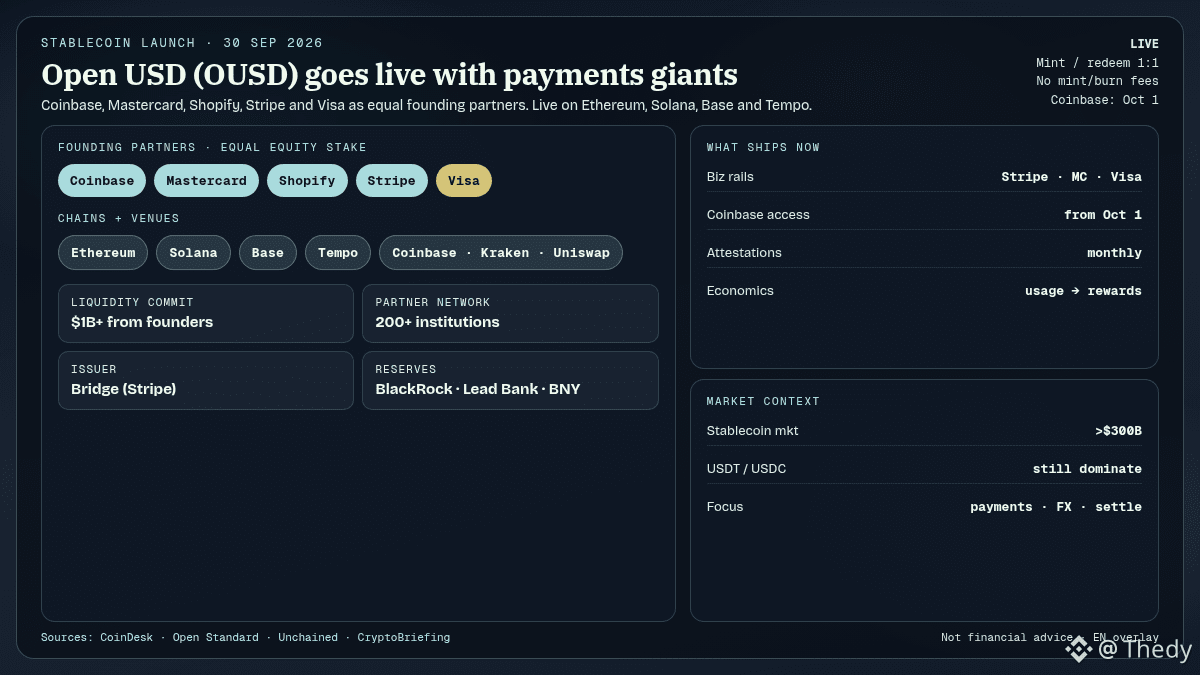
Open USD (OUSD) est live: Coinbase, Mastercard, Shopify, Stripe et Visa comme 5 founding partners à parts égales.
FAITS (CoinDesk, Open Standard, Unchained, 30/09/2026)
Le dollar token d'Open Standard tourne nativement sur Ethereum, Solana, Base et Tempo. Émetteur: Bridge (filiale Stripe). Réserves chez BlackRock, Lead Bank et BNY, avec attestations mensuelles prévues. Mint / redeem 1:1 sans frais de mint/burn. Les rails business (Stripe, Mastercard, Visa Stablecoin Platform) sont ouverts maintenant; support Coinbase annoncé pour le 1er octobre. Trading initial: Coinbase, Kraken, Uniswap. Les founders engagent plus de 1 Md$ de liquidité. Le réseau partenaires dépasse 200 institutions (UBS, SBI Holdings, Jeeves cités parmi les ajouts).
LECTURE
Ce n'est pas un énième stablecoin "crypto only". Le pitch vise paiements, FX, settlement carte et banking, dans un marché >300 Md$ encore dominé par USDT / USDC. Le modèle économique pousse rewards (et une part d'equity) selon supply + activité générée, plutôt qu'un partage bilatéral style USDC. Pour $ETH et $SOL, l'angle utile est distribution multi-chain + usage réel hors DEX, pas un pump court terme sur le token.
SCÉNARIOS
- Base: adoption entreprise via Stripe/Visa/MC, liquidité seedée, Coinbase qui élargit l'accès dès oct.
- Upside: Tempo / Bridge captent des flux cross-border volumineux si les fees restent compétitifs.
- Risque: gouvernance multi-partenaires + concurrence USDT/USDC + exécution réelle des 1 Md$ de liquidité (engagement, pas supply déjà on-chain vérifiée ici).
Spot (~18:51 UTC): $BTC ~83875 · $ETH ~2677 · $SOL ~118.4 · BNB ~767 (Kraken/CG). F&G 71 Greed.
Vous voyez OUSD plutôt comme concurrent direct de USDC, ou comme rail de paiement TradFi qui digère le stablecoin en arrière-plan?
Sources: CoinDesk (30/09), Open Standard, Unchained, CryptoBriefing
#Stablecoin #Payments #Crypto
Open USD (OUSD) est live: Coinbase, Mastercard, Shopify, Stripe et Visa comme 5 founding partners à parts égales.
FAITS (CoinDesk, Open Standard, Unchained, 30/09/2026)
Le dollar token d'Open Standard tourne nativement sur Ethereum, Solana, Base et Tempo. Émetteur: Bridge (filiale Stripe). Réserves chez BlackRock, Lead Bank et BNY, avec attestations mensuelles prévues. Mint / redeem 1:1 sans frais de mint/burn. Les rails business (Stripe, Mastercard, Visa Stablecoin Platform) sont ouverts maintenant; support Coinbase annoncé pour le 1er octobre. Trading initial: Coinbase, Kraken, Uniswap. Les founders engagent plus de 1 Md$ de liquidité. Le réseau partenaires dépasse 200 institutions (UBS, SBI Holdings, Jeeves cités parmi les ajouts).
LECTURE
Ce n'est pas un énième stablecoin "crypto only". Le pitch vise paiements, FX, settlement carte et banking, dans un marché >300 Md$ encore dominé par USDT / USDC. Le modèle économique pousse rewards (et une part d'equity) selon supply + activité générée, plutôt qu'un partage bilatéral style USDC. Pour $ETH et $SOL , l'angle utile est distribution multi-chain + usage réel hors DEX, pas un pump court terme sur le token.
SCÉNARIOS
- Base: adoption entreprise via Stripe/Visa/MC, liquidité seedée, Coinbase qui élargit l'accès dès oct.
- Upside: Tempo / Bridge captent des flux cross-border volumineux si les fees restent compétitifs.
- Risque: gouvernance multi-partenaires + concurrence USDT/USDC + exécution réelle des 1 Md$ de liquidité (engagement, pas supply déjà on-chain vérifiée ici).
Spot (~18:51 UTC): $BTC ~83875 · $ETH ~2677 · $SOL ~118.4 · BNB ~767 (Kraken/CG). F&G 71 Greed.
Vous voyez OUSD plutôt comme concurrent direct de USDC, ou comme rail de paiement TradFi qui digère le stablecoin en arrière-plan?
Sources: CoinDesk (30/09), Open Standard, Unchained, CryptoBriefing
#Stablecoin #Payments #Crypto
FAITS (CoinDesk, Open Standard, Unchained, 30/09/2026)
Le dollar token d'Open Standard tourne nativement sur Ethereum, Solana, Base et Tempo. Émetteur: Bridge (filiale Stripe). Réserves chez BlackRock, Lead Bank et BNY, avec attestations mensuelles prévues. Mint / redeem 1:1 sans frais de mint/burn. Les rails business (Stripe, Mastercard, Visa Stablecoin Platform) sont ouverts maintenant; support Coinbase annoncé pour le 1er octobre. Trading initial: Coinbase, Kraken, Uniswap. Les founders engagent plus de 1 Md$ de liquidité. Le réseau partenaires dépasse 200 institutions (UBS, SBI Holdings, Jeeves cités parmi les ajouts).
LECTURE
Ce n'est pas un énième stablecoin "crypto only". Le pitch vise paiements, FX, settlement carte et banking, dans un marché >300 Md$ encore dominé par USDT / USDC. Le modèle économique pousse rewards (et une part d'equity) selon supply + activité générée, plutôt qu'un partage bilatéral style USDC. Pour $ETH et $SOL , l'angle utile est distribution multi-chain + usage réel hors DEX, pas un pump court terme sur le token.
SCÉNARIOS
- Base: adoption entreprise via Stripe/Visa/MC, liquidité seedée, Coinbase qui élargit l'accès dès oct.
- Upside: Tempo / Bridge captent des flux cross-border volumineux si les fees restent compétitifs.
- Risque: gouvernance multi-partenaires + concurrence USDT/USDC + exécution réelle des 1 Md$ de liquidité (engagement, pas supply déjà on-chain vérifiée ici).
Spot (~18:51 UTC): $BTC ~83875 · $ETH ~2677 · $SOL ~118.4 · BNB ~767 (Kraken/CG). F&G 71 Greed.
Vous voyez OUSD plutôt comme concurrent direct de USDC, ou comme rail de paiement TradFi qui digère le stablecoin en arrière-plan?
Sources: CoinDesk (30/09), Open Standard, Unchained, CryptoBriefing
#Stablecoin #Payments #Crypto
43

AllUnity lanzó una nueva stablecoin en dólares, respaldada por reservas reales de la divisa.
Se suma a una lista cada vez más larga de stablecoins en dólares respaldadas por reservas, el tipo de activo que sigue siendo, con diferencia, el más usado dentro de cripto para pagos y ahorro en dólares fuera de EE.UU.
No es casualidad que este tipo de lanzamientos sigan apareciendo, mientras el precio de Bitcoin acapara los titulares, las stablecoins son las que mueven el volumen real del día a día en varias regiones sobre todo en Latinoamérica, donde gran parte del uso cripto es precisamente para mantenerse en dólares.
Vale la pena recordar el criterio básico al evaluar cualquier stablecoin nueva, qué tan transparente es sobre sus reservas, y quién audita que ese respaldo sea real.
¿Sigues de cerca este tipo de lanzamientos o solo te importa el precio de BTC? 👇
#Stablecoin #AllUnity #Cripto #CreatorPad
AllUnity lanzó una nueva stablecoin en dólares, respaldada por reservas reales de la divisa.
Se suma a una lista cada vez más larga de stablecoins en dólares respaldadas por reservas, el tipo de activo que sigue siendo, con diferencia, el más usado dentro de cripto para pagos y ahorro en dólares fuera de EE.UU.
No es casualidad que este tipo de lanzamientos sigan apareciendo, mientras el precio de Bitcoin acapara los titulares, las stablecoins son las que mueven el volumen real del día a día en varias regiones sobre todo en Latinoamérica, donde gran parte del uso cripto es precisamente para mantenerse en dólares.
Vale la pena recordar el criterio básico al evaluar cualquier stablecoin nueva, qué tan transparente es sobre sus reservas, y quién audita que ese respaldo sea real.
¿Sigues de cerca este tipo de lanzamientos o solo te importa el precio de BTC? 👇
#Stablecoin #AllUnity #Cripto #CreatorPad
Se suma a una lista cada vez más larga de stablecoins en dólares respaldadas por reservas, el tipo de activo que sigue siendo, con diferencia, el más usado dentro de cripto para pagos y ahorro en dólares fuera de EE.UU.
No es casualidad que este tipo de lanzamientos sigan apareciendo, mientras el precio de Bitcoin acapara los titulares, las stablecoins son las que mueven el volumen real del día a día en varias regiones sobre todo en Latinoamérica, donde gran parte del uso cripto es precisamente para mantenerse en dólares.
Vale la pena recordar el criterio básico al evaluar cualquier stablecoin nueva, qué tan transparente es sobre sus reservas, y quién audita que ese respaldo sea real.
¿Sigues de cerca este tipo de lanzamientos o solo te importa el precio de BTC? 👇
#Stablecoin #AllUnity #Cripto #CreatorPad

72

·
--
🚨 INSTITUTIONAL YEN LIQUIDITY ARRIVES AS REGULATED $JPYC EXPANDS SPOT TRADING 🏦
A compliant Japanese Yen stablecoin, $JPYC , is officially unlocking institutional liquidity rails across spot and grid markets on a top-tier exchange. 🏦 Backed 1:1 by bank deposits and government bonds under Japan Payment Services Act, this asset brings transparent fiat order flow into multi-chain ecosystems.
With minting and redemption routed through strict KYC frameworks on Ethereum and Polygon, smart money gains a seamless fiat bridge for capital efficiency. 💡 Grid trading infrastructure will allow market participants to capture structural yield while hedging foreign exchange volatility directly on-chain.
💬 Will this regulated Yen inflow trigger a broader wave of sovereign fiat stablecoin adoption across global liquidity pools? 👇
⚠️ Not financial advice. Always manage your risk. 🛡️
🏷️ #JPYC #Stablecoin #DeFi #Crypto
🎯 🦈
🚨 INSTITUTIONAL YEN LIQUIDITY ARRIVES AS REGULATED $JPYC EXPANDS SPOT TRADING 🏦
A compliant Japanese Yen stablecoin, $JPYC , is officially unlocking institutional liquidity rails across spot and grid markets on a top-tier exchange. 🏦 Backed 1:1 by bank deposits and government bonds under Japan Payment Services Act, this asset brings transparent fiat order flow into multi-chain ecosystems.
With minting and redemption routed through strict KYC frameworks on Ethereum and Polygon, smart money gains a seamless fiat bridge for capital efficiency. 💡 Grid trading infrastructure will allow market participants to capture structural yield while hedging foreign exchange volatility directly on-chain.
💬 Will this regulated Yen inflow trigger a broader wave of sovereign fiat stablecoin adoption across global liquidity pools? 👇
⚠️ Not financial advice. Always manage your risk. 🛡️
🏷️ #JPYC #Stablecoin #DeFi #Crypto
🎯 🦈
A compliant Japanese Yen stablecoin, $JPYC , is officially unlocking institutional liquidity rails across spot and grid markets on a top-tier exchange. 🏦 Backed 1:1 by bank deposits and government bonds under Japan Payment Services Act, this asset brings transparent fiat order flow into multi-chain ecosystems.
With minting and redemption routed through strict KYC frameworks on Ethereum and Polygon, smart money gains a seamless fiat bridge for capital efficiency. 💡 Grid trading infrastructure will allow market participants to capture structural yield while hedging foreign exchange volatility directly on-chain.
💬 Will this regulated Yen inflow trigger a broader wave of sovereign fiat stablecoin adoption across global liquidity pools? 👇
⚠️ Not financial advice. Always manage your risk. 🛡️
🏷️ #JPYC #Stablecoin #DeFi #Crypto
🎯 🦈
6
Connectez-vous pour découvrir plus de contenu
Rejoignez la communauté mondiale des adeptes de cryptomonnaies sur Binance Square
⚡️ Suviez les dernières informations importantes sur les cryptomonnaies.
💬 Jugé digne de confiance par la plus grande plateforme d’échange de cryptomonnaies au monde.
👍 Découvrez les connaissances que partagent les créateurs vérifiés.
Adresse e-mail/Nº de téléphone
Sujets d’actualité
1
#EtherGains70.9%InQ3
9,523 vues
247 mentions
2
#TreasuryLetsStatesFileStablecoinCertificationsEarly
0 vues
0 mentions
3
#US10YearYieldNears5.3%
48,882 vues
467 mentions
4
#DollarIndexHitsHighestSinceMay2025
2,257 vues
147 mentions
5
#USWeeklyJoblessClaimsFallTo197000
6,495 vues
187 mentions
6
#BitcoinETFsTake$6.34BillionInQ3
3,317 vues
45 mentions
7
#KoreaProposesTokenizingStocksAndBonds
34,660 vues
551 mentions
8
#MetaMaskExitsLidoValidatorsAfterSecurityIncident
114,526 vues
1,290 mentions
9
#MicronBeatsEarningsLiftsGuidance
63,646 vues
949 mentions
10
#CFTCSubmitsTwoEventContractRulesToWhiteHouse
43,676 vues
735 mentions