

#restaking
restaking
725,874 vues
2,597 mentions
Populaire
Récents


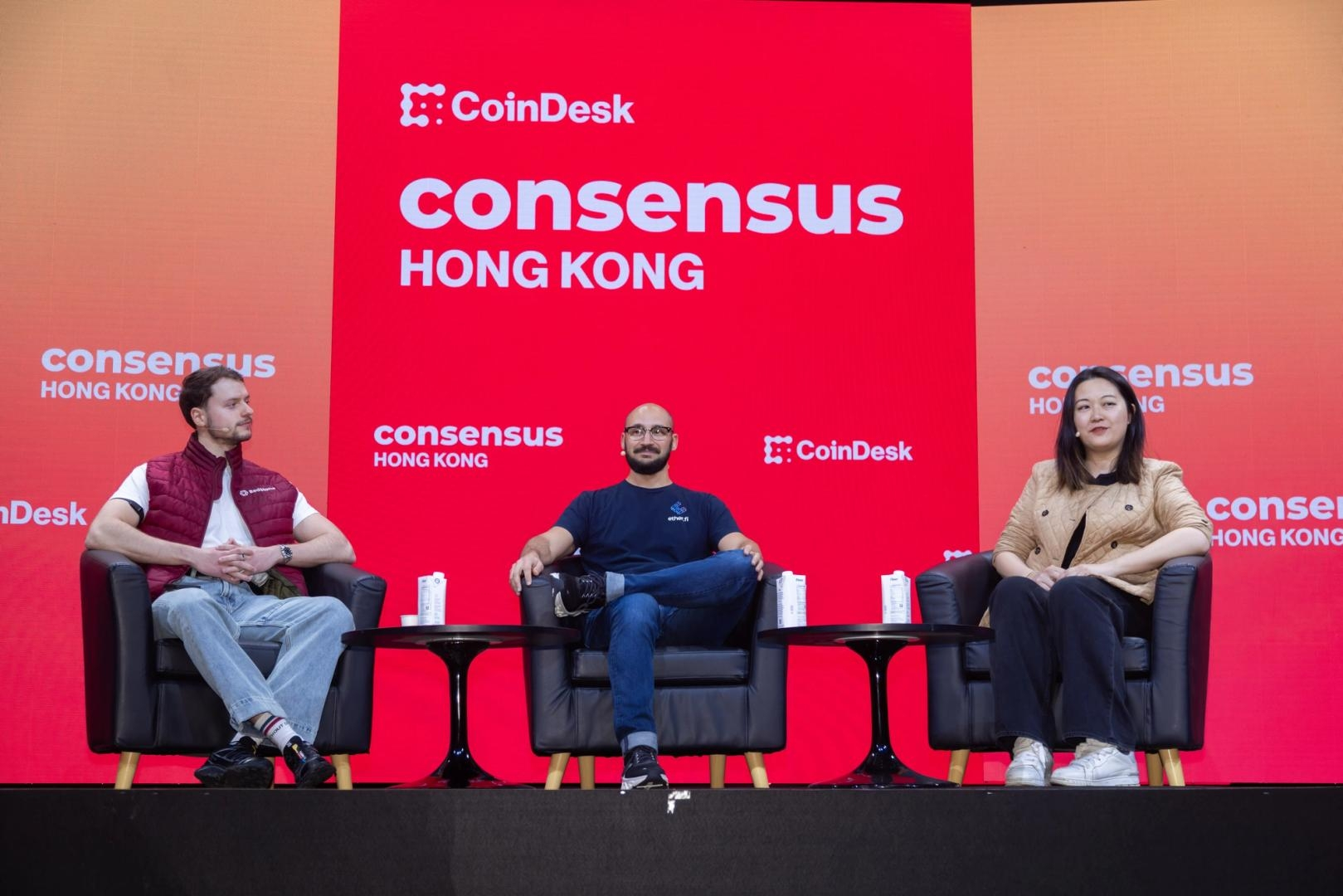
Flash update: The restaking gold rush has officially hit a wall. 📉 Top protocols are now scraping by on razor-thin margins. Here is what you need to track right now. 1. Yield farming rewards have plunged across major platforms. 2. Validator revenue fails to match last year's aggressive growth projections. 3. Smart capital is rapidly rotating out of low-fee restaking loops. $ETH #Write2Earn #CryptoNews #Restaking #DeFi
Flash update: The restaking gold rush has officially hit a wall. 📉 Top protocols are now scraping by on razor-thin margins. Here is what you need to track right now. 1. Yield farming rewards have plunged across major platforms. 2. Validator revenue fails to match last year's aggressive growth projections. 3. Smart capital is rapidly rotating out of low-fee restaking loops. $ETH #Write2Earn #CryptoNews #Restaking #DeFi
21

·
--
Restaking sold itself as free yield. The pitch: stake once, get paid, then pledge the same collateral to secure a dozen networks and collect again.
But yield is never free — it is the price of risk. And restaking is a machine for selling the same risk several times over.
When ETH sits in one staking position, you carry one validator's risk. When that same ETH is restaked across ten services, the risks stack: slashing conditions, smart contract bugs, oracle misreports — across ten different codebases, all backed by the same collateral.
This is rehypothecation with better marketing. In 2008, the same mortgage was packaged, insured, and resold until nobody knew who owned the real exposure. Restaking recreates that geometry: one asset, many claims, correlated failure modes.
That does not make it bad. It means earning 12% instead of 4% usually translates to holding 3x the risk with 1x the attention.
Yield is the market quoting you a price for danger. Stacking is proof the risk was never priced once.
The only question worth asking: if everything fails at once, what do you actually recover — and how fast?
$ETH $SOL $BTC
#Restaking #DeFi #RiskManagement #Crypto #Yield
Restaking sold itself as free yield. The pitch: stake once, get paid, then pledge the same collateral to secure a dozen networks and collect again.
But yield is never free — it is the price of risk. And restaking is a machine for selling the same risk several times over.
When ETH sits in one staking position, you carry one validator's risk. When that same ETH is restaked across ten services, the risks stack: slashing conditions, smart contract bugs, oracle misreports — across ten different codebases, all backed by the same collateral.
This is rehypothecation with better marketing. In 2008, the same mortgage was packaged, insured, and resold until nobody knew who owned the real exposure. Restaking recreates that geometry: one asset, many claims, correlated failure modes.
That does not make it bad. It means earning 12% instead of 4% usually translates to holding 3x the risk with 1x the attention.
Yield is the market quoting you a price for danger. Stacking is proof the risk was never priced once.
The only question worth asking: if everything fails at once, what do you actually recover — and how fast?
$ETH $SOL $BTC
#Restaking #DeFi #RiskManagement #Crypto #Yield
But yield is never free — it is the price of risk. And restaking is a machine for selling the same risk several times over.
When ETH sits in one staking position, you carry one validator's risk. When that same ETH is restaked across ten services, the risks stack: slashing conditions, smart contract bugs, oracle misreports — across ten different codebases, all backed by the same collateral.
This is rehypothecation with better marketing. In 2008, the same mortgage was packaged, insured, and resold until nobody knew who owned the real exposure. Restaking recreates that geometry: one asset, many claims, correlated failure modes.
That does not make it bad. It means earning 12% instead of 4% usually translates to holding 3x the risk with 1x the attention.
Yield is the market quoting you a price for danger. Stacking is proof the risk was never priced once.
The only question worth asking: if everything fails at once, what do you actually recover — and how fast?
$ETH $SOL $BTC
#Restaking #DeFi #RiskManagement #Crypto #Yield
45

·
--
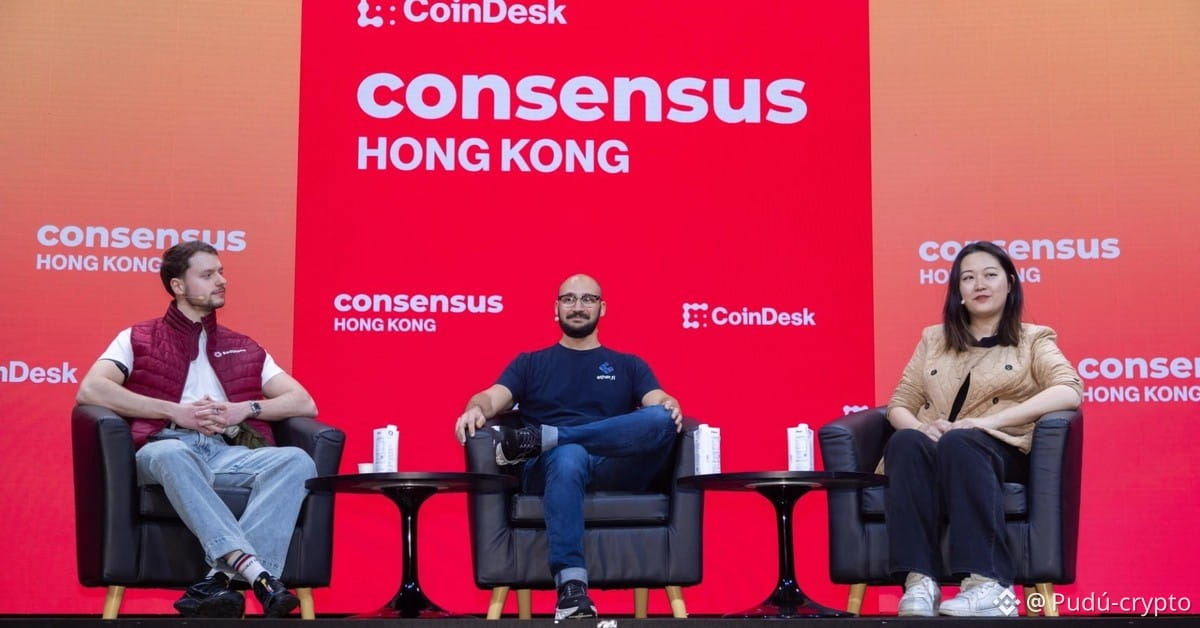
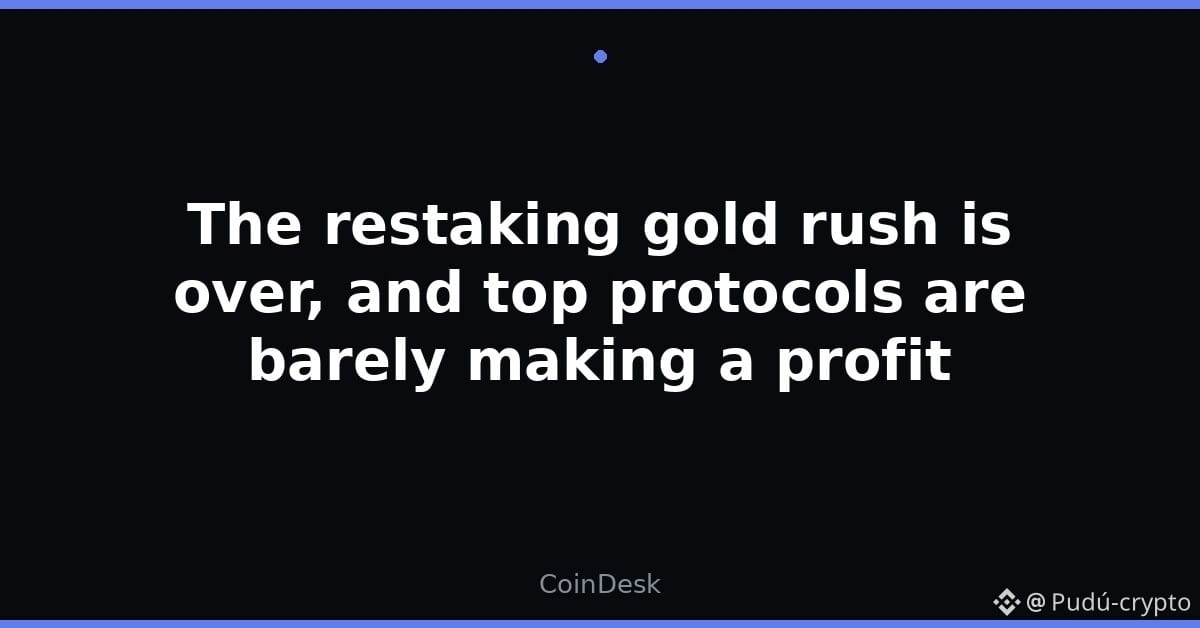
La fiebre por el restaking parece haber tocado techo.
Los rendimientos cayeron y los riesgos de contratos inteligentes se acumularon.
Por eso, uno de los protocolos principales de $ETH decidió abandonar su negocio central.
Ahora planean convertirse en un neobanco cripto.
Es un cambio de rumbo bastante drástico para un proyecto del sector.
¿Te parece una movida acertada o es desesperación?
#Ethereum #Restaking
La fiebre por el restaking parece haber tocado techo.
Los rendimientos cayeron y los riesgos de contratos inteligentes se acumularon.
Por eso, uno de los protocolos principales de $ETH decidió abandonar su negocio central.
Ahora planean convertirse en un neobanco cripto.
Es un cambio de rumbo bastante drástico para un proyecto del sector.
¿Te parece una movida acertada o es desesperación?
#Ethereum #Restaking
Los rendimientos cayeron y los riesgos de contratos inteligentes se acumularon.
Por eso, uno de los protocolos principales de $ETH decidió abandonar su negocio central.
Ahora planean convertirse en un neobanco cripto.
Es un cambio de rumbo bastante drástico para un proyecto del sector.
¿Te parece una movida acertada o es desesperación?
#Ethereum #Restaking
253

·
--
再质押的黄金时代结束了!顶级协议现在几乎赚不到钱,收益降、风险升,连以太坊最大的流动性质押协议都放弃了核心业务,跑去搞加密银行了。看来撸毛时代真的过去了... #restaking #DeFi $ETH
The restaking gold rush is officially over! Top protocols are barely making profits as yields dry up and smart contract risks mount. Even Ethereum's top liquid restaking protocol has ditched its core business to build a crypto neobank. The easy money era is truly gone... #restaking #DeFi $ETH
再质押的黄金时代结束了!顶级协议现在几乎赚不到钱,收益降、风险升,连以太坊最大的流动性质押协议都放弃了核心业务,跑去搞加密银行了。看来撸毛时代真的过去了... #restaking #DeFi $ETH
The restaking gold rush is officially over! Top protocols are barely making profits as yields dry up and smart contract risks mount. Even Ethereum's top liquid restaking protocol has ditched its core business to build a crypto neobank. The easy money era is truly gone... #restaking #DeFi $ETH
The restaking gold rush is officially over! Top protocols are barely making profits as yields dry up and smart contract risks mount. Even Ethereum's top liquid restaking protocol has ditched its core business to build a crypto neobank. The easy money era is truly gone... #restaking #DeFi $ETH
156

·
--
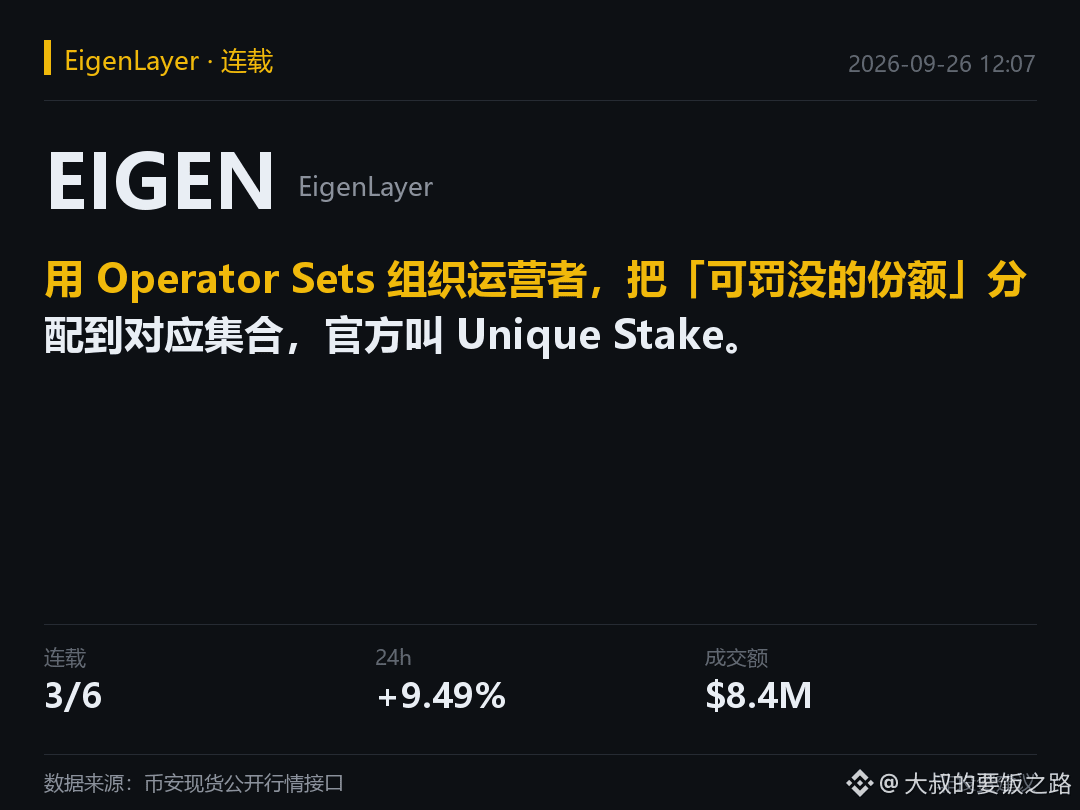
EigenLayer 用 Operator Sets 组织运营者,把「可罚没的份额」分配到对应集合,官方叫 Unique Stake。
关键在分配边界:同一份额在同一时间,只对应一个集合的罚没权。
#Restaking
非投资建议
{future}(EIGENUSDT)
EigenLayer 用 Operator Sets 组织运营者,把「可罚没的份额」分配到对应集合,官方叫 Unique Stake。
关键在分配边界:同一份额在同一时间,只对应一个集合的罚没权。
#Restaking
非投资建议
关键在分配边界:同一份额在同一时间,只对应一个集合的罚没权。
#Restaking
非投资建议
136

·
--
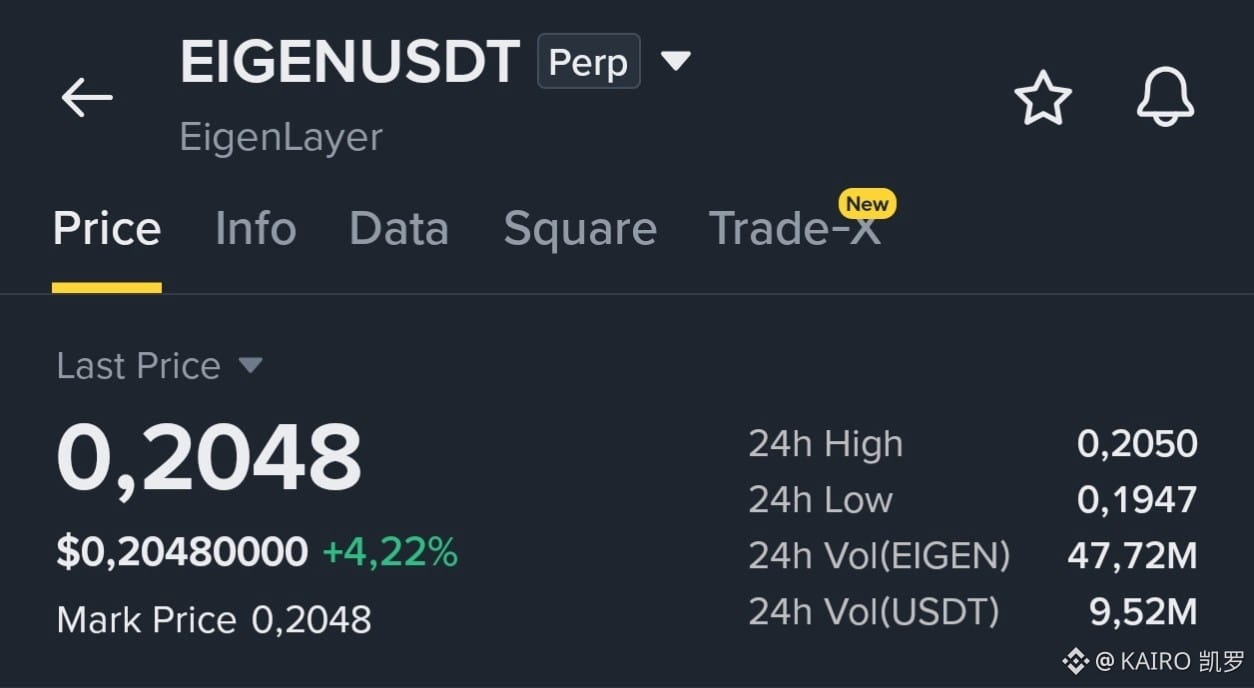
$EIGEN /USDT LONG 🔵
$EIGEN is a major Ethereum restaking infrastructure play 📊 powering EigenLayer and its ecosystem of Actively Validated Services (AVSs) ⚡
$EIGEN is setting up around the $0.2048 zone, with the restaking narrative keeping attention on the token 🧭
🟢 Buyzone: $0.20480
🔴 Stoploss: $0.17410
🎯 Target 1: $0.21500
🎯 Target 2: $0.22530
🎯 Target 3: $0.24580
⚠️ Risk: FOMO — don't chase if price spikes too fast.
Not financial advice and not a recommendation to buy or sell. Crypto is highly risky, DYOR and you are solely responsible. No coin promotion.
#EIGEN #Eigenlayer #restaking #Write2Earn
$EIGEN /USDT LONG 🔵
$EIGEN is a major Ethereum restaking infrastructure play 📊 powering EigenLayer and its ecosystem of Actively Validated Services (AVSs) ⚡
$EIGEN is setting up around the $0.2048 zone, with the restaking narrative keeping attention on the token 🧭
🟢 Buyzone: $0.20480
🔴 Stoploss: $0.17410
🎯 Target 1: $0.21500
🎯 Target 2: $0.22530
🎯 Target 3: $0.24580
⚠️ Risk: FOMO — don't chase if price spikes too fast.
Not financial advice and not a recommendation to buy or sell. Crypto is highly risky, DYOR and you are solely responsible. No coin promotion.
#EIGEN #Eigenlayer #restaking #Write2Earn
$EIGEN is a major Ethereum restaking infrastructure play 📊 powering EigenLayer and its ecosystem of Actively Validated Services (AVSs) ⚡
$EIGEN is setting up around the $0.2048 zone, with the restaking narrative keeping attention on the token 🧭
🟢 Buyzone: $0.20480
🔴 Stoploss: $0.17410
🎯 Target 1: $0.21500
🎯 Target 2: $0.22530
🎯 Target 3: $0.24580
⚠️ Risk: FOMO — don't chase if price spikes too fast.
Not financial advice and not a recommendation to buy or sell. Crypto is highly risky, DYOR and you are solely responsible. No coin promotion.
#EIGEN #Eigenlayer #restaking #Write2Earn
218

$BR
{future}(BRUSDT)
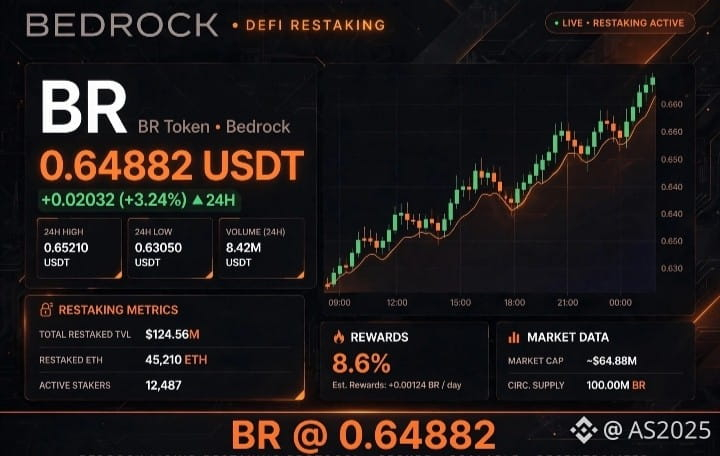
صعود خرساني من 09:00 حتى 00:00 - كل تصحيح بيرجع أقوى، آخر شمعة فوق 0.64882$.
*📍 المستويات*
- *المقاومة:* *0.65210$* - هاي اليوم
- *الدعم:* *0.645$*
- *الدعم القوي:* 0.63050$
*📌 توقعات التداول*
*سيناريو LONG (Bedrock Long)*
- *🎯 دخول:* 0.644$ - 0.64882$
- *📈 TP1:* 0.65210$ +0.5% 💰
- *🚀 TP2:* 0.68$ +4.8%
- *🔥 TP3:* 0.72$ - 0.75$ +15% لو رواية Restaking رجعت
- *⛔ SL:* تحت 0.63$
*سيناريو SHORT*
- *🎯 دخول:* رفض من 0.65210$
- *📉 TP:* 0.644$ ثم 0.635$
- *⛔ SL:* فوق 0.658$
*🔥 الخلاصة*
$BR في *LIVE RESTAKING ACTIVE* - TVL 124.56M$ + 45K ETH مرهونة + 12K staker = أساسيات خرسانة مسلحة.
الثبات فوق *0.64882$* = اختراق *0.65210$* مباشر.
اختراق 0.65210$ = *0.68$* ثم *0.70$+*.
أساس صلب ما يتهزش 🧱⚡
$BR #bedavacoin #bnb一輩子 #MemeLaunchpads82%OfArcDayOneVolume #restaking #DeFi
$BR
صعود خرساني من 09:00 حتى 00:00 - كل تصحيح بيرجع أقوى، آخر شمعة فوق 0.64882$.
*📍 المستويات*
- *المقاومة:* *0.65210$* - هاي اليوم
- *الدعم:* *0.645$*
- *الدعم القوي:* 0.63050$
*📌 توقعات التداول*
*سيناريو LONG (Bedrock Long)*
- *🎯 دخول:* 0.644$ - 0.64882$
- *📈 TP1:* 0.65210$ +0.5% 💰
- *🚀 TP2:* 0.68$ +4.8%
- *🔥 TP3:* 0.72$ - 0.75$ +15% لو رواية Restaking رجعت
- *⛔ SL:* تحت 0.63$
*سيناريو SHORT*
- *🎯 دخول:* رفض من 0.65210$
- *📉 TP:* 0.644$ ثم 0.635$
- *⛔ SL:* فوق 0.658$
*🔥 الخلاصة*
$BR في *LIVE RESTAKING ACTIVE* - TVL 124.56M$ + 45K ETH مرهونة + 12K staker = أساسيات خرسانة مسلحة.
الثبات فوق *0.64882$* = اختراق *0.65210$* مباشر.
اختراق 0.65210$ = *0.68$* ثم *0.70$+*.
أساس صلب ما يتهزش 🧱⚡
$BR #bedavacoin #bnb一輩子 #MemeLaunchpads82%OfArcDayOneVolume #restaking #DeFi
صعود خرساني من 09:00 حتى 00:00 - كل تصحيح بيرجع أقوى، آخر شمعة فوق 0.64882$.
*📍 المستويات*
- *المقاومة:* *0.65210$* - هاي اليوم
- *الدعم:* *0.645$*
- *الدعم القوي:* 0.63050$
*📌 توقعات التداول*
*سيناريو LONG (Bedrock Long)*
- *🎯 دخول:* 0.644$ - 0.64882$
- *📈 TP1:* 0.65210$ +0.5% 💰
- *🚀 TP2:* 0.68$ +4.8%
- *🔥 TP3:* 0.72$ - 0.75$ +15% لو رواية Restaking رجعت
- *⛔ SL:* تحت 0.63$
*سيناريو SHORT*
- *🎯 دخول:* رفض من 0.65210$
- *📉 TP:* 0.644$ ثم 0.635$
- *⛔ SL:* فوق 0.658$
*🔥 الخلاصة*
$BR في *LIVE RESTAKING ACTIVE* - TVL 124.56M$ + 45K ETH مرهونة + 12K staker = أساسيات خرسانة مسلحة.
الثبات فوق *0.64882$* = اختراق *0.65210$* مباشر.
اختراق 0.65210$ = *0.68$* ثم *0.70$+*.
أساس صلب ما يتهزش 🧱⚡
$BR #bedavacoin #bnb一輩子 #MemeLaunchpads82%OfArcDayOneVolume #restaking #DeFi
1
103

🚨 $ETH RESTAKING PROTOCOL FREEZES SUSPICIOUS ADDRESS ⚠️
Kelp’s temporary 24-hour freeze on a suspicious $rsETH address reads like a defensive liquidity circuit breaker, not a protocol collapse. 🦈 The $7.73M Safe-wallet loss is isolated to an unidentified user’s compromised address, while contracts remain secure, $rsETH stays fully collateralized, and minting, withdrawals, and integrations continue normally. 📊 For $ETH restaking participants, the real signal is risk containment: the team acted fast, ring-fenced the exposure, and left users with no action required. Does this incident expose a broader Safe-wallet security gap, or simply prove that transparent containment can protect restaking confidence? 👇
⚠️ Not financial advice. Always manage your risk. 🛡️
🏷️ #ETH #Restaking #Security #Crypto
🎯
🚨 $ETH RESTAKING PROTOCOL FREEZES SUSPICIOUS ADDRESS ⚠️
Kelp’s temporary 24-hour freeze on a suspicious $rsETH address reads like a defensive liquidity circuit breaker, not a protocol collapse. 🦈 The $7.73M Safe-wallet loss is isolated to an unidentified user’s compromised address, while contracts remain secure, $rsETH stays fully collateralized, and minting, withdrawals, and integrations continue normally. 📊 For $ETH restaking participants, the real signal is risk containment: the team acted fast, ring-fenced the exposure, and left users with no action required. Does this incident expose a broader Safe-wallet security gap, or simply prove that transparent containment can protect restaking confidence? 👇
⚠️ Not financial advice. Always manage your risk. 🛡️
🏷️ #ETH #Restaking #Security #Crypto
🎯
Kelp’s temporary 24-hour freeze on a suspicious $rsETH address reads like a defensive liquidity circuit breaker, not a protocol collapse. 🦈 The $7.73M Safe-wallet loss is isolated to an unidentified user’s compromised address, while contracts remain secure, $rsETH stays fully collateralized, and minting, withdrawals, and integrations continue normally. 📊 For $ETH restaking participants, the real signal is risk containment: the team acted fast, ring-fenced the exposure, and left users with no action required. Does this incident expose a broader Safe-wallet security gap, or simply prove that transparent containment can protect restaking confidence? 👇
⚠️ Not financial advice. Always manage your risk. 🛡️
🏷️ #ETH #Restaking #Security #Crypto
🎯
7

·
--
Article
🔄 كيف تجعل عملاتك تعمل في وظيفتين في نفس الوقت؟ دليلك لفهم "إعادة التخزين" (Restaking)تخيل أنك وضعت 10,000 دولار كوديعة في البنك لتحصل على عائد سنوي 5%. المال الآن محجوز ولا يمكنك استخدامه، أليس كذلك؟
ماذا لو أخبرتك أن هناك تقنية جديدة في عالم الكريبتو تسمح لك بأخذ "إيصال" هذه الوديعة، ووضعه في بنك آخر لتحصل على 5% إضافية، ثم في بنك ثالث لتحصل على 5% أخرى... كل هذا بنفس مبلغ الـ 10,000 دولار الأصلي وبدون أن تدفع دولاراً واحداً إضافياً!
هذا السحر المالي هو ما يُعرف اليوم بـ إعادة التخزين (Restaking)، وهو التريند الأضخم الذي يقوده مشروع (EigenLayer) على شبكة الإيثيريوم.
1. كيف تعمل اللعبة؟ (الأساسيات) 🧠
في الوضع التقليدي (Staking)، أنت تقوم بتجميد عملاتك (مثل ETH) لحماية شبكة الإيثيريوم، وفي المقابل تحصل على عوائد.
لكن الشبكات والتطبيقات الجديدة (مثل شبكات الأوراكل، أو الجسور التي تنقل العملات) تحتاج أيضاً إلى حماية وأمان، وبناء نظام أمان من الصفر يكلف مليارات الدولارات.
2. الحل العبقري: استنساخ الأمان 🛡️
هنا يتدخل بروتوكول (EigenLayer). بدلاً من أن تبحث التطبيقات الجديدة عن أشخاص جدد لتخزين العملات، يسمح لك البروتوكول باستخدام نفس عملات الـ ETH المخزنة مسبقاً لحماية هذه التطبيقات الجديدة في نفس الوقت!
النتيجة؟ أنت تستخدم رأس مالك مرة واحدة، لكنك تحمى عدة شبكات معاً، وتتلقى عوائد (Rewards) من الإيثيريوم ومن كل تطبيق إضافي قمت بحمايته. إنها "أرباح مركبة" بضغطة زر.
3. أين الفخ؟ (مخاطر القطع - Slashing) ⚠️
في عالم المال، لا يوجد عائد إضافي بدون مخاطرة إضافية.
عندما توافق على "إعادة تخزين" عملاتك لحماية تطبيق جديد، فأنت توقع على عقد ذكي يسمى (Slashing Conditions). هذا يعني أنه إذا تعرض هذا التطبيق الجديد للاختراق، أو إذا قمت أنت بمحاولة التلاعب، فإن العقد الذكي سيقوم بـ "قص" أو مصادرة جزء من عملات الـ ETH الأصلية الخاصة بك كعقوبة!
أنت تضاعف أرباحك، لكنك تضاعف نقاط ضعفك أيضاً.
الخلاصة:
تقنية "إعادة التخزين" (Restaking) ليست مجرد أداة لزيادة الأرباح، بل هي ثورة في الطريقة التي تتشارك بها شبكات البلوكتشين "الأمان اللامركزي". إنها تجعل الإيثيريوم أشبه بـ "مظلة أمان عالمية" يمكن لأي مشروع جديد استئجارها بدلاً من بنائها من الصفر.
شاركونا في مجموعة Crypton 👇
في مساحتنا المخصصة لاصطياد الفرص التقنية.. هل جربتم استخدام بروتوكولات (Restaking) مثل EigenLayer أو Renzo أو Ether.fi؟ وهل ترون أن العوائد المضاعفة تستحق مخاطرة تعرض الأصول للمصادرة (Slashing)؟ شاركونا استراتيجياتكم في التعليقات!
#restaking #restaking
🔄 كيف تجعل عملاتك تعمل في وظيفتين في نفس الوقت؟ دليلك لفهم "إعادة التخزين" (Restaking)
تخيل أنك وضعت 10,000 دولار كوديعة في البنك لتحصل على عائد سنوي 5%. المال الآن محجوز ولا يمكنك استخدامه، أليس كذلك؟
ماذا لو أخبرتك أن هناك تقنية جديدة في عالم الكريبتو تسمح لك بأخذ "إيصال" هذه الوديعة، ووضعه في بنك آخر لتحصل على 5% إضافية، ثم في بنك ثالث لتحصل على 5% أخرى... كل هذا بنفس مبلغ الـ 10,000 دولار الأصلي وبدون أن تدفع دولاراً واحداً إضافياً!
هذا السحر المالي هو ما يُعرف اليوم بـ إعادة التخزين (Restaking)، وهو التريند الأضخم الذي يقوده مشروع (EigenLayer) على شبكة الإيثيريوم.
1. كيف تعمل اللعبة؟ (الأساسيات) 🧠
في الوضع التقليدي (Staking)، أنت تقوم بتجميد عملاتك (مثل ETH) لحماية شبكة الإيثيريوم، وفي المقابل تحصل على عوائد.
لكن الشبكات والتطبيقات الجديدة (مثل شبكات الأوراكل، أو الجسور التي تنقل العملات) تحتاج أيضاً إلى حماية وأمان، وبناء نظام أمان من الصفر يكلف مليارات الدولارات.
2. الحل العبقري: استنساخ الأمان 🛡️
هنا يتدخل بروتوكول (EigenLayer). بدلاً من أن تبحث التطبيقات الجديدة عن أشخاص جدد لتخزين العملات، يسمح لك البروتوكول باستخدام نفس عملات الـ ETH المخزنة مسبقاً لحماية هذه التطبيقات الجديدة في نفس الوقت!
النتيجة؟ أنت تستخدم رأس مالك مرة واحدة، لكنك تحمى عدة شبكات معاً، وتتلقى عوائد (Rewards) من الإيثيريوم ومن كل تطبيق إضافي قمت بحمايته. إنها "أرباح مركبة" بضغطة زر.
3. أين الفخ؟ (مخاطر القطع - Slashing) ⚠️
في عالم المال، لا يوجد عائد إضافي بدون مخاطرة إضافية.
عندما توافق على "إعادة تخزين" عملاتك لحماية تطبيق جديد، فأنت توقع على عقد ذكي يسمى (Slashing Conditions). هذا يعني أنه إذا تعرض هذا التطبيق الجديد للاختراق، أو إذا قمت أنت بمحاولة التلاعب، فإن العقد الذكي سيقوم بـ "قص" أو مصادرة جزء من عملات الـ ETH الأصلية الخاصة بك كعقوبة!
أنت تضاعف أرباحك، لكنك تضاعف نقاط ضعفك أيضاً.
الخلاصة:
تقنية "إعادة التخزين" (Restaking) ليست مجرد أداة لزيادة الأرباح، بل هي ثورة في الطريقة التي تتشارك بها شبكات البلوكتشين "الأمان اللامركزي". إنها تجعل الإيثيريوم أشبه بـ "مظلة أمان عالمية" يمكن لأي مشروع جديد استئجارها بدلاً من بنائها من الصفر.
شاركونا في مجموعة Crypton 👇
في مساحتنا المخصصة لاصطياد الفرص التقنية.. هل جربتم استخدام بروتوكولات (Restaking) مثل EigenLayer أو Renzo أو Ether.fi؟ وهل ترون أن العوائد المضاعفة تستحق مخاطرة تعرض الأصول للمصادرة (Slashing)؟ شاركونا استراتيجياتكم في التعليقات!
#restaking #restaking
ماذا لو أخبرتك أن هناك تقنية جديدة في عالم الكريبتو تسمح لك بأخذ "إيصال" هذه الوديعة، ووضعه في بنك آخر لتحصل على 5% إضافية، ثم في بنك ثالث لتحصل على 5% أخرى... كل هذا بنفس مبلغ الـ 10,000 دولار الأصلي وبدون أن تدفع دولاراً واحداً إضافياً!
هذا السحر المالي هو ما يُعرف اليوم بـ إعادة التخزين (Restaking)، وهو التريند الأضخم الذي يقوده مشروع (EigenLayer) على شبكة الإيثيريوم.
1. كيف تعمل اللعبة؟ (الأساسيات) 🧠
في الوضع التقليدي (Staking)، أنت تقوم بتجميد عملاتك (مثل ETH) لحماية شبكة الإيثيريوم، وفي المقابل تحصل على عوائد.
لكن الشبكات والتطبيقات الجديدة (مثل شبكات الأوراكل، أو الجسور التي تنقل العملات) تحتاج أيضاً إلى حماية وأمان، وبناء نظام أمان من الصفر يكلف مليارات الدولارات.
2. الحل العبقري: استنساخ الأمان 🛡️
هنا يتدخل بروتوكول (EigenLayer). بدلاً من أن تبحث التطبيقات الجديدة عن أشخاص جدد لتخزين العملات، يسمح لك البروتوكول باستخدام نفس عملات الـ ETH المخزنة مسبقاً لحماية هذه التطبيقات الجديدة في نفس الوقت!
النتيجة؟ أنت تستخدم رأس مالك مرة واحدة، لكنك تحمى عدة شبكات معاً، وتتلقى عوائد (Rewards) من الإيثيريوم ومن كل تطبيق إضافي قمت بحمايته. إنها "أرباح مركبة" بضغطة زر.
3. أين الفخ؟ (مخاطر القطع - Slashing) ⚠️
في عالم المال، لا يوجد عائد إضافي بدون مخاطرة إضافية.
عندما توافق على "إعادة تخزين" عملاتك لحماية تطبيق جديد، فأنت توقع على عقد ذكي يسمى (Slashing Conditions). هذا يعني أنه إذا تعرض هذا التطبيق الجديد للاختراق، أو إذا قمت أنت بمحاولة التلاعب، فإن العقد الذكي سيقوم بـ "قص" أو مصادرة جزء من عملات الـ ETH الأصلية الخاصة بك كعقوبة!
أنت تضاعف أرباحك، لكنك تضاعف نقاط ضعفك أيضاً.
الخلاصة:
تقنية "إعادة التخزين" (Restaking) ليست مجرد أداة لزيادة الأرباح، بل هي ثورة في الطريقة التي تتشارك بها شبكات البلوكتشين "الأمان اللامركزي". إنها تجعل الإيثيريوم أشبه بـ "مظلة أمان عالمية" يمكن لأي مشروع جديد استئجارها بدلاً من بنائها من الصفر.
شاركونا في مجموعة Crypton 👇
في مساحتنا المخصصة لاصطياد الفرص التقنية.. هل جربتم استخدام بروتوكولات (Restaking) مثل EigenLayer أو Renzo أو Ether.fi؟ وهل ترون أن العوائد المضاعفة تستحق مخاطرة تعرض الأصول للمصادرة (Slashing)؟ شاركونا استراتيجياتكم في التعليقات!
#restaking #restaking
2
2
72

·
--
Your Restaked ETH Might Be Working Three Jobs at Once — Here's Why That's RiskyRestaking sounds simple: stake once, earn twice. What actually happens underneath is your collateral getting promised to multiple protocols simultaneously — a mechanism called re-hypothecation — and understanding exactly how that's secured is the difference between informed risk and blind exposure.
Two frameworks currently dominate this space, and they've made almost opposite bets on how to handle it.
EigenCloud (formerly EigenLayer) runs a programmatic, unified system. When you restake, your assets get committed through a StrategyManager, and EigenCloud enforces a rule called Unique Stake — a specific pool of $ETH can only be slashed by one Operator Set at any given moment, specifically to prevent a single bad actor from triggering multiple simultaneous slashing events on the same capital. If an operator misbehaves — say, double-signing on an Actively Validated Service — the AVS flags those shares as burnable. But EigenCloud doesn't let that penalty execute unchecked: a Veto Slashing Committee, a reputation-based body, reviews every slashing request and can override unfair or bugged penalties. The tradeoff is centralization of trust — you're relying on that committee's judgment and the system's overall complexity holding up.
Symbiotic takes the opposite philosophy: hyper-modular, vault-isolated. Instead of one global rule set, every vault defines its own terms. Deposits are fully asset-agnostic — stablecoins, wBTC, any ERC-20 — and when a connected network flags a violation, the request goes straight to that vault's own slasher module. Disputes aren't handled by one committee; they're handled by Resolvers — custom entities or smart contracts the vault itself designates, which can enforce instant slashing or a veto period depending on how the vault was configured. The upside is isolation: a problem in one vault doesn't automatically cascade into others. The risk is different, not smaller — a bad Resolver colluding with a malicious network can slash operators unfairly with far less centralized oversight to catch it.
Here's why the distinction actually matters for your capital: restaking isn't staking with extra steps. Your ETH's fate now depends on the primary Ethereum network, plus the restaking protocol's contract, plus every individual AVS it's plugged into. A severe exploit or slashing event on even a minor, poorly-secured AVS can trigger a cascading liquidation loop that erases your original staked position entirely — regardless of how solid Ethereum's own security is.
So before chasing that 12-15% restaking yield — do you actually know whether your capital sits inside a unified, committee-governed system, or an isolated vault whose safety depends entirely on who you've trusted to write the rules?
{spot}(ETHUSDT)
#restaking #LiquidStaking
Your Restaked ETH Might Be Working Three Jobs at Once — Here's Why That's Risky
Restaking sounds simple: stake once, earn twice. What actually happens underneath is your collateral getting promised to multiple protocols simultaneously — a mechanism called re-hypothecation — and understanding exactly how that's secured is the difference between informed risk and blind exposure.
Two frameworks currently dominate this space, and they've made almost opposite bets on how to handle it.
EigenCloud (formerly EigenLayer) runs a programmatic, unified system. When you restake, your assets get committed through a StrategyManager, and EigenCloud enforces a rule called Unique Stake — a specific pool of $ETH can only be slashed by one Operator Set at any given moment, specifically to prevent a single bad actor from triggering multiple simultaneous slashing events on the same capital. If an operator misbehaves — say, double-signing on an Actively Validated Service — the AVS flags those shares as burnable. But EigenCloud doesn't let that penalty execute unchecked: a Veto Slashing Committee, a reputation-based body, reviews every slashing request and can override unfair or bugged penalties. The tradeoff is centralization of trust — you're relying on that committee's judgment and the system's overall complexity holding up.
Symbiotic takes the opposite philosophy: hyper-modular, vault-isolated. Instead of one global rule set, every vault defines its own terms. Deposits are fully asset-agnostic — stablecoins, wBTC, any ERC-20 — and when a connected network flags a violation, the request goes straight to that vault's own slasher module. Disputes aren't handled by one committee; they're handled by Resolvers — custom entities or smart contracts the vault itself designates, which can enforce instant slashing or a veto period depending on how the vault was configured. The upside is isolation: a problem in one vault doesn't automatically cascade into others. The risk is different, not smaller — a bad Resolver colluding with a malicious network can slash operators unfairly with far less centralized oversight to catch it.
Here's why the distinction actually matters for your capital: restaking isn't staking with extra steps. Your ETH's fate now depends on the primary Ethereum network, plus the restaking protocol's contract, plus every individual AVS it's plugged into. A severe exploit or slashing event on even a minor, poorly-secured AVS can trigger a cascading liquidation loop that erases your original staked position entirely — regardless of how solid Ethereum's own security is.
So before chasing that 12-15% restaking yield — do you actually know whether your capital sits inside a unified, committee-governed system, or an isolated vault whose safety depends entirely on who you've trusted to write the rules?
#restaking #LiquidStaking
Two frameworks currently dominate this space, and they've made almost opposite bets on how to handle it.
EigenCloud (formerly EigenLayer) runs a programmatic, unified system. When you restake, your assets get committed through a StrategyManager, and EigenCloud enforces a rule called Unique Stake — a specific pool of $ETH can only be slashed by one Operator Set at any given moment, specifically to prevent a single bad actor from triggering multiple simultaneous slashing events on the same capital. If an operator misbehaves — say, double-signing on an Actively Validated Service — the AVS flags those shares as burnable. But EigenCloud doesn't let that penalty execute unchecked: a Veto Slashing Committee, a reputation-based body, reviews every slashing request and can override unfair or bugged penalties. The tradeoff is centralization of trust — you're relying on that committee's judgment and the system's overall complexity holding up.
Symbiotic takes the opposite philosophy: hyper-modular, vault-isolated. Instead of one global rule set, every vault defines its own terms. Deposits are fully asset-agnostic — stablecoins, wBTC, any ERC-20 — and when a connected network flags a violation, the request goes straight to that vault's own slasher module. Disputes aren't handled by one committee; they're handled by Resolvers — custom entities or smart contracts the vault itself designates, which can enforce instant slashing or a veto period depending on how the vault was configured. The upside is isolation: a problem in one vault doesn't automatically cascade into others. The risk is different, not smaller — a bad Resolver colluding with a malicious network can slash operators unfairly with far less centralized oversight to catch it.
Here's why the distinction actually matters for your capital: restaking isn't staking with extra steps. Your ETH's fate now depends on the primary Ethereum network, plus the restaking protocol's contract, plus every individual AVS it's plugged into. A severe exploit or slashing event on even a minor, poorly-secured AVS can trigger a cascading liquidation loop that erases your original staked position entirely — regardless of how solid Ethereum's own security is.
So before chasing that 12-15% restaking yield — do you actually know whether your capital sits inside a unified, committee-governed system, or an isolated vault whose safety depends entirely on who you've trusted to write the rules?
#restaking #LiquidStaking
55
·
--
Not all yield is the same yield — and right now, the gap between "safe" and "aggressive" in staking has never been wider.
Traditional liquid staking through Lido or Rocket Pool gets you a steady 3-4% APY, drawn from network issuance and MEV tips — boring by design, and the numbers back it up: liquid staking pulled in $23.03M in weekly fees with $2.06M in real net revenue. Restaking through platforms like Ether.fi (ETHFI) runs a completely different model — 8-12% APY on average, occasionally clearing 15% during high AVS demand — but the category as a whole brought in just $457,946 in weekly fees and a mere $4,571 in direct protocol revenue. That spread tells you restaking hasn't matured into a self-sustaining fee business yet; it's still compensating for real, additional risk.
Ether.fi is trying to close that gap with actual utility — its crypto debit card now lets you spend restaked yield directly, turning an abstract APY into something you can exit through daily spending rather than waiting on a bridge or a redemption queue.
So the real allocation question isn't "which yield is bigger." It's: how much of your stack do you want sitting in the 3-4% safe-haven lane versus how much are you willing to expose to AVS-level risk for a shot at 3x the return? $ETH #restaking
#LiquidStaking
Not all yield is the same yield — and right now, the gap between "safe" and "aggressive" in staking has never been wider.
Traditional liquid staking through Lido or Rocket Pool gets you a steady 3-4% APY, drawn from network issuance and MEV tips — boring by design, and the numbers back it up: liquid staking pulled in $23.03M in weekly fees with $2.06M in real net revenue. Restaking through platforms like Ether.fi (ETHFI) runs a completely different model — 8-12% APY on average, occasionally clearing 15% during high AVS demand — but the category as a whole brought in just $457,946 in weekly fees and a mere $4,571 in direct protocol revenue. That spread tells you restaking hasn't matured into a self-sustaining fee business yet; it's still compensating for real, additional risk.
Ether.fi is trying to close that gap with actual utility — its crypto debit card now lets you spend restaked yield directly, turning an abstract APY into something you can exit through daily spending rather than waiting on a bridge or a redemption queue.
So the real allocation question isn't "which yield is bigger." It's: how much of your stack do you want sitting in the 3-4% safe-haven lane versus how much are you willing to expose to AVS-level risk for a shot at 3x the return? $ETH #restaking
#LiquidStaking
Traditional liquid staking through Lido or Rocket Pool gets you a steady 3-4% APY, drawn from network issuance and MEV tips — boring by design, and the numbers back it up: liquid staking pulled in $23.03M in weekly fees with $2.06M in real net revenue. Restaking through platforms like Ether.fi (ETHFI) runs a completely different model — 8-12% APY on average, occasionally clearing 15% during high AVS demand — but the category as a whole brought in just $457,946 in weekly fees and a mere $4,571 in direct protocol revenue. That spread tells you restaking hasn't matured into a self-sustaining fee business yet; it's still compensating for real, additional risk.
Ether.fi is trying to close that gap with actual utility — its crypto debit card now lets you spend restaked yield directly, turning an abstract APY into something you can exit through daily spending rather than waiting on a bridge or a redemption queue.
So the real allocation question isn't "which yield is bigger." It's: how much of your stack do you want sitting in the 3-4% safe-haven lane versus how much are you willing to expose to AVS-level risk for a shot at 3x the return? $ETH #restaking
#LiquidStaking
79

·
--
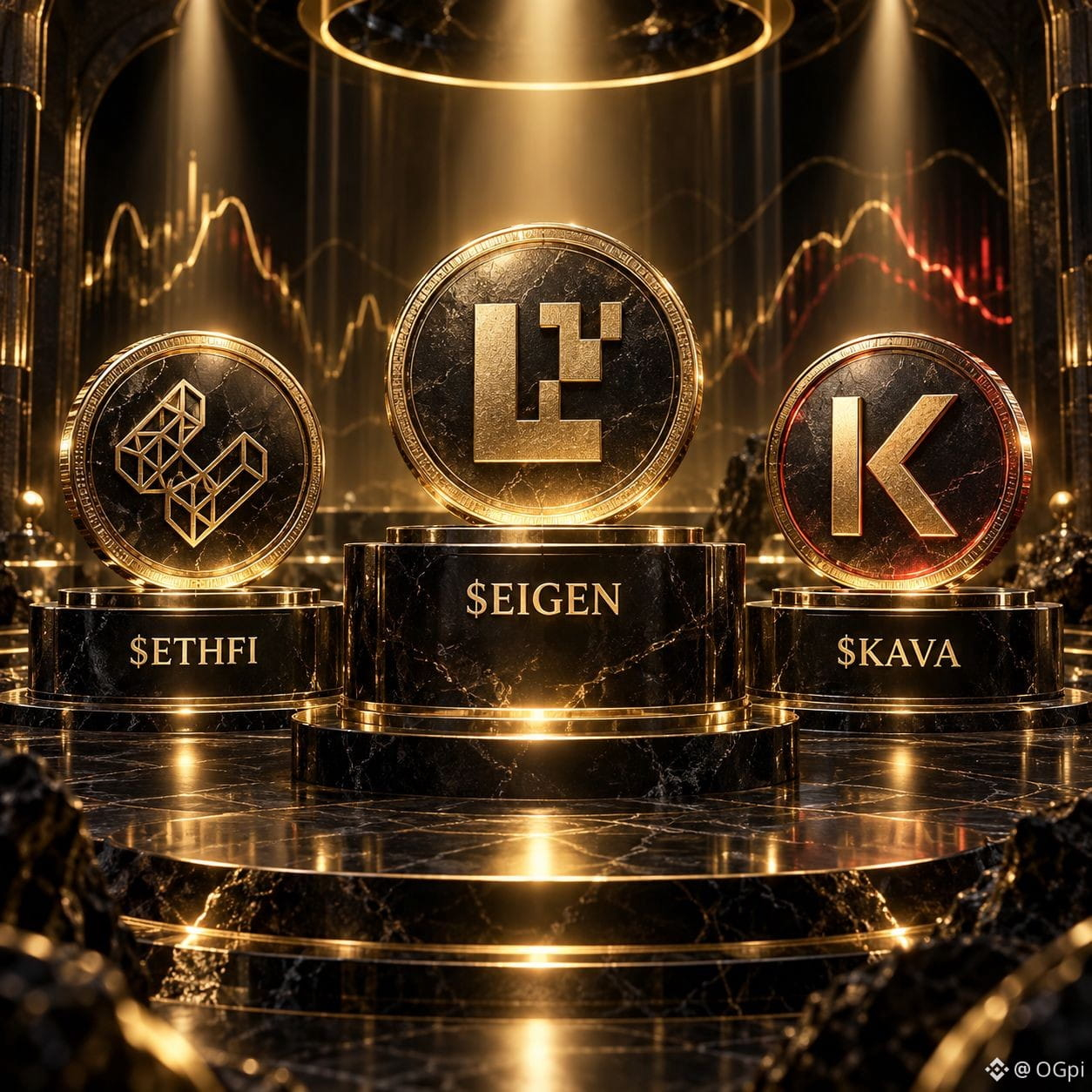
$ETHFI $EIGEN $KAVA
$ETHFI:ether.fi 现在不只是单一质押协议,更像把 ETH 质押、再质押和链上金融账户揉在一起,ETHFI 主要吃治理和生态贡献预期。前景还是看两个点:Restaking 热度能不能延续,产品侧能不能把真实用户留住。盘面这轮很猛,现价 0.7617,24 小时涨 22.93%,6 小时还有 4.41%,量也放到 1.12 亿 USDT。短线 0.7167 是我会看的承接位,0.7788 附近如果冲不过,容易先洗一波。
$EIGEN:EigenLayer 做的是以太坊再质押,把 ETH 或 LST 的安全性拿去服务 AVS,EIGEN 的叙事核心是给这套共享安全网络补治理和惩罚机制。这个方向有想象力,但要靠 AVS 真实需求兑现,不是只靠概念吹。现价 0.2247,24 小时涨 6.34%,近 6 小时涨 4.95%,成交 2039 万 USDT,资金费率中性。0.2138 下方别硬扛,能稳在 0.2252 上面,短线情绪才算继续接得住。
$KAVA:Kava 是 Cosmos SDK 和 EVM 结合的 Layer1,KAVA 主要用于质押、治理和网络安全,项目价值取决于链上应用、跨生态资产和开发者活跃度能不能重新起来。现价 0.06952,24 小时涨 6.40%,6 小时涨 4.78%,量能 1105 万 USDT,不算夸张但够看。0.06631 是这波回踩线,0.06969 上方如果放量站住,才更像资金愿意继续试。
#Restaking #Kava #行情观察
$ETHFI $EIGEN $KAVA
$ETHFI :ether.fi 现在不只是单一质押协议,更像把 ETH 质押、再质押和链上金融账户揉在一起,ETHFI 主要吃治理和生态贡献预期。前景还是看两个点:Restaking 热度能不能延续,产品侧能不能把真实用户留住。盘面这轮很猛,现价 0.7617,24 小时涨 22.93%,6 小时还有 4.41%,量也放到 1.12 亿 USDT。短线 0.7167 是我会看的承接位,0.7788 附近如果冲不过,容易先洗一波。
$EIGEN :EigenLayer 做的是以太坊再质押,把 ETH 或 LST 的安全性拿去服务 AVS,EIGEN 的叙事核心是给这套共享安全网络补治理和惩罚机制。这个方向有想象力,但要靠 AVS 真实需求兑现,不是只靠概念吹。现价 0.2247,24 小时涨 6.34%,近 6 小时涨 4.95%,成交 2039 万 USDT,资金费率中性。0.2138 下方别硬扛,能稳在 0.2252 上面,短线情绪才算继续接得住。
$KAVA :Kava 是 Cosmos SDK 和 EVM 结合的 Layer1,KAVA 主要用于质押、治理和网络安全,项目价值取决于链上应用、跨生态资产和开发者活跃度能不能重新起来。现价 0.06952,24 小时涨 6.40%,6 小时涨 4.78%,量能 1105 万 USDT,不算夸张但够看。0.06631 是这波回踩线,0.06969 上方如果放量站住,才更像资金愿意继续试。
#Restaking #Kava #行情观察
$ETHFI :ether.fi 现在不只是单一质押协议,更像把 ETH 质押、再质押和链上金融账户揉在一起,ETHFI 主要吃治理和生态贡献预期。前景还是看两个点:Restaking 热度能不能延续,产品侧能不能把真实用户留住。盘面这轮很猛,现价 0.7617,24 小时涨 22.93%,6 小时还有 4.41%,量也放到 1.12 亿 USDT。短线 0.7167 是我会看的承接位,0.7788 附近如果冲不过,容易先洗一波。
$EIGEN :EigenLayer 做的是以太坊再质押,把 ETH 或 LST 的安全性拿去服务 AVS,EIGEN 的叙事核心是给这套共享安全网络补治理和惩罚机制。这个方向有想象力,但要靠 AVS 真实需求兑现,不是只靠概念吹。现价 0.2247,24 小时涨 6.34%,近 6 小时涨 4.95%,成交 2039 万 USDT,资金费率中性。0.2138 下方别硬扛,能稳在 0.2252 上面,短线情绪才算继续接得住。
$KAVA :Kava 是 Cosmos SDK 和 EVM 结合的 Layer1,KAVA 主要用于质押、治理和网络安全,项目价值取决于链上应用、跨生态资产和开发者活跃度能不能重新起来。现价 0.06952,24 小时涨 6.40%,6 小时涨 4.78%,量能 1105 万 USDT,不算夸张但够看。0.06631 是这波回踩线,0.06969 上方如果放量站住,才更像资金愿意继续试。
#Restaking #Kava #行情观察
168
·
--
$REZ /USDT LONG 🔵
$REZ is a low-cap Ethereum restaking play 📊 focused on liquid restaking and yield through the Renzo ecosystem ⚡
$REZ is setting up around the $0.0030 zone, looking for a rebound and continuation higher 🧭
🟢 Buyzone: $0.003002
🔴 Stoploss: $0.002550
🎯 Target 1: $0.003200
🎯 Target 2: $0.003450
🎯 Target 3: $0.003800
⚠️ Risk: FOMO — don't chase if price spikes too fast.
Not financial advice and not a recommendation to buy or sell. Crypto is highly risky, DYOR and you are solely responsible. No coin promotion.
#REZ #RENZO #restaking #Write2Earn
$REZ /USDT LONG 🔵
$REZ is a low-cap Ethereum restaking play 📊 focused on liquid restaking and yield through the Renzo ecosystem ⚡
$REZ is setting up around the $0.0030 zone, looking for a rebound and continuation higher 🧭
🟢 Buyzone: $0.003002
🔴 Stoploss: $0.002550
🎯 Target 1: $0.003200
🎯 Target 2: $0.003450
🎯 Target 3: $0.003800
⚠️ Risk: FOMO — don't chase if price spikes too fast.
Not financial advice and not a recommendation to buy or sell. Crypto is highly risky, DYOR and you are solely responsible. No coin promotion.
#REZ #RENZO #restaking #Write2Earn
$REZ is a low-cap Ethereum restaking play 📊 focused on liquid restaking and yield through the Renzo ecosystem ⚡
$REZ is setting up around the $0.0030 zone, looking for a rebound and continuation higher 🧭
🟢 Buyzone: $0.003002
🔴 Stoploss: $0.002550
🎯 Target 1: $0.003200
🎯 Target 2: $0.003450
🎯 Target 3: $0.003800
⚠️ Risk: FOMO — don't chase if price spikes too fast.
Not financial advice and not a recommendation to buy or sell. Crypto is highly risky, DYOR and you are solely responsible. No coin promotion.
#REZ #RENZO #restaking #Write2Earn

1
303
·
--
"Free yield" should always make you ask what's being bundled underneath it.
Restaking tokens like eETH look like a simple yield stack — base $ETH staking plus a bonus from securing external networks. But look at what's actually nested inside: your ETH's fate now depends on Ether.fi's contract integrity, plus EigenLayer's, plus every individual AVS (Actively Validated Service) it's plugged into. If any single one of those external networks suffers a bad validator sync or a critical exploit, your underlying ETH can get slashed — even if you did everything right on Ethereum itself.
That's structurally the same problem 2008-era CDOs had: bundle enough separately-rated risks together and repackage them as one clean product, and the product looks safer than the sum of its parts actually is.
Bias: restaking yield should be priced as compensation for multi-protocol tail risk, not treated as a free bonus. Before chasing the extra APY — do you actually know how many external contracts your ETH is now exposed to? #restaking
"Free yield" should always make you ask what's being bundled underneath it.
Restaking tokens like eETH look like a simple yield stack — base $ETH staking plus a bonus from securing external networks. But look at what's actually nested inside: your ETH's fate now depends on Ether.fi's contract integrity, plus EigenLayer's, plus every individual AVS (Actively Validated Service) it's plugged into. If any single one of those external networks suffers a bad validator sync or a critical exploit, your underlying ETH can get slashed — even if you did everything right on Ethereum itself.
That's structurally the same problem 2008-era CDOs had: bundle enough separately-rated risks together and repackage them as one clean product, and the product looks safer than the sum of its parts actually is.
Bias: restaking yield should be priced as compensation for multi-protocol tail risk, not treated as a free bonus. Before chasing the extra APY — do you actually know how many external contracts your ETH is now exposed to? #restaking
Restaking tokens like eETH look like a simple yield stack — base $ETH staking plus a bonus from securing external networks. But look at what's actually nested inside: your ETH's fate now depends on Ether.fi's contract integrity, plus EigenLayer's, plus every individual AVS (Actively Validated Service) it's plugged into. If any single one of those external networks suffers a bad validator sync or a critical exploit, your underlying ETH can get slashed — even if you did everything right on Ethereum itself.
That's structurally the same problem 2008-era CDOs had: bundle enough separately-rated risks together and repackage them as one clean product, and the product looks safer than the sum of its parts actually is.
Bias: restaking yield should be priced as compensation for multi-protocol tail risk, not treated as a free bonus. Before chasing the extra APY — do you actually know how many external contracts your ETH is now exposed to? #restaking
83
·
--
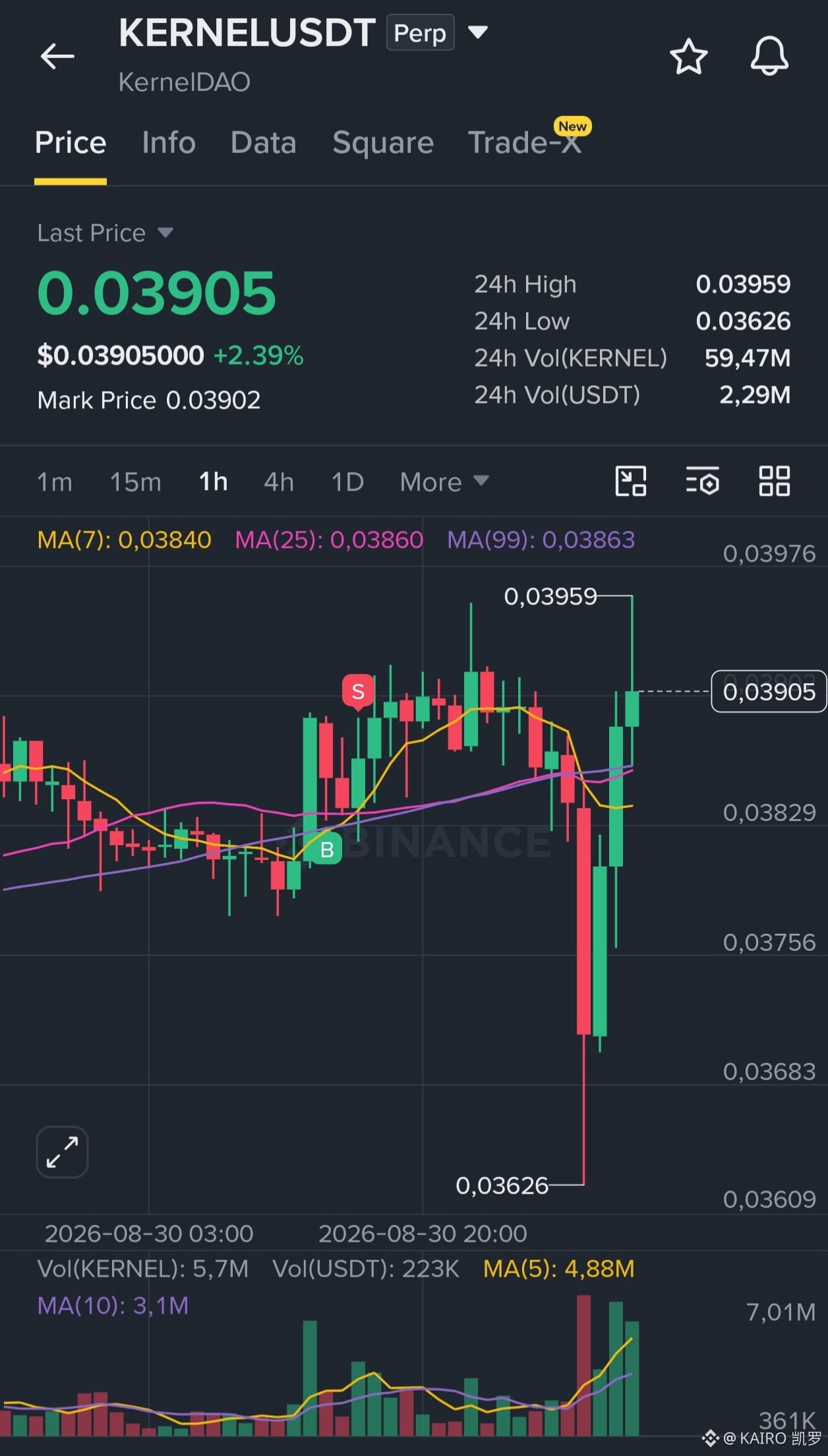
$KERNEL /USDT LONG 🔵
$KERNEL is a low-cap restaking & DeFi play 📊 powering KernelDAO across Ethereum and BNB Chain, with ~$11M market cap and ~$4.2M daily volume ⚡
$KERNEL is reclaiming the $0.039 area after bouncing from its August low, with the restaking narrative supporting a potential continuation 🧭
🟢 Buyzone: 0.03905
🔴 Stoploss: 0.03530
🎯 Target 1: 0.04100
🎯 Target 2: 0.04350
🎯 Target 3: 0.04800
⚠️ Risk: FOMO — don't chase if price spikes too fast.
Not financial advice and not a recommendation to buy or sell. Crypto is highly risky, DYOR and you are solely responsible. No coin promotion.
#kernel #restaking #DeFi #Write2Earn!
$KERNEL /USDT LONG 🔵
$KERNEL is a low-cap restaking & DeFi play 📊 powering KernelDAO across Ethereum and BNB Chain, with ~$11M market cap and ~$4.2M daily volume ⚡
$KERNEL is reclaiming the $0.039 area after bouncing from its August low, with the restaking narrative supporting a potential continuation 🧭
🟢 Buyzone: 0.03905
🔴 Stoploss: 0.03530
🎯 Target 1: 0.04100
🎯 Target 2: 0.04350
🎯 Target 3: 0.04800
⚠️ Risk: FOMO — don't chase if price spikes too fast.
Not financial advice and not a recommendation to buy or sell. Crypto is highly risky, DYOR and you are solely responsible. No coin promotion.
#kernel #restaking #DeFi #Write2Earn!
$KERNEL is a low-cap restaking & DeFi play 📊 powering KernelDAO across Ethereum and BNB Chain, with ~$11M market cap and ~$4.2M daily volume ⚡
$KERNEL is reclaiming the $0.039 area after bouncing from its August low, with the restaking narrative supporting a potential continuation 🧭
🟢 Buyzone: 0.03905
🔴 Stoploss: 0.03530
🎯 Target 1: 0.04100
🎯 Target 2: 0.04350
🎯 Target 3: 0.04800
⚠️ Risk: FOMO — don't chase if price spikes too fast.
Not financial advice and not a recommendation to buy or sell. Crypto is highly risky, DYOR and you are solely responsible. No coin promotion.
#kernel #restaking #DeFi #Write2Earn!
1
7
218

·
--
🔥 $MAGMA — Restaking Narrative Ignites: +17.6% in 24 Hours
Magma ($MAGMA), the Mantle-native liquid restaking protocol, is one of the standout movers on August 28, 2026, as restaking continues to dominate DeFi narratives.
📊 Live Market Snapshot (Binance Futures | 03:42 UTC)
• Price: $0.3533
• 24h Change: +17.60% 🟢
• 24h High / Low: $0.3846 / $0.2833
• 24h Volume: ~270.95M MAGMA ($91.4M notional)
• Open Interest: ~21.7M MAGMA
📈 Today's Market Narrative
Restaking protocols are capturing fresh capital flows as yields on vanilla staking compress. MAGMA's 24h candle shows a powerful breakout from the $0.30 resistance band — volume surged to $93.7M yesterday, confirming strong participation. The move aligns with broader DeFi rotation into yield-amplification protocols, with Mantle ecosystem tokens outperforming on sustained TVL growth.
🛡️ Key Technical Levels
Support:
• S1: $0.3360 — today's intraday low / breakout zone
• S2: $0.2994 — yesterday's close / consolidation base
Resistance:
• R1: $0.3846 — today's swing high
• R2: $0.4200 — psychological level & Fibonacci extension target
⚠️ Main Risk
Restaking tokens carry layered smart-contract risk: slashing events or protocol exploits can cascade rapidly. If broader market sentiment reverses, leveraged altcoin positions can see swift 20–30% drawdowns. Always size positions accordingly and use stop-losses.
📢 Quick Poll — What's your $MAGMA play this week?
A) 🟢 Buying the breakout — targeting $0.42+
B) ⏳ Waiting for a retest of $0.33 before entering
C) 🔴 Taking profits here — looks overextended short-term
Drop your vote below 👇 and share your thesis!
#MAGMA #Restaking #BinanceSquare
🔥 $MAGMA — Restaking Narrative Ignites: +17.6% in 24 Hours
Magma ($MAGMA ), the Mantle-native liquid restaking protocol, is one of the standout movers on August 28, 2026, as restaking continues to dominate DeFi narratives.
📊 Live Market Snapshot (Binance Futures | 03:42 UTC)
• Price: $0.3533
• 24h Change: +17.60% 🟢
• 24h High / Low: $0.3846 / $0.2833
• 24h Volume: ~270.95M MAGMA ($91.4M notional)
• Open Interest: ~21.7M MAGMA
📈 Today's Market Narrative
Restaking protocols are capturing fresh capital flows as yields on vanilla staking compress. MAGMA's 24h candle shows a powerful breakout from the $0.30 resistance band — volume surged to $93.7M yesterday, confirming strong participation. The move aligns with broader DeFi rotation into yield-amplification protocols, with Mantle ecosystem tokens outperforming on sustained TVL growth.
🛡️ Key Technical Levels
Support:
• S1: $0.3360 — today's intraday low / breakout zone
• S2: $0.2994 — yesterday's close / consolidation base
Resistance:
• R1: $0.3846 — today's swing high
• R2: $0.4200 — psychological level & Fibonacci extension target
⚠️ Main Risk
Restaking tokens carry layered smart-contract risk: slashing events or protocol exploits can cascade rapidly. If broader market sentiment reverses, leveraged altcoin positions can see swift 20–30% drawdowns. Always size positions accordingly and use stop-losses.
📢 Quick Poll — What's your $MAGMA play this week?
A) 🟢 Buying the breakout — targeting $0.42+
B) ⏳ Waiting for a retest of $0.33 before entering
C) 🔴 Taking profits here — looks overextended short-term
Drop your vote below 👇 and share your thesis!
#MAGMA #Restaking #BinanceSquare
Magma ($MAGMA ), the Mantle-native liquid restaking protocol, is one of the standout movers on August 28, 2026, as restaking continues to dominate DeFi narratives.
📊 Live Market Snapshot (Binance Futures | 03:42 UTC)
• Price: $0.3533
• 24h Change: +17.60% 🟢
• 24h High / Low: $0.3846 / $0.2833
• 24h Volume: ~270.95M MAGMA ($91.4M notional)
• Open Interest: ~21.7M MAGMA
📈 Today's Market Narrative
Restaking protocols are capturing fresh capital flows as yields on vanilla staking compress. MAGMA's 24h candle shows a powerful breakout from the $0.30 resistance band — volume surged to $93.7M yesterday, confirming strong participation. The move aligns with broader DeFi rotation into yield-amplification protocols, with Mantle ecosystem tokens outperforming on sustained TVL growth.
🛡️ Key Technical Levels
Support:
• S1: $0.3360 — today's intraday low / breakout zone
• S2: $0.2994 — yesterday's close / consolidation base
Resistance:
• R1: $0.3846 — today's swing high
• R2: $0.4200 — psychological level & Fibonacci extension target
⚠️ Main Risk
Restaking tokens carry layered smart-contract risk: slashing events or protocol exploits can cascade rapidly. If broader market sentiment reverses, leveraged altcoin positions can see swift 20–30% drawdowns. Always size positions accordingly and use stop-losses.
📢 Quick Poll — What's your $MAGMA play this week?
A) 🟢 Buying the breakout — targeting $0.42+
B) ⏳ Waiting for a retest of $0.33 before entering
C) 🔴 Taking profits here — looks overextended short-term
Drop your vote below 👇 and share your thesis!
#MAGMA #Restaking #BinanceSquare
71

·
--
Baissier
*Headline: Restaking Boom: Security Goldmine or Risk Stack?*
#restaking #Ethereum(ETH) #DeFi:
EigenLayer TVL just crossed $15B, letting ETH secure AVS like rollups and oracles. More yield for stakers, more security for new chains. But slashing risk now cascades across protocols. One bug could impact billions.
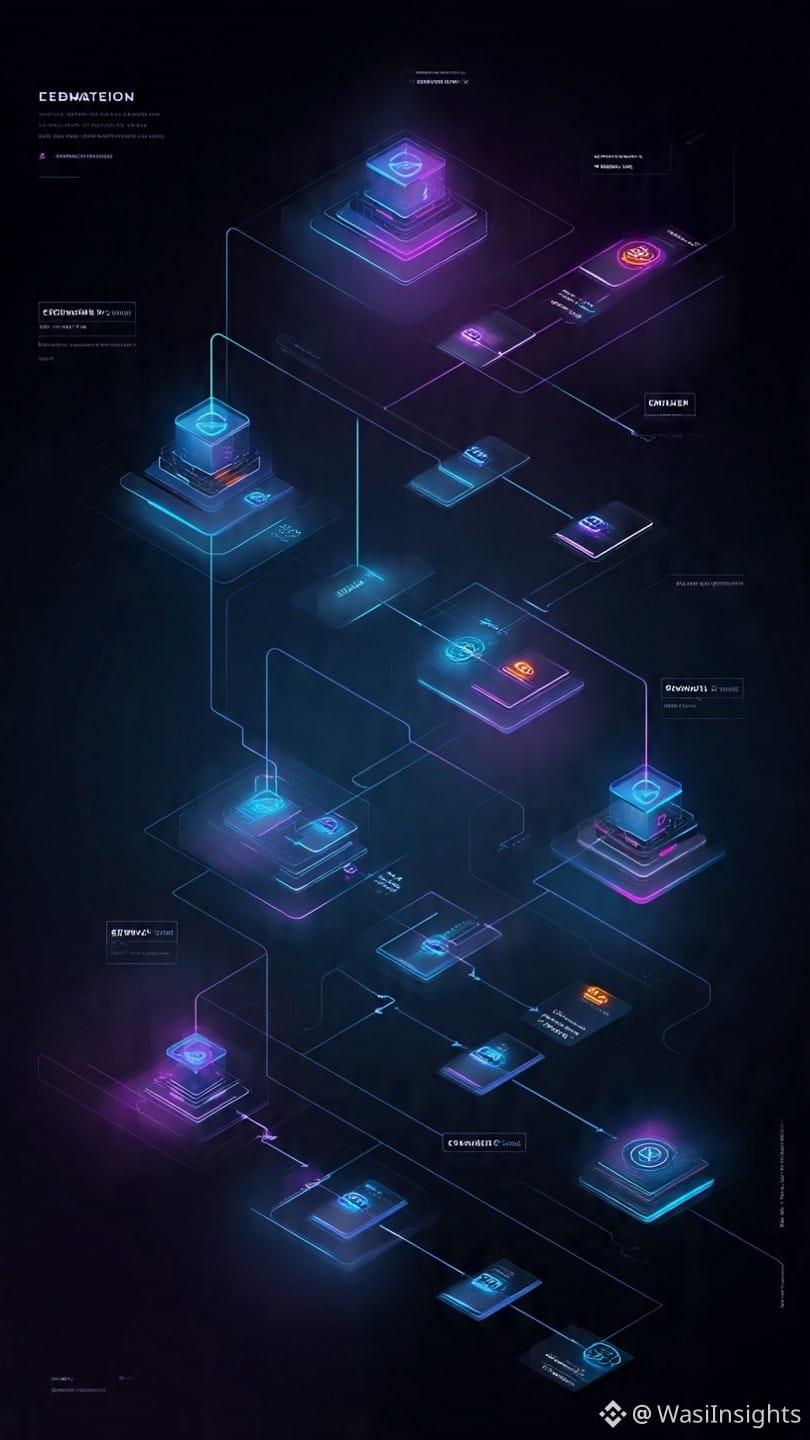
*Visual idea*: Infographic showing ETH flowing from LSTs → EigenLayer → multiple AVS with risk arrows.
Building the future means weighing tradeoffs together. @sreeramkannan @liam_east what’s your take: is restaking net positive for Ethereum security?
$BTC
{spot}(BTCUSDT)
$ETH
{spot}(ETHUSDT)
$BNB
{spot}(BNBUSDT)
*Headline: Restaking Boom: Security Goldmine or Risk Stack?*
#restaking #Ethereum(ETH) #DeFi:
EigenLayer TVL just crossed $15B, letting ETH secure AVS like rollups and oracles. More yield for stakers, more security for new chains. But slashing risk now cascades across protocols. One bug could impact billions.
*Visual idea*: Infographic showing ETH flowing from LSTs → EigenLayer → multiple AVS with risk arrows.
Building the future means weighing tradeoffs together. @sreeramkannan @liam_east what’s your take: is restaking net positive for Ethereum security?
$BTC
$ETH
$BNB
#restaking #Ethereum(ETH) #DeFi:
EigenLayer TVL just crossed $15B, letting ETH secure AVS like rollups and oracles. More yield for stakers, more security for new chains. But slashing risk now cascades across protocols. One bug could impact billions.
*Visual idea*: Infographic showing ETH flowing from LSTs → EigenLayer → multiple AVS with risk arrows.
Building the future means weighing tradeoffs together. @sreeramkannan @liam_east what’s your take: is restaking net positive for Ethereum security?
$BTC
$ETH
$BNB
1
2
123

·
--
#bedrock $BR
🚀 Is $BR the Next Big Liquid Restaking Play? 🚀
With Bedrock 2.0 picking up major steam, the multi-asset liquid restaking protocol is proving it’s more than just a passing trend. Built heavily to maximize yield across the BNB Chain and beyond, Bedrock is tackling DeFi inefficiency head-on.
The fundamentals are locking in nicely:
✅ Robust institutional backing
✅ Seamless security framework
✅ Streamlined yield farming for restaked assets
Keep an eye on $BR as liquid restaking protocols continue to dominate the market narrative this quarter. The momentum is just getting started! 📈
What are your price targets for $BR? Let me know below! 👇@Bedrock #Crypto #DeFi #restaking
#bedrock $BR
🚀 Is $BR the Next Big Liquid Restaking Play? 🚀
With Bedrock 2.0 picking up major steam, the multi-asset liquid restaking protocol is proving it’s more than just a passing trend. Built heavily to maximize yield across the BNB Chain and beyond, Bedrock is tackling DeFi inefficiency head-on.
The fundamentals are locking in nicely:
✅ Robust institutional backing
✅ Seamless security framework
✅ Streamlined yield farming for restaked assets
Keep an eye on $BR as liquid restaking protocols continue to dominate the market narrative this quarter. The momentum is just getting started! 📈
What are your price targets for $BR ? Let me know below! 👇@Bedrock #Crypto #DeFi #restaking
🚀 Is $BR the Next Big Liquid Restaking Play? 🚀
With Bedrock 2.0 picking up major steam, the multi-asset liquid restaking protocol is proving it’s more than just a passing trend. Built heavily to maximize yield across the BNB Chain and beyond, Bedrock is tackling DeFi inefficiency head-on.
The fundamentals are locking in nicely:
✅ Robust institutional backing
✅ Seamless security framework
✅ Streamlined yield farming for restaked assets
Keep an eye on $BR as liquid restaking protocols continue to dominate the market narrative this quarter. The momentum is just getting started! 📈
What are your price targets for $BR ? Let me know below! 👇@Bedrock #Crypto #DeFi #restaking
61

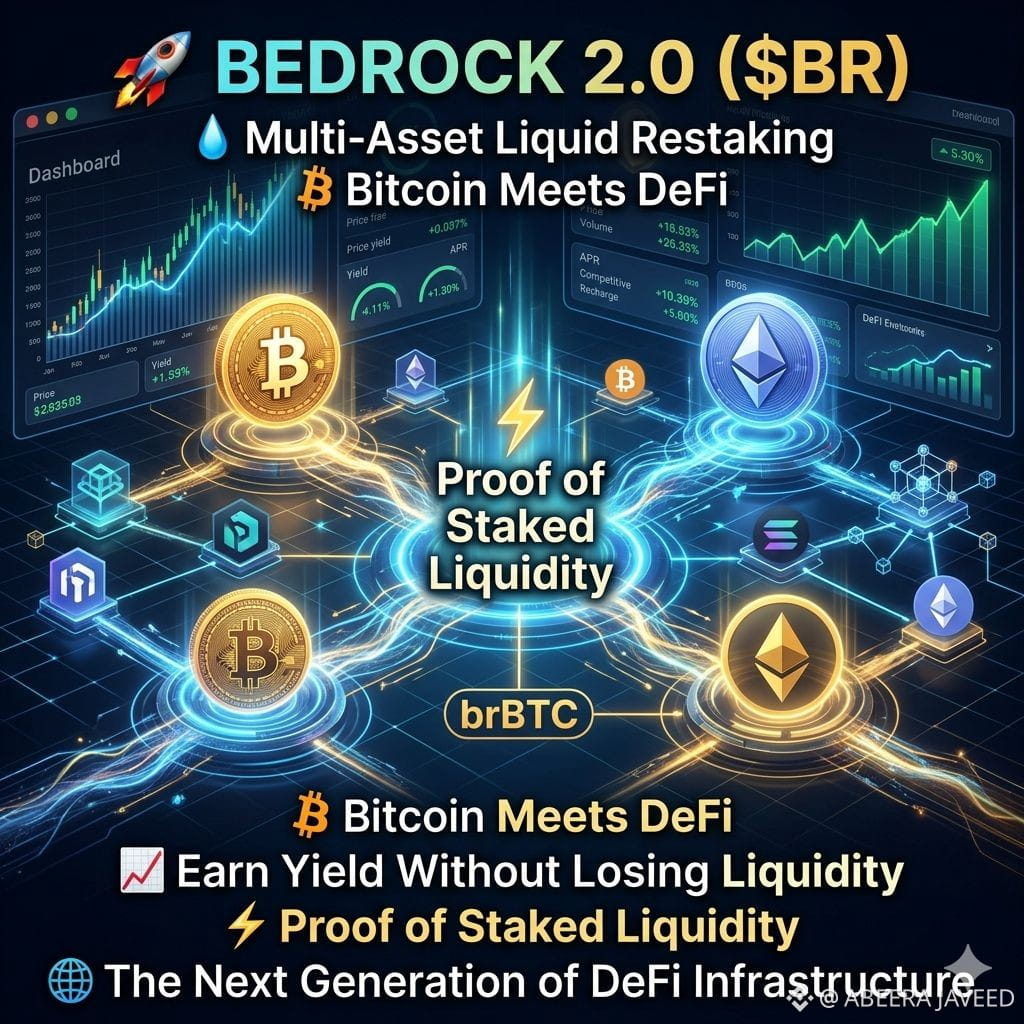
🚀 Bedrock 2.0 ($BR) Is Redefining $DEFI Efficiency
Bedrock 2.0 is introducing a new approach to decentralized finance through its multi-asset liquid restaking model. Instead of locking assets away, users can stake $BTC , $ETH, and other supported assets while still keeping them active across the DeFi ecosystem.
💡 The result?
Enhanced capital efficiency, sustainable yield opportunities, and greater flexibility without sacrificing liquidity.
One of the platform's key innovations is its Proof of Staked Liquidity framework, which directly connects rewards to liquidity participation, creating a more efficient and scalable ecosystem for users.
🔥 Bitcoin's role is evolving too.
With solutions like brBTC, Bitcoin is no longer limited to being a passive store of value. Users can generate yield, participate in governance, earn rewards, and access DeFi opportunities while maintaining exposure to their BTC holdings.
✅ Multi-asset liquid restaking
✅ Enhanced capital efficiency
✅ Active Bitcoin utility in DeFi
✅ Flexible yield generation
Bedrock 2.0 is building infrastructure designed for the next generation of DeFi, where liquidity, rewards, and usability work together seamlessly.
#BlockchainAssocBacks401kCrypto #DeFi #restaking #BTC #ETH $BR
🚀 Bedrock 2.0 ($BR ) Is Redefining $DEFI Efficiency
Bedrock 2.0 is introducing a new approach to decentralized finance through its multi-asset liquid restaking model. Instead of locking assets away, users can stake $BTC , $ETH, and other supported assets while still keeping them active across the DeFi ecosystem.
💡 The result?
Enhanced capital efficiency, sustainable yield opportunities, and greater flexibility without sacrificing liquidity.
One of the platform's key innovations is its Proof of Staked Liquidity framework, which directly connects rewards to liquidity participation, creating a more efficient and scalable ecosystem for users.
🔥 Bitcoin's role is evolving too.
With solutions like brBTC, Bitcoin is no longer limited to being a passive store of value. Users can generate yield, participate in governance, earn rewards, and access DeFi opportunities while maintaining exposure to their BTC holdings.
✅ Multi-asset liquid restaking
✅ Enhanced capital efficiency
✅ Active Bitcoin utility in DeFi
✅ Flexible yield generation
Bedrock 2.0 is building infrastructure designed for the next generation of DeFi, where liquidity, rewards, and usability work together seamlessly.
#BlockchainAssocBacks401kCrypto #DeFi #restaking #BTC #ETH $BR
Bedrock 2.0 is introducing a new approach to decentralized finance through its multi-asset liquid restaking model. Instead of locking assets away, users can stake $BTC , $ETH, and other supported assets while still keeping them active across the DeFi ecosystem.
💡 The result?
Enhanced capital efficiency, sustainable yield opportunities, and greater flexibility without sacrificing liquidity.
One of the platform's key innovations is its Proof of Staked Liquidity framework, which directly connects rewards to liquidity participation, creating a more efficient and scalable ecosystem for users.
🔥 Bitcoin's role is evolving too.
With solutions like brBTC, Bitcoin is no longer limited to being a passive store of value. Users can generate yield, participate in governance, earn rewards, and access DeFi opportunities while maintaining exposure to their BTC holdings.
✅ Multi-asset liquid restaking
✅ Enhanced capital efficiency
✅ Active Bitcoin utility in DeFi
✅ Flexible yield generation
Bedrock 2.0 is building infrastructure designed for the next generation of DeFi, where liquidity, rewards, and usability work together seamlessly.
#BlockchainAssocBacks401kCrypto #DeFi #restaking #BTC #ETH $BR
1
112

#bedrock $BR 🪨 BEDROCK 2.0 — LE PROTOCOLE QUI
FAIT TRAVAILLER TON BITCOIN POUR TOI
Tu détiens du BTC mais il ne génère
aucun rendement ? C'est exactement
le problème que @Bedrock résout.
🔍 C'est quoi Bedrock ?
Bedrock est le premier protocole
multi-actifs de restaking liquide
au monde. Il te permet de staker
ton BTC, ETH ou IOTX et de recevoir
en échange des tokens liquides comme
uniBTC ou brBTC — que tu peux
réutiliser dans la DeFi pour générer
du rendement supplémentaire.
En clair : ton BTC continue de
travailler SANS être bloqué. 🔥
📊 Les chiffres parlent d'eux-mêmes :
• TVL atteint : 1,2 milliard $
• Partenariats : Babylon, Eigenlayer,
Curve, Pendle et plus encore
• Token $BR : +90% de hausse en 2026
• Prévision analystes fin 2026 :
entre 0,186 $ et 0,232 $
🏆 Campagne en cours sur Binance :
600 000 BR à gagner !
13 642 participants déjà inscrits.
Rejoins la compétition maintenant.
💡 Pourquoi Bedrock 2.0 est important :
Avec Bedrock 2.0, le protocole entre
dans une nouvelle ère — gouvernance
décentralisée via le système veBR,
sécurité renforcée par Chainlink
Proof-of-Reserve, et expansion
multi-chain accélérée.
🧠 Conclusion :
Bedrock est l'un des projets BTCFi
les plus solides de 2026. Il résout
un vrai problème : des milliards de
BTC qui dorment sans générer de
rendement. La solution est là.
⚠️ Pas de conseil financier.
Faites vos propres recherches
avant toute décision.
@Bedrock BR#Bedrock #BTCFi
#BinanceSquare #DYOR #Crypto2026
#Restaking
#bedrock $BR 🪨 BEDROCK 2.0 — LE PROTOCOLE QUI
FAIT TRAVAILLER TON BITCOIN POUR TOI
Tu détiens du BTC mais il ne génère
aucun rendement ? C'est exactement
le problème que @Bedrock résout.
🔍 C'est quoi Bedrock ?
Bedrock est le premier protocole
multi-actifs de restaking liquide
au monde. Il te permet de staker
ton BTC, ETH ou IOTX et de recevoir
en échange des tokens liquides comme
uniBTC ou brBTC — que tu peux
réutiliser dans la DeFi pour générer
du rendement supplémentaire.
En clair : ton BTC continue de
travailler SANS être bloqué. 🔥
📊 Les chiffres parlent d'eux-mêmes :
• TVL atteint : 1,2 milliard $
• Partenariats : Babylon, Eigenlayer,
Curve, Pendle et plus encore
• Token $BR : +90% de hausse en 2026
• Prévision analystes fin 2026 :
entre 0,186 $ et 0,232 $
🏆 Campagne en cours sur Binance :
600 000 BR à gagner !
13 642 participants déjà inscrits.
Rejoins la compétition maintenant.
💡 Pourquoi Bedrock 2.0 est important :
Avec Bedrock 2.0, le protocole entre
dans une nouvelle ère — gouvernance
décentralisée via le système veBR,
sécurité renforcée par Chainlink
Proof-of-Reserve, et expansion
multi-chain accélérée.
🧠 Conclusion :
Bedrock est l'un des projets BTCFi
les plus solides de 2026. Il résout
un vrai problème : des milliards de
BTC qui dorment sans générer de
rendement. La solution est là.
⚠️ Pas de conseil financier.
Faites vos propres recherches
avant toute décision.
@Bedrock BR#Bedrock #BTCFi
#BinanceSquare #DYOR #Crypto2026
#Restaking
FAIT TRAVAILLER TON BITCOIN POUR TOI
Tu détiens du BTC mais il ne génère
aucun rendement ? C'est exactement
le problème que @Bedrock résout.
🔍 C'est quoi Bedrock ?
Bedrock est le premier protocole
multi-actifs de restaking liquide
au monde. Il te permet de staker
ton BTC, ETH ou IOTX et de recevoir
en échange des tokens liquides comme
uniBTC ou brBTC — que tu peux
réutiliser dans la DeFi pour générer
du rendement supplémentaire.
En clair : ton BTC continue de
travailler SANS être bloqué. 🔥
📊 Les chiffres parlent d'eux-mêmes :
• TVL atteint : 1,2 milliard $
• Partenariats : Babylon, Eigenlayer,
Curve, Pendle et plus encore
• Token $BR : +90% de hausse en 2026
• Prévision analystes fin 2026 :
entre 0,186 $ et 0,232 $
🏆 Campagne en cours sur Binance :
600 000 BR à gagner !
13 642 participants déjà inscrits.
Rejoins la compétition maintenant.
💡 Pourquoi Bedrock 2.0 est important :
Avec Bedrock 2.0, le protocole entre
dans une nouvelle ère — gouvernance
décentralisée via le système veBR,
sécurité renforcée par Chainlink
Proof-of-Reserve, et expansion
multi-chain accélérée.
🧠 Conclusion :
Bedrock est l'un des projets BTCFi
les plus solides de 2026. Il résout
un vrai problème : des milliards de
BTC qui dorment sans générer de
rendement. La solution est là.
⚠️ Pas de conseil financier.
Faites vos propres recherches
avant toute décision.
@Bedrock BR#Bedrock #BTCFi
#BinanceSquare #DYOR #Crypto2026
#Restaking
52
Connectez-vous pour découvrir plus de contenu
Rejoignez la communauté mondiale des adeptes de cryptomonnaies sur Binance Square
⚡️ Suviez les dernières informations importantes sur les cryptomonnaies.
💬 Jugé digne de confiance par la plus grande plateforme d’échange de cryptomonnaies au monde.
👍 Découvrez les connaissances que partagent les créateurs vérifiés.
Adresse e-mail/Nº de téléphone
Sujets d’actualité
1
#EarningsSeason
134,749 vues
1,307 mentions
2
#BitwiseLaunchesFirstSpotNEARETF
575 vues
80 mentions
3
#USJobOpeningsFallToFiveMonthLow
871 vues
59 mentions
4
#ECBToTestAIAgentsInDigitalEuroPayments
6,639 vues
257 mentions
5
#JapanFSABacksFourthStablecoinTradeSettlementPilot
7,305 vues
322 mentions
6
#BitgetHackerFailsToMoveStolenFunds
19,483 vues
453 mentions
7
#BitMineETHHoldingsTop6Million
20,373 vues
600 mentions
8
#StrategyAdds1666BTCHoldingsReach847666
16,355 vues
419 mentions
9
#NvidiaApproves$150BBuyback
3,937 vues
65 mentions
10
#OpenAIDelaysGPT6.1OverSafetyIssues
29,239 vues
773 mentions