

AI agents are evolving from systems that simply respond to systems that can reason, and execute complex tasks in the real world.
They are moving beyond answering questions and beginning to browse the web, work with files, interact with applications, use APIs and execute multi-step tasks. But as agents gain more autonomy, a critical question emerges: how do we give AI the ability to act without sacrificing security, reliability and user control?
@NEAR Protocol ’s IronClaw 1.0 offers an interesting approach to this challenge by redesigning how an AI agent thinks, acts and maintains its progress.
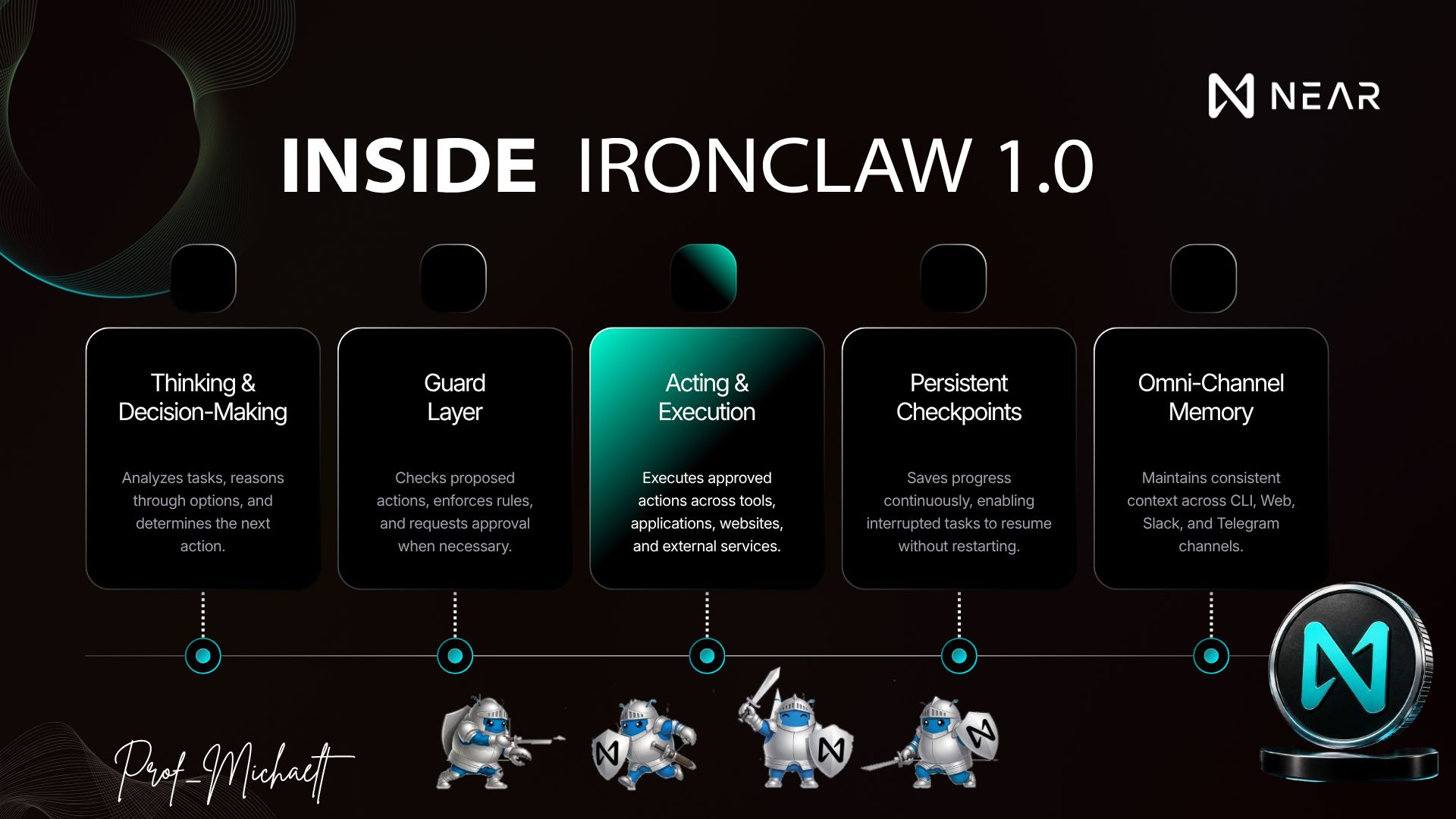
IronClaw 1.0: Separating Thinking From Acting
At the core of #IronClaw 1.0 is a simple but important architectural idea: the agent that makes decisions should not have unrestricted control over the actions it takes.
IronClaw separates the reasoning process from execution through a dedicated guard layer.
The agent can reason about a task, determine what needs to happen and select the appropriate tools. The guard then provides a controlled coordination layer between that decision-making process and real-world execution.
This creates an additional layer where actions can be evaluated and, when necessary, explicitly approved before they happen.
For enterprise environments, this distinction is particularly important. An agent interacting with emails, files, websites, credentials or business systems needs more than intelligence. It needs predictable boundaries.
Benchmark Performance That Stands Out
Architecture is only valuable when it translates into real performance.
IronClaw 1.0 demonstrates that capability across three benchmarks using the DeepSeek-V4-Flash base model.
PinchBench: 93.5% IronClaw leads the benchmark, ahead of Hermes and OpenClaw.
ClawBench: 88.6% It also ranks first in multi-step agent tasks, outperforming OpenClaw and Hermes.
OfficeQA: 76.4% IronClaw leads again in tasks focused on reasoning over workplace and enterprise information.
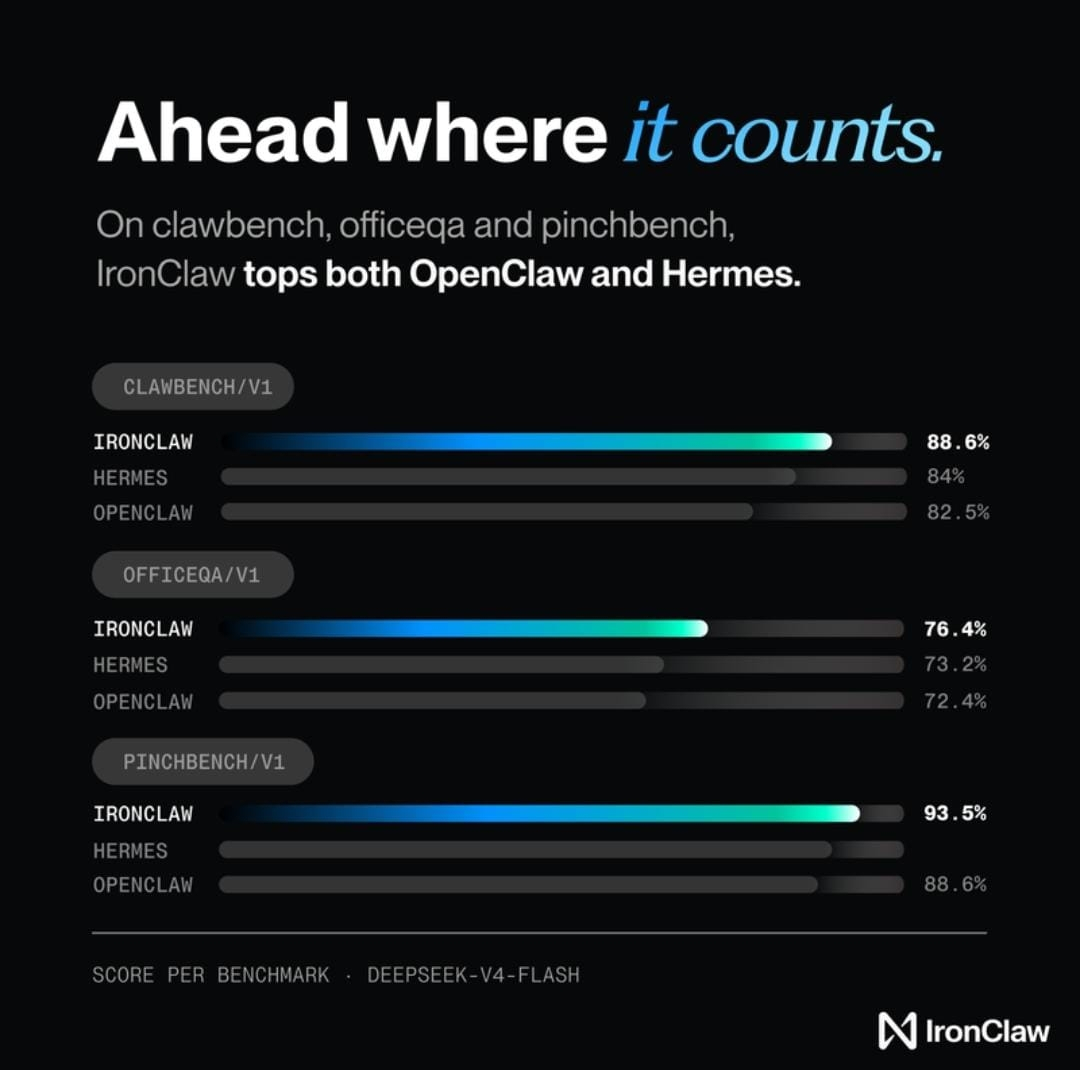
The benchmark comparison shows IronClaw maintaining the lead across all three evaluations.
On ClawBench, IronClaw scores 88.6%, ahead of Hermes at 84% and OpenClaw at 82.5%.
On OfficeQA, IronClaw reaches 76.4%, compared with 73.2% for Hermes and 72.4% for OpenClaw.
On PinchBench, IronClaw records 93.5%, compared with 90% for Hermes and 88.6% for OpenClaw.
The results highlight IronClaw’s ability to perform consistently across different types of agent workloads.
The important point is that these benchmarks cover different challenges. Rather than measuring only how well an AI responds to prompts, they examine how effectively an agent can perform tasks in practical environments. IronClaw’s consistent first-place results therefore provide measurable evidence behind its approach to building more capable AI agents.
Designed for Real-World AI Workflows
IronClaw’s value also comes from the infrastructure surrounding its core architecture.
Safer by Design
Sensitive actions can require explicit approval, giving users greater control over what the agent is allowed to execute.
Persistent State
Continuous checkpoints allow IronClaw to preserve its progress. If a task is interrupted or requires approval, the agent can resume instead of starting from the beginning.
Omni-Channel Memory
The assistant can operate across CLI, Web, Slack and Telegram while maintaining the same memory and safety rules.
Team Isolation
Organizations can separate environments and workflows, making IronClaw more suitable for teams handling different projects, tools or levels of access.
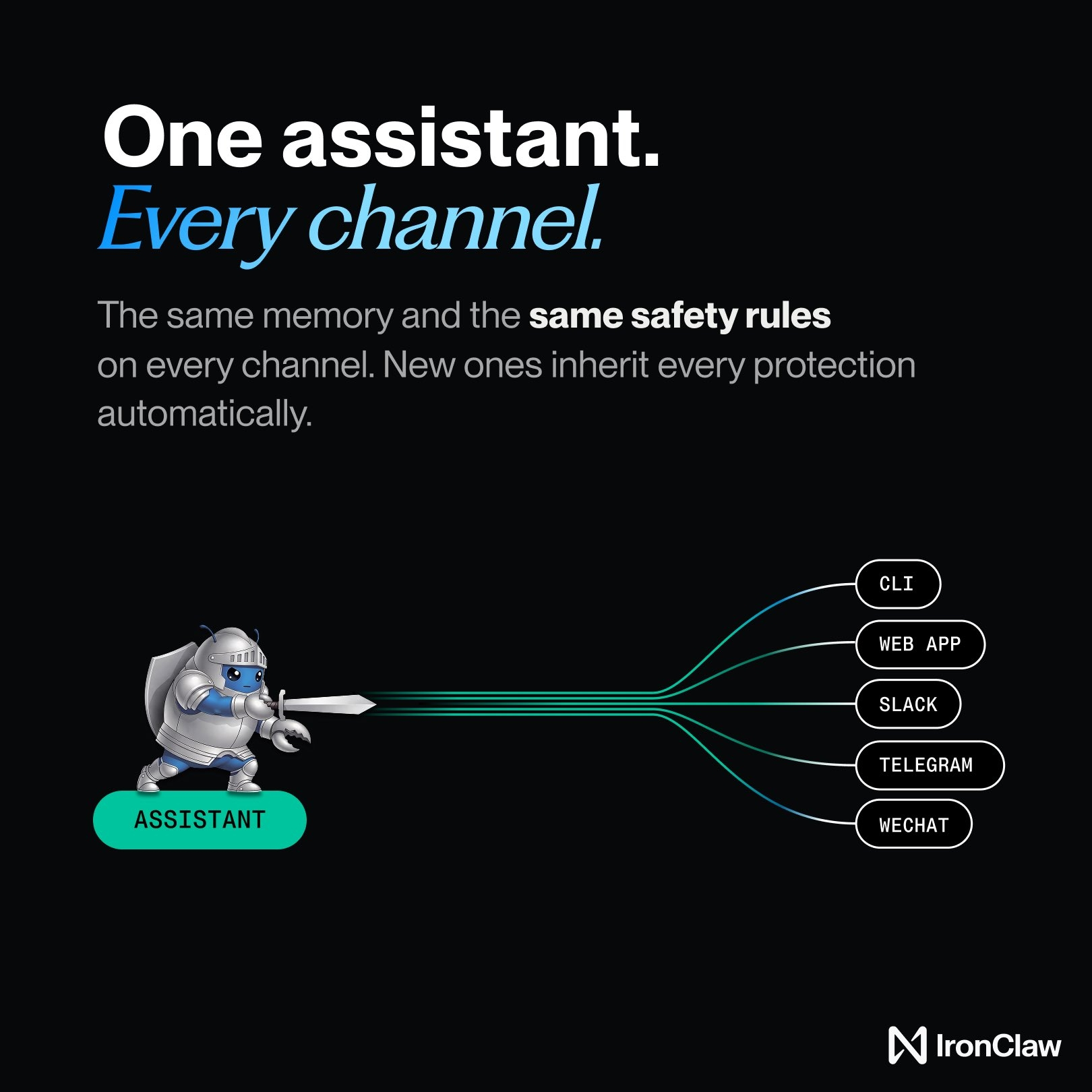
IronClaw’s multi-channel approach demonstrates how AI assistants can move beyond a single interface while maintaining continuity across different environments.
Instead of treating each channel as a separate interaction, the same assistant can operate across CLI, Web, Slack and Telegram while preserving its memory, state and safety rules.
This creates a more connected experience for users and teams working across multiple platforms.
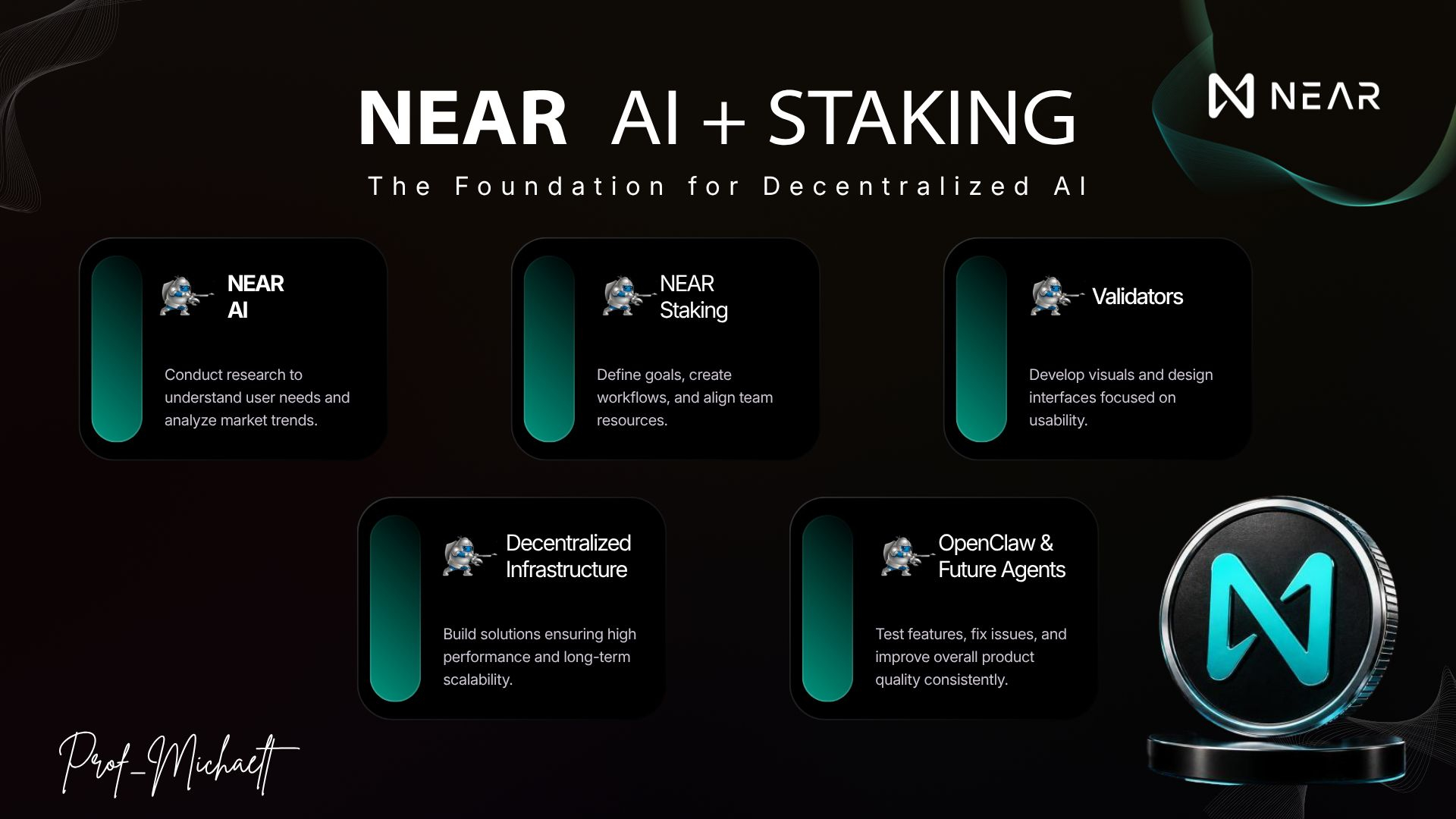
NEAR AI and the Role of Staking
IronClaw 1.0 is part of a broader direction around #NEARAI : building AI infrastructure where intelligence can become more private, verifiable and user-owned.
This vision requires more than capable AI models. It also requires infrastructure that can support decentralized applications, agents and services reliably.
That is where NEAR staking becomes relevant.
Staking is not simply about earning yield. At the network level, staked NEAR supports the validator system that helps secure the underlying blockchain. Validators are responsible for maintaining the network and processing transactions, while economic incentives help align participants with network security.
For decentralized AI, this foundation matters.
AI agents need infrastructure they can depend on as they become more capable and autonomous. As the ecosystem moves toward agent systems such as the upcoming OpenClaw, the relationship between AI infrastructure and decentralized network security becomes increasingly important.
The Bigger Picture
IronClaw 1.0 points toward a future where AI agents are judged by more than how intelligently they can respond.
The next standard will also involve how safely they act, how reliably they maintain progress, how consistently they operate across channels and how much control users retain.
#NEARAI represents the broader vision, while staking provides an important security foundation for the decentralized infrastructure beneath it.
The combination is compelling: AI that can think, infrastructure that can coordinate, networks that can be secured by economic participation, and users who can maintain greater ownership of the systems they depend on.
IronClaw 1.0 may therefore be viewed as more than another AI-agent release. It is a glimpse at what the infrastructure for a more capable, secure and decentralized AI ecosystem could look like.
References
IronClaw 1.0: https://near.ai/blog/introducing-ironclaw-1-0
NEAR AI Staking: https://www.near.ai/blog/staking-for-near-ai
NEAR Staking: https://docs.near.org/protocol/network/staking
NEAR AI Infrastructure: https://near.ai/blog/near-ai-launches-ironclaw-confidential-gpu-marketplace-and-multimodal-confidential-inference