
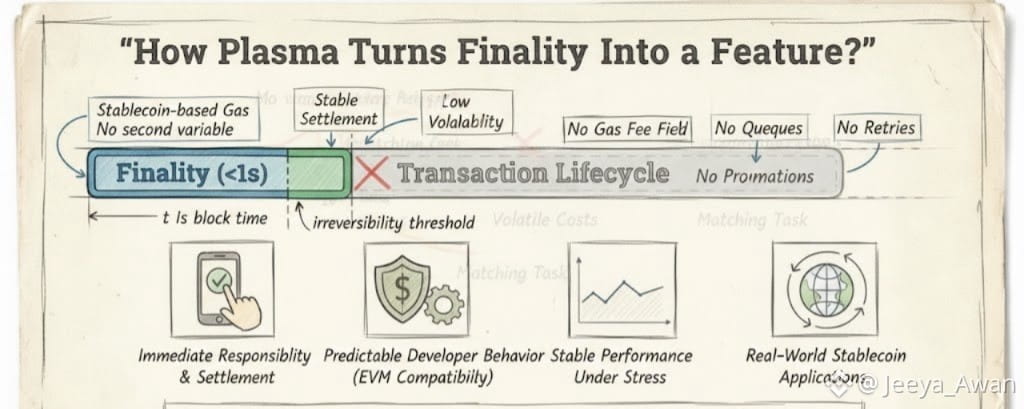
The problem didn't arise during the transfer itself, but only surfaced later when attempting to match numbers. The stablecoin payment settled successfully, but the fee field was empty, and that's when I realized how much work usually lies behind this field.
On most networks, fees spark further debate. Which token paid the gas fees? Was the balance sufficient? Did time affect costs? Often, a simple deduction evolves into a matching task that takes longer than the payment itself. You only notice this after three explanations.
In Plasma XPL, this field was never present in the first place. USDT transfers don't incur gas fees, so no allocation is needed; paying the stablecoin gas fees first means no second variable is introduced after settlement.PlasmaBFT finality closed the transaction decisively, without leaving accounting loose ends behind.
The cost itself didn't change; it just lacked explanation. This remained the case even when the fee field disappeared. For a payment team handling large-scale stablecoin transfers, this isn't an advantage; it's a convenience.
But what impressed me most was Plasma's performance under pressure. Increased transaction activity, accumulating dependencies, and more frequent coordination work occur, yet time remains completely unaffected. There are no queues, no retries, and no reassuring provisional confirmations. Plasma's BFT algorithm is also unaffected. Every transaction is completed with the same certainty and finality.
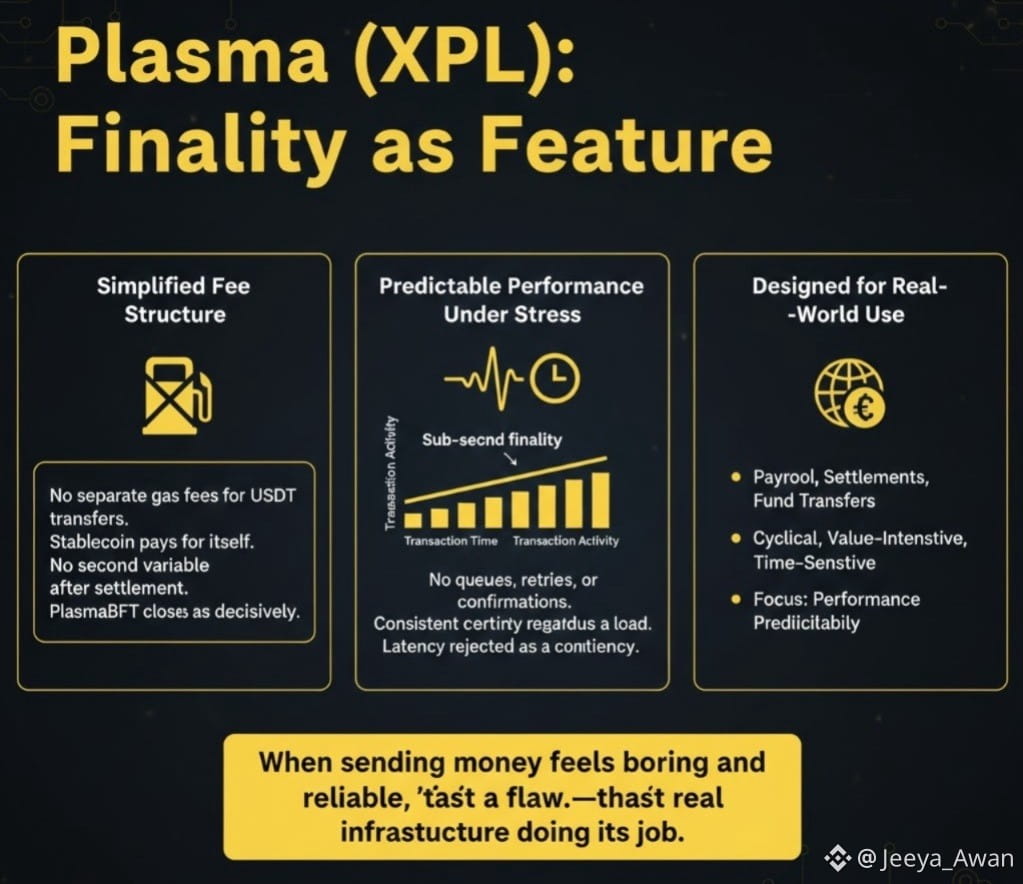
Most systems use latency as a contingency mechanism, but Plasma rejects this approach.
This rejection can initially be unsettling. Users expect buffer periods, retry periods, grace periods, and time to think. Plasma provides none of these. Responsibility is immediate, as a transaction is considered complete once it is finished. There are no gray areas of uncertainty.
This is crucial because stablecoins are not speculative assets. They are cyclical, value-intensive, and highly time-sensitive. The impact of latency not only frustrates users but also introduces risks to the matching process. Plasma treats these risks as design constraints, not exceptions.
Its architecture embodies this philosophy. Reth's full compatibility with the Ethereum Virtual Machine (EVM) ensures predictability of developer behavior. Sub-second execution times minimize uncertainty. Stablecoin-based gas fees eliminate volatility in the operational process. XPL runs silently in the background, guaranteeing continuity of validators and transactions without requiring end-users to manage other assets for transfers.
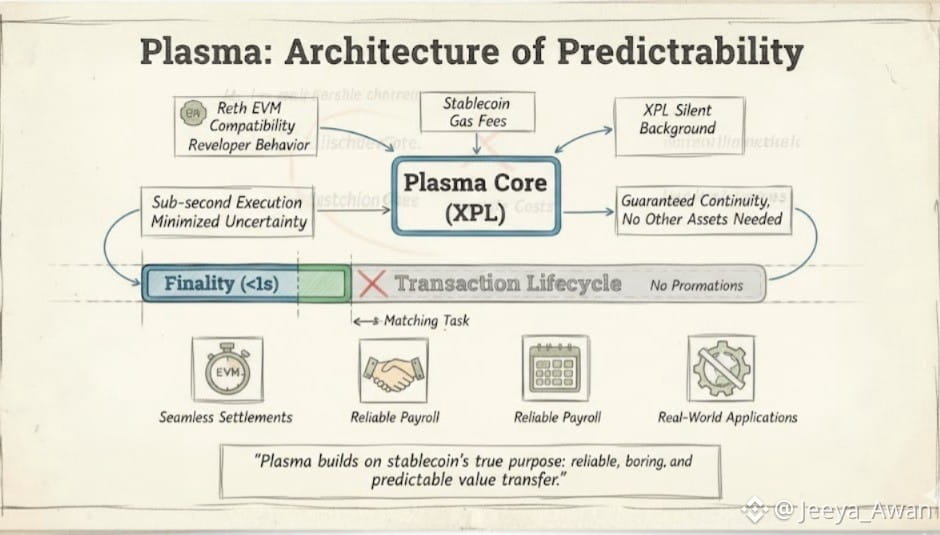
XPL is not promoted as a token. It is an infrastructure supporting incentive mechanisms, transaction validation, and long-term settlement reliability. Users rely on stablecoins. XPL maintains the credibility of the infrastructure.
Plasma's goal is not all-encompassing. It doesn't chase news or trending topics. Instead, it builds itself on the real-world applications of stablecoins today: payroll, settlements, fund transfers, and everyday transactions—scenarios where "waiting" is an issue.
Most blockchains strive for maximum performance optimization. Plasma, on the other hand, improves performance predictability under stress. This is the difference. When the load increases, the Plasma system doesn't waste time; it makes the most of it. The system never signals that there is extra time. Instead, it will remain stable and continue to operate.

