
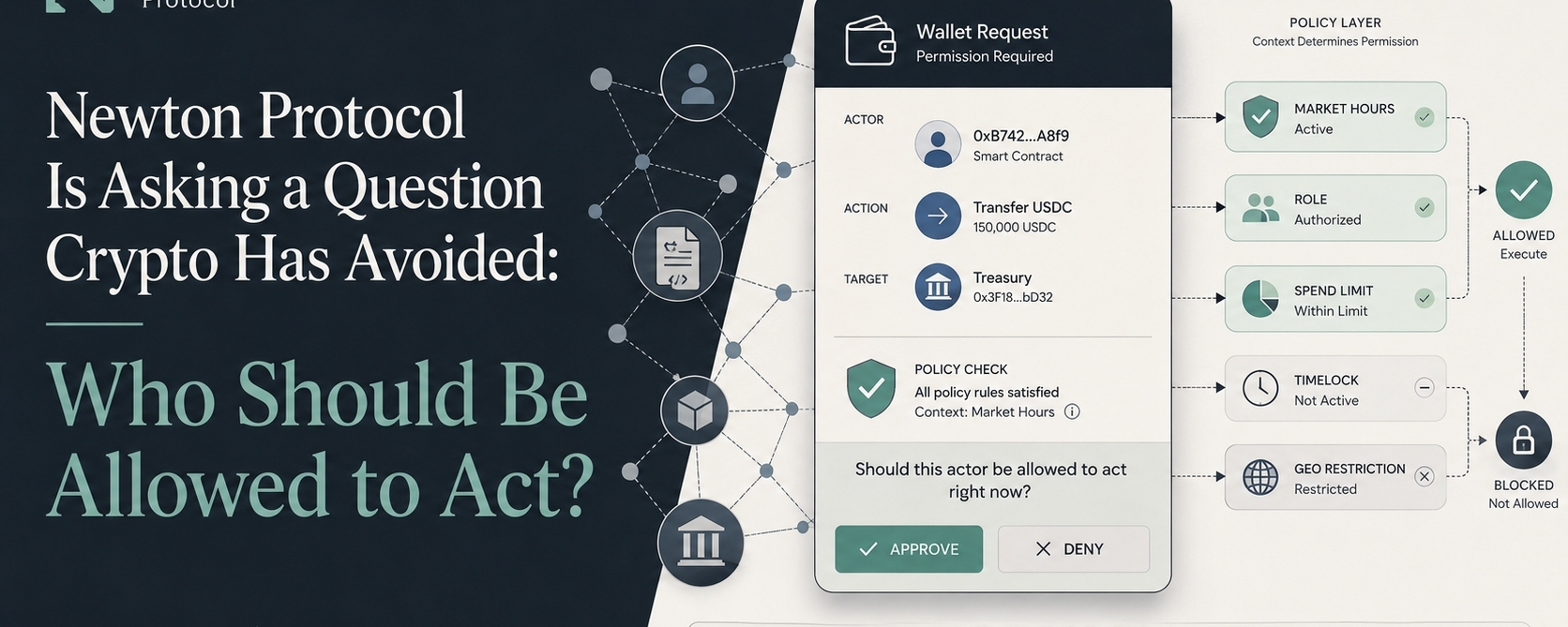

I remember staring at a wallet approval screen and realizing I could explain the token, route, and slippage, but not the basic thing: why was this address allowed to act with that much authority? I had moved on mentally. The permission had not moved. That irritation came back when I looked harder at Newton Protocol, because Newton is asking a question crypto has treated as somebody else’s problem: not can a transaction execute, but should this actor be allowed to execute this action right now?
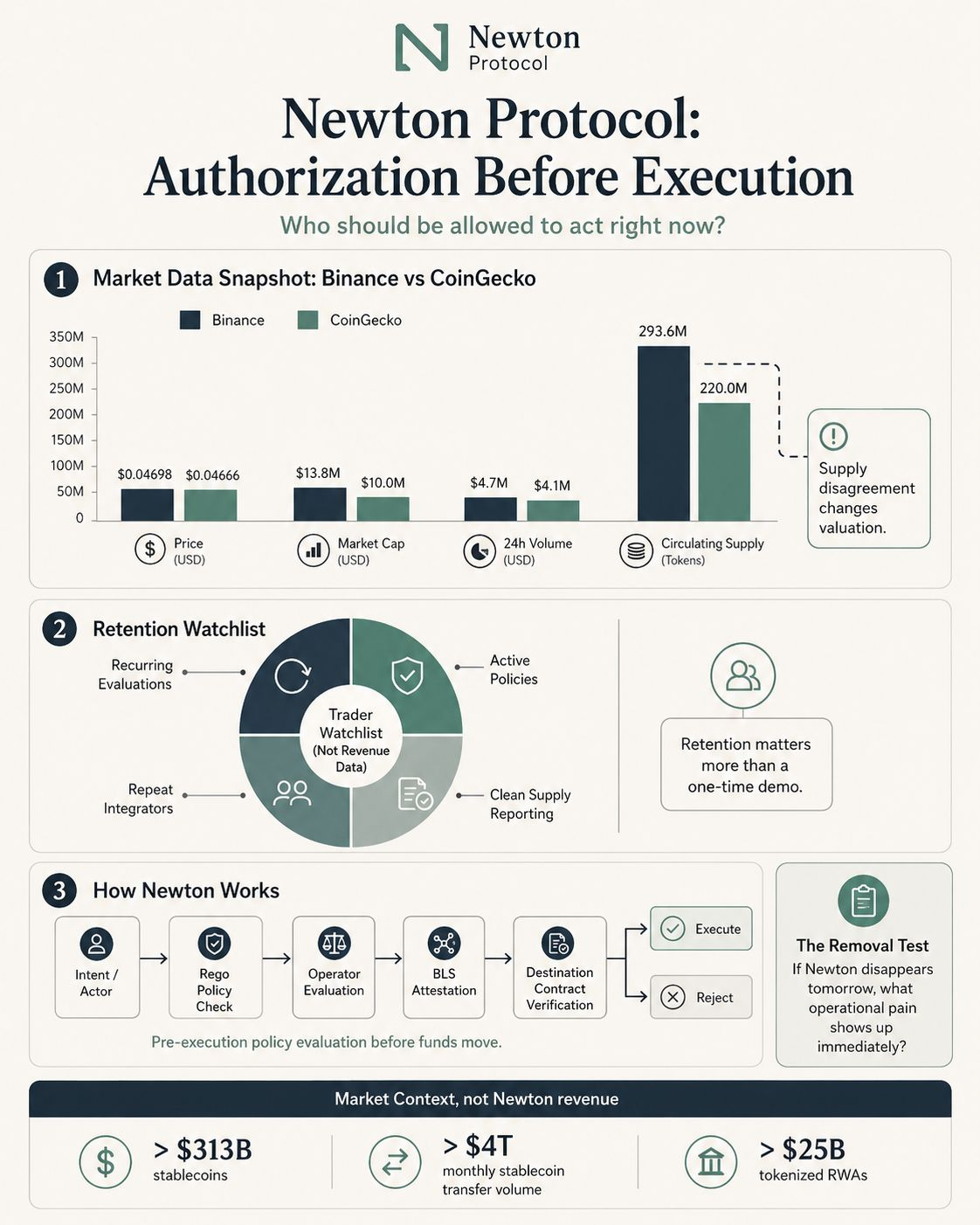
That distinction sounds bureaucratic until money is moving. A smart contract can verify a valid call. A wallet can prove a signature. Neither automatically knows whether a vault curator exceeded an exposure limit, a recipient fails a jurisdiction rule, market risk changed, or an automated agent is still inside its mandate. Newton’s pitch is policy evaluation before execution, using Rego policies, operator evaluation, and a BLS attestation the destination contract can verify. The mainnet beta went live June 23 on Ethereum and Base, with implementations tied to Euler and data and risk providers.
Here’s my framework: the Removal Test. Forget announcements and partner logos. Ask what breaks if Newton disappears tomorrow. Does a vault lose a control it uses daily? Does a payment flow need human review again? Does an allocator lose verifiable proof that a mandate was enforced? If removal causes no operational pain, the integration was decoration. If removal forces teams to rebuild policy logic, accept more risk, or slow transactions, that’s dependency. Dependency is where retention starts.
That Retention Problem matters more to me than the token chart. Newton can attract attention because authorization is a good narrative, as AI agents get more capable. But traders don’t get paid for an architectural diagram. Long term value needs repeated policy checks from applications that keep using the network after incentives and novelty fade. I want recurring evaluations, active policies, repeat integrators, and evidence developers keep Newton in the transaction path. A one time demo proves functionality. It proves little about retention.
Today’s market data makes the setup interesting, but messy. When I checked, Binance showed NEWT around $0.04698, a $13.8 million market cap, $4.7 million in 24 hour volume, and 293.6 million tokens circulating. CoinGecko simultaneously showed about $0.04666, a $10.0 million market cap, $4.1 million in volume, and 220 million circulating. That supply disagreement is not rounding error. For a trader, it changes valuation. I don’t like pretending the cleaner number is automatically true.
Still, the bull case is visible. CoinGecko had NEWT about 94.3% below its $0.8206 all time high, while Newton’s site points to more than $313 billion in stablecoins, over $4 trillion in monthly stablecoin transfer volume, and more than $25 billion in tokenized real world assets. Those figures are opportunity context, not Newton revenue. But if a narrow slice of high value onchain activity starts requiring reusable authorization rules, a project valued near today’s small cap range has room for reassessment. The key word is requiring.
The product direction is more concrete than generic “AI security.” Newton’s July 7 post describes pairing risk intelligence with enforceable vault rules, so data can affect whether a transaction proceeds rather than lighting up a dashboard afterward. That’s the part I understand as a trader. A risk feed without enforcement is like a smoke alarm connected to nothing. Useful, but still dependent on someone acting in time.
Now the criticism. Authorization adds a decision surface, and every decision surface can fail. Bad policy can block a good transaction. Stale or manipulated data can produce a bad result. Operator coordination can add friction. The project’s technical explanation says broader multi operator consensus is part of the design beyond beta, which reminds me that “mainnet beta” is exactly that: beta. I’m not comfortable valuing future decentralization as if it already exists.
There’s also a tradeoff traders shouldn’t dodge. The more finance asks “who should be allowed to act,” the closer permission systems get to choke points. Newton argues for programmable, neutral, verifiable policy rather than opaque centralized review. I see the advantage. I also know institutions can encode restrictive rules as easily as sensible ones. Better enforcement does not guarantee better policy. It makes policy harder to ignore.
So I’m watching behavior, not slogans. The bullish signal that would change my mind is sustained growth in recurring policy evaluations, more production applications that depend on Newton, and cleaner token supply reporting across major trackers. The bearish signal is simpler: integrations pile up, usage stays episodic, operator decentralization remains mostly future tense, and NEWT trades mainly on announcements.
Open the explorer. Track what gets evaluated. Watch whether applications come back next month. If Newton becomes something teams notice only when it is missing, I’ll get more bullish. If nobody feels the absence, I’ll move on.