

One question keeps bothering me when I look at Newton Protocol: what happens when a system can prove that a policy was evaluated correctly, but the policy still made the wrong call? It’s the difference between a transaction being blocked and a legitimate trade dying because a risk feed was stale, an identity signal was wrong, or a classifier misread the situation. The more I study Newton, the more this boundary matters.
My framework is simple: Newton can improve the integrity of the decision process without guaranteeing the truth of the inputs. Operators evaluate transaction intents against Rego policies, pull external data through sandboxed WASM modules, sign results with BLS keys, and aggregate agreement into an attestation a smart contract can verify. The whitepaper also describes median-based consensus for divergent numeric fields, challenge mechanisms, and slashing. But consensus can make machines agree. It cannot make bad data become true.
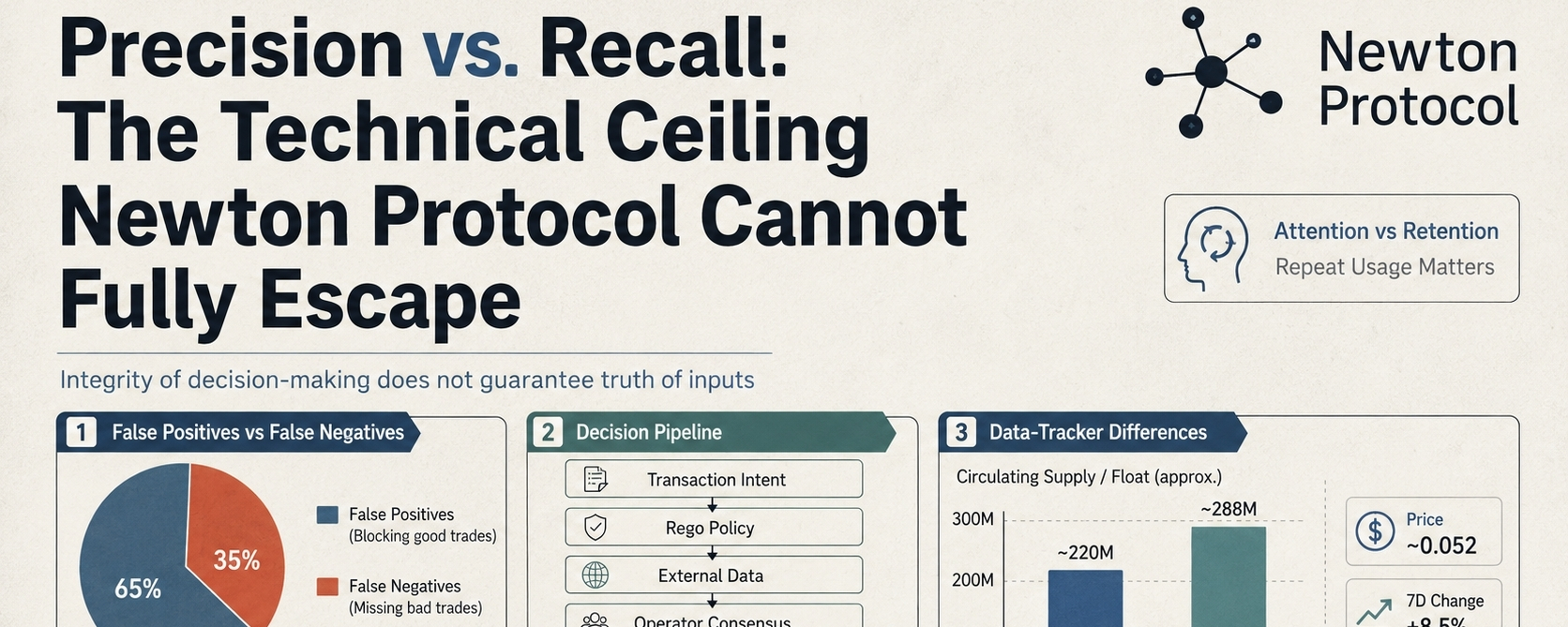
This is where precision versus recall becomes useful. Imagine a vault policy trying to block dangerous allocations. Precision asks: of the trades labeled dangerous, how many really are dangerous? Recall asks: of all genuinely dangerous trades, how many did it catch? Tighten the gate and you may catch more bad actions while blocking more good ones. Loosen it and legitimate trading improves, but more risk can slip through. Newton’s Rego engine itself is deterministic, so I wouldn’t pretend the protocol is an AI classifier. The ceiling appears when policies depend on uncertain external signals such as risk scores, sanctions screening, identity status, volatility measures, or model outputs.
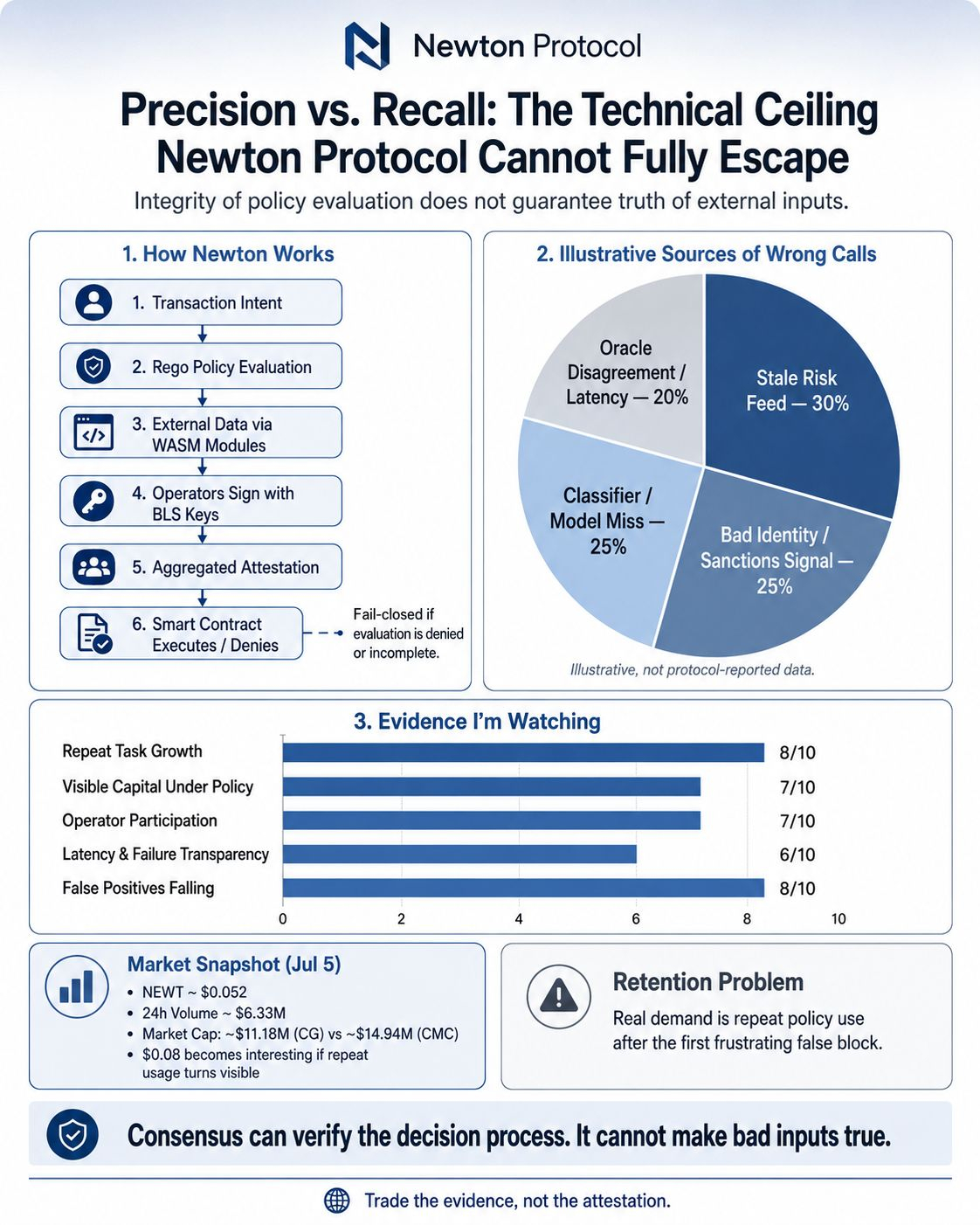
Now here’s the thing I like: Newton doesn’t hide that dependency. Its Mainnet Beta went live on June 23, 2026 on Base and Ethereum, and the Foundation says policies can use providers including Chainalysis, RedStone, Credora, Webacy, Persona and others. VaultKit can fail closed, meaning a denied or incomplete evaluation does not execute. For an institution, that bias can be rational. For a trader, it can be maddening. A missed bad trade costs money, but so does a missed good trade. Timing is risk.
That leads to what I call the Retention Problem. Launch attention is easy to confuse with durable involvement. Mainnet Beta is only days old. I could not find a clean public cohort metric showing how many integrators repeatedly use Newton policy checks week after week, how many tasks come from returning applications, or what percentage of failed evaluations cause users to retry rather than route around the control. The Explorer exposes tasks and policies, but the public evidence does not yet give me a convincing retention curve. For traders, recurring policy demand is stronger than announcements. If a curator gets false blocks three times during volatile markets, does the team keep the guardrail?
The token market adds another awkward layer. At the time I checked on July 5, CoinGecko showed NEWT near $0.05211, about 8.5% higher over seven days, with roughly $6.33 million in 24-hour volume and an $11.18 million market cap. CoinMarketCap was close on price, around $0.05178, but showed a larger $14.94 million market cap because its circulating-supply estimate was 288.46 million NEWT, versus CoinGecko’s roughly 220 million figure. I don’t love that discrepancy. When major trackers disagree materially on float, I trust valuation arguments less.
Still, there is a realistic bull case. I’m not using the old $0.8206 peak as a target. That would be lazy. My conditional case is simpler: if Newton shows sustained repeat task growth, real vault capital subject to policies, and broader operator participation after beta, then $0.08 becomes a level worth discussing rather than dreaming about. From $0.05211, that’s roughly 53.5% upside. With a 1 billion maximum supply, $0.08 implies an $80 million fully diluted valuation. It’s a comprehensible hurdle if usage becomes visible.
The bear case is more uncomfortable. Current volume can be trading churn rather than protocol demand. CoinGecko’s roughly $6.33 million daily volume is more than half its quoted market cap, while NEWT remains about 93.7% below its recorded all-time high. If repeat usage stays opaque, false rejections become a recurring complaint, external data failures create bad authorizations, or the operator set fails to decentralize meaningfully after beta, I’d treat price strength as attention without retention. The official July 1 explainer itself describes “many operators” evaluating proposals as something expected once Newton is out of Beta. I’m watching that wording.
What would change my mind? Bullishly, I want sustained task growth, repeat integrators, published latency and failure-rate data, visible capital protected by live policies, and evidence that false positives fall without dangerous misses rising. Bearishly, I’d react to stagnant repeat usage, policy bypasses, recurring oracle disagreements, or decentralization promises slipping. Don’t just watch $NEWT candles. Watch whether real users keep the policy layer switched on after it annoys them once. That’s the test. Trade the evidence, not the attestation.