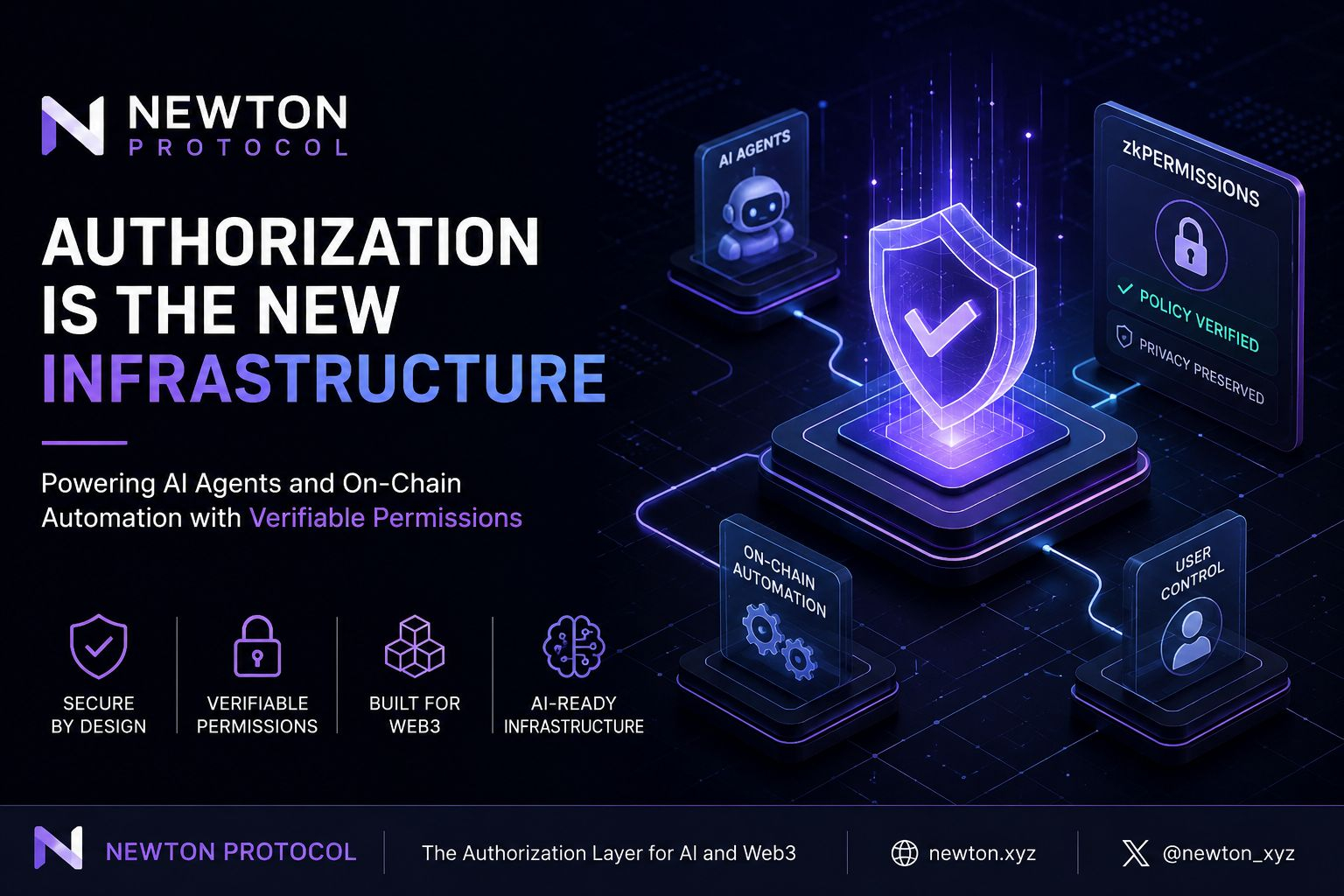

When most people think about blockchain security, they think about private keys.
Keep the key safe, and your assets stay safe.
At least, that's how the industry has worked for years.
The more I look at where crypto is heading, the more I think that assumption is starting to change.
As AI agents, automated vaults, and algorithmic strategies become part of on-chain finance, a valid signature may no longer be enough. The real question becomes whether an action should be allowed in the first place.
That's why Newton Protocol has been on my radar.
What interests me isn't just the AI narrative. It's the focus on authorization.
Instead of treating every signed transaction the same, Newton explores a model where transactions can be evaluated against predefined policies before execution. That shifts security from simply verifying who signed to also considering whether the action meets the required rules.
To me, that's an important distinction.
Traditional security is mostly reactive. Once a valid signature is used, the blockchain processes the transaction exactly as instructed.
Authorization introduces another decision point before execution.
That idea could become increasingly relevant as wallets become more programmable and AI begins handling routine on-chain tasks.
Of course, good architecture alone doesn't guarantee adoption.
Developers need tools that are easy to integrate.
Users need experiences that remain simple.
Protocols need governance that can adapt as requirements evolve.
Technology only matters if people actually use it.
That's why I see Newton as an infrastructure project rather than just another application.
Infrastructure often goes unnoticed when everything works.
Its value becomes obvious when it prevents problems before they happen.
As Web3 becomes more automated, I think the conversation will gradually shift from execution to authorization.
Because in an ecosystem where software can act on behalf of users, deciding what is allowed may become just as important as deciding what is possible.