
One idea has been sitting in the back of my mind lately.
For years, I evaluated blockchain networks using the same checklist everyone else seemed to use. Throughput. Liquidity. Security. Transaction costs. Those metrics are easy to compare because they're visible, and they tell part of the story.
But the more I follow where onchain infrastructure is heading, the more I feel we're measuring the wrong layer.
Moving value across a blockchain is no longer the difficult part.
Deciding whether that value should move at all is becoming the real challenge.
That shift feels especially relevant as AI agents begin interacting with wallets, protocols automate treasury operations, and organizations rely less on manual approvals. The industry is investing heavily in making execution faster, yet I don't think we spend enough time discussing the logic that exists before execution.
Every transaction starts with a decision.
If that decision is flawed, it doesn't matter how decentralized or efficient the settlement layer is.
Looking back at some of the biggest security incidents in crypto, the conversation usually centered on exploited code or compromised keys. Those issues absolutely mattered. Still, I often came away wondering if the deeper weakness existed one step earlier.
Why was that action authorized?
Why did a single approval carry so much authority?
Could better decision policies have stopped the transaction before it ever reached the blockchain?
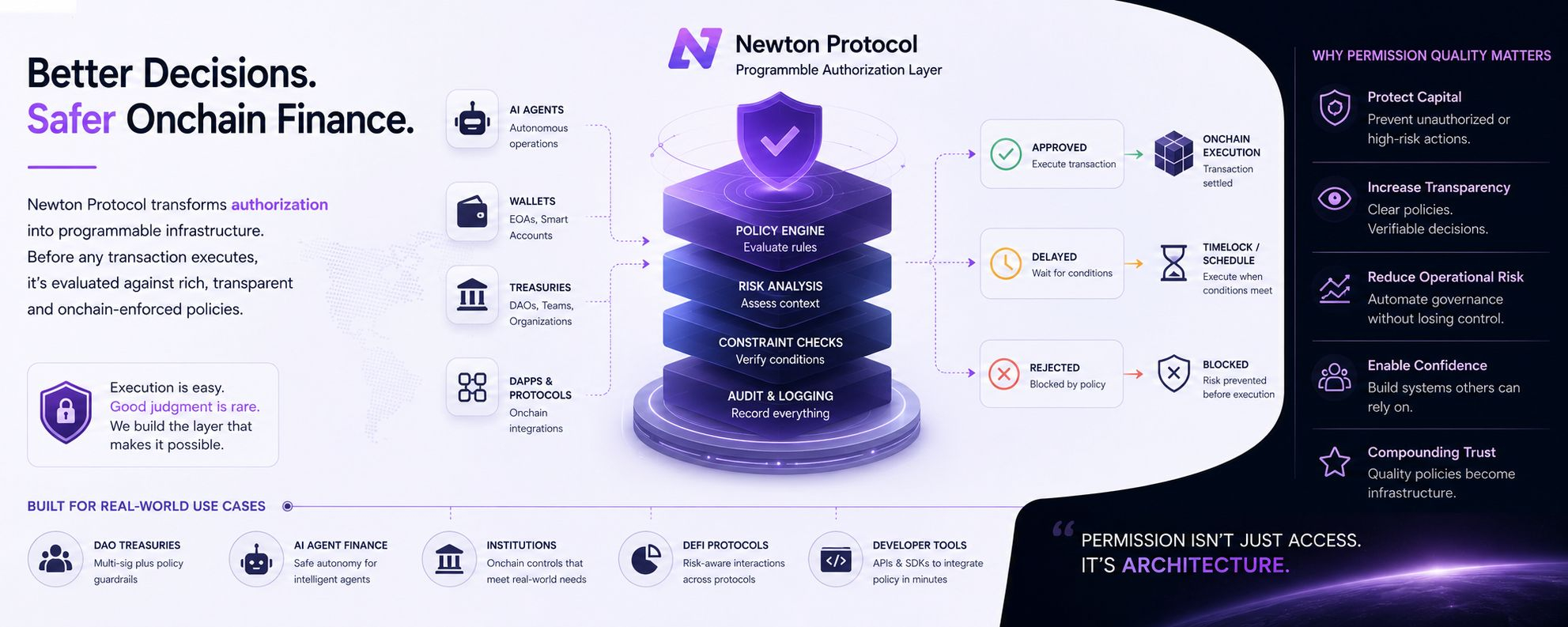
Those questions eventually led me to explore Newton Protocol more closely.
What caught my attention wasn't another promise of automation. Crypto already has plenty of automation platforms.
The interesting part is the idea that authorization itself can become programmable infrastructure rather than an afterthought.
Instead of relying on a single wallet confirmation, transactions can be evaluated against predefined policies. Spending caps, approved counterparties, timing conditions, governance requirements, or AI-specific restrictions can all become part of the approval process.
In simple terms, execution is no longer separated from judgment.
That feels like a meaningful evolution.
Traditional financial systems have always layered permissions around high-value decisions. Not because transactions were difficult, but because mistakes become increasingly expensive as operations scale.
Blockchain simplified many of those processes, which unlocked incredible innovation.
Now automation seems to be pushing us toward rebuilding certain control mechanisms in a decentralized way.
Not because crypto failed.
Because autonomous systems require better guardrails than humans making occasional manual decisions.
An AI agent capable of managing millions of dollars isn't valuable simply because it's intelligent. It's valuable only if its actions consistently stay within clearly defined boundaries.
Without that discipline, intelligence quickly becomes risk.
That's why I've started thinking about what I call "permission quality."
Not permissions controlled by centralized platforms, but the quality of the decision framework governing financial activity.
Some authorization systems are transparent and easy to audit.
Others become so complex that nobody fully understands why certain transactions pass while others don't.
The strongest frameworks strike a balance between flexibility and predictability. They protect assets without creating unnecessary friction.
Designing that balance is probably harder than writing another smart contract.
It also raises an interesting possibility.
What if trusted permission frameworks become reusable infrastructure?
Developers already build on audited code instead of reinventing everything from scratch. Security providers earn trust through proven reliability. Open-source libraries become industry standards because they've survived years of testing.
I wonder if authorization policies could follow the same path.
A framework with a long record of protecting treasuries, adapting to governance changes, and preventing costly mistakes might eventually become something teams choose to adopt instead of rebuilding themselves.
If that happens, the value isn't just in the software.
It's in the confidence people place in its decision model.
Of course, there are still unanswered questions.
Unlike TPS or gas fees, permission quality is difficult to measure. Success often means nothing happened. A risky transaction was rejected. A treasury remained protected. An exploit never materialized.
Invisible outcomes rarely receive much attention, even when they're the reason larger failures never occur.
There's also the challenge of evolution.
Policies can't remain static forever. Markets change, regulations shift, organizations grow, and AI capabilities improve. Authorization systems need enough stability to build trust while remaining flexible enough to adapt.
Finding that balance won't be simple.
I also suspect this trend will appear first in environments managing significant capital rather than among everyday users.
Large DAOs, institutional treasuries, and autonomous financial systems have far more to lose from weak authorization than individuals making occasional transfers.
As automation expands, trust may gradually shift away from private keys alone and toward the quality of the rules controlling those keys.
That's a subtle transition, but infrastructure often changes quietly before anyone notices its importance.
The more I study projects like Newton Protocol, the less convinced I am that crypto's next breakthrough will come from processing another thousand transactions per second.
We're already becoming very good at moving assets.
The bigger question may be whether we can build systems that consistently make better decisions before those assets ever move.
If that becomes the next layer of innovation, programmable authorization won't just be another feature.
It could become one of the foundations that future onchain finance quietly depends on.