
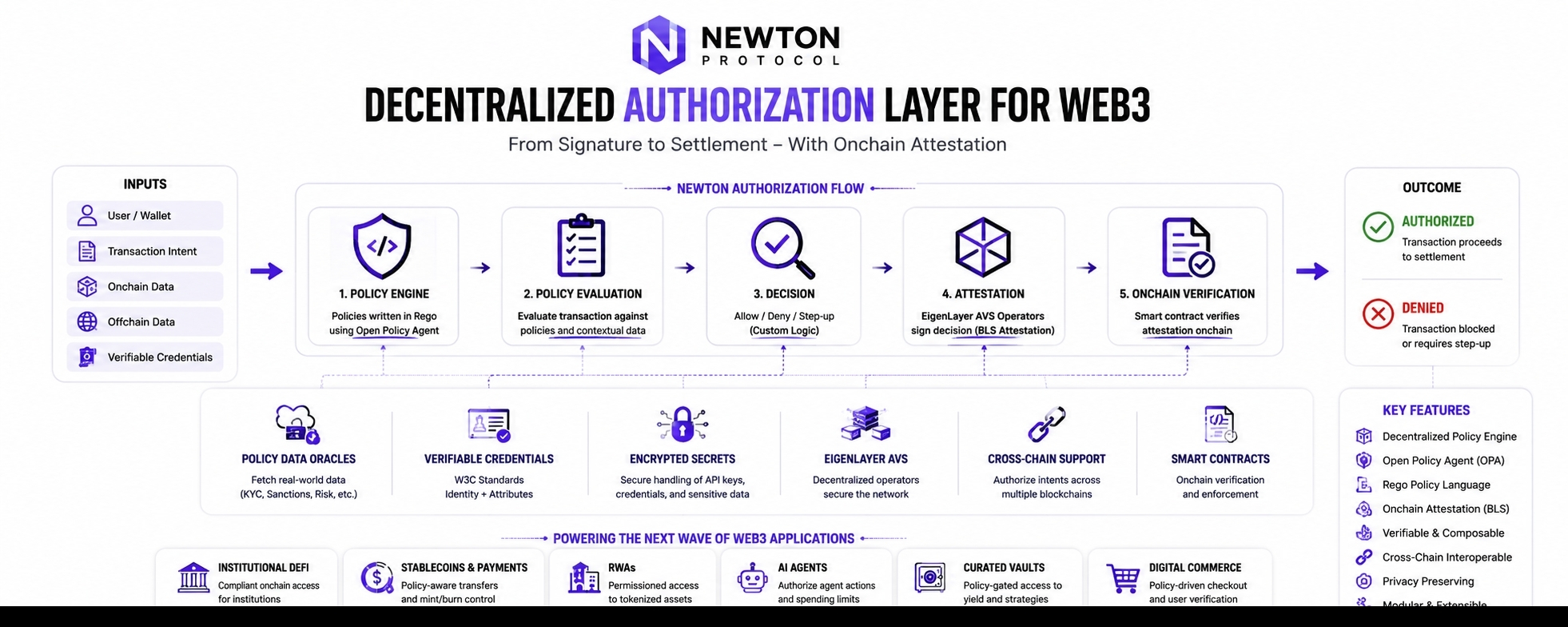

I noticed one thing in Newton that kept pulling my attention back: the attestation doesn’t just prove that a transaction was evaluated, it only proves that the policy engine reached a decision on the inputs it saw. That sounds subtle, but it felt like the real fault line to me. Newton positions itself as a decentralized policy engine for onchain transaction authorization, and the docs make it clear that the policy layer can pull in identity data, sanctions data, and other offchain signals through policy data oracles. That means the hard part is not only “can I sign?” it’s “how current was the world the policy was allowed to see?”
The more I looked into it, the more I felt this was closer to a freshness problem than a pure policy problem. In Newton, policies are written in Rego, evaluated by EigenLayer operators, and can produce a BLS attestation. That is clean. But the same architecture also relies on policy data oracles, encrypted secrets, and client-side flows to bring external context into the decision. I kept thinking about how OPA itself leans on bundle distribution and eventually consistent policy/data updates. In a normal policy engine, eventual consistency is annoying. In an authorization layer for money, it can become the whole game.
That changed how I read the Visa comparison. Visa-like authorization is not only about rule enforcement; it is about keeping a live risk view close enough to the moment of spend. Newton is trying to recreate that feeling without a centralized switch, which is ambitious. The interesting implication is that the product is not just policy expressiveness. It is authorization finality under changing context. Once I saw it that way, the design started to look less like “onchain compliance” and more like a distributed attempt to preserve a fresh decision boundary before settlement.
Practically, that matters most for stablecoins, RWAs, and AI agents, because those are exactly the places where the context can change faster than the transaction itself. Newton’s VC flow can fold KYC into the same evaluation path, and its policy data oracle model can add sanctions or risk signals without putting sensitive data onchain. But I’m still not fully convinced the hardest question is policy logic. It feels more like oracle freshness, secret handling, and operator availability all become part of the authorization budget. If any of those drift, the attestation can still be “correct” and the action can still be wrong.
That is the part I cannot get out of my head. I’m still trying to figure out whether Newton’s real bottleneck will be policy authoring at all, or whether it will be the messier problem of keeping authorization context trustworthy at the exact moment it matters. At what point does authorization stop being a rules problem and become a data freshness problem?