
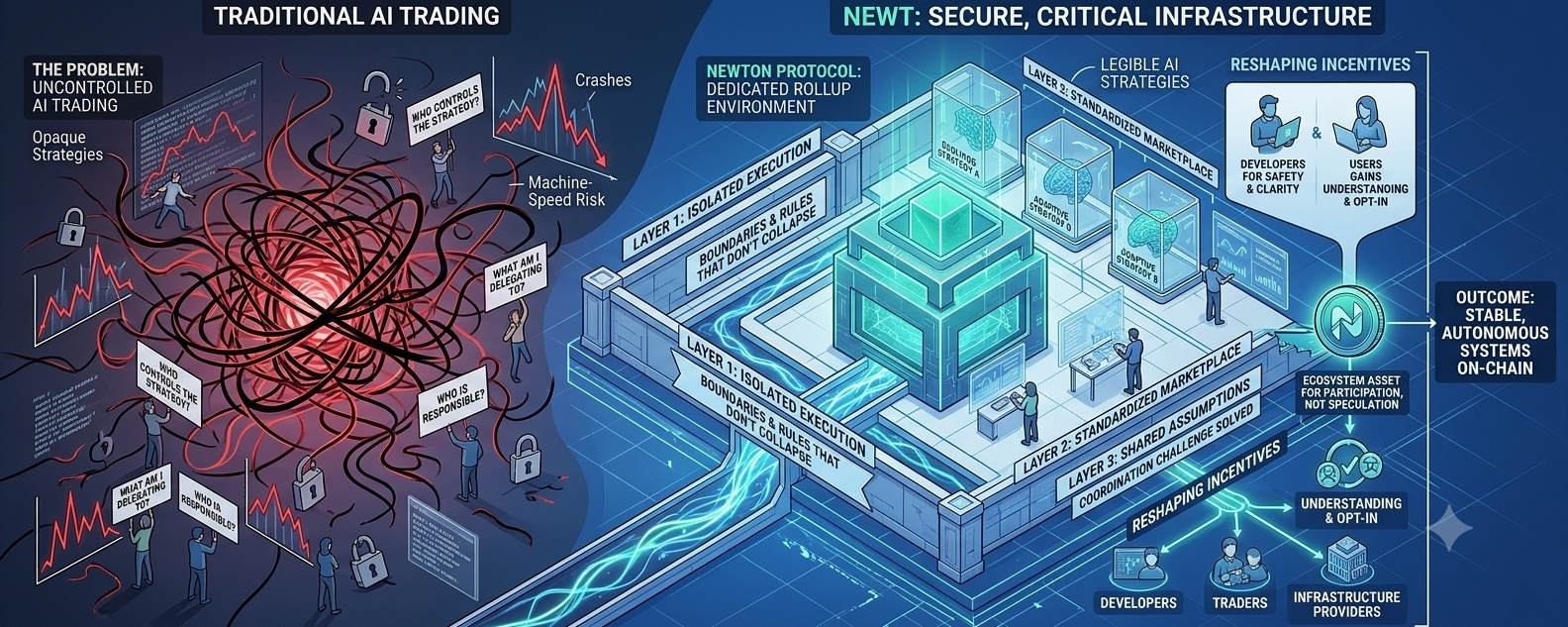
The first thing that struck me while looking through how Newton Protocol frames its work wasn’t the AI angle. It was the word secure. In a market where “AI trading” usually gets marketed as speed, edge, or intelligence, Newton keeps returning to something more basic: containment. Boundaries. Rules that don’t collapse under automation.
That choice reveals the real thesis behind the project. Newton isn’t trying to outsmart markets with better models. It’s trying to build a structure where AI-driven strategies can exist without becoming opaque, unaccountable, or dangerous to the systems they run on.
The core problem Newton is responding to is quietly growing. Automated strategies are no longer simple bots executing fixed rules. They’re adaptive systems that learn, update, and act at machine speed. When these systems operate on-chain, traditional assumptions about trust start to break down. Who controls the strategy once it’s live? Who is responsible if it behaves unexpectedly? How do users know what they’re delegating capital to?
Newton Protocol approaches this problem through the idea of a dedicated rollup environment designed specifically for AI-driven strategies. That design choice matters. Instead of forcing AI workflows into general-purpose execution layers, Newton isolates them into an environment where constraints, permissions, and execution logic can be tailored to autonomous systems.
This separation is more than architectural neatness. It’s a recognition that AI strategies behave differently from human-triggered transactions. They run continuously. They react to data feeds. They can chain decisions together faster than manual oversight allows. A rollup designed around those realities can impose clearer execution boundaries, reduce unintended interactions, and make behavior more inspectable at the system level.
The marketplace element adds another layer to this structure. Newton isn’t positioning AI strategies as private black boxes run by a few insiders. Instead, it creates a framework where AI developers can deploy strategies and users can interact with them under standardized rules. That standardization is subtle but important. It shifts AI trading away from informal trust and toward shared infrastructure.
Think of it less like copying someone’s trading bot and more like using a regulated tool inside a controlled environment. The strategy still belongs to its creator, but the execution context enforces consistent rules. That’s where accountability starts to become possible.
What’s interesting is how this setup reshapes incentives. Developers are encouraged to build strategies that can operate safely within the rollup’s constraints, rather than optimizing purely for aggressiveness or opacity. Users, on the other hand, gain a clearer sense of what they’re opting into. They’re not just handing capital to an unknown process; they’re interacting with a system designed to make AI behavior legible and bounded.
The protocol’s focus on automated trading doesn’t mean it’s limited to simple buy-and-sell logic. The broader framing around AI-driven strategies suggests support for complex decision-making processes that may evolve over time. That’s exactly why the security-first approach matters. As strategies become more autonomous, the cost of vague execution rules rises sharply.
There’s also a coordination challenge hiding here. AI developers, traders, and infrastructure providers often operate in separate silos. Newton tries to bring them into a single environment with shared assumptions about execution and responsibility. If it works, that could lower friction for developers who want distribution and for users who want access without blind trust.
Of course, the design introduces its own bottleneck. A controlled environment is only as useful as the quality of strategies built for it and the clarity of its rules. Too restrictive, and innovation stalls. Too permissive, and the safety benefits erode. Finding that balance is not a one-time technical decision; it’s an ongoing governance and design challenge.
Another pressure point is transparency versus protection. Developers need ways to showcase credibility without fully exposing proprietary logic. Users need enough visibility to assess risk without becoming AI researchers themselves. Newton’s marketplace structure suggests an attempt to navigate that tension, but its success will depend on how well the protocol communicates strategy behavior at a usable level.
What I find compelling is that Newton isn’t pretending AI trading is inherently benevolent or self-regulating. It treats automation as something that needs guardrails before scale, not after. In crypto, that’s a relatively mature stance.
The token, NEWT, fits into this picture as an ecosystem asset rather than a speculative centerpiece. Its relevance flows from participation in the protocol’s economy, not from promises about price. That alignment reinforces the idea that Newton is building infrastructure first and narratives second.
Zooming out, Newton Protocol feels less like a trading platform and more like an attempt to define how autonomous systems should be allowed to act on-chain. It acknowledges that AI is already here, already trading, already influencing markets. The question isn’t whether it should exist, but under what conditions it should operate.
If Newton succeeds, its real contribution won’t be a standout strategy or a flashy demo. It will be the normalization of AI trading as something governed by clear execution environments rather than informal trust. In a space increasingly shaped by machines, that kind of structure may end up being the most valuable innovation of all.
@NewtonProtocol #Newt $NEWT #newt
