


Artificial Intelligence is rapidly becoming one of the most transformative technologies of our time. From content creation and software development to data analysis and autonomous decision-making, AI is reshaping industries at an unprecedented pace. However, despite the explosive growth of AI, one major challenge remains unresolved: how can the people and organizations that contribute data, models, and AI services be fairly rewarded for their contributions?
This is where OpenLedger (OPEN) enters the conversation.
Over the past few months, I have been closely analyzing the intersection of blockchain and artificial intelligence. One pattern keeps appearing. AI development relies heavily on data, models, and computational resources, yet the value generated by these assets is often captured by a small number of centralized platforms. Many contributors provide valuable datasets or build innovative AI models without receiving proportional rewards for their work.
OpenLedger is attempting to address this imbalance by creating a dedicated AI blockchain focused on monetization, ownership, and transparency.
The Problem With Today's AI Economy
Most AI ecosystems operate behind closed doors. Large technology companies collect massive amounts of data, train powerful models, and monetize the resulting products. While this approach has accelerated innovation, it has also created significant barriers for independent developers, researchers, and data providers.
The current system creates several challenges.
Data contributors rarely receive ongoing compensation.
AI model creators often struggle to generate sustainable revenue.
Ownership rights are difficult to verify.
Revenue distribution lacks transparency.
AI agents have limited infrastructure for autonomous economic participation.
As AI adoption expands globally, these issues may become even more significant.
OpenLedger's Core Vision
OpenLedger is building an AI-native blockchain designed to unlock liquidity for data, models, and AI agents.
Instead of treating data as a hidden resource, OpenLedger aims to transform it into a verifiable and monetizable digital asset. The network seeks to create an ecosystem where contributors can prove ownership, track usage, and earn rewards whenever their assets create value.
In my opinion, this approach represents one of the most practical use cases for blockchain technology.
Rather than focusing solely on speculation, OpenLedger is targeting a real economic challenge within the rapidly growing AI industry.
Monetizing Data
Data is often described as the fuel of artificial intelligence.
Every AI model depends on high-quality datasets for training and improvement. Yet many individuals and organizations that provide valuable data receive little or no direct compensation.
OpenLedger envisions a marketplace where datasets can be registered, verified, and monetized.
If an AI model uses a particular dataset to generate value, contributors may be rewarded based on their participation and contribution.
This creates a stronger incentive for producing high-quality data while improving transparency across the AI supply chain.
Monetizing AI Models
Developing advanced AI models requires significant expertise, time, and computational resources.
Many developers face challenges when attempting to commercialize their work. Traditional monetization methods often rely on centralized marketplaces or private licensing agreements.
OpenLedger aims to simplify this process by allowing AI models to become blockchain-native assets.
Developers could potentially publish, distribute, and monetize their models through decentralized mechanisms while maintaining proof of ownership and contribution history.
This may reduce friction for independent builders and create new revenue opportunities across the AI ecosystem.
The Rise of AI Agents
One of the most exciting trends in technology today is the emergence of AI agents.
Unlike traditional software, AI agents can perform tasks autonomously, interact with users, make decisions, and even coordinate with other agents.
As these systems become more sophisticated, they will require infrastructure capable of supporting autonomous economic activity.
OpenLedger is positioning itself to become that infrastructure layer.
The network aims to provide mechanisms for identity, ownership verification, reward distribution, and transparent interactions between agents and contributors.
I believe this area could become one of the most important sectors within the AI industry over the next decade.
Why Blockchain Matters
Many people ask why blockchain is necessary for AI monetization.
The answer lies in transparency and trust.
Blockchain technology enables immutable records, verifiable ownership, and automated reward distribution through smart contracts.
When applied to AI ecosystems, these features can help solve long-standing problems related to attribution, compensation, and accountability.
OpenLedger is attempting to combine these advantages with an infrastructure specifically designed for AI applications rather than adapting a general-purpose blockchain for the task.
Potential Long-Term Impact
If OpenLedger successfully executes its vision, the platform could help create a more open and collaborative AI economy.
Developers could earn revenue from their models.
Data providers could be rewarded for their contributions.
AI agents could participate in economic activities autonomously.
Organizations could access transparent and verifiable AI resources.
Users could benefit from increased trust and accountability.
This represents a significant shift from today's centralized AI landscape.
Final Thoughts
The future of AI will not be determined solely by the intelligence of models. It will also depend on how value is created, distributed, and shared across the ecosystem.
In my analysis, OpenLedger is pursuing a compelling vision by focusing on one of the most overlooked aspects of artificial intelligence: monetization.
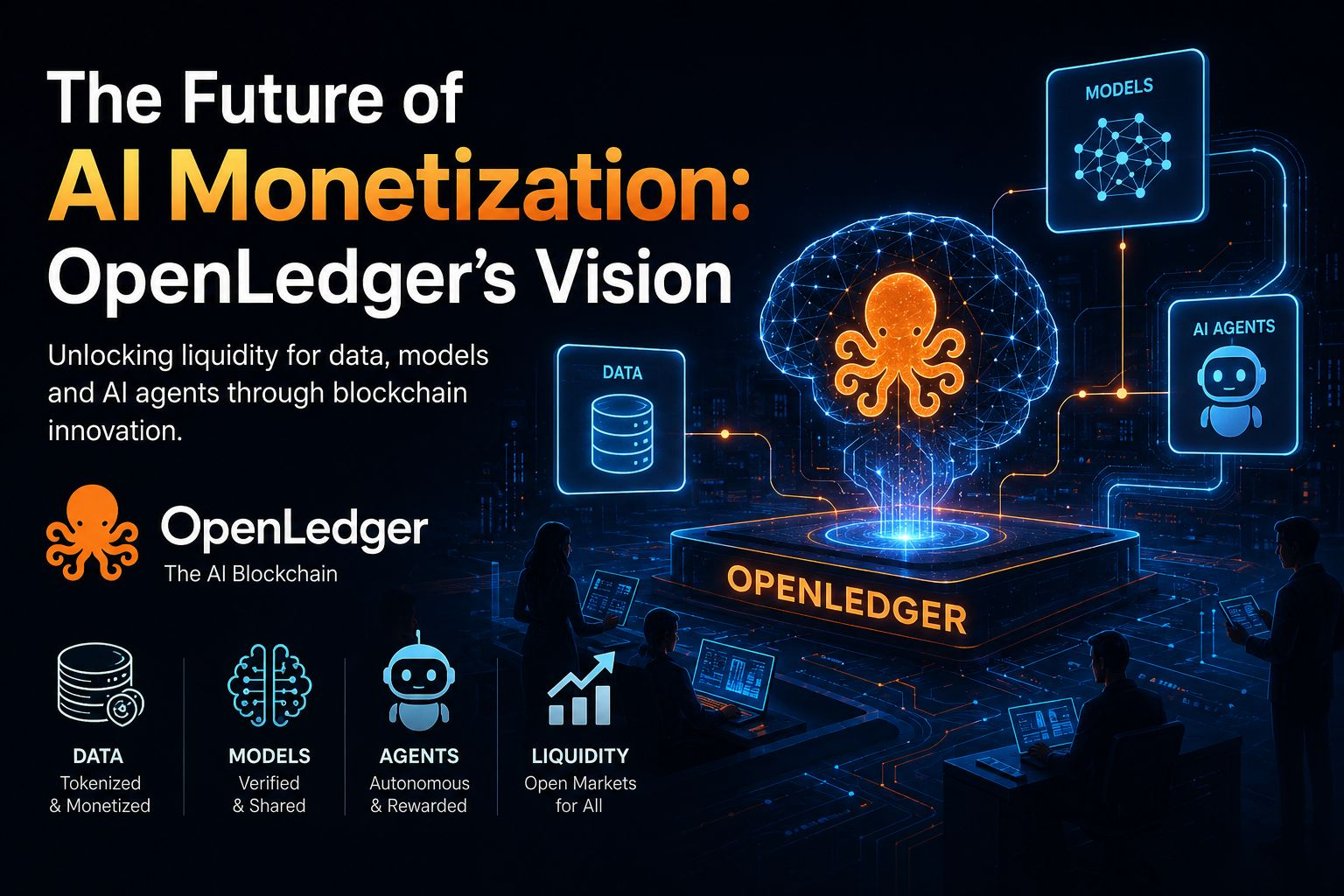
By transforming data, models, and AI agents into verifiable digital assets, OpenLedger aims to build the economic infrastructure that powers the next generation of AI innovation.
The AI revolution is already underway. The question is not whether AI will create value, but who will capture that value. OpenLedger's vision is to ensure that contributors, developers, and creators have a meaningful role in the future AI economy.@OpenLedger $OPEN #OpenLedger
