
I've been thinking about OpenLedger quite a bit lately, and what keeps bringing me back isn't the technology itself. It's the idea behind it.
At first, I thought it was another project trying to combine AI and blockchain because those two words seem to appear together everywhere these days. I've seen enough projects in this space to know that big narratives can sometimes hide a lack of substance. So I approached OpenLedger with the same skepticism I usually have whenever I come across something that promises to reshape an entire industry.
The more I looked at it, though, the more I realized that OpenLedger isn't really trying to compete on the same level as most AI projects. What stood out to me was its focus on the source of intelligence rather than the intelligence itself.
Most people talk about AI models. They talk about how powerful they are, how fast they are improving, and how much they might change the future. But very few conversations focus on where the knowledge behind those models comes from. That's the part OpenLedger seems interested in, and I think that's why it caught my attention.
I used to assume that as AI became more advanced, the biggest winners would simply be the companies building the largest models. Now I'm not so sure. The deeper I went into understanding the AI landscape, the more it became clear that access to valuable data may end up being just as important as the models themselves.
Without quality information, even the most advanced AI eventually runs into limits.
That's where OpenLedger starts to make sense.
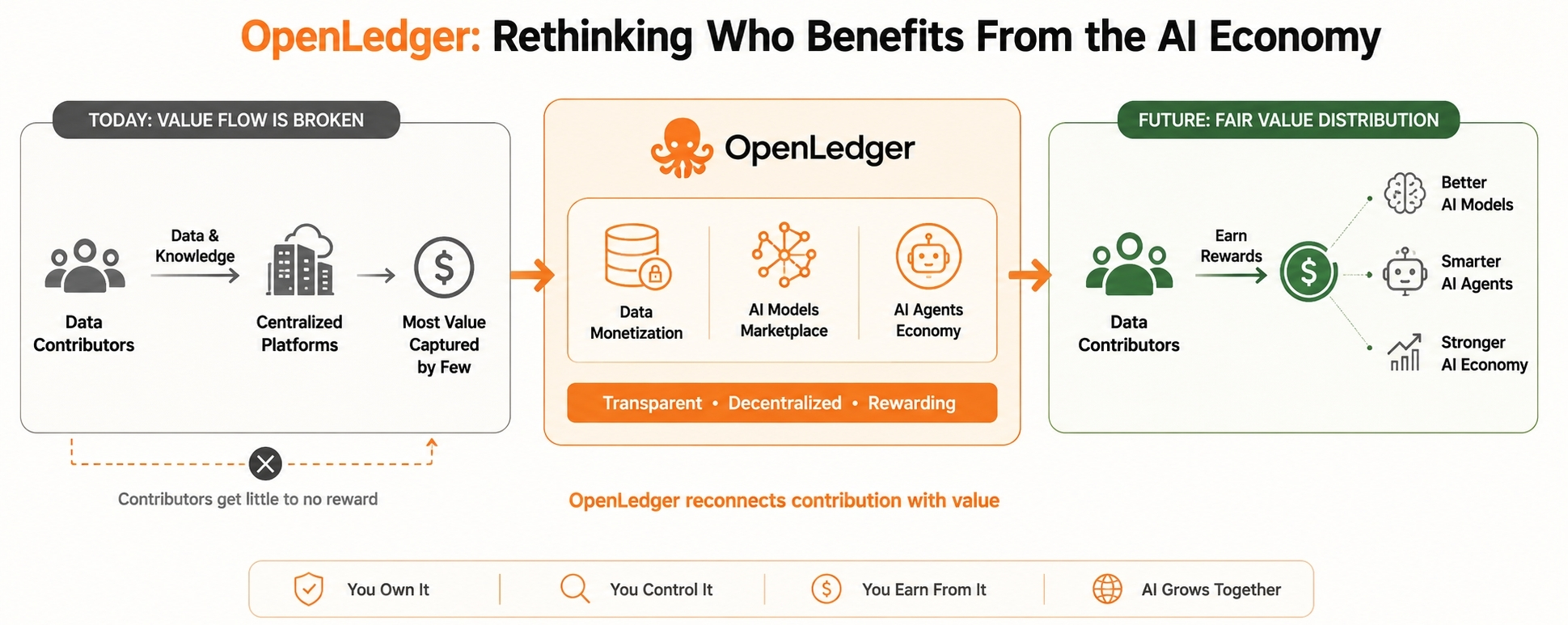
The project seems to be built around a simple observation: data creates enormous value, yet the people providing that data are often disconnected from the value it generates. Information flows into systems, models learn from it, products are built on top of it, and economic value is created. But the relationship between contribution and reward often disappears somewhere along the way.
OpenLedger appears to be questioning whether that model can work differently.
What I find interesting is that the project isn't treating data as something static. Instead, it views data as an active asset within an AI economy. That may sound like a small distinction, but I think it changes how you look at the entire ecosystem. Suddenly the conversation shifts from building AI to building an environment where intelligence can continuously grow because contributors have a reason to participate.
Of course, ideas always sound cleaner than reality.
One thing I've learned from watching blockchain projects over the years is that incentives matter more than narratives. A project can have an exciting vision, but if the incentives aren't aligned properly, the system eventually struggles. People naturally respond to rewards. That's true in every market, every platform, and every network.
As I explored OpenLedger, I found myself thinking less about the technology and more about whether the incentives can create a healthy cycle. Can contributors provide useful information and be rewarded fairly? Can quality rise above noise? Can an open network maintain standards while continuing to grow?
Those questions don't have easy answers.
Still, I think the project is asking questions that are becoming increasingly relevant. AI is moving incredibly fast, and much of the discussion is focused on outputs. Better chatbots, smarter agents, more capable models. But beneath all of that sits a foundation of information. Without fresh, reliable, and specialized knowledge, AI systems eventually lose their edge.
The interesting part isn't the model. The interesting part is the ecosystem that keeps the model useful.
That's the lens through which I now see OpenLedger.
The project feels less like an AI application and more like infrastructure. Not the kind of infrastructure most people notice immediately, but the kind that quietly supports everything built on top of it. If AI continues to expand into every corner of the digital economy, networks that help organize, verify, and reward valuable information could become increasingly important.
That doesn't guarantee success. There are still plenty of challenges ahead. Building a network is difficult. Building a sustainable economy around data is even harder. The gap between a compelling vision and a functioning ecosystem is often much larger than people expect.
But after spending time with OpenLedger, I came away with the feeling that it is focused on a problem worth solving.
The project isn't simply asking how AI can become smarter. It's asking how the people and resources that make AI possible can participate in the value being created. In a world where intelligence is becoming one of the most valuable digital resources, that feels like an important question.
Whether OpenLedger ultimately succeeds or not will depend on execution, adoption, and many factors that are impossible to predict today. But what stayed with me after researching the project wasn't a specific feature or technical detail. It was the belief that future AI economies may need better ways to connect contribution with reward.
And if that future unfolds the way many people expect, OpenLedger may be exploring a space that becomes far more important than it appears today.