

There’s something I keep noticing with Web3 games, and it’s a bit counterintuitive. The ones that look simple… almost boring at first glance… usually end up hiding the most complicated systems underneath. Pixels gave me that exact feeling. I opened it expecting a calm farming loop, something you check in on, plant a few crops, maybe wander around. And for a while, that’s exactly what it feels like. But the longer you stay, the more it starts to feel less like a game and more like something quietly tracking how your time and attention turn into value.
It didn’t even start as a token-heavy system. Back in 2021, it was just a browser farming MMO with a familiar vibe, something close to what people already understood from traditional games. But there was one difference that kept nagging at me — ownership actually meant something. Land, items, resources… they weren’t just sitting inside the game. You could hold them, move them, treat them like assets. That changes how people behave, even if they don’t realize it immediately.
The shift to the Ronin Network is where things really started to click. And I don’t mean in a flashy way. It was more subtle. Ronin already had users, habits, wallets — people who knew how these systems worked because of earlier games. Pixels didn’t have to teach anyone from scratch. It just dropped into an environment that was already active, and suddenly it wasn’t just growing on its own… it was pulling activity into the whole ecosystem.
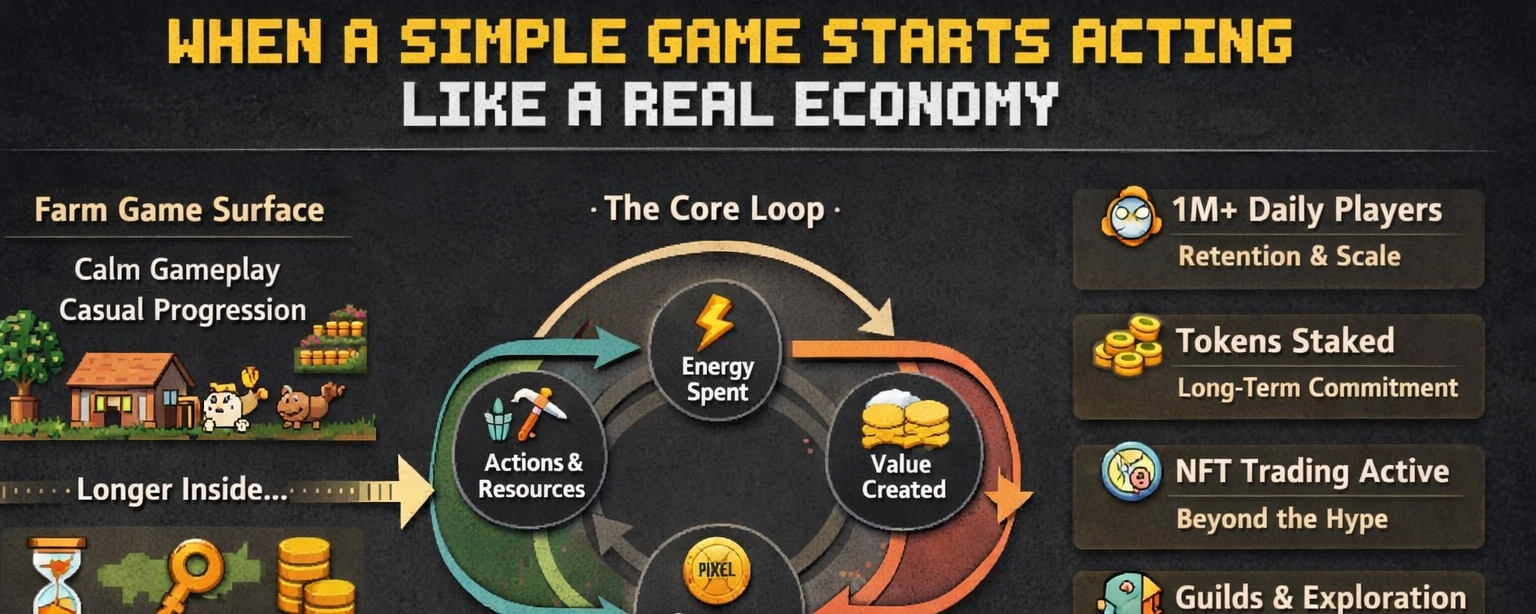
What’s interesting is how controlled everything feels once you look under the surface. The loop is simple on paper — spend energy, do actions, get resources, turn those into value. But it’s not loose. Every action costs something. Every output feeds into another layer. Nothing just flows freely. At first I thought that might slow things down too much, but then it clicked — that restriction is probably the whole point.
Because most Web3 games don’t break because of lack of users. They break because value only moves in one direction… outward. People farm, extract, leave. Pixels feels like it’s constantly trying to push against that pattern, even if it means making things slightly less convenient.
And then you start looking at the actual behavior around it, not just the design. The scale alone changes how you think about it. Once a system crosses into the million daily users range, it stops being “just another GameFi project.” It becomes something people are actively spending time in, repeatedly. What stood out to me even more was that earlier phases already showed strong retention. That’s usually where things fall apart.
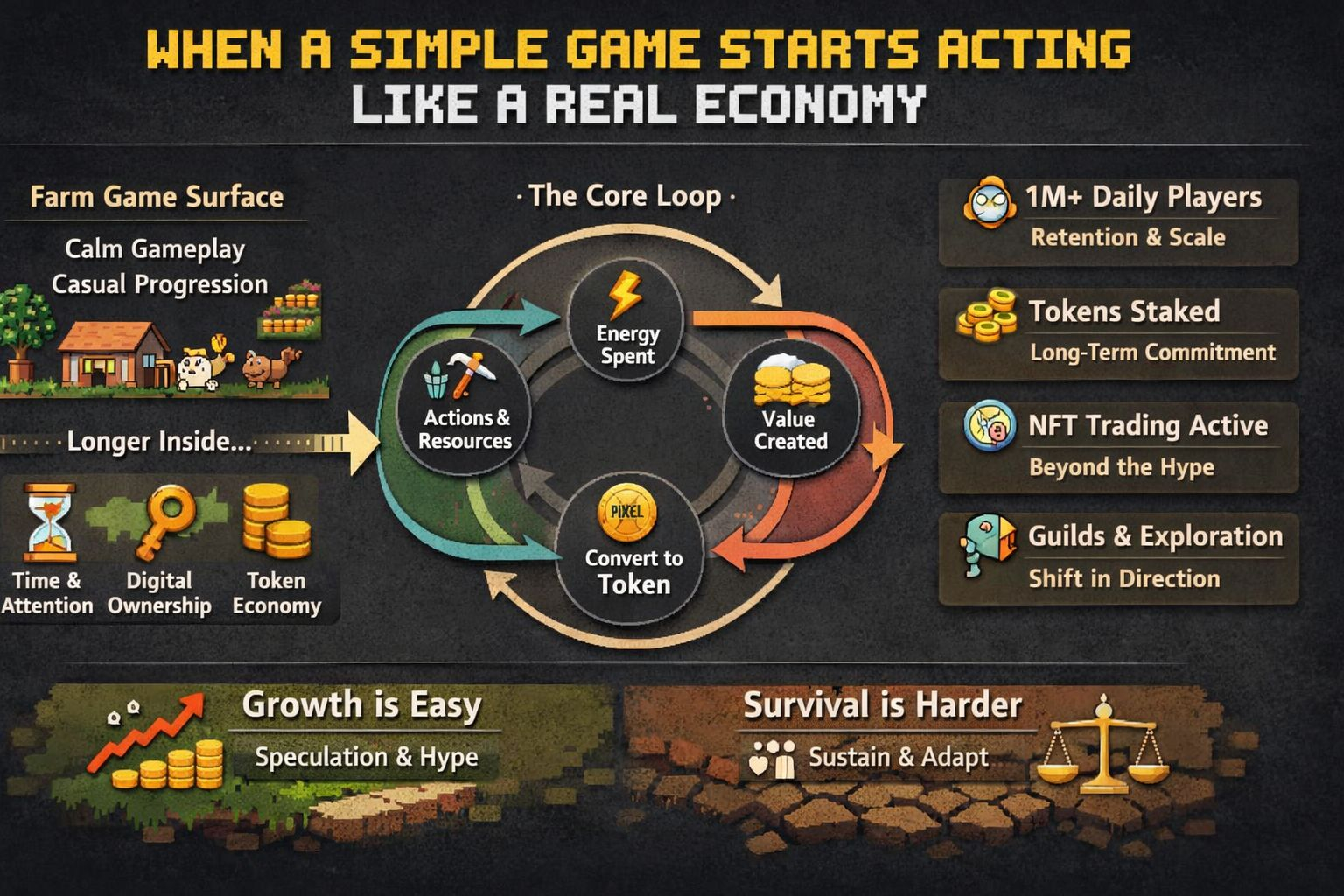
The token side is also in a different place than most projects I’ve seen. A big chunk of the supply is already out there, which means it’s not constantly fighting future dilution narratives. That shifts the pressure somewhere else — now it actually has to prove that people will keep using it, not just hold it. And when you see users staking instead of immediately cashing out, it suggests there’s at least some belief in staying inside the system a bit longer.
The trading patterns are messy, though. You can feel both usage and speculation happening at the same time. Volume spikes don’t always match organic activity, and that tension doesn’t go away. But maybe that’s just the reality of any system that mixes players and capital. The real question is what survives when the speculative layer cools off.
Inside the game, things don’t completely die when attention drops, which I found interesting. NFT activity, small transactions, internal movement — they keep going. Not loudly, not in a way that trends, but enough to suggest there’s something holding it together beyond hype cycles.
I also like that the token isn’t just handed out and forgotten. It’s tied into access, upgrades, certain actions. That creates friction, and yeah, it can feel annoying in the moment. But without that friction, tokens usually end up disposable. Systems that last tend to make you come back into them, whether you want to or not.
Lately, it feels like the direction is shifting a bit. Less focus on pure farming, more on coordination, guilds, exploration. It almost feels like they’re trying to move people from “players who extract” to “participants who stay.” That’s a hard transition. Most systems don’t pull it off cleanly.
There are still some uncomfortable edges, though. Growth always sounds good, but more players also means more pressure on the economy. If rewards scale faster than the ways to spend or burn them, imbalance creeps in slowly. On the flip side, if you tighten things too much, people lose interest. And somewhere in the middle, the game risks feeling less like a game and more like a routine.
Then there’s the dependency on Ronin itself. It’s a huge advantage, no doubt. Distribution, infrastructure, all of that. But it also means Pixels isn’t fully independent. If the underlying ecosystem shifts, it won’t stay isolated.
I think the biggest mistake people make is how they describe it. Calling it a farming game with rewards feels incomplete. It’s closer to an ongoing experiment — can a digital world take people’s time and structure it into something that doesn’t collapse once too many people start relying on it?
Right now, it’s in that weird middle phase. Too big to ignore, not stable enough to fully trust. The activity is real. The economy is moving. The system is evolving.
But I keep coming back to the same thought.
Growing is usually the easy part.
What matters is what happens after… when the system has to carry its own weight without quietly breaking underneath.
