
I’ve been staring at the narrative shifts lately and honestly, the whole privacy sector in crypto has been a massive headache. We’ve basically been stuck in this binary trap for years. On one side, you have total anonymity projects that regulators absolutely hate and delist the second they get the chance. On the other, you have completely transparent chains where everyone on Crypto Twitter knows exactly how much you hold, where you’re moving it and what your specific DeFi habits look like. It’s wild that we just accept this as normal. In any other part of life, you wouldn’t want a stranger standing behind you at an ATM watching every button you press, yet in Web3, that’s the default. I’ve been digging into what MidnightNetwork is building recently and it genuinely feels like a breath of fresh air. It’s not just another 'privacy coin' trying to hide everything from everyone; it’s more like a systemic fix for how we handle sensitive data on-chain. They’re heavily leaning into zero-knowledge proofs (ZKPs). I know, 'ZK' sounds like pure buzzword soup right now everyone and their mother is launching a ZK-something but the actual application here is what really hooked me. The "aha" moment for me was realizing that privacy isn't just about hiding; it’s about selective disclosure. Think about how messy the current KYC process is. Every time you want to join a new platform or use a specific service, you’re basically doxxing your entire life. You send a picture of your passport, your utility bill and your tax ID to a centralized database that's probably going to get hacked in six months anyway. Midnight suggests a different way. Imagine being able to prove you’ve passed a background check or that you have enough collateral for a massive loan without actually revealing your wallet history, your name or your personal details to some random protocol. That’s the exact vibe here. You provide the 'proof' without handing over the keys to your house. The way they’ve structured the tokenomics is actually pretty clever and honestly, it’s probably the only way a privacy project survives in the current regulatory climate. You have $NIGHT , which serves as the transparent, governance-focused side of the network. It’s compliant, it’s public and it keeps the lights on. Then, they use a separate, non-transferable fuel called $DUST for the actual private transactions.
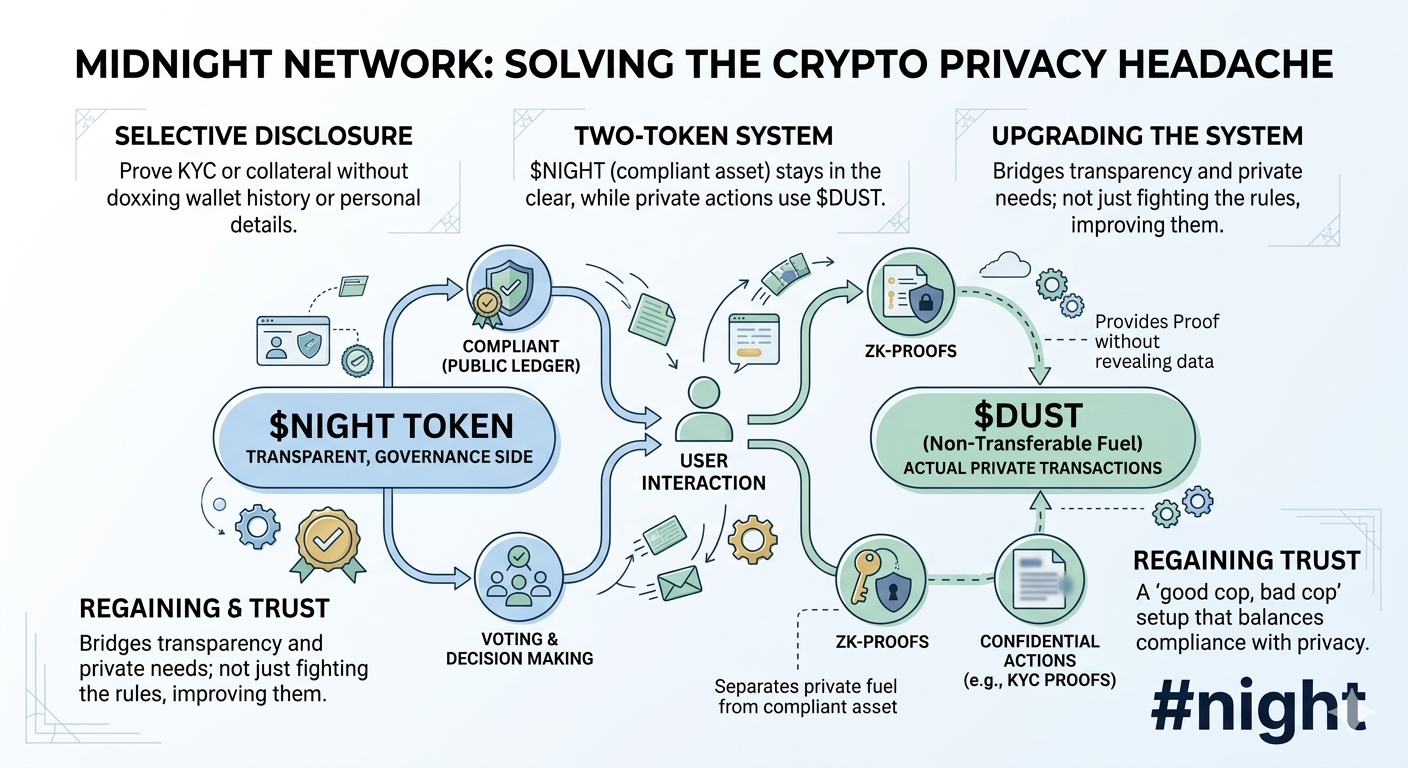
This setup is a total game-changer because it means regulators can’t just slap a blanket ban on the project like they did with Monero or Tornado Cash. By splitting the functions, the main asset @MidnightNetwork stays in the clear. It gives developers a playground to build 'un-trackable' applications while staying within the lines of global law. It’s a 'good cop, bad cop' system where the good cop handles the paperwork and the bad cop (the tech) keeps your data safe. I’ve spent a lot of time watching how value moves across public blockchains and the 'transparency at all costs' model is starting to show its cracks. Institutional money the big players we keep saying we want in crypto won't touch a system where their competitors can see their every move in real-time. If a big fund wants to hedge a position, they don't want the whole world front-running them because their wallet is tagged on Nansen. Midnight solves that structural tension. It bridges the gap between the radical transparency of early Bitcoin and the strict privacy needs of the real world. Finally, a team realized that building a walled garden of absolute secrecy just doesn't scale if we want real adoption.
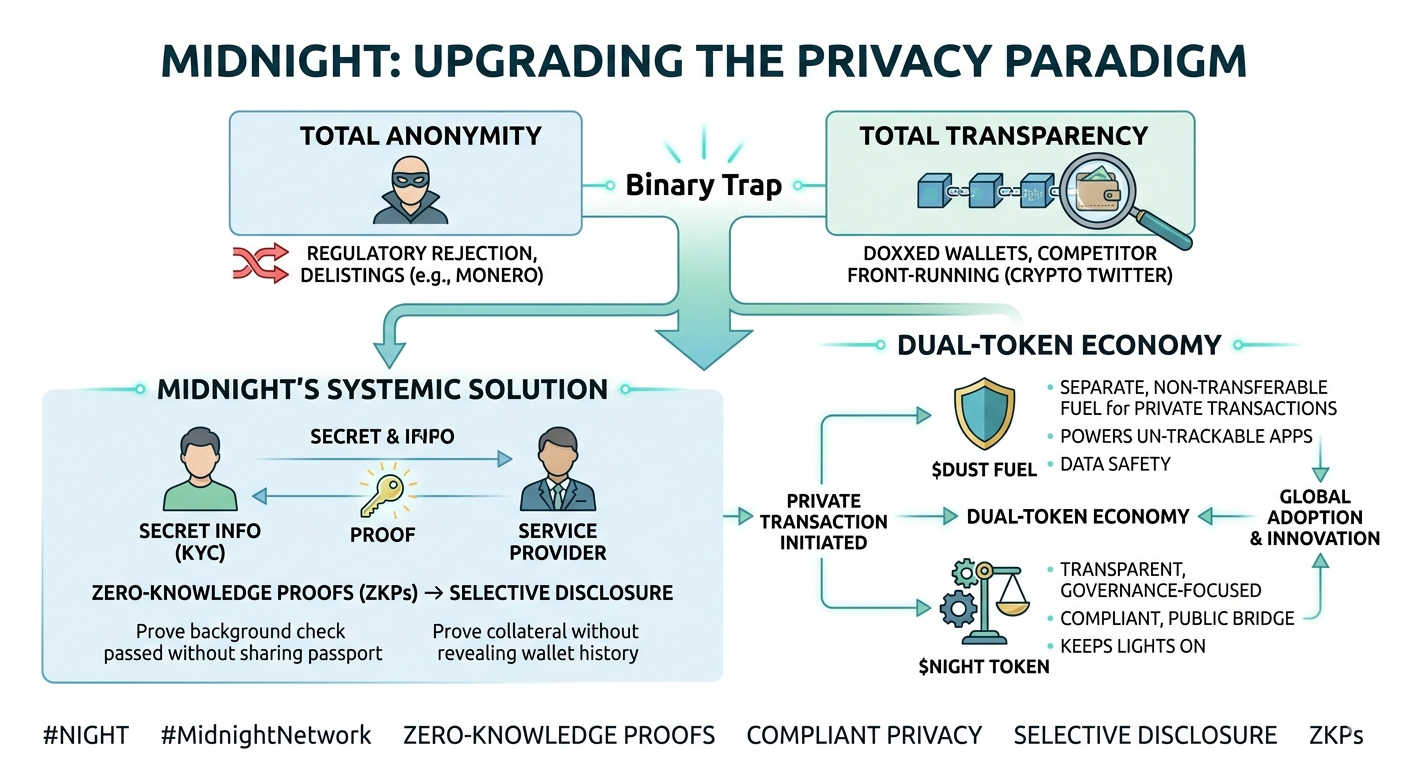
We need systems that can talk to the real world and the real world has rules. By using $NIGHT as a bridge, Midnight isn't just fighting the system; they're upgrading it. I’m definitely keeping this on my radar as we move into a year where 'compliant privacy' is probably going to be the only narrative that matters. It’s early days but the tech feels solid and the philosophy behind it is even stronger. #night