

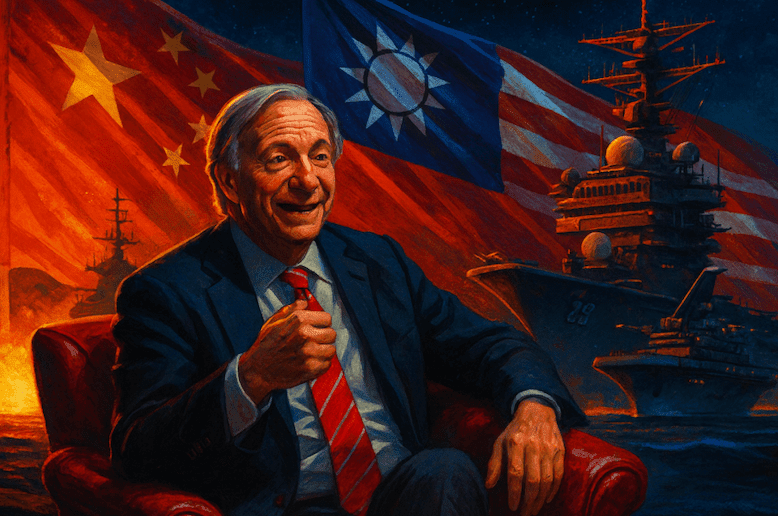
Bridgewater founder Ray Dalio was recently invited to speak and engage in discussion at the Oxford Union in the UK, focusing on changes in global order, debt cycles, the rise and fall of powers, and technological impacts. When discussing U.S.-China relations, the host brought up one of the most concerning issues for the outside world: Taiwan. In his response, Dalio did not make emotional comments but returned to his long-term research on historical cycles and Chinese political culture, explaining the position of the Taiwan issue in the minds of the Chinese and assessing whether Taiwan will become a flashpoint for military conflict between the U.S. and China.
With the background of connecting with China, understanding Taiwan first requires understanding China
Dalio recalled his experience of first visiting China in the mid-1980s, from initial curiosity to gradually understanding how China views the world through exchanges with local leaders and historians. He emphasized that to understand how today's China views Taiwan, one must first recognize its political culture and historical background.
The nation is a big family from top to bottom; the issue of Taiwan has long existed in the hearts of the Chinese people
He relayed the views of Chinese leaders and scholars, pointing out that the concept of "nation" traditionally contains the meanings of both "country" and "family," representing that the nation is viewed as a big family, maintaining order and harmony from top to bottom.
In contrast, the West emphasizes individual and bottom-up power, leading to very different ways of thinking about sovereignty, order, and power issues. After discussing China's history and governance perspective, Dalio turned the topic to Taiwan. He pointed out that Taiwan has existed in the overall narrative of China for a very long time and is not a political issue that has emerged recently, but is deeply rooted in its national history and cognition.
One China position is clear and has not changed since the end of the war
When discussing whether the U.S. and China will go to war over Taiwan, Dalio stated directly that the Chinese government undoubtedly believes that "Taiwan is part of China." He said that since the end of World War II, China has repeatedly emphasized the same position, including that Taiwan belongs to China and insists on the "One China" policy, which is considered self-evident and will not be denied within China.
The probability of short-term conflict is low; Taiwan is a long-term evolving issue
Dalio further stated that he views Taiwan as an issue that will "evolve over time" rather than an immediate trigger for a comprehensive conflict.
He emphasized that given the current situation, at this moment, he does not believe Taiwan will become the real focal point of military conflict between the U.S. and China. This reflects Dalio's observations based on historical cycles and the current situation, rather than an emotional prediction.
The battlefield has shifted to technology and finance, with Taiwan in a highly sensitive but not immediate triggering point
Dalio pointed out that U.S.-China relations have entered a new form of competition with multiple tracks running parallel, including non-traditional battlefields such as trade, technology, and finance, with Taiwan situated within this larger geopolitical competition framework.
He believes that the two major powers of the U.S. and China are moving towards greater self-sufficiency to reduce reliance and avoid being constrained. In such an environment, Taiwan remains a highly watched position, but he does not view it as an immediate trigger point for conflict in the short term, but rather as a long-term issue intertwined with historical narratives and modern competition.
This article by Ray Dalio of Bridgewater: Taiwan is a long-term structural issue and will not become a trigger point for U.S.-China conflict in the short term, first appeared in Chain News ABMedia.
