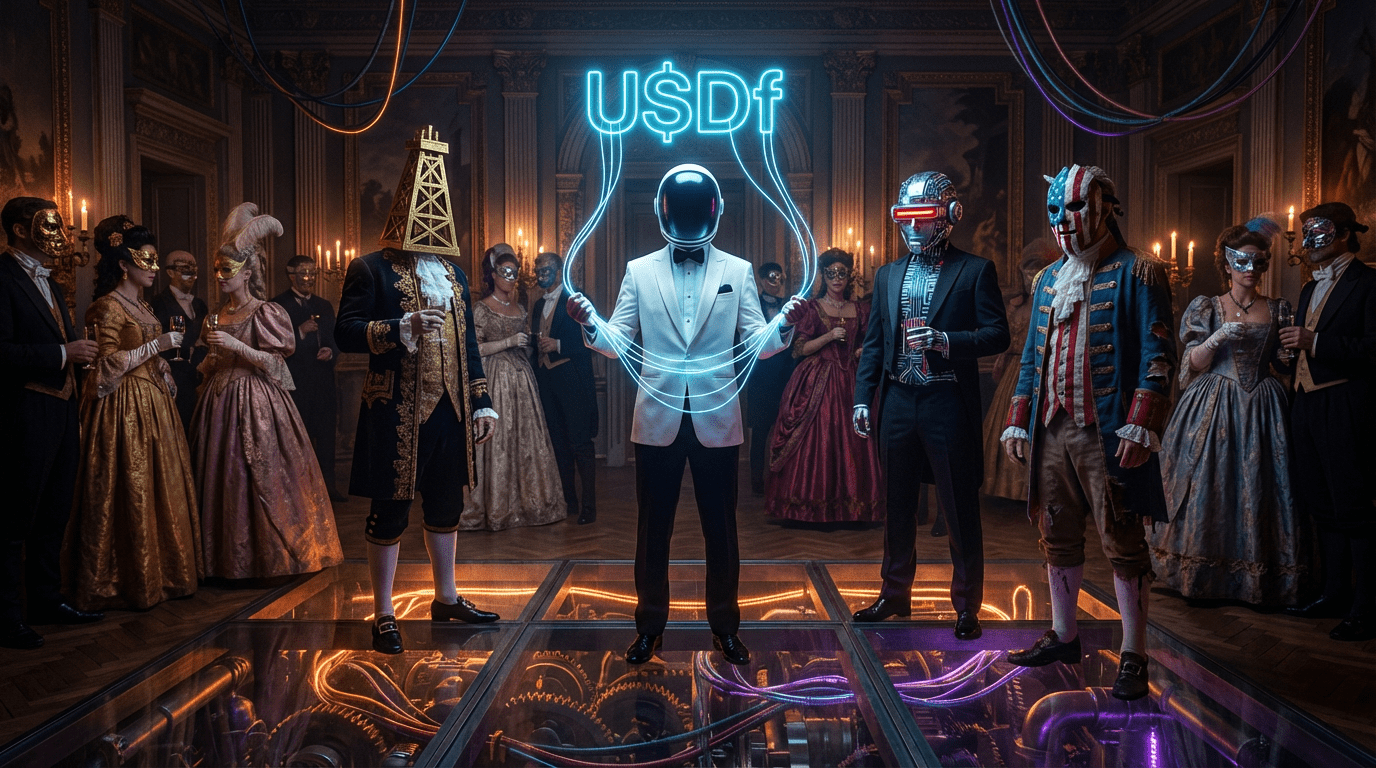
Personally, I believe that in the Web3 'Wild West,' to determine whether a project is reliable, one must not only look at the surface performance of a 'decentralized team,' but also consider those who are behind the scenes, holding real control, the capital tycoons. The success of Falcon Finance is less about a victory for grassroots programmers and more about a carefully orchestrated 'oligarch game.'
On this stage, the 'Anonymous Team' claims to be the project party, wearing featureless masks and performing the complex operations of 'universal collateral.' But in the shadows, there are high-frequency traders from DWF Labs, agents of Middle Eastern oil capital from M2 Capital, and World Liberty Financial (WLFI) along with the Trump family behind them. These are the real power players who not only provide funding but also bring influence that goes beyond code.
When we look beyond Falcon Finance's claim of being 'community-driven,' we find that its governance core is not the democratic voting of a DAO, but an iron triangle composed of market makers, custodians, and political brokers. This determines the fate of USDf and decides whose interests will be prioritized in times of crisis.
The first important guest at the ball, and the actual controller of this financial machine, is DWF Labs. In the story of Falcon Finance, DWF is not just a financial investor but the executor vital to the project's survival. Since the on-chain environment cannot support the high-frequency dynamic hedging required for options strategies, Falcon has outsourced the core function of maintaining USDf's stability to DWF, which operates in centralized exchanges (CEX). This is actually a very dangerous 'dependency.'
DWF Labs is known for its aggressive market-making style, adept at profiting from price fluctuations. For Falcon, this means that the stability of its stablecoin actually depends on whether DWF's traders follow the rules. Once DWF decides to use the protocol's hedging needs for front-running or shorting, Falcon's smart contracts will be utterly defenseless. This relationship is not the traditional 'VC and entrepreneur,' but rather 'host and parasite'—the project provides funding and traffic, while market makers create false prosperity, and both share in the users' losses.
If DWF creates momentum in the forefront, then M2 Capital represents the deep geopolitical capital force behind the scenes. As an important foothold for Falcon Finance in the Middle East, M2 not only brings funds but also compliance protection from the Abu Dhabi Global Market (ADGM). This explains why Falcon dares to exclude U.S. users in its terms and adopts a 'non-U.S. compliance' structure. This is not a simple choice, but a gamble: betting that the influence of the dollar is waning, and that the future of crypto finance belongs to the offshore financial centers of the East and the Middle East.
The existence of M2 Capital makes Falcon essentially a 'crypto product of petrodollars.' It leverages the Middle East's demand for dollar assets to build a market that avoids SEC regulation. However, this dependency also brings potential political risks. When a project's roots are planted in a specific country, it loses the 'borderlessness' that blockchain originally promised. If geopolitical changes occur, or if Abu Dhabi's regulators tighten policies, Falcon will face serious blows.
At the ball, the most eye-catching is World Liberty Financial (WLFI). As a crypto project supported by the Trump family, WLFI's investment in Falcon Finance is not just a business act but a form of 'regulatory hedging.' Falcon, on one hand, establishes a foothold in the Middle East through M2, and on the other hand, attempts to court the U.S. Republican Party by accepting WLFI's investment. This strategy is very clever: if the U.S. regulatory environment becomes favorable for cryptocurrencies in the future, Falcon can quickly enter the U.S. market through this relationship; conversely, it can continue to stay in the Middle East.
However, this practice of tying the project's fate to a specific political family reduces the project's technical content. It makes Falcon appear more like a 'lobbying tool' rather than a neutral financial infrastructure. For ordinary users, this means that each FF token you hold is essentially a bet on the U.S. elections.
Behind these big shots, the founding team of Falcon has chosen 'strategic invisibility.' Unlike Stani of Aave or Hayden of Uniswap, the identities of Falcon's core developers are unknown. This anonymity was seen as a badge of honor in the early days of DeFi, but now it seems more like a way to 'evade responsibility.' When projects involve opaque assets like private credit, the team's anonymity makes external audits nearly impossible. We do not know who is auditing the loan quality, nor do we know who decides which bad assets can enter the collateral pool. This asymmetry of information brings immense risks: the anonymous team can easily insert their poor-quality assets into the project in exchange for user funds, and then escape before the system collapses. After all, no one can sue a nonexistent person.
Lastly, it's not just the capital and the team; the infrastructure of Falcon Finance is also filled with the shadows of centralization. It relies on Ceffu (Binance) and Fireblocks for asset custody, and on Centrifuge and Backed Finance for asset issuance. This series of dependencies forms a fragile 'trust chain.' Users think they are interacting with smart contracts, but in reality, they are trusting that Binance won't be shut down by the U.S. Department of Justice, trusting that Fireblocks' private keys won't be stolen, and trusting that Centrifuge won't run away. Any problem in this chain could cause USDf to drop to zero instantly. From this perspective, Falcon Finance is not a decentralized project, but a 'CeDeFi aggregator' that gathers CEX liquidity, traditional financial assets, and centralized custody, merely wrapped in a layer of Web3.
In summary, the power structure of Falcon Finance is a game of 'oligarchs.' DWF Labs provides liquidity, M2 Capital offers compliance and funding, WLFI is responsible for inviting influential figures, while the anonymous team plays music behind the scenes like a DJ. In this game, ordinary investors serve to create the atmosphere, intoxicated by high returns, unaware that the ticket says, 'The game has risks, and consequences are at your own risk.' This is a tool constructed by the elite class aimed at obtaining public funds, whose core is not technological innovation, but rather the monopoly of resources and the redistribution of power.
I am a sword-seeker on a boat, an analyst who focuses solely on essence and does not chase noise.