

@Lorenzo Protocol When I first heard about BANK Token, the idea sounded simple but strangely powerful: a digital token meant to enable community governance and rewards as the project grows. At its essence, BANK is not just another speculative coin hoping to ride a hype wave it claims to give a voice to those holding it, letting members vote on decisions, finance allocations, strategic directions, and the overall trajectory of the protocol. 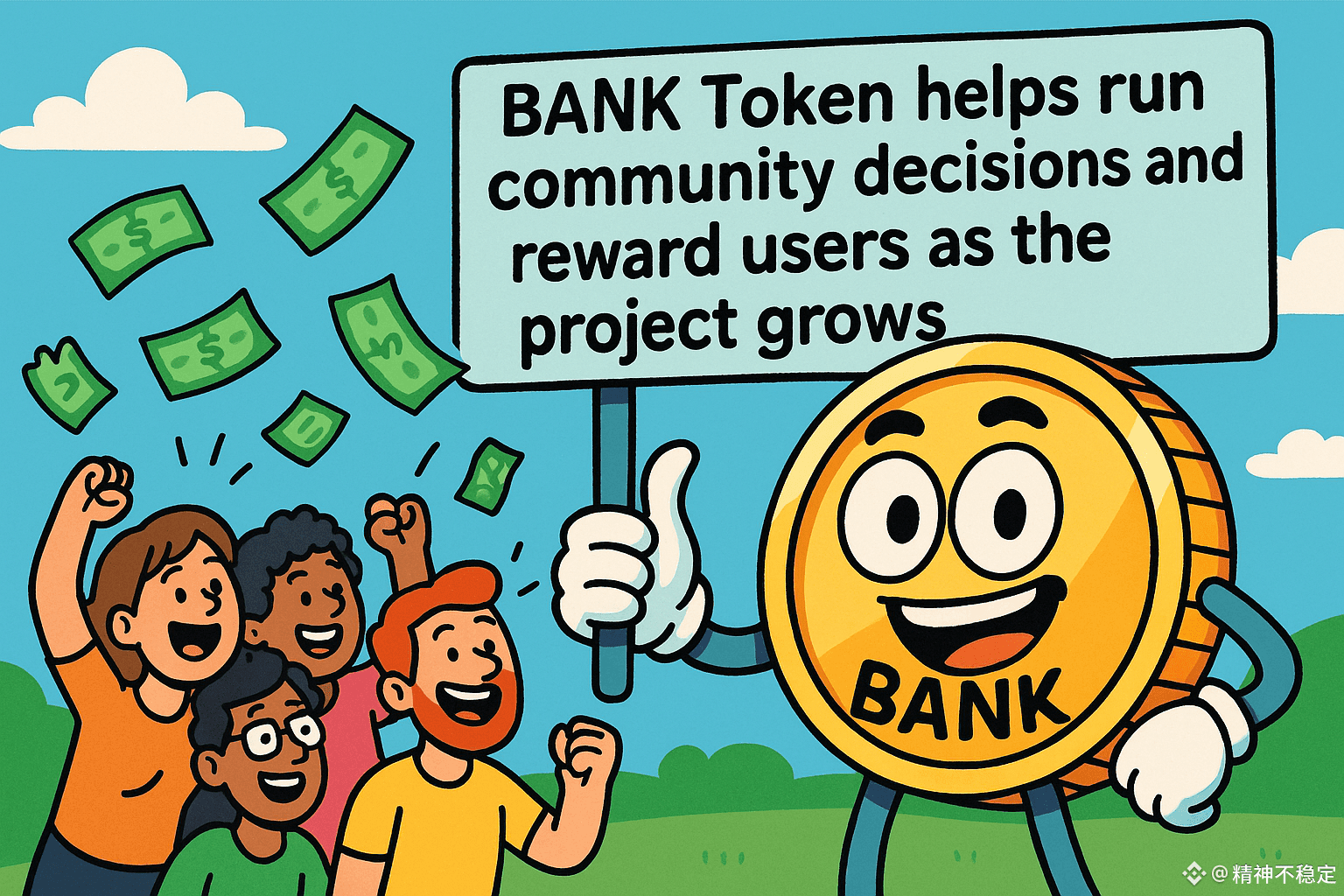
That concept — of a token as governance + utility, rather than a pure speculative asset — feels especially resonant right now.
Years of hype cycles have made many of us wary of quick-profit tokens that disappear just as fast. BANK stands out because it promises a real, community-owned project that can evolve instead of burning out.
But it’s worth pausing and asking: what does “real” really mean in this space? Technically, BANK is what’s known as a “token” — a digital representation built on an existing blockchain — rather than a native blockchain currency. Tokens like BANK generally don’t stand alone; they depend on smart-contract frameworks and the health of the ecosystem around them. That means governance power and community hope — but not necessarily financial guarantees.
In recent months, BANK has drawn renewed attention. Several writeups point to a broader trend: small-cap governance tokens might see renewed interest as investors sift through the larger crypto landscape for unmet potential. Some of the narratives around BANK reference a broader “DAO renaissance,” as decentralized autonomous organizations re-emerge in importance — especially those aiming for real utility, not just speculative reward.
Crypto is getting more thoughtful. Folks are seeing that decentralization only works when users are involved, rewarded fairly, and able to make choices that genuinely affect the system When a token supplies governance — for instance, choosing which vaults to fund, how to allocate capital, or which strategies to pursue — it forces a degree of responsibility and engagement.
Still, I approach this with caution. Governance tokens like BANK often face structural tensions. From recent academic work, there’s a concern that “decentralized” protocols may end up centralized in practice — when a small number of large holders control the vote, or when institutional actors accumulate enough tokens to sway decisions heavily. In other words: even a token built on the promise of democracy can fall victim to concentration.
For holders, this presents a trade-off. On one hand, participation in governance brings a sense of ownership, voice, and agency — especially if the community stays active, transparent, and values inclusion. On the other hand, if distribution is skewed or participation low, governance may become symbolic rather than meaningful. I’ve seen similarly ambitious tokens that end up being more like membership badges than levers of real change.
Beyond the token itself, the broader environment around tokenization seems to be shifting. There’s renewed institutional interest in what happens when traditional banking money — deposits or other bank liabilities — gets tokenized or reimagined on blockchain. From what I’ve read, proponents argue that such “bank tokens” (not the same as BANK, in many cases) could bring the stability and regulatory foundations of banking into the digital-asset world: deposit insurance, supervision, and existing frameworks around liquidity and compliance.
That trend matters because it signals a broader shift: tokenization is slowly evolving beyond speculative crypto and into a zone where real-world money, regulated banking infrastructure, and decentralized systems intersect. In that context, BANK — as a governance token with a community focus — sits at an interesting crossroads of idealism and practicality.
Still, as much as I like the ambition, I’m skeptical about how many governance tokens will survive the test of time. Real, sustained community engagement is hard — especially when market cycles push volatility and hype. I worry about inertia (people buying a token but never voting), about governance capture (few holders controlling votes), about fragmentation (conflicting incentives among holders), and about liquidity issues (when there’s little real economic activity behind the token).
Moreover, with so many tokens across chains sharing similar names or tickers (some tokens using “BANK” may not even be related), it’s easy for confusion to spread. One recent write-up makes that exact point: multiple projects claim the same ticker, which complicates evaluation and carries obvious risk if one gets mixed up with another by mistake.
And there’s a more fundamental question haunting all this: is a “tokenized community governance + reward system” sufficient to build sustainable value? For a long-term project to succeed, it seems to me you need more than votes and promises — you need real utility, clear economics, community alignment over time, transparency, and resilient governance design.
When I think about BANK, I’m both hopeful and cautious. I admire the aspiration: giving community members real say, aligning interests, and trying to build something beyond speculation. I resonate with that ideal. But idealism in crypto can sometimes clash hard with reality. Dreams depend on active, robust participation; strong fundamentals; clear incentives. Without them, governance tokens risk becoming empty shells — trendy souvenirs rather than engines of value.
If I were you and considering BANK seriously, I’d treat it as a long-shot, long-term experiment rather than a quick bet. I’d dig into the token distribution, look at how many holders are active, check proposals history, see how governance has actually changed things (or tried to), and consider what “value creation” means in this ecosystem over time.
At the end of the day, BANK feels like a small but meaningful attempt to reclaim something often lost in crypto: human agency, community, shared vision. That alone gives it a kind of quiet significance. But whether it becomes a durable part of a tokenized future — or fades as another gamble — depends less on hype and more on people actually using it, governing it, and building something together.
@Lorenzo Protocol #lorenzoprotocol $BANK

