

@Lorenzo Protocol There’s a moment in every market cycle when a quiet experiment suddenly becomes a real option. Tokenized treasuries feel like they’ve just crossed that threshold. A year ago, most people in finance would have brushed them off as interesting but too early. Now they’re popping up in risk committees, pilot programs, and strategy decks, not because they’re shiny but because they’re practical. That shift is what makes OpenEden’s tokenized treasuries slipping into Lorenzo’s USD1+ OTF strategy worth paying attention to. It signals that something more durable might finally be taking shape. 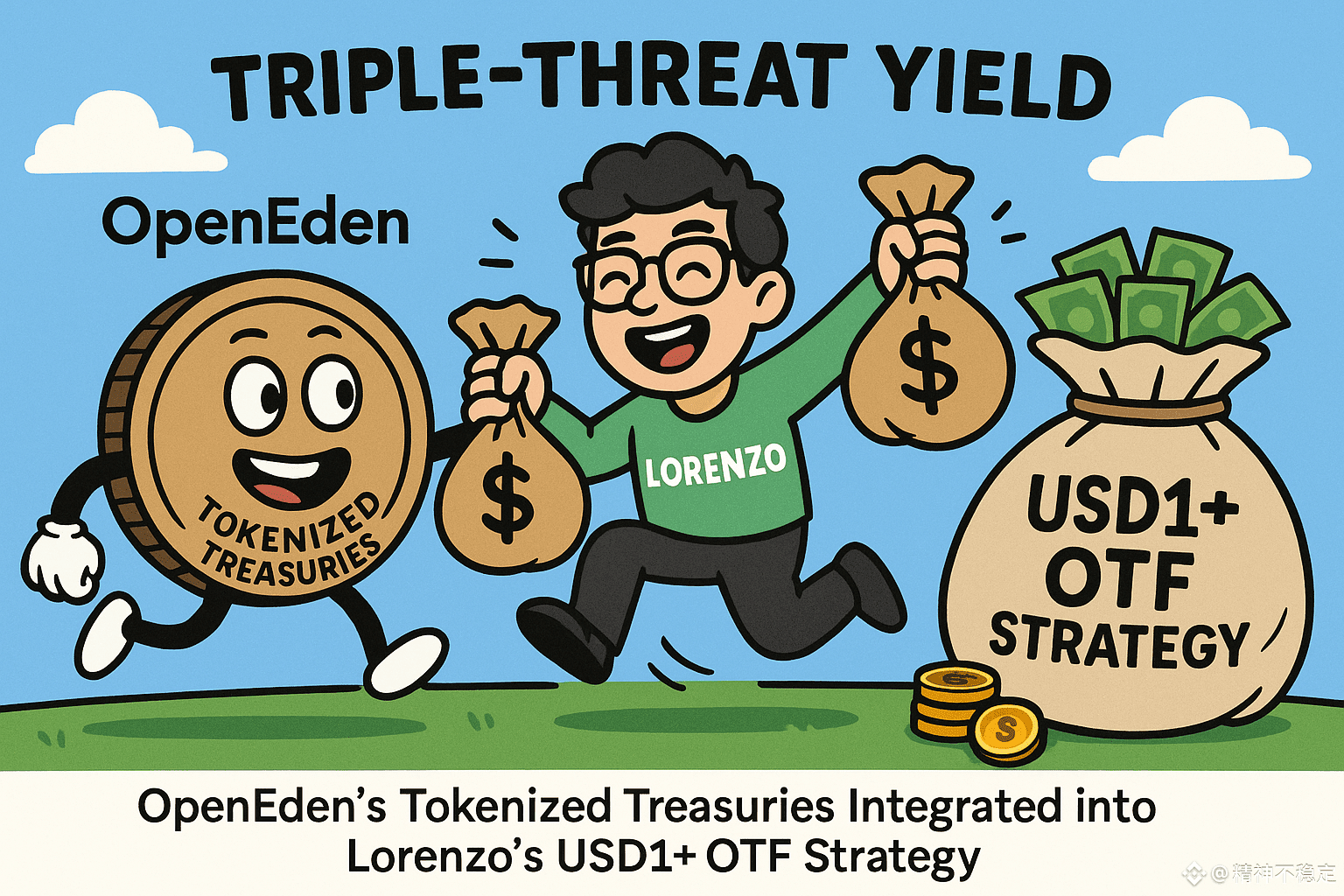
What stands out first is how ordinary the motivation is. This isn’t a moonshot or a philosophy contest; it’s simply a hunt for better yield with more flexible rails. In my own work around digital asset infrastructure, I’ve watched teams struggle to bridge traditional cash management with on-chain liquidity. They often end up with awkward half-solutions—custodians that don’t talk to smart contracts, DeFi protocols that don’t speak the language of compliance, or settlement layers with just enough friction to make treasurers nervous. Seeing OpenEden’s vault integrate into an operational strategy like @Lorenzo Protocol OTF feels like the kind of “small but real” progress that tends to matter more than big headline partnerships.
The appeal of treasuries right now is obvious. Yields climbed and stayed high enough that suddenly the world remembered they exist. But the more interesting angle is how tokenization turns them from static portfolio pieces into mobile collateral that can live inside tactical trading strategies. When you look at the USD1+ OTF setup—where yield, liquidity, and intraday optionality all matter—it makes sense that an instrument like OpenEden’s tokenized T-Bills would be considered. You’re still talking about conservative underlying assets, yet the wrapper allows these assets to plug into on-chain workflows without compromising their core characteristics.
I’ve seen that tension firsthand: wanting the reliability of traditional securities but also the agility of digital rails. People often underestimate how much of traditional finance is limited by timing. Money that sits still for a day because settlement is slow. Capital trapped in structures that can’t move freely. Decisions made at 3 p.m. because wires don’t clear after hours. Tokenized treasuries don’t magically solve all that, but they nudge open a door. They let yield-bearing assets operate closer to the rhythm of on-chain activity, a rhythm that increasingly sets expectations for speed and transparency.
What I find compelling, and a bit surprising, is how quickly this narrative has picked up momentum. Tokenized real-world assets used to be an academic topic. Now they’re on the trending lists of institutional research desks and making their way into regulated product discussions. The shift seems less about crypto enthusiasm and more about a broader structural frustration. Banks, funds, and even corporates are tired of waiting for systems built decades ago to modernize. So when someone shows a working pipeline, even if it’s not perfect, people lean in.
Lorenzo’s strategy has always been about incremental efficiency, not dramatic reinvention. That’s why this integration carries weight. It’s one thing for a tokenization platform to announce theoretical use cases. It’s another for an investment firm to weave them into something as sensitive as a cash and liquidity strategy. That indicates actual diligence, the kind where folks sit in rooms and ask uncomfortable questions. What’s the counterparty risk? What happens during a redemption surge? How does the OTF handle collateral shifts? These aren’t glamorous details, but they’re the ones that determine if a technology sticks.
From the outside, the idea of a “triple-threat yield” sounds like a tagline, but the mechanics are more grounded. Treasuries offer baseline yield. The tokenized structure smooths access and movement. And the OTF strategy layers in a methodical process for squeezing value out of short-duration cash positions. Put together, the system tries to do what every asset manager quietly wishes for: earn meaningfully more on idle dollars without taking on meaningfully more risk. It’s not a revolution; it’s responsible opportunism.
Why now? Part of it is simply timing. Post-2020 markets forced investors to question every assumption about liquidity and settlement. The rate environment added urgency: when yields matter, inefficiency hurts. And the digital asset sector matured just enough—custody is stronger, compliance frameworks improved, and regulators started acknowledging tokenized securities instead of ignoring them. All of this creates space for experiments that would’ve been dismissed earlier.
Still, I think the deeper reason is cultural. There’s a growing recognition that the old categories—traditional finance versus crypto—don’t map neatly onto the problems people need to solve. Firms aren’t choosing sides anymore; they’re choosing tools. If a blockchain-native wrapper for T-Bills helps with allocation timing, treasury operations, or intraday liquidity management, then it earns a place on the table. The ideology fades, and the utility remains.
Of course, it’s early. Every move into tokenized assets comes with trade-offs, and I’ve watched enough pilots stall to know momentum isn’t guaranteed. But this integration feels different because it’s not chasing hype. It’s responding to real operational needs. That’s often how adoption creeps in: quietly, through the back door of practical use, rather than the front door of grand narratives.
What’s unfolding here hints at a future where yield isn’t just about return percentages but about the efficiency of the rails underneath. And for the first time in a while, those rails are changing fast enough that even conservative strategies are taking notice.
@Lorenzo Protocol #lorenzoprotocol $BANK

