

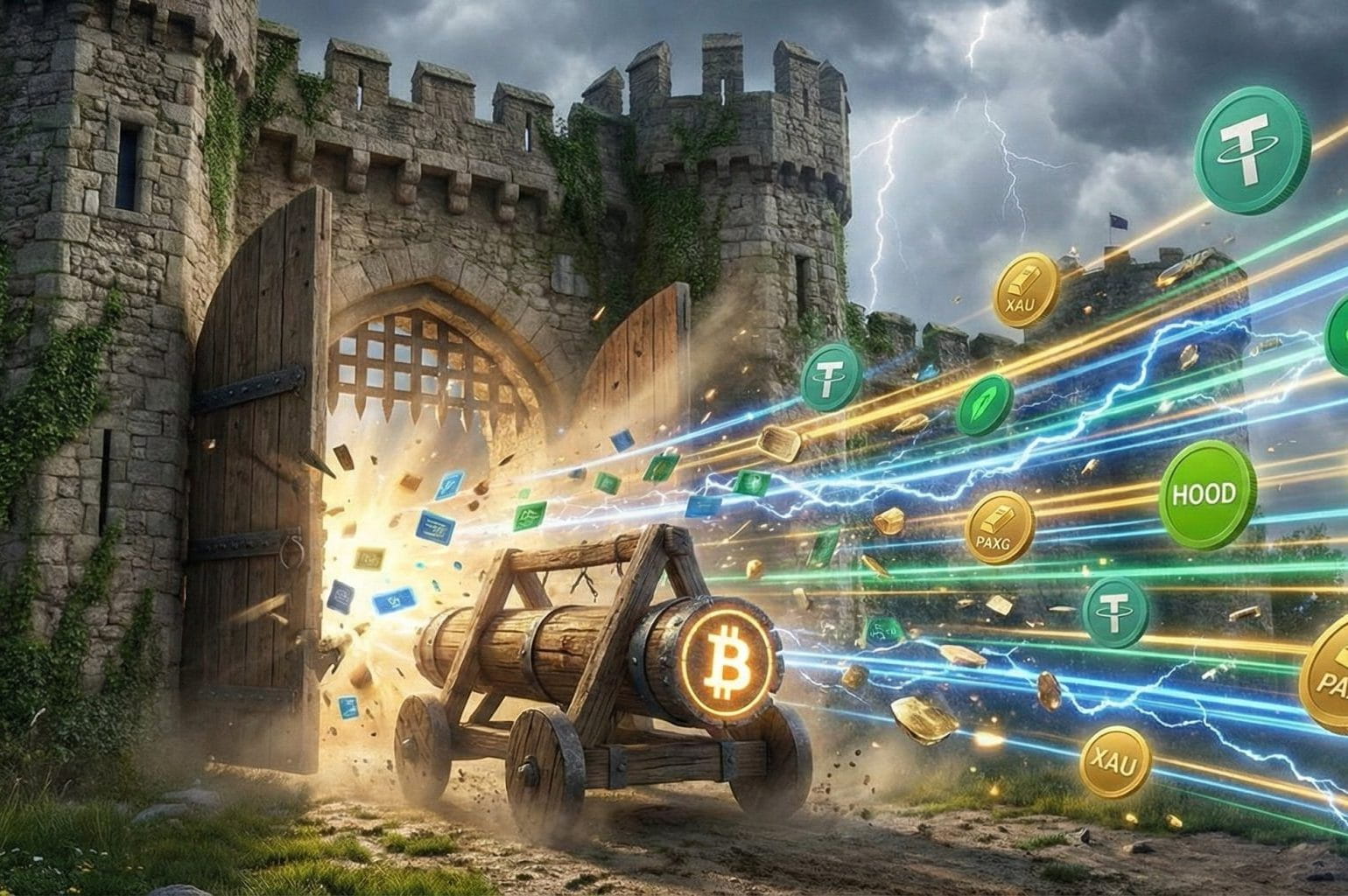
Bitcoin was once seen as the starting point of a financial revolution, from a symbol of rebellion and a weapon against regulation to a global trillion-dollar asset. However, as countries open up tokenized assets and financial infrastructure undergoes a comprehensive upgrade, capital is quietly leaving Bitcoin.
Researcher @PillageCapital argues in the article (The Great Cryptocurrency Exodus: Why Funds Are Leaving Bitcoin) that Bitcoin has completed its historical mission; it is no longer the ultimate solution but rather a 'battering ram' of the previous era. The next wave of true mainstream narratives has already shifted towards the tokenization of real assets.
The former torch of rebellion: How Bitcoin became the 'financial battering ram'?
@PillageCapital points out that Bitcoin's emergence was not for efficiency, but for survival.
From the 1990s to the 2000s, many digital currencies were easily destroyed by governments due to centralization weaknesses. The most typical example is E-gold, which was popular for its anonymity, convenience, and cross-regional nature. However, this platform, with 5 million users and an annual transaction volume of 2 billion dollars, vanished after regulatory enforcement actions in 2005.
Satoshi Nakamoto saw the fatal flaw and thus created a decentralized system that cannot be destroyed and cannot be terminated by law enforcement.
Bitcoin has never been the future of currency; rather, it is a weapon against state blockades and a battering ram to break financial monopolies.
Necessary illusion: How did Bitcoin rise to become a revolution for all?
In the early days, using Bitcoin was a political act. Downloading a wallet and scanning a QR code allowed for instant payments without banks and regulatory oversight. This was the first time people felt the shock of 'free money', and this rebellious narrative, combined with network effects and self-reinforcing value cycles, propelled Bitcoin's continuous expansion.
From heated discussions in Reddit communities to live fundraising at large conventions, to institutions and regulators being forced to join in, including BlackRock applying for ETFs, companies using corporate bonds to buy BTC, and presidential proposals to make Bitcoin a national reserve:
This activation mechanism can be called perfect. By investing in a business, posting, promoting, debating, and guiding new users, it directly increases the value of tokens in one's own wallet and friends' wallets. This rebellion can earn you rewards.
However, the author believes this is all an illusion, as Bitcoin continues to grow after each regulatory crackdown and negative report, and everyone seems to believe that this 'magical internet currency' is the true destination.
The end of the monopoly era: Bitcoin is no longer the only option.
The biggest moat of Bitcoin has never been efficiency, but rather 'monopoly'. In an era of strict financial regulation and outdated payment channels, the only path to digital value or true financial freedom is through Bitcoin.
Now the situation is different: financial products like US stocks, US bonds, and gold are beginning to move towards tokenization, tokenized fiat (stablecoins) have a market value of hundreds of billions, banks are integrating stablecoins, and exchanges like Coinbase are incorporating banking services.
The author uses the migration of USDT as an example: "USDT was initially issued on Bitcoin, but later switched to Ethereum for lower fees and better usability, then to Tron."
Stablecoin enterprises have no loyalty to any chain; they view blockchain as a disposable pipeline, where assets and issuers are what truly matters.
Therefore, when more available and competitive channels emerge, Bitcoin will lose its monopoly and pricing power.
(No one cares about your chain: After enterprise-level L1 vertical integration, is there still room for Ethereum and L2?)
Technical reality: Bitcoin has never been a good payment system.
At the same time, Bitcoin has had many technical flaws over the years, including:
Addresses are hard to remember, and easy to transfer incorrectly and lose.
Transaction fees are unstable, having spiked to hundreds of dollars.
Wallets often experience transaction lags and do not display balances.
Transfers and cross-chain transactions are complex and prone to error.
Ironically, the improvement in user experience did not come from decentralized protocols, but from centralized institutions like Coinbase and Binance, which expanded BTC's usability through Web2 mechanisms like passwords, account recovery, and customer service. It is hard to imagine that Bitcoin ultimately failed to deliver the financial services it claimed to replace.
Returns are no longer overtaking: high risks have not resulted in high rewards, but rather a comprehensive lag.
Looking back at this four-year cycle, Bitcoin's returns have been surpassed by many traditional financial products.

Investors have endured regulatory pressure, hacking attacks, various scams and phishing URLs, exchange blowups, and severe volatility, only to end up trailing a tech stock index.
In terms of supply and demand, the old giant whales need to cash out monthly to maintain their living, while the conservative new funds from ETFs only invest 1% to 2%: "These meager funds must contend with the relentless sell-off from early holders, exchange fees, fraudulent tokens, and hacking attacks just to barely keep prices from falling."
The era of gaining massive profits by evading regulation has passed.
The crypto ecosystem is stagnant: developers are turning to AI, and innovation is lacking.
In terms of technological advancement, developers seem to have sensed that the halo of technological frontier is no longer shining, and prices have stagnated. Activity levels have fallen back to 2017 levels, with many young engineers moving to fields like AI and robotics.
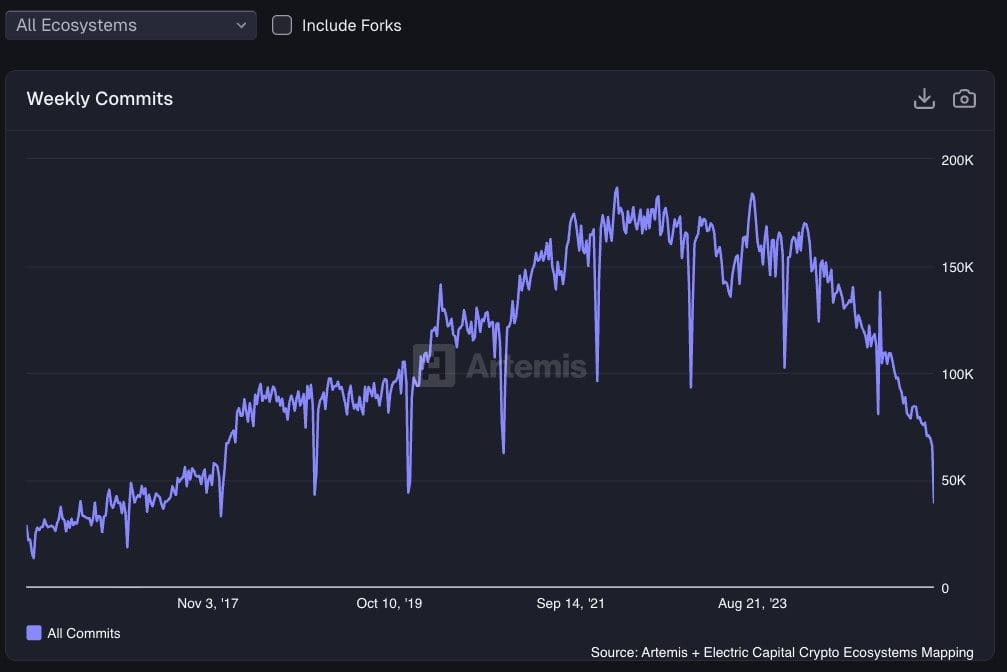 The number of developer proposals per week in each ecosystem.
Now, Bitcoin's code is hard to upgrade, and the pace of core development has slowed. Without new applications, no technological iterations, and no incremental demand, it is natural that the value is difficult to enhance.
Human nature and institutional choices: What the world truly needs is 'correctable' finance.
The irreversible reality of cryptocurrencies led by Bitcoin, which claims 'code is law', is precisely the opposite of the logic of human societal systems.
He pointed out the reasons why Tether can be widely used globally, including frozen assets due to hacking, erroneous transfers can be blacklisted and replaced, and there are complaint processes and KYC verification.
Clearly, no one truly wants a completely unregulated financial system. These 'remedial' mechanisms are what can provide most users with a sense of security.
In this era of cryptocurrency moving towards compliance, the extreme decentralization of Bitcoin has become untimely.
A new era has arrived: capital is flooding into tokenized real assets.
The author clarifies that Bitcoin has not failed; rather, it has successfully completed its mission: "It has broken the state's blockade on digital assets, forcing the world to accept tokenized finance."
Now, new protagonists are emerging, from tokenized gold, US stocks to the explosion of various infrastructure. These assets have real value, yield, regulation, and channels for complaints, and are expected to gradually become the foundation of a new global financial system.
The era of Bitcoin is coming to an end, and the door to tokenizing physical assets is opening. Instead of worshiping the tools that break through the door, it is better to start focusing on the truly important assets and transactions on the other side.
This article looks at the future prospects from the perspective of Bitcoin positioning: BTC's revolutionary mission is over, capital is retreating towards tokenized assets. It first appeared in Chain News ABMedia.

