

The market suddenly erupted into a frenzy of asset purchases, all stemming from a few dovish statements by Federal Reserve officials. On November 25, global financial markets experienced a comprehensive surge. Two senior Federal Reserve officials simultaneously released clear signals for a rate cut, driving U.S. stocks, gold, crude oil, and even cryptocurrencies higher.
The dovish remarks from Federal Reserve Governor Waller and San Francisco Fed President Daly have caused the market's expectations for a rate cut in December to soar from 42% a week ago to 82.9%.
This overall market rally is like a bomb in the recent sluggish market, with the Nasdaq index soaring by 2.7%, marking the best single-day performance since May; Bitcoin breaking through $88,000; even traditional safe-haven asset gold has surged over 1%.
 1. Federal Reserve Shift: Key Officials Speak Out
The dovish comments from two heavyweight Federal Reserve officials directly ignited global market enthusiasm. Federal Reserve Governor Waller clearly stated that he advocates a rate cut at the December policy meeting.
● Waller pointed out that most private sector data shows a weak job market, and he believes inflation is not a serious issue, with the inflation rate excluding tariff impacts only around 2.4% or 2.5%.
● More critically, San Francisco Fed President Daly also expressed support for a rate cut in December on the same day. Daly explained her decision-making logic: the likelihood of a sudden deterioration in the labor market is greater than a sudden rise in inflation, and it is also harder to control. As a staunch ally of Fed Chairman Powell, Daly's stance has always been 'neutral but hawkish,' rarely publicly opposing Powell's position.
● Analysts believe that when such figures come out to support rate cuts, it is equivalent to an official hint at a rate cut.
2. Market Reaction: Assets Rise Across the Board
Under the stimulus of dovish signals from Federal Reserve officials, a 'rally of all things' has erupted in global markets.
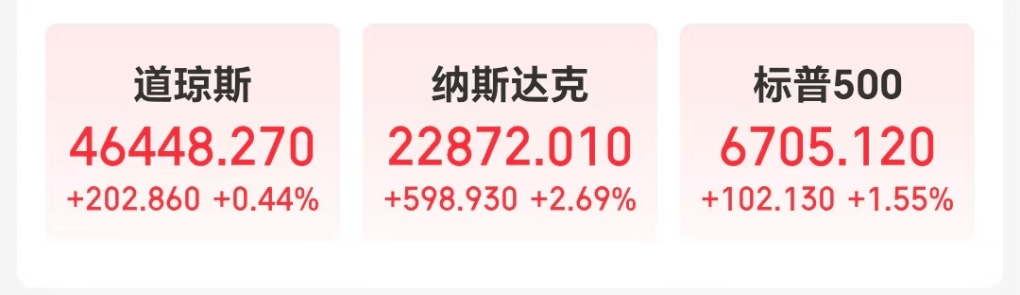
● All three major U.S. stock indices closed higher, with the S&P 500 index rising by 1.55%, marking the largest increase in six weeks; the Dow Jones rose by 0.44%; the Nasdaq index performed particularly well, surging by 2.69%.
● Tech stocks have become the leaders in the market rebound. Tesla surged nearly 7%, Google soared over 6%, Amazon and Meta both rose over 3%, and Nvidia increased by 2.05%. The semiconductor sector performed particularly well, with the Philadelphia Semiconductor Index skyrocketing by 4.63%.
● Chinese concept stocks also rose alongside the broader market, with the Nasdaq China Golden Dragon Index closing up 2.82%. WeRide rose 14.72%, Pony.ai rose 12.51%, Baidu rose 7.44%, Bilibili rose 6.80%, and Alibaba rose 5.10%.
3. From Gold to Bitcoin
Not only the stock market, but other asset classes have also risen.
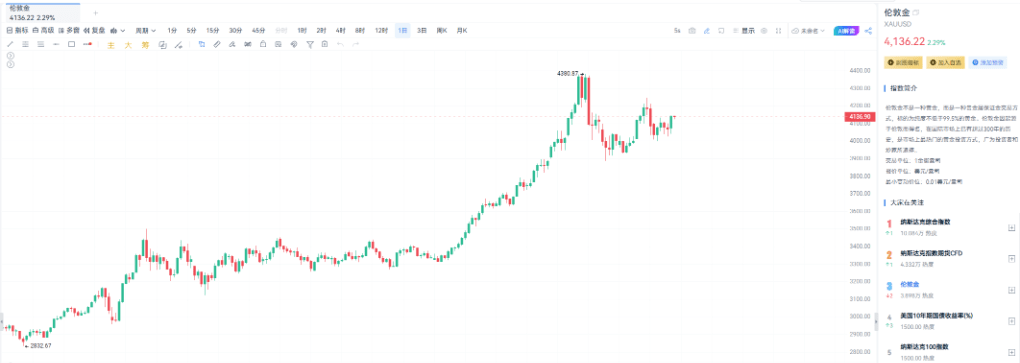
● Gold surged strongly under the influence of rising expectations for a Fed rate cut, with spot gold reaching a high of $4099.03 per ounce, an intra-day increase of 0.8%. Bart Melek, head of commodity strategy at TD Securities, interpreted: 'The market is increasingly convinced that the Fed will initiate a rate cut in December. Lower rate expectations combined with a weak dollar are supporting gold prices.'
● The crude oil market has reversed its three-day decline, rising over 1% and moving away from a one-month low.
● In the cryptocurrency space, Bitcoin has broken through the $88,000 mark, rising over 2%.
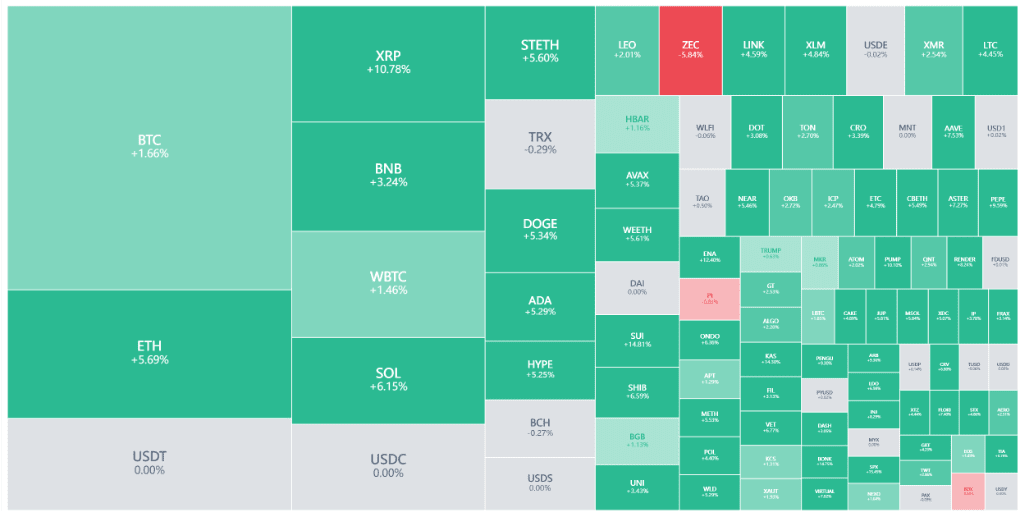
The phenomenon of risk assets and safe-haven assets rising in sync is quite rare in normal market conditions, but it was vividly illustrated on Monday.
4. Rate Cut Probability: Expectations Heat Up
With the continuous dovish statements from Federal Reserve officials, the market's expectations for a rate cut in December have changed dramatically.
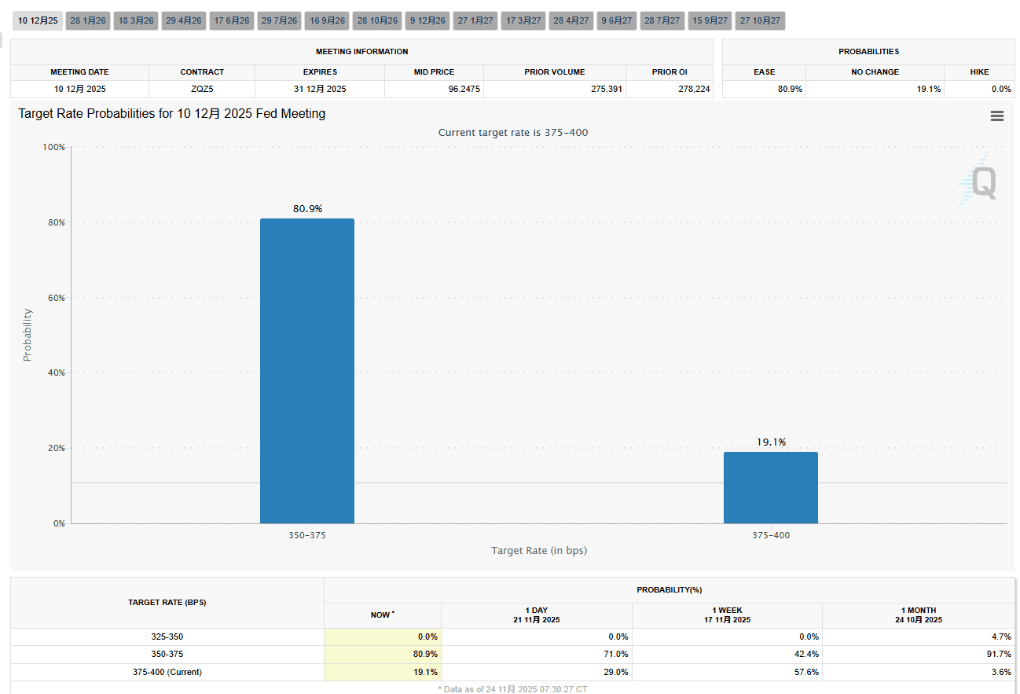
● According to CME's 'FedWatch' tool, the probability of the Fed cutting rates by 25 basis points in December has surged to 82.9%, while just the day before, this probability was only 69.4%.
● This shift is particularly surprising because just a week ago, the market's expected probability for a rate cut in December was only 42%.
● Looking longer term, the market expects that by January next year, the probability of the Fed cutting rates by a cumulative 25 basis points is 65.4%, while the probability of a cumulative cut of 50 basis points has also reached 22%.
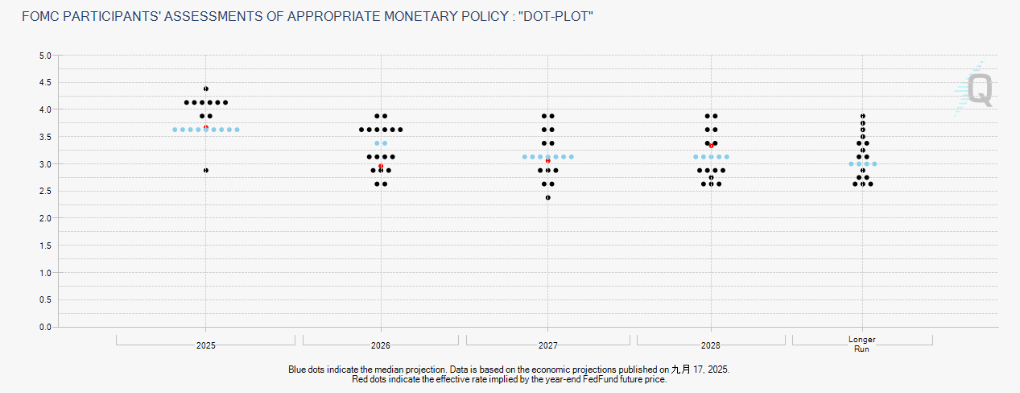
This dramatic shift demonstrates the huge influence of Federal Reserve officials' statements on market expectations.
5. U.S.-China President Call: Boosting Market Sentiment
In addition to the Federal Reserve's rate cut signals, the phone call between the Chinese and U.S. presidents has also added positive factors to market sentiment. On November 24th, 8 PM UTC+8, the two presidents spoke on the phone.
● The Chinese side emphasized during the call that since the Busan meeting, China-U.S. relations have generally stabilized and improved, and both sides should maintain this momentum. The Chinese side also pointed out the need to adhere to the correct direction, extend the cooperation list, condense the issue list, and strive for more positive progress to open up new cooperation space for China-U.S. relations.
● The U.S. side stated that both sides are fully implementing the important consensus reached at the Busan meeting. In addition, the two leaders reached a consensus on maintaining the post-war international order and discussed international hotspots such as the Ukraine crisis.
This news further boosted market risk appetite, adding momentum to the global asset rally.
6. Market Outlook: A Data-Dependent Future
Despite the market's enthusiastic response to the Fed's rate cut, there is still uncertainty about future trends.
● The Federal Reserve Governor Waller supports a rate cut in December while also hinting that once the Fed has more comprehensive economic data in January, the decision-making approach may shift to rely more on a 'meeting-by-meeting' pace.
● Waller stated in an interview with Fox Business: 'Under the framework of the Fed's dual mandate, my greatest concern at the moment is the state of the labor market. Therefore, I support taking action on rate cuts at the upcoming meeting.'
● Analysts warn that the sustainability of this rebound heavily depends on whether 'data continues to worsen.' This is the so-called 'post-cycle counter-logic'—the worse the economic data, the easier it is to support short-term trends, as it exacerbates the market's expectations for Fed intervention.
In this environment, the market rises quickly and also falls particularly fast. Some analysts believe this week is not a 'direction week,' but rather a 'volatility week.'
The market has formed a deep dependence on the Federal Reserve—when it cries, it gets sugar; when it falls, it gets expectations of rate cuts.
The Fed's rate cuts have shifted from being a tool for economic adjustment to a mechanism for market stability, and this collective frenzy of global assets raises the question of whether it marks the beginning of a sustainable bull market or yet another 'rate cut illusion.'
Join our community to discuss and become stronger together!
Official Telegram community: https://t.me/aicoincn
AiCoin Chinese Twitter: https://x.com/AiCoinzh
OKX welfare group: https://aicoin.com/link/chat?cid=l61eM4owQ
Binance welfare group: https://aicoin.com/link/chat?cid=ynr7d1P6Z


