

In November 2025, a report from the Hong Kong Police Force once again shocked the entire internet regarding the JPEX cryptocurrency scam that had been silent for two years—16 people have been formally prosecuted, 3 masterminds are wanted by Interpol, a total of 80 people have been arrested, and more than 2,700 investors have lost their entire investments, with the amount involved reaching 1.6 billion Hong Kong dollars. This event, known as the 'largest cryptocurrency explosion in Hong Kong's history,' has fully showcased a virtual asset scam's temptation of high returns, regulatory warnings, platform collapse, and transnational pursuit of culprits. Today, we will dissect the ins and outs of this case and see the true nature of the cryptocurrency traps.
Prelude to the collapse: From 'high interest myth' to the 48-hour horror of withdrawal freeze
The turning point of the story occurred on September 17, 2023, when countless JPEX users found that the virtual assets in their accounts suddenly could not be withdrawn. Just when everyone thought it was a system malfunction, a warning from the Hong Kong Securities and Futures Commission (SFC) sounded like thunder: JPEX had never obtained a virtual asset trading license and was operating illegally!
Panic spread like a tide, and within just two days, police received thousands of reports. Even more shocking was that on September 19, the police launched 'Operation Iron Gate,' arresting the first batch of 8 people, including the well-known KOL Lin Zuo, who had 150,000 Instagram followers. This Oxford graduate, a former lawyer and insurance agent, frequently claimed through live broadcasts and lectures over the past two months: 'JPEX has obtained licenses from the United States, Canada, Dubai, and other countries; I have exclusive news, it is absolutely safe!' It was these false promises that led many fans to willingly invest their funds.
At this point, investors still did not know that the seeds of this collapse had long been sown. As early as July that year, users in the mainland reported difficulties in withdrawals, and some were even lured to Hong Kong to 'solve problems,' only to be ambushed and beaten on the streets of Sheung Shui. However, the warnings at that time were overshadowed by overwhelming advertisements and KOL promotions.
Scam disclosure: How to weave the illusion of wealth with 'fake licenses + high interest'?
The rise of JPEX can be described as a meticulously planned 'wealth creation show.' Established in Dubai in 2020, this organization, claiming to be a 'global digital asset trading platform,' targeted the Hong Kong market.
The most direct impact came from offline advertisements—subway stations, bus bodies, shopping mall exteriors; JPEX's promotional posters were everywhere, even marked with the words 'Japanese cryptocurrency exchange,' creating the illusion of 'official certification.' Even more enticing was its core product 'Earn': Bitcoin annualized yield 20%, Ethereum 21%, stablecoin USDT 19%. It should be noted that at that time, bank deposit rates were less than 1%, such high returns were enough to tempt anyone.
To make the scam more credible, JPEX claimed to hold financial licenses from the United States, Canada, Australia, and Dubai VARA. However, the Securities and Futures Commission's investigation exposed the lie: these so-called 'licenses' only allowed for foreign exchange exchanges and had nothing to do with virtual asset trading. The Japanese Financial Services Agency and Dubai VARA also clarified that they had never approved JPEX's operations.
Offline OTC stores (over-the-counter trading shops) and KOL promotions constitute the 'last mile' of the scam. The platform opened several OTC stores in Hong Kong, where staff taught investors how to deposit funds; at the same time, they recruited influencers like Lin Zuo and former TVB artist Chen Yi (a YouTuber with 100,000 fans) to repeatedly instill the concept of 'low risk and high returns' through their social accounts. These promotional activities did not stop until the collapse.
Regulatory games: Regulatory loopholes and accelerated collapses under the new system
In fact, Hong Kong already had preventive mechanisms in place. On June 1, 2023, Hong Kong officially implemented the virtual asset trading platform licensing system, requiring all platforms to obtain SFC licenses to provide services to retail investors. However, JPEX did not apply for a license and continued to operate in defiance of the law.
On September 13, 2023, the Securities and Futures Commission issued a targeted warning, explicitly stating that JPEX was operating without a license, and its high-interest products were suspected of illegal fundraising, demanding that all KOLs stop promoting immediately. Unexpectedly, JPEX turned this warning into 'reverse marketing'—the platform published an article on its official website that day, claiming 'the Securities and Futures Commission is unfairly suppressing' and disingenuously said 'considering withdrawing the Hong Kong license application,' packaging itself as a 'victim of regulation.'
This operation completely ignited panic, with investor complaints soaring from hundreds to over 1,600. Four days later, JPEX finally revealed its true colors: first announcing that 'third-party market makers froze funds' and delisting all high-interest products; then raising the USDT withdrawal fee from 10 USD to 999 USD, while the single withdrawal limit was exactly 1,000 USD—this meant that after all their hard work, investors could only withdraw 1 USD, effectively 'freezing assets.' Netizens angrily criticized: 'This is not a restriction on withdrawals; it is clearly a disguised escape!'
Two years of chasing the culprit: 80 people arrested and an international red notice
After the platform collapsed, the Hong Kong Police Commercial Crime Bureau took on this 'hard nut.' As the investigation deepened, a complete criminal network covering 'core operations + OTC stores + KOL promotion + money laundering' surfaced.
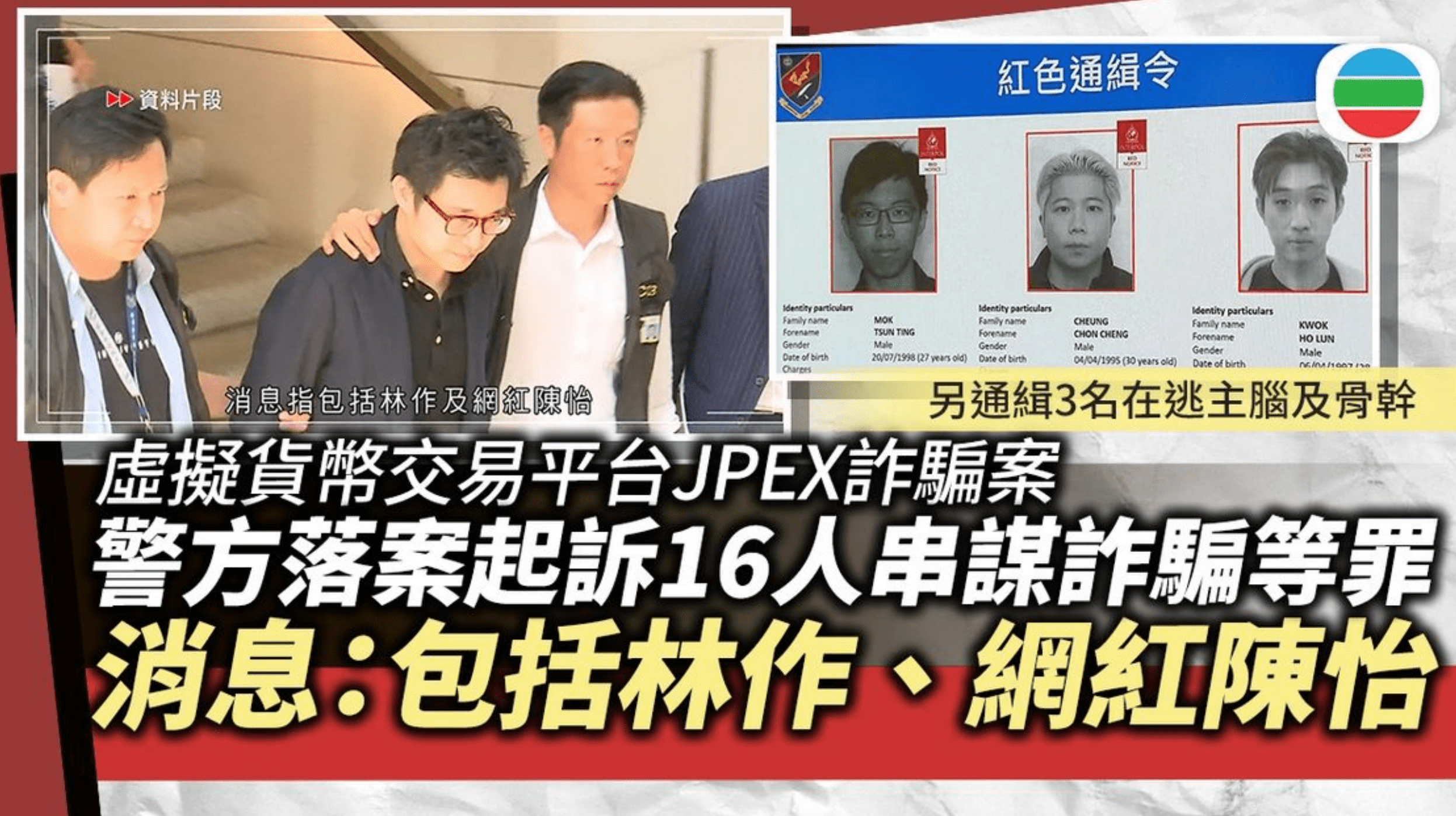
By October 2023, the number of arrests had risen to 28, including the founder of 'Hong Coin,' 28-year-old KOL Cai Xiaodong, who was found to have generated traffic through social accounts and offline clubs, profiting from the OTC store commission. This investigation lasted for two years, and it wasn't until November 5, 2025, that the police announced the first round of formal prosecutions—among the 16 defendants, 6 were core members of JPEX, 7 were OTC heads and KOLs (including Lin Zuo and Chen Yi), and 3 were 'nominal account holders' used for money laundering.
More importantly, Interpol issued red notices for three masterminds that day: 27-year-old Mo Junting, 30-year-old Zhang Juncheng, and 28-year-old Guo Haolun. These three were accused of leading the entire scam's fund transfers and money laundering, and they had long since fled abroad. So far, the police have arrested a total of 80 people and frozen 228 million Hong Kong dollars in assets, including cash, gold bars, luxury cars, and some virtual assets, but for the loss of 1.6 billion Hong Kong dollars, it is merely a drop in the bucket.
On November 6, 2025, when the Eastern District Court convened, 14 defendants were granted bail, with Lin Zuo and Chen Yi each posting 300,000 Hong Kong dollars in bail and submitting their travel documents for regular reporting. This two-year-long manhunt is far from over.
Bloody lessons: The three major traps behind the cryptocurrency frenzy
The JPEX scam is not an isolated case; rather, it is a microcosm of the chaos in the virtual asset market. It has sounded three alarms for all investors:
First, 'high interest' is always the core bait of a scam. An annual yield exceeding 6% should raise a red flag, and exceeding 10% can basically be confirmed as a scam. The 20% yield promised by JPEX is essentially paying old investors' interest with new investors' money, a typical Ponzi scheme model.
Second, KOL endorsement does not equal 'safety certification.' Influencers like Lin Zuo and Chen Yi never verified JPEX's license qualifications while promoting, only caring about promotional profits. Regulatory authorities later emphasized that KOLs promoting financial products must fulfill their verification duties; otherwise, they will bear legal responsibility.
Third, 'operating without a license' is a red line. After Hong Kong implemented the virtual asset licensing system, legitimate platforms would publicly disclose license information. Before investing, you must check the SFC's official website. Platforms without licenses, no matter how loud their advertisements, should absolutely not be touched.
Now, the JPEX scam has pushed Hong Kong's virtual asset regulation to tighten further, but for more than 2,700 victims, the lost 1.6 billion Hong Kong dollars can never be recovered. The frenzy in the cryptocurrency world will eventually come to an end; only by adhering to the bottom line of 'not being greedy for high interest, verifying licenses, and not trusting influencers' can one avoid becoming the next victim.
Disclaimer: The content of this article is for reference only and does not constitute any investment advice. Investors should consider their own risk tolerance and investment goals, rationally view cryptocurrency investments, and avoid blindly following trends.

