

The Ministry of Finance is soliciting public opinions for 60 days to implement the anti-money laundering provisions of the (GENIUS Act).
On Monday (8/18), the U.S. Department of the Treasury issued an announcement to initiate public consultation regarding the implementation of the (U.S. Stablecoin National Innovation Guidance and Establishment Act) (hereinafter referred to as the (GENIUS Act)), seeking opinions from various sectors on innovative methods for financial institutions to combat illegal activities related to digital assets.
The Treasury stated that 'interested individuals and organizations' can provide feedback by October 17, regarding 'innovative or novel methods, technologies, or strategies to detect and mitigate illegal financial risks involving digital assets.'
According to the announcement, the Treasury is specifically seeking concrete opinions from industries regarding application programming interfaces (APIs), artificial intelligence, digital identity verification, and blockchain technology monitoring applications. All submitted opinions will be publicly published on the Regulations.gov website. After collecting opinions, the Treasury will conduct analysis and research, and submit a report to the leaders of the Senate Banking Committee and House Financial Services Committee, which may further facilitate the formulation of relevant regulations.
The Finance Minister emphasized that stablecoins expand the influence of the dollar, calling it a win-win situation for all three parties.
Finance Minister Scott Bessent tweeted on X platform on Tuesday that this move is 'crucial' for ensuring America's leadership in the digital asset industry. He pointed out that 'stablecoins will expand the opportunity for billions of people worldwide to use the dollar and lead to a surge in demand for U.S. Treasury securities that support stablecoins.' Bessent described the (GENIUS Act) as a 'win-win-win' situation beneficial for stablecoin users, issuers, and the U.S. Treasury.
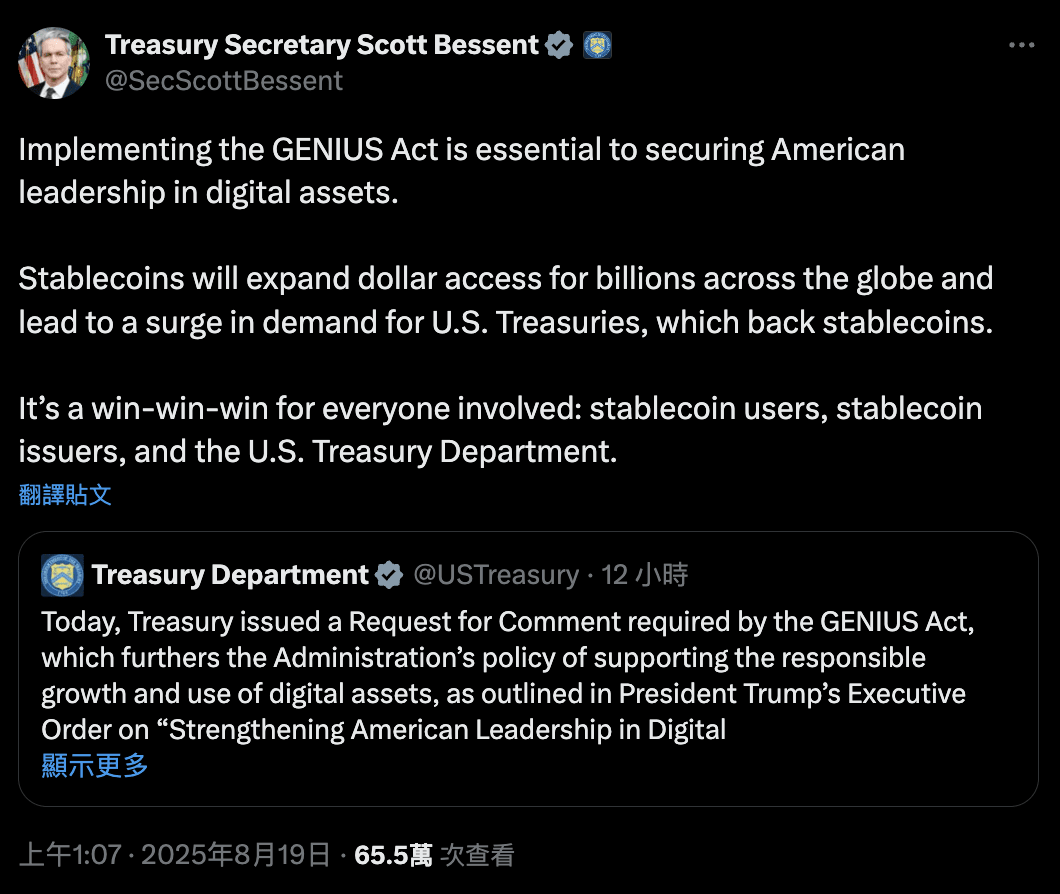 Image source: X/@secscottbessent Finance Minister Scott Bessent stated that stablecoins are 'crucial' for America's leadership in the digital asset industry.
Circle CEO Jeremy Allaire also welcomed this milestone, stating that it is not just financial legislation but also shows that the U.S. is ready to embrace innovations that make finance safer, more transparent, and more inclusive. In a subsequent post, Allaire cited a report from (Semafor) describing the (GENIUS Act) as the 'starter pistol' for a new era of fintech, emphasizing that the internet is now integrating with the global financial system to create extraordinary opportunities.
The (GENIUS Act) establishes a regulatory framework for stablecoins, effective within 18 months.
The (GENIUS Act) was signed into law by President Trump in July, establishing a comprehensive federal regulatory framework for stablecoin issuers. The act requires that stablecoins must be fully backed by dollars or similar liquid assets, and issuers with a market capitalization exceeding $50 billion must conduct annual audits and establish relevant guidelines for foreign issuances.
The act will take effect within 18 months after signing or within 120 days after the U.S. Department of the Treasury and the Federal Reserve complete the formulation of relevant regulations. It is currently entering a typical implementation phase, where federal agencies need to establish specific policies to enforce the new law. U.S. banking regulatory agencies, such as the Office of the Comptroller of the Currency (OCC) and the Federal Deposit Insurance Corporation (FDIC), will also need to develop future regulatory policies for stablecoin issuers.
Further Reading
Three major regulatory agencies voice their opinions! U.S. bank custodians for cryptocurrencies regulations are issued: they must bear all risks.
Ignoring public opinion? The Federal Reserve cancels 'reputational risk' review, why is this a major victory for the crypto industry?
The U.S. gives the green light! Banks can offer cryptocurrency services, and crypto companies are applying for banking licenses.
The banking industry worries that the interest payment ban is too lenient and may distort market mechanisms.
Despite the industry's general welcome of the establishment of a regulatory framework for stablecoins, large banking associations express concerns regarding the ban on interest payments to stablecoin issuers in the (GENIUS Act), believing that the relevant provisions are too lenient. While these organizations support the relevant restrictions, they believe that the new law could be easily circumvented by exchanges, brokers, and other related entities, thereby 'distorting market incentives' and transforming stablecoins from mere payment means into potential value storage and credit mechanisms.
TD Cowen analyst Jaret Seiberg stated that the concerns of the banking industry are reasonable. In a research report on Monday, he wrote: 'We saw funds flow into money market mutual funds during the financial crisis when the government provided 100% support for that industry. We believe that the flow of funds into stablecoins will be a greater threat, as consumers will convert deposits into stablecoins more quickly and easily.'
Further Reading
Demand to close loopholes in the GENIUS Act! U.S. banking industry: Interest on stablecoins may lead to the outflow of $6.6 trillion in deposits.
The article 'Preventing Malicious Actors from Exploiting Loopholes, Public Consultation on the GENIUS Act, Focusing on Stablecoins and Anti-Money Laundering' was first published on 'Crypto City'.