
#sec
sec
333.8M views
1.4M Discussing
Hot
Latest

·
--
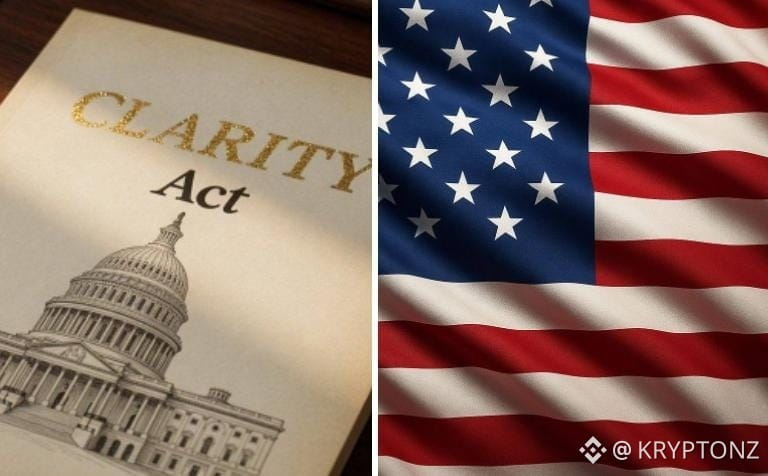
🚨 Today, the US Senate will hold a critical procedural vote on the CLARITY Act, which aims to become the first comprehensive federal regulatory framework for the crypto industry.
Core of the CLARITY Act:
The document (Digital Asset Market Clarity Act) seeks to clearly divide oversight authority over digital assets between two agencies: the Securities and Exchange Commission (SEC) and the Commodity Futures Trading Commission (CFTC).
Depending on their underlying structure, tokens will be classified either as securities or commodities.
It introduces a "blockchain maturity test" mechanism. If a cryptocurrency network can prove its decentralization, its tokens can transition from strict SEC oversight to CFTC jurisdiction.
Centralized platforms (exchanges, brokers) will face new obligations regarding registration and consumer protection.
Latest Amendments and Ethics Rules: Ahead of the vote, Republican senators released an updated draft of the bill to secure Democratic support.
Unprecedentedly strict rules preventing conflicts of interest have been integrated into the text. The restrictions will apply to the sitting President, federal officials, judges, and their spouses.
The "ethics sunset" provision has been completely removed, making the bans permanent and broader in scope.
State Attorneys General are now empowered to monitor and enforce compliance with these ethical restrictions.
US President Donald Trump has endorsed these new provisions and voluntarily agreed to the proposed restrictions.
Reactions and Chances of Passing:
Investor Optimism: Bernstein analysts report "new momentum" for the bill. Since Republicans have included numerous Democratic amendments and agreed on the ethics package, the chances of the legislation passing the Senate have increased.
State Resistance: New York Attorney General Letitia James criticized the current version of the document. She warned that the CLARITY Act would blur existing rules and seriously complicate local authorities' efforts to combat cryptocurrency fraud.
#TRUMP #SEC $TRUMP
{future}(TRUMPUSDT)
🚨 Today, the US Senate will hold a critical procedural vote on the CLARITY Act, which aims to become the first comprehensive federal regulatory framework for the crypto industry.
Core of the CLARITY Act:
The document (Digital Asset Market Clarity Act) seeks to clearly divide oversight authority over digital assets between two agencies: the Securities and Exchange Commission (SEC) and the Commodity Futures Trading Commission (CFTC).
Depending on their underlying structure, tokens will be classified either as securities or commodities.
It introduces a "blockchain maturity test" mechanism. If a cryptocurrency network can prove its decentralization, its tokens can transition from strict SEC oversight to CFTC jurisdiction.
Centralized platforms (exchanges, brokers) will face new obligations regarding registration and consumer protection.
Latest Amendments and Ethics Rules: Ahead of the vote, Republican senators released an updated draft of the bill to secure Democratic support.
Unprecedentedly strict rules preventing conflicts of interest have been integrated into the text. The restrictions will apply to the sitting President, federal officials, judges, and their spouses.
The "ethics sunset" provision has been completely removed, making the bans permanent and broader in scope.
State Attorneys General are now empowered to monitor and enforce compliance with these ethical restrictions.
US President Donald Trump has endorsed these new provisions and voluntarily agreed to the proposed restrictions.
Reactions and Chances of Passing:
Investor Optimism: Bernstein analysts report "new momentum" for the bill. Since Republicans have included numerous Democratic amendments and agreed on the ethics package, the chances of the legislation passing the Senate have increased.
State Resistance: New York Attorney General Letitia James criticized the current version of the document. She warned that the CLARITY Act would blur existing rules and seriously complicate local authorities' efforts to combat cryptocurrency fraud.
#TRUMP #SEC $TRUMP
Core of the CLARITY Act:
The document (Digital Asset Market Clarity Act) seeks to clearly divide oversight authority over digital assets between two agencies: the Securities and Exchange Commission (SEC) and the Commodity Futures Trading Commission (CFTC).
Depending on their underlying structure, tokens will be classified either as securities or commodities.
It introduces a "blockchain maturity test" mechanism. If a cryptocurrency network can prove its decentralization, its tokens can transition from strict SEC oversight to CFTC jurisdiction.
Centralized platforms (exchanges, brokers) will face new obligations regarding registration and consumer protection.
Latest Amendments and Ethics Rules: Ahead of the vote, Republican senators released an updated draft of the bill to secure Democratic support.
Unprecedentedly strict rules preventing conflicts of interest have been integrated into the text. The restrictions will apply to the sitting President, federal officials, judges, and their spouses.
The "ethics sunset" provision has been completely removed, making the bans permanent and broader in scope.
State Attorneys General are now empowered to monitor and enforce compliance with these ethical restrictions.
US President Donald Trump has endorsed these new provisions and voluntarily agreed to the proposed restrictions.
Reactions and Chances of Passing:
Investor Optimism: Bernstein analysts report "new momentum" for the bill. Since Republicans have included numerous Democratic amendments and agreed on the ethics package, the chances of the legislation passing the Senate have increased.
State Resistance: New York Attorney General Letitia James criticized the current version of the document. She warned that the CLARITY Act would blur existing rules and seriously complicate local authorities' efforts to combat cryptocurrency fraud.
#TRUMP #SEC $TRUMP
206 Atlas:
Regulatory clarity is bullish long-term, but vote timing often gets front-run. Don't confuse procedural votes with final law.
1
1
810

·
--
The biggest regulatory decision in US crypto history is happening RIGHT NOW! Are you bullish on a bipartisan green light or expecting political gridlock? 🇺🇸🚨
Senate Democrats are holding an emergency caucus meeting tonight to decide their vote on the CLARITY Act (H.R. 3633) ahead of Tuesday's crucial Senate procedural vote!
At least 9 Democratic votes are required to reach the 60-vote threshold needed to pass the procedural vote and advance the bill to the floor.
The Full Scope of the CLARITY Act:
• Regulatory Division: Clear lines between the #SEC (securities & token fundraising) and CFTC (spot crypto commodities like BTC andETH).
• The Decentralization Rule: A "mature blockchain test" allowing tokens to transition from SEC to jurisdiction once networks prove sufficiently decentralized.
• DeFi Protections: Preserves open-source non-custodial software developers and self-custody rights, while targeting controlled protocols operating under DeFi branding.
• Key Sticking Points: Democrats are demanding stricter ethics guardrails against government officials profiting from personal crypto ventures, alongside tighter stablecoin yield rules.
If passed, this bill will unlock unprecedented institutional capital inflows into the market. If rejected, regulatory uncertainty remains.
Do you think the Senate gets this passed on Tuesday, or does political friction send it back to the drawing board? Drop your predictions below! 👇
If you want to stay ahead of market-moving US regulatory news:
❤️ Hit Like / React
💬 Comment your thoughts on US crypto rules!
🔄 Share / Repost with your trading community!
📌 Follow for fast, high-confluence crypto news & chart updates!
(Not Financial Advice — Always stay risk-hedged around major political headlines!)
$BTC
{future}(BTCUSDT)
$ETH
{future}(ETHUSDT)
$BNB
{future}(BNBUSDT)
#ClarityActLawIn2026OddsRiseTo30% #AnthropicCEOCallsForAISlowdown
The biggest regulatory decision in US crypto history is happening RIGHT NOW! Are you bullish on a bipartisan green light or expecting political gridlock? 🇺🇸🚨
Senate Democrats are holding an emergency caucus meeting tonight to decide their vote on the CLARITY Act (H.R. 3633) ahead of Tuesday's crucial Senate procedural vote!
At least 9 Democratic votes are required to reach the 60-vote threshold needed to pass the procedural vote and advance the bill to the floor.
The Full Scope of the CLARITY Act:
• Regulatory Division: Clear lines between the #SEC (securities & token fundraising) and CFTC (spot crypto commodities like BTC andETH).
• The Decentralization Rule: A "mature blockchain test" allowing tokens to transition from SEC to jurisdiction once networks prove sufficiently decentralized.
• DeFi Protections: Preserves open-source non-custodial software developers and self-custody rights, while targeting controlled protocols operating under DeFi branding.
• Key Sticking Points: Democrats are demanding stricter ethics guardrails against government officials profiting from personal crypto ventures, alongside tighter stablecoin yield rules.
If passed, this bill will unlock unprecedented institutional capital inflows into the market. If rejected, regulatory uncertainty remains.
Do you think the Senate gets this passed on Tuesday, or does political friction send it back to the drawing board? Drop your predictions below! 👇
If you want to stay ahead of market-moving US regulatory news:
❤️ Hit Like / React
💬 Comment your thoughts on US crypto rules!
🔄 Share / Repost with your trading community!
📌 Follow for fast, high-confluence crypto news & chart updates!
(Not Financial Advice — Always stay risk-hedged around major political headlines!)
$BTC
$ETH
$BNB
#ClarityActLawIn2026OddsRiseTo30% #AnthropicCEOCallsForAISlowdown
Senate Democrats are holding an emergency caucus meeting tonight to decide their vote on the CLARITY Act (H.R. 3633) ahead of Tuesday's crucial Senate procedural vote!
At least 9 Democratic votes are required to reach the 60-vote threshold needed to pass the procedural vote and advance the bill to the floor.
The Full Scope of the CLARITY Act:
• Regulatory Division: Clear lines between the #SEC (securities & token fundraising) and CFTC (spot crypto commodities like BTC andETH).
• The Decentralization Rule: A "mature blockchain test" allowing tokens to transition from SEC to jurisdiction once networks prove sufficiently decentralized.
• DeFi Protections: Preserves open-source non-custodial software developers and self-custody rights, while targeting controlled protocols operating under DeFi branding.
• Key Sticking Points: Democrats are demanding stricter ethics guardrails against government officials profiting from personal crypto ventures, alongside tighter stablecoin yield rules.
If passed, this bill will unlock unprecedented institutional capital inflows into the market. If rejected, regulatory uncertainty remains.
Do you think the Senate gets this passed on Tuesday, or does political friction send it back to the drawing board? Drop your predictions below! 👇
If you want to stay ahead of market-moving US regulatory news:
❤️ Hit Like / React
💬 Comment your thoughts on US crypto rules!
🔄 Share / Repost with your trading community!
📌 Follow for fast, high-confluence crypto news & chart updates!
(Not Financial Advice — Always stay risk-hedged around major political headlines!)
$BTC
$ETH
$BNB
#ClarityActLawIn2026OddsRiseTo30% #AnthropicCEOCallsForAISlowdown
247

Verified
$XRP $XLM
🇺🇸 RIPPLE’S PRIVATE VALUE IS RISING.
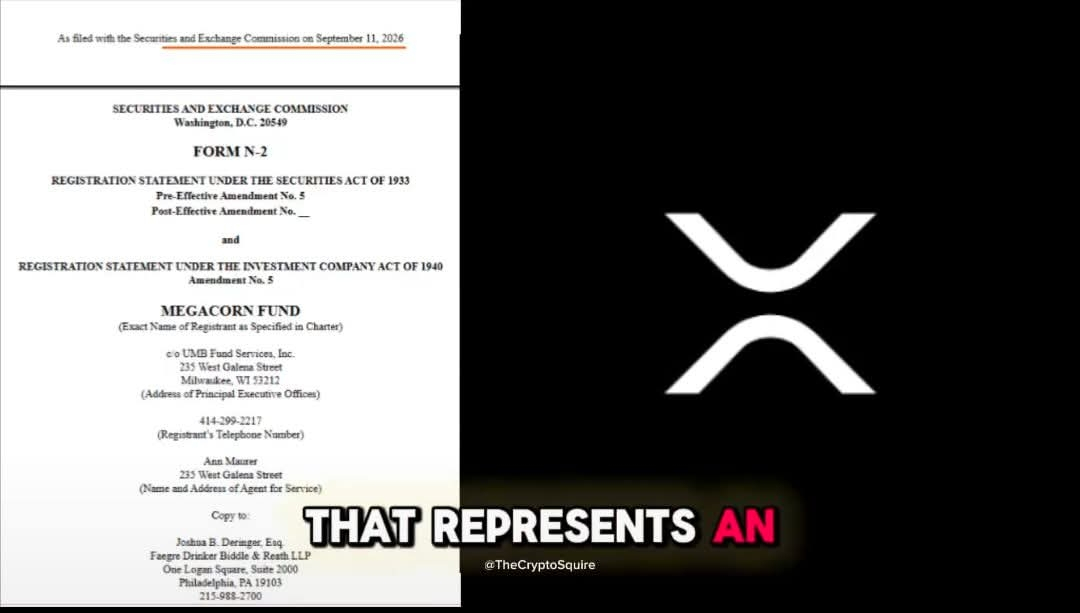
A new SEC filing shows Megacorn Fund’s Ripple equity position:
Cost: $229,840
Fair value: $373,179
Unrealized gain: +62%
Private markets are already putting a higher price on Ripple’s growth.
#sec #ripplenet #crypto
$XRP $XLM
🇺🇸 RIPPLE’S PRIVATE VALUE IS RISING.
A new SEC filing shows Megacorn Fund’s Ripple equity position:
Cost: $229,840
Fair value: $373,179
Unrealized gain: +62%
Private markets are already putting a higher price on Ripple’s growth.
#sec #ripplenet #crypto
🇺🇸 RIPPLE’S PRIVATE VALUE IS RISING.
A new SEC filing shows Megacorn Fund’s Ripple equity position:
Cost: $229,840
Fair value: $373,179
Unrealized gain: +62%
Private markets are already putting a higher price on Ripple’s growth.
#sec #ripplenet #crypto
12
12.9k

$SOL Important #U.S. regulators are talking publicly with Solana leaders today.
The #SEC Chair, Paul Atkins, and SEC Commissioner Hester Peirce are appearing at a Solana-focused event in Washington, D.C. They’ll discuss crypto rules and the proposed CLARITY legislation, which is meant to make U.S. regulation for crypto more understandable. $SOL
If regulators sound more open to clear, workable rules, it could make institutions feel more comfortable exploring Solana and crypto. If the tone is stricter, it could add uncertainty instead.
$SOL Important #U.S. regulators are talking publicly with Solana leaders today.
The #SEC Chair, Paul Atkins, and SEC Commissioner Hester Peirce are appearing at a Solana-focused event in Washington, D.C. They’ll discuss crypto rules and the proposed CLARITY legislation, which is meant to make U.S. regulation for crypto more understandable. $SOL
If regulators sound more open to clear, workable rules, it could make institutions feel more comfortable exploring Solana and crypto. If the tone is stricter, it could add uncertainty instead.
The #SEC Chair, Paul Atkins, and SEC Commissioner Hester Peirce are appearing at a Solana-focused event in Washington, D.C. They’ll discuss crypto rules and the proposed CLARITY legislation, which is meant to make U.S. regulation for crypto more understandable. $SOL
If regulators sound more open to clear, workable rules, it could make institutions feel more comfortable exploring Solana and crypto. If the tone is stricter, it could add uncertainty instead.

1
65
·
--
Bullish
$TRUMP $BTC
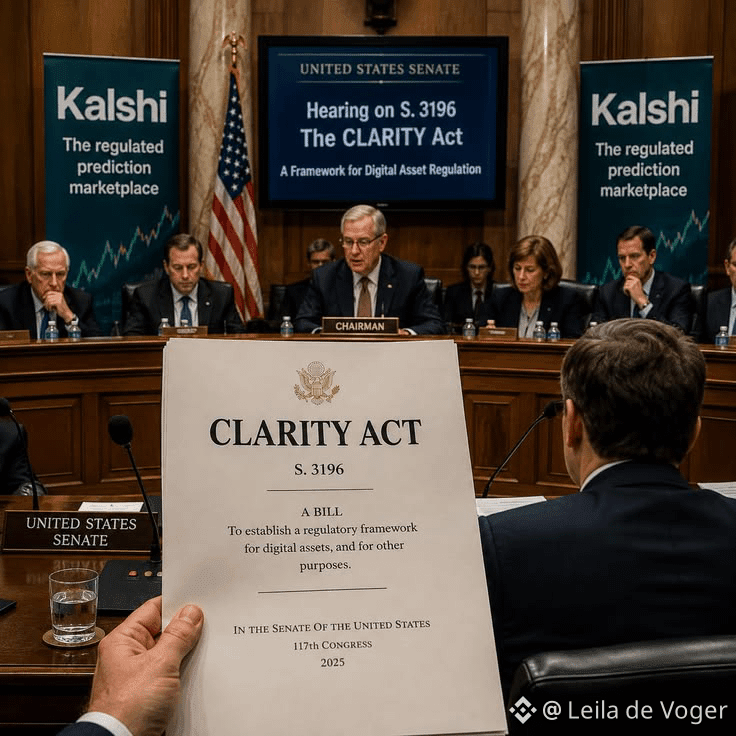
The Senate is expected to hold a key procedural vote on the #CLARITY Act on September 15, 2026. The bill aims to set clearer rules for digital-asset markets, including how responsibilities are divided between the #SEC and #CFTC . A procedural advance would not make it law immediately, but it could reduce regulatory uncertainty; failure or delay would keep the current fragmented framework in place.
$TRUMP $BTC
The Senate is expected to hold a key procedural vote on the #CLARITY Act on September 15, 2026. The bill aims to set clearer rules for digital-asset markets, including how responsibilities are divided between the #SEC and #CFTC . A procedural advance would not make it law immediately, but it could reduce regulatory uncertainty; failure or delay would keep the current fragmented framework in place.
The Senate is expected to hold a key procedural vote on the #CLARITY Act on September 15, 2026. The bill aims to set clearer rules for digital-asset markets, including how responsibilities are divided between the #SEC and #CFTC . A procedural advance would not make it law immediately, but it could reduce regulatory uncertainty; failure or delay would keep the current fragmented framework in place.

1
184

·
--
#SECReceivesGrayscaleLitecoinTrustETFFiling
SEC Receives Grayscale Litecoin Trust ETF Filing
The U.S. Securities and Exchange Commission (SEC) has received a filing related to the Grayscale Litecoin Trust ETF, marking another important step toward potentially bringing Litecoin exposure to traditional financial markets.
If approved, a Litecoin ETF could make it easier for investors to gain exposure to $LTC through regulated investment products without directly holding the cryptocurrency. The filing may also strengthen market sentiment around Litecoin and increase attention from institutional investors.
However, a filing does not mean approval. The SEC still needs to review the proposal, and the final decision could have a significant impact on Litecoin’s price and market activity.
#SECReceivesGrayscaleLitecoinTrustETFFiling #LTC #Litecoin #Crypto #ETF #Grayscale #SEC #SECReceivesGrayscaleLitecoinTrustETFFiling #ClarityActFacesProceduralVoteSept15
#SECReceivesGrayscaleLitecoinTrustETFFiling
SEC Receives Grayscale Litecoin Trust ETF Filing
The U.S. Securities and Exchange Commission (SEC) has received a filing related to the Grayscale Litecoin Trust ETF, marking another important step toward potentially bringing Litecoin exposure to traditional financial markets.
If approved, a Litecoin ETF could make it easier for investors to gain exposure to $LTC through regulated investment products without directly holding the cryptocurrency. The filing may also strengthen market sentiment around Litecoin and increase attention from institutional investors.
However, a filing does not mean approval. The SEC still needs to review the proposal, and the final decision could have a significant impact on Litecoin’s price and market activity.
#SECReceivesGrayscaleLitecoinTrustETFFiling #LTC #Litecoin #Crypto #ETF #Grayscale #SEC #SECReceivesGrayscaleLitecoinTrustETFFiling #ClarityActFacesProceduralVoteSept15
SEC Receives Grayscale Litecoin Trust ETF Filing
The U.S. Securities and Exchange Commission (SEC) has received a filing related to the Grayscale Litecoin Trust ETF, marking another important step toward potentially bringing Litecoin exposure to traditional financial markets.
If approved, a Litecoin ETF could make it easier for investors to gain exposure to $LTC through regulated investment products without directly holding the cryptocurrency. The filing may also strengthen market sentiment around Litecoin and increase attention from institutional investors.
However, a filing does not mean approval. The SEC still needs to review the proposal, and the final decision could have a significant impact on Litecoin’s price and market activity.
#SECReceivesGrayscaleLitecoinTrustETFFiling #LTC #Litecoin #Crypto #ETF #Grayscale #SEC #SECReceivesGrayscaleLitecoinTrustETFFiling #ClarityActFacesProceduralVoteSept15
48

·
--
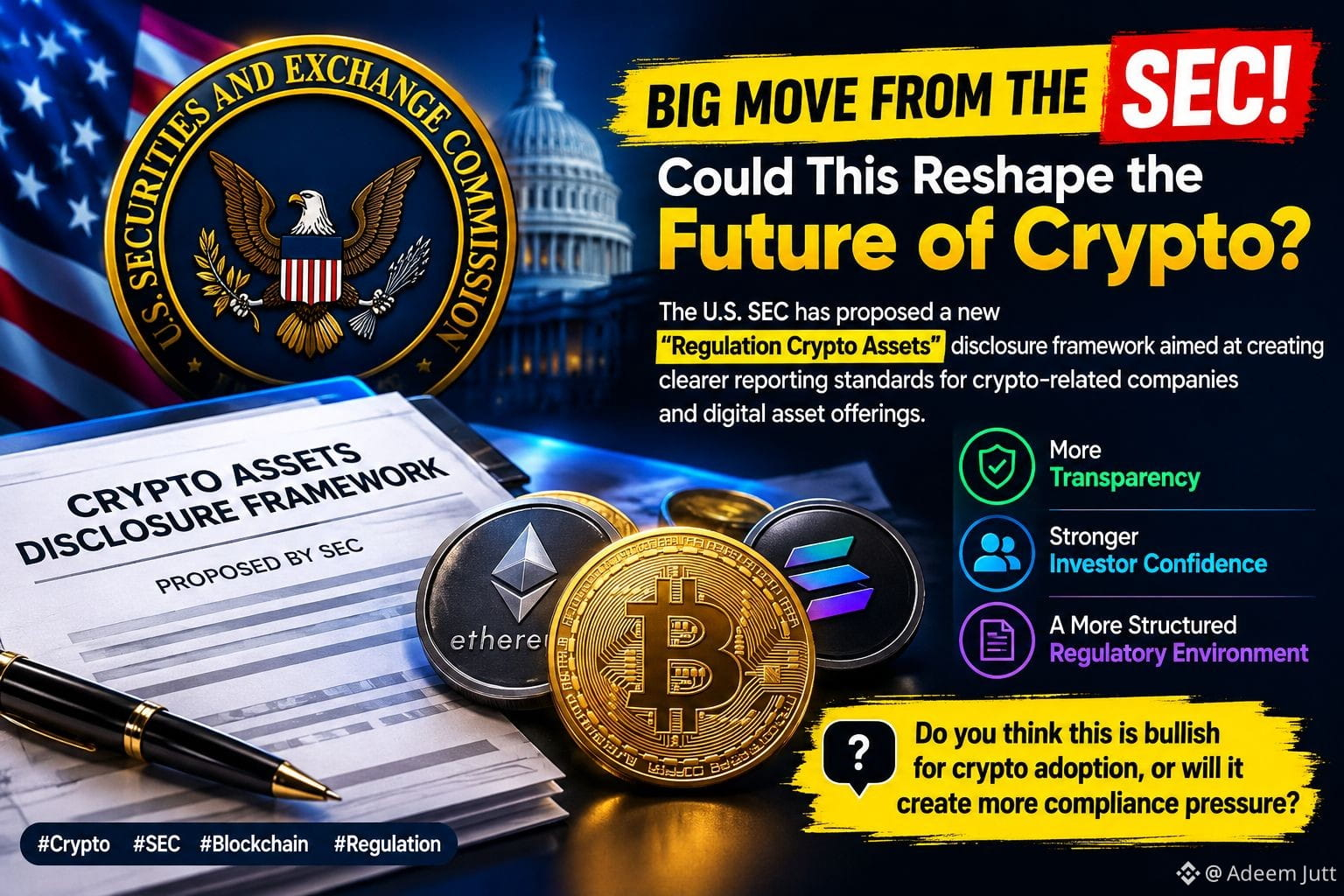
🚨 Big Move From the SEC! Could This Reshape the Future of Crypto?
The U.S. SEC has proposed a new "Regulation Crypto Assets" disclosure framework aimed at creating clearer reporting standards for crypto-related companies and digital asset offerings.
If implemented, this could improve transparency, strengthen investor confidence, and provide a more structured regulatory environment for the crypto industry.
📊 Clearer rules often reduce uncertainty—and that's something the market watches closely.
Do you think this is bullish for crypto adoption, or will it create more compliance pressure?
$BTC
{spot}(BTCUSDT)
$ETH
{spot}(ETHUSDT)
$LSK
{spot}(LSKUSDT)
#Crypto #SEC #Regulation #SECReceivesGrayscaleLitecoinTrustETFFiling #ClarityActFacesProceduralVoteSept15
🚨 Big Move From the SEC! Could This Reshape the Future of Crypto?
The U.S. SEC has proposed a new "Regulation Crypto Assets" disclosure framework aimed at creating clearer reporting standards for crypto-related companies and digital asset offerings.
If implemented, this could improve transparency, strengthen investor confidence, and provide a more structured regulatory environment for the crypto industry.
📊 Clearer rules often reduce uncertainty—and that's something the market watches closely.
Do you think this is bullish for crypto adoption, or will it create more compliance pressure?
$BTC
$ETH
$LSK
#Crypto #SEC #Regulation #SECReceivesGrayscaleLitecoinTrustETFFiling #ClarityActFacesProceduralVoteSept15
The U.S. SEC has proposed a new "Regulation Crypto Assets" disclosure framework aimed at creating clearer reporting standards for crypto-related companies and digital asset offerings.
If implemented, this could improve transparency, strengthen investor confidence, and provide a more structured regulatory environment for the crypto industry.
📊 Clearer rules often reduce uncertainty—and that's something the market watches closely.
Do you think this is bullish for crypto adoption, or will it create more compliance pressure?
$BTC
$ETH
$LSK
#Crypto #SEC #Regulation #SECReceivesGrayscaleLitecoinTrustETFFiling #ClarityActFacesProceduralVoteSept15
1
1
1
399

·
--
#SECReceivesGrayscaleLitecoinTrustETFFiling 🚨 Grayscale Litecoin Trust ETF — SEC Filing Dropped
Grayscale has officially filed with the SEC to convert its Litecoin Trust (LTCN) into a spot ETF. Here's what matters:
The basics:
• Trust would be renamed "Grayscale Litecoin Trust ETF"
• Intended listing on NYSE Arca under ticker LTCN
• Filing submitted September 11, SEC review now underway
Why it matters:
The trust has been trading at an 8% discount to its net asset value (NAV) — meaning LTCN shares are worth less than the actual Litecoin backing them . An ETF conversion would introduce creation/redemption mechanisms, letting authorized participants arbitrage away that gap. The discount is literally the business case for this filing.
The context:
• Trust AUM has dropped from $215M** (early 2025) to roughly **$82M (mid-2026) — a 62% decline
• The underlying NYSE Arca listing application (19b-4) has been stuck since January 2025 — nearly 20 months of delays
• Filing is a shelf registration (S-3/A), not an immediate offering
The fine print risk:
Currently, creations/redemptions are cash-only, not in-kind. That's a weaker arbitrage mechanism. If the sponsor restricts cash orders during a discount period, the price gap could widen instead of closing . The filing itself states nothing happens unless the listing approval comes through.
TL;DR: Grayscale is trying to close an 8% discount and revive a shrinking product. SEC approval is the only path forward — and it's been sitting on this since Jan 2025.
#SECReceivesGrayscaleLitecoinTrustETFFiling Grayscale #Litecoin oin #LTC N #CryptoETF #SEC $LTC
{future}(LTCUSDT)
#SECReceivesGrayscaleLitecoinTrustETFFiling 🚨 Grayscale Litecoin Trust ETF — SEC Filing Dropped
Grayscale has officially filed with the SEC to convert its Litecoin Trust (LTCN) into a spot ETF. Here's what matters:
The basics:
• Trust would be renamed "Grayscale Litecoin Trust ETF"
• Intended listing on NYSE Arca under ticker LTCN
• Filing submitted September 11, SEC review now underway
Why it matters:
The trust has been trading at an 8% discount to its net asset value (NAV) — meaning LTCN shares are worth less than the actual Litecoin backing them . An ETF conversion would introduce creation/redemption mechanisms, letting authorized participants arbitrage away that gap. The discount is literally the business case for this filing.
The context:
• Trust AUM has dropped from $215M** (early 2025) to roughly **$82M (mid-2026) — a 62% decline
• The underlying NYSE Arca listing application (19b-4) has been stuck since January 2025 — nearly 20 months of delays
• Filing is a shelf registration (S-3/A), not an immediate offering
The fine print risk:
Currently, creations/redemptions are cash-only, not in-kind. That's a weaker arbitrage mechanism. If the sponsor restricts cash orders during a discount period, the price gap could widen instead of closing . The filing itself states nothing happens unless the listing approval comes through.
TL;DR: Grayscale is trying to close an 8% discount and revive a shrinking product. SEC approval is the only path forward — and it's been sitting on this since Jan 2025.
#SECReceivesGrayscaleLitecoinTrustETFFiling Grayscale #Litecoin oin #LTC N #CryptoETF #SEC $LTC
Grayscale has officially filed with the SEC to convert its Litecoin Trust (LTCN) into a spot ETF. Here's what matters:
The basics:
• Trust would be renamed "Grayscale Litecoin Trust ETF"
• Intended listing on NYSE Arca under ticker LTCN
• Filing submitted September 11, SEC review now underway
Why it matters:
The trust has been trading at an 8% discount to its net asset value (NAV) — meaning LTCN shares are worth less than the actual Litecoin backing them . An ETF conversion would introduce creation/redemption mechanisms, letting authorized participants arbitrage away that gap. The discount is literally the business case for this filing.
The context:
• Trust AUM has dropped from $215M** (early 2025) to roughly **$82M (mid-2026) — a 62% decline
• The underlying NYSE Arca listing application (19b-4) has been stuck since January 2025 — nearly 20 months of delays
• Filing is a shelf registration (S-3/A), not an immediate offering
The fine print risk:
Currently, creations/redemptions are cash-only, not in-kind. That's a weaker arbitrage mechanism. If the sponsor restricts cash orders during a discount period, the price gap could widen instead of closing . The filing itself states nothing happens unless the listing approval comes through.
TL;DR: Grayscale is trying to close an 8% discount and revive a shrinking product. SEC approval is the only path forward — and it's been sitting on this since Jan 2025.
#SECReceivesGrayscaleLitecoinTrustETFFiling Grayscale #Litecoin oin #LTC N #CryptoETF #SEC $LTC
81

·
--
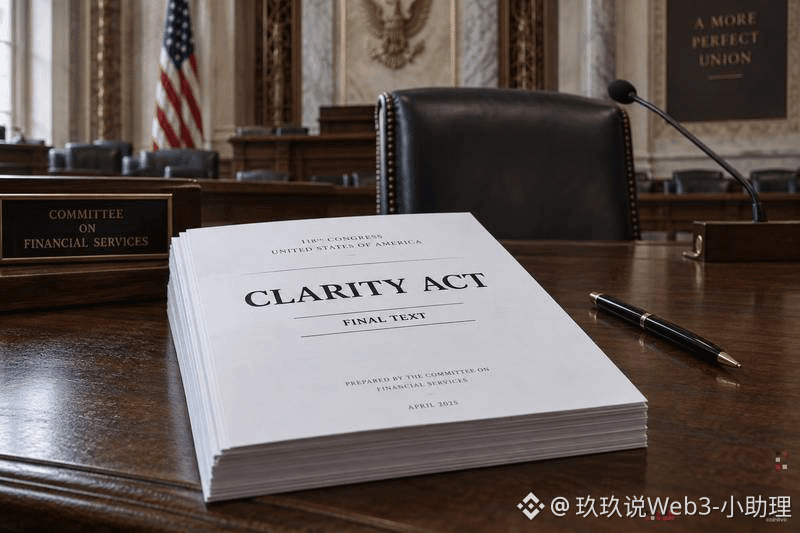
🚨 The CLARITY Act final text is here!
A key vote is coming Tuesday—does the crypto market really have to wait for the outcome this time? 🔥
Group: [点击进入玖玖的粉丝群](https://app.binance.com/uni-qr/YXXQJrPb)
U.S. crypto regulation is entering another crucial phase. Republicans have already released what they call the “final version” text of the “CLARITY Act,” and plan to face the next legislative test on Tuesday.
But here’s something you absolutely need to pay attention to:
The so-called “final text” refers to the version currently being prepared to move into the voting process—it does not mean the bill has been passed, and it certainly doesn’t mean it will become law immediately. ⚠️This is also where the market is most likely to misread things.
What truly matters about the CLARITY Act is its real significance in further clarifying the regulatory boundaries for the U.S. digital asset market—especially who between the SEC and the CFTC is responsible for regulating different types of crypto assets.
And in this revision, one of the areas the market is watching closely is still the morally charged provisions that drew major controversy earlier.
Earlier, Republicans and Democrats engaged in ongoing negotiations over issues such as officials holding crypto assets, conflicts of interest, and enforcement powers. Now, as the relevant content enters a new text, it also means that some of the disagreements that previously blocked bipartisan talks are being narrowed. 👀
But whether the bill can move forward still can’t be concluded early.
Because “text released” and “vote passed” are two different things.
Whether Tuesday’s vote is a procedural vote, a committee stage vote, or a full-floor vote depends on the Senate’s official schedule. Different stages carry completely different implications.
If the vote goes smoothly, it means the CLARITY Act can continue advancing to the next stage; if it’s blocked, it may return to the negotiating table again. More importantly, even if this vote passes, it only completes one part of the legislative process.
There are further steps ahead as well—additional review, possible text coordination, final passage, and the President’s signature, and so on. So what the market should truly focus on isn’t the words “final version,” but whether it can actually clear one procedural hurdle after another. ⚖️For XRP, ETH, and the entire U.S. crypto market, this is especially worth watching.
Click the avatar to join the Jiujiu chat group for daily strategies 🚀
#CLARITY法案 #加密监管 #xrp #SEC
🚨 The CLARITY Act final text is here!
A key vote is coming Tuesday—does the crypto market really have to wait for the outcome this time? 🔥
Group: 点击进入玖玖的粉丝群
U.S. crypto regulation is entering another crucial phase. Republicans have already released what they call the “final version” text of the “CLARITY Act,” and plan to face the next legislative test on Tuesday.
But here’s something you absolutely need to pay attention to:
The so-called “final text” refers to the version currently being prepared to move into the voting process—it does not mean the bill has been passed, and it certainly doesn’t mean it will become law immediately. ⚠️This is also where the market is most likely to misread things.
What truly matters about the CLARITY Act is its real significance in further clarifying the regulatory boundaries for the U.S. digital asset market—especially who between the SEC and the CFTC is responsible for regulating different types of crypto assets.
And in this revision, one of the areas the market is watching closely is still the morally charged provisions that drew major controversy earlier.
Earlier, Republicans and Democrats engaged in ongoing negotiations over issues such as officials holding crypto assets, conflicts of interest, and enforcement powers. Now, as the relevant content enters a new text, it also means that some of the disagreements that previously blocked bipartisan talks are being narrowed. 👀
But whether the bill can move forward still can’t be concluded early.
Because “text released” and “vote passed” are two different things.
Whether Tuesday’s vote is a procedural vote, a committee stage vote, or a full-floor vote depends on the Senate’s official schedule. Different stages carry completely different implications.
If the vote goes smoothly, it means the CLARITY Act can continue advancing to the next stage; if it’s blocked, it may return to the negotiating table again. More importantly, even if this vote passes, it only completes one part of the legislative process.
There are further steps ahead as well—additional review, possible text coordination, final passage, and the President’s signature, and so on. So what the market should truly focus on isn’t the words “final version,” but whether it can actually clear one procedural hurdle after another. ⚖️For XRP, ETH, and the entire U.S. crypto market, this is especially worth watching.
Click the avatar to join the Jiujiu chat group for daily strategies 🚀
#CLARITY法案 #加密监管 #xrp #SEC
A key vote is coming Tuesday—does the crypto market really have to wait for the outcome this time? 🔥
Group: 点击进入玖玖的粉丝群
U.S. crypto regulation is entering another crucial phase. Republicans have already released what they call the “final version” text of the “CLARITY Act,” and plan to face the next legislative test on Tuesday.
But here’s something you absolutely need to pay attention to:
The so-called “final text” refers to the version currently being prepared to move into the voting process—it does not mean the bill has been passed, and it certainly doesn’t mean it will become law immediately. ⚠️This is also where the market is most likely to misread things.
What truly matters about the CLARITY Act is its real significance in further clarifying the regulatory boundaries for the U.S. digital asset market—especially who between the SEC and the CFTC is responsible for regulating different types of crypto assets.
And in this revision, one of the areas the market is watching closely is still the morally charged provisions that drew major controversy earlier.
Earlier, Republicans and Democrats engaged in ongoing negotiations over issues such as officials holding crypto assets, conflicts of interest, and enforcement powers. Now, as the relevant content enters a new text, it also means that some of the disagreements that previously blocked bipartisan talks are being narrowed. 👀
But whether the bill can move forward still can’t be concluded early.
Because “text released” and “vote passed” are two different things.
Whether Tuesday’s vote is a procedural vote, a committee stage vote, or a full-floor vote depends on the Senate’s official schedule. Different stages carry completely different implications.
If the vote goes smoothly, it means the CLARITY Act can continue advancing to the next stage; if it’s blocked, it may return to the negotiating table again. More importantly, even if this vote passes, it only completes one part of the legislative process.
There are further steps ahead as well—additional review, possible text coordination, final passage, and the President’s signature, and so on. So what the market should truly focus on isn’t the words “final version,” but whether it can actually clear one procedural hurdle after another. ⚖️For XRP, ETH, and the entire U.S. crypto market, this is especially worth watching.
Click the avatar to join the Jiujiu chat group for daily strategies 🚀
#CLARITY法案 #加密监管 #xrp #SEC
2
5.9k

SEC supports the Clarity Act but will still apply crypto regulations
- The SEC chair supports the Clarity Act
- Focus on token issuance, modernizing transfer agency and custody
- The agency will continue to push for crypto regulation even without this law
#SEC #ClarityAct #CryptoRegulation #Blockchain
$btc $eth
#vlikevn Titanbot
Source: CoinDesk
SEC supports the Clarity Act but will still apply crypto regulations
- The SEC chair supports the Clarity Act
- Focus on token issuance, modernizing transfer agency and custody
- The agency will continue to push for crypto regulation even without this law
#SEC #ClarityAct #CryptoRegulation #Blockchain
$btc $eth
#vlikevn Titanbot
Source: CoinDesk
- The SEC chair supports the Clarity Act
- Focus on token issuance, modernizing transfer agency and custody
- The agency will continue to push for crypto regulation even without this law
#SEC #ClarityAct #CryptoRegulation #Blockchain
$btc $eth
#vlikevn Titanbot
Source: CoinDesk
75


Imagine sitting down for a coffee and watching a massive tug-of-war game between two giant regulators. ☕ That is exactly what is happening right now in the financial world. Citadel Securities just stepped into the arena, urging the SEC to take control over event contracts tied to public companies. Right now, the CFTC has been handling these prediction-style contracts, but Citadel thinks the SEC needs to step in to protect investors. 🏛️
Why does this matter to us in the crypto space? Well, the battle over who regulates what directly impacts how prediction markets and decentralized platforms operate. If the SEC wins more ground here, it could signal a much tighter grip on any derivatives or event markets tied to real-world assets. 📈
Keep an eye on how the SEC responds to this push. If they take the bait, we might see a whole new wave of regulatory decisions that could ripple through DeFi. It is a crazy time to watch the regulatory landscape evolve while we trade our favorite assets like $BTC and $ETH.
#CryptoNews #Regulation #SEC #Write2Earn
Imagine sitting down for a coffee and watching a massive tug-of-war game between two giant regulators. ☕ That is exactly what is happening right now in the financial world. Citadel Securities just stepped into the arena, urging the SEC to take control over event contracts tied to public companies. Right now, the CFTC has been handling these prediction-style contracts, but Citadel thinks the SEC needs to step in to protect investors. 🏛️
Why does this matter to us in the crypto space? Well, the battle over who regulates what directly impacts how prediction markets and decentralized platforms operate. If the SEC wins more ground here, it could signal a much tighter grip on any derivatives or event markets tied to real-world assets. 📈
Keep an eye on how the SEC responds to this push. If they take the bait, we might see a whole new wave of regulatory decisions that could ripple through DeFi. It is a crazy time to watch the regulatory landscape evolve while we trade our favorite assets like $BTC and $ETH .
#CryptoNews #Regulation #SEC #Write2Earn
Why does this matter to us in the crypto space? Well, the battle over who regulates what directly impacts how prediction markets and decentralized platforms operate. If the SEC wins more ground here, it could signal a much tighter grip on any derivatives or event markets tied to real-world assets. 📈
Keep an eye on how the SEC responds to this push. If they take the bait, we might see a whole new wave of regulatory decisions that could ripple through DeFi. It is a crazy time to watch the regulatory landscape evolve while we trade our favorite assets like $BTC and $ETH .
#CryptoNews #Regulation #SEC #Write2Earn

59

Article
An Era of Regulatory Certainty: How the CLARITY Act Is Reshaping the Global Crypto MarketFor years, the cryptocurrency industry has operated in a legal vacuum and under constant pressure from U.S. regulatory bodies. The principle of “regulation through enforcement,” actively used by the U.S. Securities and Exchange Commission (SEC), forced crypto projects to operate under the constant risk of lawsuits.
An Era of Regulatory Certainty: How the CLARITY Act Is Reshaping the Global Crypto Market
For years, the cryptocurrency industry has operated in a legal vacuum and under constant pressure from U.S. regulatory bodies. The principle of “regulation through enforcement,” actively used by the U.S. Securities and Exchange Commission (SEC), forced crypto projects to operate under the constant risk of lawsuits.
57

·
--
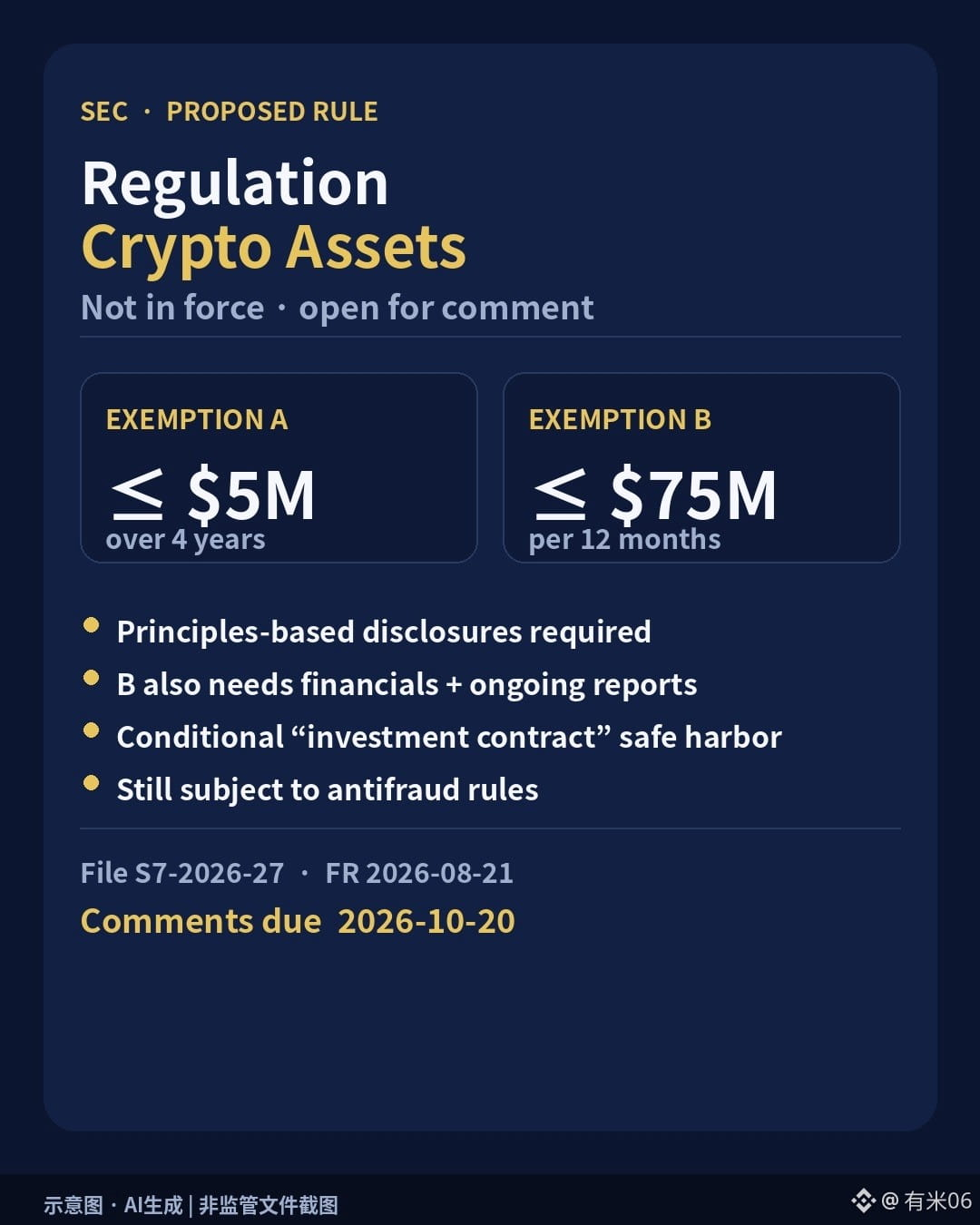
At a glance: The U.S. Securities and Exchange Commission (SEC) has proposed “Regulation Crypto Assets” (the crypto asset rules) that is still a notice of proposed rulemaking and has not yet taken effect; the public comment window remains open until 2026-10-20.
According to the text published in the Federal Register on 2026-08-21 (File No. S7-2026-27; Release Nos. 33-11434 / 34-106150): the proposal would create two sets of exempt registration pathways for certain investment contracts involving crypto assets—up to approximately $5 million in total within a four-year period; and up to approximately $75 million per 12 months (the latter also requires financial statements and ongoing reporting). Both pathways require disclosure of principles-based information, and the issuer remains subject to securities laws such as anti-fraud provisions. The proposal also includes a conditional “investment contract” safe harbor: when the conditions are met, the crypto asset may not be deemed to be a security within the meaning of an investment contract.
Independent cross-check: The SEC’s 2026-08-18 press release (2026-76) is consistent with the rule page S7-2026-27 in terms of the two exemption pathways, principles-based disclosure, and the conditional safe harbor; the comment-deadline arrangement also matches the Federal Register text.
Figure is for illustration/AI-generated, not a screenshot of regulatory documents.
Data as of: Federal Register text dated 2026-08-21; SEC press release dated 2026-08-18; comments due by 2026-10-20.
For information sharing only and does not constitute investment advice.
#监管 #SEC
At a glance: The U.S. Securities and Exchange Commission (SEC) has proposed “Regulation Crypto Assets” (the crypto asset rules) that is still a notice of proposed rulemaking and has not yet taken effect; the public comment window remains open until 2026-10-20.
According to the text published in the Federal Register on 2026-08-21 (File No. S7-2026-27; Release Nos. 33-11434 / 34-106150): the proposal would create two sets of exempt registration pathways for certain investment contracts involving crypto assets—up to approximately $5 million in total within a four-year period; and up to approximately $75 million per 12 months (the latter also requires financial statements and ongoing reporting). Both pathways require disclosure of principles-based information, and the issuer remains subject to securities laws such as anti-fraud provisions. The proposal also includes a conditional “investment contract” safe harbor: when the conditions are met, the crypto asset may not be deemed to be a security within the meaning of an investment contract.
Independent cross-check: The SEC’s 2026-08-18 press release (2026-76) is consistent with the rule page S7-2026-27 in terms of the two exemption pathways, principles-based disclosure, and the conditional safe harbor; the comment-deadline arrangement also matches the Federal Register text.
Figure is for illustration/AI-generated, not a screenshot of regulatory documents.
Data as of: Federal Register text dated 2026-08-21; SEC press release dated 2026-08-18; comments due by 2026-10-20.
For information sharing only and does not constitute investment advice.
#监管 #SEC
According to the text published in the Federal Register on 2026-08-21 (File No. S7-2026-27; Release Nos. 33-11434 / 34-106150): the proposal would create two sets of exempt registration pathways for certain investment contracts involving crypto assets—up to approximately $5 million in total within a four-year period; and up to approximately $75 million per 12 months (the latter also requires financial statements and ongoing reporting). Both pathways require disclosure of principles-based information, and the issuer remains subject to securities laws such as anti-fraud provisions. The proposal also includes a conditional “investment contract” safe harbor: when the conditions are met, the crypto asset may not be deemed to be a security within the meaning of an investment contract.
Independent cross-check: The SEC’s 2026-08-18 press release (2026-76) is consistent with the rule page S7-2026-27 in terms of the two exemption pathways, principles-based disclosure, and the conditional safe harbor; the comment-deadline arrangement also matches the Federal Register text.
Figure is for illustration/AI-generated, not a screenshot of regulatory documents.
Data as of: Federal Register text dated 2026-08-21; SEC press release dated 2026-08-18; comments due by 2026-10-20.
For information sharing only and does not constitute investment advice.
#监管 #SEC
17

·
--
🚨 MASSIVE: CLARITY IS COMING FOR CRYPTO! 🇺🇸🔥
Coinbase CEO says that even if the CLARITY Act fails to pass, the SEC and CFTC are prepared to move forward with crypto rules.
Either way, clearer regulations could be coming for the U.S. crypto market. 👀
And $XRP
{spot}(XRPUSDT)
could be one of the major assets to benefit from a more defined regulatory framework. 💯🚀
The regulatory game is changing — and crypto is watching closely.
Stay alert. DYOR. NFA. ⚠️
#XRP #CLARITYAct #Crypto #SEC #CFTC
🚨 MASSIVE: CLARITY IS COMING FOR CRYPTO! 🇺🇸🔥
Coinbase CEO says that even if the CLARITY Act fails to pass, the SEC and CFTC are prepared to move forward with crypto rules.
Either way, clearer regulations could be coming for the U.S. crypto market. 👀
And $XRP
could be one of the major assets to benefit from a more defined regulatory framework. 💯🚀
The regulatory game is changing — and crypto is watching closely.
Stay alert. DYOR. NFA. ⚠️
#XRP #CLARITYAct #Crypto #SEC #CFTC
Coinbase CEO says that even if the CLARITY Act fails to pass, the SEC and CFTC are prepared to move forward with crypto rules.
Either way, clearer regulations could be coming for the U.S. crypto market. 👀
And $XRP
could be one of the major assets to benefit from a more defined regulatory framework. 💯🚀
The regulatory game is changing — and crypto is watching closely.
Stay alert. DYOR. NFA. ⚠️
#XRP #CLARITYAct #Crypto #SEC #CFTC

362
Citadel calls on the SEC to oversee linked-stock event contracts
- Citadel Securities proposes that the SEC intervene to supervise linked-stock event contracts (event contracts).
- Objective: challenge the current self-certification authority of the CFTC over these contracts.
- Legal landscape: jurisdictional conflict between the SEC and the CFTC in regulating derivative products related to public companies.
#BinanceSquare #CryptoNews #SEC #CFTC #Citadel
$btc $eth
vlikevn Titanbot
Source: The Block
Citadel calls on the SEC to oversee linked-stock event contracts
- Citadel Securities proposes that the SEC intervene to supervise linked-stock event contracts (event contracts).
- Objective: challenge the current self-certification authority of the CFTC over these contracts.
- Legal landscape: jurisdictional conflict between the SEC and the CFTC in regulating derivative products related to public companies.
#BinanceSquare #CryptoNews #SEC #CFTC #Citadel
$btc $eth
vlikevn Titanbot
Source: The Block
- Citadel Securities proposes that the SEC intervene to supervise linked-stock event contracts (event contracts).
- Objective: challenge the current self-certification authority of the CFTC over these contracts.
- Legal landscape: jurisdictional conflict between the SEC and the CFTC in regulating derivative products related to public companies.
#BinanceSquare #CryptoNews #SEC #CFTC #Citadel
$btc $eth
vlikevn Titanbot
Source: The Block
68

·
--
The SEC wants blockchain to serve as the official shareholder recordand that’s a major turning point.
Why a new SEC plan could ease a legal headache for tokenized securities
The SEC's new proposal to overhaul transfer-agent rules could eliminate duplicate offchain shareholder records, reducing reconciliation costs and legal uncertainty for tokenized securities.
There is an awkward problem for companies putting stocks on a blockchain: The onchain data can show who owns the token, but the legal shareholder record sits somewhere else.
So when it comes to which database to consider as the legal record for these tokenized stocks, lawyers currently pick the one that isn't on the blockchain, even if the actual data is more up to date on the digital ledger.
But that might all change now after the SEC put forward a new proposal last week that would overhaul five decades-old transfer-agent rules and, for the first time, explicitly allow electronic databases, including blockchain ledgers, to serve as the official record of securities ownership.
And this is a big deal.
If approved, a blockchain could become the "master security file," replacing the parallel offchain ownership records that tokenized securities often still rely on today.
Put simply, blockchain would move from being a technology layered on top of market infrastructure to potentially becoming part of the legally recognized infrastructure itself.
"The master securityholder file used to be paper in a filing cabinet," said Joris Delanoue, CEO of SEC-registered onchain transfer agent Fairmint. "Today it is a database. The proposal recognizes that blockchain can be that database, not merely a copy of it."
#SEC #TokenizedSecurities #RWA #CryptoRegulations #blockchain
$ONDO $LINK $AAVE
{future}(AAVEUSDT)
{future}(LINKUSDT)
{future}(ONDOUSDT)
The SEC wants blockchain to serve as the official shareholder recordand that’s a major turning point.
Why a new SEC plan could ease a legal headache for tokenized securities
The SEC's new proposal to overhaul transfer-agent rules could eliminate duplicate offchain shareholder records, reducing reconciliation costs and legal uncertainty for tokenized securities.
There is an awkward problem for companies putting stocks on a blockchain: The onchain data can show who owns the token, but the legal shareholder record sits somewhere else.
So when it comes to which database to consider as the legal record for these tokenized stocks, lawyers currently pick the one that isn't on the blockchain, even if the actual data is more up to date on the digital ledger.
But that might all change now after the SEC put forward a new proposal last week that would overhaul five decades-old transfer-agent rules and, for the first time, explicitly allow electronic databases, including blockchain ledgers, to serve as the official record of securities ownership.
And this is a big deal.
If approved, a blockchain could become the "master security file," replacing the parallel offchain ownership records that tokenized securities often still rely on today.
Put simply, blockchain would move from being a technology layered on top of market infrastructure to potentially becoming part of the legally recognized infrastructure itself.
"The master securityholder file used to be paper in a filing cabinet," said Joris Delanoue, CEO of SEC-registered onchain transfer agent Fairmint. "Today it is a database. The proposal recognizes that blockchain can be that database, not merely a copy of it."
#SEC #TokenizedSecurities #RWA #CryptoRegulations #blockchain
$ONDO $LINK $AAVE
Why a new SEC plan could ease a legal headache for tokenized securities
The SEC's new proposal to overhaul transfer-agent rules could eliminate duplicate offchain shareholder records, reducing reconciliation costs and legal uncertainty for tokenized securities.
There is an awkward problem for companies putting stocks on a blockchain: The onchain data can show who owns the token, but the legal shareholder record sits somewhere else.
So when it comes to which database to consider as the legal record for these tokenized stocks, lawyers currently pick the one that isn't on the blockchain, even if the actual data is more up to date on the digital ledger.
But that might all change now after the SEC put forward a new proposal last week that would overhaul five decades-old transfer-agent rules and, for the first time, explicitly allow electronic databases, including blockchain ledgers, to serve as the official record of securities ownership.
And this is a big deal.
If approved, a blockchain could become the "master security file," replacing the parallel offchain ownership records that tokenized securities often still rely on today.
Put simply, blockchain would move from being a technology layered on top of market infrastructure to potentially becoming part of the legally recognized infrastructure itself.
"The master securityholder file used to be paper in a filing cabinet," said Joris Delanoue, CEO of SEC-registered onchain transfer agent Fairmint. "Today it is a database. The proposal recognizes that blockchain can be that database, not merely a copy of it."
#SEC #TokenizedSecurities #RWA #CryptoRegulations #blockchain
$ONDO $LINK $AAVE

206 Atlas:
Regulatory clarity on ownership records reduces legal friction for tokenized equities, a structural shift that supports long-term institutional adoption.
3
2
9.7k

·
--
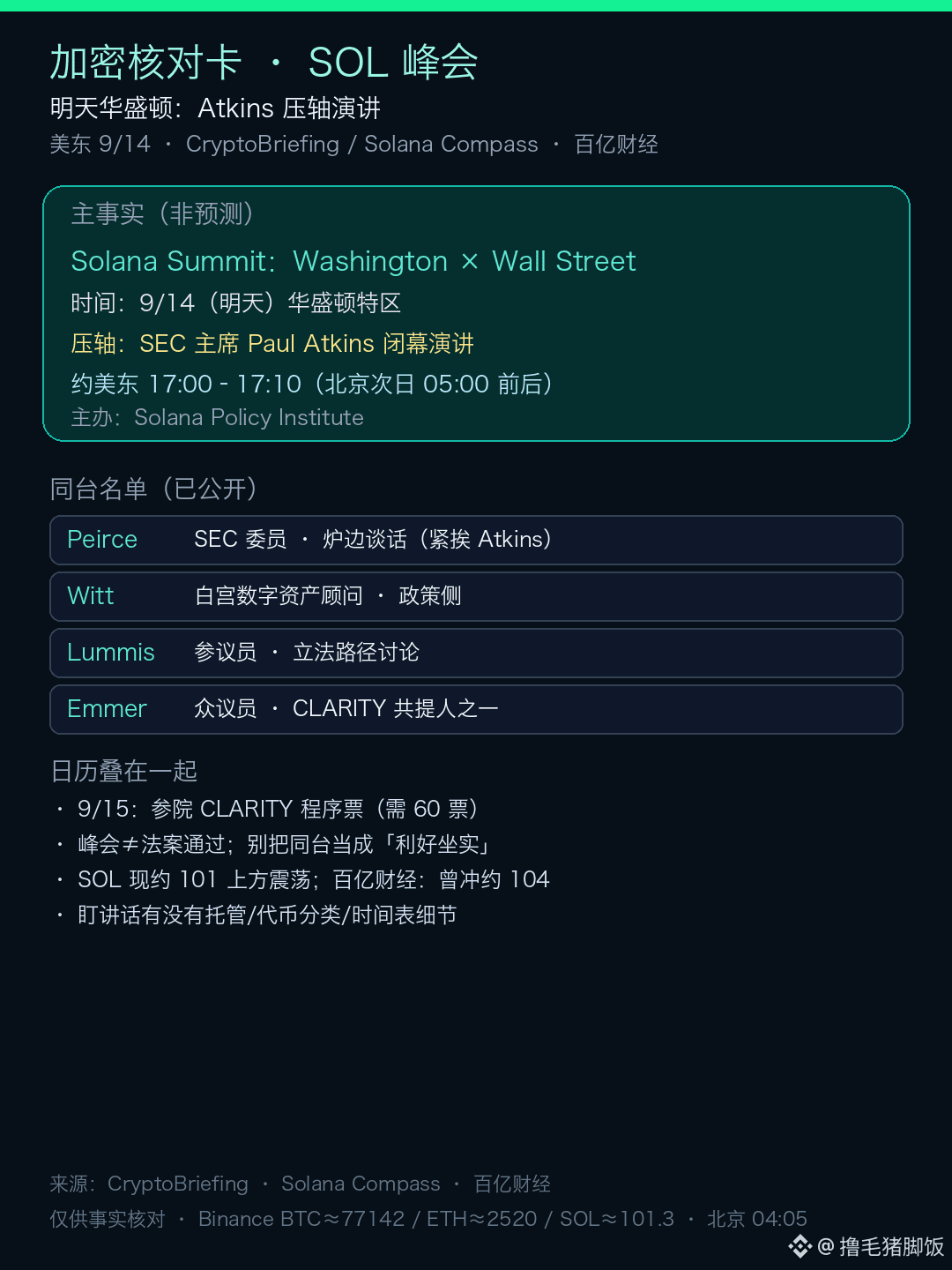
Tomorrow there’s a Solana-focused event in Washington, with the SEC Chair himself delivering the closing keynote.
It’s not the kind of developer conference like Breakpoint.
CryptoBriefing and Solana Compass: Solana Policy Institute presents “Washington × Wall Street,” on the US East Coast 9/14.
The closing keynote is SEC Chair Paul Atkins’ wrap-up speech; Hester Peirce’s fireside chat goes right before him.
The roster also includes Lummis, Emmer, and Patrick Witt from the White House’s digital assets side.
The schedule is packed tightly.
The next day, 9/15, is CLARITY—an amid procedural vote in the Senate (it needs 60 votes).
A regulator ends up wrapping up a policy summit on a public blockchain—that in itself shows the winds are changing; but a changed wind doesn’t equal a bill passing.
On the spot front, SOL has once again reclaimed 100.
The “Billion” finance outlet wrote that by Friday it briefly surged to around 104; Binance spot is currently about 101.3.
Don’t tie “crossing the integer threshold” to “must be bullish because of the summit.”
I think what’s truly worth listening for isn’t the slogans—it’s whether Atkins lays out the level of detail on custody, token classification, and the timeline to the point that you can verify it.
The stage may be bustling and lively; without the fine print, it’s still just atmosphere.
Supporting data (Binance, Beijing ~04:05): BTC≈77142 / ETH≈2520 / SOL≈101.3.
Source: CryptoBriefing / Solana Compass / Billion finance
Not investment advice.
#SOL #Solana #SEC #监管
Tomorrow there’s a Solana-focused event in Washington, with the SEC Chair himself delivering the closing keynote.
It’s not the kind of developer conference like Breakpoint.
CryptoBriefing and Solana Compass: Solana Policy Institute presents “Washington × Wall Street,” on the US East Coast 9/14.
The closing keynote is SEC Chair Paul Atkins’ wrap-up speech; Hester Peirce’s fireside chat goes right before him.
The roster also includes Lummis, Emmer, and Patrick Witt from the White House’s digital assets side.
The schedule is packed tightly.
The next day, 9/15, is CLARITY—an amid procedural vote in the Senate (it needs 60 votes).
A regulator ends up wrapping up a policy summit on a public blockchain—that in itself shows the winds are changing; but a changed wind doesn’t equal a bill passing.
On the spot front, SOL has once again reclaimed 100.
The “Billion” finance outlet wrote that by Friday it briefly surged to around 104; Binance spot is currently about 101.3.
Don’t tie “crossing the integer threshold” to “must be bullish because of the summit.”
I think what’s truly worth listening for isn’t the slogans—it’s whether Atkins lays out the level of detail on custody, token classification, and the timeline to the point that you can verify it.
The stage may be bustling and lively; without the fine print, it’s still just atmosphere.
Supporting data (Binance, Beijing ~04:05): BTC≈77142 / ETH≈2520 / SOL≈101.3.
Source: CryptoBriefing / Solana Compass / Billion finance
Not investment advice.
#SOL #Solana #SEC #监管
It’s not the kind of developer conference like Breakpoint.
CryptoBriefing and Solana Compass: Solana Policy Institute presents “Washington × Wall Street,” on the US East Coast 9/14.
The closing keynote is SEC Chair Paul Atkins’ wrap-up speech; Hester Peirce’s fireside chat goes right before him.
The roster also includes Lummis, Emmer, and Patrick Witt from the White House’s digital assets side.
The schedule is packed tightly.
The next day, 9/15, is CLARITY—an amid procedural vote in the Senate (it needs 60 votes).
A regulator ends up wrapping up a policy summit on a public blockchain—that in itself shows the winds are changing; but a changed wind doesn’t equal a bill passing.
On the spot front, SOL has once again reclaimed 100.
The “Billion” finance outlet wrote that by Friday it briefly surged to around 104; Binance spot is currently about 101.3.
Don’t tie “crossing the integer threshold” to “must be bullish because of the summit.”
I think what’s truly worth listening for isn’t the slogans—it’s whether Atkins lays out the level of detail on custody, token classification, and the timeline to the point that you can verify it.
The stage may be bustling and lively; without the fine print, it’s still just atmosphere.
Supporting data (Binance, Beijing ~04:05): BTC≈77142 / ETH≈2520 / SOL≈101.3.
Source: CryptoBriefing / Solana Compass / Billion finance
Not investment advice.
#SOL #Solana #SEC #监管
金融陈师:
每次碰上SEC这种开会SOL冲100我就手痒想赌,结果经常两头挨巴掌,交给代跑省心多了,闲下来可以翻翻 他的帖子
1
80

·
--
#SECApprovesNasdaqTexasCommodityTrustRule
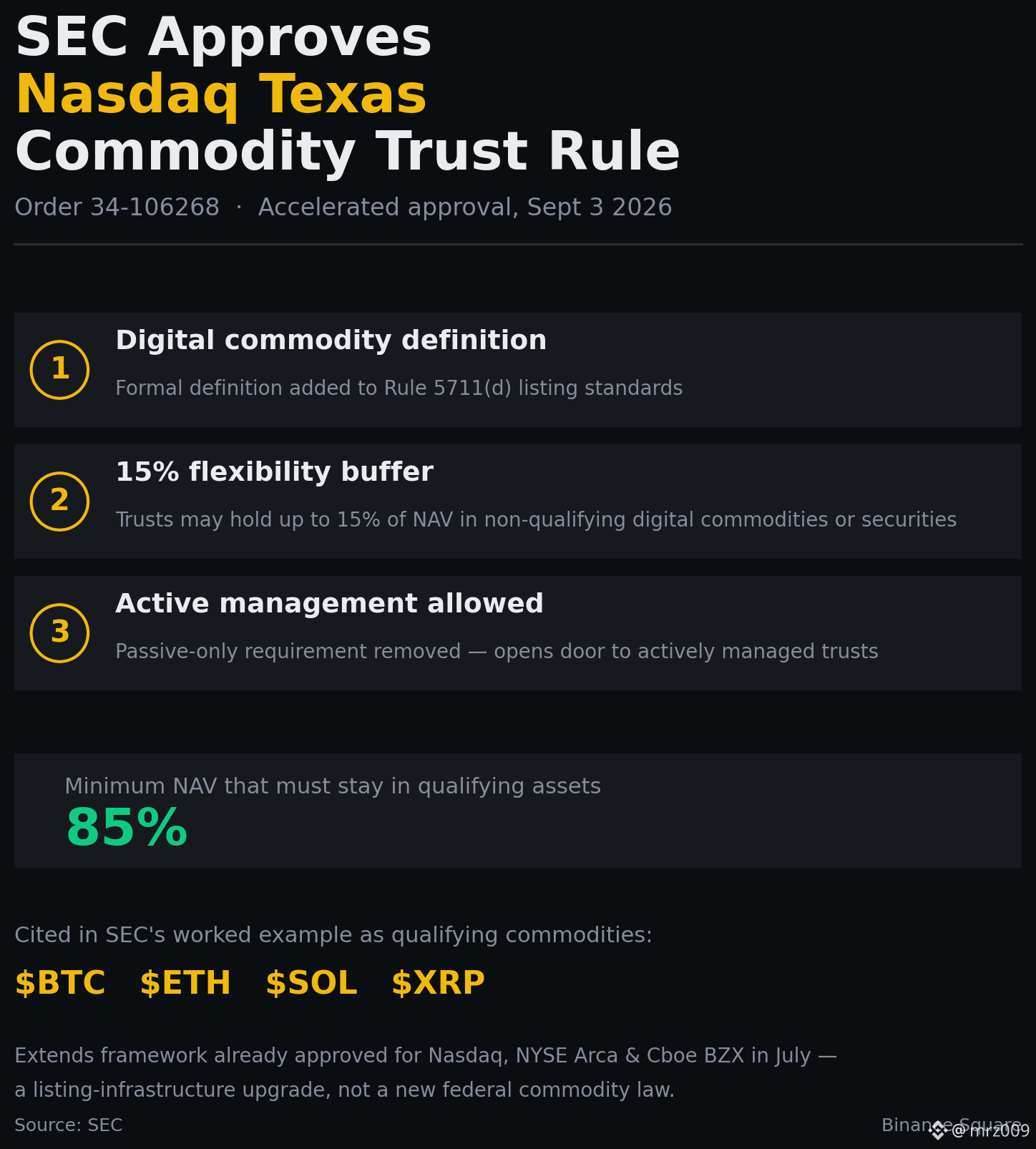
SEC Order 34-106268 (Sept 3) grants accelerated approval to a Nasdaq Texas rule amending Rule 5711(d) for Commodity-Based Trust Shares:
• Adds a formal "digital commodity" definition to listing standards
• Allows trusts to hold up to 15% of NAV in digital commodities/securities outside standard eligibility rules (85% must still qualify)
• Removes the passive-management requirement — active strategies now allowed
$BTC, $ETH, $SOL and $XRP were cited as assets that already qualify as eligible commodities in the SEC's example. This extends a framework already approved for Nasdaq, NYSE Arca, and Cboe BZX in July — not a new federal commodity law, but a listing-infrastructure upgrade that opens the door to more flexible, actively managed crypto trust products.
#SECApprovesNasdaqTexasCommodityTrustRule #SEC #NASDAQ #CryptoRegulation
#SECApprovesNasdaqTexasCommodityTrustRule
SEC Order 34-106268 (Sept 3) grants accelerated approval to a Nasdaq Texas rule amending Rule 5711(d) for Commodity-Based Trust Shares:
• Adds a formal "digital commodity" definition to listing standards
• Allows trusts to hold up to 15% of NAV in digital commodities/securities outside standard eligibility rules (85% must still qualify)
• Removes the passive-management requirement — active strategies now allowed
$BTC, $ETH, $SOL and $XRP were cited as assets that already qualify as eligible commodities in the SEC's example. This extends a framework already approved for Nasdaq, NYSE Arca, and Cboe BZX in July — not a new federal commodity law, but a listing-infrastructure upgrade that opens the door to more flexible, actively managed crypto trust products.
#SECApprovesNasdaqTexasCommodityTrustRule #SEC #NASDAQ #CryptoRegulation
SEC Order 34-106268 (Sept 3) grants accelerated approval to a Nasdaq Texas rule amending Rule 5711(d) for Commodity-Based Trust Shares:
• Adds a formal "digital commodity" definition to listing standards
• Allows trusts to hold up to 15% of NAV in digital commodities/securities outside standard eligibility rules (85% must still qualify)
• Removes the passive-management requirement — active strategies now allowed
$BTC, $ETH, $SOL and $XRP were cited as assets that already qualify as eligible commodities in the SEC's example. This extends a framework already approved for Nasdaq, NYSE Arca, and Cboe BZX in July — not a new federal commodity law, but a listing-infrastructure upgrade that opens the door to more flexible, actively managed crypto trust products.
#SECApprovesNasdaqTexasCommodityTrustRule #SEC #NASDAQ #CryptoRegulation
170

#secapprovesnasdaqtexascommoditytrustrule
🚨 Huge Update for Crypto Funds from the SEC! 🏛️
The SEC just gave the green light to updated Nasdaq Texas listing standards, and it’s a massive step forward for institutional crypto adoption. They’ve officially added a formal definition for "digital commodities."
Here’s why this is a total game-changer for the market:
Active Management is GO: Funds are no longer restricted to just holding passively. Active trading strategies are now officially on the table.
The 15% Altcoin Buffer: Funds can now allocate up to 15% of their Net Asset Value (NAV) to non-standard digital commodities.
Beyond the Majors: While heavyweights like $BTC,$ETH, SOL, andXRP were highlighted, that 15% flexibility is the real catalyst. It allows institutions to blend established blue chips with targeted altcoin exposure.
The foundation for the next wave of creative, actively managed institutional capital is being laid right now.
What kind of active crypto funds are you hoping to see hit the market? Drop your thoughts below! 👇
#SEC #crypto #NASDAQ
$SAGA
{future}(SAGAUSDT)
$ETHFI
{future}(ETHFIUSDT)
$VTHO
{future}(VTHOUSDT)
#secapprovesnasdaqtexascommoditytrustrule
🚨 Huge Update for Crypto Funds from the SEC! 🏛️
The SEC just gave the green light to updated Nasdaq Texas listing standards, and it’s a massive step forward for institutional crypto adoption. They’ve officially added a formal definition for "digital commodities."
Here’s why this is a total game-changer for the market:
Active Management is GO: Funds are no longer restricted to just holding passively. Active trading strategies are now officially on the table.
The 15% Altcoin Buffer: Funds can now allocate up to 15% of their Net Asset Value (NAV) to non-standard digital commodities.
Beyond the Majors: While heavyweights like $BTC,$ETH, SOL, andXRP were highlighted, that 15% flexibility is the real catalyst. It allows institutions to blend established blue chips with targeted altcoin exposure.
The foundation for the next wave of creative, actively managed institutional capital is being laid right now.
What kind of active crypto funds are you hoping to see hit the market? Drop your thoughts below! 👇
#SEC #crypto #NASDAQ
$SAGA
$ETHFI
$VTHO
🚨 Huge Update for Crypto Funds from the SEC! 🏛️
The SEC just gave the green light to updated Nasdaq Texas listing standards, and it’s a massive step forward for institutional crypto adoption. They’ve officially added a formal definition for "digital commodities."
Here’s why this is a total game-changer for the market:
Active Management is GO: Funds are no longer restricted to just holding passively. Active trading strategies are now officially on the table.
The 15% Altcoin Buffer: Funds can now allocate up to 15% of their Net Asset Value (NAV) to non-standard digital commodities.
Beyond the Majors: While heavyweights like $BTC,$ETH, SOL, andXRP were highlighted, that 15% flexibility is the real catalyst. It allows institutions to blend established blue chips with targeted altcoin exposure.
The foundation for the next wave of creative, actively managed institutional capital is being laid right now.
What kind of active crypto funds are you hoping to see hit the market? Drop your thoughts below! 👇
#SEC #crypto #NASDAQ
$SAGA
$ETHFI
$VTHO

1
116
Log in to explore more content
Join global crypto users on Binance Square
⚡️ Get latest and useful information about crypto.
💬 Trusted by the world’s largest crypto exchange.
👍 Discover real insights from verified creators.
Email / Phone number
Trending Topics
1
#BitcoinReboundsTo$79K
14,786 views
141 Discussing
2
#SouthKoreaCryptoTaxDelayPetitionTops50000
1,216 views
75 Discussing
3
#SolanaTransactionV1GoesLiveOnMainnet
675 views
53 Discussing
4
#RussianCentralBankFlagsCryptoAsFinancialRisk
2,402 views
105 Discussing
5
#GrayscalePutsXRPAt26.11%InAdvisorPortfolio
7,275 views
189 Discussing
6
#PhiladelphiaSemiconductorIndexFalls5.9%
3,178 views
117 Discussing
7
#SECChairUrgesCongressToAdvanceClarityAct
7,381 views
118 Discussing
8
#FedHikeOddsRiseTo89%
91,510 views
1,125 Discussing
9
#RLUSDSupplyHitsRecord$2.442B
6,909 views
66 Discussing
10
#AvalancheIntegratesIntoUAEPassDigitalVault
81,137 views
1,046 Discussing