
#celo
celo
715,571 views
4,045 Discussing
Hot
Latest


·
--
Article
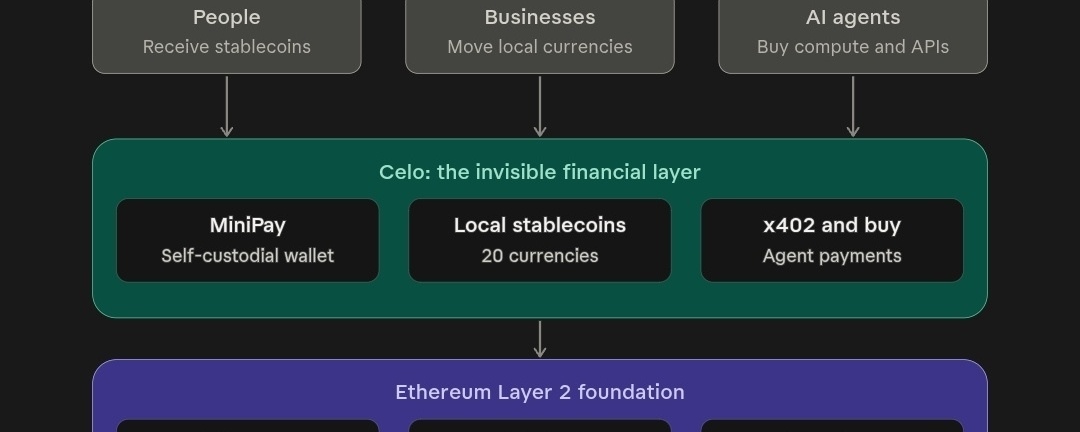
Celo: The Invisible Financial Layer Connecting People, Stablecoins and AI AgentsWhat if the biggest achievement of blockchain technology is not making people understand crypto, but making them no longer need to think about it?
Imagine three different situations.
A freelancer receives digital dollars from a client in another country. A small business needs to move money between different local currencies. An AI agent wants to purchase computing resources or access a paid API without waiting for a human to complete the payment.
These situations look unrelated, but they share one requirement: money must move quickly, reliably, affordably, and with as little friction as possible.
This is where I find Celo's strategy particularly interesting.
Rather than positioning itself only as another blockchain competing for transactions, Celo is developing infrastructure around a much bigger idea: making programmable money useful across human payments, local economies, and emerging machine-to-machine commerce.
And its transition to an Ethereum Layer 2 may be one of the most important pieces of that strategy.
1. The Real Problem Is Not Moving Money. It Is Removing Friction.
Blockchain technology has already demonstrated that digital assets can move globally without following every traditional banking process.
But technical capability and everyday usability are two different things.
A person receiving stablecoins may still face several obstacles:
- Getting funds into a wallet.
- Understanding network fees.
- Finding liquidity for local currencies.
- Converting digital assets into usable money.
- Navigating complicated wallet interfaces.
- Trusting the security and reliability of the infrastructure.
These problems matter because mainstream users do not care about execution environments, consensus mechanisms, or transaction finality.
They care about whether their money arrives and whether they can actually use it.
My view is that the next stage of blockchain adoption will depend heavily on removing these small but persistent obstacles.
The winning financial infrastructure may be the infrastructure users barely notice.
2. Celo's Layer 2 Transformation Was About More Than Scaling
Celo launched in 2020 as an independent Layer 1 blockchain, with mobile accessibility and financial inclusion at the centre of its vision.
However, maintaining an independent network also meant operating a separate security and infrastructure ecosystem.
In May 2024, the Celo community approved a transition to an Ethereum Layer 2. The migration was completed on March 26, 2025, using the Optimism OP Stack.
This was not simply a change in classification.
Celo retained its existing network state and ecosystem while moving toward closer integration with Ethereum.
Its architecture combines several important components:
OP Stack: Provides the Layer 2 execution framework.
Ethereum: Provides the Layer 1 settlement foundation.
EigenDA: Provides data availability infrastructure.
Fee Abstraction: Allows users to pay transaction fees using supported ERC-20 assets, including stablecoins.
The Superchain connection also creates opportunities for shared infrastructure, interoperability, and collaboration with other OP Stack networks.
But I think the more interesting question is why Celo needs this architecture.
Its objective is not simply to process more transactions. It is to combine Ethereum alignment with a specialised financial use case: affordable, mobile-first payments.
There is an important technical distinction here: using Ethereum settlement does not mean every component inherits identical security assumptions to Ethereum. Data availability, sequencing, bridges, and operational infrastructure still deserve independent evaluation.
That is precisely why Celo's architecture should be examined as a complete system rather than judged by the L2 label alone.
3. MiniPay: The Distribution Layer That Makes the Technology Matter
Infrastructure without distribution rarely creates mainstream adoption.
A blockchain can have excellent technology, but if ordinary users cannot access it comfortably, its potential remains limited.
This is where MiniPay becomes an important part of Celo's strategy.
MiniPay is a self-custodial stablecoin wallet developed by Opera and built on Celo. Its approach is centred on making digital financial tools accessible through smartphones.
Instead of expecting every user to understand seed phrases, gas tokens, and complicated blockchain interfaces, MiniPay focuses on simplifying the experience.
Its reported adoption figures are worth examining.
According to the November 19, 2026 announcement:
- More than 20 million activated wallets.
- More than 600 million transactions processed.
- Availability across 70+ countries.
- 77 Mini Apps.
These are meaningful distribution indicators, although activated wallets should not be confused with unique monthly active users.
Another important development is MiniPay's upgrade to Privy, the Stripe-owned wallet infrastructure provider.
The integration introduces email, social-account, and passkey sign-in options while preserving the wallet's self-custodial design and allowing users to export their keys.
This matters because wallet access is one of the biggest onboarding barriers in crypto.
The wider Stripe connection is also developing. MiniPay introduced Link by Stripe deposits for users in the EU and US, providing another route for bringing money into the stablecoin ecosystem.
However, I would distinguish the availability of these integrations from universal payment acceptance. Their actual reach depends on supported markets, partners, and services.
The real opportunity is turning a crypto wallet into a familiar financial interface without removing the user's control over their assets.
4. Local-Currency Stablecoins: A More Interesting Payment Opportunity
One aspect of Celo that deserves more attention is its focus on currencies beyond the US dollar.
Most crypto payment conversations revolve around dollar-denominated stablecoins.
But the global economy does not operate in a single currency.
A business in Brazil may need Brazilian reais. A user in Nigeria may prefer naira. A merchant in Argentina may need Argentine pesos.
Local-currency stablecoins can potentially reduce unnecessary conversion steps and support more relevant financial applications.
Celo's ecosystem includes assets such as:
- USDC and USDT.
- USA₮.
- USDm and EURm.
- BRLm and XOFm.
- Other local-currency stablecoin assets.
Celo reported an ecosystem of 33 stablecoins representing 20 currencies in its October 2026 infrastructure update.
This creates an interesting possibility: rather than treating every international transaction as a dollar conversion problem, applications could increasingly work with the currencies their users actually need.
But the number of supported stablecoins is only one part of the equation.
Their reserve quality, issuer reliability, redemption mechanisms, regulatory standing, and local liquidity are equally important.
A token representing a local currency is not automatically equivalent to a bank deposit or guaranteed redemption at every location.
For Celo, the next challenge is making this multi-currency infrastructure useful beyond simply having more assets available.
5. The Unexpected Next User: AI Agents
This is where Celo's story becomes particularly interesting.
Until now, most payment infrastructure has been designed around humans.
A person opens an application, selects a service, confirms a payment, and receives something in return.
But AI agents are changing the way digital services are accessed.
An autonomous agent may need to purchase computing power, retrieve information, access an API, or pay another digital service to complete a task.
The question becomes:
How does software pay for software without requiring a human to manually complete every transaction?
Celo is exploring this through its x402 payment infrastructure.
The concept uses the HTTP 402 Payment Required response to allow online services to request payment before providing access.
The process can work like this:
1. An AI agent requests a paid service.
2. The service returns a payment requirement.
3. The agent signs a supported stablecoin payment authorization.
4. A facilitator verifies the authorization and handles settlement.
5. The service receives confirmation and provides access.
Celo's facilitator supports this type of payment flow, including gas sponsorship for supported assets.
The October 27, 2026 update expanded support to 10 stablecoins across eight currencies.
Even more interesting is Celo's launch of buy, a services marketplace where AI agents can discover and purchase more than 700 services covering computing, data, and APIs.
This is not just another wallet feature.
It represents an attempt to connect stablecoin infrastructure with an emerging economy in which software can independently purchase digital resources.
There is still a long way to go before autonomous payments become a mainstream commercial activity.
But the infrastructure being developed today could become relevant if agent-driven commerce expands.
6. Why the Superchain Connection Matters
The Superchain narrative is sometimes reduced to a collection of networks using the same technology.
I think its bigger significance is the possibility of building specialised networks that can share infrastructure while serving different markets.
Celo's identity within that ecosystem is particularly clear.
Ethereum provides the settlement foundation.
The OP Stack provides the execution architecture.
The wider Superchain creates opportunities for ecosystem connectivity.
Celo focuses on stablecoin payments, local financial markets, and mobile accessibility.
This division of purpose is important.
Not every blockchain needs to compete for the same users or applications. A specialised network can develop a stronger identity by solving a specific problem exceptionally well.
For Celo, that problem is making digital money practical in everyday financial activity.
However, interoperability is not automatic. Bridges, liquidity fragmentation, cross-chain messaging, and differing security assumptions remain important challenges.
The Superchain opportunity will ultimately depend on how effectively these networks become connected in practice.
7. The CELO Token: Does Network Growth Create Economic Value?
This is a question that deserves an honest answer.
A growing ecosystem does not automatically guarantee a rising native token value.
CELO has roles in governance, staking, and the network's economic model. Supported stablecoins can also be used for transaction fees, meaning users do not always need to acquire CELO just to make payments.
This creates an important distinction between network adoption and token demand.
One development worth watching is CELOccelerate.
Under this framework, net sequencer revenue, after applicable operating costs and revenue-sharing obligations, is directed toward the Community Fund through CELO acquisition.
CELO holders participate in governance decisions regarding the fund's use.
That means the purchased tokens are not automatically burned. Governance can determine whether they are held, reinvested, allocated, or burned through an approved decision.
I find this mechanism interesting because it attempts to connect actual network activity with the token's economic role.
But its long-term success depends on measurable factors:
- Sustainable sequencer revenue.
- Operating costs.
- Stablecoin payment activity.
- Transparent revenue reporting.
- Governance decisions.
- The relationship between token acquisition and circulating supply.
The important point is that token value capture must be demonstrated through real economic activity, not simply promised through an attractive ecosystem narrative.
8. What Could Stop This Vision From Working?
I would not consider Celo's opportunity without examining its challenges.
Competition: Ethereum L2s, Solana, and specialised payment networks are all competing for developers, liquidity, and financial applications.
Stablecoin dependencies: The reliability of stablecoin payments depends on issuers, reserves, redemption mechanisms, and local liquidity.
User retention: Twenty million activated wallets are encouraging, but recurring financial activity is a more meaningful measure of adoption.
Infrastructure security: Sequencing, data availability, bridges, and smart contracts all introduce technical risks that need continued attention.
Regulation: Local stablecoin rules and payment regulations can affect which financial services are available in different countries.
Token economics: Network growth must translate into sustainable revenue and meaningful economic value for the ecosystem.
These are not reasons to dismiss Celo. They are the challenges that will determine whether its strategy can succeed.
9. Five Things I Would Watch Next
Rather than judging Celo only by announcements or short-term market movements, I would monitor five developments:
1. MiniPay retention: Are activated wallets becoming regular users?
2. Stablecoin liquidity: Are local-currency assets gaining meaningful liquidity and real payment use cases?
3. Agentic payments: Are x402 and the buy marketplace generating recurring commercial transactions?
4. Network economics: Is sequencer revenue growing sustainably after operating costs?
5. Superchain connectivity: Are integrations creating meaningful benefits for developers, applications, and users?
These indicators can reveal whether Celo is progressing from a promising infrastructure narrative toward a sustainable financial ecosystem.
My Final Perspective: The Best Financial Infrastructure May Be Invisible
When I look at Celo, I see three different layers of opportunity coming together.
First, there are people who need accessible digital money.
Second, there are businesses and applications that need reliable payment infrastructure across currencies.
Third, there is an emerging generation of AI agents that may need to purchase digital services independently.
Celo is attempting to build infrastructure that can serve all three.
Its Ethereum Layer 2 transition gives it a different architectural position. Its Superchain alignment creates opportunities for broader connectivity. MiniPay provides a distribution channel, while stablecoins and agentic payment tools extend the potential use cases.
But I believe its biggest test is still ahead.
Can it convert wallet activations into recurring financial activity? Can local-currency stablecoins develop real liquidity? Can autonomous payments become a meaningful source of demand? And can network usage generate sustainable economic value?
Those questions matter more than the number of announcements a project publishes.
My central takeaway is simple: Celo's opportunity is not just to become a bigger blockchain. It is to become a financial layer that people, businesses, and eventually AI agents can use without needing to understand the blockchain underneath.
If that happens, the most successful part of Celo's technology might be the part that users never notice.
Celo is now a Layer 2. Secured by Ethereum. Built on the Superchain. But its real ambition is to make digital finance work in the real world.
What do you think will drive Celo's next stage of adoption: MiniPay, local-currency stablecoins, or AI-powered payments?
#Celo @celo $CELO
{spot}(CELOUSDT)
Disclosure: Original educational research prepared for the Binance Square Celo Creator Challenge. This article reflects an independent interpretation of publicly available information.
Disclaimer: This content is for educational purposes only and is not financial advice. Cryptocurrency assets involve significant risks. Always conduct your own research.
@Binance_Square_Official
Celo: The Invisible Financial Layer Connecting People, Stablecoins and AI Agents
What if the biggest achievement of blockchain technology is not making people understand crypto, but making them no longer need to think about it?
Imagine three different situations.
A freelancer receives digital dollars from a client in another country. A small business needs to move money between different local currencies. An AI agent wants to purchase computing resources or access a paid API without waiting for a human to complete the payment.
These situations look unrelated, but they share one requirement: money must move quickly, reliably, affordably, and with as little friction as possible.
This is where I find Celo's strategy particularly interesting.
Rather than positioning itself only as another blockchain competing for transactions, Celo is developing infrastructure around a much bigger idea: making programmable money useful across human payments, local economies, and emerging machine-to-machine commerce.
And its transition to an Ethereum Layer 2 may be one of the most important pieces of that strategy.
1. The Real Problem Is Not Moving Money. It Is Removing Friction.
Blockchain technology has already demonstrated that digital assets can move globally without following every traditional banking process.
But technical capability and everyday usability are two different things.
A person receiving stablecoins may still face several obstacles:
- Getting funds into a wallet.
- Understanding network fees.
- Finding liquidity for local currencies.
- Converting digital assets into usable money.
- Navigating complicated wallet interfaces.
- Trusting the security and reliability of the infrastructure.
These problems matter because mainstream users do not care about execution environments, consensus mechanisms, or transaction finality.
They care about whether their money arrives and whether they can actually use it.
My view is that the next stage of blockchain adoption will depend heavily on removing these small but persistent obstacles.
The winning financial infrastructure may be the infrastructure users barely notice.
2. Celo's Layer 2 Transformation Was About More Than Scaling
Celo launched in 2020 as an independent Layer 1 blockchain, with mobile accessibility and financial inclusion at the centre of its vision.
However, maintaining an independent network also meant operating a separate security and infrastructure ecosystem.
In May 2024, the Celo community approved a transition to an Ethereum Layer 2. The migration was completed on March 26, 2025, using the Optimism OP Stack.
This was not simply a change in classification.
Celo retained its existing network state and ecosystem while moving toward closer integration with Ethereum.
Its architecture combines several important components:
OP Stack: Provides the Layer 2 execution framework.
Ethereum: Provides the Layer 1 settlement foundation.
EigenDA: Provides data availability infrastructure.
Fee Abstraction: Allows users to pay transaction fees using supported ERC-20 assets, including stablecoins.
The Superchain connection also creates opportunities for shared infrastructure, interoperability, and collaboration with other OP Stack networks.
But I think the more interesting question is why Celo needs this architecture.
Its objective is not simply to process more transactions. It is to combine Ethereum alignment with a specialised financial use case: affordable, mobile-first payments.
There is an important technical distinction here: using Ethereum settlement does not mean every component inherits identical security assumptions to Ethereum. Data availability, sequencing, bridges, and operational infrastructure still deserve independent evaluation.
That is precisely why Celo's architecture should be examined as a complete system rather than judged by the L2 label alone.
3. MiniPay: The Distribution Layer That Makes the Technology Matter
Infrastructure without distribution rarely creates mainstream adoption.
A blockchain can have excellent technology, but if ordinary users cannot access it comfortably, its potential remains limited.
This is where MiniPay becomes an important part of Celo's strategy.
MiniPay is a self-custodial stablecoin wallet developed by Opera and built on Celo. Its approach is centred on making digital financial tools accessible through smartphones.
Instead of expecting every user to understand seed phrases, gas tokens, and complicated blockchain interfaces, MiniPay focuses on simplifying the experience.
Its reported adoption figures are worth examining.
According to the November 19, 2026 announcement:
- More than 20 million activated wallets.
- More than 600 million transactions processed.
- Availability across 70+ countries.
- 77 Mini Apps.
These are meaningful distribution indicators, although activated wallets should not be confused with unique monthly active users.
Another important development is MiniPay's upgrade to Privy, the Stripe-owned wallet infrastructure provider.
The integration introduces email, social-account, and passkey sign-in options while preserving the wallet's self-custodial design and allowing users to export their keys.
This matters because wallet access is one of the biggest onboarding barriers in crypto.
The wider Stripe connection is also developing. MiniPay introduced Link by Stripe deposits for users in the EU and US, providing another route for bringing money into the stablecoin ecosystem.
However, I would distinguish the availability of these integrations from universal payment acceptance. Their actual reach depends on supported markets, partners, and services.
The real opportunity is turning a crypto wallet into a familiar financial interface without removing the user's control over their assets.
4. Local-Currency Stablecoins: A More Interesting Payment Opportunity
One aspect of Celo that deserves more attention is its focus on currencies beyond the US dollar.
Most crypto payment conversations revolve around dollar-denominated stablecoins.
But the global economy does not operate in a single currency.
A business in Brazil may need Brazilian reais. A user in Nigeria may prefer naira. A merchant in Argentina may need Argentine pesos.
Local-currency stablecoins can potentially reduce unnecessary conversion steps and support more relevant financial applications.
Celo's ecosystem includes assets such as:
- USDC and USDT.
- USA₮.
- USDm and EURm.
- BRLm and XOFm.
- Other local-currency stablecoin assets.
Celo reported an ecosystem of 33 stablecoins representing 20 currencies in its October 2026 infrastructure update.
This creates an interesting possibility: rather than treating every international transaction as a dollar conversion problem, applications could increasingly work with the currencies their users actually need.
But the number of supported stablecoins is only one part of the equation.
Their reserve quality, issuer reliability, redemption mechanisms, regulatory standing, and local liquidity are equally important.
A token representing a local currency is not automatically equivalent to a bank deposit or guaranteed redemption at every location.
For Celo, the next challenge is making this multi-currency infrastructure useful beyond simply having more assets available.
5. The Unexpected Next User: AI Agents
This is where Celo's story becomes particularly interesting.
Until now, most payment infrastructure has been designed around humans.
A person opens an application, selects a service, confirms a payment, and receives something in return.
But AI agents are changing the way digital services are accessed.
An autonomous agent may need to purchase computing power, retrieve information, access an API, or pay another digital service to complete a task.
The question becomes:
How does software pay for software without requiring a human to manually complete every transaction?
Celo is exploring this through its x402 payment infrastructure.
The concept uses the HTTP 402 Payment Required response to allow online services to request payment before providing access.
The process can work like this:
1. An AI agent requests a paid service.
2. The service returns a payment requirement.
3. The agent signs a supported stablecoin payment authorization.
4. A facilitator verifies the authorization and handles settlement.
5. The service receives confirmation and provides access.
Celo's facilitator supports this type of payment flow, including gas sponsorship for supported assets.
The October 27, 2026 update expanded support to 10 stablecoins across eight currencies.
Even more interesting is Celo's launch of buy, a services marketplace where AI agents can discover and purchase more than 700 services covering computing, data, and APIs.
This is not just another wallet feature.
It represents an attempt to connect stablecoin infrastructure with an emerging economy in which software can independently purchase digital resources.
There is still a long way to go before autonomous payments become a mainstream commercial activity.
But the infrastructure being developed today could become relevant if agent-driven commerce expands.
6. Why the Superchain Connection Matters
The Superchain narrative is sometimes reduced to a collection of networks using the same technology.
I think its bigger significance is the possibility of building specialised networks that can share infrastructure while serving different markets.
Celo's identity within that ecosystem is particularly clear.
Ethereum provides the settlement foundation.
The OP Stack provides the execution architecture.
The wider Superchain creates opportunities for ecosystem connectivity.
Celo focuses on stablecoin payments, local financial markets, and mobile accessibility.
This division of purpose is important.
Not every blockchain needs to compete for the same users or applications. A specialised network can develop a stronger identity by solving a specific problem exceptionally well.
For Celo, that problem is making digital money practical in everyday financial activity.
However, interoperability is not automatic. Bridges, liquidity fragmentation, cross-chain messaging, and differing security assumptions remain important challenges.
The Superchain opportunity will ultimately depend on how effectively these networks become connected in practice.
7. The CELO Token: Does Network Growth Create Economic Value?
This is a question that deserves an honest answer.
A growing ecosystem does not automatically guarantee a rising native token value.
CELO has roles in governance, staking, and the network's economic model. Supported stablecoins can also be used for transaction fees, meaning users do not always need to acquire CELO just to make payments.
This creates an important distinction between network adoption and token demand.
One development worth watching is CELOccelerate.
Under this framework, net sequencer revenue, after applicable operating costs and revenue-sharing obligations, is directed toward the Community Fund through CELO acquisition.
CELO holders participate in governance decisions regarding the fund's use.
That means the purchased tokens are not automatically burned. Governance can determine whether they are held, reinvested, allocated, or burned through an approved decision.
I find this mechanism interesting because it attempts to connect actual network activity with the token's economic role.
But its long-term success depends on measurable factors:
- Sustainable sequencer revenue.
- Operating costs.
- Stablecoin payment activity.
- Transparent revenue reporting.
- Governance decisions.
- The relationship between token acquisition and circulating supply.
The important point is that token value capture must be demonstrated through real economic activity, not simply promised through an attractive ecosystem narrative.
8. What Could Stop This Vision From Working?
I would not consider Celo's opportunity without examining its challenges.
Competition: Ethereum L2s, Solana, and specialised payment networks are all competing for developers, liquidity, and financial applications.
Stablecoin dependencies: The reliability of stablecoin payments depends on issuers, reserves, redemption mechanisms, and local liquidity.
User retention: Twenty million activated wallets are encouraging, but recurring financial activity is a more meaningful measure of adoption.
Infrastructure security: Sequencing, data availability, bridges, and smart contracts all introduce technical risks that need continued attention.
Regulation: Local stablecoin rules and payment regulations can affect which financial services are available in different countries.
Token economics: Network growth must translate into sustainable revenue and meaningful economic value for the ecosystem.
These are not reasons to dismiss Celo. They are the challenges that will determine whether its strategy can succeed.
9. Five Things I Would Watch Next
Rather than judging Celo only by announcements or short-term market movements, I would monitor five developments:
1. MiniPay retention: Are activated wallets becoming regular users?
2. Stablecoin liquidity: Are local-currency assets gaining meaningful liquidity and real payment use cases?
3. Agentic payments: Are x402 and the buy marketplace generating recurring commercial transactions?
4. Network economics: Is sequencer revenue growing sustainably after operating costs?
5. Superchain connectivity: Are integrations creating meaningful benefits for developers, applications, and users?
These indicators can reveal whether Celo is progressing from a promising infrastructure narrative toward a sustainable financial ecosystem.
My Final Perspective: The Best Financial Infrastructure May Be Invisible
When I look at Celo, I see three different layers of opportunity coming together.
First, there are people who need accessible digital money.
Second, there are businesses and applications that need reliable payment infrastructure across currencies.
Third, there is an emerging generation of AI agents that may need to purchase digital services independently.
Celo is attempting to build infrastructure that can serve all three.
Its Ethereum Layer 2 transition gives it a different architectural position. Its Superchain alignment creates opportunities for broader connectivity. MiniPay provides a distribution channel, while stablecoins and agentic payment tools extend the potential use cases.
But I believe its biggest test is still ahead.
Can it convert wallet activations into recurring financial activity? Can local-currency stablecoins develop real liquidity? Can autonomous payments become a meaningful source of demand? And can network usage generate sustainable economic value?
Those questions matter more than the number of announcements a project publishes.
My central takeaway is simple: Celo's opportunity is not just to become a bigger blockchain. It is to become a financial layer that people, businesses, and eventually AI agents can use without needing to understand the blockchain underneath.
If that happens, the most successful part of Celo's technology might be the part that users never notice.
Celo is now a Layer 2. Secured by Ethereum. Built on the Superchain. But its real ambition is to make digital finance work in the real world.
What do you think will drive Celo's next stage of adoption: MiniPay, local-currency stablecoins, or AI-powered payments?
#Celo @celo $CELO
Disclosure: Original educational research prepared for the Binance Square Celo Creator Challenge. This article reflects an independent interpretation of publicly available information.
Disclaimer: This content is for educational purposes only and is not financial advice. Cryptocurrency assets involve significant risks. Always conduct your own research.
@Binance Square Official
VICTORIA _777:
Network revenue is something I would watch closely. Sustainable economics matter more than temporary ecosystem excitement.
30
31
544

·
--
Article
CELO: BUILT ON ETHEREUM, POWERED BY THE SUPERCHAIN, DESIGNED FOR THE WORLD'S PAYMENTSThe biggest opportunity for Celo may not be becoming another successful blockchain. It may be making blockchain disappear from the payment experience altogether.
Think about the last time you sent money internationally.
You probably had to think about the payment provider, the receiving bank, currency conversion, transfer fees, processing time, and whether the person on the other side could actually receive the money.
Now imagine sending digital dollars across borders from a phone, paying a fraction of a cent in network fees, and never having to understand which blockchain is processing the transaction.
That is the problem I believe Celo is trying to solve.
And its transition from an independent Layer 1 to an Ethereum Layer 2 is one of the most important parts of understanding where this project is heading.
Because Celo is no longer positioning itself as simply another blockchain competing for attention. It is building payment infrastructure around Ethereum, participating in the Superchain ecosystem, and connecting stablecoins with real-world financial applications.
But there is more to this story than a technical upgrade.
THE LAYER 1 TO LAYER 2 TRANSITION WAS A STRATEGIC DECISION
Celo launched its independent mainnet in 2020 with a clear mission: make financial services more accessible through mobile technology.
It focused on affordable transactions, stablecoins, local currencies, and applications that could work for people outside the traditional crypto community.
That mission did not disappear when Celo changed its architecture.
Instead, the network made a major strategic decision.
In May 2024, the Celo community approved the proposal to transition from an independent Layer 1 into an Ethereum Layer 2. On March 26, 2025, that transition officially went live.
Why does this matter?
An independent Layer 1 has to maintain its own security infrastructure, validator ecosystem, liquidity relationships, and developer environment.
Celo had already built an ecosystem around payments, but aligning more closely with Ethereum offered another opportunity: combine its real-world payment focus with Ethereum's settlement ecosystem, tooling, and developer reach.
The migration was built on the Optimism OP Stack, with EigenDA providing data availability.
This is important because Celo did not simply launch a new chain and abandon the old one. Its existing network state and ecosystem were carried forward into the new Layer 2 architecture.
For me, that is the more interesting part of the transition.
Celo changed the infrastructure underneath its original mission rather than abandoning the mission itself.
WHAT DOES BEING PART OF THE SUPERCHAIN ACTUALLY MEAN?
This is where Celo's positioning becomes particularly interesting.
The Superchain is an ecosystem of OP Stack-based chains aligned around shared technology and an evolving framework for interoperability and coordination.
Celo joining this ecosystem means it is no longer developing in isolation.
It can benefit from the broader Optimism technology stack, shared developer tooling, and collaboration with other networks building around the same architecture.
But I want to make one distinction clear.
Being part of the Superchain does not automatically mean every chain shares the same liquidity, users, or applications. Interoperability requires actual technical integrations, infrastructure, and adoption.
The real advantage is the opportunity to build within a larger Ethereum-aligned ecosystem rather than trying to create every component independently.
Think about the difference.
Celo can concentrate on what makes it different: stablecoin payments, mobile-first applications, local currencies, and global financial access.
It does not need to convince the entire market that people should abandon Ethereum.
It can build on top of an ecosystem that already has developers, infrastructure, and established applications.
That is a much more practical strategy than competing for the title of the next general-purpose blockchain.
ETHEREUM SECURITY WITH A PAYMENT-FIRST ARCHITECTURE
The phrase "secured by Ethereum" is important, but it deserves more than a marketing sentence.
As an Ethereum Layer 2, Celo submits transaction data and state commitments through its Ethereum-aligned settlement architecture. Its OP Stack foundation connects it to Ethereum, while EigenDA provides the data availability layer.
This architecture gives Celo a different security and settlement model from its former independent Layer 1.
It also comes with responsibilities and trade-offs.
Layer 2 security is not identical to running every transaction directly on Ethereum mainnet. Data availability, sequencing, proof systems, upgrades, and decentralization all matter when evaluating the complete security model.
I actually think this distinction makes the project more interesting.
Celo is not trying to become Ethereum. It is trying to make Ethereum-aligned infrastructure useful for a specific economic purpose.
And that purpose is payments.
Another important feature is fee abstraction.
On many blockchains, a new user must acquire the network's native gas token before making a transaction.
That creates unnecessary friction for someone who simply wants to send $10 in digital dollars.
Celo supports paying transaction fees with supported ERC-20 assets, including stablecoins.
In practical terms, users can interact with the network without first needing to purchase a separate gas asset.
That might sound like a small technical detail.
For mainstream payment adoption, it is anything but small.
MINIPAY: WHERE THE INFRASTRUCTURE MEETS REAL USERS
A blockchain can have excellent technology, but technology alone does not create adoption.
People need something they can actually use.
This is why MiniPay deserves special attention.
Built by Opera on Celo, MiniPay is a self-custodial stablecoin wallet designed around mobile-first financial access.
Its growth provides one of the clearest examples of how Celo's infrastructure connects with an actual consumer product.
According to MiniPay's November 19, 2026 announcement:
- More than 20 million activated wallets.
- Over 600 million processed transactions.
- Availability across more than 70 countries.
- 77 Mini Apps.
Its Q3 2026 ecosystem update also reported more than $2.3 billion in processed volume since launch.
Those are meaningful distribution and activity indicators.
But I would not automatically call 20 million activated wallets 20 million active people. Wallet activations, unique users, recurring users, and retained customers are different measurements.
The next question is whether those users keep returning.
There is another development worth watching.
On November 19, MiniPay announced that it was upgrading its wallet infrastructure to Privy, the wallet infrastructure company owned by Stripe.
The upgrade is designed to support email, social account, and passkey sign-in while preserving self-custody.
That matters because one of the biggest obstacles to crypto adoption has always been the onboarding experience.
Most people do not want to manage seed phrases, understand gas tokens, or install browser extensions just to receive money.
MiniPay is attempting to remove those barriers.
And the Stripe connection makes the development even more interesting. MiniPay had already introduced Link by Stripe deposits for users in the United States and Europe.
This is how I see the opportunity:
Opera brings distribution. MiniPay provides the user experience. Celo provides the blockchain settlement infrastructure. Stablecoins provide the money.
If that combination continues to work, the blockchain becomes almost invisible to the person using it.
That is the kind of adoption I would rather see than another project celebrating a large transaction count without explaining who is actually using it.
STABLECOINS ARE NOT JUST ANOTHER CELO FEATURE
I think stablecoins are at the center of Celo's long-term strategy.
The global payments market does not need every person to hold a volatile cryptocurrency to benefit from blockchain technology.
A freelancer wants to receive predictable payment. A merchant wants to settle invoices. A family wants to transfer money across borders. A business wants access to reliable digital liquidity.
Stablecoins make those use cases more practical.
Celo's ecosystem includes USDC, USDT, USA₮, and Mento's local-currency stable assets, including USDm, EURm, BRLm, and XOFm.
By late 2026, Celo's ecosystem reported support for 33 stablecoins representing approximately 20 currencies.
That local-currency angle is especially important.
A global payment network should not assume that every transaction needs to begin and end in US dollars.
A Brazilian business may need reais. A Nigerian user may need naira. A European merchant may prefer euros.
Local-currency stablecoins can help reduce unnecessary conversion steps and create more relevant onchain payment experiences.
Of course, the number of stablecoins alone is not enough.
Issuer reliability, reserve quality, redemption rights, regulatory status, and actual liquidity matter.
Still, Celo's focus on different currencies gives its payment strategy a more practical direction than simply competing to attract another speculative token market.
THE NEXT CUSTOMER MAY NOT EVEN BE HUMAN
Now we get to one of the most interesting developments in Celo's ecosystem.
AI agents.
AI systems are moving beyond answering questions. They are increasingly being designed to access APIs, purchase digital services, use computing resources, retrieve data, and complete tasks.
But there is a missing piece.
How does an autonomous software agent pay for something?
Traditional payment systems are primarily designed around human accounts, subscriptions, cards, and manual approvals.
An AI agent that needs a small amount of computing power or access to a paid data service needs a way to authorize and settle payments programmatically.
This is where Celo's x402 infrastructure becomes relevant.
Celo introduced its native x402 facilitator to support stablecoin payments through internet-native payment requests.
The concept is relatively straightforward:
A service requests payment through an HTTP 402 response.
The agent receives the payment requirements.
The agent authorizes a supported stablecoin transfer.
The facilitator verifies the authorization and coordinates settlement on Celo.
The service receives payment confirmation and provides access.
The interesting part is that this can happen without requiring the agent to go through a traditional checkout experience for every individual service.
Celo has continued expanding this infrastructure.
On October 13, 2026, Celo Core Co. launched buy, a marketplace where AI agents can discover and purchase more than 700 services covering compute, data, and APIs.
Agents can pay using USDC, USDT, or USA₮.
Then, on October 27, the x402 facilitator expanded to support 10 stablecoins across eight currencies, including US dollar assets and local-currency stablecoins such as Brazilian real, Argentine peso, Nigerian naira, and others.
This is more than adding another AI narrative to a blockchain.
It connects three existing ideas:
Programmable money.
Accessible stablecoin infrastructure.
Autonomous software that needs to purchase services.
I would not claim that AI agents are already creating massive mainstream payment demand. That still needs to be demonstrated through recurring commercial activity.
But I do think the direction is worth taking seriously.
If autonomous agents become regular internet customers, payment infrastructure capable of handling small, fast, programmable transactions could become increasingly important.
Celo is positioning itself for that possibility.
THE PART TOKEN HOLDERS SHOULD NOT IGNORE: CELO ECONOMICS
Now comes the question that separates ecosystem research from token promotion.
If Celo grows, does CELO automatically benefit?
No.
A network can process millions of transactions while its native token captures very little economic value.
This is particularly important for Celo because users can pay transaction fees using supported stablecoins.
That is excellent for usability, but it means every new payment does not necessarily require someone to purchase CELO first.
So how does the network connect adoption with the token?
One of the most important developments is CELOccelerate.
Under the approved economic framework, net L2 sequencer revenue, after relevant protocol operating costs, is directed toward acquiring CELO and transferring it to the Community Fund.
CELO holders then govern how those funds are used.
They may choose to hold, reinvest, or approve a burn through governance.
Notice the distinction: this is not an automatic buyback-and-burn mechanism.
The acquisition and transfer of CELO are part of the revenue model, while the eventual use of the Community Fund remains subject to governance.
I like this approach because it attempts to create a direct economic relationship between network activity and the native token.
If more transactions generate more sustainable sequencer revenue, and more net revenue is converted into CELO, the token has a clearer value-accrual mechanism than relying entirely on speculative demand.
But there is a catch.
The mechanism only becomes meaningful if revenue grows, operating costs remain manageable, and the resulting purchases are material relative to the token's market liquidity and supply.
That is what I would monitor.
Not just how many transactions Celo processes, but how much sustainable revenue those transactions generate and how much of that value actually reaches the Community Fund.
WHAT COULD STOP THIS STRATEGY FROM WORKING?
I do not think a serious assessment of Celo should ignore the difficult parts.
Competition is real.
Celo is competing with other Ethereum Layer 2 networks, Solana, payment-focused blockchains, and increasingly capable traditional payment providers.
Being part of the Superchain is an advantage, but it is not a guarantee of market share.
Wallet activations are not the same as retention.
Twenty million activated wallets sounds impressive. However, recurring users and actual payment behaviour are much better indicators of product-market fit.
Stablecoin infrastructure depends on external issuers.
Celo cannot independently guarantee the reserves, redemption, or regulatory position of every stablecoin in its ecosystem.
Layer 2 security continues to evolve.
Sequencer decentralization, data availability, proof systems, upgrade governance, and operational reliability deserve continued attention.
Token value capture remains an execution challenge.
A buyback mechanism is only as strong as the revenue supporting it. If network usage grows but revenue remains limited, the economic impact on CELO may remain modest.
And finally, AI agent payments are still an emerging market. Infrastructure can arrive before meaningful demand.
These are not reasons to dismiss Celo. They are the conditions that will determine whether its strategy succeeds.
WHAT I WOULD WATCH OVER THE NEXT 12 MONTHS
If I were evaluating Celo's progress, I would focus on five indicators.
1. MiniPay retention: Are activated wallets becoming regular users who send, receive, and spend stablecoins?
2. Real stablecoin payments: Is transaction activity supported by genuine economic use rather than simply transfers and incentives?
3. Superchain integration: Are interoperability and ecosystem relationships producing actual developers, applications, and liquidity?
4. Agentic payment demand: Are x402 and the buy marketplace generating repeat commercial transactions rather than just demonstrations?
5. CELO value capture: Is net sequencer revenue increasing, and are transparent Community Fund distributions reflecting that growth?
These indicators will tell me considerably more about Celo's future than a temporary price rally.
MY TAKE: CELO IS TRYING TO SOLVE A BIGGER PROBLEM THAN BLOCKCHAIN SCALABILITY
What makes Celo interesting to me is the combination of its decisions.
It started with mobile-first financial access.
It developed a stablecoin-focused ecosystem.
It transitioned into an Ethereum Layer 2.
It joined the Superchain ecosystem.
It connected its infrastructure to MiniPay's growing distribution.
And now it is exploring programmable payments for AI agents.
Each development makes more sense when viewed as part of the same strategy.
Celo wants to provide the financial rails underneath applications, wallets, businesses, and eventually autonomous software.
I would not call that a guaranteed success story.
There is still competition, execution risk, and a very important question about whether network adoption will create enough sustainable economic value for CELO holders.
But I think the direction deserves attention.
The next major blockchain opportunity may not belong to the network with the loudest community or the most complicated technology.
It may belong to the infrastructure that people use every day without even realizing they are using blockchain.
And that is the bigger idea behind Celo's evolution.
Built on Ethereum. Connected to the Superchain. Focused on making money move in the real world.
The real test is no longer whether Celo can process transactions.
It is whether it can become infrastructure people, businesses, and software agents genuinely depend on.
That is the story I will be watching.
One question for the community:
Will Celo become one of the most important payment-focused networks in the Ethereum ecosystem, or will competition make it difficult to turn its adoption into lasting economic value?
I am more interested in real payment activity, returning users, and sustainable revenue CELO: BUILT ON ETHEREUM, POWERED BY THE SUPERCHAIN, DESIGNED FOR THE WORLD'S PAYMENTS
The biggest opportunity for Celo may not be becoming another successful blockchain. It may be making blockchain disappear from the payment experience altogether.
Think about the last time you sent money internationally.
You probably had to think about the payment provider, the receiving bank, currency conversion, transfer fees, processing time, and whether the person on the other side could actually receive the money.
Now imagine sending digital dollars across borders from a phone, paying a fraction of a cent in network fees, and never having to understand which blockchain is processing the transaction.
That is the problem I believe Celo is trying to solve.
And its transition from an independent Layer 1 to an Ethereum Layer 2 is one of the most important parts of understanding where this project is heading.
Because Celo is no longer positioning itself as simply another blockchain competing for attention. It is building payment infrastructure around Ethereum, participating in the Superchain ecosystem, and connecting stablecoins with real-world financial applications.
But there is more to this story than a technical upgrade.
THE LAYER 1 TO LAYER 2 TRANSITION WAS A STRATEGIC DECISION
Celo launched its independent mainnet in 2020 with a clear mission: make financial services more accessible through mobile technology.
It focused on affordable transactions, stablecoins, local currencies, and applications that could work for people outside the traditional crypto community.
That mission did not disappear when Celo changed its architecture.
Instead, the network made a major strategic decision.
In May 2024, the Celo community approved the proposal to transition from an independent Layer 1 into an Ethereum Layer 2. On March 26, 2025, that transition officially went live.
Why does this matter?
An independent Layer 1 has to maintain its own security infrastructure, validator ecosystem, liquidity relationships, and developer environment.
Celo had already built an ecosystem around payments, but aligning more closely with Ethereum offered another opportunity: combine its real-world payment focus with Ethereum's settlement ecosystem, tooling, and developer reach.
The migration was built on the Optimism OP Stack, with EigenDA providing data availability.
This is important because Celo did not simply launch a new chain and abandon the old one. Its existing network state and ecosystem were carried forward into the new Layer 2 architecture.
For me, that is the more interesting part of the transition.
Celo changed the infrastructure underneath its original mission rather than abandoning the mission itself.
WHAT DOES BEING PART OF THE SUPERCHAIN ACTUALLY MEAN?
This is where Celo's positioning becomes particularly interesting.
The Superchain is an ecosystem of OP Stack-based chains aligned around shared technology and an evolving framework for interoperability and coordination.
Celo joining this ecosystem means it is no longer developing in isolation.
It can benefit from the broader Optimism technology stack, shared developer tooling, and collaboration with other networks building around the same architecture.
But I want to make one distinction clear.
Being part of the Superchain does not automatically mean every chain shares the same liquidity, users, or applications. Interoperability requires actual technical integrations, infrastructure, and adoption.
The real advantage is the opportunity to build within a larger Ethereum-aligned ecosystem rather than trying to create every component independently.
Think about the difference.
Celo can concentrate on what makes it different: stablecoin payments, mobile-first applications, local currencies, and global financial access.
It does not need to convince the entire market that people should abandon Ethereum.
It can build on top of an ecosystem that already has developers, infrastructure, and established applications.
That is a much more practical strategy than competing for the title of the next general-purpose blockchain.
ETHEREUM SECURITY WITH A PAYMENT-FIRST ARCHITECTURE
The phrase "secured by Ethereum" is important, but it deserves more than a marketing sentence.
As an Ethereum Layer 2, Celo submits transaction data and state commitments through its Ethereum-aligned settlement architecture. Its OP Stack foundation connects it to Ethereum, while EigenDA provides the data availability layer.
This architecture gives Celo a different security and settlement model from its former independent Layer 1.
It also comes with responsibilities and trade-offs.
Layer 2 security is not identical to running every transaction directly on Ethereum mainnet. Data availability, sequencing, proof systems, upgrades, and decentralization all matter when evaluating the complete security model.
I actually think this distinction makes the project more interesting.
Celo is not trying to become Ethereum. It is trying to make Ethereum-aligned infrastructure useful for a specific economic purpose.
And that purpose is payments.
Another important feature is fee abstraction.
On many blockchains, a new user must acquire the network's native gas token before making a transaction.
That creates unnecessary friction for someone who simply wants to send $10 in digital dollars.
Celo supports paying transaction fees with supported ERC-20 assets, including stablecoins.
In practical terms, users can interact with the network without first needing to purchase a separate gas asset.
That might sound like a small technical detail.
For mainstream payment adoption, it is anything but small.
MINIPAY: WHERE THE INFRASTRUCTURE MEETS REAL USERS
A blockchain can have excellent technology, but technology alone does not create adoption.
People need something they can actually use.
This is why MiniPay deserves special attention.
Built by Opera on Celo, MiniPay is a self-custodial stablecoin wallet designed around mobile-first financial access.
Its growth provides one of the clearest examples of how Celo's infrastructure connects with an actual consumer product.
According to MiniPay's November 19, 2026 announcement:
- More than 20 million activated wallets.
- Over 600 million processed transactions.
- Availability across more than 70 countries.
- 77 Mini Apps.
Its Q3 2026 ecosystem update also reported more than $2.3 billion in processed volume since launch.
Those are meaningful distribution and activity indicators.
But I would not automatically call 20 million activated wallets 20 million active people. Wallet activations, unique users, recurring users, and retained customers are different measurements.
The next question is whether those users keep returning.
There is another development worth watching.
On November 19, MiniPay announced that it was upgrading its wallet infrastructure to Privy, the wallet infrastructure company owned by Stripe.
The upgrade is designed to support email, social account, and passkey sign-in while preserving self-custody.
That matters because one of the biggest obstacles to crypto adoption has always been the onboarding experience.
Most people do not want to manage seed phrases, understand gas tokens, or install browser extensions just to receive money.
MiniPay is attempting to remove those barriers.
And the Stripe connection makes the development even more interesting. MiniPay had already introduced Link by Stripe deposits for users in the United States and Europe.
This is how I see the opportunity:
Opera brings distribution. MiniPay provides the user experience. Celo provides the blockchain settlement infrastructure. Stablecoins provide the money.
If that combination continues to work, the blockchain becomes almost invisible to the person using it.
That is the kind of adoption I would rather see than another project celebrating a large transaction count without explaining who is actually using it.
STABLECOINS ARE NOT JUST ANOTHER CELO FEATURE
I think stablecoins are at the center of Celo's long-term strategy.
The global payments market does not need every person to hold a volatile cryptocurrency to benefit from blockchain technology.
A freelancer wants to receive predictable payment. A merchant wants to settle invoices. A family wants to transfer money across borders. A business wants access to reliable digital liquidity.
Stablecoins make those use cases more practical.
Celo's ecosystem includes USDC, USDT, USA₮, and Mento's local-currency stable assets, including USDm, EURm, BRLm, and XOFm.
By late 2026, Celo's ecosystem reported support for 33 stablecoins representing approximately 20 currencies.
That local-currency angle is especially important.
A global payment network should not assume that every transaction needs to begin and end in US dollars.
A Brazilian business may need reais. A Nigerian user may need naira. A European merchant may prefer euros.
Local-currency stablecoins can help reduce unnecessary conversion steps and create more relevant onchain payment experiences.
Of course, the number of stablecoins alone is not enough.
Issuer reliability, reserve quality, redemption rights, regulatory status, and actual liquidity matter.
Still, Celo's focus on different currencies gives its payment strategy a more practical direction than simply competing to attract another speculative token market.
THE NEXT CUSTOMER MAY NOT EVEN BE HUMAN
Now we get to one of the most interesting developments in Celo's ecosystem.
AI agents.
AI systems are moving beyond answering questions. They are increasingly being designed to access APIs, purchase digital services, use computing resources, retrieve data, and complete tasks.
But there is a missing piece.
How does an autonomous software agent pay for something?
Traditional payment systems are primarily designed around human accounts, subscriptions, cards, and manual approvals.
An AI agent that needs a small amount of computing power or access to a paid data service needs a way to authorize and settle payments programmatically.
This is where Celo's x402 infrastructure becomes relevant.
Celo introduced its native x402 facilitator to support stablecoin payments through internet-native payment requests.
The concept is relatively straightforward:
A service requests payment through an HTTP 402 response.
The agent receives the payment requirements.
The agent authorizes a supported stablecoin transfer.
The facilitator verifies the authorization and coordinates settlement on Celo.
The service receives payment confirmation and provides access.
The interesting part is that this can happen without requiring the agent to go through a traditional checkout experience for every individual service.
Celo has continued expanding this infrastructure.
On October 13, 2026, Celo Core Co. launched buy, a marketplace where AI agents can discover and purchase more than 700 services covering compute, data, and APIs.
Agents can pay using USDC, USDT, or USA₮.
Then, on October 27, the x402 facilitator expanded to support 10 stablecoins across eight currencies, including US dollar assets and local-currency stablecoins such as Brazilian real, Argentine peso, Nigerian naira, and others.
This is more than adding another AI narrative to a blockchain.
It connects three existing ideas:
Programmable money.
Accessible stablecoin infrastructure.
Autonomous software that needs to purchase services.
I would not claim that AI agents are already creating massive mainstream payment demand. That still needs to be demonstrated through recurring commercial activity.
But I do think the direction is worth taking seriously.
If autonomous agents become regular internet customers, payment infrastructure capable of handling small, fast, programmable transactions could become increasingly important.
Celo is positioning itself for that possibility.
THE PART TOKEN HOLDERS SHOULD NOT IGNORE: CELO ECONOMICS
Now comes the question that separates ecosystem research from token promotion.
If Celo grows, does CELO automatically benefit?
No.
A network can process millions of transactions while its native token captures very little economic value.
This is particularly important for Celo because users can pay transaction fees using supported stablecoins.
That is excellent for usability, but it means every new payment does not necessarily require someone to purchase CELO first.
So how does the network connect adoption with the token?
One of the most important developments is CELOccelerate.
Under the approved economic framework, net L2 sequencer revenue, after relevant protocol operating costs, is directed toward acquiring CELO and transferring it to the Community Fund.
CELO holders then govern how those funds are used.
They may choose to hold, reinvest, or approve a burn through governance.
Notice the distinction: this is not an automatic buyback-and-burn mechanism.
The acquisition and transfer of CELO are part of the revenue model, while the eventual use of the Community Fund remains subject to governance.
I like this approach because it attempts to create a direct economic relationship between network activity and the native token.
If more transactions generate more sustainable sequencer revenue, and more net revenue is converted into CELO, the token has a clearer value-accrual mechanism than relying entirely on speculative demand.
But there is a catch.
The mechanism only becomes meaningful if revenue grows, operating costs remain manageable, and the resulting purchases are material relative to the token's market liquidity and supply.
That is what I would monitor.
Not just how many transactions Celo processes, but how much sustainable revenue those transactions generate and how much of that value actually reaches the Community Fund.
WHAT COULD STOP THIS STRATEGY FROM WORKING?
I do not think a serious assessment of Celo should ignore the difficult parts.
Competition is real.
Celo is competing with other Ethereum Layer 2 networks, Solana, payment-focused blockchains, and increasingly capable traditional payment providers.
Being part of the Superchain is an advantage, but it is not a guarantee of market share.
Wallet activations are not the same as retention.
Twenty million activated wallets sounds impressive. However, recurring users and actual payment behaviour are much better indicators of product-market fit.
Stablecoin infrastructure depends on external issuers.
Celo cannot independently guarantee the reserves, redemption, or regulatory position of every stablecoin in its ecosystem.
Layer 2 security continues to evolve.
Sequencer decentralization, data availability, proof systems, upgrade governance, and operational reliability deserve continued attention.
Token value capture remains an execution challenge.
A buyback mechanism is only as strong as the revenue supporting it. If network usage grows but revenue remains limited, the economic impact on CELO may remain modest.
And finally, AI agent payments are still an emerging market. Infrastructure can arrive before meaningful demand.
These are not reasons to dismiss Celo. They are the conditions that will determine whether its strategy succeeds.
WHAT I WOULD WATCH OVER THE NEXT 12 MONTHS
If I were evaluating Celo's progress, I would focus on five indicators.
1. MiniPay retention: Are activated wallets becoming regular users who send, receive, and spend stablecoins?
2. Real stablecoin payments: Is transaction activity supported by genuine economic use rather than simply transfers and incentives?
3. Superchain integration: Are interoperability and ecosystem relationships producing actual developers, applications, and liquidity?
4. Agentic payment demand: Are x402 and the buy marketplace generating repeat commercial transactions rather than just demonstrations?
5. CELO value capture: Is net sequencer revenue increasing, and are transparent Community Fund distributions reflecting that growth?
These indicators will tell me considerably more about Celo's future than a temporary price rally.
MY TAKE: CELO IS TRYING TO SOLVE A BIGGER PROBLEM THAN BLOCKCHAIN SCALABILITY
What makes Celo interesting to me is the combination of its decisions.
It started with mobile-first financial access.
It developed a stablecoin-focused ecosystem.
It transitioned into an Ethereum Layer 2.
It joined the Superchain ecosystem.
It connected its infrastructure to MiniPay's growing distribution.
And now it is exploring programmable payments for AI agents.
Each development makes more sense when viewed as part of the same strategy.
Celo wants to provide the financial rails underneath applications, wallets, businesses, and eventually autonomous software.
I would not call that a guaranteed success story.
There is still competition, execution risk, and a very important question about whether network adoption will create enough sustainable economic value for CELO holders.
But I think the direction deserves attention.
The next major blockchain opportunity may not belong to the network with the loudest community or the most complicated technology.
It may belong to the infrastructure that people use every day without even realizing they are using blockchain.
And that is the bigger idea behind Celo's evolution.
Built on Ethereum. Connected to the Superchain. Focused on making money move in the real world.
The real test is no longer whether Celo can process transactions.
It is whether it can become infrastructure people, businesses, and software agents genuinely depend on.
That is the story I will be watching.
One question for the community:
Will Celo become one of the most important payment-focused networks in the Ethereum ecosystem, or will competition make it difficult to turn its adoption into lasting economic value?
I am more interested in real payment activity, returning users, and sustainable revenue than another headline about blockchain growth.
Disclosure: This is independent educational research prepared for the Celo Creator Challenge. The views expressed are my own interpretation of publicly available information.
Disclaimer: This article is not financial advice. Cryptocurrency assets involve significant risks, and readers should conduct their own research.than another headline about blockchain growth.
Disclosure: This is independent educational research prepared for the Celo Creator Challenge. The views expressed are my own interpretation of publicly available information.
Disclaimer: This article is not financial advice. Cryptocurrency assets involve significant risks, and readers should conduct their own research.
$CELO @celo #CELO #celo
{spot}(CELOUSDT)
CELO: BUILT ON ETHEREUM, POWERED BY THE SUPERCHAIN, DESIGNED FOR THE WORLD'S PAYMENTS
The biggest opportunity for Celo may not be becoming another successful blockchain. It may be making blockchain disappear from the payment experience altogether.
Think about the last time you sent money internationally.
You probably had to think about the payment provider, the receiving bank, currency conversion, transfer fees, processing time, and whether the person on the other side could actually receive the money.
Now imagine sending digital dollars across borders from a phone, paying a fraction of a cent in network fees, and never having to understand which blockchain is processing the transaction.
That is the problem I believe Celo is trying to solve.
And its transition from an independent Layer 1 to an Ethereum Layer 2 is one of the most important parts of understanding where this project is heading.
Because Celo is no longer positioning itself as simply another blockchain competing for attention. It is building payment infrastructure around Ethereum, participating in the Superchain ecosystem, and connecting stablecoins with real-world financial applications.
But there is more to this story than a technical upgrade.
THE LAYER 1 TO LAYER 2 TRANSITION WAS A STRATEGIC DECISION
Celo launched its independent mainnet in 2020 with a clear mission: make financial services more accessible through mobile technology.
It focused on affordable transactions, stablecoins, local currencies, and applications that could work for people outside the traditional crypto community.
That mission did not disappear when Celo changed its architecture.
Instead, the network made a major strategic decision.
In May 2024, the Celo community approved the proposal to transition from an independent Layer 1 into an Ethereum Layer 2. On March 26, 2025, that transition officially went live.
Why does this matter?
An independent Layer 1 has to maintain its own security infrastructure, validator ecosystem, liquidity relationships, and developer environment.
Celo had already built an ecosystem around payments, but aligning more closely with Ethereum offered another opportunity: combine its real-world payment focus with Ethereum's settlement ecosystem, tooling, and developer reach.
The migration was built on the Optimism OP Stack, with EigenDA providing data availability.
This is important because Celo did not simply launch a new chain and abandon the old one. Its existing network state and ecosystem were carried forward into the new Layer 2 architecture.
For me, that is the more interesting part of the transition.
Celo changed the infrastructure underneath its original mission rather than abandoning the mission itself.
WHAT DOES BEING PART OF THE SUPERCHAIN ACTUALLY MEAN?
This is where Celo's positioning becomes particularly interesting.
The Superchain is an ecosystem of OP Stack-based chains aligned around shared technology and an evolving framework for interoperability and coordination.
Celo joining this ecosystem means it is no longer developing in isolation.
It can benefit from the broader Optimism technology stack, shared developer tooling, and collaboration with other networks building around the same architecture.
But I want to make one distinction clear.
Being part of the Superchain does not automatically mean every chain shares the same liquidity, users, or applications. Interoperability requires actual technical integrations, infrastructure, and adoption.
The real advantage is the opportunity to build within a larger Ethereum-aligned ecosystem rather than trying to create every component independently.
Think about the difference.
Celo can concentrate on what makes it different: stablecoin payments, mobile-first applications, local currencies, and global financial access.
It does not need to convince the entire market that people should abandon Ethereum.
It can build on top of an ecosystem that already has developers, infrastructure, and established applications.
That is a much more practical strategy than competing for the title of the next general-purpose blockchain.
ETHEREUM SECURITY WITH A PAYMENT-FIRST ARCHITECTURE
The phrase "secured by Ethereum" is important, but it deserves more than a marketing sentence.
As an Ethereum Layer 2, Celo submits transaction data and state commitments through its Ethereum-aligned settlement architecture. Its OP Stack foundation connects it to Ethereum, while EigenDA provides the data availability layer.
This architecture gives Celo a different security and settlement model from its former independent Layer 1.
It also comes with responsibilities and trade-offs.
Layer 2 security is not identical to running every transaction directly on Ethereum mainnet. Data availability, sequencing, proof systems, upgrades, and decentralization all matter when evaluating the complete security model.
I actually think this distinction makes the project more interesting.
Celo is not trying to become Ethereum. It is trying to make Ethereum-aligned infrastructure useful for a specific economic purpose.
And that purpose is payments.
Another important feature is fee abstraction.
On many blockchains, a new user must acquire the network's native gas token before making a transaction.
That creates unnecessary friction for someone who simply wants to send $10 in digital dollars.
Celo supports paying transaction fees with supported ERC-20 assets, including stablecoins.
In practical terms, users can interact with the network without first needing to purchase a separate gas asset.
That might sound like a small technical detail.
For mainstream payment adoption, it is anything but small.
MINIPAY: WHERE THE INFRASTRUCTURE MEETS REAL USERS
A blockchain can have excellent technology, but technology alone does not create adoption.
People need something they can actually use.
This is why MiniPay deserves special attention.
Built by Opera on Celo, MiniPay is a self-custodial stablecoin wallet designed around mobile-first financial access.
Its growth provides one of the clearest examples of how Celo's infrastructure connects with an actual consumer product.
According to MiniPay's November 19, 2026 announcement:
- More than 20 million activated wallets.
- Over 600 million processed transactions.
- Availability across more than 70 countries.
- 77 Mini Apps.
Its Q3 2026 ecosystem update also reported more than $2.3 billion in processed volume since launch.
Those are meaningful distribution and activity indicators.
But I would not automatically call 20 million activated wallets 20 million active people. Wallet activations, unique users, recurring users, and retained customers are different measurements.
The next question is whether those users keep returning.
There is another development worth watching.
On November 19, MiniPay announced that it was upgrading its wallet infrastructure to Privy, the wallet infrastructure company owned by Stripe.
The upgrade is designed to support email, social account, and passkey sign-in while preserving self-custody.
That matters because one of the biggest obstacles to crypto adoption has always been the onboarding experience.
Most people do not want to manage seed phrases, understand gas tokens, or install browser extensions just to receive money.
MiniPay is attempting to remove those barriers.
And the Stripe connection makes the development even more interesting. MiniPay had already introduced Link by Stripe deposits for users in the United States and Europe.
This is how I see the opportunity:
Opera brings distribution. MiniPay provides the user experience. Celo provides the blockchain settlement infrastructure. Stablecoins provide the money.
If that combination continues to work, the blockchain becomes almost invisible to the person using it.
That is the kind of adoption I would rather see than another project celebrating a large transaction count without explaining who is actually using it.
STABLECOINS ARE NOT JUST ANOTHER CELO FEATURE
I think stablecoins are at the center of Celo's long-term strategy.
The global payments market does not need every person to hold a volatile cryptocurrency to benefit from blockchain technology.
A freelancer wants to receive predictable payment. A merchant wants to settle invoices. A family wants to transfer money across borders. A business wants access to reliable digital liquidity.
Stablecoins make those use cases more practical.
Celo's ecosystem includes USDC, USDT, USA₮, and Mento's local-currency stable assets, including USDm, EURm, BRLm, and XOFm.
By late 2026, Celo's ecosystem reported support for 33 stablecoins representing approximately 20 currencies.
That local-currency angle is especially important.
A global payment network should not assume that every transaction needs to begin and end in US dollars.
A Brazilian business may need reais. A Nigerian user may need naira. A European merchant may prefer euros.
Local-currency stablecoins can help reduce unnecessary conversion steps and create more relevant onchain payment experiences.
Of course, the number of stablecoins alone is not enough.
Issuer reliability, reserve quality, redemption rights, regulatory status, and actual liquidity matter.
Still, Celo's focus on different currencies gives its payment strategy a more practical direction than simply competing to attract another speculative token market.
THE NEXT CUSTOMER MAY NOT EVEN BE HUMAN
Now we get to one of the most interesting developments in Celo's ecosystem.
AI agents.
AI systems are moving beyond answering questions. They are increasingly being designed to access APIs, purchase digital services, use computing resources, retrieve data, and complete tasks.
But there is a missing piece.
How does an autonomous software agent pay for something?
Traditional payment systems are primarily designed around human accounts, subscriptions, cards, and manual approvals.
An AI agent that needs a small amount of computing power or access to a paid data service needs a way to authorize and settle payments programmatically.
This is where Celo's x402 infrastructure becomes relevant.
Celo introduced its native x402 facilitator to support stablecoin payments through internet-native payment requests.
The concept is relatively straightforward:
A service requests payment through an HTTP 402 response.
The agent receives the payment requirements.
The agent authorizes a supported stablecoin transfer.
The facilitator verifies the authorization and coordinates settlement on Celo.
The service receives payment confirmation and provides access.
The interesting part is that this can happen without requiring the agent to go through a traditional checkout experience for every individual service.
Celo has continued expanding this infrastructure.
On October 13, 2026, Celo Core Co. launched buy, a marketplace where AI agents can discover and purchase more than 700 services covering compute, data, and APIs.
Agents can pay using USDC, USDT, or USA₮.
Then, on October 27, the x402 facilitator expanded to support 10 stablecoins across eight currencies, including US dollar assets and local-currency stablecoins such as Brazilian real, Argentine peso, Nigerian naira, and others.
This is more than adding another AI narrative to a blockchain.
It connects three existing ideas:
Programmable money.
Accessible stablecoin infrastructure.
Autonomous software that needs to purchase services.
I would not claim that AI agents are already creating massive mainstream payment demand. That still needs to be demonstrated through recurring commercial activity.
But I do think the direction is worth taking seriously.
If autonomous agents become regular internet customers, payment infrastructure capable of handling small, fast, programmable transactions could become increasingly important.
Celo is positioning itself for that possibility.
THE PART TOKEN HOLDERS SHOULD NOT IGNORE: CELO ECONOMICS
Now comes the question that separates ecosystem research from token promotion.
If Celo grows, does CELO automatically benefit?
No.
A network can process millions of transactions while its native token captures very little economic value.
This is particularly important for Celo because users can pay transaction fees using supported stablecoins.
That is excellent for usability, but it means every new payment does not necessarily require someone to purchase CELO first.
So how does the network connect adoption with the token?
One of the most important developments is CELOccelerate.
Under the approved economic framework, net L2 sequencer revenue, after relevant protocol operating costs, is directed toward acquiring CELO and transferring it to the Community Fund.
CELO holders then govern how those funds are used.
They may choose to hold, reinvest, or approve a burn through governance.
Notice the distinction: this is not an automatic buyback-and-burn mechanism.
The acquisition and transfer of CELO are part of the revenue model, while the eventual use of the Community Fund remains subject to governance.
I like this approach because it attempts to create a direct economic relationship between network activity and the native token.
If more transactions generate more sustainable sequencer revenue, and more net revenue is converted into CELO, the token has a clearer value-accrual mechanism than relying entirely on speculative demand.
But there is a catch.
The mechanism only becomes meaningful if revenue grows, operating costs remain manageable, and the resulting purchases are material relative to the token's market liquidity and supply.
That is what I would monitor.
Not just how many transactions Celo processes, but how much sustainable revenue those transactions generate and how much of that value actually reaches the Community Fund.
WHAT COULD STOP THIS STRATEGY FROM WORKING?
I do not think a serious assessment of Celo should ignore the difficult parts.
Competition is real.
Celo is competing with other Ethereum Layer 2 networks, Solana, payment-focused blockchains, and increasingly capable traditional payment providers.
Being part of the Superchain is an advantage, but it is not a guarantee of market share.
Wallet activations are not the same as retention.
Twenty million activated wallets sounds impressive. However, recurring users and actual payment behaviour are much better indicators of product-market fit.
Stablecoin infrastructure depends on external issuers.
Celo cannot independently guarantee the reserves, redemption, or regulatory position of every stablecoin in its ecosystem.
Layer 2 security continues to evolve.
Sequencer decentralization, data availability, proof systems, upgrade governance, and operational reliability deserve continued attention.
Token value capture remains an execution challenge.
A buyback mechanism is only as strong as the revenue supporting it. If network usage grows but revenue remains limited, the economic impact on CELO may remain modest.
And finally, AI agent payments are still an emerging market. Infrastructure can arrive before meaningful demand.
These are not reasons to dismiss Celo. They are the conditions that will determine whether its strategy succeeds.
WHAT I WOULD WATCH OVER THE NEXT 12 MONTHS
If I were evaluating Celo's progress, I would focus on five indicators.
1. MiniPay retention: Are activated wallets becoming regular users who send, receive, and spend stablecoins?
2. Real stablecoin payments: Is transaction activity supported by genuine economic use rather than simply transfers and incentives?
3. Superchain integration: Are interoperability and ecosystem relationships producing actual developers, applications, and liquidity?
4. Agentic payment demand: Are x402 and the buy marketplace generating repeat commercial transactions rather than just demonstrations?
5. CELO value capture: Is net sequencer revenue increasing, and are transparent Community Fund distributions reflecting that growth?
These indicators will tell me considerably more about Celo's future than a temporary price rally.
MY TAKE: CELO IS TRYING TO SOLVE A BIGGER PROBLEM THAN BLOCKCHAIN SCALABILITY
What makes Celo interesting to me is the combination of its decisions.
It started with mobile-first financial access.
It developed a stablecoin-focused ecosystem.
It transitioned into an Ethereum Layer 2.
It joined the Superchain ecosystem.
It connected its infrastructure to MiniPay's growing distribution.
And now it is exploring programmable payments for AI agents.
Each development makes more sense when viewed as part of the same strategy.
Celo wants to provide the financial rails underneath applications, wallets, businesses, and eventually autonomous software.
I would not call that a guaranteed success story.
There is still competition, execution risk, and a very important question about whether network adoption will create enough sustainable economic value for CELO holders.
But I think the direction deserves attention.
The next major blockchain opportunity may not belong to the network with the loudest community or the most complicated technology.
It may belong to the infrastructure that people use every day without even realizing they are using blockchain.
And that is the bigger idea behind Celo's evolution.
Built on Ethereum. Connected to the Superchain. Focused on making money move in the real world.
The real test is no longer whether Celo can process transactions.
It is whether it can become infrastructure people, businesses, and software agents genuinely depend on.
That is the story I will be watching.
One question for the community:
Will Celo become one of the most important payment-focused networks in the Ethereum ecosystem, or will competition make it difficult to turn its adoption into lasting economic value?
I am more interested in real payment activity, returning users, and sustainable revenue CELO: BUILT ON ETHEREUM, POWERED BY THE SUPERCHAIN, DESIGNED FOR THE WORLD'S PAYMENTS
The biggest opportunity for Celo may not be becoming another successful blockchain. It may be making blockchain disappear from the payment experience altogether.
Think about the last time you sent money internationally.
You probably had to think about the payment provider, the receiving bank, currency conversion, transfer fees, processing time, and whether the person on the other side could actually receive the money.
Now imagine sending digital dollars across borders from a phone, paying a fraction of a cent in network fees, and never having to understand which blockchain is processing the transaction.
That is the problem I believe Celo is trying to solve.
And its transition from an independent Layer 1 to an Ethereum Layer 2 is one of the most important parts of understanding where this project is heading.
Because Celo is no longer positioning itself as simply another blockchain competing for attention. It is building payment infrastructure around Ethereum, participating in the Superchain ecosystem, and connecting stablecoins with real-world financial applications.
But there is more to this story than a technical upgrade.
THE LAYER 1 TO LAYER 2 TRANSITION WAS A STRATEGIC DECISION
Celo launched its independent mainnet in 2020 with a clear mission: make financial services more accessible through mobile technology.
It focused on affordable transactions, stablecoins, local currencies, and applications that could work for people outside the traditional crypto community.
That mission did not disappear when Celo changed its architecture.
Instead, the network made a major strategic decision.
In May 2024, the Celo community approved the proposal to transition from an independent Layer 1 into an Ethereum Layer 2. On March 26, 2025, that transition officially went live.
Why does this matter?
An independent Layer 1 has to maintain its own security infrastructure, validator ecosystem, liquidity relationships, and developer environment.
Celo had already built an ecosystem around payments, but aligning more closely with Ethereum offered another opportunity: combine its real-world payment focus with Ethereum's settlement ecosystem, tooling, and developer reach.
The migration was built on the Optimism OP Stack, with EigenDA providing data availability.
This is important because Celo did not simply launch a new chain and abandon the old one. Its existing network state and ecosystem were carried forward into the new Layer 2 architecture.
For me, that is the more interesting part of the transition.
Celo changed the infrastructure underneath its original mission rather than abandoning the mission itself.
WHAT DOES BEING PART OF THE SUPERCHAIN ACTUALLY MEAN?
This is where Celo's positioning becomes particularly interesting.
The Superchain is an ecosystem of OP Stack-based chains aligned around shared technology and an evolving framework for interoperability and coordination.
Celo joining this ecosystem means it is no longer developing in isolation.
It can benefit from the broader Optimism technology stack, shared developer tooling, and collaboration with other networks building around the same architecture.
But I want to make one distinction clear.
Being part of the Superchain does not automatically mean every chain shares the same liquidity, users, or applications. Interoperability requires actual technical integrations, infrastructure, and adoption.
The real advantage is the opportunity to build within a larger Ethereum-aligned ecosystem rather than trying to create every component independently.
Think about the difference.
Celo can concentrate on what makes it different: stablecoin payments, mobile-first applications, local currencies, and global financial access.
It does not need to convince the entire market that people should abandon Ethereum.
It can build on top of an ecosystem that already has developers, infrastructure, and established applications.
That is a much more practical strategy than competing for the title of the next general-purpose blockchain.
ETHEREUM SECURITY WITH A PAYMENT-FIRST ARCHITECTURE
The phrase "secured by Ethereum" is important, but it deserves more than a marketing sentence.
As an Ethereum Layer 2, Celo submits transaction data and state commitments through its Ethereum-aligned settlement architecture. Its OP Stack foundation connects it to Ethereum, while EigenDA provides the data availability layer.
This architecture gives Celo a different security and settlement model from its former independent Layer 1.
It also comes with responsibilities and trade-offs.
Layer 2 security is not identical to running every transaction directly on Ethereum mainnet. Data availability, sequencing, proof systems, upgrades, and decentralization all matter when evaluating the complete security model.
I actually think this distinction makes the project more interesting.
Celo is not trying to become Ethereum. It is trying to make Ethereum-aligned infrastructure useful for a specific economic purpose.
And that purpose is payments.
Another important feature is fee abstraction.
On many blockchains, a new user must acquire the network's native gas token before making a transaction.
That creates unnecessary friction for someone who simply wants to send $10 in digital dollars.
Celo supports paying transaction fees with supported ERC-20 assets, including stablecoins.
In practical terms, users can interact with the network without first needing to purchase a separate gas asset.
That might sound like a small technical detail.
For mainstream payment adoption, it is anything but small.
MINIPAY: WHERE THE INFRASTRUCTURE MEETS REAL USERS
A blockchain can have excellent technology, but technology alone does not create adoption.
People need something they can actually use.
This is why MiniPay deserves special attention.
Built by Opera on Celo, MiniPay is a self-custodial stablecoin wallet designed around mobile-first financial access.
Its growth provides one of the clearest examples of how Celo's infrastructure connects with an actual consumer product.
According to MiniPay's November 19, 2026 announcement:
- More than 20 million activated wallets.
- Over 600 million processed transactions.
- Availability across more than 70 countries.
- 77 Mini Apps.
Its Q3 2026 ecosystem update also reported more than $2.3 billion in processed volume since launch.
Those are meaningful distribution and activity indicators.
But I would not automatically call 20 million activated wallets 20 million active people. Wallet activations, unique users, recurring users, and retained customers are different measurements.
The next question is whether those users keep returning.
There is another development worth watching.
On November 19, MiniPay announced that it was upgrading its wallet infrastructure to Privy, the wallet infrastructure company owned by Stripe.
The upgrade is designed to support email, social account, and passkey sign-in while preserving self-custody.
That matters because one of the biggest obstacles to crypto adoption has always been the onboarding experience.
Most people do not want to manage seed phrases, understand gas tokens, or install browser extensions just to receive money.
MiniPay is attempting to remove those barriers.
And the Stripe connection makes the development even more interesting. MiniPay had already introduced Link by Stripe deposits for users in the United States and Europe.
This is how I see the opportunity:
Opera brings distribution. MiniPay provides the user experience. Celo provides the blockchain settlement infrastructure. Stablecoins provide the money.
If that combination continues to work, the blockchain becomes almost invisible to the person using it.
That is the kind of adoption I would rather see than another project celebrating a large transaction count without explaining who is actually using it.
STABLECOINS ARE NOT JUST ANOTHER CELO FEATURE
I think stablecoins are at the center of Celo's long-term strategy.
The global payments market does not need every person to hold a volatile cryptocurrency to benefit from blockchain technology.
A freelancer wants to receive predictable payment. A merchant wants to settle invoices. A family wants to transfer money across borders. A business wants access to reliable digital liquidity.
Stablecoins make those use cases more practical.
Celo's ecosystem includes USDC, USDT, USA₮, and Mento's local-currency stable assets, including USDm, EURm, BRLm, and XOFm.
By late 2026, Celo's ecosystem reported support for 33 stablecoins representing approximately 20 currencies.
That local-currency angle is especially important.
A global payment network should not assume that every transaction needs to begin and end in US dollars.
A Brazilian business may need reais. A Nigerian user may need naira. A European merchant may prefer euros.
Local-currency stablecoins can help reduce unnecessary conversion steps and create more relevant onchain payment experiences.
Of course, the number of stablecoins alone is not enough.
Issuer reliability, reserve quality, redemption rights, regulatory status, and actual liquidity matter.
Still, Celo's focus on different currencies gives its payment strategy a more practical direction than simply competing to attract another speculative token market.
THE NEXT CUSTOMER MAY NOT EVEN BE HUMAN
Now we get to one of the most interesting developments in Celo's ecosystem.
AI agents.
AI systems are moving beyond answering questions. They are increasingly being designed to access APIs, purchase digital services, use computing resources, retrieve data, and complete tasks.
But there is a missing piece.
How does an autonomous software agent pay for something?
Traditional payment systems are primarily designed around human accounts, subscriptions, cards, and manual approvals.
An AI agent that needs a small amount of computing power or access to a paid data service needs a way to authorize and settle payments programmatically.
This is where Celo's x402 infrastructure becomes relevant.
Celo introduced its native x402 facilitator to support stablecoin payments through internet-native payment requests.
The concept is relatively straightforward:
A service requests payment through an HTTP 402 response.
The agent receives the payment requirements.
The agent authorizes a supported stablecoin transfer.
The facilitator verifies the authorization and coordinates settlement on Celo.
The service receives payment confirmation and provides access.
The interesting part is that this can happen without requiring the agent to go through a traditional checkout experience for every individual service.
Celo has continued expanding this infrastructure.
On October 13, 2026, Celo Core Co. launched buy, a marketplace where AI agents can discover and purchase more than 700 services covering compute, data, and APIs.
Agents can pay using USDC, USDT, or USA₮.
Then, on October 27, the x402 facilitator expanded to support 10 stablecoins across eight currencies, including US dollar assets and local-currency stablecoins such as Brazilian real, Argentine peso, Nigerian naira, and others.
This is more than adding another AI narrative to a blockchain.
It connects three existing ideas:
Programmable money.
Accessible stablecoin infrastructure.
Autonomous software that needs to purchase services.
I would not claim that AI agents are already creating massive mainstream payment demand. That still needs to be demonstrated through recurring commercial activity.
But I do think the direction is worth taking seriously.
If autonomous agents become regular internet customers, payment infrastructure capable of handling small, fast, programmable transactions could become increasingly important.
Celo is positioning itself for that possibility.
THE PART TOKEN HOLDERS SHOULD NOT IGNORE: CELO ECONOMICS
Now comes the question that separates ecosystem research from token promotion.
If Celo grows, does CELO automatically benefit?
No.
A network can process millions of transactions while its native token captures very little economic value.
This is particularly important for Celo because users can pay transaction fees using supported stablecoins.
That is excellent for usability, but it means every new payment does not necessarily require someone to purchase CELO first.
So how does the network connect adoption with the token?
One of the most important developments is CELOccelerate.
Under the approved economic framework, net L2 sequencer revenue, after relevant protocol operating costs, is directed toward acquiring CELO and transferring it to the Community Fund.
CELO holders then govern how those funds are used.
They may choose to hold, reinvest, or approve a burn through governance.
Notice the distinction: this is not an automatic buyback-and-burn mechanism.
The acquisition and transfer of CELO are part of the revenue model, while the eventual use of the Community Fund remains subject to governance.
I like this approach because it attempts to create a direct economic relationship between network activity and the native token.
If more transactions generate more sustainable sequencer revenue, and more net revenue is converted into CELO, the token has a clearer value-accrual mechanism than relying entirely on speculative demand.
But there is a catch.
The mechanism only becomes meaningful if revenue grows, operating costs remain manageable, and the resulting purchases are material relative to the token's market liquidity and supply.
That is what I would monitor.
Not just how many transactions Celo processes, but how much sustainable revenue those transactions generate and how much of that value actually reaches the Community Fund.
WHAT COULD STOP THIS STRATEGY FROM WORKING?
I do not think a serious assessment of Celo should ignore the difficult parts.
Competition is real.
Celo is competing with other Ethereum Layer 2 networks, Solana, payment-focused blockchains, and increasingly capable traditional payment providers.
Being part of the Superchain is an advantage, but it is not a guarantee of market share.
Wallet activations are not the same as retention.
Twenty million activated wallets sounds impressive. However, recurring users and actual payment behaviour are much better indicators of product-market fit.
Stablecoin infrastructure depends on external issuers.
Celo cannot independently guarantee the reserves, redemption, or regulatory position of every stablecoin in its ecosystem.
Layer 2 security continues to evolve.
Sequencer decentralization, data availability, proof systems, upgrade governance, and operational reliability deserve continued attention.
Token value capture remains an execution challenge.
A buyback mechanism is only as strong as the revenue supporting it. If network usage grows but revenue remains limited, the economic impact on CELO may remain modest.
And finally, AI agent payments are still an emerging market. Infrastructure can arrive before meaningful demand.
These are not reasons to dismiss Celo. They are the conditions that will determine whether its strategy succeeds.
WHAT I WOULD WATCH OVER THE NEXT 12 MONTHS
If I were evaluating Celo's progress, I would focus on five indicators.
1. MiniPay retention: Are activated wallets becoming regular users who send, receive, and spend stablecoins?
2. Real stablecoin payments: Is transaction activity supported by genuine economic use rather than simply transfers and incentives?
3. Superchain integration: Are interoperability and ecosystem relationships producing actual developers, applications, and liquidity?
4. Agentic payment demand: Are x402 and the buy marketplace generating repeat commercial transactions rather than just demonstrations?
5. CELO value capture: Is net sequencer revenue increasing, and are transparent Community Fund distributions reflecting that growth?
These indicators will tell me considerably more about Celo's future than a temporary price rally.
MY TAKE: CELO IS TRYING TO SOLVE A BIGGER PROBLEM THAN BLOCKCHAIN SCALABILITY
What makes Celo interesting to me is the combination of its decisions.
It started with mobile-first financial access.
It developed a stablecoin-focused ecosystem.
It transitioned into an Ethereum Layer 2.
It joined the Superchain ecosystem.
It connected its infrastructure to MiniPay's growing distribution.
And now it is exploring programmable payments for AI agents.
Each development makes more sense when viewed as part of the same strategy.
Celo wants to provide the financial rails underneath applications, wallets, businesses, and eventually autonomous software.
I would not call that a guaranteed success story.
There is still competition, execution risk, and a very important question about whether network adoption will create enough sustainable economic value for CELO holders.
But I think the direction deserves attention.
The next major blockchain opportunity may not belong to the network with the loudest community or the most complicated technology.
It may belong to the infrastructure that people use every day without even realizing they are using blockchain.
And that is the bigger idea behind Celo's evolution.
Built on Ethereum. Connected to the Superchain. Focused on making money move in the real world.
The real test is no longer whether Celo can process transactions.
It is whether it can become infrastructure people, businesses, and software agents genuinely depend on.
That is the story I will be watching.
One question for the community:
Will Celo become one of the most important payment-focused networks in the Ethereum ecosystem, or will competition make it difficult to turn its adoption into lasting economic value?
I am more interested in real payment activity, returning users, and sustainable revenue than another headline about blockchain growth.
Disclosure: This is independent educational research prepared for the Celo Creator Challenge. The views expressed are my own interpretation of publicly available information.
Disclaimer: This article is not financial advice. Cryptocurrency assets involve significant risks, and readers should conduct their own research.than another headline about blockchain growth.
Disclosure: This is independent educational research prepared for the Celo Creator Challenge. The views expressed are my own interpretation of publicly available information.
Disclaimer: This article is not financial advice. Cryptocurrency assets involve significant risks, and readers should conduct their own research.
$CELO @celo #CELO #celo
Think about the last time you sent money internationally.
You probably had to think about the payment provider, the receiving bank, currency conversion, transfer fees, processing time, and whether the person on the other side could actually receive the money.
Now imagine sending digital dollars across borders from a phone, paying a fraction of a cent in network fees, and never having to understand which blockchain is processing the transaction.
That is the problem I believe Celo is trying to solve.
And its transition from an independent Layer 1 to an Ethereum Layer 2 is one of the most important parts of understanding where this project is heading.
Because Celo is no longer positioning itself as simply another blockchain competing for attention. It is building payment infrastructure around Ethereum, participating in the Superchain ecosystem, and connecting stablecoins with real-world financial applications.
But there is more to this story than a technical upgrade.
THE LAYER 1 TO LAYER 2 TRANSITION WAS A STRATEGIC DECISION
Celo launched its independent mainnet in 2020 with a clear mission: make financial services more accessible through mobile technology.
It focused on affordable transactions, stablecoins, local currencies, and applications that could work for people outside the traditional crypto community.
That mission did not disappear when Celo changed its architecture.
Instead, the network made a major strategic decision.
In May 2024, the Celo community approved the proposal to transition from an independent Layer 1 into an Ethereum Layer 2. On March 26, 2025, that transition officially went live.
Why does this matter?
An independent Layer 1 has to maintain its own security infrastructure, validator ecosystem, liquidity relationships, and developer environment.
Celo had already built an ecosystem around payments, but aligning more closely with Ethereum offered another opportunity: combine its real-world payment focus with Ethereum's settlement ecosystem, tooling, and developer reach.
The migration was built on the Optimism OP Stack, with EigenDA providing data availability.
This is important because Celo did not simply launch a new chain and abandon the old one. Its existing network state and ecosystem were carried forward into the new Layer 2 architecture.
For me, that is the more interesting part of the transition.
Celo changed the infrastructure underneath its original mission rather than abandoning the mission itself.
WHAT DOES BEING PART OF THE SUPERCHAIN ACTUALLY MEAN?
This is where Celo's positioning becomes particularly interesting.
The Superchain is an ecosystem of OP Stack-based chains aligned around shared technology and an evolving framework for interoperability and coordination.
Celo joining this ecosystem means it is no longer developing in isolation.
It can benefit from the broader Optimism technology stack, shared developer tooling, and collaboration with other networks building around the same architecture.
But I want to make one distinction clear.
Being part of the Superchain does not automatically mean every chain shares the same liquidity, users, or applications. Interoperability requires actual technical integrations, infrastructure, and adoption.
The real advantage is the opportunity to build within a larger Ethereum-aligned ecosystem rather than trying to create every component independently.
Think about the difference.
Celo can concentrate on what makes it different: stablecoin payments, mobile-first applications, local currencies, and global financial access.
It does not need to convince the entire market that people should abandon Ethereum.
It can build on top of an ecosystem that already has developers, infrastructure, and established applications.
That is a much more practical strategy than competing for the title of the next general-purpose blockchain.
ETHEREUM SECURITY WITH A PAYMENT-FIRST ARCHITECTURE
The phrase "secured by Ethereum" is important, but it deserves more than a marketing sentence.
As an Ethereum Layer 2, Celo submits transaction data and state commitments through its Ethereum-aligned settlement architecture. Its OP Stack foundation connects it to Ethereum, while EigenDA provides the data availability layer.
This architecture gives Celo a different security and settlement model from its former independent Layer 1.
It also comes with responsibilities and trade-offs.
Layer 2 security is not identical to running every transaction directly on Ethereum mainnet. Data availability, sequencing, proof systems, upgrades, and decentralization all matter when evaluating the complete security model.
I actually think this distinction makes the project more interesting.
Celo is not trying to become Ethereum. It is trying to make Ethereum-aligned infrastructure useful for a specific economic purpose.
And that purpose is payments.
Another important feature is fee abstraction.
On many blockchains, a new user must acquire the network's native gas token before making a transaction.
That creates unnecessary friction for someone who simply wants to send $10 in digital dollars.
Celo supports paying transaction fees with supported ERC-20 assets, including stablecoins.
In practical terms, users can interact with the network without first needing to purchase a separate gas asset.
That might sound like a small technical detail.
For mainstream payment adoption, it is anything but small.
MINIPAY: WHERE THE INFRASTRUCTURE MEETS REAL USERS
A blockchain can have excellent technology, but technology alone does not create adoption.
People need something they can actually use.
This is why MiniPay deserves special attention.
Built by Opera on Celo, MiniPay is a self-custodial stablecoin wallet designed around mobile-first financial access.
Its growth provides one of the clearest examples of how Celo's infrastructure connects with an actual consumer product.
According to MiniPay's November 19, 2026 announcement:
- More than 20 million activated wallets.
- Over 600 million processed transactions.
- Availability across more than 70 countries.
- 77 Mini Apps.
Its Q3 2026 ecosystem update also reported more than $2.3 billion in processed volume since launch.
Those are meaningful distribution and activity indicators.
But I would not automatically call 20 million activated wallets 20 million active people. Wallet activations, unique users, recurring users, and retained customers are different measurements.
The next question is whether those users keep returning.
There is another development worth watching.
On November 19, MiniPay announced that it was upgrading its wallet infrastructure to Privy, the wallet infrastructure company owned by Stripe.
The upgrade is designed to support email, social account, and passkey sign-in while preserving self-custody.
That matters because one of the biggest obstacles to crypto adoption has always been the onboarding experience.
Most people do not want to manage seed phrases, understand gas tokens, or install browser extensions just to receive money.
MiniPay is attempting to remove those barriers.
And the Stripe connection makes the development even more interesting. MiniPay had already introduced Link by Stripe deposits for users in the United States and Europe.
This is how I see the opportunity:
Opera brings distribution. MiniPay provides the user experience. Celo provides the blockchain settlement infrastructure. Stablecoins provide the money.
If that combination continues to work, the blockchain becomes almost invisible to the person using it.
That is the kind of adoption I would rather see than another project celebrating a large transaction count without explaining who is actually using it.
STABLECOINS ARE NOT JUST ANOTHER CELO FEATURE
I think stablecoins are at the center of Celo's long-term strategy.
The global payments market does not need every person to hold a volatile cryptocurrency to benefit from blockchain technology.
A freelancer wants to receive predictable payment. A merchant wants to settle invoices. A family wants to transfer money across borders. A business wants access to reliable digital liquidity.
Stablecoins make those use cases more practical.
Celo's ecosystem includes USDC, USDT, USA₮, and Mento's local-currency stable assets, including USDm, EURm, BRLm, and XOFm.
By late 2026, Celo's ecosystem reported support for 33 stablecoins representing approximately 20 currencies.
That local-currency angle is especially important.
A global payment network should not assume that every transaction needs to begin and end in US dollars.
A Brazilian business may need reais. A Nigerian user may need naira. A European merchant may prefer euros.
Local-currency stablecoins can help reduce unnecessary conversion steps and create more relevant onchain payment experiences.
Of course, the number of stablecoins alone is not enough.
Issuer reliability, reserve quality, redemption rights, regulatory status, and actual liquidity matter.
Still, Celo's focus on different currencies gives its payment strategy a more practical direction than simply competing to attract another speculative token market.
THE NEXT CUSTOMER MAY NOT EVEN BE HUMAN
Now we get to one of the most interesting developments in Celo's ecosystem.
AI agents.
AI systems are moving beyond answering questions. They are increasingly being designed to access APIs, purchase digital services, use computing resources, retrieve data, and complete tasks.
But there is a missing piece.
How does an autonomous software agent pay for something?
Traditional payment systems are primarily designed around human accounts, subscriptions, cards, and manual approvals.
An AI agent that needs a small amount of computing power or access to a paid data service needs a way to authorize and settle payments programmatically.
This is where Celo's x402 infrastructure becomes relevant.
Celo introduced its native x402 facilitator to support stablecoin payments through internet-native payment requests.
The concept is relatively straightforward:
A service requests payment through an HTTP 402 response.
The agent receives the payment requirements.
The agent authorizes a supported stablecoin transfer.
The facilitator verifies the authorization and coordinates settlement on Celo.
The service receives payment confirmation and provides access.
The interesting part is that this can happen without requiring the agent to go through a traditional checkout experience for every individual service.
Celo has continued expanding this infrastructure.
On October 13, 2026, Celo Core Co. launched buy, a marketplace where AI agents can discover and purchase more than 700 services covering compute, data, and APIs.
Agents can pay using USDC, USDT, or USA₮.
Then, on October 27, the x402 facilitator expanded to support 10 stablecoins across eight currencies, including US dollar assets and local-currency stablecoins such as Brazilian real, Argentine peso, Nigerian naira, and others.
This is more than adding another AI narrative to a blockchain.
It connects three existing ideas:
Programmable money.
Accessible stablecoin infrastructure.
Autonomous software that needs to purchase services.
I would not claim that AI agents are already creating massive mainstream payment demand. That still needs to be demonstrated through recurring commercial activity.
But I do think the direction is worth taking seriously.
If autonomous agents become regular internet customers, payment infrastructure capable of handling small, fast, programmable transactions could become increasingly important.
Celo is positioning itself for that possibility.
THE PART TOKEN HOLDERS SHOULD NOT IGNORE: CELO ECONOMICS
Now comes the question that separates ecosystem research from token promotion.
If Celo grows, does CELO automatically benefit?
No.
A network can process millions of transactions while its native token captures very little economic value.
This is particularly important for Celo because users can pay transaction fees using supported stablecoins.
That is excellent for usability, but it means every new payment does not necessarily require someone to purchase CELO first.
So how does the network connect adoption with the token?
One of the most important developments is CELOccelerate.
Under the approved economic framework, net L2 sequencer revenue, after relevant protocol operating costs, is directed toward acquiring CELO and transferring it to the Community Fund.
CELO holders then govern how those funds are used.
They may choose to hold, reinvest, or approve a burn through governance.
Notice the distinction: this is not an automatic buyback-and-burn mechanism.
The acquisition and transfer of CELO are part of the revenue model, while the eventual use of the Community Fund remains subject to governance.
I like this approach because it attempts to create a direct economic relationship between network activity and the native token.
If more transactions generate more sustainable sequencer revenue, and more net revenue is converted into CELO, the token has a clearer value-accrual mechanism than relying entirely on speculative demand.
But there is a catch.
The mechanism only becomes meaningful if revenue grows, operating costs remain manageable, and the resulting purchases are material relative to the token's market liquidity and supply.
That is what I would monitor.
Not just how many transactions Celo processes, but how much sustainable revenue those transactions generate and how much of that value actually reaches the Community Fund.
WHAT COULD STOP THIS STRATEGY FROM WORKING?
I do not think a serious assessment of Celo should ignore the difficult parts.
Competition is real.
Celo is competing with other Ethereum Layer 2 networks, Solana, payment-focused blockchains, and increasingly capable traditional payment providers.
Being part of the Superchain is an advantage, but it is not a guarantee of market share.
Wallet activations are not the same as retention.
Twenty million activated wallets sounds impressive. However, recurring users and actual payment behaviour are much better indicators of product-market fit.
Stablecoin infrastructure depends on external issuers.
Celo cannot independently guarantee the reserves, redemption, or regulatory position of every stablecoin in its ecosystem.
Layer 2 security continues to evolve.
Sequencer decentralization, data availability, proof systems, upgrade governance, and operational reliability deserve continued attention.
Token value capture remains an execution challenge.
A buyback mechanism is only as strong as the revenue supporting it. If network usage grows but revenue remains limited, the economic impact on CELO may remain modest.
And finally, AI agent payments are still an emerging market. Infrastructure can arrive before meaningful demand.
These are not reasons to dismiss Celo. They are the conditions that will determine whether its strategy succeeds.
WHAT I WOULD WATCH OVER THE NEXT 12 MONTHS
If I were evaluating Celo's progress, I would focus on five indicators.
1. MiniPay retention: Are activated wallets becoming regular users who send, receive, and spend stablecoins?
2. Real stablecoin payments: Is transaction activity supported by genuine economic use rather than simply transfers and incentives?
3. Superchain integration: Are interoperability and ecosystem relationships producing actual developers, applications, and liquidity?
4. Agentic payment demand: Are x402 and the buy marketplace generating repeat commercial transactions rather than just demonstrations?
5. CELO value capture: Is net sequencer revenue increasing, and are transparent Community Fund distributions reflecting that growth?
These indicators will tell me considerably more about Celo's future than a temporary price rally.
MY TAKE: CELO IS TRYING TO SOLVE A BIGGER PROBLEM THAN BLOCKCHAIN SCALABILITY
What makes Celo interesting to me is the combination of its decisions.
It started with mobile-first financial access.
It developed a stablecoin-focused ecosystem.
It transitioned into an Ethereum Layer 2.
It joined the Superchain ecosystem.
It connected its infrastructure to MiniPay's growing distribution.
And now it is exploring programmable payments for AI agents.
Each development makes more sense when viewed as part of the same strategy.
Celo wants to provide the financial rails underneath applications, wallets, businesses, and eventually autonomous software.
I would not call that a guaranteed success story.
There is still competition, execution risk, and a very important question about whether network adoption will create enough sustainable economic value for CELO holders.
But I think the direction deserves attention.
The next major blockchain opportunity may not belong to the network with the loudest community or the most complicated technology.
It may belong to the infrastructure that people use every day without even realizing they are using blockchain.
And that is the bigger idea behind Celo's evolution.
Built on Ethereum. Connected to the Superchain. Focused on making money move in the real world.
The real test is no longer whether Celo can process transactions.
It is whether it can become infrastructure people, businesses, and software agents genuinely depend on.
That is the story I will be watching.
One question for the community:
Will Celo become one of the most important payment-focused networks in the Ethereum ecosystem, or will competition make it difficult to turn its adoption into lasting economic value?
I am more interested in real payment activity, returning users, and sustainable revenue CELO: BUILT ON ETHEREUM, POWERED BY THE SUPERCHAIN, DESIGNED FOR THE WORLD'S PAYMENTS
The biggest opportunity for Celo may not be becoming another successful blockchain. It may be making blockchain disappear from the payment experience altogether.
Think about the last time you sent money internationally.
You probably had to think about the payment provider, the receiving bank, currency conversion, transfer fees, processing time, and whether the person on the other side could actually receive the money.
Now imagine sending digital dollars across borders from a phone, paying a fraction of a cent in network fees, and never having to understand which blockchain is processing the transaction.
That is the problem I believe Celo is trying to solve.
And its transition from an independent Layer 1 to an Ethereum Layer 2 is one of the most important parts of understanding where this project is heading.
Because Celo is no longer positioning itself as simply another blockchain competing for attention. It is building payment infrastructure around Ethereum, participating in the Superchain ecosystem, and connecting stablecoins with real-world financial applications.
But there is more to this story than a technical upgrade.
THE LAYER 1 TO LAYER 2 TRANSITION WAS A STRATEGIC DECISION
Celo launched its independent mainnet in 2020 with a clear mission: make financial services more accessible through mobile technology.
It focused on affordable transactions, stablecoins, local currencies, and applications that could work for people outside the traditional crypto community.
That mission did not disappear when Celo changed its architecture.
Instead, the network made a major strategic decision.
In May 2024, the Celo community approved the proposal to transition from an independent Layer 1 into an Ethereum Layer 2. On March 26, 2025, that transition officially went live.
Why does this matter?
An independent Layer 1 has to maintain its own security infrastructure, validator ecosystem, liquidity relationships, and developer environment.
Celo had already built an ecosystem around payments, but aligning more closely with Ethereum offered another opportunity: combine its real-world payment focus with Ethereum's settlement ecosystem, tooling, and developer reach.
The migration was built on the Optimism OP Stack, with EigenDA providing data availability.
This is important because Celo did not simply launch a new chain and abandon the old one. Its existing network state and ecosystem were carried forward into the new Layer 2 architecture.
For me, that is the more interesting part of the transition.
Celo changed the infrastructure underneath its original mission rather than abandoning the mission itself.
WHAT DOES BEING PART OF THE SUPERCHAIN ACTUALLY MEAN?
This is where Celo's positioning becomes particularly interesting.
The Superchain is an ecosystem of OP Stack-based chains aligned around shared technology and an evolving framework for interoperability and coordination.
Celo joining this ecosystem means it is no longer developing in isolation.
It can benefit from the broader Optimism technology stack, shared developer tooling, and collaboration with other networks building around the same architecture.
But I want to make one distinction clear.
Being part of the Superchain does not automatically mean every chain shares the same liquidity, users, or applications. Interoperability requires actual technical integrations, infrastructure, and adoption.
The real advantage is the opportunity to build within a larger Ethereum-aligned ecosystem rather than trying to create every component independently.
Think about the difference.
Celo can concentrate on what makes it different: stablecoin payments, mobile-first applications, local currencies, and global financial access.
It does not need to convince the entire market that people should abandon Ethereum.
It can build on top of an ecosystem that already has developers, infrastructure, and established applications.
That is a much more practical strategy than competing for the title of the next general-purpose blockchain.
ETHEREUM SECURITY WITH A PAYMENT-FIRST ARCHITECTURE
The phrase "secured by Ethereum" is important, but it deserves more than a marketing sentence.
As an Ethereum Layer 2, Celo submits transaction data and state commitments through its Ethereum-aligned settlement architecture. Its OP Stack foundation connects it to Ethereum, while EigenDA provides the data availability layer.
This architecture gives Celo a different security and settlement model from its former independent Layer 1.
It also comes with responsibilities and trade-offs.
Layer 2 security is not identical to running every transaction directly on Ethereum mainnet. Data availability, sequencing, proof systems, upgrades, and decentralization all matter when evaluating the complete security model.
I actually think this distinction makes the project more interesting.
Celo is not trying to become Ethereum. It is trying to make Ethereum-aligned infrastructure useful for a specific economic purpose.
And that purpose is payments.
Another important feature is fee abstraction.
On many blockchains, a new user must acquire the network's native gas token before making a transaction.
That creates unnecessary friction for someone who simply wants to send $10 in digital dollars.
Celo supports paying transaction fees with supported ERC-20 assets, including stablecoins.
In practical terms, users can interact with the network without first needing to purchase a separate gas asset.
That might sound like a small technical detail.
For mainstream payment adoption, it is anything but small.
MINIPAY: WHERE THE INFRASTRUCTURE MEETS REAL USERS
A blockchain can have excellent technology, but technology alone does not create adoption.
People need something they can actually use.
This is why MiniPay deserves special attention.
Built by Opera on Celo, MiniPay is a self-custodial stablecoin wallet designed around mobile-first financial access.
Its growth provides one of the clearest examples of how Celo's infrastructure connects with an actual consumer product.
According to MiniPay's November 19, 2026 announcement:
- More than 20 million activated wallets.
- Over 600 million processed transactions.
- Availability across more than 70 countries.
- 77 Mini Apps.
Its Q3 2026 ecosystem update also reported more than $2.3 billion in processed volume since launch.
Those are meaningful distribution and activity indicators.
But I would not automatically call 20 million activated wallets 20 million active people. Wallet activations, unique users, recurring users, and retained customers are different measurements.
The next question is whether those users keep returning.
There is another development worth watching.
On November 19, MiniPay announced that it was upgrading its wallet infrastructure to Privy, the wallet infrastructure company owned by Stripe.
The upgrade is designed to support email, social account, and passkey sign-in while preserving self-custody.
That matters because one of the biggest obstacles to crypto adoption has always been the onboarding experience.
Most people do not want to manage seed phrases, understand gas tokens, or install browser extensions just to receive money.
MiniPay is attempting to remove those barriers.
And the Stripe connection makes the development even more interesting. MiniPay had already introduced Link by Stripe deposits for users in the United States and Europe.
This is how I see the opportunity:
Opera brings distribution. MiniPay provides the user experience. Celo provides the blockchain settlement infrastructure. Stablecoins provide the money.
If that combination continues to work, the blockchain becomes almost invisible to the person using it.
That is the kind of adoption I would rather see than another project celebrating a large transaction count without explaining who is actually using it.
STABLECOINS ARE NOT JUST ANOTHER CELO FEATURE
I think stablecoins are at the center of Celo's long-term strategy.
The global payments market does not need every person to hold a volatile cryptocurrency to benefit from blockchain technology.
A freelancer wants to receive predictable payment. A merchant wants to settle invoices. A family wants to transfer money across borders. A business wants access to reliable digital liquidity.
Stablecoins make those use cases more practical.
Celo's ecosystem includes USDC, USDT, USA₮, and Mento's local-currency stable assets, including USDm, EURm, BRLm, and XOFm.
By late 2026, Celo's ecosystem reported support for 33 stablecoins representing approximately 20 currencies.
That local-currency angle is especially important.
A global payment network should not assume that every transaction needs to begin and end in US dollars.
A Brazilian business may need reais. A Nigerian user may need naira. A European merchant may prefer euros.
Local-currency stablecoins can help reduce unnecessary conversion steps and create more relevant onchain payment experiences.
Of course, the number of stablecoins alone is not enough.
Issuer reliability, reserve quality, redemption rights, regulatory status, and actual liquidity matter.
Still, Celo's focus on different currencies gives its payment strategy a more practical direction than simply competing to attract another speculative token market.
THE NEXT CUSTOMER MAY NOT EVEN BE HUMAN
Now we get to one of the most interesting developments in Celo's ecosystem.
AI agents.
AI systems are moving beyond answering questions. They are increasingly being designed to access APIs, purchase digital services, use computing resources, retrieve data, and complete tasks.
But there is a missing piece.
How does an autonomous software agent pay for something?
Traditional payment systems are primarily designed around human accounts, subscriptions, cards, and manual approvals.
An AI agent that needs a small amount of computing power or access to a paid data service needs a way to authorize and settle payments programmatically.
This is where Celo's x402 infrastructure becomes relevant.
Celo introduced its native x402 facilitator to support stablecoin payments through internet-native payment requests.
The concept is relatively straightforward:
A service requests payment through an HTTP 402 response.
The agent receives the payment requirements.
The agent authorizes a supported stablecoin transfer.
The facilitator verifies the authorization and coordinates settlement on Celo.
The service receives payment confirmation and provides access.
The interesting part is that this can happen without requiring the agent to go through a traditional checkout experience for every individual service.
Celo has continued expanding this infrastructure.
On October 13, 2026, Celo Core Co. launched buy, a marketplace where AI agents can discover and purchase more than 700 services covering compute, data, and APIs.
Agents can pay using USDC, USDT, or USA₮.
Then, on October 27, the x402 facilitator expanded to support 10 stablecoins across eight currencies, including US dollar assets and local-currency stablecoins such as Brazilian real, Argentine peso, Nigerian naira, and others.
This is more than adding another AI narrative to a blockchain.
It connects three existing ideas:
Programmable money.
Accessible stablecoin infrastructure.
Autonomous software that needs to purchase services.
I would not claim that AI agents are already creating massive mainstream payment demand. That still needs to be demonstrated through recurring commercial activity.
But I do think the direction is worth taking seriously.
If autonomous agents become regular internet customers, payment infrastructure capable of handling small, fast, programmable transactions could become increasingly important.
Celo is positioning itself for that possibility.
THE PART TOKEN HOLDERS SHOULD NOT IGNORE: CELO ECONOMICS
Now comes the question that separates ecosystem research from token promotion.
If Celo grows, does CELO automatically benefit?
No.
A network can process millions of transactions while its native token captures very little economic value.
This is particularly important for Celo because users can pay transaction fees using supported stablecoins.
That is excellent for usability, but it means every new payment does not necessarily require someone to purchase CELO first.
So how does the network connect adoption with the token?
One of the most important developments is CELOccelerate.
Under the approved economic framework, net L2 sequencer revenue, after relevant protocol operating costs, is directed toward acquiring CELO and transferring it to the Community Fund.
CELO holders then govern how those funds are used.
They may choose to hold, reinvest, or approve a burn through governance.
Notice the distinction: this is not an automatic buyback-and-burn mechanism.
The acquisition and transfer of CELO are part of the revenue model, while the eventual use of the Community Fund remains subject to governance.
I like this approach because it attempts to create a direct economic relationship between network activity and the native token.
If more transactions generate more sustainable sequencer revenue, and more net revenue is converted into CELO, the token has a clearer value-accrual mechanism than relying entirely on speculative demand.
But there is a catch.
The mechanism only becomes meaningful if revenue grows, operating costs remain manageable, and the resulting purchases are material relative to the token's market liquidity and supply.
That is what I would monitor.
Not just how many transactions Celo processes, but how much sustainable revenue those transactions generate and how much of that value actually reaches the Community Fund.
WHAT COULD STOP THIS STRATEGY FROM WORKING?
I do not think a serious assessment of Celo should ignore the difficult parts.
Competition is real.
Celo is competing with other Ethereum Layer 2 networks, Solana, payment-focused blockchains, and increasingly capable traditional payment providers.
Being part of the Superchain is an advantage, but it is not a guarantee of market share.
Wallet activations are not the same as retention.
Twenty million activated wallets sounds impressive. However, recurring users and actual payment behaviour are much better indicators of product-market fit.
Stablecoin infrastructure depends on external issuers.
Celo cannot independently guarantee the reserves, redemption, or regulatory position of every stablecoin in its ecosystem.
Layer 2 security continues to evolve.
Sequencer decentralization, data availability, proof systems, upgrade governance, and operational reliability deserve continued attention.
Token value capture remains an execution challenge.
A buyback mechanism is only as strong as the revenue supporting it. If network usage grows but revenue remains limited, the economic impact on CELO may remain modest.
And finally, AI agent payments are still an emerging market. Infrastructure can arrive before meaningful demand.
These are not reasons to dismiss Celo. They are the conditions that will determine whether its strategy succeeds.
WHAT I WOULD WATCH OVER THE NEXT 12 MONTHS
If I were evaluating Celo's progress, I would focus on five indicators.
1. MiniPay retention: Are activated wallets becoming regular users who send, receive, and spend stablecoins?
2. Real stablecoin payments: Is transaction activity supported by genuine economic use rather than simply transfers and incentives?
3. Superchain integration: Are interoperability and ecosystem relationships producing actual developers, applications, and liquidity?
4. Agentic payment demand: Are x402 and the buy marketplace generating repeat commercial transactions rather than just demonstrations?
5. CELO value capture: Is net sequencer revenue increasing, and are transparent Community Fund distributions reflecting that growth?
These indicators will tell me considerably more about Celo's future than a temporary price rally.
MY TAKE: CELO IS TRYING TO SOLVE A BIGGER PROBLEM THAN BLOCKCHAIN SCALABILITY
What makes Celo interesting to me is the combination of its decisions.
It started with mobile-first financial access.
It developed a stablecoin-focused ecosystem.
It transitioned into an Ethereum Layer 2.
It joined the Superchain ecosystem.
It connected its infrastructure to MiniPay's growing distribution.
And now it is exploring programmable payments for AI agents.
Each development makes more sense when viewed as part of the same strategy.
Celo wants to provide the financial rails underneath applications, wallets, businesses, and eventually autonomous software.
I would not call that a guaranteed success story.
There is still competition, execution risk, and a very important question about whether network adoption will create enough sustainable economic value for CELO holders.
But I think the direction deserves attention.
The next major blockchain opportunity may not belong to the network with the loudest community or the most complicated technology.
It may belong to the infrastructure that people use every day without even realizing they are using blockchain.
And that is the bigger idea behind Celo's evolution.
Built on Ethereum. Connected to the Superchain. Focused on making money move in the real world.
The real test is no longer whether Celo can process transactions.
It is whether it can become infrastructure people, businesses, and software agents genuinely depend on.
That is the story I will be watching.
One question for the community:
Will Celo become one of the most important payment-focused networks in the Ethereum ecosystem, or will competition make it difficult to turn its adoption into lasting economic value?
I am more interested in real payment activity, returning users, and sustainable revenue than another headline about blockchain growth.
Disclosure: This is independent educational research prepared for the Celo Creator Challenge. The views expressed are my own interpretation of publicly available information.
Disclaimer: This article is not financial advice. Cryptocurrency assets involve significant risks, and readers should conduct their own research.than another headline about blockchain growth.
Disclosure: This is independent educational research prepared for the Celo Creator Challenge. The views expressed are my own interpretation of publicly available information.
Disclaimer: This article is not financial advice. Cryptocurrency assets involve significant risks, and readers should conduct their own research.
$CELO @celo #CELO #celo
2
102

·
--

Article
Celo Caught My Attention for One Reason: It Wants to Make Digital Payments Feel Normal$CELO | Stablecoins | MiniPay | Ethereum Layer 2 | AI Payments
I have looked at plenty of blockchain projects, and one thing I keep noticing is that many of them are trying to convince people to use crypto. But I think the bigger opportunity is building something people can use without having to think about crypto at all.
That is what caught my attention about Celo.
Imagine receiving money from another country, paying someone in your local currency, or buying an online service without dealing with complicated wallet settings, expensive fees or confusing blockchain processes. It sounds simple, but making that experience work reliably is a much bigger challenge than it appears.
Celo seems to understand this problem, and the more I explore its ecosystem, the more I see why its payment-focused approach deserves attention.
It Started With a Simple Problem: Money Should Be Easier to Move
Celo launched in 2020 as an independent blockchain, with a clear focus on financial inclusion and mobile payments.
Its approach has always felt a little different to me. Instead of making the technology the centre of everything, Celo is trying to make financial applications easier for ordinary people.
That thinking also explains its move to Ethereum Layer 2 in March 2025.
By transitioning to an OP Stack-based L2, Celo moved closer to Ethereum's settlement ecosystem while maintaining its focus on affordable, fast transactions.
Its infrastructure uses OP Stack for execution, EigenDA for data availability and Ethereum for settlement.
One detail I particularly like is fee abstraction. Supported tokens can be used to pay transaction fees, meaning users do not always need to obtain a separate gas token just to send a payment.
For someone new to crypto, removing even one unnecessary step can make a real difference.
MiniPay Is Where the Story Gets Interesting
When I look at Celo, MiniPay is one of the first things I pay attention to.
Developed by Opera, MiniPay is a self-custodial wallet designed around mobile users and stablecoin payments.
What makes it interesting is its potential distribution. Reaching people who have never used a traditional crypto wallet could be more valuable than attracting another group of experienced traders.
According to MiniPay's November 19, 2026 announcement, the wallet has reported more than 20 million activated wallets, over 600 million transactions and availability in more than 70 countries.
Those are impressive numbers, although I would be careful not to confuse activated wallets with monthly active users. They measure different things.
Another development caught my attention: MiniPay's announced integration with Privy, the wallet infrastructure company owned by Stripe.
The goal is to make wallet access easier through options such as email, social login and passkeys, while maintaining self-custody.
Personally, I think this is an important direction. Most people do not want to spend their time understanding private keys and network configurations. They simply want their money to work.
If MiniPay can consistently deliver that experience, it could become an important entry point into stablecoin payments.
Stablecoins Are Not Just Another Feature Here
One thing I find particularly interesting about Celo is its focus on stablecoins.
A payment network becomes much more useful when people can transact in currencies they already understand.
Celo supports stablecoins such as USDT, USDC and USA₮, alongside Mento's local-currency assets.
The ecosystem reported more than 33 stablecoin assets representing 20 currencies by late 2026.
Think about what that could mean in practice.
A freelancer in Brazil may prefer receiving Brazilian reais. Someone in Nigeria may need access to naira-denominated payments. A business working with international customers may want to settle payments using digital dollars.
Not everyone has the same financial needs, and I believe that is where multi-currency infrastructure becomes valuable.
Of course, having a stablecoin available does not automatically guarantee strong liquidity or reliable redemption. Those details matter just as much as the number of supported currencies.
Still, I like the direction Celo is taking: making digital payments relevant to different regions instead of focusing on one type of user.
The AI Payment Opportunity Is What I Want to Watch Closely
This is probably the most forward-looking part of Celo's ecosystem.
AI agents are becoming more capable. They can search for information, interact with applications, use APIs and complete tasks with less human involvement.
But there is one practical question that does not get enough attention: how will these agents pay for the services they use?
For example, an AI agent might need computing resources, access to a database or a paid API. Traditional payment systems are not always designed for this kind of automated activity.
Celo is exploring this through x402.
The idea is quite straightforward. A service can request payment through an HTTP 402 response. An agent can then authorize a stablecoin payment, which is verified and settled through the facilitator.
What makes this interesting is that the payment process can be integrated directly into the interaction between software and online services.
There is also Celo's buy marketplace, introduced in October 2026, which allows agents to discover and pay for more than 700 services covering areas such as computing, data and APIs.
I find this development worth following because it gives Celo another possible use case beyond ordinary human payments.
However, I would not call AI payments a proven mass market yet. The real test will be whether developers and businesses start using this infrastructure regularly and whether those transactions generate meaningful economic activity.
Where Does CELO Fit Into All This?
This is where I think investors need to be a little more careful.
A growing ecosystem is encouraging, but it does not automatically mean the native token will benefit by the same amount.
CELO plays important roles in governance, staking and the network's economic model. But because Celo supports stablecoin fee payments, ordinary users do not necessarily need to hold CELO for every transaction.
That creates an interesting balance.
On one side, fee flexibility improves the user experience. On the other, token holders need a clear understanding of how ecosystem activity creates value for CELO.
One development worth watching is CELOccelerate. Its framework aims to connect net sequencer revenue with CELO acquisition and the Community Fund, with governance playing a role in how funds are managed.
I would pay attention to actual revenue, transparent acquisition reports and governance decisions rather than assuming every token purchase automatically results in a burn.
For me, sustainable token economics are demonstrated through real results, not just attractive descriptions.
What Makes Me Cautious?
I like Celo's direction, but I would not ignore the challenges.
MiniPay's activated wallet numbers need to translate into regular users and recurring payments.
Stablecoin adoption depends on liquidity, issuer reliability and local regulatory conditions.
Other blockchain networks and traditional payment companies are also competing in this space.
AI agent payments are promising, but commercial adoption still needs to prove itself.
And finally, ecosystem growth does not guarantee CELO price appreciation.
These are important distinctions, especially when a project has an exciting narrative.
What I Will Be Watching Next
If I continue following Celo over the coming months, I will be looking beyond headlines.
I want to see whether MiniPay users keep returning, whether local-currency stablecoin activity expands, whether x402 attracts real businesses and whether network revenue grows alongside adoption.
I also want to see how effectively the network's economic model connects that activity with CELO.
Those developments will tell me much more than a short-term price movement.
My Honest Take
What I appreciate about Celo is that its ambition is not limited to building another place where people trade tokens.
It is trying to solve a problem that exists outside the crypto community: making money easier to move.
MiniPay addresses the user experience. Stablecoins provide familiar currencies. Ethereum Layer 2 infrastructure supports programmable payments. And x402 opens an interesting possibility for software and AI agents to pay for services independently.
Will all of this become a major global payment ecosystem? That remains to be seen.
But I think the idea is worth taking seriously.
One thought I keep coming back to is this: the next stage of crypto adoption might not happen when everyone learns how blockchains work. It might happen when people stop needing to learn about them just to make a payment.
That is what makes Celo interesting to me. Not simply what it can do today, but the financial infrastructure it is trying to build for tomorrow.
$CELO is a project I will continue watching, particularly for real adoption, payment activity and sustainable token value capture.
This is my personal research and opinion, not financial advice. Project-reported figures are not independently verified user counts.
#CELO @celo $CELO
{spot}(CELOUSDT)
@Binance_Square_Official
Celo Caught My Attention for One Reason: It Wants to Make Digital Payments Feel Normal
$CELO | Stablecoins | MiniPay | Ethereum Layer 2 | AI Payments
I have looked at plenty of blockchain projects, and one thing I keep noticing is that many of them are trying to convince people to use crypto. But I think the bigger opportunity is building something people can use without having to think about crypto at all.
That is what caught my attention about Celo.
Imagine receiving money from another country, paying someone in your local currency, or buying an online service without dealing with complicated wallet settings, expensive fees or confusing blockchain processes. It sounds simple, but making that experience work reliably is a much bigger challenge than it appears.
Celo seems to understand this problem, and the more I explore its ecosystem, the more I see why its payment-focused approach deserves attention.
It Started With a Simple Problem: Money Should Be Easier to Move
Celo launched in 2020 as an independent blockchain, with a clear focus on financial inclusion and mobile payments.
Its approach has always felt a little different to me. Instead of making the technology the centre of everything, Celo is trying to make financial applications easier for ordinary people.
That thinking also explains its move to Ethereum Layer 2 in March 2025.
By transitioning to an OP Stack-based L2, Celo moved closer to Ethereum's settlement ecosystem while maintaining its focus on affordable, fast transactions.
Its infrastructure uses OP Stack for execution, EigenDA for data availability and Ethereum for settlement.
One detail I particularly like is fee abstraction. Supported tokens can be used to pay transaction fees, meaning users do not always need to obtain a separate gas token just to send a payment.
For someone new to crypto, removing even one unnecessary step can make a real difference.
MiniPay Is Where the Story Gets Interesting
When I look at Celo, MiniPay is one of the first things I pay attention to.
Developed by Opera, MiniPay is a self-custodial wallet designed around mobile users and stablecoin payments.
What makes it interesting is its potential distribution. Reaching people who have never used a traditional crypto wallet could be more valuable than attracting another group of experienced traders.
According to MiniPay's November 19, 2026 announcement, the wallet has reported more than 20 million activated wallets, over 600 million transactions and availability in more than 70 countries.
Those are impressive numbers, although I would be careful not to confuse activated wallets with monthly active users. They measure different things.
Another development caught my attention: MiniPay's announced integration with Privy, the wallet infrastructure company owned by Stripe.
The goal is to make wallet access easier through options such as email, social login and passkeys, while maintaining self-custody.
Personally, I think this is an important direction. Most people do not want to spend their time understanding private keys and network configurations. They simply want their money to work.
If MiniPay can consistently deliver that experience, it could become an important entry point into stablecoin payments.
Stablecoins Are Not Just Another Feature Here
One thing I find particularly interesting about Celo is its focus on stablecoins.
A payment network becomes much more useful when people can transact in currencies they already understand.
Celo supports stablecoins such as USDT, USDC and USA₮, alongside Mento's local-currency assets.
The ecosystem reported more than 33 stablecoin assets representing 20 currencies by late 2026.
Think about what that could mean in practice.
A freelancer in Brazil may prefer receiving Brazilian reais. Someone in Nigeria may need access to naira-denominated payments. A business working with international customers may want to settle payments using digital dollars.
Not everyone has the same financial needs, and I believe that is where multi-currency infrastructure becomes valuable.
Of course, having a stablecoin available does not automatically guarantee strong liquidity or reliable redemption. Those details matter just as much as the number of supported currencies.
Still, I like the direction Celo is taking: making digital payments relevant to different regions instead of focusing on one type of user.
The AI Payment Opportunity Is What I Want to Watch Closely
This is probably the most forward-looking part of Celo's ecosystem.
AI agents are becoming more capable. They can search for information, interact with applications, use APIs and complete tasks with less human involvement.
But there is one practical question that does not get enough attention: how will these agents pay for the services they use?
For example, an AI agent might need computing resources, access to a database or a paid API. Traditional payment systems are not always designed for this kind of automated activity.
Celo is exploring this through x402.
The idea is quite straightforward. A service can request payment through an HTTP 402 response. An agent can then authorize a stablecoin payment, which is verified and settled through the facilitator.
What makes this interesting is that the payment process can be integrated directly into the interaction between software and online services.
There is also Celo's buy marketplace, introduced in October 2026, which allows agents to discover and pay for more than 700 services covering areas such as computing, data and APIs.
I find this development worth following because it gives Celo another possible use case beyond ordinary human payments.
However, I would not call AI payments a proven mass market yet. The real test will be whether developers and businesses start using this infrastructure regularly and whether those transactions generate meaningful economic activity.
Where Does CELO Fit Into All This?
This is where I think investors need to be a little more careful.
A growing ecosystem is encouraging, but it does not automatically mean the native token will benefit by the same amount.
CELO plays important roles in governance, staking and the network's economic model. But because Celo supports stablecoin fee payments, ordinary users do not necessarily need to hold CELO for every transaction.
That creates an interesting balance.
On one side, fee flexibility improves the user experience. On the other, token holders need a clear understanding of how ecosystem activity creates value for CELO.
One development worth watching is CELOccelerate. Its framework aims to connect net sequencer revenue with CELO acquisition and the Community Fund, with governance playing a role in how funds are managed.
I would pay attention to actual revenue, transparent acquisition reports and governance decisions rather than assuming every token purchase automatically results in a burn.
For me, sustainable token economics are demonstrated through real results, not just attractive descriptions.
What Makes Me Cautious?
I like Celo's direction, but I would not ignore the challenges.
MiniPay's activated wallet numbers need to translate into regular users and recurring payments.
Stablecoin adoption depends on liquidity, issuer reliability and local regulatory conditions.
Other blockchain networks and traditional payment companies are also competing in this space.
AI agent payments are promising, but commercial adoption still needs to prove itself.
And finally, ecosystem growth does not guarantee CELO price appreciation.
These are important distinctions, especially when a project has an exciting narrative.
What I Will Be Watching Next
If I continue following Celo over the coming months, I will be looking beyond headlines.
I want to see whether MiniPay users keep returning, whether local-currency stablecoin activity expands, whether x402 attracts real businesses and whether network revenue grows alongside adoption.
I also want to see how effectively the network's economic model connects that activity with CELO.
Those developments will tell me much more than a short-term price movement.
My Honest Take
What I appreciate about Celo is that its ambition is not limited to building another place where people trade tokens.
It is trying to solve a problem that exists outside the crypto community: making money easier to move.
MiniPay addresses the user experience. Stablecoins provide familiar currencies. Ethereum Layer 2 infrastructure supports programmable payments. And x402 opens an interesting possibility for software and AI agents to pay for services independently.
Will all of this become a major global payment ecosystem? That remains to be seen.
But I think the idea is worth taking seriously.
One thought I keep coming back to is this: the next stage of crypto adoption might not happen when everyone learns how blockchains work. It might happen when people stop needing to learn about them just to make a payment.
That is what makes Celo interesting to me. Not simply what it can do today, but the financial infrastructure it is trying to build for tomorrow.
$CELO is a project I will continue watching, particularly for real adoption, payment activity and sustainable token value capture.
This is my personal research and opinion, not financial advice. Project-reported figures are not independently verified user counts.
#CELO @celo $CELO
@Binance Square Official
ALFA BNB:
Celo's Ethereum Layer 2 journey is worth following.
3
4
139

·
--
Article
Celo ($CELO): Not Just Another Layer 2 — Its Real Focus Is Stablecoins and Mobile PaymentsMost blockchains are built around traders, DeFi, and on-chain activity. Celo is taking a different route by focusing on something people use every day: payments.
Its main goal is to make sending and receiving money through crypto simple, affordable, and accessible, especially on mobile devices.
Celo's Move to Ethereum Layer 2
On March 26, 2025, Celo officially moved from its independent Layer 1 network to an Ethereum Layer 2 built with the Optimism OP Stack. This wasn't just a technical upgrade — it brought Celo closer to Ethereum's ecosystem while keeping its focus on low-cost transactions and mobile-first payments.
The move also gives Celo access to Ethereum's security and a wider network of developers, applications, and liquidity. The challenge now is to turn those advantages into real usage.
Stablecoins Are at the Center of Celo
Stablecoins are one of the most important parts of Celo's strategy. The network supports assets such as cUSD, cEUR, and cREAL, which are designed to maintain their value against the US dollar, euro, and Brazilian real.
This matters because people don't always want to deal with the price swings of cryptocurrencies when making everyday payments. Stablecoins offer a more practical option for sending money, receiving payments, and transferring value.
For Celo, real-world stablecoin usage could be more important than simply attracting traders.
MiniPay Is One of Celo's Biggest Strengths
MiniPay is a mobile wallet built to make stablecoin payments easier, particularly in markets where access to traditional financial services can be limited.
As of November 2026, MiniPay has surpassed 20 million wallet activations, processed more than 600 million transactions, and expanded to over 70 countries. That's impressive growth, but wallet numbers alone don't tell the whole story. What matters is how many people actively use it, how often they make transactions, and whether that activity continues over time.
DeFi Is Also Growing on Celo
Celo isn't limited to payments. Its ecosystem also includes DeFi applications and protocols such as Uniswap, Aave, Velodrome, and Morpho.
These platforms give users more ways to trade, lend, borrow, and put their digital assets to work. Ethereum integration can also make it easier for Celo to connect with a larger DeFi ecosystem.
Still, the number of protocols doesn't tell the whole story. Liquidity, active users, transaction activity, and long-term demand are much more meaningful indicators of ecosystem health.
What Does the CELO Token Actually Do?
CELO is the network's native token. It plays a role in governance and the wider Celo ecosystem, while network fees and transaction costs are also part of the token economy.
One important feature is fee abstraction. Celo allows users to pay gas fees in supported stablecoins instead of needing to buy and hold CELO just to make transactions. This makes the network easier to use, especially for people who are new to crypto and mainly want to send or receive payments.
However, there's an important difference between a growing blockchain ecosystem and a token that delivers strong market performance. A growing network doesn't automatically mean a rising token price. Investors should also watch token supply, demand, actual network activity, and how much value the ecosystem creates for the token itself.
Risks and Challenges
Celo also faces some important challenges. Competition from larger Layer 2 networks could make it harder to attract developers, liquidity, and users. Stablecoin regulations may also affect how its payment ecosystem grows across different countries. Most importantly, attracting users is only the first step — keeping them active over the long term will be the real test.
My Take on Celo
What makes Celo interesting to me is its focus. Instead of trying to compete only for traders and DeFi users, it's working toward making crypto useful for everyday payments.
The Ethereum Layer 2 transition gives it a stronger foundation, while MiniPay and stablecoins give the project a clear direction. But the real test is adoption. I'll be watching active wallet usage, stablecoin transaction volume, MiniPay growth, and actual demand for the CELO token.
If Celo can turn its mobile-first approach into consistent real-world usage, it could build a meaningful position in the payments sector. But execution matters more than promises.
Do you see Celo winning in real-world payments, or will bigger L2s dominate? Drop your thoughts below.
@celo #CELO $CELO @Binance_Square_Official
{future}(CELOUSDT)
Celo ($CELO): Not Just Another Layer 2 — Its Real Focus Is Stablecoins and Mobile Payments
Most blockchains are built around traders, DeFi, and on-chain activity. Celo is taking a different route by focusing on something people use every day: payments.
Its main goal is to make sending and receiving money through crypto simple, affordable, and accessible, especially on mobile devices.
Celo's Move to Ethereum Layer 2
On March 26, 2025, Celo officially moved from its independent Layer 1 network to an Ethereum Layer 2 built with the Optimism OP Stack. This wasn't just a technical upgrade — it brought Celo closer to Ethereum's ecosystem while keeping its focus on low-cost transactions and mobile-first payments.
The move also gives Celo access to Ethereum's security and a wider network of developers, applications, and liquidity. The challenge now is to turn those advantages into real usage.
Stablecoins Are at the Center of Celo
Stablecoins are one of the most important parts of Celo's strategy. The network supports assets such as cUSD, cEUR, and cREAL, which are designed to maintain their value against the US dollar, euro, and Brazilian real.
This matters because people don't always want to deal with the price swings of cryptocurrencies when making everyday payments. Stablecoins offer a more practical option for sending money, receiving payments, and transferring value.
For Celo, real-world stablecoin usage could be more important than simply attracting traders.
MiniPay Is One of Celo's Biggest Strengths
MiniPay is a mobile wallet built to make stablecoin payments easier, particularly in markets where access to traditional financial services can be limited.
As of November 2026, MiniPay has surpassed 20 million wallet activations, processed more than 600 million transactions, and expanded to over 70 countries. That's impressive growth, but wallet numbers alone don't tell the whole story. What matters is how many people actively use it, how often they make transactions, and whether that activity continues over time.
DeFi Is Also Growing on Celo
Celo isn't limited to payments. Its ecosystem also includes DeFi applications and protocols such as Uniswap, Aave, Velodrome, and Morpho.
These platforms give users more ways to trade, lend, borrow, and put their digital assets to work. Ethereum integration can also make it easier for Celo to connect with a larger DeFi ecosystem.
Still, the number of protocols doesn't tell the whole story. Liquidity, active users, transaction activity, and long-term demand are much more meaningful indicators of ecosystem health.
What Does the CELO Token Actually Do?
CELO is the network's native token. It plays a role in governance and the wider Celo ecosystem, while network fees and transaction costs are also part of the token economy.
One important feature is fee abstraction. Celo allows users to pay gas fees in supported stablecoins instead of needing to buy and hold CELO just to make transactions. This makes the network easier to use, especially for people who are new to crypto and mainly want to send or receive payments.
However, there's an important difference between a growing blockchain ecosystem and a token that delivers strong market performance. A growing network doesn't automatically mean a rising token price. Investors should also watch token supply, demand, actual network activity, and how much value the ecosystem creates for the token itself.
Risks and Challenges
Celo also faces some important challenges. Competition from larger Layer 2 networks could make it harder to attract developers, liquidity, and users. Stablecoin regulations may also affect how its payment ecosystem grows across different countries. Most importantly, attracting users is only the first step — keeping them active over the long term will be the real test.
My Take on Celo
What makes Celo interesting to me is its focus. Instead of trying to compete only for traders and DeFi users, it's working toward making crypto useful for everyday payments.
The Ethereum Layer 2 transition gives it a stronger foundation, while MiniPay and stablecoins give the project a clear direction. But the real test is adoption. I'll be watching active wallet usage, stablecoin transaction volume, MiniPay growth, and actual demand for the CELO token.
If Celo can turn its mobile-first approach into consistent real-world usage, it could build a meaningful position in the payments sector. But execution matters more than promises.
Do you see Celo winning in real-world payments, or will bigger L2s dominate? Drop your thoughts below.
@celo #CELO $CELO @Binance Square Official
248

·
--
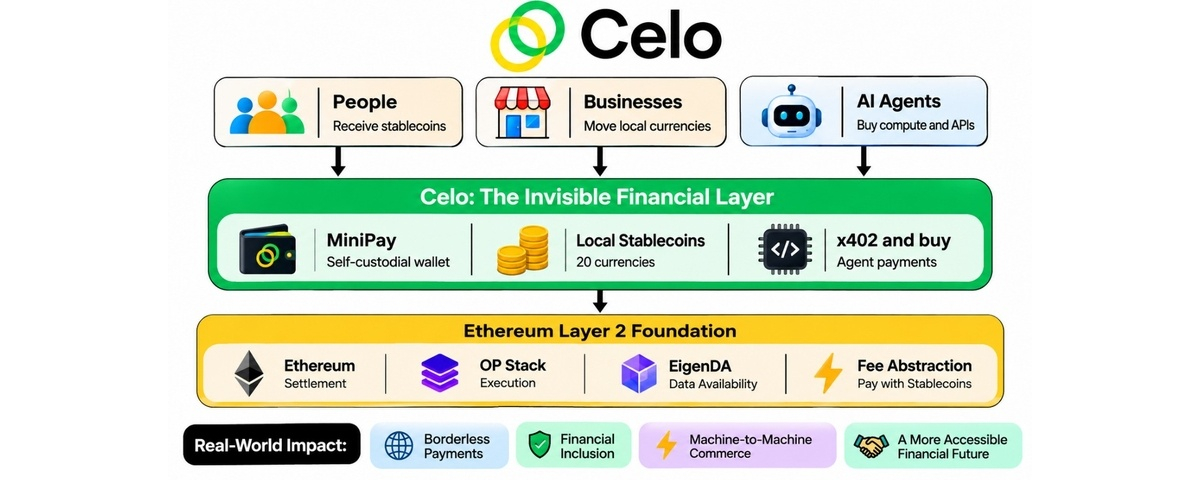
Article
Celo Is Building the Financial Infrastructure for a World Where Money Moves Without BordersCelo Is Building the Financial Infrastructure for a World Where Money Moves Without Borders
What if the future of finance is not about creating another way to trade digital assets, but about making money move so naturally that people barely notice the technology behind it?
I think this is one of the most interesting questions in blockchain today.
Consider a world where a freelancer receives international payments in seconds, a merchant accepts digital dollars without dealing with complicated crypto processes, and an AI agent independently pays for computing resources or online services.
Different users. Different needs. One common requirement: financial infrastructure that works without unnecessary friction.
This is the direction that makes Celo particularly interesting.
Rather than competing only on transaction speed or blockchain performance, Celo is building around a broader financial vision: connecting stablecoins, everyday payments, local currencies, and emerging AI-driven commerce through accessible infrastructure.
And what makes this strategy worth examining is how several pieces of its ecosystem are beginning to connect.
1. The Future of Payments Is About Accessibility, Not Complexity
Blockchain has already shown that money can move globally without relying entirely on traditional banking infrastructure.
But there is a difference between transferring a token and making digital money genuinely useful.
Most ordinary users do not want to understand gas markets, private keys, network configurations, or cross-chain infrastructure.
They simply want to receive money, send payments, and access financial services.
This is an important distinction.
Crypto adoption will not necessarily happen because millions of people suddenly become interested in blockchain technology. It could happen because applications make the underlying technology almost invisible.
That is where Celo's mobile-first approach becomes relevant.
Its strategy focuses on reducing the distance between blockchain infrastructure and real-world financial activity.
2. Ethereum Layer 2: A Strategic Foundation for Celo
Celo originally operated as an independent Layer 1 blockchain.
However, its long-term development required more than maintaining a separate network. It needed stronger alignment with Ethereum while preserving the characteristics that made its ecosystem attractive for payments.
The transition to an Ethereum Layer 2 was completed on March 26, 2025, using the OP Stack.
This changed Celo's architectural position.
Its infrastructure now brings together several important components:
- OP Stack: Provides the Layer 2 execution framework.
- Ethereum: Provides the settlement foundation.
- EigenDA: Supports data availability.
- Fee Abstraction: Allows users to pay transaction fees using supported assets instead of necessarily holding CELO.
The Superchain connection also creates opportunities for collaboration and interoperability with other OP Stack networks.
But I think the bigger story is not simply that Celo became an Ethereum Layer 2.
It is that Celo can pursue a specialised financial use case while operating within a broader Ethereum-aligned ecosystem.
For a network focused on stablecoin payments, this architectural direction could become an important advantage.
Of course, Ethereum alignment does not eliminate every infrastructure risk. Sequencing, bridges, data availability, and operational assumptions still deserve attention.
3. MiniPay: Turning Blockchain Infrastructure Into Everyday Finance
Technology alone does not create adoption.
Distribution does.
A network can offer low-cost transactions and sophisticated infrastructure, but if people struggle to access it, its potential remains limited.
This is why MiniPay is such an important part of Celo's ecosystem.
Developed by Opera and built on Celo, MiniPay is designed to make stablecoin payments accessible through a familiar mobile experience.
Its approach is interesting because it reduces the need for users to interact directly with blockchain complexity.
The reported ecosystem milestones are particularly notable:
- More than 20 million activated wallets.
- Over 600 million transactions processed.
- Availability across more than 70 countries.
- 77 Mini Apps.
These numbers suggest meaningful distribution, although activated wallets should not automatically be interpreted as unique active users.
Another important development is the integration of Privy wallet infrastructure, introducing familiar onboarding options such as email, social sign-in, and passkeys while maintaining self-custodial functionality.
MiniPay has also introduced Stripe-related payment integrations, including Link deposits for supported users in the US and EU.
The bigger opportunity is clear.
If users can access stablecoins through familiar interfaces, blockchain payments become less of a technical activity and more of a financial utility.
But the real measure of success will be how many users continue returning to MiniPay for actual financial activity.
4. Stablecoins Could Become Celo's Strongest Adoption Engine
One of the biggest opportunities in blockchain is the expansion of stablecoin-based payments.
Stablecoins offer something traditional cryptocurrencies often struggle to provide for everyday transactions: relatively predictable unit value.
However, the global economy is not built around a single currency.
A Brazilian merchant may prefer reais. A Nigerian user may need naira. A European business may operate in euros.
This creates an opportunity for local-currency stablecoins.
Celo's ecosystem is developing around multiple stablecoin assets, including:
- USDC and USDT.
- USA₮.
- USDm and EURm.
- BRLm and XOFm.
- Other local-currency stablecoin assets.
According to Celo's October 2026 infrastructure update, its ecosystem included 33 stablecoins representing 20 currencies.
I find this direction particularly interesting because it moves the conversation beyond simply transferring US dollars.
Imagine financial applications that can support users in their preferred currencies without forcing every transaction through unnecessary conversion steps.
That could make stablecoin infrastructure more relevant to local businesses, international payments, and everyday financial services.
However, asset availability alone does not guarantee adoption.
Liquidity, redemption mechanisms, issuer credibility, reserves, and regulatory compliance will determine whether these stablecoins become useful financial instruments.
5. The AI Agent Economy Could Introduce an Entirely New Payment Market
This is perhaps the most forward-looking part of Celo's strategy.
Traditional payment infrastructure was designed around human decisions.
A person selects a service, approves a transaction, and makes a payment.
But AI agents are beginning to operate differently.
An AI agent may need to purchase computing resources, access a premium API, retrieve specialised information, or pay another digital service while completing a task.
This introduces a new question:
What happens when software needs its own payment infrastructure?
Celo is exploring this opportunity through x402.
The concept uses the HTTP 402 Payment Required response to enable payment-gated internet services.
A simplified process looks like this:
1. An AI agent requests access to a service.
2. The service responds with payment requirements.
3. The agent provides an authorised stablecoin payment.
4. A facilitator verifies the payment and handles settlement.
5. The service grants access after confirmation.
This creates a potential payment relationship between software applications without requiring a human to manually approve every individual purchase.
Celo has also developed its buy marketplace, allowing AI agents to discover and purchase hundreds of digital services across areas such as computing, data, and APIs.
The significance is not that AI agents will immediately replace traditional payment systems.
It is that autonomous software may create a new category of financial demand.
If agent-driven commerce expands, networks capable of supporting affordable, programmable payments could become increasingly relevant.
6. Why the Superchain Could Strengthen Celo's Position
The blockchain industry has spent years creating separate networks for different applications.
But the next stage may depend less on how many chains exist and more on how effectively they connect.
This is where the Superchain concept becomes important.
Celo brings a specialised focus on payments and financial accessibility into the wider OP Stack ecosystem.
The potential benefits include shared development tools, ecosystem collaboration, and improved connectivity between applications.
However, interoperability should not be confused with automatic liquidity or seamless security.
Bridges, cross-chain messaging, fragmented liquidity, and different network assumptions remain challenges.
Celo's long-term opportunity will depend on whether its Superchain relationship creates practical benefits for developers and users.
7. CELO Token Economics: Adoption Must Translate Into Value
There is one question I believe every serious ecosystem analysis should address:
If Celo adoption increases, what does that actually mean for CELO?
Network growth and token value are not automatically connected.
CELO has roles in governance, staking, and the network's economic framework. At the same time, fee abstraction allows supported stablecoins to be used for transaction fees.
This creates an important distinction between using the network and directly demanding its native token.
One development worth watching is CELOccelerate.
Its framework connects eligible net sequencer revenue with CELO acquisition through the Community Fund, subject to applicable costs and revenue-sharing arrangements.
However, acquired tokens are not automatically burned. Governance decisions determine their subsequent use.
This is an interesting attempt to establish a relationship between network economics and the native token.
But the mechanism needs to be evaluated through measurable results:
- Actual sequencer revenue.
- Operating expenses.
- Sustainable stablecoin activity.
- Transparent reporting.
- Governance decisions.
- Long-term token supply dynamics.
For me, this is where the difference between an attractive ecosystem narrative and sustainable token economics becomes important.
8. The Challenges Celo Still Needs to Overcome
I would not evaluate Celo's opportunity without considering the risks.
Competition: Other Ethereum Layer 2s, Solana, and specialised payment networks are competing for users and liquidity.
User retention: Activated wallets are encouraging, but recurring financial activity matters much more.
Stablecoin liquidity: Local-currency stablecoins need reliable issuers, redemption mechanisms, and sufficient liquidity.
Infrastructure security: Bridges, sequencing, data availability, and smart contracts introduce risks that require continuous monitoring.
AI payment adoption: Agentic commerce remains an emerging market, and its commercial scale is still uncertain.
Token economics: More network activity does not automatically create sustainable value for CELO holders.
These challenges do not invalidate Celo's vision. They define what the project must prove.
9. Five Signals I Would Watch Going Forward
Instead of judging Celo by announcements alone, I would focus on five measurable developments:
1. MiniPay retention: Are activated wallets becoming recurring users?
2. Stablecoin liquidity: Are local-currency assets generating meaningful payment activity?
3. x402 adoption: Are AI agents producing repeat commercial transactions?
4. Network revenue: Is sequencer revenue growing sustainably?
5. Superchain connectivity: Are integrations creating measurable advantages for applications and developers?
These indicators could provide a much clearer picture of Celo's progress than short-term market sentiment.
My Final Perspective: Celo Wants to Make Blockchain Disappear Into Finance
When I look at Celo, I see a project attempting to connect three different financial environments.
The first is human payments: people who need affordable and accessible ways to move money.
The second is digital finance: businesses and applications that need stablecoins, local currencies, and reliable settlement infrastructure.
The third is autonomous commerce: AI agents that may eventually need to purchase digital services independently.
Celo is attempting to build infrastructure that can serve all three.
Its Ethereum Layer 2 architecture provides the foundation. Its Superchain alignment creates opportunities for connectivity. MiniPay offers a distribution channel, while local-currency stablecoins and x402 expand the potential use cases.
But the real test is still ahead.
Can Celo turn wallet activations into consistent financial activity? Can local stablecoins develop meaningful liquidity? Can AI-powered payments move beyond experimentation? And can growing network usage create sustainable economic value?
These are the questions that will determine whether its vision becomes reality.
My central takeaway is simple:
The next major stage of blockchain adoption may not belong to the network with the most complicated technology or the loudest narrative.
It may belong to the infrastructure that makes financial technology feel effortless.
Celo is trying to build exactly that kind of infrastructure: a financial layer where people, businesses, stablecoins, and AI agents can interact without constantly thinking about the blockchain underneath.
The most successful blockchain might eventually be the one people use every day without even realising they are using it.
What do you think will become Celo's biggest adoption driver: MiniPay, local-currency stablecoins, or autonomous AI payments?
#Celo @celo $CELO
Disclosure: Original educational research prepared for the Celo ecosystem. This article reflects an independent interpretation of publicly available information.
Disclaimer: This content is for educational purposes only and is not financial advice. Cryptocurrency assets involve significant risks. Always conduct your own research.#Celo #BinanceSquare
{future}(CELOUSDT)
Celo Is Building the Financial Infrastructure for a World Where Money Moves Without Borders
Celo Is Building the Financial Infrastructure for a World Where Money Moves Without Borders
What if the future of finance is not about creating another way to trade digital assets, but about making money move so naturally that people barely notice the technology behind it?
I think this is one of the most interesting questions in blockchain today.
Consider a world where a freelancer receives international payments in seconds, a merchant accepts digital dollars without dealing with complicated crypto processes, and an AI agent independently pays for computing resources or online services.
Different users. Different needs. One common requirement: financial infrastructure that works without unnecessary friction.
This is the direction that makes Celo particularly interesting.
Rather than competing only on transaction speed or blockchain performance, Celo is building around a broader financial vision: connecting stablecoins, everyday payments, local currencies, and emerging AI-driven commerce through accessible infrastructure.
And what makes this strategy worth examining is how several pieces of its ecosystem are beginning to connect.
1. The Future of Payments Is About Accessibility, Not Complexity
Blockchain has already shown that money can move globally without relying entirely on traditional banking infrastructure.
But there is a difference between transferring a token and making digital money genuinely useful.
Most ordinary users do not want to understand gas markets, private keys, network configurations, or cross-chain infrastructure.
They simply want to receive money, send payments, and access financial services.
This is an important distinction.
Crypto adoption will not necessarily happen because millions of people suddenly become interested in blockchain technology. It could happen because applications make the underlying technology almost invisible.
That is where Celo's mobile-first approach becomes relevant.
Its strategy focuses on reducing the distance between blockchain infrastructure and real-world financial activity.
2. Ethereum Layer 2: A Strategic Foundation for Celo
Celo originally operated as an independent Layer 1 blockchain.
However, its long-term development required more than maintaining a separate network. It needed stronger alignment with Ethereum while preserving the characteristics that made its ecosystem attractive for payments.
The transition to an Ethereum Layer 2 was completed on March 26, 2025, using the OP Stack.
This changed Celo's architectural position.
Its infrastructure now brings together several important components:
- OP Stack: Provides the Layer 2 execution framework.
- Ethereum: Provides the settlement foundation.
- EigenDA: Supports data availability.
- Fee Abstraction: Allows users to pay transaction fees using supported assets instead of necessarily holding CELO.
The Superchain connection also creates opportunities for collaboration and interoperability with other OP Stack networks.
But I think the bigger story is not simply that Celo became an Ethereum Layer 2.
It is that Celo can pursue a specialised financial use case while operating within a broader Ethereum-aligned ecosystem.
For a network focused on stablecoin payments, this architectural direction could become an important advantage.
Of course, Ethereum alignment does not eliminate every infrastructure risk. Sequencing, bridges, data availability, and operational assumptions still deserve attention.
3. MiniPay: Turning Blockchain Infrastructure Into Everyday Finance
Technology alone does not create adoption.
Distribution does.
A network can offer low-cost transactions and sophisticated infrastructure, but if people struggle to access it, its potential remains limited.
This is why MiniPay is such an important part of Celo's ecosystem.
Developed by Opera and built on Celo, MiniPay is designed to make stablecoin payments accessible through a familiar mobile experience.
Its approach is interesting because it reduces the need for users to interact directly with blockchain complexity.
The reported ecosystem milestones are particularly notable:
- More than 20 million activated wallets.
- Over 600 million transactions processed.
- Availability across more than 70 countries.
- 77 Mini Apps.
These numbers suggest meaningful distribution, although activated wallets should not automatically be interpreted as unique active users.
Another important development is the integration of Privy wallet infrastructure, introducing familiar onboarding options such as email, social sign-in, and passkeys while maintaining self-custodial functionality.
MiniPay has also introduced Stripe-related payment integrations, including Link deposits for supported users in the US and EU.
The bigger opportunity is clear.
If users can access stablecoins through familiar interfaces, blockchain payments become less of a technical activity and more of a financial utility.
But the real measure of success will be how many users continue returning to MiniPay for actual financial activity.
4. Stablecoins Could Become Celo's Strongest Adoption Engine
One of the biggest opportunities in blockchain is the expansion of stablecoin-based payments.
Stablecoins offer something traditional cryptocurrencies often struggle to provide for everyday transactions: relatively predictable unit value.
However, the global economy is not built around a single currency.
A Brazilian merchant may prefer reais. A Nigerian user may need naira. A European business may operate in euros.
This creates an opportunity for local-currency stablecoins.
Celo's ecosystem is developing around multiple stablecoin assets, including:
- USDC and USDT.
- USA₮.
- USDm and EURm.
- BRLm and XOFm.
- Other local-currency stablecoin assets.
According to Celo's October 2026 infrastructure update, its ecosystem included 33 stablecoins representing 20 currencies.
I find this direction particularly interesting because it moves the conversation beyond simply transferring US dollars.
Imagine financial applications that can support users in their preferred currencies without forcing every transaction through unnecessary conversion steps.
That could make stablecoin infrastructure more relevant to local businesses, international payments, and everyday financial services.
However, asset availability alone does not guarantee adoption.
Liquidity, redemption mechanisms, issuer credibility, reserves, and regulatory compliance will determine whether these stablecoins become useful financial instruments.
5. The AI Agent Economy Could Introduce an Entirely New Payment Market
This is perhaps the most forward-looking part of Celo's strategy.
Traditional payment infrastructure was designed around human decisions.
A person selects a service, approves a transaction, and makes a payment.
But AI agents are beginning to operate differently.
An AI agent may need to purchase computing resources, access a premium API, retrieve specialised information, or pay another digital service while completing a task.
This introduces a new question:
What happens when software needs its own payment infrastructure?
Celo is exploring this opportunity through x402.
The concept uses the HTTP 402 Payment Required response to enable payment-gated internet services.
A simplified process looks like this:
1. An AI agent requests access to a service.
2. The service responds with payment requirements.
3. The agent provides an authorised stablecoin payment.
4. A facilitator verifies the payment and handles settlement.
5. The service grants access after confirmation.
This creates a potential payment relationship between software applications without requiring a human to manually approve every individual purchase.
Celo has also developed its buy marketplace, allowing AI agents to discover and purchase hundreds of digital services across areas such as computing, data, and APIs.
The significance is not that AI agents will immediately replace traditional payment systems.
It is that autonomous software may create a new category of financial demand.
If agent-driven commerce expands, networks capable of supporting affordable, programmable payments could become increasingly relevant.
6. Why the Superchain Could Strengthen Celo's Position
The blockchain industry has spent years creating separate networks for different applications.
But the next stage may depend less on how many chains exist and more on how effectively they connect.
This is where the Superchain concept becomes important.
Celo brings a specialised focus on payments and financial accessibility into the wider OP Stack ecosystem.
The potential benefits include shared development tools, ecosystem collaboration, and improved connectivity between applications.
However, interoperability should not be confused with automatic liquidity or seamless security.
Bridges, cross-chain messaging, fragmented liquidity, and different network assumptions remain challenges.
Celo's long-term opportunity will depend on whether its Superchain relationship creates practical benefits for developers and users.
7. CELO Token Economics: Adoption Must Translate Into Value
There is one question I believe every serious ecosystem analysis should address:
If Celo adoption increases, what does that actually mean for CELO?
Network growth and token value are not automatically connected.
CELO has roles in governance, staking, and the network's economic framework. At the same time, fee abstraction allows supported stablecoins to be used for transaction fees.
This creates an important distinction between using the network and directly demanding its native token.
One development worth watching is CELOccelerate.
Its framework connects eligible net sequencer revenue with CELO acquisition through the Community Fund, subject to applicable costs and revenue-sharing arrangements.
However, acquired tokens are not automatically burned. Governance decisions determine their subsequent use.
This is an interesting attempt to establish a relationship between network economics and the native token.
But the mechanism needs to be evaluated through measurable results:
- Actual sequencer revenue.
- Operating expenses.
- Sustainable stablecoin activity.
- Transparent reporting.
- Governance decisions.
- Long-term token supply dynamics.
For me, this is where the difference between an attractive ecosystem narrative and sustainable token economics becomes important.
8. The Challenges Celo Still Needs to Overcome
I would not evaluate Celo's opportunity without considering the risks.
Competition: Other Ethereum Layer 2s, Solana, and specialised payment networks are competing for users and liquidity.
User retention: Activated wallets are encouraging, but recurring financial activity matters much more.
Stablecoin liquidity: Local-currency stablecoins need reliable issuers, redemption mechanisms, and sufficient liquidity.
Infrastructure security: Bridges, sequencing, data availability, and smart contracts introduce risks that require continuous monitoring.
AI payment adoption: Agentic commerce remains an emerging market, and its commercial scale is still uncertain.
Token economics: More network activity does not automatically create sustainable value for CELO holders.
These challenges do not invalidate Celo's vision. They define what the project must prove.
9. Five Signals I Would Watch Going Forward
Instead of judging Celo by announcements alone, I would focus on five measurable developments:
1. MiniPay retention: Are activated wallets becoming recurring users?
2. Stablecoin liquidity: Are local-currency assets generating meaningful payment activity?
3. x402 adoption: Are AI agents producing repeat commercial transactions?
4. Network revenue: Is sequencer revenue growing sustainably?
5. Superchain connectivity: Are integrations creating measurable advantages for applications and developers?
These indicators could provide a much clearer picture of Celo's progress than short-term market sentiment.
My Final Perspective: Celo Wants to Make Blockchain Disappear Into Finance
When I look at Celo, I see a project attempting to connect three different financial environments.
The first is human payments: people who need affordable and accessible ways to move money.
The second is digital finance: businesses and applications that need stablecoins, local currencies, and reliable settlement infrastructure.
The third is autonomous commerce: AI agents that may eventually need to purchase digital services independently.
Celo is attempting to build infrastructure that can serve all three.
Its Ethereum Layer 2 architecture provides the foundation. Its Superchain alignment creates opportunities for connectivity. MiniPay offers a distribution channel, while local-currency stablecoins and x402 expand the potential use cases.
But the real test is still ahead.
Can Celo turn wallet activations into consistent financial activity? Can local stablecoins develop meaningful liquidity? Can AI-powered payments move beyond experimentation? And can growing network usage create sustainable economic value?
These are the questions that will determine whether its vision becomes reality.
My central takeaway is simple:
The next major stage of blockchain adoption may not belong to the network with the most complicated technology or the loudest narrative.
It may belong to the infrastructure that makes financial technology feel effortless.
Celo is trying to build exactly that kind of infrastructure: a financial layer where people, businesses, stablecoins, and AI agents can interact without constantly thinking about the blockchain underneath.
The most successful blockchain might eventually be the one people use every day without even realising they are using it.
What do you think will become Celo's biggest adoption driver: MiniPay, local-currency stablecoins, or autonomous AI payments?
#Celo @celo $CELO
Disclosure: Original educational research prepared for the Celo ecosystem. This article reflects an independent interpretation of publicly available information.
Disclaimer: This content is for educational purposes only and is not financial advice. Cryptocurrency assets involve significant risks. Always conduct your own research.#Celo #BinanceSquare
26

·
--
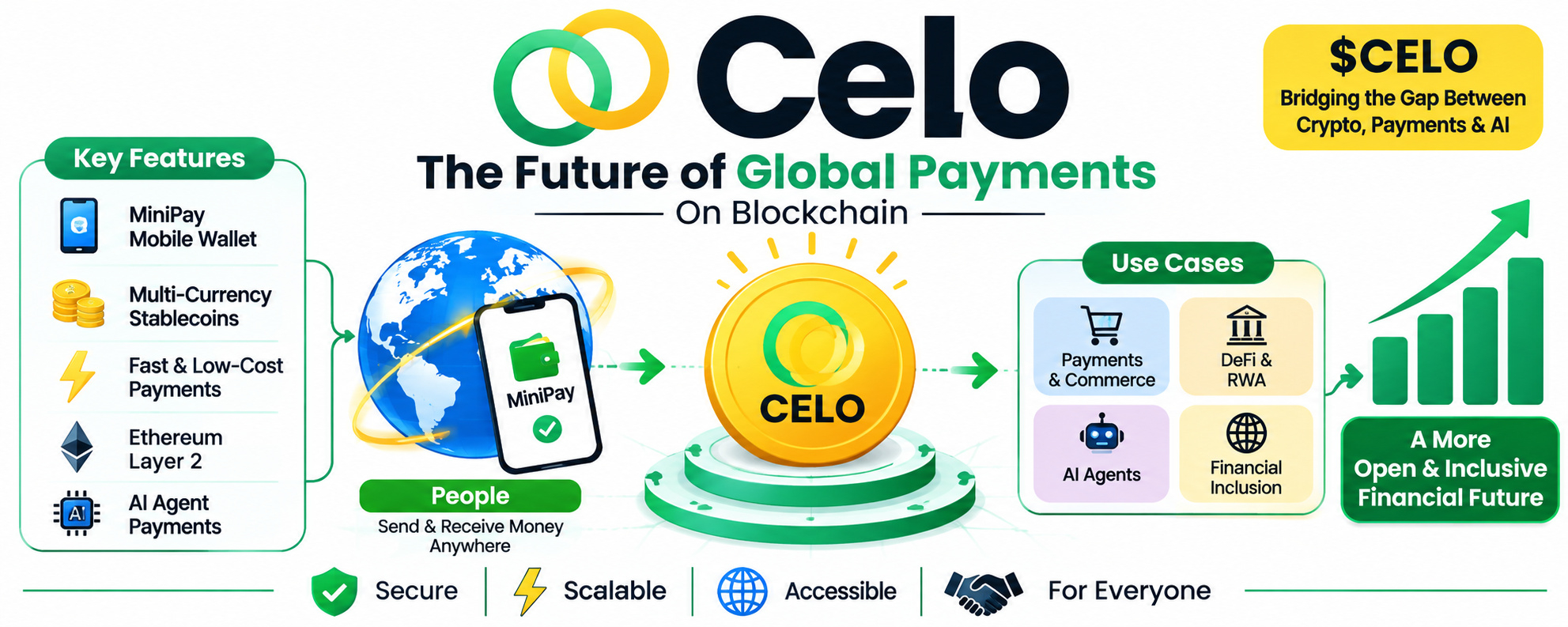
Article
Celo: The Future of Global Payments Is Being Built on Blockchain — And $CELO Is at the Center of theBeyond Crypto Trading: How Celo Is Connecting Stablecoins, Mobile Payments, Ethereum, and the Emerging AI Economy
What if sending money across borders became as simple as sending a message?
What if someone in Africa could receive digital dollars from Europe, a freelancer in Asia could get paid instantly, and an AI agent could purchase online services without depending on traditional banking infrastructure?
This is the kind of financial future that blockchain technology promises. And one project working to make that vision practical is Celo ($CELO).
I believe the most interesting thing about Celo is not simply its blockchain technology. It is the problem it is trying to solve: making digital payments accessible, affordable, and useful in everyday life.Celo Is Building More Than Another Blockchain
Celo launched in 2020 with a clear mission: make financial tools accessible to everyone, especially people who are underserved by traditional financial systems.
In March 2025, Celo completed its transition from an independent Layer 1 blockchain to an Ethereum Layer 2 network.
Why does this matter?
Because Celo combines an Ethereum-aligned development environment with infrastructure designed around fast, affordable payments.
Its architecture brings together:
OP Stack: Provides the Layer 2 execution environment.EigenDA: Supports cost-efficient data availability.Ethereum: Provides the settlement and security foundation.
- Fee Abstraction: Helps users pay transaction fees with supported assets rather than needing a separate gas token.
The bigger objective is simple: blockchain should become easier to use without requiring ordinary people to understand its technical complexity.
MiniPay: Bringing Crypto Payments to Everyday People
One of the most interesting parts of Celo's ecosystem is MiniPay, a mobile-first, self-custodial wallet developed by Opera.
Think about a freelancer receiving an international payment.
Traditional payment systems can involve intermediaries, currency conversion, delays, and additional costs.
With stablecoin-based payment applications, users can access another way to receive and transfer digital value.
MiniPay aims to simplify this experience through an accessible mobile interface.
Its importance goes beyond wallet technology. Distribution matters.
A powerful blockchain with complicated access may struggle to reach ordinary users. A simple wallet connected to useful payment infrastructure has a different opportunity.
Celo's connection with MiniPay gives its ecosystem an interesting route toward mainstream adoption.
Stablecoins: The Real Foundation of Celo's Payment Vision
Here is where I think Celo becomes particularly interesting.
Stablecoins are transforming how people think about digital money.
Unlike volatile cryptocurrencies, stablecoins are designed to maintain a relatively stable value against a reference currency or asset.
Celo supports a growing multi-currency stablecoin ecosystem, including assets such as USDT, USDC, and local-currency-focused stablecoinsWhy is this important?
Because global payments should not be limited to one currency.
A freelancer in Nigeria, a merchant in Brazil, and a business in Europe may all have different financial requirements.
Local-currency stablecoins can help make digital payments more relevant to these different markets.
The opportunity is not simply moving money between wallets. It is building financial infrastructure that can support payments, savings, lending, and international commerce.
Of course, stablecoin quality, liquidity, reserves, and redemption mechanisms remain important considerations.
The Next Opportunity: AI Agents That Can Make Payments
Perhaps one of the most exciting developments in the blockchain industry is the growing relationship between artificial intelligence and digital payments.
AI agents are becoming capable of performing tasks, accessing information, interacting with applications, and using online services.
But there is one important question:
How will an autonomous AI agent pay for the services it uses?
Traditional payment systems were largely designed around human users, bank accounts, and conventional subscriptions.
Blockchain-based payment infrastructure introduces another possibility.
Celo's work with the x402 payment ecosystem explores how internet services can request stablecoin payments before providing access.
Imagine this process:
An AI agent requests access to a paid service. The service communicates its payment requirements.
The agent authorizes a stablecoin payment. The payment infrastructure verifies and facilitates settlement. The service becomes available after payment confirmation.
This could create opportunities for automated payments between software, services, and AI agents.
However, infrastructure development should not be confused with widespread adoption. Real usage, security, and recurring payment activity will determine how significant this opportunity becomes. Understanding the $CELO Token
A strong ecosystem also needs a sustainable economic mode$CELO is the native token of the Celo ecosystemIts roles include:Network governance.
Staking and participation in network security.Supporting the ecosystem's economic infrastructure.Participation in the protocol's tokenomics.
One development worth watching is CELOccelerate, an initiative designed to connect network economics with the CELO ecosystem through sequencer-revenue-based acquisitions.
The broader idea is to create a relationship between actual network activity and token economics.
This is an important distinction.
A blockchain can attract users and process transactions, but sustainable value creation also depends on whether its economic model captures meaningful value.
For CELO, the long-term question is whether growing payment activity can translate into stronger and more sustainable token economics.What Could Make Celo Different
In my view, Celo's opportunity comes from bringing several important sectors together
Payments: Making digital money easier to transfer.
Stablecoins: Supporting practical digital currencies across different markets.
Mobile Adoption: Connecting blockchain infrastructure with accessible applications.
Ethereum Compatibility: Giving developers an established smart-contract environment.
AI Payments: Exploring a new financial layer for autonomous software.
Individually, these areas are interesting. Together, they create a broader vision of an internet-native financial system.
But there are challenges too.
Competition from other payment networks, stablecoin regulation, security, liquidity, network decentralization, and sustainable token demand will all matter.
No blockchain project is guaranteed to succeed simply because its vision sounds promising.
Execution is what separates a strong narrative from a successful ecosystem.My Final Perspective: Judge Celo by What People Can Actually Do With ItI don't think the future of blockchain will be decided only by which network has the loudest community or the biggest marketing campaign.It will be decided by usefulness.Can people send money more easily?Can businesses accept digital payments?
Can developers build applications that solve real problems?
Can stablecoins support everyday financial activity?Can AI agents eventually participate in an open payment economy?
These are the questions I believe are worth asking when evaluating Celo.
The real opportunity is not simply creating another cryptocurrency. It is building financial infrastructure that people can actually use.
Celo's vision is ambitious: make money move more freely, make blockchain less complicated, and connect the global payment economy with the next generation of digital services.
And that is why I believe $CELO deserves attention beyond its market price.
The future of finance will need more than tokens. It will need useful infrastructure.
What do you think? Will mobile-first stablecoin payments and AI-powered transactions become major drivers of blockchain adoption?
Let's discuss the future of Celo.
$CELO @celo
#CELO
Celo: The Future of Global Payments Is Being Built on Blockchain — And $CELO Is at the Center of the
Beyond Crypto Trading: How Celo Is Connecting Stablecoins, Mobile Payments, Ethereum, and the Emerging AI Economy
What if sending money across borders became as simple as sending a message?
What if someone in Africa could receive digital dollars from Europe, a freelancer in Asia could get paid instantly, and an AI agent could purchase online services without depending on traditional banking infrastructure?
This is the kind of financial future that blockchain technology promises. And one project working to make that vision practical is Celo ($CELO ).
I believe the most interesting thing about Celo is not simply its blockchain technology. It is the problem it is trying to solve: making digital payments accessible, affordable, and useful in everyday life.Celo Is Building More Than Another Blockchain
Celo launched in 2020 with a clear mission: make financial tools accessible to everyone, especially people who are underserved by traditional financial systems.
In March 2025, Celo completed its transition from an independent Layer 1 blockchain to an Ethereum Layer 2 network.
Why does this matter?
Because Celo combines an Ethereum-aligned development environment with infrastructure designed around fast, affordable payments.
Its architecture brings together:
OP Stack: Provides the Layer 2 execution environment.EigenDA: Supports cost-efficient data availability.Ethereum: Provides the settlement and security foundation.
- Fee Abstraction: Helps users pay transaction fees with supported assets rather than needing a separate gas token.
The bigger objective is simple: blockchain should become easier to use without requiring ordinary people to understand its technical complexity.
MiniPay: Bringing Crypto Payments to Everyday People
One of the most interesting parts of Celo's ecosystem is MiniPay, a mobile-first, self-custodial wallet developed by Opera.
Think about a freelancer receiving an international payment.
Traditional payment systems can involve intermediaries, currency conversion, delays, and additional costs.
With stablecoin-based payment applications, users can access another way to receive and transfer digital value.
MiniPay aims to simplify this experience through an accessible mobile interface.
Its importance goes beyond wallet technology. Distribution matters.
A powerful blockchain with complicated access may struggle to reach ordinary users. A simple wallet connected to useful payment infrastructure has a different opportunity.
Celo's connection with MiniPay gives its ecosystem an interesting route toward mainstream adoption.
Stablecoins: The Real Foundation of Celo's Payment Vision
Here is where I think Celo becomes particularly interesting.
Stablecoins are transforming how people think about digital money.
Unlike volatile cryptocurrencies, stablecoins are designed to maintain a relatively stable value against a reference currency or asset.
Celo supports a growing multi-currency stablecoin ecosystem, including assets such as USDT, USDC, and local-currency-focused stablecoinsWhy is this important?
Because global payments should not be limited to one currency.
A freelancer in Nigeria, a merchant in Brazil, and a business in Europe may all have different financial requirements.
Local-currency stablecoins can help make digital payments more relevant to these different markets.
The opportunity is not simply moving money between wallets. It is building financial infrastructure that can support payments, savings, lending, and international commerce.
Of course, stablecoin quality, liquidity, reserves, and redemption mechanisms remain important considerations.
The Next Opportunity: AI Agents That Can Make Payments
Perhaps one of the most exciting developments in the blockchain industry is the growing relationship between artificial intelligence and digital payments.
AI agents are becoming capable of performing tasks, accessing information, interacting with applications, and using online services.
But there is one important question:
How will an autonomous AI agent pay for the services it uses?
Traditional payment systems were largely designed around human users, bank accounts, and conventional subscriptions.
Blockchain-based payment infrastructure introduces another possibility.
Celo's work with the x402 payment ecosystem explores how internet services can request stablecoin payments before providing access.
Imagine this process:
An AI agent requests access to a paid service. The service communicates its payment requirements.
The agent authorizes a stablecoin payment. The payment infrastructure verifies and facilitates settlement. The service becomes available after payment confirmation.
This could create opportunities for automated payments between software, services, and AI agents.
However, infrastructure development should not be confused with widespread adoption. Real usage, security, and recurring payment activity will determine how significant this opportunity becomes. Understanding the $CELO Token
A strong ecosystem also needs a sustainable economic mode$CELO is the native token of the Celo ecosystemIts roles include:Network governance.
Staking and participation in network security.Supporting the ecosystem's economic infrastructure.Participation in the protocol's tokenomics.
One development worth watching is CELOccelerate, an initiative designed to connect network economics with the CELO ecosystem through sequencer-revenue-based acquisitions.
The broader idea is to create a relationship between actual network activity and token economics.
This is an important distinction.
A blockchain can attract users and process transactions, but sustainable value creation also depends on whether its economic model captures meaningful value.
For CELO, the long-term question is whether growing payment activity can translate into stronger and more sustainable token economics.What Could Make Celo Different
In my view, Celo's opportunity comes from bringing several important sectors together
Payments: Making digital money easier to transfer.
Stablecoins: Supporting practical digital currencies across different markets.
Mobile Adoption: Connecting blockchain infrastructure with accessible applications.
Ethereum Compatibility: Giving developers an established smart-contract environment.
AI Payments: Exploring a new financial layer for autonomous software.
Individually, these areas are interesting. Together, they create a broader vision of an internet-native financial system.
But there are challenges too.
Competition from other payment networks, stablecoin regulation, security, liquidity, network decentralization, and sustainable token demand will all matter.
No blockchain project is guaranteed to succeed simply because its vision sounds promising.
Execution is what separates a strong narrative from a successful ecosystem.My Final Perspective: Judge Celo by What People Can Actually Do With ItI don't think the future of blockchain will be decided only by which network has the loudest community or the biggest marketing campaign.It will be decided by usefulness.Can people send money more easily?Can businesses accept digital payments?
Can developers build applications that solve real problems?
Can stablecoins support everyday financial activity?Can AI agents eventually participate in an open payment economy?
These are the questions I believe are worth asking when evaluating Celo.
The real opportunity is not simply creating another cryptocurrency. It is building financial infrastructure that people can actually use.
Celo's vision is ambitious: make money move more freely, make blockchain less complicated, and connect the global payment economy with the next generation of digital services.
And that is why I believe $CELO deserves attention beyond its market price.
The future of finance will need more than tokens. It will need useful infrastructure.
What do you think? Will mobile-first stablecoin payments and AI-powered transactions become major drivers of blockchain adoption?
Let's discuss the future of Celo.
$CELO @celo
#CELO
1
51

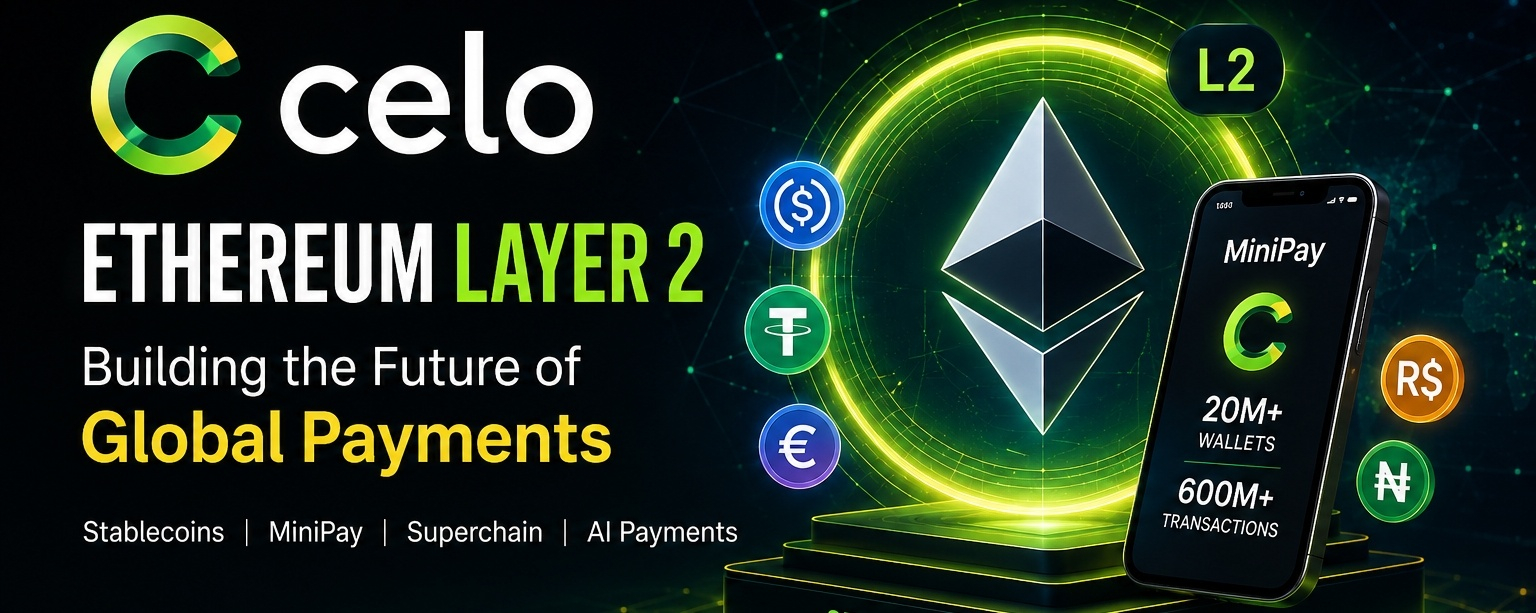
Article
Celo Is No Longer Just an L1: The Ethereum Layer 2 Building the Future of Global PaymentsCelo is no longer just another blockchain competing for attention. It has made a major architectural move: becoming an Ethereum Layer 2 while keeping its original mission of making financial services accessible to people around the world.
But what does that actually mean?
Why did Celo move away from being an independent Layer 1? How does Ethereum security fit into its architecture? What is the Superchain? And why are stablecoins, MiniPay, local currencies and everyday payments at the center of its strategy?
Let's explore the technology, ecosystem, tokenomics and future opportunities behind Celo.
1. Understanding Celo's Transformation
Originally, Celo operated as an independent, EVM-compatible Layer 1 blockchain.
In May 2024, the Celo community approved the proposal to migrate the network to an Ethereum Layer 2.
The transition officially went live on March 26, 2025, at block 31,056,500.
This was not simply a branding change. It was a major technical transformation.
Celo adopted the Optimism OP Stack, integrated Ethereum into its security and settlement architecture, and introduced EigenDA for data availability.
The objective was straightforward:
- Maintain Celo's payment-focused identity.
- Improve its connection with Ethereum.
- Reduce the cost of maintaining independent security infrastructure.
- Make it easier for Ethereum developers and applications to integrate.
- Build a scalable foundation for global financial services.
2. What Does Ethereum Layer 2 Actually Mean?
Think of Ethereum as the main financial settlement infrastructure.
Layer 2 networks process transactions through a separate execution environment while using Ethereum as part of their underlying settlement and security architecture.
Celo's transition means developers can build applications in a familiar EVM environment while benefiting from its connection to Ethereum.
However, Celo uses an Optimium architecture. Its transaction data availability is handled through EigenDA rather than publishing all transaction data directly to Ethereum.
This distinction matters because different Layer 2 designs have different security assumptions.
3. The Technology Behind Celo
Three technologies are especially important.
Optimism OP Stack
Celo uses the open-source OP Stack framework to power its Layer 2 architecture.
This provides Ethereum-compatible infrastructure, familiar development tools and opportunities for integration with other Superchain networks.
EigenDA
EigenDA provides data availability for Celo.
In simple terms, data availability means making sure the information required to reconstruct and verify blockchain activity is accessible.
This allows Celo to pursue higher transaction capacity without publishing all transaction data directly on Ethereum.
OP Succinct Lite and Zero-Knowledge Proofs
Celo's Jello hardfork, activated on December 10, 2025, introduced OP Succinct Lite, developed with Succinct and EigenDA.
It brought ZK-powered fault-proof mechanisms and a verification bridge for EigenDA data availability.
This is an important development because cryptographic proofs can help strengthen the verification process.
However, it does not mean every decentralization milestone has been completed.
4. What Is the Superchain?
The Superchain is an ecosystem of blockchain networks built using the OP Stack and aligned around shared infrastructure and standards.
Think of it as a network of specialized blockchains rather than one blockchain trying to handle every application.
Different chains can focus on different industries:
- Payments and stablecoins.
- DeFi and financial applications.
- Consumer applications.
- Gaming.
- Institutional infrastructure.
Celo brings something particularly interesting to this ecosystem: its existing focus on mobile-first financial services and real-world stablecoin usage.
Being part of the Superchain creates opportunities for developers, liquidity and applications to connect with a broader Ethereum scaling ecosystem.
However, membership does not automatically mean every chain has identical security, governance or interoperability.
5. Celo's Real Competitive Advantage: Stablecoins
This is where Celo becomes particularly interesting.
Many blockchain networks compete through DeFi incentives, speculative trading or NFT ecosystems.
Celo has spent years developing a different approach: making stablecoins practical for everyday financial activity.
Its ecosystem includes USDT, USDC and Mento's local-currency stablecoins.
These include assets linked to currencies such as:
- Brazilian real.
- Euro.
- Ghanaian cedi.
- Kenyan shilling.
- Nigerian naira.
- Colombian peso.
Why is this important?
Imagine someone in Nigeria wants to receive digital dollars, while someone in Brazil wants to transact using Brazilian reais.
A blockchain supporting multiple currencies can help create more efficient financial connections.
This creates opportunities for:
1. International transfers.
2. Local-currency payments.
3. Onchain foreign exchange.
4. Digital savings.
5. Merchant payments.
6. Financial applications for underserved communities.
Celo is positioning itself not simply as a network where stablecoins exist, but as infrastructure where stablecoins are intended to be used.
6. MiniPay: The Consumer Adoption Engine
One of the strongest examples of Celo's real-world strategy is MiniPay.
MiniPay is a self-custodial stablecoin wallet developed by Opera and built on Celo.
Its goal is to make stablecoin transactions feel more like using a normal mobile financial application.
According to the November 19, 2026 announcement:
- More than 20 million activated wallets.
- Over 600 million transactions.
- Users across more than 70 countries.
- More than 77 Mini Apps.
On November 19, MiniPay announced an upgrade to Privy wallet infrastructure, enabling email, social login and passkey-based access while maintaining self-custody and the ability to export keys.
The partnership builds on MiniPay's integration with Stripe's Link payment infrastructure, announced on November 12, 2026.
This could reduce two major barriers to crypto adoption:
- Complicated wallet creation.
- Difficult ways of moving money into a crypto wallet.
The important point is that Celo is working on the entire user experience, not just the blockchain underneath it.
7. Celo and Stripe: Connecting Blockchain With Traditional Payments
Another development worth understanding is the growing relationship between Celo's ecosystem and Stripe.
Bridge, a Stripe-owned stablecoin infrastructure platform, added support for Celo in 2026.
Bridge provides infrastructure that helps businesses integrate stablecoin payments, transfers and cross-chain functionality.
Businesses need more than cheap transactions. They also need:
- Payment infrastructure.
- Reliable stablecoin liquidity.
- Onramps and offramps.
- Developer-friendly APIs.
- Connections with existing financial systems.
MiniPay's Link integration also allows eligible users in the United States and European Union to purchase stablecoins using familiar payment methods.
The bigger picture is emerging: Celo provides blockchain infrastructure, while partners help connect that infrastructure to financial products people already understand.
8. DeFi Is Another Important Part of the Ecosystem
Celo is not exclusively a payments network.
Its Ethereum compatibility creates opportunities for decentralized finance.
Some notable ecosystem protocols include:
- Uniswap decentralized token trading and liquidity.
- Aave lending and borrowing.
- Morpho lending markets and vault infrastructure.
- Velodrome decentralized trading and liquidity.
Stablecoins become more useful when they can move beyond holding and transferring.
Users and developers need ways to trade, lend, borrow and access financial applications.
The combination of stablecoin liquidity, Ethereum-compatible smart contracts and low transaction costs creates opportunities for a broader financial ecosystem.
The challenge is ensuring that liquidity, security and sustainable demand grow alongside the number of deployed applications.
9. The Next Frontier: AI Agents and Blockchain Payments
One of the most interesting developments in Celo's 2026 ecosystem is the emergence of agentic payments.
AI agents are increasingly capable of performing tasks such as purchasing services, accessing APIs and interacting with digital platforms.
But autonomous agents also need a way to pay.
This is where x402 becomes relevant.
The x402 protocol enables internet services to request payments through HTTP payment flows.
Celo has developed a native x402 facilitator to support stablecoin-based payments by AI agents.
Its October 27, 2026 announcement expanded support to ten stablecoins, including:
- USDC.
- USDT.
- USA₮.
- wARS.
- wBRL.
- wCOP.
- wMXN.
- wCLP.
- wPEN.
- cNGN.
Celo also launched a marketplace called buy, where agents can access more than 700 services and pay using supported stablecoins.
Imagine an AI agent purchasing computing resources from a provider in another country and settling the payment automatically using a digital currency.
This introduces a new potential use case for blockchain payments.
Agentic commerce is still developing, and adoption, reliability, compliance and security will determine its long-term impact.
But Celo is already building infrastructure around this emerging opportunity.
10. Understanding the CELO Token
The native token of the ecosystem is CELO.
Its role includes:
Network Fees: CELO is the network's native gas token. Celo also supports fee abstraction, allowing users to pay transaction fees using supported ERC-20 assets, including stablecoins.
Governance: CELO holders can participate in network governance. Voting power is associated with locked CELO.
Staking and Network Participation: CELO participates in the network's proof-of-stake economic model.
Ecosystem Economics: Governance and community fund mechanisms help direct resources toward network development and ecosystem growth.
One important tokenomics detail: CELO has a maximum supply of 1 billion tokens.
However, investors should understand the distinction between network adoption and token value.
More stablecoin transactions do not automatically translate into higher CELO prices.
The economic relationship depends on fee generation, token demand, staking, governance decisions, supply dynamics and how network revenue is directed.
A growing ecosystem is an important fundamental signal, but it is not a guaranteed investment return.
11. The Security Question: What Should Users Understand?
Celo's transition to Ethereum L2 improves its relationship with Ethereum, but it does not mean every security responsibility has automatically moved to Ethereum.
Independent infrastructure tracker ETHBeat classifies Celo as an Optimium and Stage 0 network.
Its assessment identifies several important considerations:
- Transaction data availability relies on EigenDA.
- Proposer and challenger permissions remain relevant.
- Some upgrades are controlled through multisignature arrangements.
- Withdrawal and dispute mechanisms have specific trust assumptions.
The Jello upgrade introduced ZK-based fault-proof infrastructure, which is meaningful progress.
However, Stage 0 indicates that additional decentralization requirements remain.
A serious blockchain ecosystem should be judged not only by transaction speed and adoption, but also by how independently its security mechanisms operate.
12. What Makes Celo Different From Other Ethereum Layer 2 Networks?
Many Layer 2 networks compete around transaction costs, DeFi liquidity, developer incentives and scalability.
Celo has a more specialized identity.
Its strategy combines four major areas:
- Infrastructure: Ethereum L2 using OP Stack.
- Data availability: EigenDA.
- Payments: Stablecoins and MiniPay.
- Future applications: AI-agent payments and global finance.
Its biggest differentiator is the combination of mobile-first distribution and local-currency financial infrastructure.
A network may have impressive DeFi applications, but that does not automatically mean millions of people are using it to move money.
Celo is trying to connect both sides: blockchain infrastructure and practical financial applications.
13. What Should We Watch Next?
There are five developments worth following.
1. Superchain Interoperability
How effectively Celo connects with other OP Stack networks could determine how much additional liquidity and application activity it attracts.
2. Stablecoin Adoption
Watch the growth of USDT, USDC, USA₮ and local-currency stablecoins. More importantly, examine actual transfers and economic activity rather than simply counting supported tokens.
3. MiniPay Expansion
The growth of MiniPay, its Stripe integrations and its expanding payment ecosystem could be important indicators of consumer adoption.
4. Security Decentralization
Further improvements to challengers, fault proofs, data availability and governance would strengthen the network's long-term architecture.
5. AI-Powered Financial Applications
The x402 ecosystem could become an interesting source of new demand if autonomous agents begin making payments at meaningful scale.
Final Thoughts: Celo Is Building More Than Another Layer 2
The most interesting thing about Celo is not simply that it moved from Layer 1 to Layer 2.
It is the reason behind that decision.
Celo is combining Ethereum-oriented security and infrastructure with a long-standing focus on global payments, stablecoins and financial accessibility.
Its Superchain integration provides a broader technical foundation. EigenDA and OP Succinct Lite represent important infrastructure developments. MiniPay demonstrates how stablecoins can reach everyday mobile users. Stripe integrations strengthen the connection between blockchain and familiar payment experiences. Meanwhile, x402 introduces a new direction for AI-powered commerce.
There are still challenges around decentralization, data availability, liquidity and sustainable token economics.
But the larger vision is worth understanding.
#Celo @celo $CELO
{spot}(CELOUSDT)
The next generation of blockchain adoption may not come from people buying more tokens. It may come from people using blockchain technology without even realizing they are interacting with it.
And that is the future Celo is trying to build.
Celo is now a Layer 2. Secured by Ethereum. Built on the Superchain. But its real ambition is to become infrastructure for how the world moves money.
@Binance Square Official
Celo Is No Longer Just an L1: The Ethereum Layer 2 Building the Future of Global Payments
Celo is no longer just another blockchain competing for attention. It has made a major architectural move: becoming an Ethereum Layer 2 while keeping its original mission of making financial services accessible to people around the world.
But what does that actually mean?
Why did Celo move away from being an independent Layer 1? How does Ethereum security fit into its architecture? What is the Superchain? And why are stablecoins, MiniPay, local currencies and everyday payments at the center of its strategy?
Let's explore the technology, ecosystem, tokenomics and future opportunities behind Celo.
1. Understanding Celo's Transformation
Originally, Celo operated as an independent, EVM-compatible Layer 1 blockchain.
In May 2024, the Celo community approved the proposal to migrate the network to an Ethereum Layer 2.
The transition officially went live on March 26, 2025, at block 31,056,500.
This was not simply a branding change. It was a major technical transformation.
Celo adopted the Optimism OP Stack, integrated Ethereum into its security and settlement architecture, and introduced EigenDA for data availability.
The objective was straightforward:
- Maintain Celo's payment-focused identity.
- Improve its connection with Ethereum.
- Reduce the cost of maintaining independent security infrastructure.
- Make it easier for Ethereum developers and applications to integrate.
- Build a scalable foundation for global financial services.
2. What Does Ethereum Layer 2 Actually Mean?
Think of Ethereum as the main financial settlement infrastructure.
Layer 2 networks process transactions through a separate execution environment while using Ethereum as part of their underlying settlement and security architecture.
Celo's transition means developers can build applications in a familiar EVM environment while benefiting from its connection to Ethereum.
However, Celo uses an Optimium architecture. Its transaction data availability is handled through EigenDA rather than publishing all transaction data directly to Ethereum.
This distinction matters because different Layer 2 designs have different security assumptions.
3. The Technology Behind Celo
Three technologies are especially important.
Optimism OP Stack
Celo uses the open-source OP Stack framework to power its Layer 2 architecture.
This provides Ethereum-compatible infrastructure, familiar development tools and opportunities for integration with other Superchain networks.
EigenDA
EigenDA provides data availability for Celo.
In simple terms, data availability means making sure the information required to reconstruct and verify blockchain activity is accessible.
This allows Celo to pursue higher transaction capacity without publishing all transaction data directly on Ethereum.
OP Succinct Lite and Zero-Knowledge Proofs
Celo's Jello hardfork, activated on December 10, 2025, introduced OP Succinct Lite, developed with Succinct and EigenDA.
It brought ZK-powered fault-proof mechanisms and a verification bridge for EigenDA data availability.
This is an important development because cryptographic proofs can help strengthen the verification process.
However, it does not mean every decentralization milestone has been completed.
4. What Is the Superchain?
The Superchain is an ecosystem of blockchain networks built using the OP Stack and aligned around shared infrastructure and standards.
Think of it as a network of specialized blockchains rather than one blockchain trying to handle every application.
Different chains can focus on different industries:
- Payments and stablecoins.
- DeFi and financial applications.
- Consumer applications.
- Gaming.
- Institutional infrastructure.
Celo brings something particularly interesting to this ecosystem: its existing focus on mobile-first financial services and real-world stablecoin usage.
Being part of the Superchain creates opportunities for developers, liquidity and applications to connect with a broader Ethereum scaling ecosystem.
However, membership does not automatically mean every chain has identical security, governance or interoperability.
5. Celo's Real Competitive Advantage: Stablecoins
This is where Celo becomes particularly interesting.
Many blockchain networks compete through DeFi incentives, speculative trading or NFT ecosystems.
Celo has spent years developing a different approach: making stablecoins practical for everyday financial activity.
Its ecosystem includes USDT, USDC and Mento's local-currency stablecoins.
These include assets linked to currencies such as:
- Brazilian real.
- Euro.
- Ghanaian cedi.
- Kenyan shilling.
- Nigerian naira.
- Colombian peso.
Why is this important?
Imagine someone in Nigeria wants to receive digital dollars, while someone in Brazil wants to transact using Brazilian reais.
A blockchain supporting multiple currencies can help create more efficient financial connections.
This creates opportunities for:
1. International transfers.
2. Local-currency payments.
3. Onchain foreign exchange.
4. Digital savings.
5. Merchant payments.
6. Financial applications for underserved communities.
Celo is positioning itself not simply as a network where stablecoins exist, but as infrastructure where stablecoins are intended to be used.
6. MiniPay: The Consumer Adoption Engine
One of the strongest examples of Celo's real-world strategy is MiniPay.
MiniPay is a self-custodial stablecoin wallet developed by Opera and built on Celo.
Its goal is to make stablecoin transactions feel more like using a normal mobile financial application.
According to the November 19, 2026 announcement:
- More than 20 million activated wallets.
- Over 600 million transactions.
- Users across more than 70 countries.
- More than 77 Mini Apps.
On November 19, MiniPay announced an upgrade to Privy wallet infrastructure, enabling email, social login and passkey-based access while maintaining self-custody and the ability to export keys.
The partnership builds on MiniPay's integration with Stripe's Link payment infrastructure, announced on November 12, 2026.
This could reduce two major barriers to crypto adoption:
- Complicated wallet creation.
- Difficult ways of moving money into a crypto wallet.
The important point is that Celo is working on the entire user experience, not just the blockchain underneath it.
7. Celo and Stripe: Connecting Blockchain With Traditional Payments
Another development worth understanding is the growing relationship between Celo's ecosystem and Stripe.
Bridge, a Stripe-owned stablecoin infrastructure platform, added support for Celo in 2026.
Bridge provides infrastructure that helps businesses integrate stablecoin payments, transfers and cross-chain functionality.
Businesses need more than cheap transactions. They also need:
- Payment infrastructure.
- Reliable stablecoin liquidity.
- Onramps and offramps.
- Developer-friendly APIs.
- Connections with existing financial systems.
MiniPay's Link integration also allows eligible users in the United States and European Union to purchase stablecoins using familiar payment methods.
The bigger picture is emerging: Celo provides blockchain infrastructure, while partners help connect that infrastructure to financial products people already understand.
8. DeFi Is Another Important Part of the Ecosystem
Celo is not exclusively a payments network.
Its Ethereum compatibility creates opportunities for decentralized finance.
Some notable ecosystem protocols include:
- Uniswap decentralized token trading and liquidity.
- Aave lending and borrowing.
- Morpho lending markets and vault infrastructure.
- Velodrome decentralized trading and liquidity.
Stablecoins become more useful when they can move beyond holding and transferring.
Users and developers need ways to trade, lend, borrow and access financial applications.
The combination of stablecoin liquidity, Ethereum-compatible smart contracts and low transaction costs creates opportunities for a broader financial ecosystem.
The challenge is ensuring that liquidity, security and sustainable demand grow alongside the number of deployed applications.
9. The Next Frontier: AI Agents and Blockchain Payments
One of the most interesting developments in Celo's 2026 ecosystem is the emergence of agentic payments.
AI agents are increasingly capable of performing tasks such as purchasing services, accessing APIs and interacting with digital platforms.
But autonomous agents also need a way to pay.
This is where x402 becomes relevant.
The x402 protocol enables internet services to request payments through HTTP payment flows.
Celo has developed a native x402 facilitator to support stablecoin-based payments by AI agents.
Its October 27, 2026 announcement expanded support to ten stablecoins, including:
- USDC.
- USDT.
- USA₮.
- wARS.
- wBRL.
- wCOP.
- wMXN.
- wCLP.
- wPEN.
- cNGN.
Celo also launched a marketplace called buy, where agents can access more than 700 services and pay using supported stablecoins.
Imagine an AI agent purchasing computing resources from a provider in another country and settling the payment automatically using a digital currency.
This introduces a new potential use case for blockchain payments.
Agentic commerce is still developing, and adoption, reliability, compliance and security will determine its long-term impact.
But Celo is already building infrastructure around this emerging opportunity.
10. Understanding the CELO Token
The native token of the ecosystem is CELO.
Its role includes:
Network Fees: CELO is the network's native gas token. Celo also supports fee abstraction, allowing users to pay transaction fees using supported ERC-20 assets, including stablecoins.
Governance: CELO holders can participate in network governance. Voting power is associated with locked CELO.
Staking and Network Participation: CELO participates in the network's proof-of-stake economic model.
Ecosystem Economics: Governance and community fund mechanisms help direct resources toward network development and ecosystem growth.
One important tokenomics detail: CELO has a maximum supply of 1 billion tokens.
However, investors should understand the distinction between network adoption and token value.
More stablecoin transactions do not automatically translate into higher CELO prices.
The economic relationship depends on fee generation, token demand, staking, governance decisions, supply dynamics and how network revenue is directed.
A growing ecosystem is an important fundamental signal, but it is not a guaranteed investment return.
11. The Security Question: What Should Users Understand?
Celo's transition to Ethereum L2 improves its relationship with Ethereum, but it does not mean every security responsibility has automatically moved to Ethereum.
Independent infrastructure tracker ETHBeat classifies Celo as an Optimium and Stage 0 network.
Its assessment identifies several important considerations:
- Transaction data availability relies on EigenDA.
- Proposer and challenger permissions remain relevant.
- Some upgrades are controlled through multisignature arrangements.
- Withdrawal and dispute mechanisms have specific trust assumptions.
The Jello upgrade introduced ZK-based fault-proof infrastructure, which is meaningful progress.
However, Stage 0 indicates that additional decentralization requirements remain.
A serious blockchain ecosystem should be judged not only by transaction speed and adoption, but also by how independently its security mechanisms operate.
12. What Makes Celo Different From Other Ethereum Layer 2 Networks?
Many Layer 2 networks compete around transaction costs, DeFi liquidity, developer incentives and scalability.
Celo has a more specialized identity.
Its strategy combines four major areas:
- Infrastructure: Ethereum L2 using OP Stack.
- Data availability: EigenDA.
- Payments: Stablecoins and MiniPay.
- Future applications: AI-agent payments and global finance.
Its biggest differentiator is the combination of mobile-first distribution and local-currency financial infrastructure.
A network may have impressive DeFi applications, but that does not automatically mean millions of people are using it to move money.
Celo is trying to connect both sides: blockchain infrastructure and practical financial applications.
13. What Should We Watch Next?
There are five developments worth following.
1. Superchain Interoperability
How effectively Celo connects with other OP Stack networks could determine how much additional liquidity and application activity it attracts.
2. Stablecoin Adoption
Watch the growth of USDT, USDC, USA₮ and local-currency stablecoins. More importantly, examine actual transfers and economic activity rather than simply counting supported tokens.
3. MiniPay Expansion
The growth of MiniPay, its Stripe integrations and its expanding payment ecosystem could be important indicators of consumer adoption.
4. Security Decentralization
Further improvements to challengers, fault proofs, data availability and governance would strengthen the network's long-term architecture.
5. AI-Powered Financial Applications
The x402 ecosystem could become an interesting source of new demand if autonomous agents begin making payments at meaningful scale.
Final Thoughts: Celo Is Building More Than Another Layer 2
The most interesting thing about Celo is not simply that it moved from Layer 1 to Layer 2.
It is the reason behind that decision.
Celo is combining Ethereum-oriented security and infrastructure with a long-standing focus on global payments, stablecoins and financial accessibility.
Its Superchain integration provides a broader technical foundation. EigenDA and OP Succinct Lite represent important infrastructure developments. MiniPay demonstrates how stablecoins can reach everyday mobile users. Stripe integrations strengthen the connection between blockchain and familiar payment experiences. Meanwhile, x402 introduces a new direction for AI-powered commerce.
There are still challenges around decentralization, data availability, liquidity and sustainable token economics.
But the larger vision is worth understanding.
#Celo @celo $CELO
The next generation of blockchain adoption may not come from people buying more tokens. It may come from people using blockchain technology without even realizing they are interacting with it.
And that is the future Celo is trying to build.
Celo is now a Layer 2. Secured by Ethereum. Built on the Superchain. But its real ambition is to become infrastructure for how the world moves money.
@Binance Square Official
Muhammad乃缦:
The combination of OP Stack and EigenDA makes Celo's architecture worth following.
6
6
60

·
--
🚀 $CELO COIN: From $10.66 ATH to Around $0.05 — Can It Recover by 2030?
Let's take a closer look at Celo ($CELO). 👀
📌 Project History
Celo officially launched on April 22, 2020. Its main goal is to make digital payments and financial services accessible worldwide, especially through mobile devices.
📊 Tokenomics
- Maximum Supply: 1 Billion CELO
- Total Supply: 1 Billion CELO
- Circulating Supply: Approximately 610 Million CELO
- Previous ATH: $10.66 (August 2021)
- Price: Around $0.055 (November 23, 2026)
🔥 Why Is Celo Interesting?
Celo focuses on stablecoin payments, mobile financial services and real-world adoption. Its ecosystem also includes MiniPay, which aims to simplify stablecoin transactions.
Another interesting development is its transition to an Ethereum Layer-2 network.
🔮 What Could CELO Be Worth in 2030?
Here are hypothetical price scenarios, not guaranteed predictions:
🐻 Bearish: $0.05–$0.10
📊 Moderate: $0.25–$0.50
🚀 Bullish: $1.00–$2.00
These targets depend on adoption, market conditions, token demand and ecosystem growth.
My Question: Can CELO make a comeback in the next four years, or has its biggest opportunity already passed?
Would you hold CELO until 2030? 👇
#CELO #CryptoResearch #Altcoins #Crypto2030
{future}(CELOUSDT)
🚀 $CELO COIN: From $10.66 ATH to Around $0.05 — Can It Recover by 2030?
Let's take a closer look at Celo ($CELO ). 👀
📌 Project History
Celo officially launched on April 22, 2020. Its main goal is to make digital payments and financial services accessible worldwide, especially through mobile devices.
📊 Tokenomics
- Maximum Supply: 1 Billion CELO
- Total Supply: 1 Billion CELO
- Circulating Supply: Approximately 610 Million CELO
- Previous ATH: $10.66 (August 2021)
- Price: Around $0.055 (November 23, 2026)
🔥 Why Is Celo Interesting?
Celo focuses on stablecoin payments, mobile financial services and real-world adoption. Its ecosystem also includes MiniPay, which aims to simplify stablecoin transactions.
Another interesting development is its transition to an Ethereum Layer-2 network.
🔮 What Could CELO Be Worth in 2030?
Here are hypothetical price scenarios, not guaranteed predictions:
🐻 Bearish: $0.05–$0.10
📊 Moderate: $0.25–$0.50
🚀 Bullish: $1.00–$2.00
These targets depend on adoption, market conditions, token demand and ecosystem growth.
My Question: Can CELO make a comeback in the next four years, or has its biggest opportunity already passed?
Would you hold CELO until 2030? 👇
#CELO #CryptoResearch #Altcoins #Crypto2030
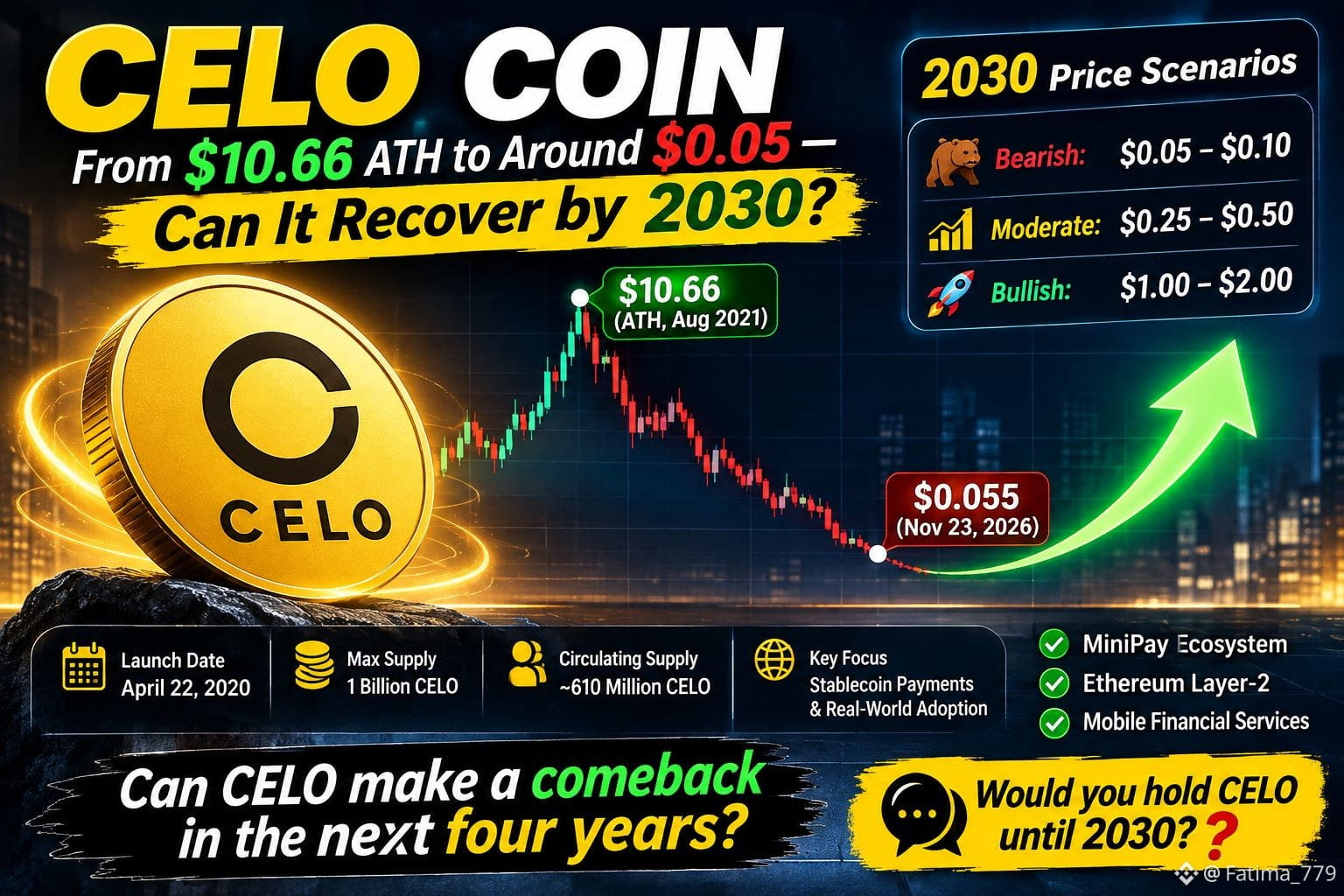
2
176

·
--
$CELO #CELO is up 6.98% and riding the altcoin bounce into the evening. 🚀
Direction: LONG
Entry zone: 0.0573 to 0.0579
Stop loss: 0.0549
Target 1: 0.0601
Target 2: 0.0624
Celo is trading at $0.0578 on CoinGecko, up 6.98 percent in 24 hours, while Bitcoin holds $62,899 and total market value sits at $2.18 trillion. A coin that rises nearly 7 percent on a day the leaders rise 3 to 4 percent is catching up fast when the market turns. My view is that the entry zone near $0.0573 to $0.0579 keeps the trade tight to the live price, with a stop at $0.0549 if the market rolls over again. 📈
Do you take the CELO long toward $0.0601, or wait for a close above $0.0624 first? 📊
Futures trading is risky, trade small and manage risk. ⚠️
Follow for more trades.
#Celo #Crypto #FuturesTrading #TradingSignals
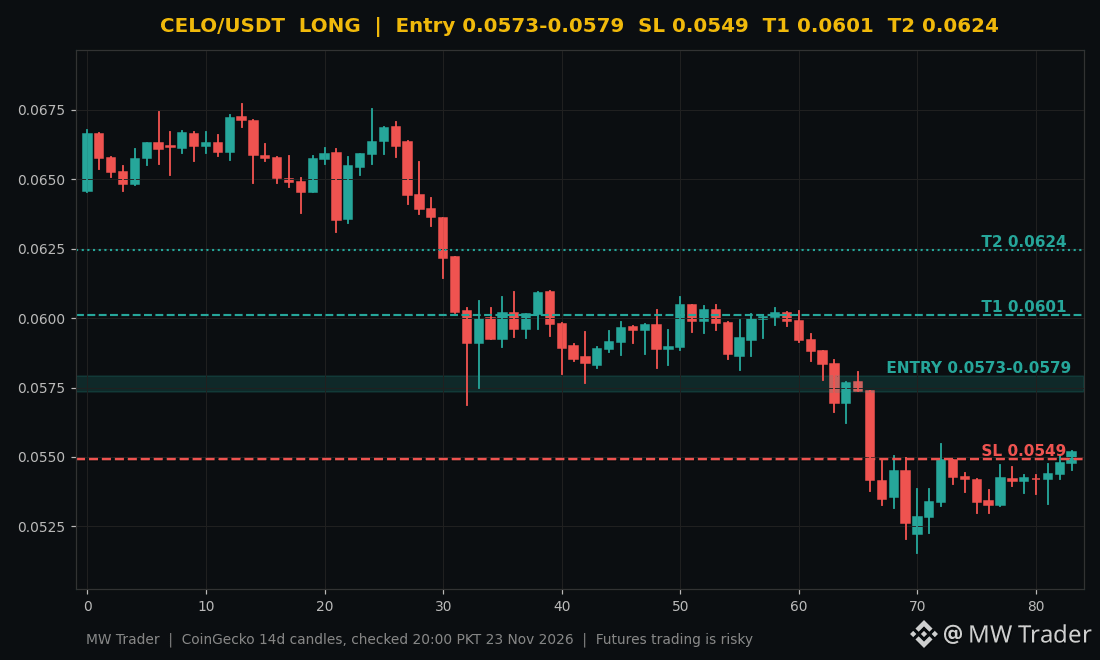
11

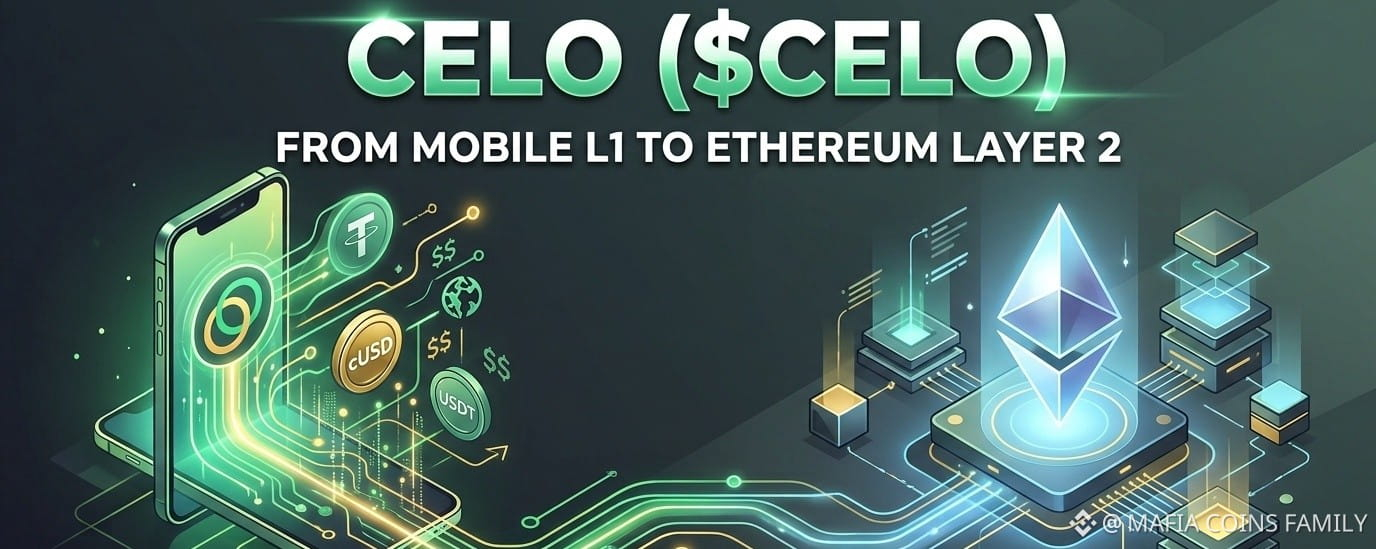
Article
The Complete Journey of Celo ($CELO): From a Mobile-First Vision to Ethereum Layer 2Few projects in the crypto space have executed a structural pivot as ambitious as Celo ( $CELO ). Originally launched as an independent, mobile-first Layer 1 blockchain, Celo successfully completed a historic transition to become an Ethereum Layer 2 network—bringing millions of mobile users and massive stablecoin volume directly into the Ethereum ecosystem.
1. The Origin: Banking the Unbanked via Smartphones (2017–2020)
Founded in 2017 by René Reinsberg, Marek Olszewski, and Sep Kamvar, Celo launched with a clear mission: financial inclusion for anyone with a smartphone.
While early blockchains struggled with complex wallet addresses and high fees, Celo built an EVM-compatible Layer 1 tailored for mobile devices:
Phone Number Mapping: Users could send crypto to mobile phone numbers instead of long hexadecimal addresses.
Sub-Cent Gas Fees & Fee Abstraction: Users could pay gas fees directly in stablecoins (like cUSD) rather than needing the native token first.
Ultralight Sync: Fast synchronization allowed low-end smartphones in developing regions to interact with the blockchain seamlessly.
2. Real-World Adoption & The Stablecoin Boom (2021–2023)
Rather than chasing pure speculation, Celo focused on everyday payments, micro-lending, and regenerative finance (ReFi).
The ecosystem became a major hub for native stablecoins, eventually welcoming native USDT and USDC alongside regional currencies like cUSD, cEUR, and cREAL.
Integrations like Opera MiniPay—a non-custodial stablecoin wallet built directly into the Opera Mini browser—unlocked massive adoption across Africa and emerging markets, onboarding millions of users who had never interacted with Web3 before.
3. The "Return Home": Migrating from L1 to Ethereum L2 (2023–2025)
In July 2023, cLabs proposed a bold architectural shift: transitioning Celo from a standalone Layer 1 into an Ethereum Layer 2. Rather than competing with Ethereum for liquidity and security, Celo chose to align with it.
In March 2025, Celo officially executed the migration without a chain regenesis—preserving nearly five years of transaction history and smart contracts intact.
Key Architectural Upgrades:
• OP Stack Foundation: Built using Optimism's OP Stack, making Celo part of the broader Superchain vision and simplifying Ethereum tooling compatibility.
• EigenDA Integration: By leveraging EigenLayer’s data availability solution (EigenDA), Celo kept transaction costs ultra-low (fractions of a cent) while avoiding Ethereum mainnet data bottlenecks.
• 1-Second Block Times: Block times dropped from 5 seconds to 1 second, delivering near-instant payment confirmations for mobile apps.
• Ethereum-Grade Security: Celo retired its standalone validator set in favor of Ethereum settlement, inheriting Ethereum's security guarantees while maintaining a decentralized sequence roadmap.
4. What the L2 Era Means for $CELO
Following the migration, the canonical $CELO token moved to Ethereum while retaining its core utility on the Celo L2 network:
• Governance: Holders vote on protocol upgrades, treasury allocations, and ecosystem grants.
• Gas & Fee Abstraction: $CELO remains a primary gas token alongside stablecoins.
• Ecosystem Alignment: Seamless bridging between Ethereum and Celo allows DeFi protocols, liquidity providers, and institutions to tap into Celo’s high-velocity mobile user base without friction.
Celo’s journey proves that established Layer 1 networks can evolve rather than stagnate. By combining Ethereum’s security and liquidity with proven mobile distribution and real-world stablecoin volume, Celo has positioned itself as one of the most practical payment layers in Web3.
{spot}(CELOUSDT)
{spot}(ETHUSDT)
Disclaimer: This article is for informational purposes only and does not constitute financial or investment advice. Always conduct your own research (DYOR) before making trading decisions.
#Celo #Write2Earn #Ethereum #Stablecoins #Web3
The Complete Journey of Celo ($CELO): From a Mobile-First Vision to Ethereum Layer 2
Few projects in the crypto space have executed a structural pivot as ambitious as Celo ( $CELO ). Originally launched as an independent, mobile-first Layer 1 blockchain, Celo successfully completed a historic transition to become an Ethereum Layer 2 network—bringing millions of mobile users and massive stablecoin volume directly into the Ethereum ecosystem.
1. The Origin: Banking the Unbanked via Smartphones (2017–2020)
Founded in 2017 by René Reinsberg, Marek Olszewski, and Sep Kamvar, Celo launched with a clear mission: financial inclusion for anyone with a smartphone.
While early blockchains struggled with complex wallet addresses and high fees, Celo built an EVM-compatible Layer 1 tailored for mobile devices:
Phone Number Mapping: Users could send crypto to mobile phone numbers instead of long hexadecimal addresses.
Sub-Cent Gas Fees & Fee Abstraction: Users could pay gas fees directly in stablecoins (like cUSD) rather than needing the native token first.
Ultralight Sync: Fast synchronization allowed low-end smartphones in developing regions to interact with the blockchain seamlessly.
2. Real-World Adoption & The Stablecoin Boom (2021–2023)
Rather than chasing pure speculation, Celo focused on everyday payments, micro-lending, and regenerative finance (ReFi).
The ecosystem became a major hub for native stablecoins, eventually welcoming native USDT and USDC alongside regional currencies like cUSD, cEUR, and cREAL.
Integrations like Opera MiniPay—a non-custodial stablecoin wallet built directly into the Opera Mini browser—unlocked massive adoption across Africa and emerging markets, onboarding millions of users who had never interacted with Web3 before.
3. The "Return Home": Migrating from L1 to Ethereum L2 (2023–2025)
In July 2023, cLabs proposed a bold architectural shift: transitioning Celo from a standalone Layer 1 into an Ethereum Layer 2. Rather than competing with Ethereum for liquidity and security, Celo chose to align with it.
In March 2025, Celo officially executed the migration without a chain regenesis—preserving nearly five years of transaction history and smart contracts intact.
Key Architectural Upgrades:
• OP Stack Foundation: Built using Optimism's OP Stack, making Celo part of the broader Superchain vision and simplifying Ethereum tooling compatibility.
• EigenDA Integration: By leveraging EigenLayer’s data availability solution (EigenDA), Celo kept transaction costs ultra-low (fractions of a cent) while avoiding Ethereum mainnet data bottlenecks.
• 1-Second Block Times: Block times dropped from 5 seconds to 1 second, delivering near-instant payment confirmations for mobile apps.
• Ethereum-Grade Security: Celo retired its standalone validator set in favor of Ethereum settlement, inheriting Ethereum's security guarantees while maintaining a decentralized sequence roadmap.
4. What the L2 Era Means for $CELO
Following the migration, the canonical $CELO token moved to Ethereum while retaining its core utility on the Celo L2 network:
• Governance: Holders vote on protocol upgrades, treasury allocations, and ecosystem grants.
• Gas & Fee Abstraction: $CELO remains a primary gas token alongside stablecoins.
• Ecosystem Alignment: Seamless bridging between Ethereum and Celo allows DeFi protocols, liquidity providers, and institutions to tap into Celo’s high-velocity mobile user base without friction.
Celo’s journey proves that established Layer 1 networks can evolve rather than stagnate. By combining Ethereum’s security and liquidity with proven mobile distribution and real-world stablecoin volume, Celo has positioned itself as one of the most practical payment layers in Web3.
Disclaimer: This article is for informational purposes only and does not constitute financial or investment advice. Always conduct your own research (DYOR) before making trading decisions.
#Celo #Write2Earn #Ethereum #Stablecoins #Web3
Saifulislam081985:
ETH
1
2
194

·
--
Why is $CELO getting attention?
@celo is an Ethereum-compatible Layer 1 focused on making blockchain more accessible, especially for mobile users and real-world payments.
What makes CELO interesting is its focus on:
• Fast and low-cost transactions
• Mobile-first blockchain experiences
• Stablecoin payments
• A growing ecosystem of Web3 applications
With the CELO Trading Festival now live on Binance, $CELO is definitely one project worth keeping on the radar.
I’ll be watching how the ecosystem develops from here.
#CELO
Autumn Riley:
Mobile-first blockchain adoption could be a major narrative for CELO.
9
8
185

·
--
$CELO CELO/USDT (4H) – Quick Analysis**
Trend: Bearish. Price (0.05494) is trading just above EMA(7) 0.05441 and MA(7) 0.05426, but below EMA(25) and MA(25), both at 0.05547, and well below EMA(99) 0.06143 and MA(99) 0.06154. All the averages are sloping down, and the 99 averages are far above price. The chart shows a steady series of lower highs since the 0.08727 peak, with the latest bottom at 0.05119. Over longer periods it is down about 8% over 7 days, 33% over 30 days, 30% over 90 days and 65% over one year.
Momentum: RSI(6) is about 61.9, which is moderately bullish. It has recovered from oversold territory and is now pointing up. Still, the 24h volume is very low (about 185K USDT), so the bounce has little backing and can fade quickly. The header shows +3.19% on 24h, and the "Today" figure shows +1.81%, because they use different windows.
Key levels:
Resistance: 0.05547 (EMA/MA 25), then 0.06143 to 0.06154 (the 99 averages), then 0.06327 on the chart. The 24h high is 0.05517, just under the 25 averages.
Support: 0.05426 to 0.05441 (MA/EMA 7), then 0.05318 (24h low), then 0.05119 (the recent bottom). Below that, the chart shows 0.05002.
Outlook: The bias is bearish while price stays under 0.05547. A move above the 25 averages would be the first sign the downtrend is easing, and it would open a test of the 0.0614 area. A 4H close below 0.05318 would put 0.05119 in play, and losing that would extend the decline. Until price reclaims the 99 averages, bounces are more likely to be sold than followed.
This is a technical read not financial advice. Use stop-losses and keep position sizes small.
#CELO #Binance
{spot}(CELOUSDT)
$CELO CELO/USDT (4H) – Quick Analysis**
Trend: Bearish. Price (0.05494) is trading just above EMA(7) 0.05441 and MA(7) 0.05426, but below EMA(25) and MA(25), both at 0.05547, and well below EMA(99) 0.06143 and MA(99) 0.06154. All the averages are sloping down, and the 99 averages are far above price. The chart shows a steady series of lower highs since the 0.08727 peak, with the latest bottom at 0.05119. Over longer periods it is down about 8% over 7 days, 33% over 30 days, 30% over 90 days and 65% over one year.
Momentum: RSI(6) is about 61.9, which is moderately bullish. It has recovered from oversold territory and is now pointing up. Still, the 24h volume is very low (about 185K USDT), so the bounce has little backing and can fade quickly. The header shows +3.19% on 24h, and the "Today" figure shows +1.81%, because they use different windows.
Key levels:
Resistance: 0.05547 (EMA/MA 25), then 0.06143 to 0.06154 (the 99 averages), then 0.06327 on the chart. The 24h high is 0.05517, just under the 25 averages.
Support: 0.05426 to 0.05441 (MA/EMA 7), then 0.05318 (24h low), then 0.05119 (the recent bottom). Below that, the chart shows 0.05002.
Outlook: The bias is bearish while price stays under 0.05547. A move above the 25 averages would be the first sign the downtrend is easing, and it would open a test of the 0.0614 area. A 4H close below 0.05318 would put 0.05119 in play, and losing that would extend the decline. Until price reclaims the 99 averages, bounces are more likely to be sold than followed.
This is a technical read not financial advice. Use stop-losses and keep position sizes small.
#CELO #Binance
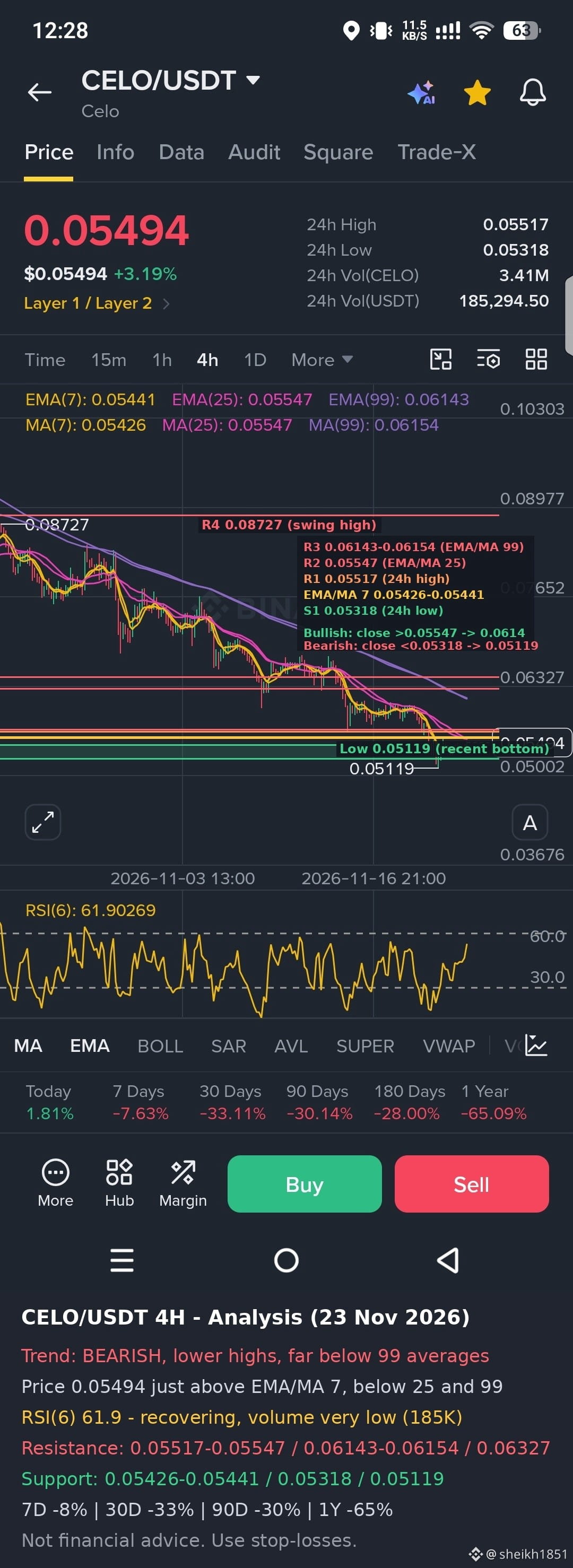
151

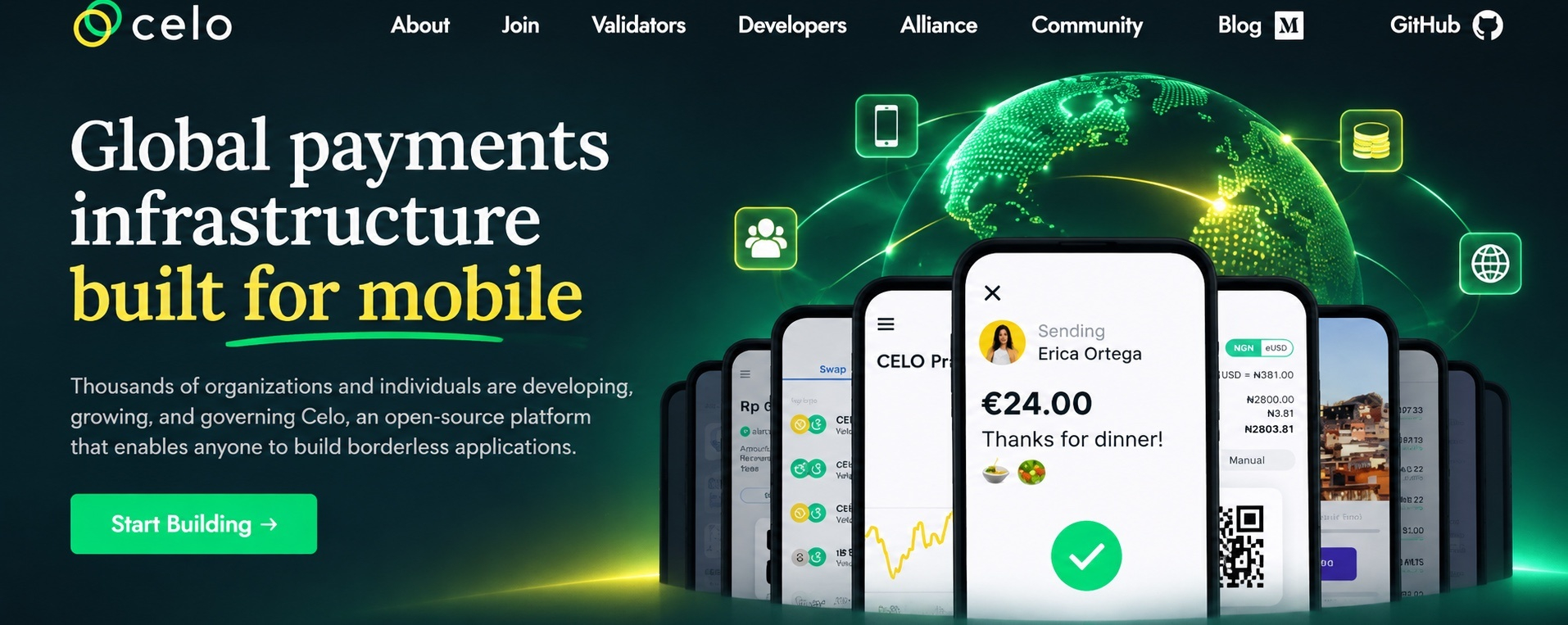
Article
Celo: Building the Payment Rails for a Global EconomyCELO | Global Payments | Stablecoins | Ethereum Layer 2 | AI Agents
Celo’s opportunity is not simply to process more transactions. It is to make stablecoin payments usable for people, businesses, and eventually autonomous AI agents.
The problem: Crypto has money, but everyday payments still have friction
There is a contradiction in the current financial system.
Blockchain networks can transfer digital assets around the world, but using those assets for ordinary payments is still more complicated than it should be.
Consider someone receiving money from another country. They may need to deal with currency conversion, banking delays, transfer charges, and limited access to financial services.
Crypto introduced an alternative through stablecoins, but stablecoin ownership alone does not solve the entire problem.
Users still need accessible wallets, reliable settlement, local currency liquidity, and an interface that does not require technical knowledge.
This is the problem I find interesting about $CELO
Rather than focusing exclusively on blockchain performance, Celo has spent years developing infrastructure around mobile-first financial applications, stablecoins, and global payments.
Its strategy is to make blockchain infrastructure less visible to the end user while allowing applications to benefit from programmable money underneath.
That distinction is important.
The strongest payment infrastructure is not necessarily the one users talk about most. It is the one that lets them complete transactions without thinking about the underlying network.
What is Celo, and why did it move to Ethereum Layer 2?
Celo is an open source blockchain ecosystem originally launched as an independent Layer 1 in 2020.
Its focus has been financial inclusion, mobile payments, and accessible stablecoin infrastructure.
However, one of its biggest architectural changes came in March 2025, when Celo transitioned to an Ethereum Layer 2 using the OP Stack.
The migration followed community approval in 2024.
Why make this change?
Operating as an independent Layer 1 means maintaining a separate network security and validator ecosystem. Moving to an Ethereum Layer 2 allows Celo to align more closely with Ethereum’s settlement and security ecosystem while retaining a specialized execution environment.
Its infrastructure combines several components:
OP Stack: The Layer 2 execution foundation.EigenDA: Modular data availability.Succinct SP1: Zero knowledge proving infrastructure.Fee abstraction: Enables transaction fees using supported ERC 20 tokens, including stablecoins.
The objective is to combine Ethereum alignment with a payment focused user experience.
One feature deserves particular attention: fee abstraction.
Imagine someone receiving stablecoins but not having any $ETH or CELO available to pay transaction fees.
For an ordinary user, that is an unnecessary complication.
Celo’s fee abstraction allows supported tokens to be used to cover network fees, reducing the need to acquire a separate gas asset before making a payment.
This is the kind of infrastructure decision that can make a real difference to mainstream usability.
How Celo’s payment infrastructure connects
The important point is that Celo is not just providing transaction execution. It is trying to connect wallets, stablecoins, payment applications, and settlement into one usable financial environment.
MiniPay: Bringing stablecoins to everyday users
One of the strongest parts of Celo’s strategy is MiniPay.
MiniPay is a self custodial stablecoin wallet developed by Opera, designed around mobile first access.
Its approach is different from the traditional crypto wallet experience.
Instead of expecting users to understand blockchain networks, gas tokens, and complicated wallet interfaces, MiniPay focuses on making digital dollar payments accessible through a familiar mobile experience.
Consider a practical scenario.
A freelancer receives payment from a client abroad. Instead of relying entirely on traditional banking transfers, the freelancer can receive supported stablecoins into a wallet and use available services to move or convert funds.
The wallet provides the interface, while Celo supplies the underlying blockchain infrastructure.
According to the November 19, 2026 announcement, MiniPay reported:
20 million plus activated wallets.600 million plus processed transactions.Availability across more than 70 countries.77 Mini Apps.
These are significant distribution indicators.
However, activated wallets should not be confused with monthly active users. Transaction counts also do not independently establish profitability.
MiniPay’s November 2026 upgrade involving Privy, a Stripe owned wallet infrastructure provider, is another development worth watching. Its aim is to simplify account access through options such as email, social login, and passkeys while retaining self custody.
The larger idea is straightforward: make stablecoins accessible to people who may never consider themselves crypto users.
How MiniPay connects users to digital payments
What I find particularly interesting is the distribution advantage.
Opera’s existing mobile ecosystem gives MiniPay a potential route to users outside the traditional crypto native audience.
The next question is whether those users continue using it after their initial transaction.
Stablecoins: The foundation of Celo’s payment strategy
I think this is where Celo’s positioning becomes especially interesting.
Many blockchain ecosystems focus heavily on their native tokens. Celo has placed significant emphasis on stablecoins as practical payment instruments.
Its ecosystem supports assets including $USDT , USDC, USA₮, USDm, EURm, BRLm, XOFm, and other local currency stablecoins.
By late 2026, Celo reported more than 33 stablecoin assets representing approximately 20 currencies.
Why is that important?
Because global payments should not assume that every user wants to transact in US dollars.
A merchant in Brazil may prefer Brazilian reais. A user in Argentina may need pesos. A business operating in West Africa may have different currency requirements.
Local currency stablecoins can reduce unnecessary conversion steps and make blockchain payments more relevant to local financial activity.
Celo’s multi currency stablecoin ecosystem
There is an important distinction, though.
A stablecoin representing a particular currency is not automatically equivalent to holding a bank deposit in that currency. Its issuer, reserves, redemption mechanisms, and liquidity all matter.
That is why I would evaluate the quality of the stablecoin ecosystem, not just the number of supported assets.
AI agents: The next payment users may not be human
One of the newer directions in Celo’s ecosystem is AI agent payments.
AI agents are increasingly capable of interacting with websites, using APIs, researching information, and completing tasks.
But there is a practical limitation: these agents also need to pay for services.
An AI agent might need computing resources, access to a data service, or a paid API call.
Traditional payment infrastructure was largely designed around human account holders and subscription based relationships.
Celo is exploring a different approach through stablecoin native agent payments.
In July 2026, Celo introduced its native x402 facilitator.
The x402 approach uses the HTTP 402 Payment Required response to allow web services to request payment before providing access.
Here is the basic process:
An AI agent requests a paid service.
The service returns a payment requirement
The agent signs a stablecoin payment authorization.
The facilitator verifies the authorization.The facilitator submits the settlement transaction and sponsors gas.
The service receives confirmation and delivers the requested resource.
The implementation uses EIP-3009 transferWithAuthorization for supported assets.
This is particularly interesting because the facilitator can coordinate verification and settlement without taking custody of the buyer’s funds.
Celo expanded this infrastructure in October 2026, with its x402 facilitator supporting ten stablecoins across eight currencies.
The project also introduced buy, a services marketplace where agents can discover and pay for more than 700 services spanning compute, data, and APIs.
This creates a new possibility: AI agents could purchase services using stablecoins without requiring a human to manually approve every individual payment.
How an AI agent pays through x402
I find this direction worth monitoring because it connects Celo’s established stablecoin infrastructure with a potentially new category of demand.
However, having the infrastructure does not mean autonomous payments have already achieved mainstream commercial adoption.
Recurring payment activity will be the real test.
DeFi and tokenized real world assets
Celo’s payment focus does not mean its ecosystem is limited to wallets and transfers.
Its Ethereum compatible environment supports decentralized finance applications, including Aave, Uniswap, Morpho, Curve, and other ecosystem participants.
Stablecoins can serve as the foundation for lending, borrowing, liquidity provision, and onchain foreign exchange.
Tokenization is another important opportunity.
Tokenized financial assets need reliable settlement infrastructure, liquidity, and access to programmable currencies.
For example, a tokenized financial instrument could use stablecoins for settlement while connecting to decentralized lending markets.
The combination of Ethereum compatibility and stablecoin infrastructure makes this a relevant area for Celo.
But I would distinguish technical capability from actual institutional adoption.
The existence of tokenization infrastructure does not prove that large financial institutions are already using Celo at scale.
The indicators that matter are actual issuance, recurring liquidity, integrations, and commercial activity
Adoption: What do the numbers actually tell us?
I prefer looking at measurable activity instead of relying entirely on a project’s narrative.
Celo’s first year as an Ethereum Layer 2 provides an important reference point.
Its March 2026 ecosystem review reported more than $65.9 billion in stablecoin transaction volume during 2025, representing approximately 142% growth over 2024.
That is a significant figure, but volume alone does not tell the entire story
A network can process substantial transaction volume without generating equivalent revenue.
For a broader perspective, the November 22, 2026 Growthepie snapshot cited earlier reported:
These metrics measure different things:
Transactions show how much network activity is taking place.Active addresses indicate onchain participation, not necessarily unique people.Stablecoin supply indicates the value of stablecoins present on the network.Chain revenue provides insight into the network’s ability to capture economic value.
The distinction between usage and revenue is particularly important.
Stablecoin volume growth
What I take from these numbers is that Celo has established meaningful stablecoin activity
The next challenge is demonstrating that this activity translates into sustainable network economics.
CELO token utility: Connecting network activity with economic value
Now comes the part token holders should understand
CELO is the native token of the Celo ecosystem.
Its functions include staking, network participation, governance, and supporting the protocol’s economic model.
But one development I find particularly interesting is the CELOccelerate tokenomics initiative.
Its economic model aims to connect network revenue with the CELO ecosystem.
The proposed mechanism works through several stages:
The network generates sequencer revenue.Relevant operating costs are accounted for.Net revenue is directed toward the Community Fund through programmatic CELO acquisition.CELO holders participate in governance decisions concerning the fund.Approved allocations can support ecosystem development or other authorized uses, including burning tokens where approved.
This is interesting because it attempts to connect network activity with the native token’s economic role
CELO has a maximum supply of 1 billion tokens according to its published token information.
However, token acquisition does not automatically guarantee price appreciation.
The outcome depends on sustainable revenue, operating expenses, governance decisions, and actual implementation.
The CELO economic flywheelConceptual representation of the CELOccelerate revenue mechanism. Actual fund allocation and token treatment depend on approved governance decisions and implementation.
I would pay particular attention to whether network revenue grows alongside stablecoin activity.
That relationship will tell us more about CELO’s long term economic model than transaction counts alone.
Where I remain cautious
There are several challenges worth discussing.
Competition
Ethereum Layer 2 networks and payment-focused blockchains are competing for the same developers, liquidity, and applications. Celo needs to maintain a clear reason for businesses to choose its ecosystem.
Stablecoin dependencies
Celo does not control every stablecoin issuer, local payment provider, or redemption mechanism. Those external relationships influence the reliability of its payment ecosystem.
User retention
Twenty million activated wallets is an encouraging distribution metric, but recurring users are more important than registrations.
Network economics
High transaction volume does not automatically translate into high revenue. The relationship between operating costs, sequencer revenue, and token economics needs continued examination.
AI agent adoption
The x402 infrastructure is an interesting development, but actual recurring commercial payments from AI agents still need to demonstrate meaningful scale.
These challenges do not invalidate Celo’s strategy. They identify the areas where execution will matter most.
What I am watching next
Instead of focusing exclusively on the CELO price chart, I would monitor five developments.
MiniPay retention: Are activated wallets becoming regular payment users?
Stablecoin activity: Is volume translating into sustained economic demand?
AI agent payments: Are x402 and MPP integrations generating recurring transactions?
Protocol economics: Is sequencer revenue growing enough to support the Community Fund after operating costs?
Ecosystem expansion: Are more developers, merchants, local-currency issuers, and financial applications choosing Celo?
These are more useful indicators of long term progress than short term market movements.
My Take:
What makes Celo interesting to me is its focus on a practical problem.
Crypto does not necessarily need another network competing for attention. It needs infrastructure that makes digital money easier to move, easier to use, and more accessible across different financial markets.
Celo has made several meaningful moves in that direction.
Its Ethereum Layer 2 transition, MiniPay distribution, stablecoin ecosystem, local currency payment infrastructure, and emerging AI agent payment tools form a coherent strategy.
The strongest part of the thesis is the combination of distribution and infrastructure.
MiniPay provides the user facing entry point, while Celo provides the programmable settlement layer underneath it.
But the next chapter is about economics.
Can Celo turn millions of activated wallets and substantial stablecoin activity into sustainable, recurring financial usage?
Can its protocol revenue support the network’s longterm development?
And can it maintain a meaningful position as competing payment networks evolve?
Those are the questions I would continue investigating.
I would rather watch real payments, returning users, and sustainable revenue than rely on a compelling narrative alone.
Because the future of digital payments will not be decided by how many networks exist. It will be decided by how many people actually find them useful.
Disclosure: This article was created as original educational research for the Binance Square Celo Creator Challenge. It reflects my own analysis and interpretation of publicly available information.
Disclaimer: This content is for educational purposes only and is not financial advice. Cryptocurrency assets are volatile and involve significant risks. Always conduct your own research before making investment decisions.
#CELO #stablecoin #Web3 #BinanceSquare
#cryptofirst21
Celo: Building the Payment Rails for a Global Economy
CELO | Global Payments | Stablecoins | Ethereum Layer 2 | AI Agents
Celo’s opportunity is not simply to process more transactions. It is to make stablecoin payments usable for people, businesses, and eventually autonomous AI agents.
The problem: Crypto has money, but everyday payments still have friction
There is a contradiction in the current financial system.
Blockchain networks can transfer digital assets around the world, but using those assets for ordinary payments is still more complicated than it should be.
Consider someone receiving money from another country. They may need to deal with currency conversion, banking delays, transfer charges, and limited access to financial services.
Crypto introduced an alternative through stablecoins, but stablecoin ownership alone does not solve the entire problem.
Users still need accessible wallets, reliable settlement, local currency liquidity, and an interface that does not require technical knowledge.
This is the problem I find interesting about $CELO
Rather than focusing exclusively on blockchain performance, Celo has spent years developing infrastructure around mobile-first financial applications, stablecoins, and global payments.
Its strategy is to make blockchain infrastructure less visible to the end user while allowing applications to benefit from programmable money underneath.
That distinction is important.
The strongest payment infrastructure is not necessarily the one users talk about most. It is the one that lets them complete transactions without thinking about the underlying network.
What is Celo, and why did it move to Ethereum Layer 2?
Celo is an open source blockchain ecosystem originally launched as an independent Layer 1 in 2020.
Its focus has been financial inclusion, mobile payments, and accessible stablecoin infrastructure.
However, one of its biggest architectural changes came in March 2025, when Celo transitioned to an Ethereum Layer 2 using the OP Stack.
The migration followed community approval in 2024.
Why make this change?
Operating as an independent Layer 1 means maintaining a separate network security and validator ecosystem. Moving to an Ethereum Layer 2 allows Celo to align more closely with Ethereum’s settlement and security ecosystem while retaining a specialized execution environment.
Its infrastructure combines several components:
OP Stack: The Layer 2 execution foundation.EigenDA: Modular data availability.Succinct SP1: Zero knowledge proving infrastructure.Fee abstraction: Enables transaction fees using supported ERC 20 tokens, including stablecoins.
The objective is to combine Ethereum alignment with a payment focused user experience.
One feature deserves particular attention: fee abstraction.
Imagine someone receiving stablecoins but not having any $ETH or CELO available to pay transaction fees.
For an ordinary user, that is an unnecessary complication.
Celo’s fee abstraction allows supported tokens to be used to cover network fees, reducing the need to acquire a separate gas asset before making a payment.
This is the kind of infrastructure decision that can make a real difference to mainstream usability.
How Celo’s payment infrastructure connects
The important point is that Celo is not just providing transaction execution. It is trying to connect wallets, stablecoins, payment applications, and settlement into one usable financial environment.
MiniPay: Bringing stablecoins to everyday users
One of the strongest parts of Celo’s strategy is MiniPay.
MiniPay is a self custodial stablecoin wallet developed by Opera, designed around mobile first access.
Its approach is different from the traditional crypto wallet experience.
Instead of expecting users to understand blockchain networks, gas tokens, and complicated wallet interfaces, MiniPay focuses on making digital dollar payments accessible through a familiar mobile experience.
Consider a practical scenario.
A freelancer receives payment from a client abroad. Instead of relying entirely on traditional banking transfers, the freelancer can receive supported stablecoins into a wallet and use available services to move or convert funds.
The wallet provides the interface, while Celo supplies the underlying blockchain infrastructure.
According to the November 19, 2026 announcement, MiniPay reported:
20 million plus activated wallets.600 million plus processed transactions.Availability across more than 70 countries.77 Mini Apps.
These are significant distribution indicators.
However, activated wallets should not be confused with monthly active users. Transaction counts also do not independently establish profitability.
MiniPay’s November 2026 upgrade involving Privy, a Stripe owned wallet infrastructure provider, is another development worth watching. Its aim is to simplify account access through options such as email, social login, and passkeys while retaining self custody.
The larger idea is straightforward: make stablecoins accessible to people who may never consider themselves crypto users.
How MiniPay connects users to digital payments
What I find particularly interesting is the distribution advantage.
Opera’s existing mobile ecosystem gives MiniPay a potential route to users outside the traditional crypto native audience.
The next question is whether those users continue using it after their initial transaction.
Stablecoins: The foundation of Celo’s payment strategy
I think this is where Celo’s positioning becomes especially interesting.
Many blockchain ecosystems focus heavily on their native tokens. Celo has placed significant emphasis on stablecoins as practical payment instruments.
Its ecosystem supports assets including $USDT , USDC, USA₮, USDm, EURm, BRLm, XOFm, and other local currency stablecoins.
By late 2026, Celo reported more than 33 stablecoin assets representing approximately 20 currencies.
Why is that important?
Because global payments should not assume that every user wants to transact in US dollars.
A merchant in Brazil may prefer Brazilian reais. A user in Argentina may need pesos. A business operating in West Africa may have different currency requirements.
Local currency stablecoins can reduce unnecessary conversion steps and make blockchain payments more relevant to local financial activity.
Celo’s multi currency stablecoin ecosystem
There is an important distinction, though.
A stablecoin representing a particular currency is not automatically equivalent to holding a bank deposit in that currency. Its issuer, reserves, redemption mechanisms, and liquidity all matter.
That is why I would evaluate the quality of the stablecoin ecosystem, not just the number of supported assets.
AI agents: The next payment users may not be human
One of the newer directions in Celo’s ecosystem is AI agent payments.
AI agents are increasingly capable of interacting with websites, using APIs, researching information, and completing tasks.
But there is a practical limitation: these agents also need to pay for services.
An AI agent might need computing resources, access to a data service, or a paid API call.
Traditional payment infrastructure was largely designed around human account holders and subscription based relationships.
Celo is exploring a different approach through stablecoin native agent payments.
In July 2026, Celo introduced its native x402 facilitator.
The x402 approach uses the HTTP 402 Payment Required response to allow web services to request payment before providing access.
Here is the basic process:
An AI agent requests a paid service.
The service returns a payment requirement
The agent signs a stablecoin payment authorization.
The facilitator verifies the authorization.The facilitator submits the settlement transaction and sponsors gas.
The service receives confirmation and delivers the requested resource.
The implementation uses EIP-3009 transferWithAuthorization for supported assets.
This is particularly interesting because the facilitator can coordinate verification and settlement without taking custody of the buyer’s funds.
Celo expanded this infrastructure in October 2026, with its x402 facilitator supporting ten stablecoins across eight currencies.
The project also introduced buy, a services marketplace where agents can discover and pay for more than 700 services spanning compute, data, and APIs.
This creates a new possibility: AI agents could purchase services using stablecoins without requiring a human to manually approve every individual payment.
How an AI agent pays through x402
I find this direction worth monitoring because it connects Celo’s established stablecoin infrastructure with a potentially new category of demand.
However, having the infrastructure does not mean autonomous payments have already achieved mainstream commercial adoption.
Recurring payment activity will be the real test.
DeFi and tokenized real world assets
Celo’s payment focus does not mean its ecosystem is limited to wallets and transfers.
Its Ethereum compatible environment supports decentralized finance applications, including Aave, Uniswap, Morpho, Curve, and other ecosystem participants.
Stablecoins can serve as the foundation for lending, borrowing, liquidity provision, and onchain foreign exchange.
Tokenization is another important opportunity.
Tokenized financial assets need reliable settlement infrastructure, liquidity, and access to programmable currencies.
For example, a tokenized financial instrument could use stablecoins for settlement while connecting to decentralized lending markets.
The combination of Ethereum compatibility and stablecoin infrastructure makes this a relevant area for Celo.
But I would distinguish technical capability from actual institutional adoption.
The existence of tokenization infrastructure does not prove that large financial institutions are already using Celo at scale.
The indicators that matter are actual issuance, recurring liquidity, integrations, and commercial activity
Adoption: What do the numbers actually tell us?
I prefer looking at measurable activity instead of relying entirely on a project’s narrative.
Celo’s first year as an Ethereum Layer 2 provides an important reference point.
Its March 2026 ecosystem review reported more than $65.9 billion in stablecoin transaction volume during 2025, representing approximately 142% growth over 2024.
That is a significant figure, but volume alone does not tell the entire story
A network can process substantial transaction volume without generating equivalent revenue.
For a broader perspective, the November 22, 2026 Growthepie snapshot cited earlier reported:
These metrics measure different things:
Transactions show how much network activity is taking place.Active addresses indicate onchain participation, not necessarily unique people.Stablecoin supply indicates the value of stablecoins present on the network.Chain revenue provides insight into the network’s ability to capture economic value.
The distinction between usage and revenue is particularly important.
Stablecoin volume growth
What I take from these numbers is that Celo has established meaningful stablecoin activity
The next challenge is demonstrating that this activity translates into sustainable network economics.
CELO token utility: Connecting network activity with economic value
Now comes the part token holders should understand
CELO is the native token of the Celo ecosystem.
Its functions include staking, network participation, governance, and supporting the protocol’s economic model.
But one development I find particularly interesting is the CELOccelerate tokenomics initiative.
Its economic model aims to connect network revenue with the CELO ecosystem.
The proposed mechanism works through several stages:
The network generates sequencer revenue.Relevant operating costs are accounted for.Net revenue is directed toward the Community Fund through programmatic CELO acquisition.CELO holders participate in governance decisions concerning the fund.Approved allocations can support ecosystem development or other authorized uses, including burning tokens where approved.
This is interesting because it attempts to connect network activity with the native token’s economic role
CELO has a maximum supply of 1 billion tokens according to its published token information.
However, token acquisition does not automatically guarantee price appreciation.
The outcome depends on sustainable revenue, operating expenses, governance decisions, and actual implementation.
The CELO economic flywheelConceptual representation of the CELOccelerate revenue mechanism. Actual fund allocation and token treatment depend on approved governance decisions and implementation.
I would pay particular attention to whether network revenue grows alongside stablecoin activity.
That relationship will tell us more about CELO’s long term economic model than transaction counts alone.
Where I remain cautious
There are several challenges worth discussing.
Competition
Ethereum Layer 2 networks and payment-focused blockchains are competing for the same developers, liquidity, and applications. Celo needs to maintain a clear reason for businesses to choose its ecosystem.
Stablecoin dependencies
Celo does not control every stablecoin issuer, local payment provider, or redemption mechanism. Those external relationships influence the reliability of its payment ecosystem.
User retention
Twenty million activated wallets is an encouraging distribution metric, but recurring users are more important than registrations.
Network economics
High transaction volume does not automatically translate into high revenue. The relationship between operating costs, sequencer revenue, and token economics needs continued examination.
AI agent adoption
The x402 infrastructure is an interesting development, but actual recurring commercial payments from AI agents still need to demonstrate meaningful scale.
These challenges do not invalidate Celo’s strategy. They identify the areas where execution will matter most.
What I am watching next
Instead of focusing exclusively on the CELO price chart, I would monitor five developments.
MiniPay retention: Are activated wallets becoming regular payment users?
Stablecoin activity: Is volume translating into sustained economic demand?
AI agent payments: Are x402 and MPP integrations generating recurring transactions?
Protocol economics: Is sequencer revenue growing enough to support the Community Fund after operating costs?
Ecosystem expansion: Are more developers, merchants, local-currency issuers, and financial applications choosing Celo?
These are more useful indicators of long term progress than short term market movements.
My Take:
What makes Celo interesting to me is its focus on a practical problem.
Crypto does not necessarily need another network competing for attention. It needs infrastructure that makes digital money easier to move, easier to use, and more accessible across different financial markets.
Celo has made several meaningful moves in that direction.
Its Ethereum Layer 2 transition, MiniPay distribution, stablecoin ecosystem, local currency payment infrastructure, and emerging AI agent payment tools form a coherent strategy.
The strongest part of the thesis is the combination of distribution and infrastructure.
MiniPay provides the user facing entry point, while Celo provides the programmable settlement layer underneath it.
But the next chapter is about economics.
Can Celo turn millions of activated wallets and substantial stablecoin activity into sustainable, recurring financial usage?
Can its protocol revenue support the network’s longterm development?
And can it maintain a meaningful position as competing payment networks evolve?
Those are the questions I would continue investigating.
I would rather watch real payments, returning users, and sustainable revenue than rely on a compelling narrative alone.
Because the future of digital payments will not be decided by how many networks exist. It will be decided by how many people actually find them useful.
Disclosure: This article was created as original educational research for the Binance Square Celo Creator Challenge. It reflects my own analysis and interpretation of publicly available information.
Disclaimer: This content is for educational purposes only and is not financial advice. Cryptocurrency assets are volatile and involve significant risks. Always conduct your own research before making investment decisions.
#CELO #stablecoin #Web3 #BinanceSquare
#cryptofirst21
Mr_Green个:
Celo is tackling a practical challenge: making stablecoin payments simpler and more accessible worldwide. Its focus on mobile wallets, local currencies, and AI-agent payments is promising, but long-term success will depend on real user retention and sustainable network revenue.
7
6
924

Article
Celo (CELO): Can Blockchain Become Useful Enough for Everyday Payments?Most people don't care whether a transaction runs on Ethereum, an L2, or another blockchain. They care about whether their money reaches the other person, how much the transfer costs, and whether the process is simple enough to use without technical knowledge.
That's the problem Celo is trying to solve.
Rather than competing only for attention in the DeFi or trading space, Celo has been building around stablecoin payments, mobile wallets, low-cost transactions, and financial applications designed for everyday users.
1. From an Independent Blockchain to Ethereum Layer 2
One of Celo's biggest changes was its transition from an independent Layer 1 blockchain to an Ethereum Layer 2 network built using the OP Stack.
The migration was completed in March 2025. It was an important strategic decision because Celo could maintain its focus on affordable transactions while connecting more closely with Ethereum's infrastructure and ecosystem.
The move also matters for developers. Ethereum compatibility makes it easier for applications, tools, and smart contracts to work within Celo's ecosystem.
But technology alone doesn't guarantee adoption. The real question is whether users and businesses actually find a reason to use it.
2. Stablecoins Are at the Center of Celo's Strategy
This is where Celo becomes interesting to me.
Stablecoins aren't just another crypto asset for speculation. People can use them to transfer dollar value, receive payments, store money digitally, or move funds across borders.
Celo supports stablecoin-based activity and has focused on making transactions affordable. Its ecosystem includes assets such as USDC, USDT, and stable assets connected with the Mento ecosystem.
Another useful feature is fee abstraction, allowing users to pay transaction fees using supported tokens rather than always needing a separate native gas token.
That removes one small but frustrating barrier for new users.
A payment system becomes easier when the user doesn't have to think about the blockchain mechanics behind every transaction.
3. MiniPay Could Be One of Celo's Most Important Adoption Drivers
MiniPay, developed by Opera, is one of the clearest examples of Celo's mobile-first approach.
The wallet is designed around stablecoins and everyday accessibility. Instead of expecting users to understand private keys, gas fees, bridges, and complicated interfaces before making their first transaction, the goal is to make digital payments feel more familiar.
MiniPay's ecosystem has reported significant wallet activation growth. But wallet activations should not automatically be treated as active users.
The more important metrics are repeat usage, transaction activity, retention, and whether people use the wallet for meaningful financial activity.
Adoption is not just downloading an app. It's coming back because the app solves a real problem.
4. The AI Agent Narrative Is Another Interesting Direction
Crypto is increasingly exploring AI agents that can interact with digital services, make decisions, and execute transactions.
For agents to do anything economically useful, they need infrastructure for payments, permissions, identity, and verification.
Celo is exploring this area through agent-oriented payment infrastructure, including x402-related integrations.
I think this narrative has potential, but it is also easy to overhype.
An AI agent making a payment sounds exciting in a demo. The harder questions are what happens when it makes a mistake, how spending limits are enforced, who is responsible, and whether the payment can be trusted.
The infrastructure matters much more than the headline.
5. What Is the Role of the CELO Token?
The network and the token should be evaluated separately.
CELO is the native asset associated with the Celo ecosystem and plays a role in network economics, governance, and participation.
However, the growth of stablecoin transactions doesn't automatically mean the CELO token price must rise.
This is one of the most important things investors should understand.
A blockchain can become more useful while its token struggles if the economic value generated by the network doesn't translate into demand for the token.
So I would watch token utility, governance decisions, supply dynamics, network fees, and how the ecosystem's growth affects CELO's economics—not just transaction numbers.
6. The Risks Are Real
Celo operates in a competitive market.
Other networks are also targeting stablecoin payments, cheaper transactions, mobile users, and developer adoption. Technology can be copied, and users can move between ecosystems.
There are also regulatory risks around stablecoins, security risks common to smart contracts and blockchain infrastructure, and the challenge of turning early adoption into sustainable usage.
The biggest question isn't whether Celo can process transactions cheaply.
It's whether it can build a lasting financial ecosystem that people choose to use repeatedly.
7. What I Would Watch Going Forward
Instead of focusing only on short-term price movements, I'd watch:
• Stablecoin transaction growth
• MiniPay's active users and retention
• Developer activity and new applications
• Stablecoin liquidity within the ecosystem
• Real-world payment adoption
• CELO token utility and economics
• Network security and ecosystem partnerships
These indicators could tell us more about the project's actual progress than social media hype.
8. My Personal View
Celo's strongest narrative isn't simply another blockchain trying to become faster.
It's the combination of Ethereum infrastructure, stablecoin payments, mobile accessibility, and an ecosystem that is increasingly experimenting with AI-driven transactions.
I would be more interested in watching its real payment activity, MiniPay retention, developer growth, stablecoin liquidity, and CELO's token economics than chasing a short-term price move.
If Celo can make blockchain payments feel almost invisible to ordinary users, that could be a more meaningful achievement than another technical benchmark.
Sometimes the best technology is the one people barely notice because it simply works.
Final Thought
What do you think matters more for Celo's future: stablecoin adoption, MiniPay growth, or CELO token economics?
$CELO @celo #CELO #Stablecoin #BinanceSquare
Celo (CELO): Can Blockchain Become Useful Enough for Everyday Payments?
Most people don't care whether a transaction runs on Ethereum, an L2, or another blockchain. They care about whether their money reaches the other person, how much the transfer costs, and whether the process is simple enough to use without technical knowledge.
That's the problem Celo is trying to solve.
Rather than competing only for attention in the DeFi or trading space, Celo has been building around stablecoin payments, mobile wallets, low-cost transactions, and financial applications designed for everyday users.
1. From an Independent Blockchain to Ethereum Layer 2
One of Celo's biggest changes was its transition from an independent Layer 1 blockchain to an Ethereum Layer 2 network built using the OP Stack.
The migration was completed in March 2025. It was an important strategic decision because Celo could maintain its focus on affordable transactions while connecting more closely with Ethereum's infrastructure and ecosystem.
The move also matters for developers. Ethereum compatibility makes it easier for applications, tools, and smart contracts to work within Celo's ecosystem.
But technology alone doesn't guarantee adoption. The real question is whether users and businesses actually find a reason to use it.
2. Stablecoins Are at the Center of Celo's Strategy
This is where Celo becomes interesting to me.
Stablecoins aren't just another crypto asset for speculation. People can use them to transfer dollar value, receive payments, store money digitally, or move funds across borders.
Celo supports stablecoin-based activity and has focused on making transactions affordable. Its ecosystem includes assets such as USDC, USDT, and stable assets connected with the Mento ecosystem.
Another useful feature is fee abstraction, allowing users to pay transaction fees using supported tokens rather than always needing a separate native gas token.
That removes one small but frustrating barrier for new users.
A payment system becomes easier when the user doesn't have to think about the blockchain mechanics behind every transaction.
3. MiniPay Could Be One of Celo's Most Important Adoption Drivers
MiniPay, developed by Opera, is one of the clearest examples of Celo's mobile-first approach.
The wallet is designed around stablecoins and everyday accessibility. Instead of expecting users to understand private keys, gas fees, bridges, and complicated interfaces before making their first transaction, the goal is to make digital payments feel more familiar.
MiniPay's ecosystem has reported significant wallet activation growth. But wallet activations should not automatically be treated as active users.
The more important metrics are repeat usage, transaction activity, retention, and whether people use the wallet for meaningful financial activity.
Adoption is not just downloading an app. It's coming back because the app solves a real problem.
4. The AI Agent Narrative Is Another Interesting Direction
Crypto is increasingly exploring AI agents that can interact with digital services, make decisions, and execute transactions.
For agents to do anything economically useful, they need infrastructure for payments, permissions, identity, and verification.
Celo is exploring this area through agent-oriented payment infrastructure, including x402-related integrations.
I think this narrative has potential, but it is also easy to overhype.
An AI agent making a payment sounds exciting in a demo. The harder questions are what happens when it makes a mistake, how spending limits are enforced, who is responsible, and whether the payment can be trusted.
The infrastructure matters much more than the headline.
5. What Is the Role of the CELO Token?
The network and the token should be evaluated separately.
CELO is the native asset associated with the Celo ecosystem and plays a role in network economics, governance, and participation.
However, the growth of stablecoin transactions doesn't automatically mean the CELO token price must rise.
This is one of the most important things investors should understand.
A blockchain can become more useful while its token struggles if the economic value generated by the network doesn't translate into demand for the token.
So I would watch token utility, governance decisions, supply dynamics, network fees, and how the ecosystem's growth affects CELO's economics—not just transaction numbers.
6. The Risks Are Real
Celo operates in a competitive market.
Other networks are also targeting stablecoin payments, cheaper transactions, mobile users, and developer adoption. Technology can be copied, and users can move between ecosystems.
There are also regulatory risks around stablecoins, security risks common to smart contracts and blockchain infrastructure, and the challenge of turning early adoption into sustainable usage.
The biggest question isn't whether Celo can process transactions cheaply.
It's whether it can build a lasting financial ecosystem that people choose to use repeatedly.
7. What I Would Watch Going Forward
Instead of focusing only on short-term price movements, I'd watch:
• Stablecoin transaction growth
• MiniPay's active users and retention
• Developer activity and new applications
• Stablecoin liquidity within the ecosystem
• Real-world payment adoption
• CELO token utility and economics
• Network security and ecosystem partnerships
These indicators could tell us more about the project's actual progress than social media hype.
8. My Personal View
Celo's strongest narrative isn't simply another blockchain trying to become faster.
It's the combination of Ethereum infrastructure, stablecoin payments, mobile accessibility, and an ecosystem that is increasingly experimenting with AI-driven transactions.
I would be more interested in watching its real payment activity, MiniPay retention, developer growth, stablecoin liquidity, and CELO's token economics than chasing a short-term price move.
If Celo can make blockchain payments feel almost invisible to ordinary users, that could be a more meaningful achievement than another technical benchmark.
Sometimes the best technology is the one people barely notice because it simply works.
Final Thought
What do you think matters more for Celo's future: stablecoin adoption, MiniPay growth, or CELO token economics?
$CELO @celo #CELO #Stablecoin #BinanceSquare
Volatile:
Great But We can't Understand the why everyone is promoto of the $CELO 🤔🏋🏼♀️
2
11
401

Article
Celo (CELO): The Stablecoin-Focused Chain That Became an Ethereum Layer 2Educational article
Most blockchains compete for traders and DeFi users. Celo has taken a different route, aiming at everyday payments with stablecoins, mainly through a phone wallet called MiniPay.
What is Celo?
Celo is a blockchain whose native asset is CELO. Its tokenomics changed over the five years since mainnet launched, including the "Great Celo Halvening," which cut inflation to 1%. Celo is now a Layer 2 secured by Ethereum and built on the Superchain. In plain terms, it started as its own chain and now builds on Ethereum's security while keeping the low fees and speed that payments need.
Why stablecoins and MiniPay matter
Celo's pitch is real-world use: sending and receiving dollar-pegged stablecoins cheaply. Celo's team cites sub-cent fees and 1-second finality. MiniPay, a wallet built on Celo, is the main way people use it. Celo says nearly 1 million transactions settle on the network every day. These figures come from the project itself, so check them against independent data.
Recent developments
Distribution: The Celo community voted to give Opera a 160M CELO allocation, making it a key network stakeholder. The goal is to push MiniPay to Opera's large user base.Payments infrastructure: Bridge, the Stripe-owned stablecoin platform, added Celo-native USDC support, and Gnosis Pay now supports Celo.Tokenomics (CELOccelerate): The proposal included CELO buybacks from at least 50% of network profits, with the majority permanently burned. Celo reported a new all-time-high daily network revenue of $6,349.49 after the upgrade.Visibility: Grayscale included CELO in its Q2 2026 Assets Under Consideration. That is only a research list, not a product launch or an endorsement.
Risks to keep in mind
Self-reported numbers: Celo's transaction counts and revenue figures come from the team. Verify them on Token Terminal or Celo's block explorer.Distribution is not retention: A big partner like Opera can bring in users, but that doesn't mean they stay.Competition: Many chains and payment companies are chasing stablecoin payments.Volatility: CELO's price can swing sharply, and tokenomics changes don't guarantee price growth.
Bottom line
Celo is one of the clearer bets on crypto as a payments tool rather than a trading venue. Whether it wins depends on sustained real-world usage. The numbers worth watching are daily active users, payment volume, and network revenue, not the price chart.
#CELO/USDT #CELO #Celousdt
Celo (CELO): The Stablecoin-Focused Chain That Became an Ethereum Layer 2
Educational article
Most blockchains compete for traders and DeFi users. Celo has taken a different route, aiming at everyday payments with stablecoins, mainly through a phone wallet called MiniPay.
What is Celo?
Celo is a blockchain whose native asset is CELO. Its tokenomics changed over the five years since mainnet launched, including the "Great Celo Halvening," which cut inflation to 1%. Celo is now a Layer 2 secured by Ethereum and built on the Superchain. In plain terms, it started as its own chain and now builds on Ethereum's security while keeping the low fees and speed that payments need.
Why stablecoins and MiniPay matter
Celo's pitch is real-world use: sending and receiving dollar-pegged stablecoins cheaply. Celo's team cites sub-cent fees and 1-second finality. MiniPay, a wallet built on Celo, is the main way people use it. Celo says nearly 1 million transactions settle on the network every day. These figures come from the project itself, so check them against independent data.
Recent developments
Distribution: The Celo community voted to give Opera a 160M CELO allocation, making it a key network stakeholder. The goal is to push MiniPay to Opera's large user base.Payments infrastructure: Bridge, the Stripe-owned stablecoin platform, added Celo-native USDC support, and Gnosis Pay now supports Celo.Tokenomics (CELOccelerate): The proposal included CELO buybacks from at least 50% of network profits, with the majority permanently burned. Celo reported a new all-time-high daily network revenue of $6,349.49 after the upgrade.Visibility: Grayscale included CELO in its Q2 2026 Assets Under Consideration. That is only a research list, not a product launch or an endorsement.
Risks to keep in mind
Self-reported numbers: Celo's transaction counts and revenue figures come from the team. Verify them on Token Terminal or Celo's block explorer.Distribution is not retention: A big partner like Opera can bring in users, but that doesn't mean they stay.Competition: Many chains and payment companies are chasing stablecoin payments.Volatility: CELO's price can swing sharply, and tokenomics changes don't guarantee price growth.
Bottom line
Celo is one of the clearer bets on crypto as a payments tool rather than a trading venue. Whether it wins depends on sustained real-world usage. The numbers worth watching are daily active users, payment volume, and network revenue, not the price chart.
#CELO/USDT #CELO #Celousdt
AloNe72:
very interesting and informative post on $CELO good brother like this praspectiv it's very nice
2
1
205
🚨 $CELO /USDT Market Watch: Bounce Incoming or More Downside? 👀📊
$CELO is testing critical short-term levels on Binance Spot today as traders look for a clear breakout direction. With 6M+ weekly active stablecoin users and real-world mobile adoption via MiniPay, fundamentals remain strong—even while price consolidates near local lows.
📍 Live Market Snapshot:
• Current Price: ~$0.0542 USDT
• 24H Range: $0.0530 – $0.0586
• Market Cap: ~$38.9M | 24H Vol: ~$4.67M
🎯 Key Technical Levels to Watch:
• Immediate Support: $0.0530 (24H & recent cycle floor) — Must hold to prevent further downside.
• Major Accumulation Zone: $0.0400 – $0.0500
• Immediate Resistance: $0.0586 (24H high)
• Breakout Resistance: $0.0620 — A confirmed close above this level shifts short-term momentum bullish🚀🚀
💡 Trading Strategy:
Watch how price reacts around the $0.0530 support zone. A strong defense with rising volume could spark a relief rally toward $0.0586 – $0.0620, while a clean breakdown below $0.0530 signals caution. (Always manage risk and use a stop-loss!)
👇 What’s your move on $CELO?
Are you buying the $0.0530 support dip or waiting for a $0.0620 breakout? Share your chart below!
#CELO #Celousdt #cryptotrading #TechnicalAnalysis #BinanceSquare #Write2Earn #Altcoin
🚨 $CELO /USDT Market Watch: Bounce Incoming or More Downside? 👀📊
$CELO is testing critical short-term levels on Binance Spot today as traders look for a clear breakout direction. With 6M+ weekly active stablecoin users and real-world mobile adoption via MiniPay, fundamentals remain strong—even while price consolidates near local lows.
📍 Live Market Snapshot:
• Current Price: ~$0.0542 USDT
• 24H Range: $0.0530 – $0.0586
• Market Cap: ~$38.9M | 24H Vol: ~$4.67M
🎯 Key Technical Levels to Watch:
• Immediate Support: $0.0530 (24H & recent cycle floor) — Must hold to prevent further downside.
• Major Accumulation Zone: $0.0400 – $0.0500
• Immediate Resistance: $0.0586 (24H high)
• Breakout Resistance: $0.0620 — A confirmed close above this level shifts short-term momentum bullish🚀🚀
💡 Trading Strategy:
Watch how price reacts around the $0.0530 support zone. A strong defense with rising volume could spark a relief rally toward $0.0586 – $0.0620, while a clean breakdown below $0.0530 signals caution. (Always manage risk and use a stop-loss!)
👇 What’s your move on $CELO ?
Are you buying the $0.0530 support dip or waiting for a $0.0620 breakout? Share your chart below!
#CELO #Celousdt #cryptotrading #TechnicalAnalysis #BinanceSquare #Write2Earn #Altcoin
2
335

·
--
Article
BUILD AI AGENTS WITH REALWORLD UTILITY ON CELOHmm Really, what makes an AI agent genuinely useful in crypto?
I think that’s becoming a more important question than simply asking how intelligent an agent is or how many tasks it can automate. An agent that can answer questions is useful, sure, but an agent that can actually move money, pay for services, interact with applications, and operate without someone manually approving every small step could change how people use blockchain.
This is where Celo caught my attention.
Celo seems to be positioning itself around something much more practical than just being another blockchain competing for attention. Its focus is connecting global money with local markets, financial platforms, currencies, and payment services. That idea becomes even more interesting when you look at it through the lens of AI agents. of crose, Most AI agents today still feel disconnected from the financial world. They can process information, make decisions, and automate workflows, but the moment a task requires an actual payment or an onchain transaction, things get more complicated. You need wallets, permissions, transaction infrastructure, gas, and a system that can operate reliably without making every interaction unnecessarily expensive.
And honestly, this is one area where blockchain infrastructure could make a difference🤔
Celo is an Ethereum Layer 2 built on the OP Stack, with average block times around one second and typical transaction fees below $0.01 according to its documentation. The website also lists an average gas fee of around $0.0002. If those costs remain consistently low, it makes small automated transactions far more practical. An AI agent paying for an API request, completing a task, sending a small payment, or interacting with another service doesn't need to worry about expensive transaction overhead every time it does something.
ability to pay gas using stablecoins is another part I find interesting. Celo supports gas payments using tokens such as USDT, USDC, USA₮ and USDm. For someone building AI agents, that removes an unnecessary layer of complexity. Instead of having to understand a separate gas token just to execute an operation, an agent could work with the same stablecoin balance it already uses for payments.
That might sound like a small improvement, but small friction points become significant when an automated system performs hundreds or thousands of operations. hmm, infrastructure behind Celo is also worth looking at. Its stack includes OP Stack technology, EigenDA v2 for data availability, and zkEVM capbilities through Succinct SP1. These aren't just names to put on a technical page. They address different parts of the system, including scaling, data availability, and verifiable execution. The real question is how effectively these components work together as applications and agent activity grow. Really, numbers on Celo's ecosystem also caught my eye. The information provided lists more than 1.5 billion total transactions, around 443K daily active users, $6.2 billion in monthly stablecoin volume, approximately 156 million CELO holders, and $261 million in total value secured. Those figures suggest the network is being used beyond a purely speculative environment, particularly around stablecoin activity and payments. Of course, transaction numbers alone don't tell us how many users are genuinely active or how much activity is sustainable, but they do give some context for the infrastructure agents could potentially use.
And then there is MiniPay.
A wallet with over 20 million wallet activations creates a different opportunity for developers. Instead of building an AI agent that only works for crypto-native users, developers could potentially create tools connected to payment experiences that are already familiar to people. The recent updates mentioned on Celo's website, including MiniPay's move toward Privy wallet infrastructure and stablecoin purchases using Link by Stripe for users in Europe and the US, are particularly interesting in this context.
It makes me wonder whether the next wave of AI adoption in crypto will actually come from agents that people barely notice. An agent that helps someone manage payments, purchase services, handle repetitive financial tasks, or interact with local payment systems might be more useful than another chatbot with a complicated dashboard.
Celo's documentation is already pointing builders toward agent wallets, x402 and MPP payment protocols, and ERC-8004 onchain identities. That combination starts to make the idea of autonomous ecnomic agents feel less abstract. An agent could potentially have an identity, hold funds, pay for resources, and interact with other services through programmable infrastructure.
Still, there is a lot to prove. Giving an AI access to a wallet introduces real risks around permissions, mistakes, security, and financial accountability. Low fees and fast transactions solve only part of the problem. The agent itself needs reliable safeguards, and users need a clear way to control what it can and cannot do. That is probably where I would focus most of my attention as this ecosystem develops.
Celo doesn't need every AI agent to become some futuristic autonomous machine. The more interesting outcome might be much simpler: agents that quietly handle useful financial tasks, make small payments, connect services, and save people time without making blockchain feel like another thing they have to learn. If Celo can make that experience reliable, accessible, and affordable, then building AI agents with realworld utility might become more than just another narrative in the crypto market. It could become an actual use case people return to every day.
And that's the part I think is worth watching. Not how many AI agents get launched, but how many actually become useful enough that people keep using them...🤔
@celo #CELO $CELO
{future}(CELOUSDT)
@BinanceTG
BUILD AI AGENTS WITH REALWORLD UTILITY ON CELO
Hmm Really, what makes an AI agent genuinely useful in crypto?
I think that’s becoming a more important question than simply asking how intelligent an agent is or how many tasks it can automate. An agent that can answer questions is useful, sure, but an agent that can actually move money, pay for services, interact with applications, and operate without someone manually approving every small step could change how people use blockchain.
This is where Celo caught my attention.
Celo seems to be positioning itself around something much more practical than just being another blockchain competing for attention. Its focus is connecting global money with local markets, financial platforms, currencies, and payment services. That idea becomes even more interesting when you look at it through the lens of AI agents. of crose, Most AI agents today still feel disconnected from the financial world. They can process information, make decisions, and automate workflows, but the moment a task requires an actual payment or an onchain transaction, things get more complicated. You need wallets, permissions, transaction infrastructure, gas, and a system that can operate reliably without making every interaction unnecessarily expensive.
And honestly, this is one area where blockchain infrastructure could make a difference🤔
Celo is an Ethereum Layer 2 built on the OP Stack, with average block times around one second and typical transaction fees below $0.01 according to its documentation. The website also lists an average gas fee of around $0.0002. If those costs remain consistently low, it makes small automated transactions far more practical. An AI agent paying for an API request, completing a task, sending a small payment, or interacting with another service doesn't need to worry about expensive transaction overhead every time it does something.
ability to pay gas using stablecoins is another part I find interesting. Celo supports gas payments using tokens such as USDT, USDC, USA₮ and USDm. For someone building AI agents, that removes an unnecessary layer of complexity. Instead of having to understand a separate gas token just to execute an operation, an agent could work with the same stablecoin balance it already uses for payments.
That might sound like a small improvement, but small friction points become significant when an automated system performs hundreds or thousands of operations. hmm, infrastructure behind Celo is also worth looking at. Its stack includes OP Stack technology, EigenDA v2 for data availability, and zkEVM capbilities through Succinct SP1. These aren't just names to put on a technical page. They address different parts of the system, including scaling, data availability, and verifiable execution. The real question is how effectively these components work together as applications and agent activity grow. Really, numbers on Celo's ecosystem also caught my eye. The information provided lists more than 1.5 billion total transactions, around 443K daily active users, $6.2 billion in monthly stablecoin volume, approximately 156 million CELO holders, and $261 million in total value secured. Those figures suggest the network is being used beyond a purely speculative environment, particularly around stablecoin activity and payments. Of course, transaction numbers alone don't tell us how many users are genuinely active or how much activity is sustainable, but they do give some context for the infrastructure agents could potentially use.
And then there is MiniPay.
A wallet with over 20 million wallet activations creates a different opportunity for developers. Instead of building an AI agent that only works for crypto-native users, developers could potentially create tools connected to payment experiences that are already familiar to people. The recent updates mentioned on Celo's website, including MiniPay's move toward Privy wallet infrastructure and stablecoin purchases using Link by Stripe for users in Europe and the US, are particularly interesting in this context.
It makes me wonder whether the next wave of AI adoption in crypto will actually come from agents that people barely notice. An agent that helps someone manage payments, purchase services, handle repetitive financial tasks, or interact with local payment systems might be more useful than another chatbot with a complicated dashboard.
Celo's documentation is already pointing builders toward agent wallets, x402 and MPP payment protocols, and ERC-8004 onchain identities. That combination starts to make the idea of autonomous ecnomic agents feel less abstract. An agent could potentially have an identity, hold funds, pay for resources, and interact with other services through programmable infrastructure.
Still, there is a lot to prove. Giving an AI access to a wallet introduces real risks around permissions, mistakes, security, and financial accountability. Low fees and fast transactions solve only part of the problem. The agent itself needs reliable safeguards, and users need a clear way to control what it can and cannot do. That is probably where I would focus most of my attention as this ecosystem develops.
Celo doesn't need every AI agent to become some futuristic autonomous machine. The more interesting outcome might be much simpler: agents that quietly handle useful financial tasks, make small payments, connect services, and save people time without making blockchain feel like another thing they have to learn. If Celo can make that experience reliable, accessible, and affordable, then building AI agents with realworld utility might become more than just another narrative in the crypto market. It could become an actual use case people return to every day.
And that's the part I think is worth watching. Not how many AI agents get launched, but how many actually become useful enough that people keep using them...🤔
@celo #CELO $CELO
@Binance TG Community
4
334

·
--

Article
Celo Doesn't Have a Tech Problem. It Has a Distribution Problem. Here's Why That's Good News.Ask most people what makes a blockchain win, and they will say speed, low fees or high TPS.
Celo's story points to something different: the chain that wins is the one that puts crypto where people already are.
With the CELO Trading Festival 2026 running from November 20 to December 20, it is a good time to look at Celo beyond the price chart and ask a simple question: what is this network actually trying to become?
1. The problem Celo started with
Most blockchains were built by crypto people for crypto people. To use them, you need a desktop wallet, a long hex address, a native token for gas, and a fair amount of patience.
Celo started from the opposite end. Founded in 2017 by Rene Reinsberg, Marek Olszewski and Sep Kamvar, the project asked a simple question: what if a smartphone was all anyone needed to access financial services?
That question shaped three ideas that still define the network: financial inclusion, mobile-first accessibility, and affordable global payments.
It is not the most exciting pitch in a bull market. But it is one of the few that is aimed at billions of potential users instead of millions of traders.
2. Stablecoins first, not as an afterthought
Celo launched its mainnet on April 22, 2020 as an independent Layer 1 with Proof of Stake. Just two months later, in June 2020, it introduced cUSD, a dollar-pegged stablecoin.
That order matters. Many chains launch first and look for use cases later. Celo launched with a clear use case: digital dollars that regular people can send without worrying about price swings.
The stablecoin line kept growing:
- April 2021: cEUR, a euro-denominated stablecoin, arrived. Around the same time, Deutsche Telekom's T-Systems MMS joined as a validator.
- January 2022: cREAL, a Brazilian real stablecoin, launched.
The pattern is clear. Celo kept building money for different regions, not just another dollar token. For anyone who earns, saves or sends money in a local currency, that is a far more practical idea than "buy this token and wait."
3. The big shift: from Layer 1 to Ethereum Layer 2
In July 2023, cLabs proposed moving Celo from its own Layer 1 to an Ethereum Layer 2. The reasoning was straightforward. Ethereum had built the deepest ecosystem of developers, applications, liquidity and tooling. Competing alone meant rebuilding all of that. Joining it meant inheriting it.
The community approved the move in 2024. The architecture was built on the OP Stack, with EigenDA selected for data availability.
On March 26, 2025, Celo officially became an Ethereum Layer 2. The migration kept the existing network state and transaction history, so the ecosystem did not have to start from zero.
Why this matters: Celo no longer has to prove it can be fast or cheap on its own. It can focus on what it was always about, which is payments and real usage, while leaning on Ethereum for security and ecosystem depth.
4. Fee abstraction: the quiet feature that removes the biggest wall
Anyone who has onboarded a friend into crypto knows the first wall: "You need to buy the native token before you can do anything."
Celo supports fee abstraction, which lets users pay eligible transaction fees with supported stablecoins and other approved assets. For a new user holding digital dollars, that means one less confusing step before their first transaction.
It sounds small. In practice, onboarding friction is where most new users quit. Removing a step there is worth more than another speed benchmark.
5. MiniPay: crypto inside an app people already trust
One of the strongest examples of Celo's approach is MiniPay, a self-custodial stablecoin wallet developed by Opera.
The key idea is distribution. Instead of asking people to download a crypto app and learn a new world, MiniPay lives inside a product people already use and trust. Stablecoin payments simply appear as a feature.
That is the real lesson. Crypto adoption rarely comes from people "entering crypto." It comes from crypto quietly showing up inside something familiar.
6. Where the CELO token fits
It is important to understand the token correctly:
- Governance: CELO holders can take part in network governance through the applicable mechanisms.
- Staking and security: CELO has played a role in staking and validator economics, and these roles evolved after the Layer 2 migration.
- Network fees: CELO can be used for transaction fees, while fee abstraction also allows supported stablecoins.
One more point that new users often miss: CELO is a volatile asset. It is not the same as cUSD or any other stablecoin. Mixing the two up is a common beginner mistake.
7. The honest bear case
No project deserves a one-sided story, so here are the real challenges:
- Adoption is hard to prove. Payments and remittances are a slow business, and growth does not always show up as loud headlines.
- Competition is intense. Many chains and wallets are chasing stablecoin payments and emerging markets.
- Layer 2 is crowded. Being part of Ethereum's ecosystem gives Celo benefits, but it also puts it in a crowded field.
- The vision must become habit. A mobile-first design only matters if people actually use it every week.
Celo's future depends on ecosystem adoption, developer activity, stablecoin usage and its ability to deliver useful financial applications. That is the honest scorecard.
8. What I'm watching
Instead of price alone, I am tracking:
- Stablecoin activity on Celo
- MiniPay adoption across new markets
- Real apps, not just wallets, building on the Layer 2
- Developer growth after the migration
If these numbers keep improving, the thesis gets stronger. If they stall, no amount of narrative will save it.
My take
Most chains compete for traders and developers. Celo is betting on everyday users who want to send, save and spend digital dollars from a phone. That is a slower game and it is harder to show on a chart.
But if blockchain really reaches billions of people, it probably will not happen through the chain with the best benchmark. It will happen through the one that makes crypto feel invisible.
That is why I see Celo less as a "trading story" and more as a distribution experiment. The CELO Trading Festival is a good reason to study it. Just remember that trading volume is not profit, and every trade carries risk.
Risk check: This post is for educational purposes only and is not financial advice. Always do your own research and verify details on the official campaign page.
Question for you: if you never had to buy a gas token to use crypto, would you use it every day? Tell me in the comments. 👇
$CELO #CELO #CeloEcosystem #Binance #CELOTradingFestival #Web3
Celo Doesn't Have a Tech Problem. It Has a Distribution Problem. Here's Why That's Good News.
Ask most people what makes a blockchain win, and they will say speed, low fees or high TPS.
Celo's story points to something different: the chain that wins is the one that puts crypto where people already are.
With the CELO Trading Festival 2026 running from November 20 to December 20, it is a good time to look at Celo beyond the price chart and ask a simple question: what is this network actually trying to become?
1. The problem Celo started with
Most blockchains were built by crypto people for crypto people. To use them, you need a desktop wallet, a long hex address, a native token for gas, and a fair amount of patience.
Celo started from the opposite end. Founded in 2017 by Rene Reinsberg, Marek Olszewski and Sep Kamvar, the project asked a simple question: what if a smartphone was all anyone needed to access financial services?
That question shaped three ideas that still define the network: financial inclusion, mobile-first accessibility, and affordable global payments.
It is not the most exciting pitch in a bull market. But it is one of the few that is aimed at billions of potential users instead of millions of traders.
2. Stablecoins first, not as an afterthought
Celo launched its mainnet on April 22, 2020 as an independent Layer 1 with Proof of Stake. Just two months later, in June 2020, it introduced cUSD, a dollar-pegged stablecoin.
That order matters. Many chains launch first and look for use cases later. Celo launched with a clear use case: digital dollars that regular people can send without worrying about price swings.
The stablecoin line kept growing:
- April 2021: cEUR, a euro-denominated stablecoin, arrived. Around the same time, Deutsche Telekom's T-Systems MMS joined as a validator.
- January 2022: cREAL, a Brazilian real stablecoin, launched.
The pattern is clear. Celo kept building money for different regions, not just another dollar token. For anyone who earns, saves or sends money in a local currency, that is a far more practical idea than "buy this token and wait."
3. The big shift: from Layer 1 to Ethereum Layer 2
In July 2023, cLabs proposed moving Celo from its own Layer 1 to an Ethereum Layer 2. The reasoning was straightforward. Ethereum had built the deepest ecosystem of developers, applications, liquidity and tooling. Competing alone meant rebuilding all of that. Joining it meant inheriting it.
The community approved the move in 2024. The architecture was built on the OP Stack, with EigenDA selected for data availability.
On March 26, 2025, Celo officially became an Ethereum Layer 2. The migration kept the existing network state and transaction history, so the ecosystem did not have to start from zero.
Why this matters: Celo no longer has to prove it can be fast or cheap on its own. It can focus on what it was always about, which is payments and real usage, while leaning on Ethereum for security and ecosystem depth.
4. Fee abstraction: the quiet feature that removes the biggest wall
Anyone who has onboarded a friend into crypto knows the first wall: "You need to buy the native token before you can do anything."
Celo supports fee abstraction, which lets users pay eligible transaction fees with supported stablecoins and other approved assets. For a new user holding digital dollars, that means one less confusing step before their first transaction.
It sounds small. In practice, onboarding friction is where most new users quit. Removing a step there is worth more than another speed benchmark.
5. MiniPay: crypto inside an app people already trust
One of the strongest examples of Celo's approach is MiniPay, a self-custodial stablecoin wallet developed by Opera.
The key idea is distribution. Instead of asking people to download a crypto app and learn a new world, MiniPay lives inside a product people already use and trust. Stablecoin payments simply appear as a feature.
That is the real lesson. Crypto adoption rarely comes from people "entering crypto." It comes from crypto quietly showing up inside something familiar.
6. Where the CELO token fits
It is important to understand the token correctly:
- Governance: CELO holders can take part in network governance through the applicable mechanisms.
- Staking and security: CELO has played a role in staking and validator economics, and these roles evolved after the Layer 2 migration.
- Network fees: CELO can be used for transaction fees, while fee abstraction also allows supported stablecoins.
One more point that new users often miss: CELO is a volatile asset. It is not the same as cUSD or any other stablecoin. Mixing the two up is a common beginner mistake.
7. The honest bear case
No project deserves a one-sided story, so here are the real challenges:
- Adoption is hard to prove. Payments and remittances are a slow business, and growth does not always show up as loud headlines.
- Competition is intense. Many chains and wallets are chasing stablecoin payments and emerging markets.
- Layer 2 is crowded. Being part of Ethereum's ecosystem gives Celo benefits, but it also puts it in a crowded field.
- The vision must become habit. A mobile-first design only matters if people actually use it every week.
Celo's future depends on ecosystem adoption, developer activity, stablecoin usage and its ability to deliver useful financial applications. That is the honest scorecard.
8. What I'm watching
Instead of price alone, I am tracking:
- Stablecoin activity on Celo
- MiniPay adoption across new markets
- Real apps, not just wallets, building on the Layer 2
- Developer growth after the migration
If these numbers keep improving, the thesis gets stronger. If they stall, no amount of narrative will save it.
My take
Most chains compete for traders and developers. Celo is betting on everyday users who want to send, save and spend digital dollars from a phone. That is a slower game and it is harder to show on a chart.
But if blockchain really reaches billions of people, it probably will not happen through the chain with the best benchmark. It will happen through the one that makes crypto feel invisible.
That is why I see Celo less as a "trading story" and more as a distribution experiment. The CELO Trading Festival is a good reason to study it. Just remember that trading volume is not profit, and every trade carries risk.
Risk check: This post is for educational purposes only and is not financial advice. Always do your own research and verify details on the official campaign page.
Question for you: if you never had to buy a gas token to use crypto, would you use it every day? Tell me in the comments. 👇
$CELO #CELO #CeloEcosystem #Binance #CELOTradingFestival #Web3
112

·
--
Verified
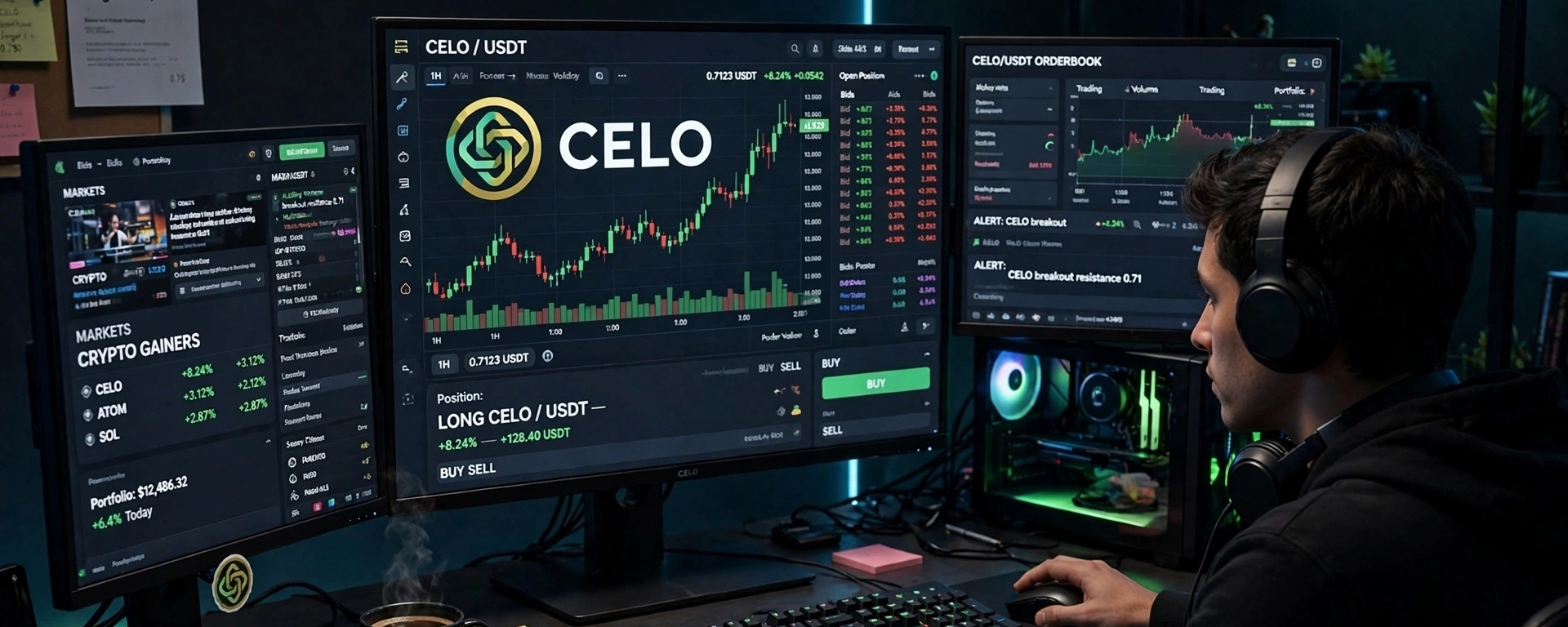
Article
CELO: The Complete Journey -From a Mobile-First Blockchain to Ethereum Layer 2Why was Celo created, what problem does it solve, and why did it move to Ethereum? Let's understand the technology behind this project.
Imagine a worker living in Africa who wants to receive money from Europe. Traditional international transfers can involve banks, intermediaries, conversion fees and waiting periods.
Now imagine sending digital dollars directly through a smartphone, with low transaction costs and without complicated banking infrastructure.
This is the kind of problem Celo was designed to address.
But Celo's story is much bigger than just sending cryptocurrency.
1. The Beginning: Why was Celo created?
Celo's journey began in 2017, with founders Rene Reinsberg, Marek Olszewski and Sep Kamvar.
At that time, blockchain technology was gaining attention, but everyday adoption remained difficult.
Bitcoin introduced decentralized digital money, while Ethereum introduced programmable blockchain applications. However, making these technologies accessible to ordinary smartphone users was still a challenge.
Celo wanted to approach this problem differently.
Its original vision was built around three important ideas:
1. Financial inclusion.
2. Mobile-first blockchain accessibility.
3. Affordable global payments.
The team wanted to create financial infrastructure that could work for people who might not have access to traditional banking services.
The main idea was simple: Your smartphone should be enough to access digital financial services.
2. 2020: Celo Mainnet officially launched
On April 22, 2020, Celo launched its mainnet as an independent Layer 1 blockchain.
It introduced a Proof of Stake consensus mechanism and an architecture designed for fast, affordable transactions.
But why was this important?
Because Celo was not trying to become another Bitcoin.
It wanted to make blockchain useful for everyday financial activities.
In June 2020, Celo introduced cUSD, also known as Celo Dollar.
This was a dollar-pegged stablecoin designed to reduce the price volatility associated with cryptocurrencies.
For example:
If someone wanted to transfer approximately $100 digitally, using a dollar-pegged stablecoin could be more predictable than sending a volatile asset like BTC.
This became one of the foundations of Celo's payment-focused ecosystem.
3. 2021–2022: Expansion beyond the US dollar
Celo understood that financial inclusion could not depend on a single currency.
Different countries have different financial systems and local currencies.
So its ecosystem expanded.
cEUR: A euro-pegged stablecoin introduced in 2021.
cREAL: A Brazilian real-pegged stablecoin introduced in 2022.
This was an important development because it showed that Celo was thinking beyond cryptocurrency trading.
Its objective was to support local-currency digital payments and financial applications.
The broader vision was to make digital money accessible across different economies.
4. Understanding Celo's Technology
Let's understand what makes Celo different.
A. Proof of Stake
Celo originally used Proof of Stake to secure its Layer 1 blockchain.
Instead of relying on energy-intensive mining, validators participate in securing the network through a staking-based consensus mechanism.
B. EVM Compatibility
Celo supports Ethereum Virtual Machine compatibility.
This allows developers familiar with Ethereum tools and smart contracts to build applications in the Celo ecosystem.
C. Low-cost transactions
Payment networks need transactions to be affordable.
Imagine paying $2 for a small digital service but spending another $3 on network fees.
That would make everyday payments impractical.
Celo focuses on keeping transaction costs low, making smaller payments more realistic.
D. Mobile-first architecture
Celo's original design emphasized smartphone accessibility, including user-friendly wallet experiences and easier payment interactions.
These features reflect its original mission of bringing financial services to more people.
5. 2023–2024: Why did Celo decide to become Ethereum Layer 2?
This is probably the most important chapter in Celo's history.
Initially, Celo operated as an independent Layer 1 blockchain.
However, operating an independent blockchain also meant maintaining its own infrastructure, security arrangements and developer ecosystem.
Celo recognized an opportunity to become more closely integrated with Ethereum.
In July 2023, the Layer 2 migration proposal was introduced.
In May 2024, the Celo community approved the transition.
But what exactly is Layer 2?
Think about Ethereum as a major financial infrastructure network.
When too many transactions compete for limited blockspace, fees and congestion can become challenges.
Layer 2 networks process transactions through additional infrastructure while connecting back to Ethereum for important security and settlement functions.
This can help expand transaction capacity without requiring every transaction to be processed directly on Ethereum Layer 1.
Why did Celo make this move?
- Stronger alignment with Ethereum.
- Access to a larger developer ecosystem.
- Better interoperability opportunities.
- Improved scalability.
- Continued focus on affordable payments.
It was a strategic decision to combine Celo's payment-focused vision with Ethereum's growing Layer 2 ecosystem.
6. March 26, 2025: Celo officially became Ethereum Layer 2
Celo completed its migration on March 26, 2025.
It adopted the Optimism OP Stack and integrated EigenDA for data availability.
This was not simply a new branding exercise.
It was a major technical transformation.
The migration preserved the existing network state and ecosystem while changing the underlying architecture.
The network also introduced important improvements:
- Approximately one-second block times.
- Ethereum interoperability.
- New bridging infrastructure.
- Fee abstraction.
- Support for paying network fees using supported ERC-20 assets.
One particularly interesting feature is fee abstraction.
Traditionally, blockchain users often need to hold a network's native token to pay transaction fees.
Celo's architecture allows supported stablecoins and other ERC-20 assets to be used for gas payments.
This reduces friction for ordinary users.
Important: Becoming an Ethereum Layer 2 does not mean Celo is identical to Ethereum. It has its own architecture, execution environment and ecosystem.
7. MiniPay: Connecting blockchain with real people
Now let's discuss one of the most interesting parts of the Celo ecosystem.
MiniPay is a stablecoin wallet developed by Opera and built on Celo.
It launched in 2023, initially targeting smartphone users in Africa.
Why is MiniPay important?
Because blockchain adoption does not happen simply because a network has good technology.
People need applications they can actually use.
MiniPay focuses on:
- Sending and receiving stablecoins.
- Mobile-friendly wallet access.
- Everyday digital payments.
- Access to third-party financial services.
- Easier onboarding.
A major November 19, 2026 update:
MiniPay announced an upgrade of its 20 million activated wallets to Privy wallet infrastructure, owned by Stripe.
According to the announcement, MiniPay had also processed over 600 million transactions across more than 70 countries.
These are wallet activation figures, not necessarily 20 million unique active users.
This is an important distinction when evaluating adoption.
8. 2026: Celo's next direction – AI Agent Payments
Here is where the story becomes particularly interesting.
AI agents are evolving beyond answering questions.
In the future, they may independently purchase services, access data, pay for APIs and complete digital tasks on behalf of their users.
But there is a problem.
How can an AI agent pay for a service without requiring a human to manually complete every transaction?
This is where stablecoin payment infrastructure becomes interesting.
Celo introduced its native x402 facilitator in July 2026.
The x402 payment standard enables internet services to request payments through HTTP payment flows.
For example:
Imagine an AI agent that needs access to a paid data API.
1. The agent requests the service.
2. The service requests payment.
3. The agent authorizes a stablecoin payment.
4. The payment is settled onchain.
5. The agent receives access to the service.
Celo is building infrastructure to support these types of transactions.
In September 2026, its x402 facilitator added support for local-currency agent payments, including Argentine Peso, Brazilian Real and Colombian Peso stablecoins.
In October 2026, Celo also launched the buy marketplace, where agents can purchase more than 700 services using supported stablecoins.
This means Celo is exploring two major financial markets:
Human-to-human payments and machine-to-machine payments.
That is a significant development to watch.
9. What is the actual utility of the CELO token?
Now comes the most important question for crypto investors.
If the Celo ecosystem grows, does that automatically mean the CELO token price will increase?
Not necessarily.
We must understand the difference between network adoption and token value.
CELO is the native asset of the network.
Its important roles include:
- Governance participation.
- Staking and validator economics.
- Network-level utility.
- Participation in the broader Celo ecosystem.
However, Celo also allows users to pay transaction fees using supported stablecoins.
This means network activity does not automatically translate into direct demand for CELO for every transaction.
Investors should therefore examine token supply, distribution, staking economics, governance and actual value capture rather than assuming that more transactions always mean a higher token price.
10. What could drive Celo's future growth?
I see five areas worth monitoring.
1. Stablecoin adoption
If more people use digital dollars and local-currency stablecoins for everyday payments, Celo could benefit from its payment-focused infrastructure.
2. MiniPay expansion
Wallet adoption, repeat usage, transaction activity and successful financial integrations will be important indicators.
3. Ethereum ecosystem
Its Layer 2 positioning gives Celo opportunities to connect with Ethereum developers, applications and liquidity.
4. AI Agent Economy
Automated payments could become an emerging use case. Celo's x402 and MPP infrastructure is positioning the ecosystem for this opportunity.
5. Global financial applications
Remittances, onchain foreign exchange, DeFi and local-currency payment applications could create additional demand for its infrastructure.
11. Risks investors should not ignore
Every blockchain project faces challenges.
Celo must compete with Ethereum Layer 2 networks, Solana and other payment-focused blockchain ecosystems.
Other risks include:
- Stablecoin regulatory uncertainty.
- Competition from traditional payment providers.
- Dependence on real-world user adoption.
- Liquidity and stablecoin issuer risks.
- Smart contract and bridge vulnerabilities.
- Token value capture and supply-related risks.
A growing ecosystem does not guarantee a profitable investment.
My Final Research Perspective
When I look at Celo's complete journey, I see a project that has evolved significantly.
It started with a mobile-first financial inclusion vision.
It launched an independent Layer 1 blockchain.
It expanded into stablecoins and local-currency payments.
It then transitioned into an Ethereum Layer 2.
Now it is exploring stablecoin payments, global financial applications and AI-agent transactions.
But I believe the most important question is not how many features a blockchain announces.
It is how many people actually use its infrastructure, how frequently they use it and whether that activity creates sustainable economic value.
The future of blockchain may not be determined only by speculation. It may also be determined by how useful the technology becomes in everyday life.
Let's discuss:
1. Can Celo become an important global stablecoin payment network?
2. Will MiniPay help bring millions of new users into Web3?
3. Can AI-agent payments become a meaningful source of blockchain activity?
4. Does Celo's Layer 2 transformation give it a stronger long-term position?
What is your opinion about Celo's future?
$CELO
{future}(CELOUSDT)
#CELO @celo
CELO: The Complete Journey -From a Mobile-First Blockchain to Ethereum Layer 2
Why was Celo created, what problem does it solve, and why did it move to Ethereum? Let's understand the technology behind this project.
Imagine a worker living in Africa who wants to receive money from Europe. Traditional international transfers can involve banks, intermediaries, conversion fees and waiting periods.
Now imagine sending digital dollars directly through a smartphone, with low transaction costs and without complicated banking infrastructure.
This is the kind of problem Celo was designed to address.
But Celo's story is much bigger than just sending cryptocurrency.
1. The Beginning: Why was Celo created?
Celo's journey began in 2017, with founders Rene Reinsberg, Marek Olszewski and Sep Kamvar.
At that time, blockchain technology was gaining attention, but everyday adoption remained difficult.
Bitcoin introduced decentralized digital money, while Ethereum introduced programmable blockchain applications. However, making these technologies accessible to ordinary smartphone users was still a challenge.
Celo wanted to approach this problem differently.
Its original vision was built around three important ideas:
1. Financial inclusion.
2. Mobile-first blockchain accessibility.
3. Affordable global payments.
The team wanted to create financial infrastructure that could work for people who might not have access to traditional banking services.
The main idea was simple: Your smartphone should be enough to access digital financial services.
2. 2020: Celo Mainnet officially launched
On April 22, 2020, Celo launched its mainnet as an independent Layer 1 blockchain.
It introduced a Proof of Stake consensus mechanism and an architecture designed for fast, affordable transactions.
But why was this important?
Because Celo was not trying to become another Bitcoin.
It wanted to make blockchain useful for everyday financial activities.
In June 2020, Celo introduced cUSD, also known as Celo Dollar.
This was a dollar-pegged stablecoin designed to reduce the price volatility associated with cryptocurrencies.
For example:
If someone wanted to transfer approximately $100 digitally, using a dollar-pegged stablecoin could be more predictable than sending a volatile asset like BTC.
This became one of the foundations of Celo's payment-focused ecosystem.
3. 2021–2022: Expansion beyond the US dollar
Celo understood that financial inclusion could not depend on a single currency.
Different countries have different financial systems and local currencies.
So its ecosystem expanded.
cEUR: A euro-pegged stablecoin introduced in 2021.
cREAL: A Brazilian real-pegged stablecoin introduced in 2022.
This was an important development because it showed that Celo was thinking beyond cryptocurrency trading.
Its objective was to support local-currency digital payments and financial applications.
The broader vision was to make digital money accessible across different economies.
4. Understanding Celo's Technology
Let's understand what makes Celo different.
A. Proof of Stake
Celo originally used Proof of Stake to secure its Layer 1 blockchain.
Instead of relying on energy-intensive mining, validators participate in securing the network through a staking-based consensus mechanism.
B. EVM Compatibility
Celo supports Ethereum Virtual Machine compatibility.
This allows developers familiar with Ethereum tools and smart contracts to build applications in the Celo ecosystem.
C. Low-cost transactions
Payment networks need transactions to be affordable.
Imagine paying $2 for a small digital service but spending another $3 on network fees.
That would make everyday payments impractical.
Celo focuses on keeping transaction costs low, making smaller payments more realistic.
D. Mobile-first architecture
Celo's original design emphasized smartphone accessibility, including user-friendly wallet experiences and easier payment interactions.
These features reflect its original mission of bringing financial services to more people.
5. 2023–2024: Why did Celo decide to become Ethereum Layer 2?
This is probably the most important chapter in Celo's history.
Initially, Celo operated as an independent Layer 1 blockchain.
However, operating an independent blockchain also meant maintaining its own infrastructure, security arrangements and developer ecosystem.
Celo recognized an opportunity to become more closely integrated with Ethereum.
In July 2023, the Layer 2 migration proposal was introduced.
In May 2024, the Celo community approved the transition.
But what exactly is Layer 2?
Think about Ethereum as a major financial infrastructure network.
When too many transactions compete for limited blockspace, fees and congestion can become challenges.
Layer 2 networks process transactions through additional infrastructure while connecting back to Ethereum for important security and settlement functions.
This can help expand transaction capacity without requiring every transaction to be processed directly on Ethereum Layer 1.
Why did Celo make this move?
- Stronger alignment with Ethereum.
- Access to a larger developer ecosystem.
- Better interoperability opportunities.
- Improved scalability.
- Continued focus on affordable payments.
It was a strategic decision to combine Celo's payment-focused vision with Ethereum's growing Layer 2 ecosystem.
6. March 26, 2025: Celo officially became Ethereum Layer 2
Celo completed its migration on March 26, 2025.
It adopted the Optimism OP Stack and integrated EigenDA for data availability.
This was not simply a new branding exercise.
It was a major technical transformation.
The migration preserved the existing network state and ecosystem while changing the underlying architecture.
The network also introduced important improvements:
- Approximately one-second block times.
- Ethereum interoperability.
- New bridging infrastructure.
- Fee abstraction.
- Support for paying network fees using supported ERC-20 assets.
One particularly interesting feature is fee abstraction.
Traditionally, blockchain users often need to hold a network's native token to pay transaction fees.
Celo's architecture allows supported stablecoins and other ERC-20 assets to be used for gas payments.
This reduces friction for ordinary users.
Important: Becoming an Ethereum Layer 2 does not mean Celo is identical to Ethereum. It has its own architecture, execution environment and ecosystem.
7. MiniPay: Connecting blockchain with real people
Now let's discuss one of the most interesting parts of the Celo ecosystem.
MiniPay is a stablecoin wallet developed by Opera and built on Celo.
It launched in 2023, initially targeting smartphone users in Africa.
Why is MiniPay important?
Because blockchain adoption does not happen simply because a network has good technology.
People need applications they can actually use.
MiniPay focuses on:
- Sending and receiving stablecoins.
- Mobile-friendly wallet access.
- Everyday digital payments.
- Access to third-party financial services.
- Easier onboarding.
A major November 19, 2026 update:
MiniPay announced an upgrade of its 20 million activated wallets to Privy wallet infrastructure, owned by Stripe.
According to the announcement, MiniPay had also processed over 600 million transactions across more than 70 countries.
These are wallet activation figures, not necessarily 20 million unique active users.
This is an important distinction when evaluating adoption.
8. 2026: Celo's next direction – AI Agent Payments
Here is where the story becomes particularly interesting.
AI agents are evolving beyond answering questions.
In the future, they may independently purchase services, access data, pay for APIs and complete digital tasks on behalf of their users.
But there is a problem.
How can an AI agent pay for a service without requiring a human to manually complete every transaction?
This is where stablecoin payment infrastructure becomes interesting.
Celo introduced its native x402 facilitator in July 2026.
The x402 payment standard enables internet services to request payments through HTTP payment flows.
For example:
Imagine an AI agent that needs access to a paid data API.
1. The agent requests the service.
2. The service requests payment.
3. The agent authorizes a stablecoin payment.
4. The payment is settled onchain.
5. The agent receives access to the service.
Celo is building infrastructure to support these types of transactions.
In September 2026, its x402 facilitator added support for local-currency agent payments, including Argentine Peso, Brazilian Real and Colombian Peso stablecoins.
In October 2026, Celo also launched the buy marketplace, where agents can purchase more than 700 services using supported stablecoins.
This means Celo is exploring two major financial markets:
Human-to-human payments and machine-to-machine payments.
That is a significant development to watch.
9. What is the actual utility of the CELO token?
Now comes the most important question for crypto investors.
If the Celo ecosystem grows, does that automatically mean the CELO token price will increase?
Not necessarily.
We must understand the difference between network adoption and token value.
CELO is the native asset of the network.
Its important roles include:
- Governance participation.
- Staking and validator economics.
- Network-level utility.
- Participation in the broader Celo ecosystem.
However, Celo also allows users to pay transaction fees using supported stablecoins.
This means network activity does not automatically translate into direct demand for CELO for every transaction.
Investors should therefore examine token supply, distribution, staking economics, governance and actual value capture rather than assuming that more transactions always mean a higher token price.
10. What could drive Celo's future growth?
I see five areas worth monitoring.
1. Stablecoin adoption
If more people use digital dollars and local-currency stablecoins for everyday payments, Celo could benefit from its payment-focused infrastructure.
2. MiniPay expansion
Wallet adoption, repeat usage, transaction activity and successful financial integrations will be important indicators.
3. Ethereum ecosystem
Its Layer 2 positioning gives Celo opportunities to connect with Ethereum developers, applications and liquidity.
4. AI Agent Economy
Automated payments could become an emerging use case. Celo's x402 and MPP infrastructure is positioning the ecosystem for this opportunity.
5. Global financial applications
Remittances, onchain foreign exchange, DeFi and local-currency payment applications could create additional demand for its infrastructure.
11. Risks investors should not ignore
Every blockchain project faces challenges.
Celo must compete with Ethereum Layer 2 networks, Solana and other payment-focused blockchain ecosystems.
Other risks include:
- Stablecoin regulatory uncertainty.
- Competition from traditional payment providers.
- Dependence on real-world user adoption.
- Liquidity and stablecoin issuer risks.
- Smart contract and bridge vulnerabilities.
- Token value capture and supply-related risks.
A growing ecosystem does not guarantee a profitable investment.
My Final Research Perspective
When I look at Celo's complete journey, I see a project that has evolved significantly.
It started with a mobile-first financial inclusion vision.
It launched an independent Layer 1 blockchain.
It expanded into stablecoins and local-currency payments.
It then transitioned into an Ethereum Layer 2.
Now it is exploring stablecoin payments, global financial applications and AI-agent transactions.
But I believe the most important question is not how many features a blockchain announces.
It is how many people actually use its infrastructure, how frequently they use it and whether that activity creates sustainable economic value.
The future of blockchain may not be determined only by speculation. It may also be determined by how useful the technology becomes in everyday life.
Let's discuss:
1. Can Celo become an important global stablecoin payment network?
2. Will MiniPay help bring millions of new users into Web3?
3. Can AI-agent payments become a meaningful source of blockchain activity?
4. Does Celo's Layer 2 transformation give it a stronger long-term position?
What is your opinion about Celo's future?
$CELO
#CELO @celo
Agusting_交易40:
El post repasa la evolución de CELO: nació como una blockchain enfocada en pagos móviles, inclusión financiera y stablecoins locales. En 2025 migró de una Layer 1 independiente a una Layer 2 de Ethereum usando OP Stack, buscando mayor interoperabilidad y escalabilidad.
30
9
34
1.1k

·
--
Verified
Article
The Complete Journey of Celo ($CELO): From a Mobile-First Vision to Ethereum Layer 2Every major blockchain project starts with a vision. But Celo started with a particularly important question:
What if anyone with a smartphone could access affordable financial services?
Celo was created with the ambition of making financial services more accessible, especially for people underserved by traditional banking systems.
Let's explore the complete journey of Celo, from its early vision to its evolution into an Ethereum Layer 2 network.
1. The Beginning: Celo's Original Vision (2017)
Celo's journey began in 2017.
The project was co-founded by Rene Reinsberg, Marek Olszewski, and Sep Kamvar.
Its original vision was built around three important ideas:
Financial Inclusion.Mobile-First Blockchain Accessibility.Affordable Global Payments.
The team wanted to create financial infrastructure that could work for people who might not have access to traditional banking services.
The main idea was simple:
Your smartphone should be enough to access digital financial services.
Instead of building technology only for crypto enthusiasts, Celo wanted to make blockchain useful for everyday financial activities.
2. April 22, 2020: Celo Mainnet Officially Launched
On April 22, 2020, Celo launched its mainnet as an independent Layer 1 blockchain.
It introduced a Proof of Stake consensus mechanism and an architecture designed for fast, affordable transactions.
But why was this important?
Because Celo was not trying to become another Bitcoin.
Its vision was different: to build a blockchain infrastructure focused on accessible payments, stablecoins, and real-world financial applications.
The mainnet launch was a major milestone in turning that vision into reality.
3. June 2020: The Launch of cUSD
One of the most important milestones came in June 2020 with the introduction of Celo Dollar (cUSD).
cUSD was designed as a dollar-pegged stablecoin that could make digital-dollar transactions more accessible.
This was important because users could interact with a digital dollar without having to deal with the same price volatility associated with cryptocurrencies like Bitcoin.
It helped establish Celo's focus on practical financial applications.
4. 2021: Expansion of the Stablecoin Ecosystem
Celo continued expanding its stablecoin ecosystem.
In April 2021, cEUR, a euro-denominated stablecoin, was introduced.
The same period also saw Deutsche Telekom's T-Systems MMS joining the network as a validator.
This represented an important step in expanding Celo's international ecosystem and infrastructure participation.
5. 2022: cREAL and More Regional Use Cases
In January 2022, Celo introduced cREAL, a Brazilian real-denominated stablecoin.
The goal was to support more local-currency financial applications.
This development demonstrated Celo's ambition to go beyond dollar-based digital payments and support financial use cases across different regions.
6. 2023: A New Direction Towards Ethereum
In July 2023, cLabs proposed migrating Celo from an independent Layer 1 blockchain to an Ethereum Layer 2 network.
Why?
Because the blockchain industry was evolving.
Ethereum had developed a powerful ecosystem of developers, applications, liquidity and infrastructure.
Celo saw an opportunity to combine its mobile-first financial vision with Ethereum's security and ecosystem advantages.
This proposal marked the beginning of a major transformation.
7. 2024: The Layer 2 Transition Takes Shape
In 2024, the Celo community moved forward with the Layer 2 transition.
The community approved the move, and the technical architecture was developed around the OP Stack.
EigenDA was selected to provide data availability.
The objective was to improve scalability, interoperability, and alignment with Ethereum while maintaining Celo's focus on affordable transactions and mobile accessibility.
8. March 26, 2025: Celo Becomes an Ethereum Layer 2
This was one of the biggest milestones in Celo's history.
On March 26, 2025, Celo officially migrated from an independent Layer 1 blockchain to an Ethereum Layer 2 network.
The migration used the OP Stack and EigenDA.
Importantly, the migration preserved the existing network state and its transaction history
This meant Celo did not have to abandon its previous ecosystem to begin a new chapter.
Instead, it evolved its infrastructure while maintaining its original mission.
Celo was no longer an independent Layer 1. It had become part of Ethereum's Layer 2 ecosystem.
9. 2025–2026: Growing Focus on Payments and Stablecoins
After its Layer 2 migration, Celo continued focusing on real-world financial applications.
Its ecosystem includes:
Stablecoin payments.Decentralized Finance (DeFi).Mobile-first financial applications.Onchain foreign exchange.Developer infrastructure.Global payment solutions.
One notable application is MiniPay, a self-custodial stablecoin wallet developed by Opera.
MiniPay has helped bring stablecoin-based financial experiences to mobile users in multiple markets.
Celo's broader vision remains focused on making digital financial services more accessible....
10. Understanding the $CELO Token
Now let's understand the role of the CELO token.
CELO is the native cryptoasset of the Celo ecosystem.
It has an important role in the network's economic and governance structure.
Some of its key functions include:
1. Governance
CELO holders can participate in network governance through the applicable governance mechanisms.
2. Staking and Network Security
CELO has played an important role in staking and validator economics. Following the Layer 2 migration, the network's architecture and validator roles evolved.
3. Network Fees
CELO can be used for transaction fees. Celo also supports fee abstraction, allowing users to pay eligible transaction fees using supported stablecoins and other approved assets.
Important: CELO is a volatile cryptoasset. It is not the same as cUSD or other stablecoins
11. What Makes Celo Different?
Celo's identity is built around several important ideas:
Mobile-first blockchain accessibility.Affordable transactions.Stablecoin-focused financial applications.Ethereum compatibility.Global payments.An ecosystem designed for real-world usage.
Rather than focusing exclusively on cryptocurrency trading, Celo aims to build infrastructure that developers and users can apply to everyday financial activities.
12. What's Next for Celo?
Celo's transition to Ethereum Layer 2 represents a major chapter in its evolution.
Its future development will depend on ecosystem adoption, developer activity, stablecoin usage, network infrastructure, and the ability to deliver useful financial applications
The bigger question is:
Can Celo help make blockchain-based financial services accessible to billions of people?
Only time and real-world adoption will tell.
Beyond Payments: 4 Unique Real-World Use Cases of Celo
Celo's potential goes beyond sending stablecoins and making mobile payments.
Its infrastructure can support financial applications, decentralized markets, digital identity, and global business operations.
Here are four additional use cases that demonstrate how Celo can connect blockchain technology with real-world economic activity.
1. 🌐 Cross-Border Business Settlements and Freelancer Payments
Imagine a freelancer in India working for a company in Europe.
Traditionally, receiving international payments may involve multiple intermediaries, currency conversion, banking delays, and additional charges.
Blockchain-based stablecoin infrastructure can offer another way to settle payments.
With Celo supporting assets such as USDT and USDC, businesses and freelancers can potentially use onchain transfers to move digital dollars across borders
Real-world example:
A software developer in India completes a project for a client in the United States.
Instead of relying entirely on traditional international payment channels, the client can pay an agreed amount in a supported stablecoin.
The developer can then use an appropriate exchange or regulated on-ramp to convert the funds into INR.
Why it matters:
Global payment accessibility.
Faster onchain settlement.Reduced dependence on multiple payment intermediaries.
Opportunities for international freelancers and small businesses.
Actual conversion, withdrawal, and regulatory requirements still depend on the user's country and service providers.
2. 🏦 DeFi Lending and Borrowing: Turning Digital Assets into Financial Tools
Another important use case is decentralized finance.
Celo supports DeFi applications where users can supply eligible digital assets to lending markets and potentially earn interest.
Users can also borrow against eligible collateral, subject to protocol rules.
Real-world example:
Imagine a user holding USDC who wants to access short-term liquidity without immediately selling their assets.
Through a supported DeFi lending market such as Aave or Morpho, the user may be able to supply assets or borrow against eligible collateral.
This creates opportunities for:
Onchain lending.Collateralized borrowing.
Stablecoin liquidity.
Automated financial markets.
Why it matters:
Celo can provide access to financial applications without requiring every transaction to pass through a traditional banking intermediary.
However, DeFi involves liquidation, smart-contract, liquidity, and market risks.
3. 🪪 Digital Identity and Human Verification
A less-discussed but interesting area is digital identity.
As blockchain applications grow, one important challenge is determining whether an account represents a unique human without exposing unnecessary personal information.
Celo's ecosystem includes Self, a project focused on privacy-preserving identity verification and proof of personhood.
Real-world example:
Imagine an online platform wants to distribute a limited community reward.
Without identity protections, a single person might create multiple accounts to claim the reward repeatedly.
Privacy-preserving verification can help the platform check eligibility while reducing the need to publicly reveal sensitive personal information.
Potential applications:
Community reward distribution.Sybil-resistant participation.
Human verification.Access to selected financial applications.More trustworthy digital communities.
This is particularly interesting for applications that need to distinguish real participants from automated or duplicate accounts.
4. 🔄 Onchain Foreign Exchange and Multi-Currency Financial Markets
Global businesses often deal with multiple currencies.
A company operating in different countries may need to manage payments in USD, EUR, BRL, or other local currencies.
Celo's Mento ecosystem provides infrastructure for blockchain-based currency markets and stable assets.
Real-world example:
Imagine a business receiving payments in USD but needing to settle some expenses in a euro-denominated asset.
Onchain foreign exchange infrastructure can potentially allow the business to exchange supported digital currencies through decentralized liquidity markets.
Why it matters:
Access to multiple currency markets.
Programmable currency exchange.Onchain settlement.
Opportunities for global businesses and financial applications.
Actual exchange rates, liquidity, availability, and market risks still apply.
📊 Understanding Demand for $CELO
Now comes one of the most important parts of the Celo ecosystem.
A blockchain can have millions of transactions, but how does that activity translate into demand for its native token?
To understand $CELO, we need to examine its utility and economic mechanisms.
1. Governance Demand
CELO is the native governance token of the network.
Token holders can lock CELO and participate in onchain governance.
They can vote on protocol upgrades, economic parameters, and ecosystem decisions.
Example:
Suppose the Celo community proposes an important network upgrade.
Eligible locked CELO holders can participate in the governance process.
This creates a reason for some participants to hold and lock CELO rather than simply trade it.
2. Network Utility and Transaction Fees
CELO is a native network asset and can be used for transaction fees.
However, one important feature of Celo is fee abstraction.
Users can also pay transaction fees using supported stablecoins and other approved gas currencies.
Why is this important?
A new user does not necessarily need to purchase CELO before interacting with the network.
This can reduce onboarding friction and make the ecosystem more accessible.
At the same time, network activity can contribute to the broader economic model of CELO through protocol revenue mechanisms.
3. Revenue-Driven CELO Buybacks
One of the most interesting developments is the CELOccelerate tokenomics initiative.
The initiative introduced an economic model under which eligible network revenue is directed toward the DAO-governed Community Fund.
Revenue received in assets such as USDT and USDC can be converted into CELO through programmatic market purchases.
Example:
Imagine the network collects eligible fees in stablecoins.
Under the approved economic framework, those revenues can be used to acquire CELO in the open market.
The purchased CELO is directed to the Community Fund.
Governance can then decide whether to burn the tokens or use them for ecosystem development.
This creates a potential connection between real network usage and CELO market demand.
Importantly, this is not the same as an automatic guaranteed price increase.
4. Staking and Network Participation
CELO also plays a role in network participation and economic incentives.
Following the Ethereum Layer 2 migration, its validator and infrastructure arrangements evolved.
Locked CELO holders can participate in the election of community RPC providers and receive eligible epoch rewards for voting with locked tokens.
This creates another economic reason for participants to hold and lock CELO.
$ETH CELO Token Supply: Understanding the Numbers
Supply is another important part of tokenomics.
According to the published token information:
Maximum supply: 1,000,000,000 CELO.Total supply: 1,000,000,000 CELO.Circulating supply: Approximately 610 million CELO in the November 2026
The exact circulating amount changes over time.
Fixed Maximum Supply
CELO has a maximum supply of 1 billion tokens.
This means the protocol has a defined upper limit on its token supply.
However, fixed maximum supply does not automatically mean that all tokens are circulating or that the circulating supply cannot change.
What Can Influence Available Supply?
Three factors are important:
Token distribution and vesting: Previously allocated tokens can enter circulation as applicable vesting conditions are completed.
Network rewards: Epoch rewards distribute CELO to eligible network participants according to protocol parameters.
Token burns: If governance approves a burn, the burned tokens are permanently removed from the available supply.
Therefore, investors should examine circulating supply, token distribution, vesting schedules, and governance decisions rather than looking only at the maximum supply.
⚖️ Demand vs Supply: What Could Influence $CELO?
The relationship between demand and supply is important when evaluating any cryptoasset.
Potential demand drivers
Growth in DeFi activity.More developers building on Celo.
Governance participation and locked CELO.Network revenue and programmatic CELO purchases
Increased ecosystem adoption.
Potential supply-side pressures
New token rewards entering circulation.Vesting and token unlocks.Existing holders selling their tokens.Changes in network reward parameters.
What Does This Mean for the Future?
If real-world usage increases, network revenue grows, and the approved economic mechanisms continue operating effectively, CELO could potentially benefit from stronger economic demand.
However, increased blockchain usage does not guarantee increased token prices.
Market liquidity, investor sentiment, token distribution, competition, and broader crypto market conditions also matter.
🔥 Final Perspective: Celo's Real Value Proposition
Celo's story is not just about a cryptocurrency.
It is about building financial infrastructure that can connect:
Global payments.
Decentralized lending.Digital identity.
Multi-currency markets.Stablecoin infrastructure.
Ethereum-based applications.
Its long-term success will depend on whether these applications generate sustainable real-world demand.
The most important question is not how many tokens a project can distribute, but how much real economic activity its infrastructure can SUPPORT
Final Thoughts
From a mobile-first f#Tokenomics ion in 2017 to an Ethereum Layer 2 network in 2025, Celo has undergone a significant transformation.
Its journey is not simply about launching another cryptocurrency.
It is about exploring how blockchain infrastructure can make digital payments, stablecoins, and financial services more accessible.
The story of Celo is still being written.
🚀 Explore the ecosystem. Understand the technology. Follow the journey of $CELO.
#CELO #CeloEcosystem #NvidiaLoses$2.7TrillionInMonthAndAHalf
The Complete Journey of Celo ($CELO): From a Mobile-First Vision to Ethereum Layer 2
Every major blockchain project starts with a vision. But Celo started with a particularly important question:
What if anyone with a smartphone could access affordable financial services?
Celo was created with the ambition of making financial services more accessible, especially for people underserved by traditional banking systems.
Let's explore the complete journey of Celo, from its early vision to its evolution into an Ethereum Layer 2 network.
1. The Beginning: Celo's Original Vision (2017)
Celo's journey began in 2017.
The project was co-founded by Rene Reinsberg, Marek Olszewski, and Sep Kamvar.
Its original vision was built around three important ideas:
Financial Inclusion.Mobile-First Blockchain Accessibility.Affordable Global Payments.
The team wanted to create financial infrastructure that could work for people who might not have access to traditional banking services.
The main idea was simple:
Your smartphone should be enough to access digital financial services.
Instead of building technology only for crypto enthusiasts, Celo wanted to make blockchain useful for everyday financial activities.
2. April 22, 2020: Celo Mainnet Officially Launched
On April 22, 2020, Celo launched its mainnet as an independent Layer 1 blockchain.
It introduced a Proof of Stake consensus mechanism and an architecture designed for fast, affordable transactions.
But why was this important?
Because Celo was not trying to become another Bitcoin.
Its vision was different: to build a blockchain infrastructure focused on accessible payments, stablecoins, and real-world financial applications.
The mainnet launch was a major milestone in turning that vision into reality.
3. June 2020: The Launch of cUSD
One of the most important milestones came in June 2020 with the introduction of Celo Dollar (cUSD).
cUSD was designed as a dollar-pegged stablecoin that could make digital-dollar transactions more accessible.
This was important because users could interact with a digital dollar without having to deal with the same price volatility associated with cryptocurrencies like Bitcoin.
It helped establish Celo's focus on practical financial applications.
4. 2021: Expansion of the Stablecoin Ecosystem
Celo continued expanding its stablecoin ecosystem.
In April 2021, cEUR, a euro-denominated stablecoin, was introduced.
The same period also saw Deutsche Telekom's T-Systems MMS joining the network as a validator.
This represented an important step in expanding Celo's international ecosystem and infrastructure participation.
5. 2022: cREAL and More Regional Use Cases
In January 2022, Celo introduced cREAL, a Brazilian real-denominated stablecoin.
The goal was to support more local-currency financial applications.
This development demonstrated Celo's ambition to go beyond dollar-based digital payments and support financial use cases across different regions.
6. 2023: A New Direction Towards Ethereum
In July 2023, cLabs proposed migrating Celo from an independent Layer 1 blockchain to an Ethereum Layer 2 network.
Why?
Because the blockchain industry was evolving.
Ethereum had developed a powerful ecosystem of developers, applications, liquidity and infrastructure.
Celo saw an opportunity to combine its mobile-first financial vision with Ethereum's security and ecosystem advantages.
This proposal marked the beginning of a major transformation.
7. 2024: The Layer 2 Transition Takes Shape
In 2024, the Celo community moved forward with the Layer 2 transition.
The community approved the move, and the technical architecture was developed around the OP Stack.
EigenDA was selected to provide data availability.
The objective was to improve scalability, interoperability, and alignment with Ethereum while maintaining Celo's focus on affordable transactions and mobile accessibility.
8. March 26, 2025: Celo Becomes an Ethereum Layer 2
This was one of the biggest milestones in Celo's history.
On March 26, 2025, Celo officially migrated from an independent Layer 1 blockchain to an Ethereum Layer 2 network.
The migration used the OP Stack and EigenDA.
Importantly, the migration preserved the existing network state and its transaction history
This meant Celo did not have to abandon its previous ecosystem to begin a new chapter.
Instead, it evolved its infrastructure while maintaining its original mission.
Celo was no longer an independent Layer 1. It had become part of Ethereum's Layer 2 ecosystem.
9. 2025–2026: Growing Focus on Payments and Stablecoins
After its Layer 2 migration, Celo continued focusing on real-world financial applications.
Its ecosystem includes:
Stablecoin payments.Decentralized Finance (DeFi).Mobile-first financial applications.Onchain foreign exchange.Developer infrastructure.Global payment solutions.
One notable application is MiniPay, a self-custodial stablecoin wallet developed by Opera.
MiniPay has helped bring stablecoin-based financial experiences to mobile users in multiple markets.
Celo's broader vision remains focused on making digital financial services more accessible....
10. Understanding the $CELO Token
Now let's understand the role of the CELO token.
CELO is the native cryptoasset of the Celo ecosystem.
It has an important role in the network's economic and governance structure.
Some of its key functions include:
1. Governance
CELO holders can participate in network governance through the applicable governance mechanisms.
2. Staking and Network Security
CELO has played an important role in staking and validator economics. Following the Layer 2 migration, the network's architecture and validator roles evolved.
3. Network Fees
CELO can be used for transaction fees. Celo also supports fee abstraction, allowing users to pay eligible transaction fees using supported stablecoins and other approved assets.
Important: CELO is a volatile cryptoasset. It is not the same as cUSD or other stablecoins
11. What Makes Celo Different?
Celo's identity is built around several important ideas:
Mobile-first blockchain accessibility.Affordable transactions.Stablecoin-focused financial applications.Ethereum compatibility.Global payments.An ecosystem designed for real-world usage.
Rather than focusing exclusively on cryptocurrency trading, Celo aims to build infrastructure that developers and users can apply to everyday financial activities.
12. What's Next for Celo?
Celo's transition to Ethereum Layer 2 represents a major chapter in its evolution.
Its future development will depend on ecosystem adoption, developer activity, stablecoin usage, network infrastructure, and the ability to deliver useful financial applications
The bigger question is:
Can Celo help make blockchain-based financial services accessible to billions of people?
Only time and real-world adoption will tell.
Beyond Payments: 4 Unique Real-World Use Cases of Celo
Celo's potential goes beyond sending stablecoins and making mobile payments.
Its infrastructure can support financial applications, decentralized markets, digital identity, and global business operations.
Here are four additional use cases that demonstrate how Celo can connect blockchain technology with real-world economic activity.
1. 🌐 Cross-Border Business Settlements and Freelancer Payments
Imagine a freelancer in India working for a company in Europe.
Traditionally, receiving international payments may involve multiple intermediaries, currency conversion, banking delays, and additional charges.
Blockchain-based stablecoin infrastructure can offer another way to settle payments.
With Celo supporting assets such as USDT and USDC, businesses and freelancers can potentially use onchain transfers to move digital dollars across borders
Real-world example:
A software developer in India completes a project for a client in the United States.
Instead of relying entirely on traditional international payment channels, the client can pay an agreed amount in a supported stablecoin.
The developer can then use an appropriate exchange or regulated on-ramp to convert the funds into INR.
Why it matters:
Global payment accessibility.
Faster onchain settlement.Reduced dependence on multiple payment intermediaries.
Opportunities for international freelancers and small businesses.
Actual conversion, withdrawal, and regulatory requirements still depend on the user's country and service providers.
2. 🏦 DeFi Lending and Borrowing: Turning Digital Assets into Financial Tools
Another important use case is decentralized finance.
Celo supports DeFi applications where users can supply eligible digital assets to lending markets and potentially earn interest.
Users can also borrow against eligible collateral, subject to protocol rules.
Real-world example:
Imagine a user holding USDC who wants to access short-term liquidity without immediately selling their assets.
Through a supported DeFi lending market such as Aave or Morpho, the user may be able to supply assets or borrow against eligible collateral.
This creates opportunities for:
Onchain lending.Collateralized borrowing.
Stablecoin liquidity.
Automated financial markets.
Why it matters:
Celo can provide access to financial applications without requiring every transaction to pass through a traditional banking intermediary.
However, DeFi involves liquidation, smart-contract, liquidity, and market risks.
3. 🪪 Digital Identity and Human Verification
A less-discussed but interesting area is digital identity.
As blockchain applications grow, one important challenge is determining whether an account represents a unique human without exposing unnecessary personal information.
Celo's ecosystem includes Self, a project focused on privacy-preserving identity verification and proof of personhood.
Real-world example:
Imagine an online platform wants to distribute a limited community reward.
Without identity protections, a single person might create multiple accounts to claim the reward repeatedly.
Privacy-preserving verification can help the platform check eligibility while reducing the need to publicly reveal sensitive personal information.
Potential applications:
Community reward distribution.Sybil-resistant participation.
Human verification.Access to selected financial applications.More trustworthy digital communities.
This is particularly interesting for applications that need to distinguish real participants from automated or duplicate accounts.
4. 🔄 Onchain Foreign Exchange and Multi-Currency Financial Markets
Global businesses often deal with multiple currencies.
A company operating in different countries may need to manage payments in USD, EUR, BRL, or other local currencies.
Celo's Mento ecosystem provides infrastructure for blockchain-based currency markets and stable assets.
Real-world example:
Imagine a business receiving payments in USD but needing to settle some expenses in a euro-denominated asset.
Onchain foreign exchange infrastructure can potentially allow the business to exchange supported digital currencies through decentralized liquidity markets.
Why it matters:
Access to multiple currency markets.
Programmable currency exchange.Onchain settlement.
Opportunities for global businesses and financial applications.
Actual exchange rates, liquidity, availability, and market risks still apply.
📊 Understanding Demand for $CELO
Now comes one of the most important parts of the Celo ecosystem.
A blockchain can have millions of transactions, but how does that activity translate into demand for its native token?
To understand $CELO , we need to examine its utility and economic mechanisms.
1. Governance Demand
CELO is the native governance token of the network.
Token holders can lock CELO and participate in onchain governance.
They can vote on protocol upgrades, economic parameters, and ecosystem decisions.
Example:
Suppose the Celo community proposes an important network upgrade.
Eligible locked CELO holders can participate in the governance process.
This creates a reason for some participants to hold and lock CELO rather than simply trade it.
2. Network Utility and Transaction Fees
CELO is a native network asset and can be used for transaction fees.
However, one important feature of Celo is fee abstraction.
Users can also pay transaction fees using supported stablecoins and other approved gas currencies.
Why is this important?
A new user does not necessarily need to purchase CELO before interacting with the network.
This can reduce onboarding friction and make the ecosystem more accessible.
At the same time, network activity can contribute to the broader economic model of CELO through protocol revenue mechanisms.
3. Revenue-Driven CELO Buybacks
One of the most interesting developments is the CELOccelerate tokenomics initiative.
The initiative introduced an economic model under which eligible network revenue is directed toward the DAO-governed Community Fund.
Revenue received in assets such as USDT and USDC can be converted into CELO through programmatic market purchases.
Example:
Imagine the network collects eligible fees in stablecoins.
Under the approved economic framework, those revenues can be used to acquire CELO in the open market.
The purchased CELO is directed to the Community Fund.
Governance can then decide whether to burn the tokens or use them for ecosystem development.
This creates a potential connection between real network usage and CELO market demand.
Importantly, this is not the same as an automatic guaranteed price increase.
4. Staking and Network Participation
CELO also plays a role in network participation and economic incentives.
Following the Ethereum Layer 2 migration, its validator and infrastructure arrangements evolved.
Locked CELO holders can participate in the election of community RPC providers and receive eligible epoch rewards for voting with locked tokens.
This creates another economic reason for participants to hold and lock CELO.
$ETH CELO Token Supply: Understanding the Numbers
Supply is another important part of tokenomics.
According to the published token information:
Maximum supply: 1,000,000,000 CELO.Total supply: 1,000,000,000 CELO.Circulating supply: Approximately 610 million CELO in the November 2026
The exact circulating amount changes over time.
Fixed Maximum Supply
CELO has a maximum supply of 1 billion tokens.
This means the protocol has a defined upper limit on its token supply.
However, fixed maximum supply does not automatically mean that all tokens are circulating or that the circulating supply cannot change.
What Can Influence Available Supply?
Three factors are important:
Token distribution and vesting: Previously allocated tokens can enter circulation as applicable vesting conditions are completed.
Network rewards: Epoch rewards distribute CELO to eligible network participants according to protocol parameters.
Token burns: If governance approves a burn, the burned tokens are permanently removed from the available supply.
Therefore, investors should examine circulating supply, token distribution, vesting schedules, and governance decisions rather than looking only at the maximum supply.
⚖️ Demand vs Supply: What Could Influence $CELO ?
The relationship between demand and supply is important when evaluating any cryptoasset.
Potential demand drivers
Growth in DeFi activity.More developers building on Celo.
Governance participation and locked CELO.Network revenue and programmatic CELO purchases
Increased ecosystem adoption.
Potential supply-side pressures
New token rewards entering circulation.Vesting and token unlocks.Existing holders selling their tokens.Changes in network reward parameters.
What Does This Mean for the Future?
If real-world usage increases, network revenue grows, and the approved economic mechanisms continue operating effectively, CELO could potentially benefit from stronger economic demand.
However, increased blockchain usage does not guarantee increased token prices.
Market liquidity, investor sentiment, token distribution, competition, and broader crypto market conditions also matter.
🔥 Final Perspective: Celo's Real Value Proposition
Celo's story is not just about a cryptocurrency.
It is about building financial infrastructure that can connect:
Global payments.
Decentralized lending.Digital identity.
Multi-currency markets.Stablecoin infrastructure.
Ethereum-based applications.
Its long-term success will depend on whether these applications generate sustainable real-world demand.
The most important question is not how many tokens a project can distribute, but how much real economic activity its infrastructure can SUPPORT
Final Thoughts
From a mobile-first f#Tokenomics ion in 2017 to an Ethereum Layer 2 network in 2025, Celo has undergone a significant transformation.
Its journey is not simply about launching another cryptocurrency.
It is about exploring how blockchain infrastructure can make digital payments, stablecoins, and financial services more accessible.
The story of Celo is still being written.
🚀 Explore the ecosystem. Understand the technology. Follow the journey of $CELO .
#CELO #CeloEcosystem #NvidiaLoses$2.7TrillionInMonthAndAHalf
Tomas Pforr:
Good rundown, especially the tokenomics section. The tension for me is fee abstraction — if users can pay gas in stables, they never need to hold CELO, so the buyback funded by real network revenue has to do the heavy lifting. The L2 move buys Ethereum security, but the demand case now rests on usage actually converting into revenue, not on the chain itself.
6
6
25
2.3k
Log in to explore more content
Join global crypto users on Binance Square
⚡️ Get latest and useful information about crypto.
💬 Trusted by the world’s largest crypto exchange.
👍 Discover real insights from verified creators.
Email / Phone number
Trending Topics
1
#NVIDIAReinstatesJensenHuangasCEO
23,654 views
573 Discussing
2
#WillMarketsStageAThanksgivingReliefRally?
125,748 views
1,676 Discussing
3
#WillOctCorePCEShiftFedHikeExpectations?
47,471 views
700 Discussing
4
#BitcoinEndsRecord17DayStreakOfLowerHighs
5,068 views
191 Discussing
5
#TradersPriceOut50bpDecemberFedHike
4,335 views
123 Discussing
6
#EvolveAtBinanceBlockchainWeek
105,675 views
962 Discussing
7
#TrumpBackedAmericanBitcoinRaisesHoldingsToOver8500BTC
810 views
29 Discussing
8
#MuskWarnsOfAICashCrunch
57,970 views
680 Discussing
9
#TradFiForBeginners
1.1M views
5,973 Discussing
10
#SkyPSMUSDCLiquidityReboundsTo$1.77B
454 views
9 Discussing