

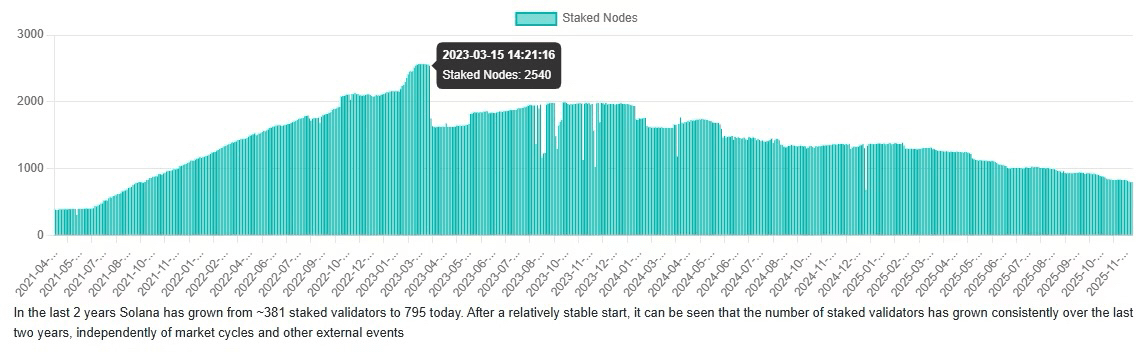
The number of active validators in Solana has sharply declined, dropping from over 2500 in March 2023 to nearly 800, representing a decrease of 68%.
One perspective claims that this decline is a "healthy trimming" that removes Sybil nodes and improves true decentralization and network quality.
An opposing viewpoint, supported by infrastructure teams, suggests that the leavers are genuine operators forced to exit due to high hardware and bandwidth costs and changing staking rewards.
The real impact on decentralization depends on the distribution of the stake among the remaining 800 validators, which is the key metric for controlling the network and its resilience.
The number of validators on the Solana network has sharply declined over the past three years. In March 2023, the blockchain had over 2,500 active validators. Today, this number is approaching 800, representing a sharp decline of about 68%. Validators play a crucial role in keeping Solana operational, confirming transactions and signing blocks, and they also contribute to securing the network against attacks. A decrease in the number of validators means there are fewer independent devices to secure the network, and this fact alone has sparked new debate within the Solana community. $SOL
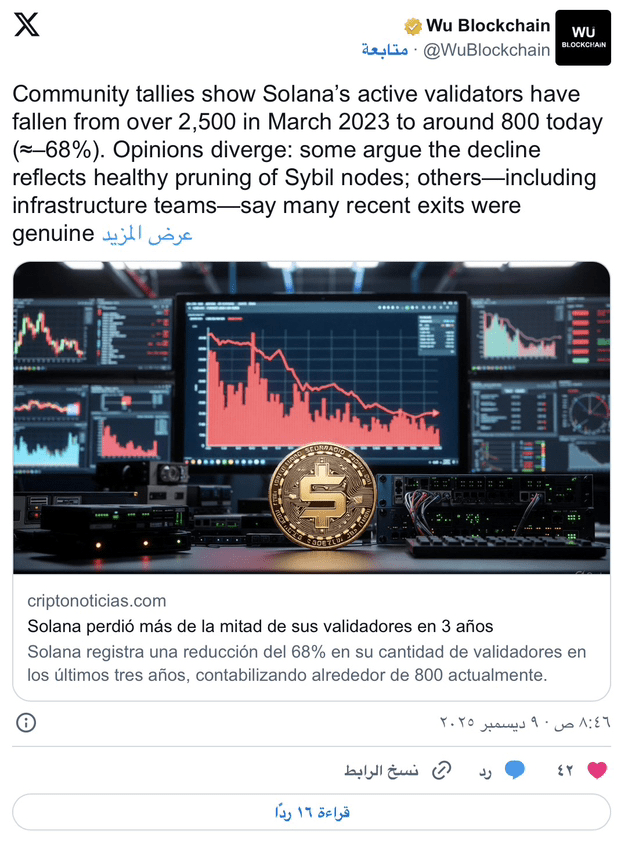
Community tracker data and external dashboards indicate that the decline occurred in phases. Some exits came during market downturns, while others coincided with changes in staking rewards and operational costs. Now, with the number stabilizing around 800, the network faces tough questions: Is this just a cleanup phase or a warning sign?
Some see a "healthy pruning" of Sybil nodes
Not everyone views the decline as a negative. Some community members see the downturn as a reflection of quality over quantity. They believe that many of the validators who left were Sybil nodes. Sybil nodes appear as multiple operators but are actually controlled by a single entity, and these structures can distort decentralization and inflate numbers without adding real independence.
From this perspective, the loss of Sybil nodes makes the network stronger. Proponents say that 800 reliable operators are better than 3,000 questionable ones. They add that trust, not numbers, is what defines decentralization. They also point out that smaller, more serious validators often hold more meaningful stakes and responsibilities. If the exits are purging the network of illusory diversity, the network may be more resilient now. This view has gained traction on social media, where the decline is presented as a necessary reset.
Infrastructure teams say that many of the exits were from real operators $SOL
Conversely, others reject the Sybil nodes narrative altogether. Developers close to the Solana validator layer say that most of the exits were from real teams. For example, the Layer 33 group, which builds operational tools for Solana nodes, shared that they personally know many teams that shut down. According to them, most were not Sybil, but real operators who could no longer afford the costs.
Running a Solana node is expensive. Hardware requirements remain high, and bandwidth costs accumulate. Staking rewards have also changed over time, which has quickly weakened profit margins for small validators. Some teams faced technical pressures, with frequent software updates and strict performance targets, making long-term operations difficult. Over time, many simply chose to exit. This presents a different picture, as the decline may reflect economic pressures on the validator system rather than just being a cleanup.
What actually matters for decentralization $SOL
The main issue now is not just the number of validators, but how power is distributed among the remaining ones. If 800 validators participate in the stakes equally, Solana can claim to maintain decentralization. However, if a few major players control most of the voting power, the risks rise quickly. Currently, analysts say both factors are important: the number of validators reflects the apparent health, and the distribution of stakes reflects actual control. Without transparency in both, the debate will not be settled.
Solana developers continue to work on low-cost hardware and better validator tools. The primary goal is simple: to facilitate node operation and reduce the need for exits. However, the community remains divided; some see discipline in the work, while others perceive pressure behind the scenes. However, everyone agrees on one thing: the health of the validators will determine Solana's future more than any short-term price movement.
#solana #sol #BinanceSquareFamily #BinanceSquare #NewsAboutCrypto