
Let's take a quick look at the DefiLlama data snapshot:
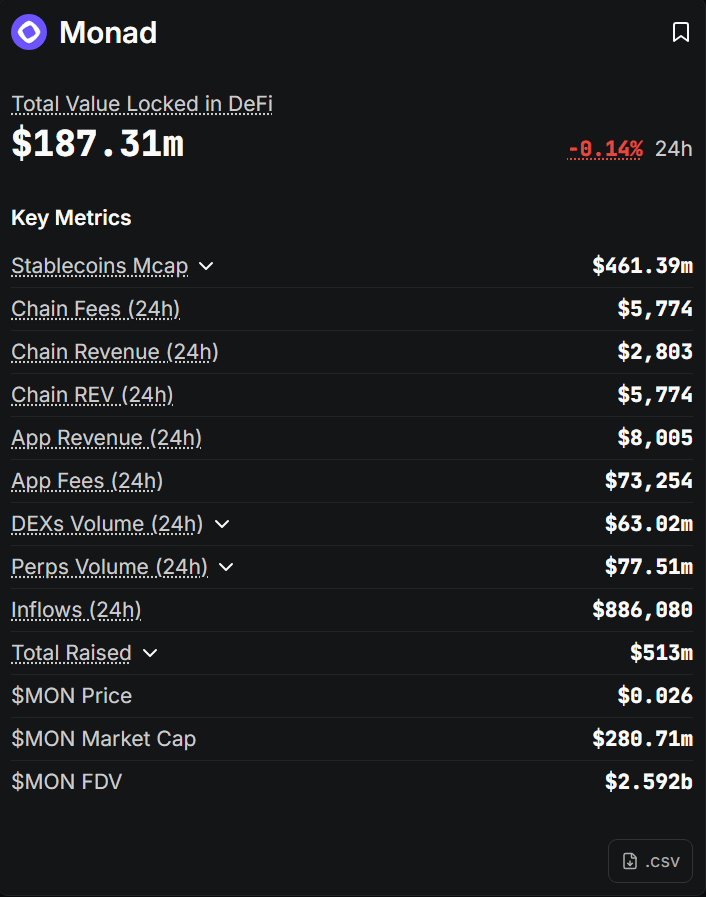
TVL (Total Value Locked): $187.31m
Stablecoin Market Cap: $461.39m
Chain Fees (24h transaction fees): $5,774
Chain Revenue (24h on-chain income): $2,803
App Fees (24h application transaction fees): $73,254
App Revenue (24h application income): $8,005
DEX Spot Trading Volume (24h): $63.02m
Perps Contract Trading Volume (24h): $77.51m
Net Inflow (24h): $886,080
Total Financing: $513m
Market Cap (Circulating Mcap): $280.71m
FDV (Fully Diluted Valuation): $2.592b
Looking solely at TVL and trading volume, Monad is not a zombie chain; there are indeed people using and trading on the chain. The issue lies in the two dimensions of 'profitability and token structure', which can be a bit scary when unpacked.
One, transaction fees and income: the volume is okay, but it's not really profitable.
The entire chain's 24-hour transaction fees are only $5,774, and only $2,803 can be attributed to 'chain income'. It should be noted that this was during the initial phase of Monad when attention was highest. This indicates that the current chain has very limited 'value capture ability' for users and projects.
Two, circulation is less than 11%, high FDV + low circulation = pressure preparation team
The current data is approximately:
Circulating market value ≈ $280 million
FDV ≈ $2.59 billion
In other words, only about 10.8% of the tokens are truly circulating. Nearly 90% of the tokens remain in:
Foundation, ecological incentive pool
Team & Investors
In various future unlocking plans
What does this mean?
Today you are trading with 10% of the chips, while 90% are queuing to go online in the future.
Even ignoring price fluctuations, structurally, there will be a very stable 'supply flood' in the coming years, which will continuously exert a gravitational pull on prices.
Three, the biggest problem: inflation mechanism = continuous downward pressure
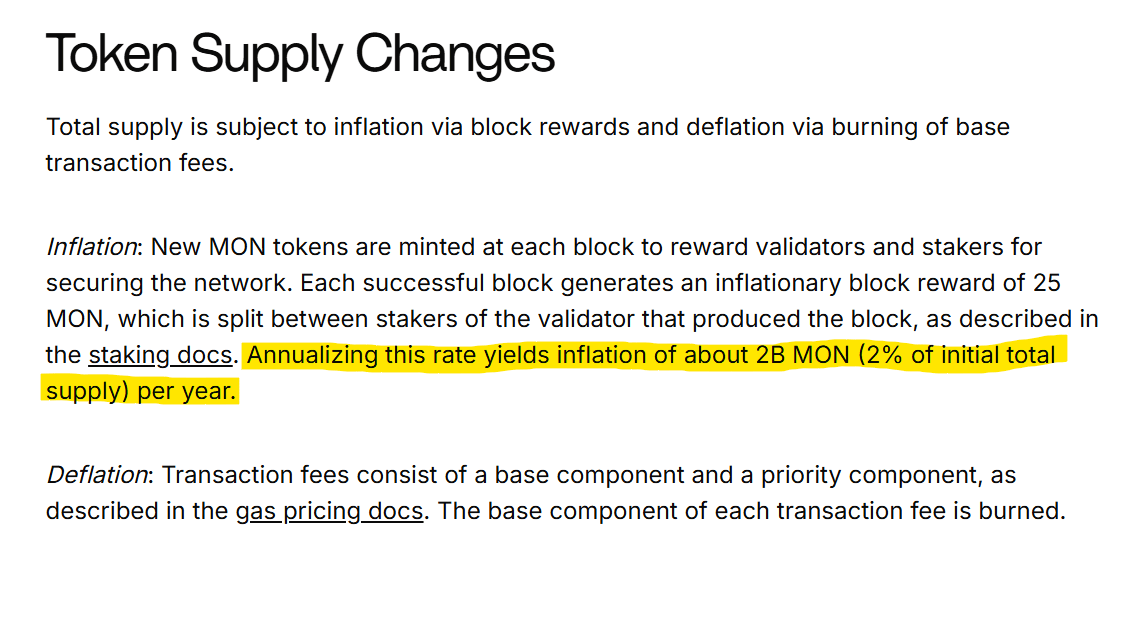
The design of Monad is 'inflation + deflation coexisting':
Each block rewards 25 MON to validators/stakers
Block time is about 0.5s, roughly 63 million blocks a year
Roughly calculated, about 1.6–2% inflation rate annually with approximately 1.6–2 billion MON added each year, compared to an initial total of 100 billion
At the same time, transaction fees are divided into two parts:
base fee: directly destroyed
priority fee: given to validators (similar to tips)
Theoretically, if the chain is prosperous enough, and the base fee is sufficient, it can offset the 2% inflation each year, or even achieve deflation.
But let's input some real numbers:
Each block adds 25 MON,
About 172,800 blocks per day →
Daily addition of 4,320,000 MON
To achieve no inflation, the chain needs to destroy at least 4,320,000 MON every day.
According to the current price of approximately $0.026 / MON:
Every day, approximately $112,000 of MON needs to be destroyed to just offset inflation.
Let's look at the reality on DefiLlama:
The total chain transaction fees for 24 hours are only $5,774
Among them, only a portion is base fee, which will be destroyed.
Even in extreme assumptions:
'100% of transaction fees are counted as base fee and all destroyed'
That's only $5.7k / day, far below the 'inflation-neutral' red line of $112k / day.
Reality is harsher: the amount truly destroyed is definitely less than $5.7k.
In other words, based on the current activity level:
Monad has a huge unlocking in the next few years, and there is structural inflation. The amount burned in transaction fees is not enough to consider.
Four, my conclusion: it's not a 'garbage chain', but very unfriendly for long-term holders.
To summarize:
The chain is not considered dead, with TVL and trading volume, and a certain level of ecological activity.
But the income volume is too small compared to the financing scale and FDV, which is highly mismatched.
Circulation is only 10.8%, and the subsequent unlocking + foundation tokens mean there will be huge long-term supply pressure.
With the current level of activity, the transaction fees are far from sufficient to hedge against inflation. The tokens resemble a 'continuously diluted certificate', rather than a scarce asset.
So in my eyes:
Monad resembles a 'transaction-oriented public chain' with high FDV, VC backing, and a strong narrative;
For short-term traders, as long as there is a narrative and volatility, opportunities are not lacking;
But for those who hold coins for 'value investment', if income and transaction fees do not increase by an order of magnitude in the next few years, this token economic design is naturally biased towards a downward price structure.
In simple terms:
Before money comes in, tokens have already been continuously printed out.
