
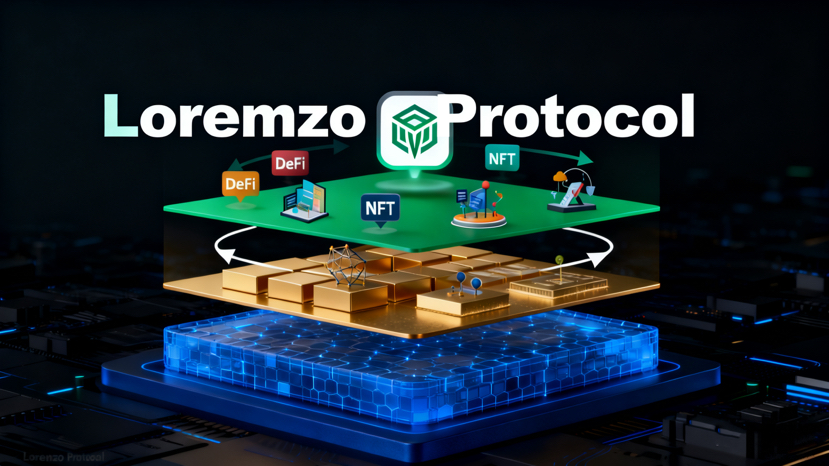


Many people, when they first hear about the Lorenzo Protocol, tend to focus on its OTF, yield strategies, and asset portfolios—these 'visible products.' However, in reality, what truly supports the entire ecosystem is its underlying smart contract system. You can think of it as an 'operating system on the chain,' where all operations such as strategies, portfolios, yield distribution, and governance are completed within this system.
If you do not understand this layer, it will be difficult to truly grasp what problems the Lorenzo Protocol aims to solve, why the technical route is structured this way, and why it can stand out in the field of on-chain asset management.
Now, let's start from scratch and clarify this smart contract system.
I. The starting point of Lorenzo's design: Transparency, Automation, Modularity
Most on-chain fund-type products share a common problem: the complexity of on-chain strategies is high, but the execution logic is often not transparent enough.
The smart contract system of the Lorenzo Protocol has chosen a different route:
Breaking down asset management into composable modules, allowing each action to be publicly verifiable.
In other words, it does not stuff an entire set of fund logic into a large contract, but rather breaks down different functions into multiple independently upgradeable and verifiable modules like building blocks.
There are several benefits to doing this:
• More transparent: Users can see the logic of every step of the operation.
• More secure: Issues with a certain module won't cause widespread problems.
• More flexible: can update strategies without affecting overall operations.
• More scalable: it will be easier to add new strategies and integrate external protocols in the future.
This design direction lays the foundation for all subsequent functions.
II. Core Module: The 'engine' and 'roadmap' for strategy execution
The smart contract system of the Lorenzo Protocol can generally be divided into three layers:
1. Asset Custody Layer
Used to store the real assets in the OTF portfolio.
It ensures fund security and non-transferability, with all changes requiring authorization from upper-level logic.
You can think of it as a 'safe'.
2. Strategy Logic Layer
This is the most important position in the entire system, responsible for defining:
• How funds are allocated
• Choose which strategies to implement
• When to rebalance
• How to handle earnings
• How to manage risks
This layer is more like the 'operation manual for asset management', but everything is written on-chain and verifiable.
3. Execution and Settlement Layer
When there are price changes on-chain, strategy triggers, user subscriptions, etc., this layer will automatically execute corresponding actions and write the results into the state.
It is the 'robot executor' of the entire process.
Together, these three layers constitute the OTF fully automated on-chain asset management structure of the Lorenzo Protocol.
III. Permissions and Governance: The role of the BANK token within the system
One difficulty of smart contracts is:
It must maintain automation while allowing ecosystem participants to co-govern.
In the Lorenzo Protocol, this balance is achieved by the BANK token.
The role of BANK in the smart contract system includes:
• Propose new strategies or parameter updates
• Vote on the launch or delisting of strategies
• Authorize contract upgrades or module replacements
• Adjust the fee structure within the OTF products
In simple terms, it means:
BANK is used to determine how the smart contract operates, what updates to make, and how to iterate.
This preserves community consensus while preventing the system from falling into centralized control.
IV. Automation Mechanism: From human governance to chain governance
Many processes in traditional funds rely on manual work:
Rebalancing, position adjustments, risk control...
These processes are susceptible to human judgment, institutional efficiency, and other factors.
The smart contract system of the Lorenzo Protocol chooses to be directly on-chain:
• Trigger operations with on-chain data
• Use contract logic to determine conditions
• Ensure consistency with automated execution processes
This means:
Strategies are not decided by any individual but run automatically by the system according to rules.
This automation not only increases execution speed but also enhances credibility.
V. 'Composability': Where is Lorenzo's future potential?
The smart contract system of the Lorenzo Protocol is 'modular', which gives it very high scalability.
Future capabilities that may be realized include:
• Allow third-party strategy teams to access the OTF structure
• Expanding to more on-chain assets (e.g., re-staking, yield tokens, etc.)
• Creating on-chain fund groups for different risk preferences
• Supports cross-chain asset management (through secure bridges or AVS)
None of this requires rewriting the system, just adding or replacing modules.
This is the strength of the Lorenzo Protocol:
The system is not designed for today but is prepared for the evolution of on-chain asset management over the next decade.
Conclusion: The best way to understand the protocol is to look at its underlying skeleton
From the perspective of the smart contract system, the Lorenzo Protocol is not a simple on-chain fund tool, but an asset management framework that fully integrates 'asset custody, strategy logic, execution mechanism, and governance authority' onto the chain.
Its value does not lie in how brilliant a single strategy is, but rather in:
It transforms asset management into a verifiable, auditable, and composable structured system.
In the future, regardless of how on-chain assets evolve, and regardless of where new sources of income emerge,
The smart contract system of the Lorenzo Protocol can continue to expand, upgrade, and support new strategies.
This is also why many people believe it is not a project, but rather a set of on-chain asset management infrastructure.